
Ginger: Benefits, Dosage & Side Effects (2026)
Ginger is a culinary rhizome whose pungent gingerols reliably calm nausea and settle digestion at about 1 g/day, with weaker, mixed evidence for joint and general inflammation.
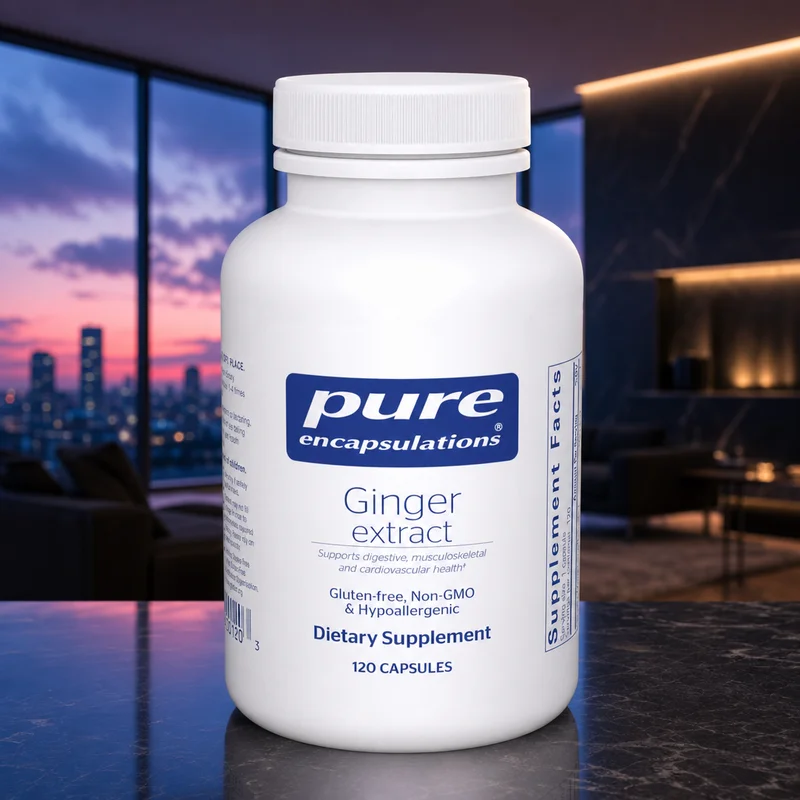
Ginger Root Extract 500mg (Standardized 5% Gingerols), 120 Capsules
What is Ginger?
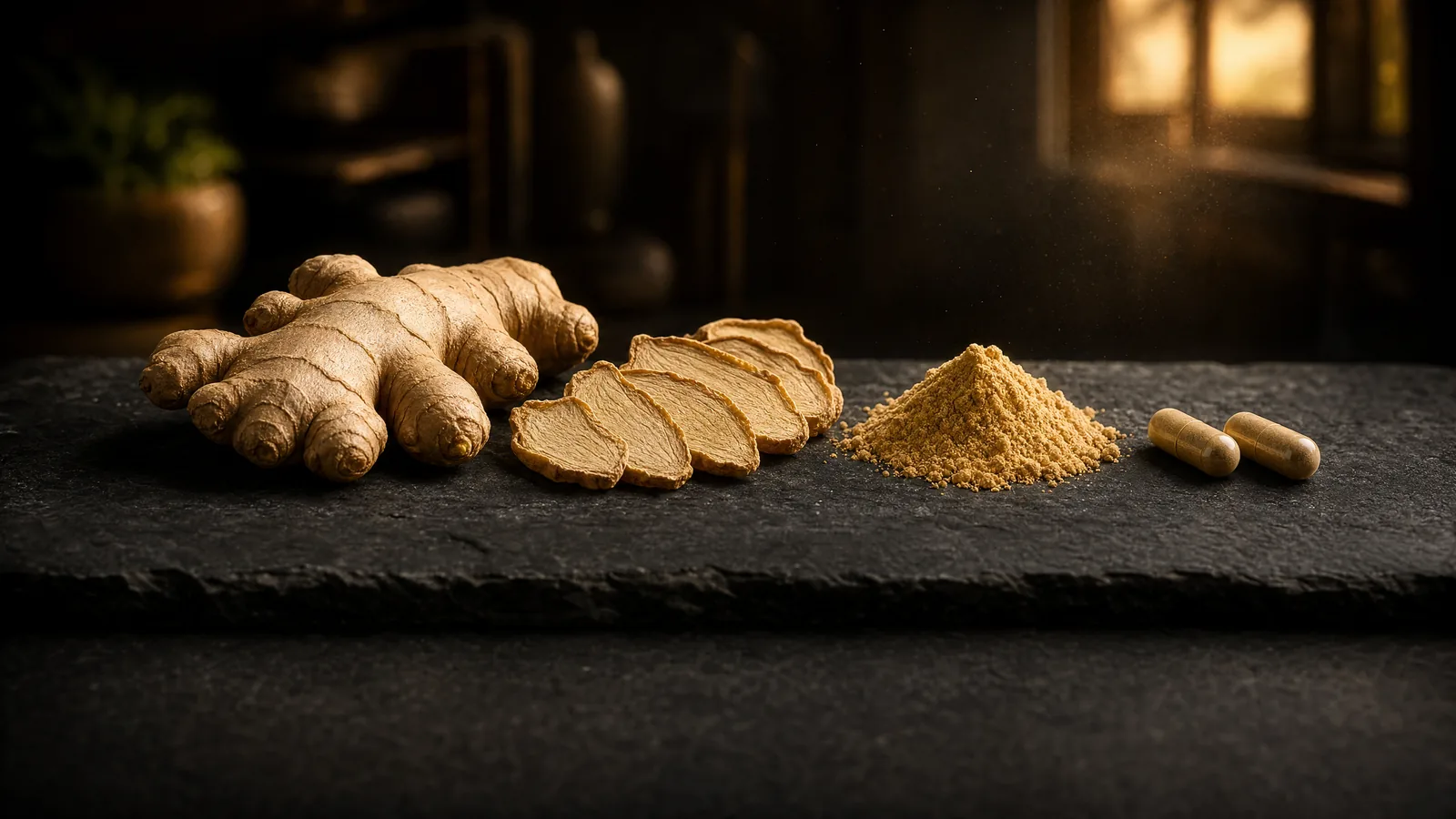
Ginger (Zingiber officinale) is the underground stem of a tropical flowering plant used for millennia as both a spice and a remedy for an upset stomach. Its activity comes mostly from a family of pungent oil compounds — gingerols in the fresh root and shogaols in the dried root — that act on the gut and the nausea centers of the brain. In supplement form it shows up as whole-root powder in capsules, concentrated extracts (some standardized to a labeled gingerol percentage, most not), loose extract powder, CO2 extracts, gummies, and lozenges. The single most repeatable, best-documented benefit is anti-nausea; digestive comfort is well-supported; anti-inflammatory and pain claims are real but modest and inconsistent.
How it works
Gingerols and shogaols speed gastric emptying and stimulate stomach and intestinal muscle contractions (prokinetic effect), which helps food move through and reduces the bloated, queasy "stuck" feeling. For nausea specifically, ginger's compounds appear to blunt signaling at 5-HT3 (serotonin) receptors in the gut and brainstem — a similar target to prescription anti-nausea drugs like ondansetron — which is why it works across such different triggers: pregnancy, motion, and chemotherapy. Its anti-inflammatory action comes from mild inhibition of COX and lipoxygenase pathways and pro-inflammatory cytokines, but this effect is much weaker than an NSAID, which is exactly why the joint-pain evidence is modest rather than dramatic. Most benefits track a total daily dose around 1 gram of ginger (roughly 250 mg four times daily in nausea trials); standardized extracts let you hit a known gingerol amount, while whole-root powder delivers an unlabeled, batch-variable amount.
At-a-glance facts
- Primary evidence-backed use
- Nausea & vomiting (pregnancy, motion, chemo)
- Typical effective dose
- ~1 g/day total, often split (250 mg x4)
- Active compounds
- Gingerols (fresh) & shogaols (dried)
- Onset for nausea
- Often within 30–60 minutes
- Strongest form for precision
- Extract standardized to a % gingerols
- Anti-inflammatory strength
- Modest and mixed — not NSAID-level
- Main safety flag
- Mild blood-thinning at high doses; heartburn
Evidence: Human evidence is genuinely strong for nausea (multiple RCTs and meta-analyses across pregnancy, motion, and chemotherapy) and good for digestion, but only modest and inconsistent for osteoarthritis and general inflammation — so it earns a 4 overall, not a 5.
Who it's for — and who it isn't
- People with pregnancy-related nausea and vomiting (morning sickness) looking for a non-drug first step — ginger is specifically endorsed in obstetric nausea guidance
- Anyone prone to motion sickness or post-operative/travel queasiness who wants a well-tolerated option
- Chemotherapy patients (with their oncologist's OK) using it as an add-on to standard anti-emetics to further reduce acute nausea
- People with sluggish digestion, bloating, or functional dyspepsia who want to support gastric emptying
- Those wanting a mild, food-derived anti-inflammatory as a complement to — not a replacement for — proven therapies
- People expecting strong, fast joint-pain or arthritis relief — the effect is modest and inconsistent, not an NSAID substitute
- Anyone on blood thinners (warfarin, DOACs) or with a bleeding disorder without checking with a clinician, since high doses may add antiplatelet effect
- People scheduled for surgery within about a week (stop beforehand due to bleeding-risk theory)
- Those with active gallstone disease, as ginger increases bile flow
- Anyone seeking a proven treatment for a serious condition — ginger is a supportive aid, not a primary therapy
Week-by-week, what happens
- 30–60 minutesAcute nausea and queasiness often ease; gastric emptying begins to speed up
- Days 1–4In pregnancy-nausea trials, meaningful reductions in nausea and vomiting frequency by roughly day 3–4 of consistent ~1 g/day dosing
- 1–2 weeksDigestive comfort, bloating, and post-meal fullness tend to improve with daily use
- 4–12 weeksAny osteoarthritis/joint-pain benefit, where it occurs, emerges slowly and is modest — expect a small edge over placebo, not dramatic relief
Safety & contraindications
- Generally very safe at ~1 g/day; the most common side effects are mild — heartburn, reflux, burping, and a burning aftertaste, more likely with raw powder or higher doses
- May have a mild antiplatelet (blood-thinning) effect at high doses; use caution and consult a clinician if on warfarin, DOACs, aspirin, or with a bleeding disorder, and stop about a week before surgery
- Pregnancy: widely studied and endorsed for morning sickness, but keep to ~1 g/day, prefer food-grade/USDA-organic products, and clear it with your OB — very high doses are not well studied in pregnancy
- Can increase bile flow — use caution with gallstones — and may modestly lower blood sugar and blood pressure, which matters if you take medication for either
- Whole-root and unstandardized 'X:1' products don't label actual gingerol content, so real potency varies batch to batch; product-quality and third-party testing matter more here than with standardized drugs
All articles on Ginger
Best Digestive Enzyme Supplements
Digestive enzymes ranked by what you actually need — targeted (lactase for dairy) beats broad-spectrum for most — by enzyme activity units, evidence, and value, with an honest take on who doesn't need them.
Read →Best Ginger Supplements
9 ginger supplements ranked on form and standardization, dose against the clinical range, third-party testing, tolerability and value.
Read →Best L-Glutamine Supplements
L-Glutamine ranked by purity (single-ingredient powder beats capsules on dose economics), third-party testing, and value — the gut-lining amino acid for IBS and intestinal permeability.
Read →Best Magnesium for Constipation
Citrate dominates (osmotic) and glycinate sinks (chelated, no laxative effect) — the form ranking is fully inverted vs. magnesium-for-sleep, with acute breakthrough + chronic maintenance protocols spelled out.
Read →Best Peppermint Oil Capsules for IBS
Enteric-coated peppermint oil ranked by coating quality first (it has to survive the stomach to work), dose, and value — one of the best-evidenced OTC options for IBS cramping and bloating.
Read →Best Probiotics Supplements
The 10 best probiotic supplements ranked by strain specificity + verified CFU — matching documented strains to your actual goal (IBS, post-antibiotic, women's, daily), not chasing the biggest number.
Read →Best Psyllium Fiber Supplements
Psyllium husk ranked by form honesty (powder vs capsules vs the dose math), additive load, and value — the most RCT-backed soluble fiber for regularity, cholesterol, and blood sugar.
Read →Align Probiotic 24/7 Digestive Support Review
The evidence-backed strain for IBS — and only for IBS.
Read →Anthony's Organic Psyllium Husk Powder Review
The organic bulk-buy — best per-gram organic value, in a bag not a tub.
Read →BioGaia Protectis Chewable Review
A clean single-strain chewable — L. reuteri DSM 17938 and nothing else.
Read →Carlyle Peppermint Oil, 150ct Review
Cheap and high-count — but a low dose and a less-documented coat hold it back.
Read →Culturelle Daily Probiotic Review
The cleanest, most affordable way to get the most-studied strain (LGG); plain capsule, no potency-through-expiry promise printed. 7.8/10.
Read →Designs for Health Digestzymes Review
The clinical bridge — low-acid support plus gluten/casein peptide coverage, for a specific buyer.
Read →Designs for Health L-Glutamine Powder Review
Clinic-grade free-form glutamine at the best value in the clinical tier.
Read →Enzymedica Digest Gold + ATPro Review
The high-activity broad blend benchmark — for heavy, varied meals, not for everyone.
Read →Florastor Daily Probiotic Review
The yeast antibiotics can't kill — the textbook pick for antibiotic-associated diarrhea.
Read →Garden of Life Dr. Formulated Once Daily Women's Review
The right pick for women caring for digestive AND vaginal flora.
Read →Garden of Life Dr. Formulated Organic Digest+ Review
Organic chewable with 13 enzymes, each with its activity unit, but no amylase on the panel; about $0.26 a tablet. 7.1/10.
Read →Garden of Life Omega-Zyme Ultra Review
The widest plant-based spread, no HCl — best for varied, fiber-heavy diets.
Read →Garden of Life Raw Organic Fiber, Unflavored Review
The deliberate psyllium-FREE pick — for guts that can't tolerate psyllium.
Read →Ginger Gummies, 200mg Organic Ginger Root per 3-Gummy Serving, 90 Count Review
The easiest ginger to actually take — but at 200mg per serving plus added sugar, it's a taste pick, not a therapeutic dose.
Read →Ginger Root (Zingiber officinale) 550 mg, 100 Veg Capsules Review
A cheap, no-nonsense whole-root staple from a brand with a genuinely strong in-house testing lab — just take two a day.
Read →Ginger Root Capsules – 25:1 Extract with 20% Gingerols + Curcumin & Black Pepper, 60 Capsules Review
The most gingerol-dense capsule here — but it's a ginger-curcumin-piperine blend, so you can't isolate ginger's contribution.
Read →Ginger Root Capsules, 1100 mg per 2-Capsule Serving, 100 Count Review
Hits the full ~1g studied nausea dose in one serving, botanically authenticated, for about a dollar a week.
Read →Ginger Root Extract 500mg (Standardized 5% Gingerols), 120 Capsules Review
The only pick on this list that tells you exactly how much gingerol you're getting — the reason it wins despite a premium price.
Read →Ginger Root Extract 550 mg (4:1), 240 Capsules Review
An eight-month supply of concentrated 4:1 extract — great value, but the '4:1' hides an unlabeled gingerol content.
Read →Ginger Root Extract Powder, 500mg per Serving, 250g (8.8 oz) Review
The cheapest gram of ginger you can buy, with published COAs — if you own a scale and can handle the pungency.
Read →Ginger Supreme (Organic Ginger CO2 Extract + Turmeric), 60 Vegan Liquid Phyto-Caps Review
A beautifully made CO2 craft extract with batch traceability — but only ~150mg ginger per cap, far below the nausea dose.
Read →Heather's Tummy Tamers Peppermint Oil, 90ct Review
The reflux-tolerant peppermint for people other softgels burned.
Read →IBgard Peppermint Oil Capsules, 48ct Review
The most-studied IBS peppermint, with the lowest heartburn risk.
Read →Jarrow Formulas L-Glutamine Powder Review
The set-and-forget supply pick — a year of 99%-pure powder at low cost per gram.
Read →Klaire Labs L-Glutamine Powder Review
A full 5 g trial per-dose amount in one hypoallergenic scoop.
Read →Konsyl Daily Psyllium Fiber Powder, Unflavored Review
The high-dose, pure-husk pick when grams matter most.
Read →Lactaid Fast Act Lactase Caplets Review
If dairy is your one problem, this is the single best — and best-evidenced — pick.
Read →Life Extension L-Glutamine Powder Review
A cheap starter tub to test whether you respond before buying bulk.
Read →Mason Natural Peppermint Oil 50mg Enteric, 90ct Review
Genuinely enteric at a bargain price — but 50 mg per softgel is the catch.
Read →Metabolic Maintenance L-Glutamine Powder Review
The titration specialist — fine 1 g dosing for a reactive, IBS-prone gut.
Read →Metamucil 4-in-1 Psyllium Fiber, Sugar-Free, Orange Review
The safe, doctor-trusted default psyllium for first-time buyers.
Read →Metamucil Psyllium Fiber Capsules Review
The convenience pick from the most-trusted brand — bought with eyes open.
Read →Morning Sickness Sweets, Organic Ginger + Vitamin B6, 30 Wrapped Drops Review
A ginger + B6 candy that smartly mirrors pregnancy-nausea guidance — but it's an as-needed aid, not a measured supplement.
Read →Nature's Way CompleteGest Review
The dependable mainstream vegan blend — reliable and available, not a spec leader.
Read →Nature's Way Pepogest Enteric Peppermint Oil, 60ct Review
The clinically validated dose at the best price — the default for most buyers.
Read →Nature's Way Peppermint Soothe, 60ct Review
A trustworthy heritage enteric peppermint — outcompeted by its own sibling.
Read →NOW Peppermint Gels with Ginger & Fennel, Enteric, 90ct Review
A budget brand getting the fundamentals right — the best bulk value.
Read →NOW Probiotic-10 25 Billion Review
The honest value floor — cheap, a code printed on every strain, no frills. 7.3/10.
Read →NOW Psyllium Husk Caps 500 mg Review
The vegan, value-minded capsule — convenient and grit-free, but low-dose.
Read →NOW Psyllium Husk Powder, Non-GMO Review
The lowest-cost honest way to take psyllium — if you'll stir plain husk.
Read →NOW Sports L-Glutamine Pure Powder Review
The value benchmark — genuine free-form glutamine at the lowest cost per gram.
Read →NOW Super Enzymes Review
The best value on the list — real pancreatic + acid support at a third of premium prices.
Read →Nutricost Digestive Enzymes 620mg Review
Maximum enzyme variety per dollar — the low-risk budget experiment.
Read →Nutricost L-Glutamine Powder, Unflavored Review
The bulk-budget sweet spot — exact 5 g scoops at near-benchmark value.
Read →Nutricost Peppermint Oil 50mg, 120ct Review
Well-made and clean — but NON-enteric, the one disqualifying flaw for the gut.
Read →Optimum Nutrition L-Glutamine Powder Review
A fine free-form powder that ranks last on fit, not quality.
Read →Organic India Whole Husk Psyllium Powder, USDA Organic Review
The organic pick that still delivers a real dose.
Read →Physician's Choice Probiotics 60 Billion CFU Review
A low-cost high-CFU generalist whose label names ten species but no strain codes. 6.8/10.
Read →Pure Encapsulations Digestive Enzymes Ultra Review
The cleanest broad blend — the safe pick for a sensitive, allergy-prone gut.
Read →Pure Encapsulations L-Glutamine Powder Review
The cleanest hypoallergenic label for the reactive, IBS-prone gut.
Read →Regimint Peppermint Oil Plus Caraway, 60ct Review
The European peppermint-caraway combo for IBS-plus-dyspepsia overlap.
Read →Renew Life Ultimate Flora Extra Care 50 Billion Review
A broad high-potency blend for sensitive guts — with LGG and delayed-release doing the work.
Read →Ritual Synbiotic+ Review
The most complete formulation on paper, with the best traceability.
Read →Seed DS-01 Daily Synbiotic Review
The survivability-engineered default for general gut health.
Read →Solaray Peppermint Oil, Enteric, 60ct Review
A clinical 250 mg enteric peppermint dose, plus botanicals you're partly paying for.
Read →Sunergetic 4-in-1 Probiotic Review
Spore-based probiotic with enzymes and PreforPro, but only two named strains and 3 billion CFU. 6.6/10.
Read →Thorne Advanced Digestive Enzymes Review
The low-stomach-acid powerhouse — excellent for the right buyer, contraindicated for many.
Read →Thorne L-Glutamine Powder Review
The cleanest, most credible way to run the one glutamine protocol with real human evidence.
Read →Viva Naturals Organic Psyllium Husk Powder Review
The finely-ground organic pick for smoothies and keto baking.
Read →Yerba Prima Psyllium Husks Powder Review
The heritage purist's pure-husk pick — dependable, honest, lower-profile.
Read →Zenwise Digestive Enzymes + Probiotics & Prebiotics Review
Amazon's bestselling all-in-one — convenient, but a compromise on every component.
Read →FAQ
How much ginger should I take for nausea?
Most positive trials used about 1 gram of ginger per day, commonly split into four 250 mg doses. Going much above ~1.5 g/day adds little proven benefit and raises the chance of heartburn. If you use whole-root capsules, that's usually two capsules; with a standardized extract you can hit the dose more precisely.
Is standardized gingerol extract better than plain ginger powder?
For precision, yes — a product standardized to a labeled gingerol percentage tells you exactly how much active compound you're getting, batch to batch. Whole-root powder and vague '4:1' or '25:1' concentrates don't disclose gingerol content, so potency varies. That said, many nausea studies actually used whole dried root, so a well-tested whole-root product that hits ~1 g/day is still a legitimate, cheaper option.
Does ginger actually reduce inflammation and joint pain?
Honestly, only modestly. Meta-analyses of osteoarthritis trials show a small, statistically real benefit over placebo — but it's far weaker than an NSAID and not consistent across studies. Treat ginger as a gentle complement for inflammation, not a primary painkiller.
Can I take ginger during pregnancy for morning sickness?
Ginger is one of the best-studied non-drug options for pregnancy nausea and is commonly recommended as a first step, often paired with vitamin B6. Keep to about 1 g/day, choose a clean food-grade or organic product, and confirm with your OB-GYN — especially before combining it with anti-nausea medication.
Are ginger gummies or lozenges enough to work?
Usually not for a full therapeutic effect. Most gummies deliver ~200 mg per serving and lozenges even less — well under the ~1 g studied dose — plus added sugar. They're fine for mild, acute queasiness or as a palatable option if capsules make you gag, but capsules, extracts, or powder are what reach the doses used in research.
Does ginger interact with any medications?
The main concerns are blood thinners (possible additive bleeding risk at high doses), diabetes medication (ginger may modestly lower blood sugar), and blood-pressure medication (possible mild additive lowering). It may also increase absorption or effect of some drugs via faster gastric emptying. If you take any of these, or you're heading into surgery, talk to your clinician first.
Sources & further reading
- Viljoen E, Visser J, Koen N, Musekiwa A. A systematic review and meta-analysis of the effect and safety of ginger in the treatment of pregnancy-associated nausea and vomiting. Nutr J. 2014;13:20.A systematic review and meta-analysis of the effect and safety of ginger in the treatment of pregnancy-associated nausea and vomiting
Ginger significantly improved nausea symptoms in pregnancy versus placebo, with no significant increase in adverse pregnancy outcomes, supporting it as a first-line non-drug option.
- Ryan JL, Heckler CE, Roscoe JA, et al. Ginger (Zingiber officinale) reduces acute chemotherapy-induced nausea: a URCC CCOP study of 576 patients. Support Care Cancer. 2012;20(7):1479-1489.Ginger (Zingiber officinale) reduces acute chemotherapy-induced nausea: a URCC CCOP study of 576 patients
In a large randomized trial, 0.5–1.0 g/day of ginger added to standard anti-emetics significantly reduced the severity of acute chemotherapy-induced nausea.
- Bartels EM, Folmer VN, Bliddal H, et al. Efficacy and safety of ginger in osteoarthritis patients: a meta-analysis of randomized placebo-controlled trials. Osteoarthritis Cartilage. 2015;23(1):13-21.Efficacy and safety of ginger in osteoarthritis patients: a meta-analysis of randomized placebo-controlled trials
Ginger produced a statistically significant but modest reduction in osteoarthritis pain versus placebo, with mild GI side effects — confirming a real but small anti-inflammatory effect.
- Ernst E, Pittler MH. Efficacy of ginger for nausea and vomiting: a systematic review of randomized clinical trials. Br J Anaesth. 2000;84(3):367-371.Efficacy of ginger for nausea and vomiting: a systematic review of randomized clinical trials
An early systematic review found ginger superior to placebo for several nausea types (including seasickness and morning sickness), establishing the anti-nausea signal that later trials confirmed.
- Nikkhah Bodagh M, Maleki I, Hekmatdoost A. Ginger in gastrointestinal disorders: A systematic review of clinical trials. Food Sci Nutr. 2019;7(1):96-108.Ginger in gastrointestinal disorders: A systematic review of clinical trials
Across clinical trials, ginger accelerated gastric emptying and improved dyspepsia and nausea symptoms, supporting its use for digestive comfort.
- Wu KL, Rayner CK, Chuah SK, et al. Effects of ginger on gastric emptying and motility in healthy humans. Eur J Gastroenterol Hepatol. 2008;20(5):436-440.Effects of ginger on gastric emptying and motility in healthy humans
In healthy volunteers, 1.2 g of ginger accelerated gastric emptying and stimulated antral contractions, providing a mechanistic basis for its digestive and anti-nausea effects.