
Physician's Choice Probiotics 60 Billion CFU Review
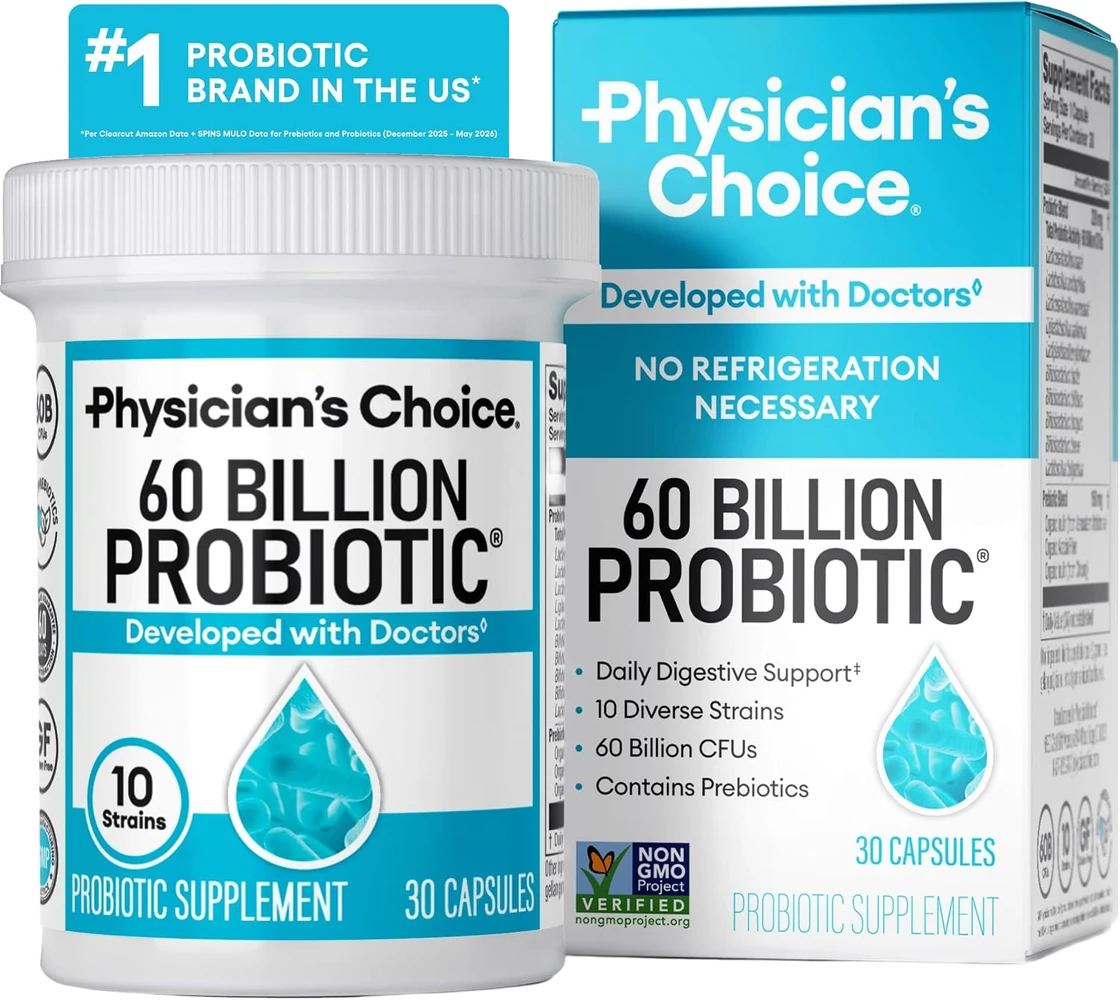 #10 of 11 · Low-cost high-CFU✓ Label verified · Supplement Facts read Oct 18, 2026
Real retailer photo, cut out. Label unedited.
Consider it. A low-cost high-CFU generalist whose label names species, not strains. A 10-species, 60B-CFU synbiotic with a 150 mg organic prebiotic blend, shelf-stable and subscription-free at ~$26/month.
$26 / month$0.87 / 1-capsule daily dose
Why It Scores 6.8 — And The Label Line Behind Each Number
Strain specificity + clinical match
35% of scoreThe panel names ten species but prints no strain designation for any of them — not even for the Lacticaseibacillus and Lactiplantibacillus entries where a studied code would matter — and gives one combined 220 mg figure with no amount per species. The methodology rewards bottles that name studied strains down to the code and penalizes blends that hide which organisms you are getting. This one is not an unnamed 'proprietary blend', because the species are listed, but with zero codes you cannot tie any of it to a trial. We score it below Sunergetic (5.5), whose panel prints designations for two of its strains, and well below Culturelle and Ritual, which print LGG and BB-12 by name.
- Daily dose
- 1 capsule/day
Survivability to the gut
25% of scoreThe maker's listing says the product uses acid-resistant capsules, and the front of the box prints 'No Refrigeration Necessary'. The panel itself shows a plain vegetable capsule (hypromellose, gellan gum) and no enteric, delayed-release or capsule-in-capsule design, and no promise that the 60B holds through expiration. A claim that appears only in marketing is never the basis for a score, so this sits at the plain-capsule baseline, behind the engineered picks (Seed's capsule-in-capsule, Ritual's and Renew Life's delayed-release).
Formulation completeness
20% of scoreA genuine synbiotic: 60B CFU across ten species plus a 150 mg prebiotic blend of organic inulin (Jerusalem artichoke), organic acacia fiber and organic inulin (chicory), so the bacteria come with their food. A sensible dose and a three-fiber prebiotic make it more complete than a plain single-strain probiotic; it stops short of Ritual's 3-in-1, which adds a tributyrin postbiotic.
- Delivery
- Vegetable capsule (hypromellose, gellan gum). The maker's listing says acid-resistant; the panel prints no delivery design
- Other ingredients
- Vegetable capsule, rice flour, rice hull concentrate, gum arabic, sunflower oil
Third-party testing + transparency
12% of scoreThe box prints 'Third-Party Tested for safety, purity, and potency' and carries the Non-GMO Project Verified seal, with the full ingredient panel and the other ingredients (vegetable capsule, rice flour, rice hull concentrate, gum arabic, sunflower oil) listed. We did not find the testing lab or a certificate, and the lack of strain codes is scored on the strain axis rather than counted twice here. Short of the top tier because there is no NSF certification (Garden of Life Women's) and no traceability story like Ritual's.
- Species
- 10 species named, no strain designations: L. casei, L. acidophilus, L. paracasei, L. salivarius, L. plantarum, B. lactis, B. bifidum, B. longum, B. breve, L. bulgaricus (one 220 mg blend, no per-species amounts)
- Testing
- Box prints 'Third-Party Tested for safety, purity, and potency'; Non-GMO Project Verified seal; 'No Refrigeration Necessary' on the front
Value / cost-per-day
8% of scoreAbout $0.87/day ($26/month), no subscription, with a prebiotic included. It undercuts Seed and Ritual by a wide margin. Value is only an 8% tie-breaker in our method, and it does not offset the missing strain information.
- Bottle
- 30 capsules (30-day supply at 1/day)
- Price
- ~$26/month = ~$0.87 per once-daily capsule, no subscription
- More Specs
- Potency
- 60 billion CFU per capsule (printed as total probiotic activity; the panel does not say whether at manufacture or expiration)
- Prebiotic
- 150 mg blend: organic inulin (Jerusalem artichoke), organic acacia fiber, organic inulin (chicory); no individual amounts
Label verified. Every figure read from the Supplement Facts photo, Oct 18, 2026.
Marketing Claims Vs. Reality
60 billion CFU across 10 diverse strains for comprehensive gut support.
The panel does print 60 billion CFU, and lists ten species, so the count is real. 'Strains' overstates it: no strain designation is printed for any of them, so you cannot tell which strains are inside. 'Comprehensive' is also a stretch — a broad blend supports general gut health (Ford 2014, PMID 25070051 for the class effect) but cannot be matched to specific studied strains for specific conditions.
Acid-resistant capsules help the probiotics survive stomach acid.
This is a statement in the maker's listing. The panel prints the capsule as vegetable capsule (hypromellose, gellan gum) and no enteric coating, delayed-release or other delivery design, and we found no published survival data. We treat it as an unverified claim and give it no score credit.
Includes organic prebiotics to feed the good bacteria.
The panel prints a 150 mg prebiotic blend of organic inulin (from Jerusalem artichoke), organic acacia fiber and organic inulin (from chicory), making this a synbiotic rather than bacteria alone. No individual fiber amounts are printed.
Third-party tested for safety, purity, and potency.
The box prints that statement, and it carries a Non-GMO Project Verified seal. It names no lab and no certificate, so it is the brand's own statement rather than an independent certification such as NSF.
No refrigeration necessary.
Printed on the front of the box. It is a convenience point about storage; it says nothing about how many organisms survive the stomach.
What Our Test Actually Found
The label names ten species and zero strains
The front says '10 Diverse Strains'. The panel lists ten species in one 220 mg blend, with no code such as GG, BB-12 or 35624 on any of them and no per-species amount. In this category the benefit belongs to a specific strain for a specific problem, so a species list leaves you unable to check anything against the research. That is the main reason it ranks where it does, whatever the headline CFU number says.
The acid-resistant capsule is the maker's claim, not the panel's
The listing says 'acid-resistant capsules' and describes the product as designed to survive the gut. The Supplement Facts panel prints a vegetable capsule made of hypromellose and gellan gum and nothing about an enteric or delayed-release design. Without a printed design or survival data, we score the delivery as a plain capsule. If you buy it, take it as the label says; do not assume the survivability engineering of the delayed-release picks.
60 billion is a big number, but the number isn't why anything works
The recurring lesson of this category applies here: a bigger CFU of unmatched strains does nothing extra. Align's B. infantis 35624 relieves IBS at just 1B (Whorwell 2006); Seed reports AFU, which isn't comparable to CFU at all. Physician's Choice's 60B is a reasonable everyday dose for a broad generalist, but if you find yourself choosing it because 60 beats 50, you're shopping the wrong axis.
A real prebiotic and a low price are what it has going for it
It prints a 150 mg prebiotic blend of three organic fibers and costs roughly half Seed's per-day price with no subscription. For a buyer who wants everyday coverage and doesn't need a named strain for a diagnosis, that is a legitimate trade. What you give up versus Seed: named strains, capsule-in-capsule engineering and the AFU-based count.
Shelf-stable is a quiet real-world advantage
Refrigerated probiotics lose potency if they sit warm in shipping or on a counter, so a shelf-stable product is more forgiving in practice. The front of the box prints 'No Refrigeration Necessary', which is an edge over picks like Garden of Life Women's and many Renew Life lots that want refrigeration. It is a storage convenience, not evidence of gut survival.
Full analysis: all pros & cons (7), buy if / skip if
- High 60B CFU with a 150 mg three-fiber organic prebiotic blend, so it's a synbiotic not just a probiotic
- Box prints a third-party tested statement for safety, purity and potency, and carries the Non-GMO Project Verified seal
- A very widely sold probiotic (the front of the box claims the top probiotic brand in the US), so it is easy to find and keep buying
- Mainstream price, shelf-stable and no subscription required
- The panel names ten species but prints no strain designation for any of them, and no per-species amounts
- The acid-resistant capsule is a maker claim; the panel shows a plain vegetable capsule and no delivery design
- Not a targeted tool: no matched strain for IBS or post-antibiotic use, and no NSF certification or traceability story like the premium picks
- You want broad, affordable everyday gut support without a subscription
- You want a high-CFU product with a built-in prebiotic blend and shelf-stable convenience
- You're cost-conscious and don't need to match a specific studied strain to a diagnosis
- You are comfortable with a label that names species but not strains
- Your problem is specifically IBS-type pain and bloating — buy the studied strain, Align's B. infantis 35624
- You're on or starting antibiotics — a bacterial blend gets killed; use Florastor (S. boulardii)
- You want strain codes on the label so you know exactly what you are taking — Seed or Culturelle print them
A 10-species, 60B-CFU synbiotic with a 150 mg organic prebiotic blend, shelf-stable and subscription-free at ~$26/month. A reasonable everyday value option, but the panel prints species names only (no strain codes, no per-species amounts), and the acid-resistant capsule is a maker claim the panel does not show. For IBS buy the studied strain (Align); for antibiotic recovery buy the yeast (Florastor); for a named-strain panel buy Seed.
Physician's Choice 60 Billion is the bottle to grab when you want broad daily gut support at a low price without a subscription — but read the label before you read the front. The front says '10 Diverse Strains' and '60 Billion CFUs'. The Supplement Facts panel lists ten species (Lacticaseibacillus casei, Lactobacillus acidophilus, Lacticaseibacillus paracasei, Ligilactobacillus salivarius, Lactiplantibacillus plantarum, Bifidobacterium lactis, Bifidobacterium bifidum, Bifidobacterium longum, Bifidobacterium breve and Lactobacillus bulgaricus) as one 220 mg blend, and prints no strain designation for any of them. Probiotic benefits are strain-specific, so a species list cannot be matched to a trial. It does pair the blend with a 150 mg organic prebiotic mix, and it is shelf-stable. The maker also says the capsule is acid-resistant, but the panel shows a plain vegetable capsule, so we do not credit that. It is a generalist, not a specialist, and it scores that way.
A low-cost high-CFU generalist — read the label before the front.

Physician's Choice 60 Billion is the pick when you want broad daily gut support without a subscription or a premium price. It prints 60 billion CFU, a 150 mg three-fiber organic prebiotic blend, a third-party tested statement and a Non-GMO Project Verified seal, and it is shelf-stable at about $26 a month. The honest limits are about what the label does not tell you. It lists ten species and not one strain designation, so you cannot match anything in the bottle to the studied strains behind IBS or antibiotic-recovery evidence. And the acid-resistant capsule is the maker's statement: the panel prints a plain vegetable capsule. If your problem is IBS-type pain and bloating, buy the studied strain, Align's B. infantis 35624. If you're on or starting antibiotics, use Florastor (S. boulardii). If you want the broadest named strain panel with real delivery engineering, step up to Seed. For everyone who just wants affordable everyday coverage and accepts a species-level label, this is a reasonable but not top-tier choice.
If This Doesn’t Fit — Try These
 01
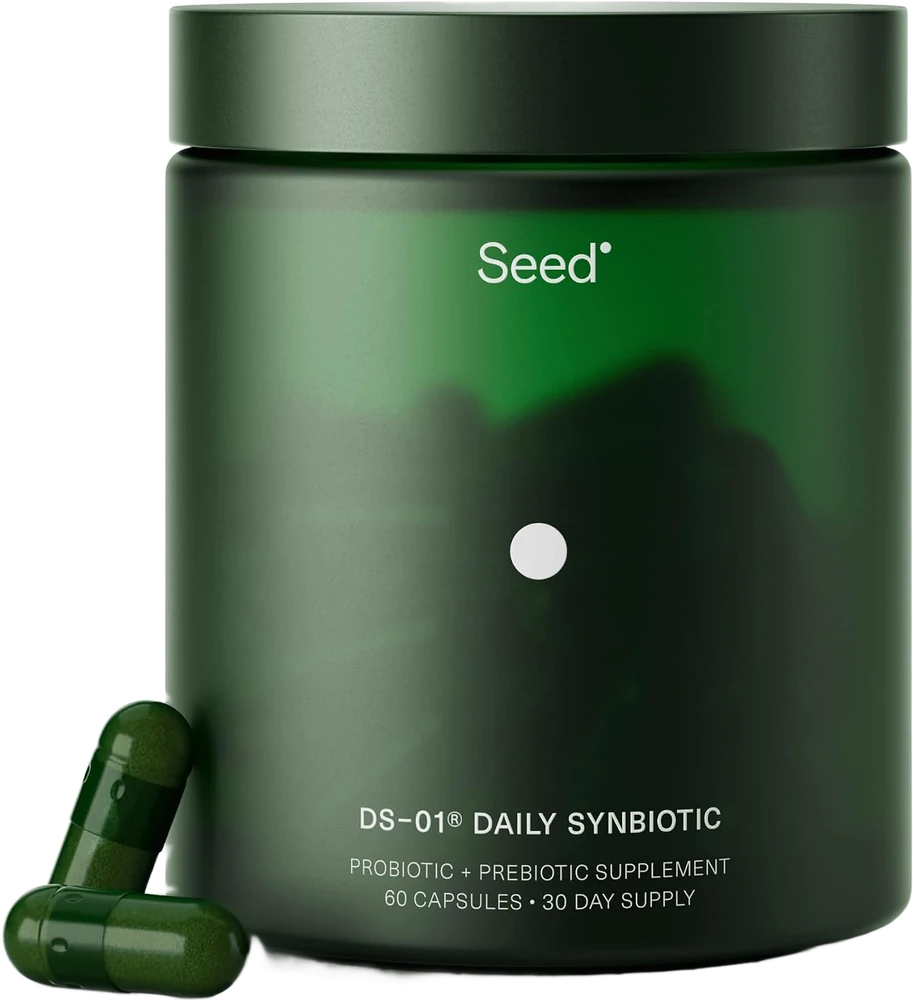
01Seed DS-01
If you want one probiotic for general gut health, bloating, and a credible daily synbiotic, Seed DS-01 is the pick and the benchmark the rest of this list is measured against.
 04
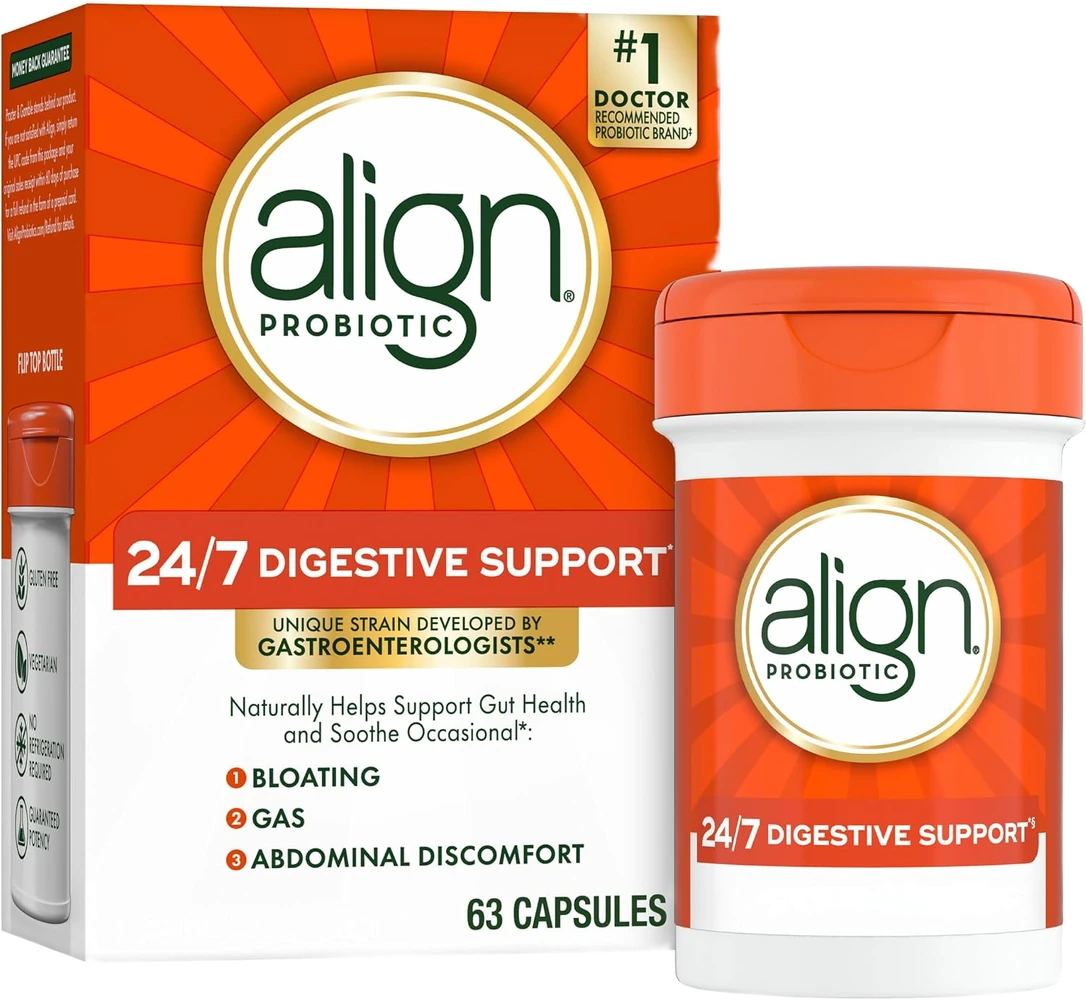
04Align Probiotic 24/7
Align is the answer to one specific question: 'I have IBS-type cramping, bloating, and irregularity — what's the evidence-backed strain?' That strain is Bifidobacterium 35624 (Bifantis), and Align is how you buy it.
 08
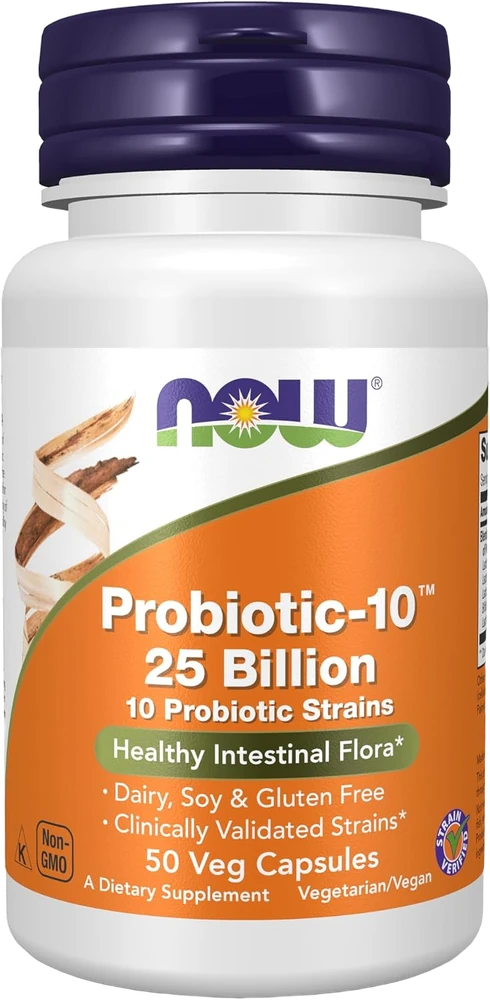
08NOW Probiotic-10
NOW Probiotic-10 is the budget answer: the lowest cost-per-day on the list from a family-owned brand with a GMP Quality Assured seal.
Quick Answers
Is 60 billion CFU actually better than Seed's 53.6B AFU or Align's 1B?
Not necessarily — and this is the most important thing to understand before you buy on the number. CFU (colony-forming units) counts viable cells, but a bigger count of unstudied or mismatched strains does nothing extra. The clearest proof is Align: its B. infantis 35624 relieves IBS at just 1×10⁸ CFU/day (Whorwell 2006, PMID 16863564) because that exact strain at that dose is what the trial used. Seed reports AFU (a different viability unit), so '53.6B AFU' and '60B CFU' aren't directly comparable. Physician's Choice's 60B is a sensible dose for a broad daily generalist, but its panel prints species names only, with no strain codes, so you cannot match any of it to a trial. Buy it for the price and the prebiotic, not because 60 beats 50.
Is the capsule really acid-resistant?
The maker says so; the label does not show it. The product listing states that it uses acid-resistant capsules, but the Supplement Facts panel prints the capsule as 'vegetable capsule (hypromellose, gellan gum)' and prints no enteric coating, delayed-release or other delivery design. Per our label-first rule, a claim that appears only in marketing is not a basis for a score, so we treat survivability as a plain capsule. The failure mode itself is real: stomach acid and bile kill many naked probiotic bacteria before they reach the colon. The front of the box does print 'No Refrigeration Necessary', which is about storage, not about surviving the stomach.
Is this a good probiotic for IBS?
It may help, but it isn't the targeted tool — for IBS specifically, buy the studied strain. Ford 2014 (PMID 25070051) shows probiotics as a class improve IBS symptoms, so a broad 10-species blend like this can ease bloating and bowel comfort for some people. But the single best-evidenced IBS strain is Bifidobacterium infantis 35624 (Whorwell 2006), sold as Align, and the Hungin 2018 consensus (PMID 29460487) backs strain-specific selection for symptom relief. Physician's Choice prints no strain code at all, so there is no way to tell from the label whether any studied strain is inside. The clean decision: if you want broad, affordable everyday gut support without a subscription, this is a value option; if your dominant problem is IBS-type cramping and bloating, choose the named strain instead of a generalist blend.
Why is this so much cheaper than Seed or Ritual?
Because you're paying for a generalist, not a premium documentation-and-survivability package. At ~$26/month with no subscription, Physician's Choice undercuts Seed (~$50) and Ritual (~$54) by delivering a 10-species blend and a 150 mg prebiotic blend — the core of the job — without the named strain panel, capsule-in-capsule or delayed-release engineering, postbiotic, or ingredient-traceability story those premium picks carry. That can be a fair trade for everyday buyers, but note what you give up: its label names species only, so you cannot see which strains you are getting, and its capsule is plain.
Does it need refrigeration?
No — the front of the box prints 'No Refrigeration Necessary', which is part of its everyday-convenience appeal and a real advantage over picks that want cold storage, such as Garden of Life Women's and many Renew Life lots. Shelf stability matters because a probiotic meant to be refrigerated that sat warm in shipping can lose viability, so a product built to be stable at room temperature is more forgiving in the real world. As always, the label is the source of truth, and the potency you get at the end of the bottle is not stated: the panel gives 60 billion CFU without saying whether that is at manufacture or at expiration.
Is it a complete synbiotic or just a probiotic?
It's a genuine synbiotic. The panel prints a 150 mg prebiotic blend of organic inulin (from Jerusalem artichoke), organic acacia fiber and organic inulin (from chicory), with no individual amounts, so the strains come with something to ferment. That's a step more complete than a plain single-strain probiotic, though not as elaborate as Ritual's 3-in-1, which adds a tributyrin postbiotic on top. For an everyday value pick, probiotic plus a three-fiber prebiotic is a sensible, complete-enough formulation concept; the weak point is the probiotic half, where the species are named but the strains are not.
Sources & Further Reading
3 peer-reviewed sources, each linked to PubMed
- [1] Ford 2014 PMID 25070051 — Efficacy of prebiotics, probiotics, and synbiotics in irritable bowel syndrome and chronic idiopathic constipation: systematic review and meta-analysis. Meta-analysis of 43 RCTs: probiotics as a class significantly reduced persistent IBS symptoms versus placebo (RR 0.79), with benefits on pain, bloating, and flatulence — while noting the best strains remain uncertain. The class-level support for a broad daily generalist like this, plus the caveat that a single diagnosis is better served by a matched strain.
- [2] Whorwell 2006 PMID 16863564 — Efficacy of an encapsulated probiotic Bifidobacterium infantis 35624 in women with irritable bowel syndrome. RCT in 362 women: B. infantis 35624 at just 1×10⁸ CFU/day significantly relieved IBS pain and bloating. The textbook proof that the right strain at a modest dose beats a big CFU of unmatched strains — the reason this product's 60B headline isn't why it works.
- [3] Hungin 2018 PMID 29460487 — Systematic review: probiotics in the management of lower gastrointestinal symptoms — an updated evidence-based international consensus. International primary-care consensus over 70 RCTs: specific probiotics reduce overall symptom burden and abdominal pain in some patients, and specified strains help prevent antibiotic-associated diarrhea. Supports a documented blend for general support while reinforcing strain-matching for specific diagnoses — the line between this generalist and the targeted picks.
Affiliate disclosure: every Amazon link uses our Associates tag (superachieverclub-20). We earn a small commission at no cost to you; it funds independent reviews. We never accept payment to change a ranking.