
News & Updates
Fresh findings from the SAC research desk — the same verified numbers behind our video series, tied to the honest ranking they came from. Every claim sourced. Nothing sponsored.

A 2026 trial gave 64 sedentary adults aged 45 to 65 either 10 grams of creatine a day or a placebo for 12 weeks. The creatine group that did not exercise gained 1.1 kg of lean tissue on a DXA scan. That group was 13 people, they chose not to exercise themselves, and the company that makes the creatine supplied it. With training the gain was 1.27 kg, against 0.14 kg on placebo.
Prime Big Deal Days run on October 6 and 7. A discount on a mediocre product is still a mediocre product, so this page lists the number-one pick from seven of our rankings, each ordered by score. There are no prices here, because they change by the hour.
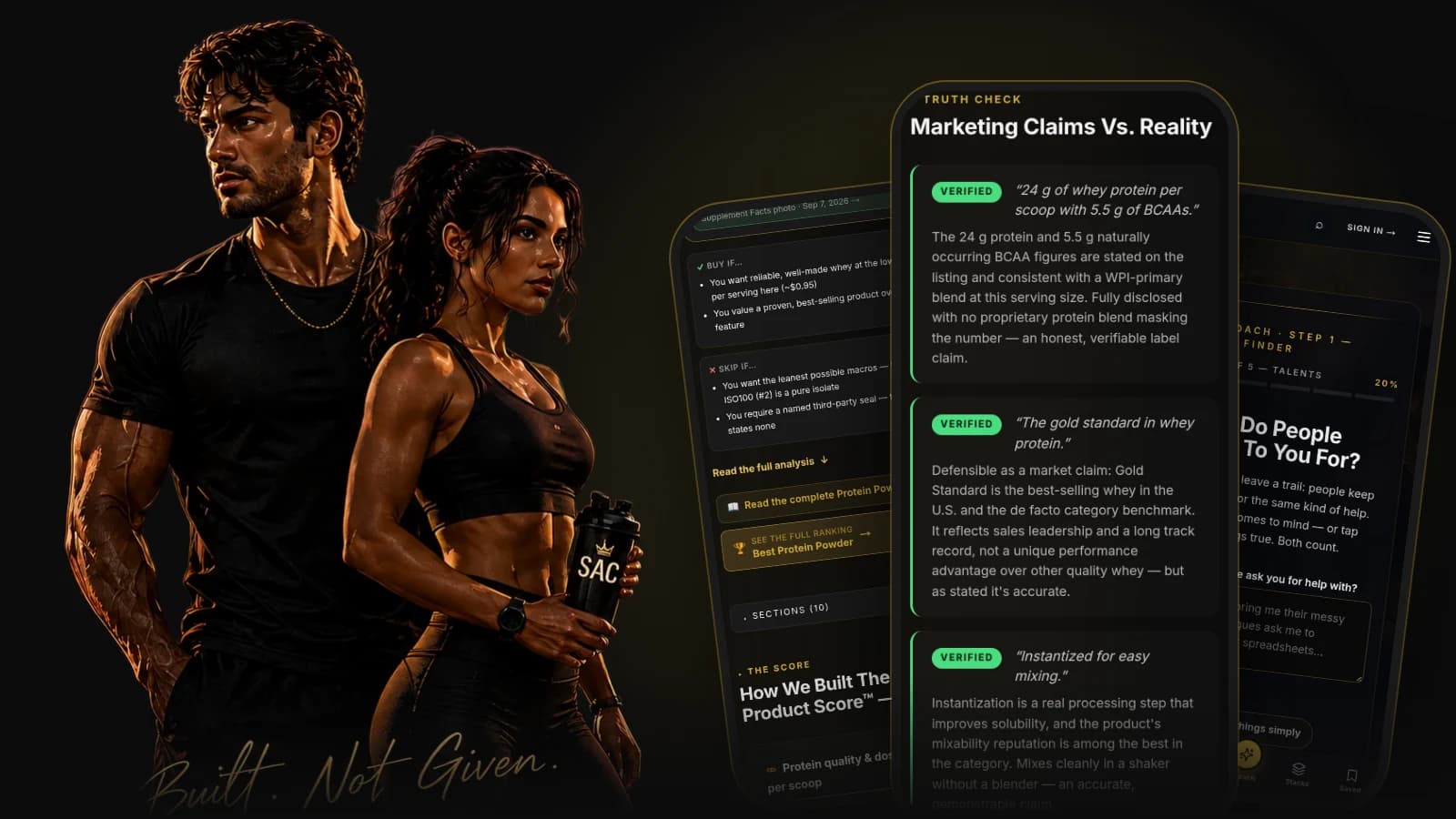
620 of our supplement reviews are now checked line by line against the Supplement Facts panel on the bottle. Where our own text and the label disagreed, the label won. Then we rebuilt the reviews, the rankings and the goal pages around that. Here is what you can do with it.

We scored nine protein powders on protein per scoop, label honesty, third-party testing, cost per gram of protein and taste. The board runs 9.4 down to 7.5 — a spread of only 1.9 points. The prices run from $0.95 to $2.37 a serving, and they run against the scores at both ends.

The animal literature is thirty years deep and genuinely impressive — severed tendons healed back stronger under load testing. The human literature is three pilot studies totalling thirty analysed people, all sharing one first author and one journal. Two trials have ever been registered, and neither has reported.

Monacolin K, the active compound in red yeast rice, is chemically identical to the prescription statin lovastatin — the EU says so in a binding regulation. Researchers bought 28 brands at mainstream US retailers: two contained none at all, and following each label's own daily serving the dose ranged more than 120-fold.

Researchers pulled the 20 best-selling liver cleanse supplements on Amazon — 1,420,584 units and $38,783,937 a year. Every one promised to eliminate toxins and 85% promised better liver function, against evidence the paper calls limited and inconclusive. Milk thistle was in 19 of the 20, and it is the one part of the bottle with real randomised trials behind it.

A Rutgers pilot was reported this week as protection against dementia. It measured no dementia. It is registered as a bone study, cognition was one of twenty exploratory measures, and of four cognitive tests exactly one beat the control group.
Liver detox, sea moss's "92 minerals", the magnesium-deficiency scare, ashwagandha and cortisol, creatine for the brain, creatine gummies. We pulled the anchor study behind each, and published the whole board — including the five topics we scored highly and then refused to make.

Across 31 randomised trials in 1,168 people, a single 200 mg dose improved choice reaction time. The calm everyone markets it for was modest for stress and non-significant for anxiety — and fully null at 450-900 mg in patients with generalised anxiety.

A randomised placebo-controlled trial of purified shilajit raised total testosterone about 20%, free testosterone 19% and DHEAS 31% over 90 days. It used a standardised, purity-tested extract — not the raw resin going viral, where thallium levels vary batch to batch.

The internet's #1 magnesium rule says only glycinate absorbs — about 4x better than "useless" oxide. The famous insomnia trial dosed oxide. The human isotope study measured 23.5% vs 22.8%. And the only three-way head-to-head crowned citrate.

Three minutes fast, three minutes slow, repeated — that's it. In a 5-month randomized trial of 246 middle-aged and older adults, interval walking beat continuous walking on leg strength, aerobic capacity and blood pressure. And the 10,000-step target it replaces was never evidence-based.

Orange juice, coconut water and sea salt is all over TikTok as a fix for 'adrenal fatigue'. There is not one clinical trial on the drink, and a systematic review of 58 studies concluded adrenal fatigue is not a real condition. What does lower cortisol has actual randomized evidence.

Berberine genuinely lowers blood sugar — HbA1c fell 0.63% across 37 trials in 3,048 patients. But the weight claim that made it go viral does not hold: pooled randomized trials found no significant change in body weight at all. Use it for glucose, not your waistline.

Ozempic, Wegovy and Mounjaro work — but a big share of the weight you lose isn't fat. In the SURMOUNT-1 DXA substudy, of the weight lost on tirzepatide, roughly 75% was fat and 25% was lean (muscle) mass. That's the 'skinny-fat' trap. The fix isn't quitting the drug — it's protecting muscle with protein and resistance training.

Mouth tape, magnesium and $300 sleep rings are everywhere. But the only first-line fix with strong, lasting evidence is CBT-I: a 20-trial meta-analysis found people fell asleep ~19 minutes faster and kept the benefit for years. Magnesium's near-identical number rests on just 3 tiny, very-low-quality trials — and some of the hyped gear can backfire.

Your brain runs on creatine too. In a national survey of 22,000+ adults, the highest dietary creatine intake was linked to 32% lower odds of depression. A 2023 meta-analysis found creatine improved memory — biggest gains in older adults. Same cheap ~$0.10 scoop; the wins are clearest if you're older, stressed, or sleep-deprived.

Skip the $300 'test boosters' with zero studies. In a randomized, placebo-controlled trial, 200 mg/day of standardized Tongkat Ali for four weeks raised testosterone status +37% and cut the stress hormone cortisol −16% in stressed adults. It's one credible lever for low-normal testosterone — not a replacement for sleep, training, or medical care.

In a two-year randomized trial, high-dose DHA reached the brain (CSF DHA rose ~17%) but produced no difference in cognitive performance versus placebo. Separately, a meta-analysis links high-dose omega-3 to a higher atrial-fibrillation risk. Fish oil isn't useless — its evidence-backed job is lowering triglycerides. Take it for the right reason, and dose it right.

The trend is right that fiber matters, but for the wrong reason. Fermentable fiber feeds gut bacteria that release GLP-1 — the same appetite hormone the new weight-loss drugs mimic — for free. In a randomized trial, delivering fiber's propionate to the colon raised GLP-1, cut how much people ate, and cut weight gain. The catch the trend skips: jumping from 15 g to 40 g overnight backfires.

In the largest randomized trial, a daily multivitamin did not reduce major cardiovascular events over 11 years — it matched placebo exactly. For healthy eaters the pill is gap-insurance at best, and high-dose versions of some vitamins raise mortality. But a real nutrient gap is a different story.

The best evidence puts a thermogenic's real effect at roughly a pound, and the strongest review found the weight loss small and statistically non-significant. Meanwhile high-dose green-tea extract — the core ingredient — has a documented liver-injury signal. It's a caffeine pill sold as magic.

In a 2025 randomized trial, a commercial phytosteroid product contained less than 1% of its claimed active and built no muscle over placebo. The one positive human study gym influencers point to is on ecdysterone — a different molecule.

On the protein-quality scale collagen scores 0 — it's missing tryptophan entirely — and eaten collagen never reaches your skin as collagen; your gut breaks it down first. Yet in pooled trials the peptides do modestly firm skin and ease joint pain, by signaling your own cells. The nuance is the whole story.

Court-documented cases found protein powders delivering half the protein on the label, padded with cheap glycine to fool the nitrogen test. And the viral heavy-metal panic? It's measured against a limit ~20× stricter than the FDA's — spinach trips it too.

The effective dose is about 0.3 mg; shelf pills are 5–10 mg. Even done right, melatonin adds roughly 8 minutes of sleep — it's a clock, not a sedative. One analysis found actual content from 83% under to 478% over the label.

AG1’s entire clinical record is a single company-funded study: 30 people, four weeks, surrogate endpoints. Meanwhile you pay ~$3.30 a day for megadosed water-soluble vitamins your body largely excretes.

Two peer-reviewed studies on two continents found ~50% of fish-oil supplements exceed freshness limits — and a “1000 mg” cap holds only ~300 mg of the omega-3s that actually matter.

Powder runs about $0.23 per real 5 g dose. We read the live US buy box for every gummy on our ranking on 27 July 2026: a real dose runs $0.67 to $2.78 depending on which one you pick. Over 500 trials back creatine monohydrate, and none show a pricier form beats it at the same dose.