
Turkesterone Tested Under 1% of Its Label — and the Study Sellers Cite Isn't Even Turkesterone
In a 2025 randomized trial, a commercial phytosteroid product contained less than 1% of its claimed active and built no muscle over placebo. The one positive human study gym influencers point to is on ecdysterone — a different molecule.
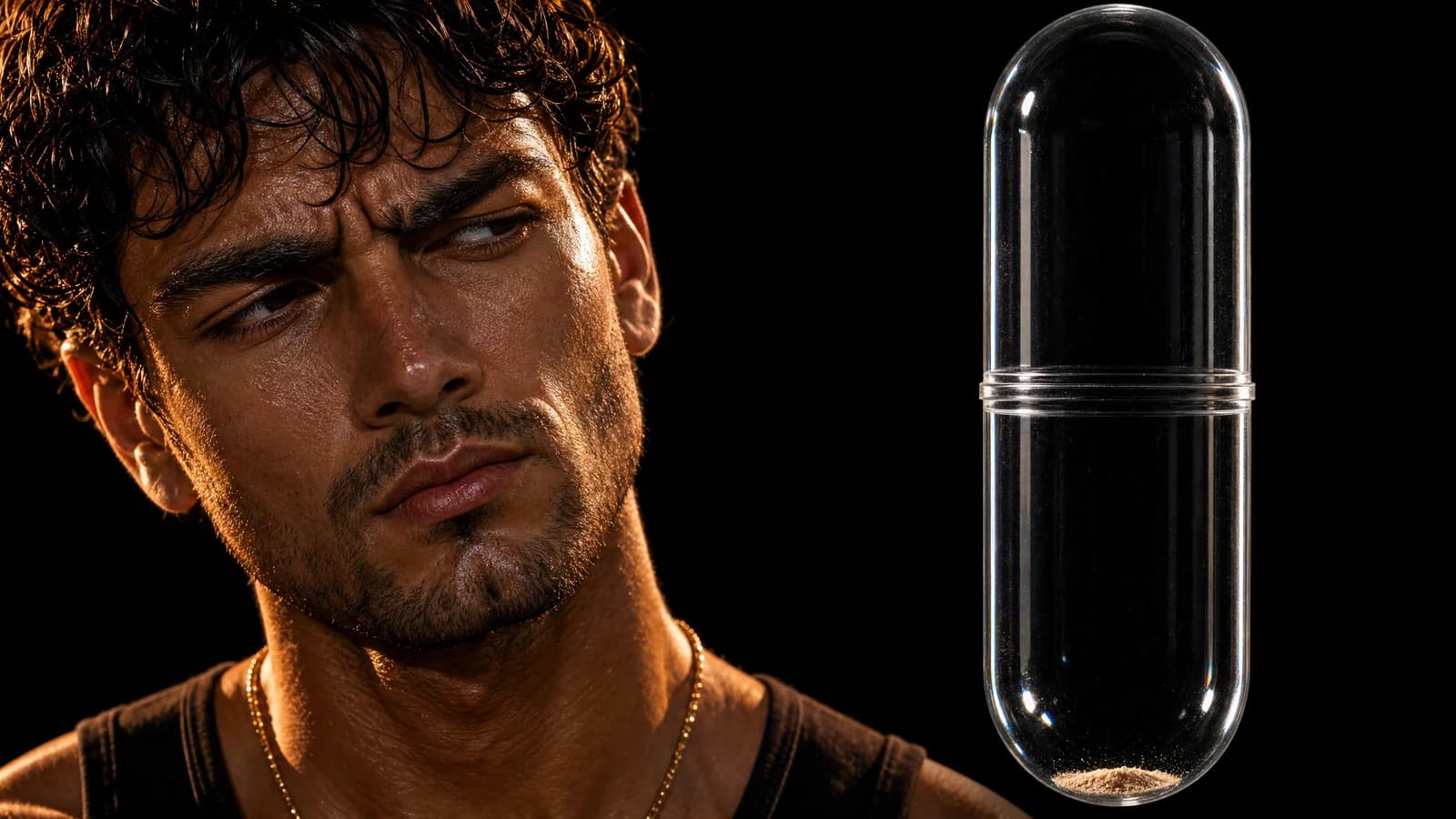
A suspicious Sterling inspects a nearly empty transparent capsule
For years, the knock on turkesterone was circumstantial: independent labs kept buying popular products, testing them, and finding almost none of the active they promised. In 2025 a peer-reviewed trial made it official. Researchers put a commercial phytosteroid supplement through a 12-week randomized, double-blind training study — and when they measured what was actually inside, the product held less than 1% of its claimed 20-hydroxyecdysone. Barely a trace.
The trial went further: it tracked strength and muscle in trained men taking the supplement versus placebo. Both groups improved — from the training. There was no group effect. In plain English, the supplement did nothing the placebo didn't (Dissemond & Isenmann, 2025).
The one study sellers cite is a different molecule
Push a turkesterone brand and you'll hear about "the study" — a 2019 paper showing real muscle gains. Read it: that study is on ecdysterone, a related but distinct compound, in 46 men over 10 weeks (Isenmann 2019). Not turkesterone. And even that result is contested — the supplement used was later reported to be badly under-dosed. There is still no good human trial showing turkesterone itself builds muscle; the hype rests on rodent and cell data.
If you're going to try it anyway
The ingredient's evidence is weak, so the only thing that separates products is whether the company actually proves what's in the bottle. That's how we scored the category — third-party verification and dose accuracy first, marketing last. One brand cleared that bar well enough to earn a 9.4: Toniiq. But the honest headline stands — you can't out-supplement an under-dosed bottle, and turkesterone's muscle claim is unproven in humans.
The 25-second version — as seen on TikTok, Reels & Shorts.
SOURCES
- Dissemond J, … Isenmann E — J Int Soc Sports Nutr 2025: 12-wk RCT; <1% of claimed 20E content; no group effect vs placebo (PMID 40781783)
- Isenmann E et al. — Arch Toxicol 2019: the positive muscle study is on ECDYSTERONE, a different compound, 46 men/10 wks (PMID 31123801)
- Independent lab teardowns (Nootropics Depot, More Plates More Dates) — marketed turkesterone repeatedly assayed under 1% of claimed content