
Top 9 Best Creatine Supplements (2026)
 01 · Best overall✓ Label verified · Supplement Facts read Oct 6, 2026
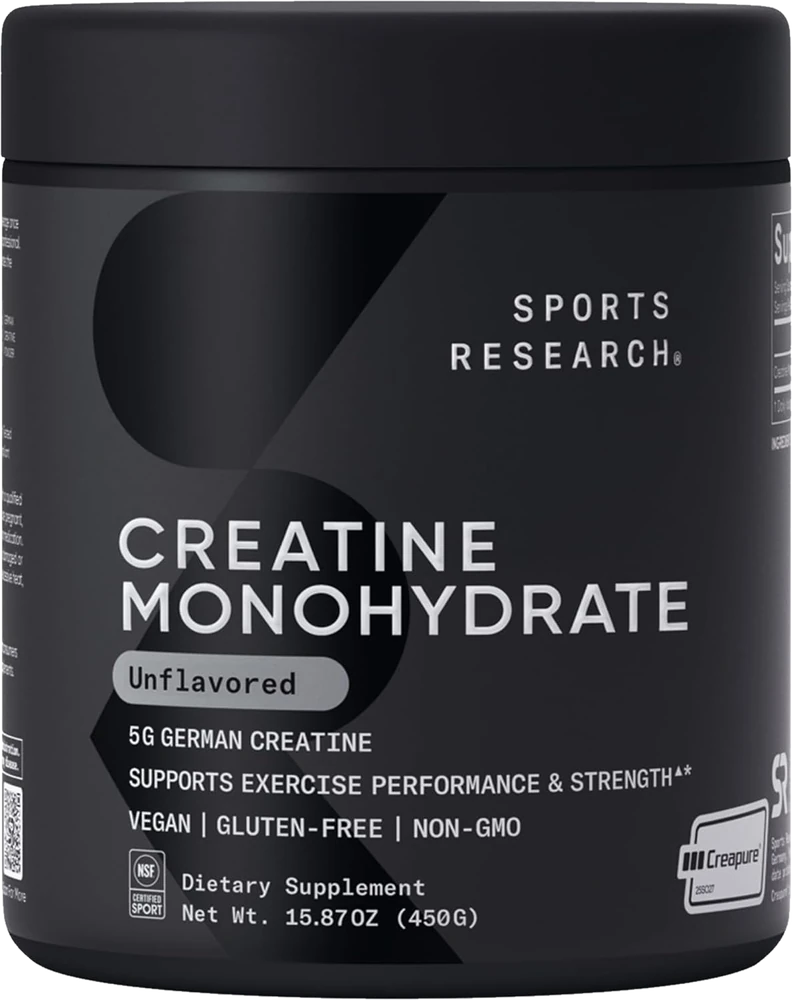
Best overall: Sports Research Creatine Monohydrate (Creapure)
The best-documented tub on the board: Creapure named on the Supplement Facts panel and the NSF Certified for Sport mark on the front, one ingredient, an exact 5 g scoop, about $0.41 a dose.
$37 / 450 g (90 servings)~$0.41 / real 5 g dose (1 scoop)
Why it wins: all five scores, pros & cons, full label
- Creapure named on the Supplement Facts panel, the only powder on this list that states its source
- NSF Certified for Sport mark on the tub, confirmed on the nsfsport.com list
- Single ingredient, 5 g per scoop, unflavored
- About $0.41 a serving at the $36.95 list price, less than Thorne
- One certified lot on the NSF list so far; Thorne has 66
- Costs more per serving than Optimum Nutrition
- Sports Research sells a plain creatine in the same tub; look for the Creapure logo
- Real 5 g dose
- 1 scoop = exact 5 g (single ingredient, unflavored)
- Supply
- 450 g · 90 servings · ~3 months at 5 g/day
- Testing
- NSF Certified for Sport mark on the tub; nsfsport.com lists one certified lot (26174B, checked Oct 6, 2026); match the lot number on your tub
- Form
- Creatine monohydrate, Creapure named on the Supplement Facts panel

Our take — The highest-scoring product on the board. Plain monohydrate is the form the evidence supports, and this is the one tub that states its source (Creapure) on the facts panel and carries the NSF Certified for Sport mark, which we confirmed on NSF's list on Oct 6, 2026. At about $0.41 a dose it costs less than Thorne. NSF certifies lot by lot and lists one lot so far, so drug-tested athletes should match the lot number or choose Thorne (#2) for its 66 listed lots.
 02
 03
 04
 05
 06
 07
 08
 09
Who Wins Which Aspect
Sorted by overall SAC Product Score™ — the official ranking.
| # | Pick | Score | Form purity25% | Third-party testing25% | Per-serving creatine20% | Cost per active gram20% | Brand QC track record10% | Cost Per Dose | Buy |
|---|---|---|---|---|---|---|---|---|---|
| 01 | | 9.1 | 9.51 | 9.52 | 9.51 | 8.03 | 8.5 | ~$0.41 / real 5 g dose | Check price |
| Creapure named on the Supplement Facts panel, the only powder on this list that states its sourceOne certified lot on the NSF list so far; Thorne has 66 | |||||||||
| 02 | | 9.0 | 8.52 | 10.01 | 9.51 | 7.5 | 10.01 | ~$0.50 / real 5 g dose | Check price |
| NSF Certified for Sport, confirmed on the nsfsport.com list — the only cert accepted by major US federations$0.50/dose is roughly double ON — overkill if you're not drug-tested | |||||||||
| 03 | | 8.9 | 8.52 | 8.53 | 9.51 | 9.01 | 9.52 | ~$0.23 / real 5 g dose | Check price |
| Micronized creatine monohydrate, the trial-grade molecule; the label prints Banned Substance TestedNot NSF Certified for Sport — drug-tested athletes should jump to Thorne | |||||||||
| 04 | | 8.4 | 8.52 | 7.5 | 9.02 | 8.52 | 9.03 | ~$0.21 / real 5 g dose | Check price |
| Micronized creatine monohydrate, like ON, at about $0.21 per real 5 g doseThe label serving is about 4.2 g, not 5 g; per real 5 g dose it is about $0.21, a hair under ON's $0.23 | |||||||||
| 05 | | 8.3 | 8.52 | 7.5 | 9.51 | 8.52 | 7.5 | ~$0.22 / real 5 g dose | Check price |
| Among the lowest cost-per-dose tubs here (~$0.22, a cent above NOW per real 5 g dose) — pure micronized monohydrate, no fillersCreatine source not stated and no public per-batch COA — ON is nearly the same price | |||||||||
| 06 | | 7.9 | 8.52 | 9.52 | 9.02 | 3.5 | 8.5 | ~$1.67 / real 5 g dose | Check price |
| Best per-batch COA transparency on the entire board — lookup-able by lot code~$1.67/dose — 7x plain monohydrate powder (ON) for an add-on most trained lifters don't need | |||||||||
| 07 | | 7.3 | 9.51 | 7.0 | 4.5 | 8.52 | 5.5 | $1.85 / real 5 g dose · ~8x the same 5 g as powder | Check price |
| Highest dose density in the gummy aisle — 1.5 g/gummy means just 3-4 for a real 5 g dose$1.85 per real 5 g dose against ~$0.23 for the same 5 g as powder — roughly 8x, and dearer than most gummies too ($0.67 to $2.78 across the five we rank) | |||||||||
| 08 | | 6.9 | 8.52 | 5.5 | 9.51 | 5.0 | 5.0 | $0.98 | Check price |
| One ingredient on the panel: creatine monohydrate$0.98 per 5 g serving, more than every plain monohydrate powder we rank | |||||||||
| 09 | | 6.4 | 7.03 | 8.0 | 5.03 | 4.0 | 8.0 | ~$0.33 / capsule | Check price |
| Highly water-soluble and mixes fast — the only honest advantage of the HCl formDifferent molecule with no head-to-head outcome edge over monohydrate (Antonio 2021) | |||||||||
The Other 8, Ranked
- 02
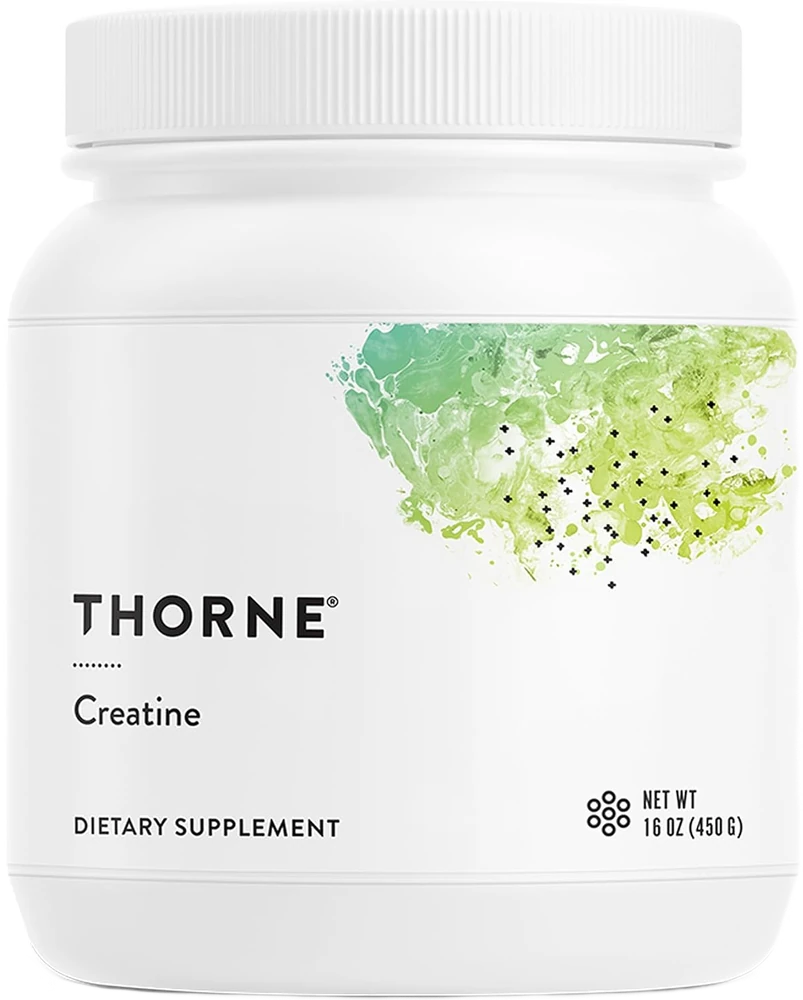
Best for drug-tested athletes: Thorne Creatine
9.0SAC Score™The pick for drug-tested athletes: plain creatine monohydrate with NSF Certified for Sport, the banned-substance certification the NCAA, IOC, and pro leagues require (certified lots are listed at nsfsport.com; match the lot number on your tub). The premium buys the certification, not better creatine.
StrongestThird-party testing10.01WeakestCost per active gram7.5- Real 5 g dose
- 1 scoop = exact 5 g (no fillers, no flavoring)
- Supply
- 450 g · 90 servings · ~3 months at 5 g/day
- Testing
- NSF Certified for Sport (lot-specific) — 270+ banned substances
All five scores, pros & cons, full label
What We Like- NSF Certified for Sport, confirmed on the nsfsport.com list — the only cert accepted by major US federations
- Plain monohydrate like ON — the premium is the sport certification, not the molecule
- Clinical-grade brand QC trusted by US Olympic teams, UFC, and CrossFit
- Exact 5 g scoop, no fillers, no proprietary blend
What You Live With- $0.50/dose is roughly double ON — overkill if you're not drug-tested
- Smaller 450 g / 90-serving tub means more frequent re-orders than ON
- Form
- Creatine monohydrate (Creapure is not stated on the label, listing or thorne.com, checked Oct 6, 2026)
Our take — The right buy for exactly one kind of person: the drug-tested athlete. NSF Certified for Sport is non-negotiable in any tested federation — a single contaminated batch of an otherwise clean supplement can end a career — and Thorne has by far the longest list of certified lots (66 on nsfsport.com, checked Oct 6, 2026; match the lot number on your tub). Underneath the certification it's plain creatine monohydrate like ON, so you're paying the premium for the certification, not better creatine. If your federation, coach, or dietitian requires NSF, buy it without hesitation. If you're a recreational lifter who isn't tested, save the difference and run ON. Want NSF in a gummy instead? See Create.
- 03
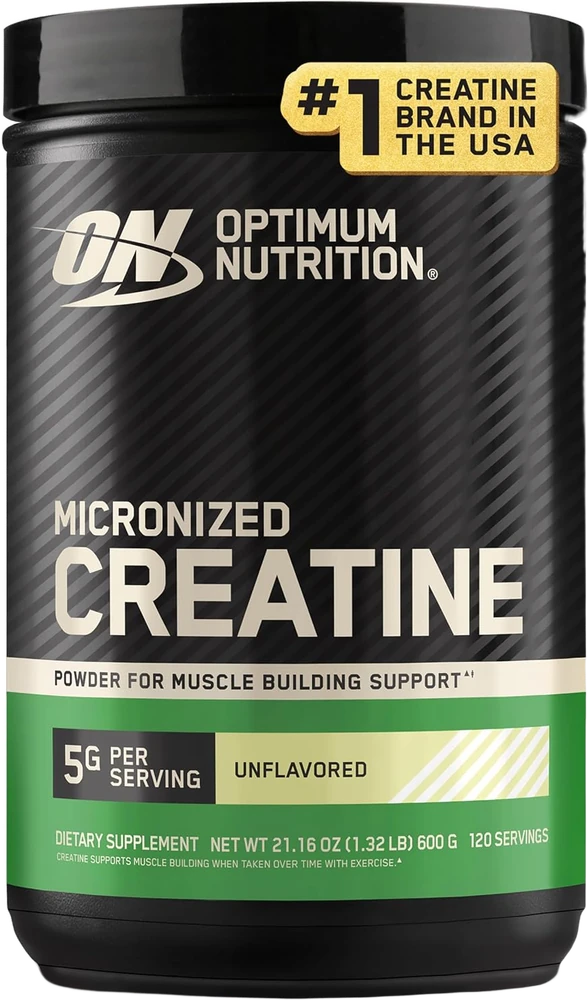
Best household brand: Optimum Nutrition Micronized Creatine Powder
8.9SAC Score™The default value pick for almost anyone: micronized creatine monohydrate, an exact 5 g scoop, a 120-serving tub, and a 30-year no-recall track record — all at the value sweet spot, with no disqualifying flaw.
StrongestPer-serving creatine9.51WeakestForm purity8.5- Real 5 g dose
- 1 level scoop = exact 5 g (honest, no dose spin)
- Supply
- 600 g · 120 servings · ~4 months at 5 g/day
- Testing
- Label prints Banned Substance Tested; the listing names the Informed Choice program (brand statement, not confirmed by us); not on the NSF Certified for Sport list (see Thorne)
All five scores, pros & cons, full label
What We Like- Micronized creatine monohydrate, the trial-grade molecule; the label prints Banned Substance Tested
- Exact 5 g scoop + 120-serving tub = honest dosing and a 4-month supply
- $0.23/dose — a low price from a household brand, the baseline every other form is measured against
- 30+ years of brand QC with no recalls — the safe 'I just want a tub' default
What You Live With- Not NSF Certified for Sport — drug-tested athletes should jump to Thorne
- Modest premium over pure generic micronized monohydrate (Nutricost at ~$0.22)
- Form
- Micronized creatine monohydrate (neither the label nor the listing says Creapure, checked Oct 6, 2026)
Our take — This is the creatine to buy if you've never bought creatine before, and the one most experienced lifters quietly come back to. It clears every meaningful bar — monohydrate form, an exact 5 g dose, a generous tub, a competitive price, three decades of QC — and has no asterisk. Sports Research (#1) ranks higher because it names Creapure on its facts panel and carries the NSF mark, but it costs about $0.18 more a dose. Most other picks on this list win a specific segment, and each of those wins comes with a trade-off: Thorne charges double for NSF, gummies cost 3x to 12x for the format depending which one you buy, HCl is a different molecule with no edge. ON has none of those compromises. If you're shopping for your first creatine, or you just want to stop thinking about it, this is the tub. For the full powder field — budget bags, alternative Creapure brands, capsules — see Best Creatine Monohydrate.
- 04
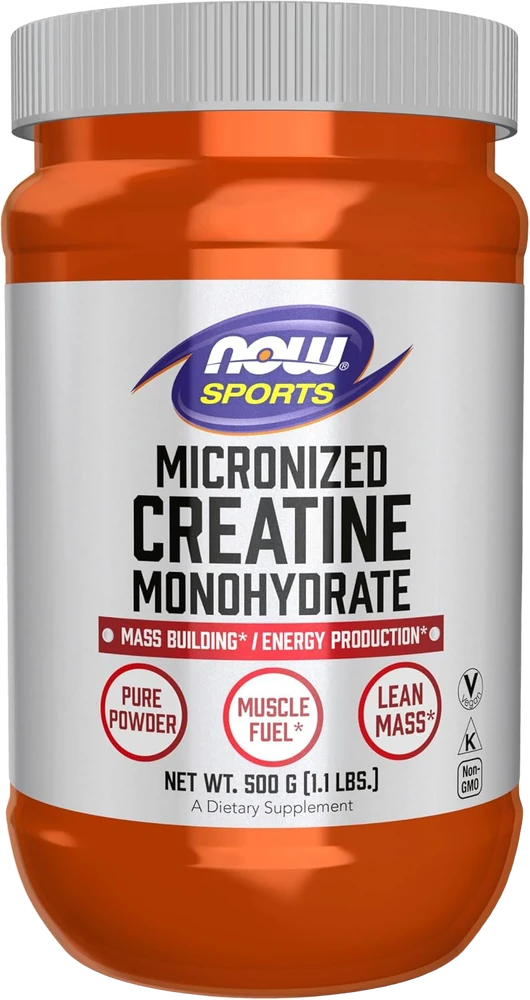
Household-brand pick: NOW Sports Micronized Creatine Monohydrate
8.4SAC Score™The household-brand pick: micronized creatine monohydrate wrapped in NOW's in-house QC, kosher and non-GMO label marks, and the offline-shelf availability that means your supply never depends on a single Amazon listing.
StrongestPer-serving creatine9.02WeakestThird-party testing7.5- Real 5 g dose
- About 1.2 label servings (label serving is about 4.2 g; no fillers, no flavoring)
- Supply
- 500 g · about 119 servings of 4.2 g
- Testing
- Brand in-house QC only; no Informed Sport seal on the label · Vegan, Kosher, Non-GMO, GMP Quality Assured
All five scores, pros & cons, full label
What We Like- Micronized creatine monohydrate, like ON, at about $0.21 per real 5 g dose
- NOW's 30-year in-house QC with a real voluntary-recall track record
- Available offline at most US health stores — supply-continuity backup
- Kosher and non-GMO label marks as free QC signals
What You Live With- The label serving is about 4.2 g, not 5 g; per real 5 g dose it is about $0.21, a hair under ON's $0.23
- No Informed Sport seal on the label and not on the NSF Certified for Sport list — drug-tested athletes should pick Thorne
- Form
- Micronized creatine monohydrate (neither the label nor the listing says Creapure, checked Oct 6, 2026)
Our take — The household-brand pick for the buyer who values supply continuity. At ~$0.21 per real 5 g dose it's a whisker under ON, and you get NOW's in-house QC, kosher and non-GMO label marks, and — the underrated part — a distribution footprint that means you can grab a tub at Whole Foods or Vitamin Shoppe when Amazon is out. It is micronized creatine monohydrate, like ON, and neither the label nor the listing says Creapure (checked Oct 6, 2026). If you're optimizing purely on Amazon price, NOW edges ON by about two cents a dose; if you want a recognizable household brand with offline backup, this is the answer; if you're drug-tested, Thorne is the pick, because NOW is not on the NSF Certified for Sport list and its label has no Informed Sport seal. A strong, no-drama tub.
- 05
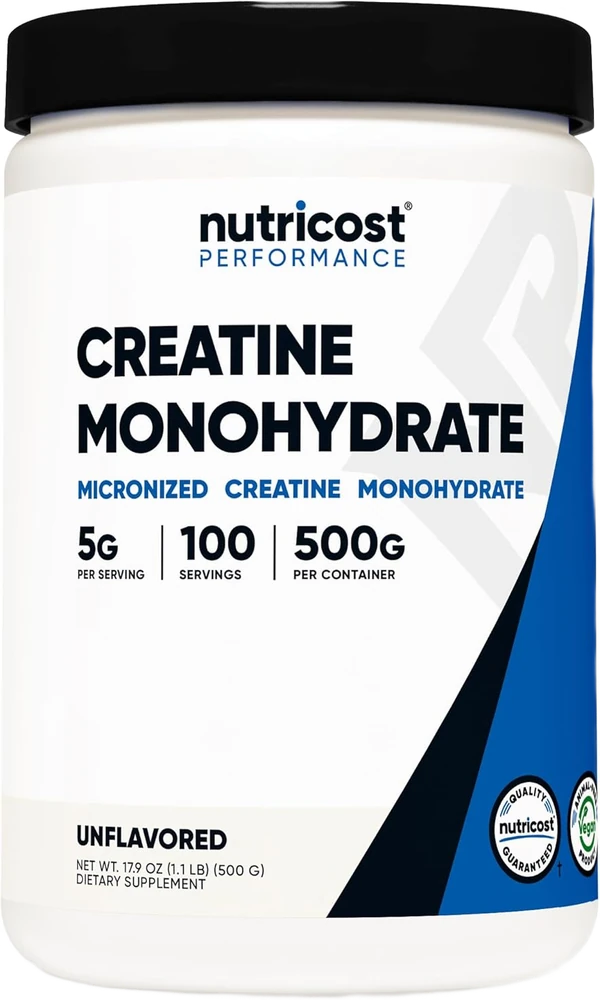
Best bulk value: Nutricost Creatine Monohydrate
8.3SAC Score™One of the lowest cost-per-dose tubs on the board: pure micronized monohydrate, a calibrated 5 g scoop, and reliable Amazon stock at ~$0.22 per real dose. You trade a public COA for the cheapest legitimate creatine in tub form.
StrongestPer-serving creatine9.51WeakestThird-party testing7.5- Real 5 g dose
- 1 calibrated scoop = exact 5 g (no fillers, no flavoring)
- Supply
- 500 g · 100 servings · ~3 months at 5 g/day
- Testing
- GMP facility + internal batch QC (no public per-batch COA, no NSF)
All five scores, pros & cons, full label
What We Like- Among the lowest cost-per-dose tubs here (~$0.22, a cent above NOW per real 5 g dose) — pure micronized monohydrate, no fillers
- Reliable Amazon stock and a tub format with a calibrated 5 g scoop
- GMP-certified facility with a 10+ year brand track record, no major recalls
- Same elemental creatine delivered to muscle as the other monohydrate picks
What You Live With- Creatine source not stated and no public per-batch COA — ON is nearly the same price
- Not NSF Certified for Sport — drug-tested athletes need Thorne
- Form
- Micronized creatine monohydrate (generic, GMP-certified supply)
Our take — The bulk-value play, and a genuinely good one — it's among the cheapest legitimate creatine in tub form here at ~$0.22 per real dose, a cent above NOW. The molecule delivered to your muscle is identical to the other monohydrate picks; what you give up is a consumer-facing per-batch COA. The honest wrinkle is that ON sits at near-parity on price (~$0.23). Nutricost wins specifically when you want a near-lowest tub price, value its reliable stock and tub format, or already trust the brand from its broader line. For the full value field — 1 kg bags, alternative budget brands — see Best Creatine Monohydrate.
- 06
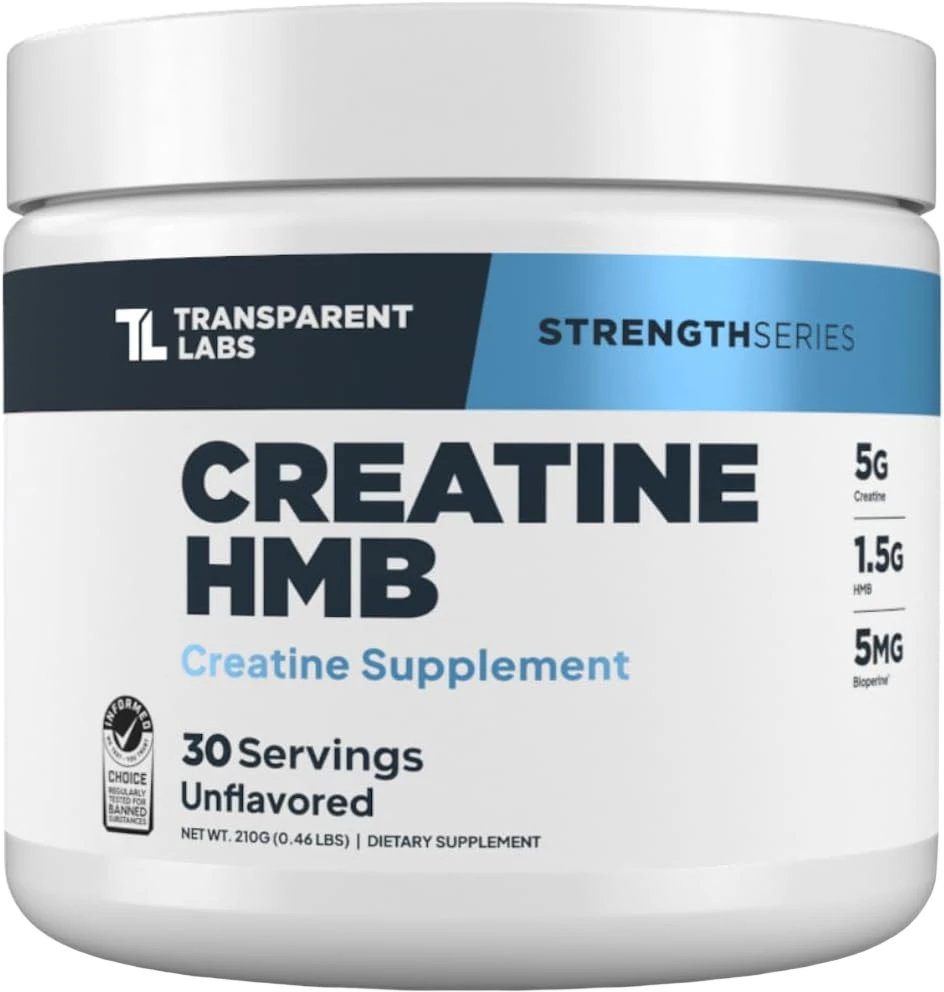
Best premium / stack: Transparent Labs Creatine HMB
7.9SAC Score™The premium combo for a narrow buyer: a clean monohydrate base stacked with 1.5 g HMB, backed by the best per-batch COA transparency on the board. Genuinely worth it for untrained beginners and deep cutting phases — a marketing-driven upcharge for everyone else.
StrongestThird-party testing9.52WeakestCost per active gram3.5- Real 5 g dose
- 1 scoop = exact 5 g creatine + 1.5 g HMB (honest serving math)
- Supply
- 30 servings · ~1 month at 5 g/day
- Testing
- Per-batch COA published, lookup-able by lot code — best on the board; also on the NSF Certified for Sport list for specific lots (match the lot number on your tub)
All five scores, pros & cons, full label
What We Like- Best per-batch COA transparency on the entire board — lookup-able by lot code
- Monohydrate base at 5 g per scoop, with the HMB in the same scoop
- Clean panel: no fillers, no artificial sweeteners, no proprietary blend
- The HMB add-on has real evidence for untrained beginners (first 8-12 weeks)
What You Live With- ~$1.67/dose — 7x plain monohydrate powder (ON) for an add-on most trained lifters don't need
- HMB's evidence collapses in trained athletes (Wilson 2013) — the audience for a $50 combo
- Form
- Creatine monohydrate (5 g) + myHMB calcium HMB (1.5 g) per scoop (Creapure not stated)
Our take — A genuinely clean product on a marketing-driven premise — which is why it earns the 'premium' slot rather than a higher rank. The monohydrate base is solid and the per-batch published COA is the best transparency on this list, full stop. It is also on the NSF Certified for Sport list for specific lots, so match the lot number on your tub if you are tested. What it can't escape is HMB: the evidence is robust in untrained beginners for the first 8-12 weeks and minimal-to-absent in trained athletes, who are exactly the people paying $50 for a creatine combo. So buy it if you're brand-new to lifting, deep in a cutting phase where every anti-catabolic mechanism matters, or you simply value the COA program and one-scoop convenience over cost. If you're a trained recreational lifter optimizing value, buy plain monohydrate (ON) and put the savings into protein. The creatine and the transparency are real; the HMB is positioning.
- 07
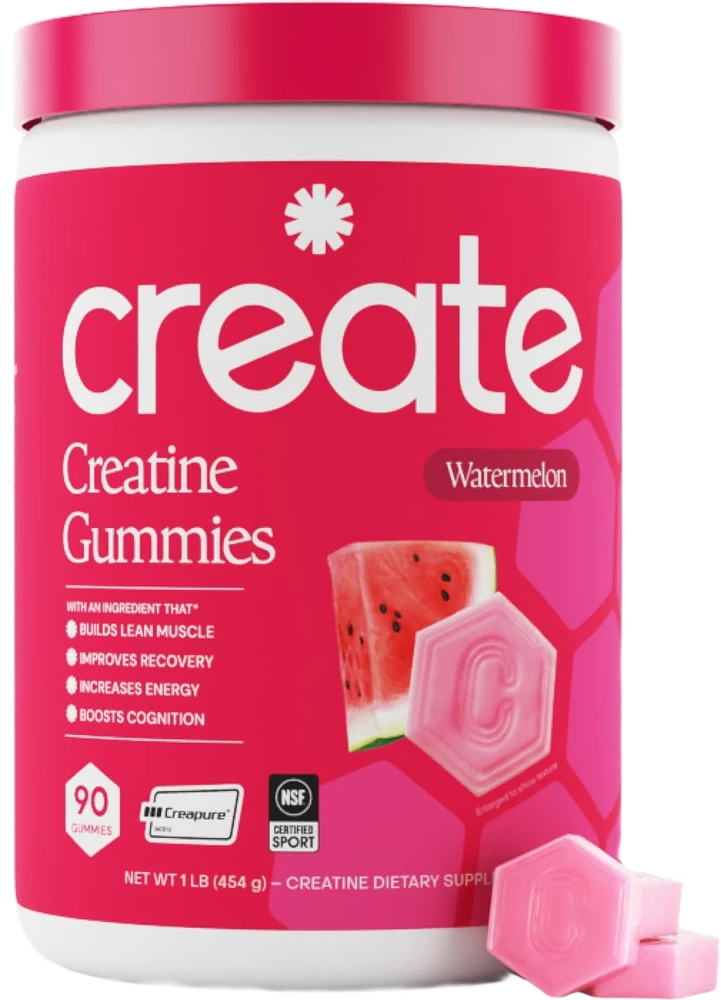
Best gummy: Create Wellness Creatine Gummies
7.3SAC Score™The best gummy in the category, and the adherence pick for anyone powder never sticks with: 1.5 g per gummy — the highest dose density in the aisle, so a real 5 g dose is just 3-4 gummies — plus NSF Certified for Sport and an anti-melt formula built for travel.
StrongestForm purity9.51WeakestPer-serving creatine4.5- Real 5 g dose
- 3-4 gummies (brand markets 3 = 4.5 g; take 4 for a clean 5 g)
- Supply
- 90 gummies · ~22-30 days at a real dose
- Cost per real 5 g dose
- $1.85 ($49.98 ÷ 135 g of creatine ÷ 5 g). Powder is ~$0.23; the cheapest gummy we rank is $0.67
All five scores, pros & cons, full label
What We Like- Highest dose density in the gummy aisle — 1.5 g/gummy means just 3-4 for a real 5 g dose
- NSF Certified for Sport, confirmed at the certifier — the only gummy with a confirmed sport certification at this price
- Anti-melt formula survives a hot gym bag; no scoop, no water, no shaker
- Highest dose density of any gummy we checked — 3-4 pieces for a real 5 g dose
What You Live With- $1.85 per real 5 g dose against ~$0.23 for the same 5 g as powder — roughly 8x, and dearer than most gummies too ($0.67 to $2.78 across the five we rank)
- A 90-count tub is only ~22-30 days at a real dose — expect roughly monthly re-orders
- Rescored 9.0 → 7.3 on 2026-07-27: Creapure is not printed on the Supplement Facts panel, so it no longer counts toward the score
- Form
- Creatine monohydrate · 1.5 g per gummy (highest density in the aisle; Creapure not stated on the label or listing)
- Testing
- NSF Certified for Sport — batch-tested, 270+ banned substances
Our take — If a scoop-and-water ritual is the friction that breaks your creatine streak, the right answer isn't to white-knuckle the powder — it's to buy the best gummy, and that's Create. It fixes the category's defining flaw with the highest dose density in the aisle (1.5 g per gummy, so a real dose is 3-4 gummies instead of five), and its NSF Certified for Sport listing is confirmed in the certifier's own database — Creapure, by contrast, is not stated on the label or listing (checked Oct 6, 2026). Go in clear-eyed on cost: $49.98 for 90 gummies on the US buy box on 27 July 2026 works out to $1.85 per real 5 g dose, roughly eight times the ~$0.23 the same 5 g costs as powder — and dearer than most of the gummy aisle too, where a real dose runs $0.67 to $2.78 across the five we rank. A tub lasts about three weeks at a real dose. But a 5 g dose you actually take daily beats a perfect scoop sitting in the cupboard — and the smartest setup is the hybrid, cheap powder at home and Create for the road. For the full gummy field, see Best Creatine Gummies.
- 08
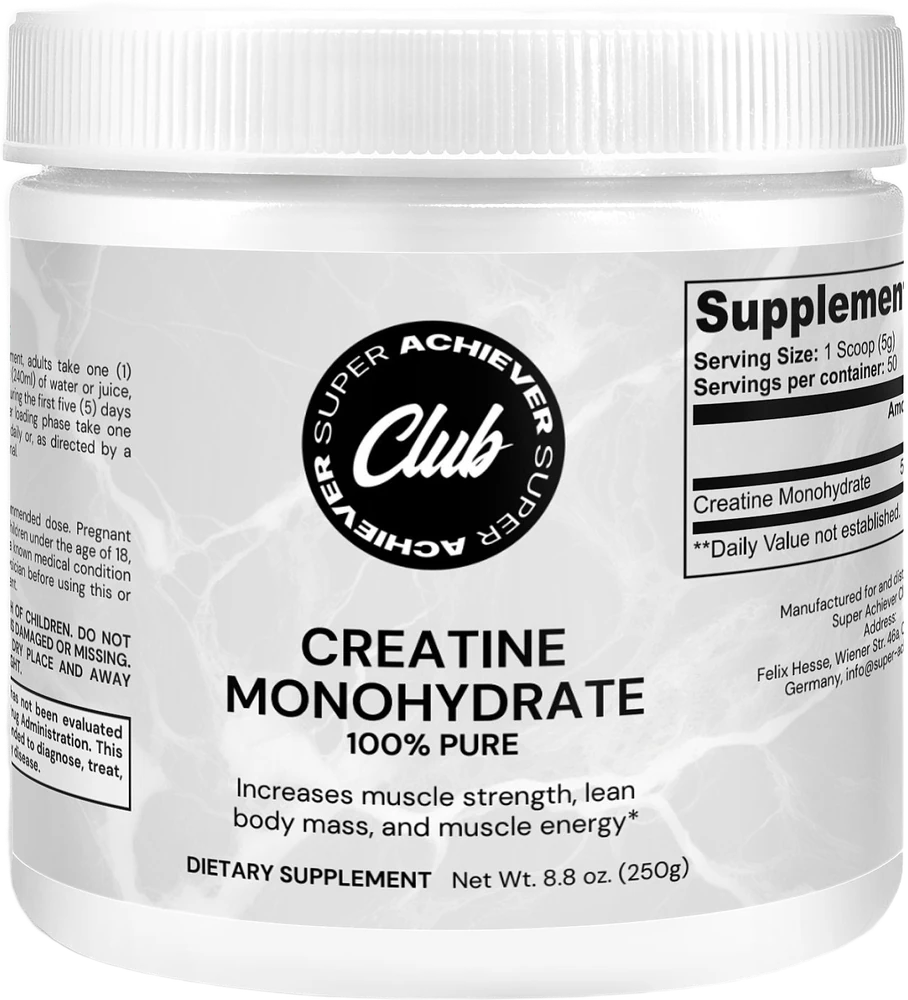
Our own brand: Super Achiever Creatine Monohydrate
6.9SAC Score™Our own creatine: one ingredient and an exact 5 g scoop. It ranks here because it costs $0.98 a serving and has no certificate or lab report to show.
StrongestPer-serving creatine9.51WeakestCost per active gram5.0- Per serving
- 5 g creatine monohydrate (1 scoop)
- Cost per serving
- $0.98
- Tub size
- 250 g · 50 servings
All five scores, pros & cons, full label
What We Like- One ingredient on the panel: creatine monohydrate
- Exact 5 g per scoop, the dose the research standardises on
- Unflavored powder that mixes into anything
What You Live With- $0.98 per 5 g serving, more than every plain monohydrate powder we rank
- No certificate, sport certification or published lab report
- Source
- Not named on the label
- Certifications
- None on the label
Our take — Right molecule and right dose, with nothing on the label you can verify from outside. If price or a sport certificate matters, buy the #1 pick.
- 09
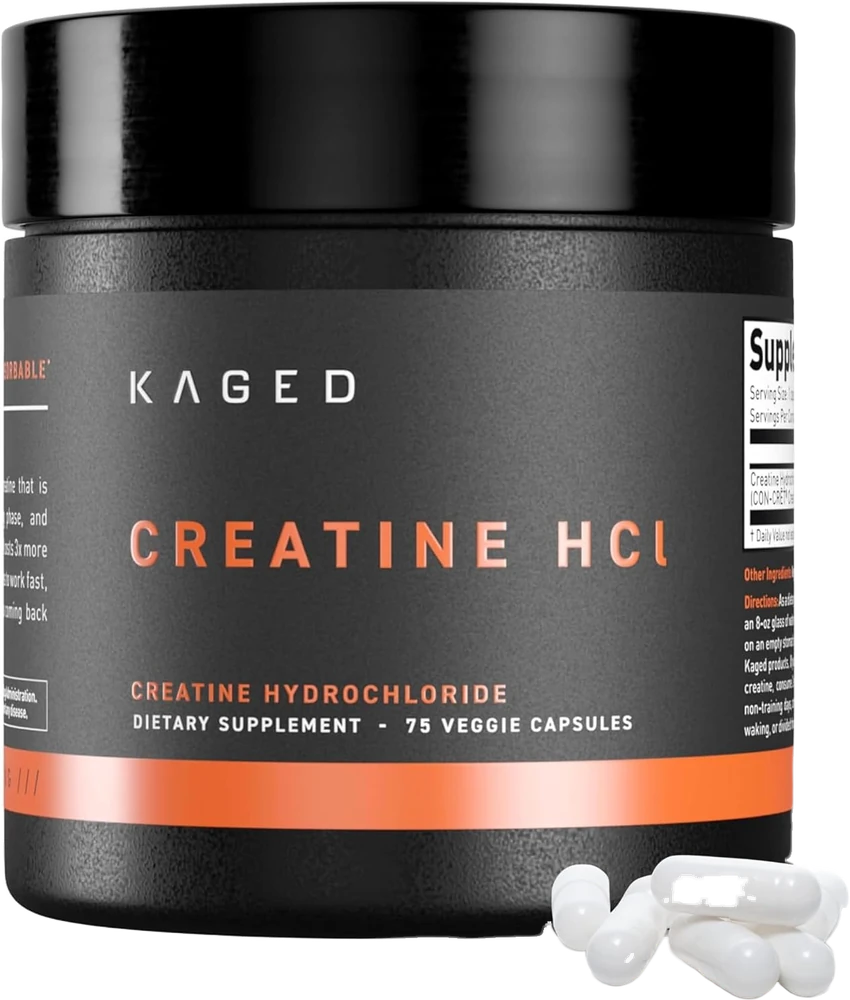
Best for sensitive stomachs (HCl): Kaged Creatine HCl
6.4SAC Score™The one situational case for an alternative form: a clean, highly-soluble creatine HCl capsule from a credible brand. It's the pick for the rare buyer who genuinely can't tolerate monohydrate — but it's a different molecule with no outcome edge, and the worst value here once you dose it to a real 5 g.
StrongestThird-party testing8.0WeakestCost per active gram4.0- Per capsule
- 750 mg HCl ≈ 585 mg creatine — a real 5 g dose needs 6-7 capsules
- Supply
- 75 capsules · ~1.25-2.5 months depending on dose
- Testing
- Informed Sport seal on the label · non-GMO · vegan capsule
All five scores, pros & cons, full label
What We Like- Highly water-soluble and mixes fast — the only honest advantage of the HCl form
- Clean execution from Kaged's credible 10-year brand with an Informed Sport seal on the label
- Capsule format travels well and the smaller per-dose volume can suit a truly sensitive gut
What You Live With- Different molecule with no head-to-head outcome edge over monohydrate (Antonio 2021)
- Dosed to a real 5 g it costs ~$2/day — the single worst value on this board
- Form
- Creatine hydrochloride (HCl) — a different molecule from monohydrate
Our take — Included as the honest answer to one real question — 'what if monohydrate genuinely upsets my stomach?' — not as a recommendation for most buyers. Kaged's execution is clean and the brand is credible, but HCl is a chemically different salt that delivers the same biological endpoint with no proven advantage (Antonio 2021), and the 'no bloating' case for it collapses once you stop comparing a tiny HCl dose to a 20 g monohydrate load. Before you buy it, do the cheaper experiment: drop the loading phase and run 5 g/day of monohydrate continuously, which resolves the GI issue for ~95% of people. If you're in the genuine minority who still can't tolerate it, this is a reasonable capsule option — just dose it to a true 5 g (6-7 capsules) and accept it's the priciest creatine here. For the science of how the forms actually differ, see Best Creatine Forms.
Creatine In Four Short Lessons
Why monohydrate powder is the default — and forms are upgrades
- 5 g
- Research-standard daily dose — the number every form is measured against
- 500+
- RCTs behind creatine monohydrate — no other form is close
- 3-12x
- What a gummy costs vs powder per real 5 g dose — $0.67 to $2.78 against ~$0.23 (US buy box, 2026-07-27)
- $0.23
- Cost of one real 5 g powder dose — the value baseline
Sources: Kreider 2017 ISSN position stand (PMID 28615996); Antonio 2021 myths review (PMID 33557850); Cooper 2012 safety review (PMID 22817979). Pricing per current Amazon listings, 2026-06.
Default to monohydrate powder.
The molecule is identical in every quality product, and once a real 5 g dose reaches your muscle it saturates the same way. Powder monohydrate wins on value for almost everyone.
Check that a serving is a real 5 g.
Dose accuracy carries a quarter of our score, and cost only counts per real 5 g dose.
Pay for an upgrade only if you have its problem.
Gummies help adherence, HCl helps the few with genuine GI intolerance, and NSF Certified for Sport matters if you are drug-tested. None is a free upgrade.
Kreider 2017 ISSN position stand (PMID 28615996) · 500+ RCTs — full scoring in the methodology below.
Every pick was scored 0-10 across five criteria, then weighted to a composite — and crucially, scored against a single yardstick that spans all forms: a real, label-honest 5 g dose of the proven molecule. Form purity carries the most weight because monohydrate (ideally Creapure) is the only form with 500+ RCTs behind it; everything else is either the same molecule in a different wrapper or an unproven variant. Dose accuracy comes next, because a 'serving' that quietly under-doses you (the gummy and HCl trap) is worse than a slightly less convenient scoop that hits 5 g exactly. Cost per real dose treats monohydrate powder as the baseline — every gummy and capsule is measured against the ~$0.23 it costs to deliver the identical creatine as powder, which is why the default winner is a powder and every other form has to earn its premium. Third-party testing (NSF > Informed Sport > public COA) and format-fit/adherence round it out — the latter being the one axis on which a gummy can legitimately beat a scoop, but only for the buyer whose consistency depends on it.
Form purity · 30%
Is it creatine monohydrate — ideally Creapure (99.9%+, contaminant-screened) — the only form with 500+ RCTs? Generic micronized monohydrate scores well; Creapure scores highest, but only when the label or listing says so, and only Sports Research (#1) does (checked Oct 6, 2026); alternative forms like HCl are marked down because no study shows them beating monohydrate at an equal creatine dose (Antonio 2021). This is the molecule that does the work, so it's weighted highest.
Dose accuracy · 25%
Does a real serving deliver a true 5 g of creatine, honestly labeled? Powder with an exact scoop scores top. Gummies are judged on grams-per-gummy and whether the marketed 'serving' actually hits 5 g (most don't). HCl is marked down hard because the recommended capsule serving falls below the 5 g trial floor entirely.
Cost per real 5 g dose · 20%
Price divided by the number of REAL 5 g doses, with monohydrate powder (~$0.23) as the baseline every form is measured against. Gummies run ~6-12x; HCl dosed properly is 8-15x. The honest economic axis — and the reason a powder wins overall while every other format has to justify its multiple through a specific benefit.
Third-party testing · 15%
The certification tier: NSF Certified for Sport (lot-specific, federation-grade) > Informed Sport / HPLC batch testing > public per-batch COA > internal GMP only. Decisive for drug-tested athletes, and a meaningful trust signal for everyone — especially in gummy form, where a moist matrix can degrade creatine.
Format-fit & adherence · 10%
The one axis where a non-powder form can legitimately win: does the format remove the friction that would otherwise stop you taking creatine daily? A gummy earns points for travel and texture; a capsule for portability. But this only counts for the buyer whose consistency actually depends on it — for everyone else, plain powder is the rational choice.

How creatine works — powder, gummy, or capsule, it's the same molecule
- 1
Intramuscular storage
The creatine — ideally Creapure monohydrate — is absorbed and raises muscle creatine and phosphocreatine stores by 15-40%. The same uptake whether it came from a scoop, a gummy, or a capsule, provided you reach a real 5 g/day dose.
- 2
ATP regeneration
Phosphocreatine donates a phosphate to ADP to rapidly regenerate ATP during the first 8-10 seconds of max-effort work — the energy currency for heavy sets and sprints. Identical regardless of which form delivered the creatine.
- 3
Cell volumization + training output
Creatine pulls water into muscle cells (an anabolic signal) and adds rep capacity per set. Total training volume rises, and lean mass + strength follow. The form's only job is to get you to take the dose consistently.
What to expect on creatine
Intramuscular water retention
1-2 kg of scale weight from cell volumization. Muscles look fuller. This is the creatine working — not fat gain — and a sign you're saturating.
Strength + rep capacity
An extra 1-2 reps on top working sets at the same weight. Power output noticeable on max-effort sets and sprints once stores approach saturation.
Lean mass + body composition
Cumulative training volume compounds. Real muscle accrual of +0.5-1.5 kg lean mass vs placebo — provided you hit the full 5 g dose every day.
The bottom line
Just want to be told: Sports Research Creatine Monohydrate (Creapure) (#1).
The only powder that states Creapure on its label, with the NSF Certified for Sport mark on the tub and an exact 5 g scoop, at about $0.41 a dose. On a tighter budget, Optimum Nutrition (#3) at ~$0.23 a dose is the value default.
From there it's a decision tree: Thorne (#2) if drug-tested, Transparent Labs HMB (#6) for a beginner/cut combo, Nutricost (#5) for the cheapest real 5 g, Create Gummies (#7) if powder never sticks, Kaged HCl (#9) for true monohydrate intolerance.
The list isn't a popularity contest — start at #1, and if a later pick describes you exactly, that's your creatine.
The rule: default to monohydrate powder; pay a premium for another form only when it earns it.
Take a real 5 g every day including rest days, skip the loading phase, and expect water weight in week 1, strength by week 2–3, lean mass over 4–8 weeks — the same timeline in every form, because it's the same molecule.
Quick Answers
Does the FORM of creatine actually matter — powder vs gummy vs HCl?
Less than the marketing wants you to believe. Every quality creatine delivers the same molecule (creatine monohydrate, ideally Creapure) to your muscle, and once a real 5 g dose is in your bloodstream, saturation outcomes are identical regardless of how it got there (Kreider 2017; Antonio 2021). So 'form' is mostly a delivery and adherence question, not a pharmacology one. Powder monohydrate is the default because it's the cheapest, the most dose-accurate, and the most studied. Gummies are a situational upgrade if the format is what keeps you consistent. HCl is a situational option for the narrow group with genuine monohydrate GI intolerance. No form beats monohydrate on outcomes at an equal creatine dose — they differ on cost, convenience, and who they fit.
Do I need to do a loading phase?
No. Loading (20 g/day split into 4 doses for 5-7 days) saturates muscle creatine about two weeks faster than a steady dose — but the endpoint is identical, and loading causes more GI upset and acute water retention, which is the single biggest reason new users quit (they assume the bloating is permanent). For about 95% of buyers, the right protocol is simply 5 g/day, every day including rest days, indefinitely, with no cycling. You'll reach full saturation in 3-4 weeks. The only real case for loading is a hard 1-2 week deadline before a meet or photoshoot. Note that the 'no loading needed!' you'll see on HCl labels is equally true of plain monohydrate — it isn't a form advantage.
Powder or gummies — which should I actually buy?
Buy powder unless adherence is your real problem. On value and dose accuracy, powder wins decisively: a plain monohydrate scoop is ~$0.23 for an exact 5 g, while a good gummy takes 3-5 pieces to reach the same 5 g and cost $0.67 to $2.78 per real dose on the US buy box on 2026-07-27 — roughly 3x to 12x the powder depending which gummy, because you're paying for the format, not better creatine. So if you're fine mixing a scoop in water, there's no functional reason to pay more. The honest case for gummies is behavioral: if you've bought a tub before and let it sit, gag on the chalky texture, or travel constantly and won't carry a shaker, then a 5 g dose you actually take as gummies beats a perfect scoop you skip. The smartest move for most people is the hybrid — cheap powder at home, gummies for travel.
Do I need NSF Certified for Sport creatine?
Only if you're drug-tested. NSF Certified for Sport means each certified lot is independently tested against 270+ banned substances — the certification required by the NCAA, IOC, and the major US pro leagues. If you compete in any tested federation, it's non-negotiable, because a single contaminated batch of an otherwise 'clean' supplement can end a career. That's exactly why Thorne (#2) earns its spot: it's plain creatine monohydrate with NSF Certified for Sport layered on top, and it has by far the longest list of certified lots at nsfsport.com (66 listed; match the lot number on your tub). It costs roughly double ON (#3). Sports Research (#1) also carries the mark but has one certified lot listed, so match the lot number there too. For recreational lifters who aren't tested, the certification is real but unused — you're paying for assurance you don't need, and ON (#3) gets you the identical molecule for about half the cost. If you want NSF in a gummy specifically, Create (#7) carries it too.
Is creatine HCl better than monohydrate, or worth the extra money?
No on better, and almost never on worth it. Creatine HCl is a chemically different salt (creatine bonded to hydrochloride instead of water) that dissolves faster in liquid — and that faster mixing is the only honest advantage. The 'better absorption,' 'no loading,' and 'no bloating' claims that justify its 3-4x price don't survive equivalent-dose comparison: Antonio 2021 concludes plainly that HCl shows no head-to-head outcome superiority over monohydrate at the same creatine dose. The 'no bloating' testimonials almost always compare a tiny HCl dose against a 20 g monohydrate loading dose, which is a rigged comparison. Worse, a typical HCl capsule serving is well under a real 5 g of creatine, so dosing it correctly makes it the most expensive creatine on this board. The only genuine niche: someone who truly can't tolerate monohydrate even at 5 g/day and values capsules for travel. Everyone else should run monohydrate.
How long until I notice creatine working?
Expect a predictable curve if you take a real 5 g/day continuously. Week 1: 1-2 kg of scale weight from intramuscular water retention — this is the creatine working, not fat gain, and it's a sign your muscles are saturating. Weeks 2-3: a noticeable bump in strength and rep capacity as phosphocreatine stores fill — an extra rep or two on your top working sets at the same weight, and more pop on max-effort sets and sprints. Weeks 4-8: the real payoff, as the added training volume compounds into measurable lean-mass and strength gains versus placebo. The timeline is the same whether you take powder, gummies, or capsules, because it's the same molecule — the only thing that changes it is whether you actually hit the full 5 g every day.
Every Claim Ranked Above Traces Back To One Of These
9 sources — studies link to PubMed, product specs to the manufacturer
- [1] Kreider 2017 PMID 28615996 — International Society of Sports Nutrition position stand: safety and efficacy of creatine supplementation in exercise, sport, and medicine. ISSN position statement after reviewing 500+ studies: creatine monohydrate is the most effective form, with no evidence that alternative forms (HCl, ethyl ester, magnesium chelate) outperform it at equivalent doses. 3-5 g/day chronic dosing (5 g standard) is safe and effective. The benchmark that anchors this umbrella: monohydrate is the default, and the 5 g/day target is the yardstick every form is measured against.
- [2] Buford 2007 PMID 17908288 — International Society of Sports Nutrition position stand: creatine supplementation and exercise. The earlier ISSN position stand establishing creatine monohydrate as the most extensively studied and clinically effective form, with muscle phosphocreatine saturation as the mechanism. Confirms the molecule — not the delivery format — drives the effect, so a monohydrate scoop, a monohydrate gummy, and an HCl capsule are functionally equivalent once dosed to the same grams. Also notes no-loading at 5 g/day reaches the same saturation as a 20 g/day load.
- [3] Cooper 2012 PMID 22817979 — Creatine supplementation with specific view to exercise/sports performance: an update. Comprehensive safety and efficacy review across 30+ controlled trials: chronic creatine at 3-5 g/day shows no adverse effects on kidney function, liver enzymes, or muscle integrity in healthy adults. The safety floor that lets any form run indefinitely without cycling — and that undercuts the 'HCl is gentler on the gut' premise, since the bloating concern is tied to loading, not to monohydrate itself.
- [4] Antonio 2021 PMID 33557850 — Common questions and misconceptions about creatine supplementation: what does the scientific evidence really show?. Myths review covering creatine forms (HCl, ethyl ester, multi-form blends), cycling, kidney safety, and water retention. Explicit conclusion: no alternative form has been shown to outperform monohydrate at equivalent total creatine doses, and at equal doses there is no difference in GI tolerance between HCl and monohydrate. The reference document for ranking forms across this umbrella and for cutting through HCl and combo marketing.
- [5] Volek 1997 PMID 9216554 — Creatine supplementation enhances muscular performance during high-intensity resistance exercise. Seminal RCT showing creatine supplementation significantly increased peak power output and total work during high-intensity resistance exercise — at the standard dose. The methodological template for the hundreds of trials that established creatine's strength and power effect, and the basis for the strength claim that every form on this list inherits only by delivering a real creatine dose.
- [6] Rae 2003 PMID 14561278 — Oral creatine monohydrate supplementation improves brain performance: a double-blind, placebo-controlled, cross-over trial. Demonstrated creatine monohydrate improved working memory and processing speed vs placebo in vegetarian subjects. Establishes the legitimate cognitive co-benefit of creatine itself — a real reason to take it beyond strength, and one that comes from the creatine molecule rather than any form-specific add-on or 'focus' blend.
- [7] SAC News — Creatine Without Working Out After 45: 2.4 Pounds of Lean Tissue in 12 Weeks, in a Group of 13. A 2026 trial gave 64 sedentary adults aged 45 to 65 either 10 grams of creatine a day or a placebo for 12 weeks. The creatine group that did not exercise gained 1.1 kg of lean tissue on a DXA scan. That group was 13 people, they chose not to exercise themselves, and the company that makes the creatine supplied it. With training the gain was 1.27 kg, against 0.14 kg on placebo.
- [8] SAC News — Creatine Isn't Just for Muscle: 32% Lower Depression Odds and a Real Memory Boost in the Data. Your brain runs on creatine too. In a national survey of 22,000+ adults, the highest dietary creatine intake was linked to 32% lower odds of depression. A 2023 meta-analysis found creatine improved memory — biggest gains in older adults. Same cheap ~$0.10 scoop; the wins are clearest if you're older, stressed, or sleep-deprived.
- [9] SAC News — Creatine Gummies Cost 3× to 12× More Than Powder — for the Same Molecule. Powder runs about $0.23 per real 5 g dose. We read the live US buy box for every gummy on our ranking on 27 July 2026: a real dose runs $0.67 to $2.78 depending on which one you pick. Over 500 trials back creatine monohydrate, and none show a pricier form beats it at the same dose.
More Creatine Guides
- Best Form of Creatine: Why Monohydrate WinsEvery creatine form compared — monohydrate, micronized, Creapure, HCl, buffered, ethyl ester, multi-form. The ISSN-anchored verdict: monohydrate wins, the rest are markups on the same molecule.
- Best Creatine for BrainCreatine raises brain phosphocreatine — biggest cognitive lift for vegetarians + the sleep-deprived (Rae 2003). Monohydrate at 5 g/day; ranked by label purity, dose, and cognitive-trial alignment.
- Best Creatine for MenSame 10-product roster as the general creatine list, reframed for the male-lifter cohort — NSF Certified for Sport leads, then plain monohydrate form, tub size for bulking macros and per-scoop creatine.
- Best Creatine for Muscle GrowthTen creatine picks ranked for hypertrophy — cell volumization, satellite-cell proliferation, saturation over loading. Monohydrate is the only form with RCT weight.
- Best Creatine for WomenTen creatine picks re-scored for women: lean-mass preservation, postmenopausal bone-density support (Chilibeck 2015), cognition/mood uplift, no-loading-default, kitchen-friendly tub sizes.
- Best Creatine GummiesCreatine gummies ranked by grams-per-gummy and cost per real 5 g dose — $0.67 to $2.78 across our six picks, read off the Amazon US offer. Most gummies under-deliver and a '3-gummy serving' usually isn't 5 g. Honest picks, including when powder still wins.
- Best Creatine MonohydrateThe most-studied supplement in sports nutrition — and 95% of buyers get it wrong by paying for fancier forms or flavored blends. Ranked by label purity, price per gram, and lab transparency.
- Best Supplements for Muscle GrowthThe supplement categories for muscle growth, ranked by how much each one adds — creatine first, protein powder second, the rest honest margins — with the #1 product of each category. Training, calories and protein beat all of them.
Affiliate disclosure: every Amazon link uses our Associates tag (superachieverclub-20). We earn a small commission at no cost to you; it funds independent reviews. We never accept payment to change a ranking.