
Creatine: Benefits, Dosage & Side Effects (2026)
Creatine Monohydrate is a small naturally-occurring molecule (synthesised from glycine + arginine + methionine) that increases phosphocreatine stores in muscle, fuelling high-intensity ATP regeneration — backed by 500+ human RCTs showing reproducible strength + lean-mass gains.
The Creatine market in numbers
Our independent analysis of 20 creatine products, scored on three proprietary indices — the SAC Product Score™, Transparency Index™, and real Cost-Per-Effective-Dose™. Updated October 2026.
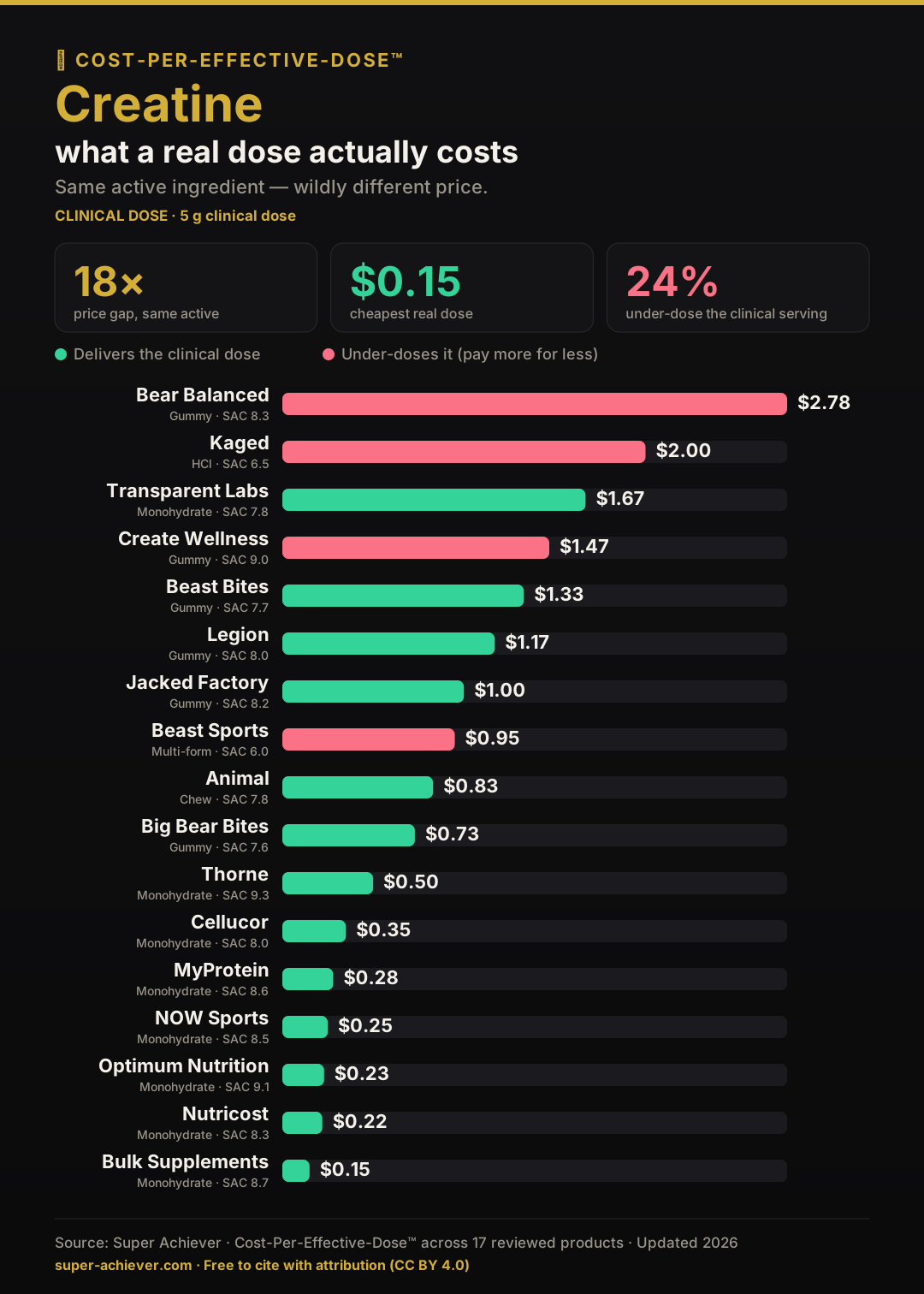
Methodology. SAC Product Score™ blends our editorial rating (RCT quality, dose, safety, value) 50/50 with community ratings. Transparency Index™ (0-100) = third-party certification (0-50) + public batch COA (0-30) + dose honesty (0-20). Cost-Per-Effective-Dose™ is the real price of one clinical dose, not one marketed "serving". Free to cite with attribution to Super Achiever.
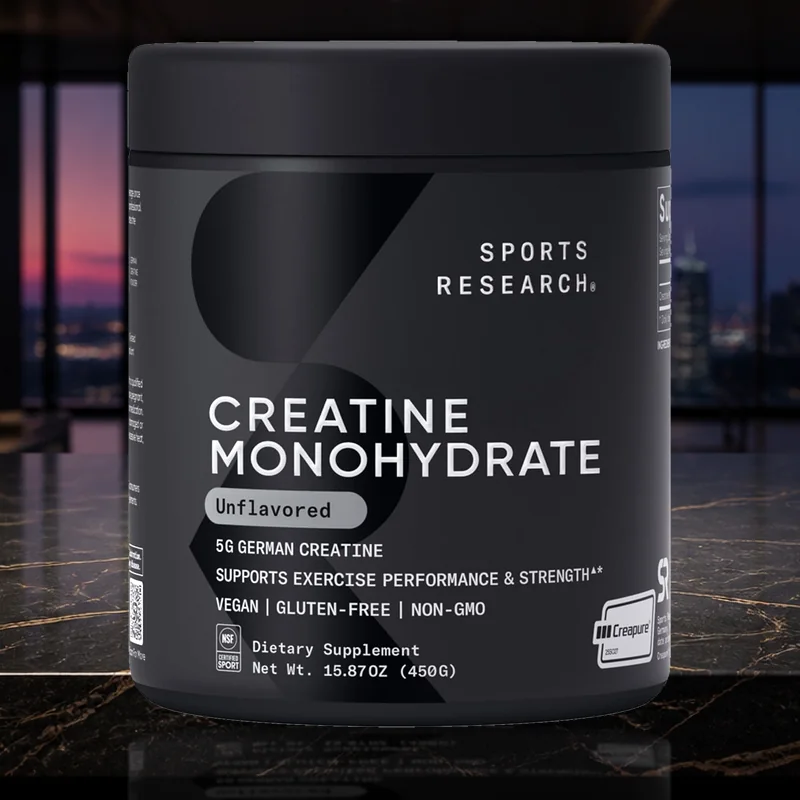
Sports Research Creatine Monohydrate (Creapure)
What is Creatine?
Creatine is a small nitrogenous compound made of three amino acids — glycine, arginine, and methionine. The body produces ~1 g/day endogenously in the liver and kidneys, and a typical omnivore diet provides another 1-2 g/day from red meat and fish. Roughly 95% of body creatine sits in skeletal muscle as phosphocreatine, where it serves as an instant-access ATP reservoir for high-intensity contractions (squats, sprints, last reps).
Creatine MONOHYDRATE — the form bound to a single water molecule — is the version that 500+ RCTs have tested. Every other form on the supplement-industry shelf (creatine HCl, ethyl ester, magnesium chelate, buffered "Kre-Alkalyn") has zero published evidence of being superior at standard 5 g/day doses, and most cost 2-3× more. "Fancier" creatine is marketing; monohydrate is the molecule that built modern sports nutrition.
Creapure is a branded, German-made monohydrate from AlzChem, used in the majority of academic trials, and a fair quality mark when a label prints it. On our creatine lists only Sports Research states Creapure on its label; the other powders (Thorne, Optimum Nutrition, Now Sports and others) do not state a source (checked Oct 6, 2026). Plain monohydrate at lower price (Bulk Supplements, Nutricost) is chemically equivalent at the molecular level — a Creapure premium is mostly QC discipline and contamination-risk reduction, not bioactive difference.
How it works
Phosphocreatine (PCr) regenerates ATP at a rate that exceeds glycolysis or oxidative phosphorylation for the first 10-15 seconds of any maximal effort. When you start a heavy set, your muscle cell's ATP pool depletes in ~2 seconds; PCr donates a phosphate group to ADP, regenerating ATP within milliseconds. The PCr reservoir is what makes the difference between hitting your last rep with full force vs failing one rep short.
Dietary creatine increases the muscle PCr pool by 15-40% above baseline, depending on the starting level. Vegetarians and vegans (with lower baseline creatine from diet) tend to see larger relative gains than omnivores. The effect on performance: 5-15% increase in strength, 10-20% increase in high-rep work capacity, and 1-3 kg of additional lean mass over 8-12 weeks of consistent training + supplementation vs placebo (Chilibeck 2017 meta-analysis).
Secondary effects on cognition emerged from the literature in the 2010s. Creatine also powers brain ATP production — the Rae 2003 trial showed cognitive improvements (working memory, processing speed) in vegetarian populations supplementing 5 g/day. The effect in omnivores is smaller because baseline brain creatine is already higher. This is why creatine has cross-over relevance to cognition goals, not just muscle.
The Creatine deep dives
Creatine Benefits
What it actually does — strength, lean mass, power, and the emerging brain evidence, every claim scored against the trials.
Read →SafetyCreatine Side Effects
Kidneys, hair loss, bloating, cramps — every feared side effect checked against the evidence. What's real, what's a myth.
Read →DataCreatine by the Numbers
The full data report — dosing, saturation, cost-per-dose, effect sizes. The citable stats page behind the guide.
Read →At-a-glance facts
- Active form
- Creatine monohydrate (the only form with published RCT evidence)
- Typical dose
- 5 g/day continuous · OR 20 g/day × 5 days loading + 5 g/day maintenance
- Time to muscle saturation
- Continuous loading: 3-4 weeks · Loading phase: 5-7 days
- Effect onset
- Water weight: 1 week · Strength: 2-3 weeks · Lean mass: 4-8 weeks
- Cycling
- Not required — no tolerance, no down-regulation in 12+ month trials
- Best sourcing
- Plain monohydrate (Sports Research, Thorne, ON, Bulk Supplements); Creapure is a fair quality mark when a label prints it, and of these only Sports Research states it (checked Oct 6, 2026)
- Cost range (US)
- $8-25 / month at 5 g/day
- Stack synergy
- Carbs at dosing time (insulin-driven uptake), Protein 1.6-2.2 g/kg, Magnesium Glycinate (overnight recovery)
Evidence: 500+ placebo-controlled human RCTs. The ISSN Position Statement (Kreider 2017, PMID 28615996) calls creatine monohydrate 'the most effective ergogenic nutritional supplement available to athletes for increasing high-intensity exercise capacity and lean body mass.' Multiple meta-analyses (Chilibeck 2017, Branch 2003, Cooper 2012) all converge on the same conclusions: monohydrate works, alternative forms don't offer advantage, safety profile is clean across decades of use.
Who it's for — and who it isn't
- Anyone resistance-training 3+ times per week and chasing strength + lean mass — the population where the evidence base is largest
- Athletes in any sport with high-intensity intermittent demands (sprints, jumps, throws, fight sports)
- Vegetarians and vegans — baseline muscle creatine is 20-30% lower from diet alone, so supplementation has larger relative effect
- Older adults (60+) wanting to slow sarcopenia — 5 g/day combined with resistance training maintains muscle mass measurably better than training alone
- Anyone in a fat-loss cut wanting to preserve lean mass + performance during caloric deficit
- People with severe kidney disease — creatine breaks down to creatinine, which is the metabolite kidneys excrete. Healthy kidneys handle 5-25 g/day without issue, but pre-existing CKD is a real contraindication
- Anyone pursuing pure endurance (>2 hours steady-state) — creatine is for sprint/anaerobic work, not aerobic. Slight body-water retention can mildly impair longer endurance events
- Buyers attracted to flavored pre-workout blends — most have only 1-3 g creatine per serving (sub-clinical dose) at a 10× markup vs unflavored monohydrate
- Anyone expecting acute pump or workout-day feel — creatine's effect is chronic + body-pool-driven, not acute stimulant
Week-by-week, what happens
- Week 1Water retention shows up first — 0.5-2 kg of intracellular water as the body pool repletes. This is MUSCLE water, not subcutaneous, so you look fuller, not bloated. Loading-protocol users see this in 5-7 days; maintenance-only users see it spread over week 1-2.
- Week 2-3Strength improvements become measurable in the gym. 5-10% increases on key compound lifts (squat, bench, deadlift) at the same RPE. High-rep work capacity climbs first — you suddenly hit 10 reps on the same load you used to fail at 8.
- Week 4-8Lean mass gain measurable on DEXA — typically +1-3 kg vs placebo when combined with resistance training. The lean-mass gain comes from improved training volume + better recovery, not direct anabolism — creatine is a performance amplifier, not a hormone.
- Week 8-12Steady-state. The new performance ceiling is the new normal. Continued benefits come from training adaptation that creatine made possible, not from creatine itself. Body composition changes are durable as long as supplementation continues.
- DiscontinuationBody pool returns to baseline over 4-6 weeks after stopping. Water weight drops first, then performance metrics fade back to pre-creatine baseline within 6-8 weeks. No rebound effect — you don't lose more than you gained.
Safety & contraindications
- Cleanest safety profile of any sports-nutrition supplement. Multi-decade use at 5-25 g/day has produced no adverse hepatic, renal, or cardiovascular markers in healthy populations.
- The 'creatine damages kidneys' myth: pre-existing CKD is a real contraindication, but healthy kidneys handle creatine at any reasonable dose. The elevated serum creatinine post-supplementation is mechanical (more substrate, more breakdown product) — not kidney damage. eGFR equations that use creatinine can falsely flag CKD; ask for cystatin-C-based eGFR if you supplement.
- Hydrate adequately. Creatine pulls water into muscle cells; under-hydration can cause cramping or dehydration-adjacent symptoms in hot training environments. Aim for 3-4 L water/day at standard 5 g creatine dose.
- Loading protocol (20 g/day × 5 days) is safe but unnecessary. Some users get GI upset at 20 g/day — split into 4× 5 g doses with food to reduce. Continuous 5 g/day reaches muscle saturation in 3-4 weeks without any GI risk.
- Combine with carbs (or carb-protein combos) for slightly better uptake — insulin drives creatine into muscle cells more efficiently than fasted ingestion. Marginal but real ~10-15% absorption advantage.
- Avoid pairing with caffeine if you're prone to dehydration (caffeine is mildly diuretic). The historical 'caffeine cancels creatine' claim from a single 1996 study (Vandenberghe) has not replicated in 30 subsequent trials.
All articles on Creatine
Best Creatine for Brain
Creatine raises brain phosphocreatine — biggest cognitive lift for vegetarians + the sleep-deprived (Rae 2003). Monohydrate at 5 g/day; ranked by label purity, dose, and cognitive-trial alignment.
Read →Best Creatine for Men
Same 10-product roster as the general creatine list, reframed for the male-lifter cohort — NSF Certified for Sport leads, then plain monohydrate form, tub size for bulking macros and per-scoop creatine.
Read →Best Creatine for Muscle Growth
Ten creatine picks ranked for hypertrophy — cell volumization, satellite-cell proliferation, saturation over loading. Monohydrate is the only form with RCT weight.
Read →Best Creatine for Women
Ten creatine picks re-scored for women: lean-mass preservation, postmenopausal bone-density support (Chilibeck 2015), cognition/mood uplift, no-loading-default, kitchen-friendly tub sizes.
Read →Best Creatine Gummies
Creatine gummies ranked by grams-per-gummy and cost per real 5 g dose — $0.67 to $2.78 across our six picks, read off the Amazon US offer. Most gummies under-deliver and a '3-gummy serving' usually isn't 5 g. Honest picks, including when powder still wins.
Read →Best Creatine Monohydrate
The most-studied supplement in sports nutrition — and 95% of buyers get it wrong by paying for fancier forms or flavored blends. Ranked by label purity, price per gram, and lab transparency.
Read →Best Creatine Supplements
The definitive creatine buying guide — the single best pick for each kind of buyer across powder, gummies, and HCl. Monohydrate powder wins on raw value; every other form is a situational upgrade for adherence, testing, or tolerance.
Read →Best Form of Creatine: Why Monohydrate Wins
Every creatine form compared — monohydrate, micronized, Creapure, HCl, buffered, ethyl ester, multi-form. The ISSN-anchored verdict: monohydrate wins, the rest are markups on the same molecule.
Read →Best Supplements for Muscle Growth
The supplement categories for muscle growth, ranked by how much each one adds — creatine first, protein powder second, the rest honest margins — with the #1 product of each category. Training, calories and protein beat all of them.
Read →Alani Nu Creatine Unflavored Review
Plain creatine from a brand women already know from its energy drinks: 5 g of monohydrate per scoop and nothing else, at $0.83 a day.
Read →Animal Creatine Chews Review
Universal's old-school creatine chew, and a chew rather than a gummy — an honest 5 g per 4 chews at $31.75 for 120, or $1.06 per real 5 g dose, third-cheapest on our list. Not sugar-free: the panel prints 2 g of added sugar and lists sugar first in the other ingredients. Honest read on the AstraGin and sea-salt add-ons: marketing more than mechanism.
Read →Bear Balanced Creatine Gummies Review
The only gummy that prints Creapure on the Supplement Facts panel — and the most expensive creatine we rank, at $49.98 for 90 gummies, or $2.78 per real 5 g dose. 1 g per gummy means five to a dose and an 18-day bag. Not Cologne List-certified; no published COA.
Read →Beast Bites Creatine Infused Gummies Review
NSF Certified for Sport for all lots, confirmed at the certifier, at $1.17 per real 5 g dose. Only 1 g per gummy, so a dose is five chews. Score 6.7, #5 of the six creatine gummies we rank.
Read →Beast Sports Creature Multi-Form Creatine Review
5-form creatine blend = marketing theater. Less total creatine per scoop at 2-4× the cost of pure monohydrate. Skip.
Read →Bloom Nutrition Creatine Monohydrate Unflavored Review
The women-marketed creatine that turns out to be plain creatine: 5 g of micronized monohydrate per scoop, nothing else on the panel, $0.50 a day.
Read →Bulk Supplements Creatine Monohydrate Micronized Review
The cheapest legit creatine per gram on Amazon — pure micronized monohydrate in a 1kg bag at $0.04/serving. Honest budget pick.
Read →Cellucor COR-Performance Creatine Review
Cellucor's micronized creatine — a solid mass-market pick with a brand-placement premium that doesn't pay for itself.
Read →Clean Nutra Creatine for Women Review
5 g of creatine buried in a 15-ingredient blend with 10,000 mcg of biotin per scoop, enough to distort common blood tests.
Read →Create Wellness Creatine Monohydrate Gummies Review
Still our #1 creatine gummy, at a corrected 7.3 — 1.5 g per gummy on the panel and NSF Certified for Sport confirmed in the certifier’s own database. $49.98 for 90 gummies, or $1.85 per real 5 g dose. The Creapure claim is brand-stated only: it never appears on the Supplement Facts panel.
Read →Jacked Factory Creatine Monohydrate Review
Plain 5 g monohydrate with an Informed Choice listing confirmed at the certifier, about $0.24 a serving. 8.6/10.
Read →Jacked Factory Sugar-Free Creatine Gummies Review
The value gummy, and sugar-free — 1.25 g per gummy with an honest 4-gummy, 5 g serving, at $19.99 for 120: $0.67 per real 5 g dose, the cheapest we rank. No NSF, no Cologne List and no published COA, so the “third-party tested” line has been retracted.
Read →Kaged Creatine HCl Review
Creatine hydrochloride — different molecule, 3-4× the price, no head-to-head superiority over monohydrate per Antonio 2021. Skip.
Read →Kaged Pre-Workout Elite Review
The fully-loaded premium scoop — everything disclosed, including 5 g creatine; high stim, high price.
Read →Legion Creatine Monohydrate Gummies Review
The best-documented gummy here — a published COA plus two Labdoor assays, though Labdoor is a brand-participating programme rather than neutral surveillance. Better value than it looks: $34.95 for 150, or $1.17 per real 5 g dose, under our #1 pick. Two catches: 1 g per gummy means five to a real dose, and the panel prints 10 g of sugar alcohols per serving.
Read →MuscleTech Cell-Tech Creatine Review
Creatine with 38 g of carbohydrate per scoop, built on a real finding: carbs raise creatine uptake. You pay for sugar you could get from food.
Read →MyProtein Creatine Monohydrate Review
Plain creatine monohydrate in a 1 kg, 200-serving pouch from a large European brand — no Creapure on the label.
Read →NOW Sports Micronized Creatine Monohydrate Review
Plain micronized creatine monohydrate from NOW Sports — a household brand with kosher and non-GMO marks; no Creapure or sport seal on the label.
Read →Nutricost Creatine Monohydrate Micronized Review
Mid-tier value-play creatine — Nutricost's 500g tub at a fair price. Solid alt-budget if Bulk Supplements' bag format doesn't suit you.
Read →Old School Labs Creatine Gummies Review
Sugar-free creatine gummies at 5 g per 4 gummies with a lot COA from Eurofins, but no third-party certification. 7.3/10.
Read →Optimum Nutrition Micronized Creatine Powder Review
The default creatine for 80% of lifters — household brand, plain micronized monohydrate, a Banned Substance Tested mark on the label. Why this is the bottle to buy.
Read →PrimaForce Creatine Monohydrate Review
A clean 5 g monohydrate tub at $0.22 a serving, but its third-party testing claim names no lab or certifier. 8.2/10.
Read →Sports Research Creatine Monohydrate (Creapure) Review
Creapure on the Supplement Facts panel and the NSF Certified for Sport mark on the tub, both checked. Why it leads our creatine list, and the one limit to know.
Read →Super Achiever Creatine Monohydrate Review
Our own creatine, scored like every other tub: one ingredient and an exact 5 g scoop, held back by price per serving and by having no test report to show.
Read →Thorne Creatine Review
NSF Certified for Sport creatine monohydrate — the athlete-tested premium. What the certification stamp actually buys.
Read →Transparent Labs Creatine HMB Review
Creatine monohydrate + 1.5 g myHMB per scoop — where the HMB addition pays off (untrained) vs. doesn't (trained lifters per Wilson 2013).
Read →FAQ
Do I need to load creatine?
No, but loading is faster. The loading protocol (20 g/day × 5 days, split into 4 doses) saturates muscle phosphocreatine in 5-7 days. Maintenance-only at 5 g/day reaches the same saturation in 3-4 weeks. Both arrive at the same steady state. Load if you want measurable benefits in 1-2 weeks; skip loading if you don't mind waiting a month and want to avoid the mild GI upset some users get at 20 g/day.
Creapure vs generic monohydrate — is the premium worth it?
Sometimes. Creapure is German-manufactured monohydrate from AlzChem, 99.95% purity, used in the majority of academic trials. Generic monohydrate (Bulk Supplements, Nutricost) is chemically identical at the molecular level. The Creapure premium pays for: (1) trademark licensing, (2) heavy-metals + adulterant testing at the patent-holder level, (3) consistent batch-to-batch QC. For competitive athletes drug-tested, NSF Certified for Sport (Thorne and Sports Research are on the NSF list; match the lot number on your tub) is the safest bet against contamination disqualifications. On our lists only Sports Research states Creapure on its label (checked Oct 6, 2026). For recreational lifters, generic micronized monohydrate at $0.10/serving is the right call.
Will creatine make me look bloated?
No — but it adds intramuscular water, not subcutaneous water. The 0.5-2 kg you gain in week 1 is INSIDE muscle cells, which makes you look fuller, harder, more vascular. Subcutaneous water (the bloated-look kind) doesn't change. The 'creatine bloating' meme comes from people loading at 20 g/day with cheap monohydrate forms that have inconsistent purity — at maintenance 5 g/day of pure micronized monohydrate, no GI distension issue.
What about creatine HCl, ethyl ester, or 'Kre-Alkalyn'?
Marketing. There's no published evidence that any of these forms outperforms monohydrate at standard 5 g/day doses. The claims (better absorption, less bloating, no loading needed) are not supported by head-to-head RCTs. Creatine HCl IS more water-soluble, which helps if you can't tolerate the texture of monohydrate in a shake. But the bioactive endpoint is identical. You're paying 2-3× the price for marketing differentiation, not pharmacology.
Should I cycle off creatine?
No. Multiple long-term safety studies (Persky 2003, Schilling 2001, Cooper 2012) show no benefit to cycling and no risk to continuous use. Your kidneys, liver, and cardiovascular system handle creatine perfectly well at maintenance dose indefinitely. The only reason to stop is if you're training in a sport with a creatine ban (extremely rare — NCAA + WADA both consider it legal) or you're on a long-term cut where the water weight matters competitively (bodybuilding peak week).
Can creatine help cognition?
Yes, especially in vegetarians + older adults. The Rae 2003 RCT showed cognitive improvements (working memory, processing speed) at 5 g/day in vegetarians. Vegan + vegetarian populations have lower baseline brain creatine (no dietary intake from meat), so supplementation has larger relative effect. Omnivores see smaller cognitive effects because baseline brain creatine is already higher. Older adults (60+) see meaningful cognitive benefit from creatine combined with resistance training — the muscle + brain compound effect.
Does creatine affect testosterone or hormones?
Slightly. Vatani 2011 showed creatine combined with resistance training produced a modest +20% testosterone increase vs training alone over 10 weeks in young men. The mechanism is indirect — better training quality drives stronger anabolic signal. Don't expect TRT-level effects; expect the kind of bump that comes from training harder more consistently. Creatine is not a hormone.
How do I stack creatine with other supplements?
The standard sports-nutrition stack: 5 g creatine + 1.6-2.2 g/kg protein + 200-400 mg magnesium glycinate (overnight recovery). Optional adds: 5 g L-citrulline pre-workout (pump + work capacity), 3-5 g beta-alanine (lactic-acid buffer for high-rep work). Avoid loading creatine in stim-heavy pre-workouts with mystery 'creatine matrix' blends — you don't know the dose and you're paying premium for what should be $0.10.
Sources & further reading
- Kreider 2017 (ISSN Position Statement)International Society of Sports Nutrition position stand: safety and efficacy of creatine supplementation in exercise, sport, and medicine
The ISSN position statement on creatine — synthesises 500+ trials and concludes creatine monohydrate is the most effective ergogenic nutritional supplement available to athletes for increasing high-intensity exercise capacity and lean body mass.
- Chilibeck 2017Effect of creatine supplementation during resistance training on lean tissue mass and muscular strength in older adults: a meta-analysis
Meta-analysis of creatine + resistance training in adults 50+: pooled effect +1.4 kg lean mass and significant strength gains vs placebo. The reference paper for creatine's role in age-related muscle preservation.
- Branch 2003Effect of creatine supplementation on body composition and performance: a meta-analysis
Foundational meta-analysis covering creatine's body-composition and performance effects across populations. Effect sizes are robust on lean mass and high-intensity performance; modest on aerobic performance.
- Cooper 2012Creatine supplementation with specific view to exercise/sports performance: an update
Review of creatine's efficacy and safety profile across populations. Concludes creatine is the most-evidenced legal performance aid available and that safety concerns about kidney function are not supported by multi-decade data in healthy adults.
- Rae 2003Oral creatine monohydrate supplementation improves brain performance: a double-blind, placebo-controlled, cross-over trial
Vegetarians supplementing 5 g/day creatine for 6 weeks showed measurable improvements in working memory and intelligence-test performance vs placebo. The foundational cognition-endpoint trial — establishes creatine's cross-over relevance beyond muscle.
- Vatani 2011The effects of creatine supplementation on performance and hormonal response in amateur swimmers
Creatine 7 days loading + maintenance combined with training produced modest but significant testosterone increases vs training alone in trained swimmers. Establishes indirect hormonal benefit via improved training quality.
- Persky 2003Clinical pharmacology of the dietary supplement creatine monohydrate
Comprehensive review of creatine pharmacology — absorption, distribution, metabolism, excretion. Establishes the pharmacokinetic basis for the 5 g/day maintenance dose and the muscle-saturation timeline.