
Animal Creatine Chews Review
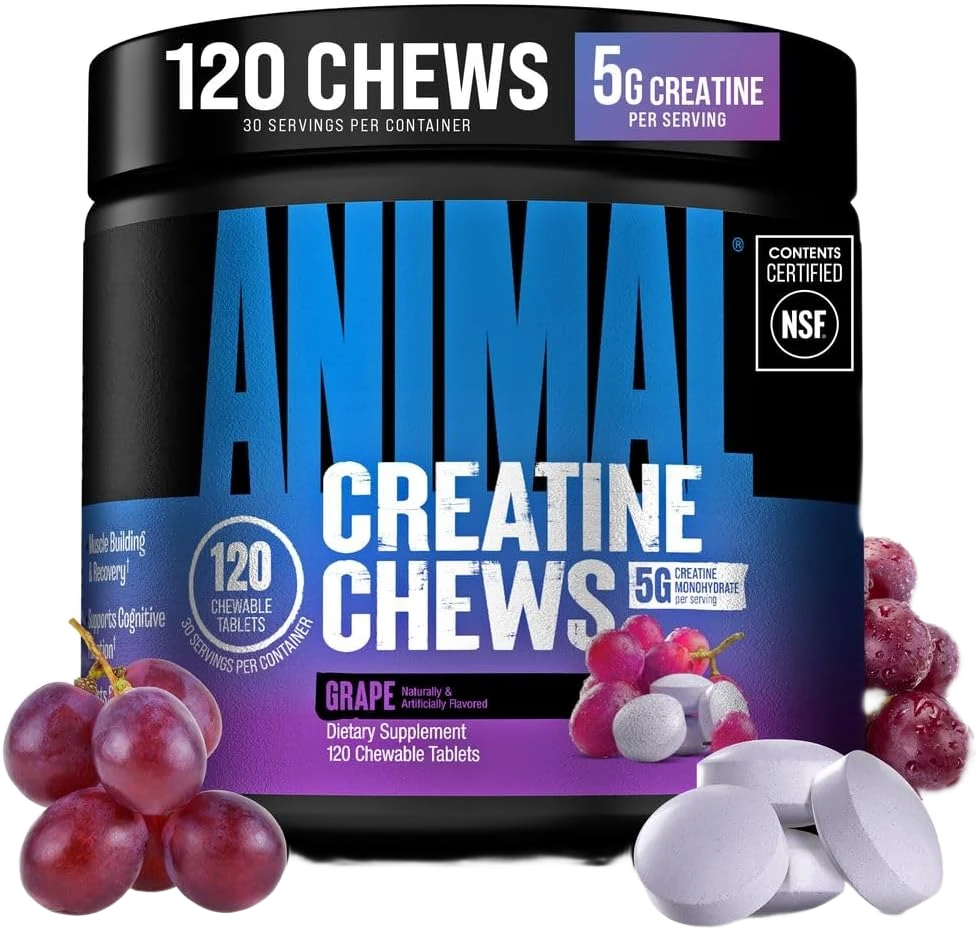 #4 of 7 · Best chew✓ Label verified · Supplement Facts read Sep 7, 2026
Real retailer photo, cut out. Label unedited.
Buy it. An honestly-dosed, low-cost chew — not a gummy, and not sugar-free. A labeled 5 g dose in 4 chews (~1.25 g each, derived from the serving), a 120-count tub that really is 30 full servings, at $31.75 on the US buy box (2026-07-27) — $1.06 per real 5 g dose, second-cheapest on our gummy list.
$31.75 · 120 count (US buy box, 2026-07-27)$1.06 per real 5 g dose · 30 real doses per 120-count tub
Why It Scores 6.8 — And The Label Line Behind Each Number
Cost per real 5 g dose
20% of scoreA genuine strength, and now with a sourced number behind it. The US Amazon buy box on 27 July 2026 was $31.75 for the 120-count tub, read from the genuine featured offer in a live browser session with a New York delivery address and confirmed against the listing's canonical ASIN. 120 chews divided by a 4-chew serving is 30 full 5 g doses, so a real dose costs $1.06 — second-cheapest on our gummy list, behind Jacked Factory's $0.67 and ahead of Legion ($1.17), Create Wellness ($1.85) and Bear Balanced ($2.78). The structure explains the price: a pressed chew with a sugar/dextrose carrier, unbranded monohydrate and no certification to pay for is cheap to make. It does not score higher because plain powder still delivers the same 5 g for roughly $0.23, about a quarter of this. Prices move; check the current buy box before you order.
- Trial-dose alignment
- 5 g/day (4 chews) matches Kreider 2017 ISSN maintenance protocol
- Price
- $31.75 for the 120-count tub — US Amazon buy box, 2026-07-27, New York delivery address, ASIN-matched to the listing
- Cost per real 5 g dose
- $1.06 ($31.75 ÷ 30 real doses) — second-cheapest on our gummy list. Powder is about $0.23; Jacked Factory is $0.67
Form purity + third-party testing
25% of scoreAnimal states GMP manufacturing and third-party testing; nothing beyond that survives an outside check. There is no NSF Certified for Sport listing, no Kölner Liste (Cologne List) entry, no publicly posted certificate of analysis for any lot, and Creapure is not named on the panel. Universal Nutrition is a 40-year manufacturer with its own facility, which is worth something — but it is the manufacturer's own word, not verification you can look up. Workable for a recreational lifter; disqualifying for anyone subject to drug testing.
- Active form
- Creatine monohydrate — Creapure is not named on the Supplement Facts panel
- Labeled serving
- 4 chews = 5 g creatine monohydrate (this is what the panel states)
- Testing
- Brand-stated GMP + third-party testing; not verifiable — no NSF Certified for Sport listing, no Cologne List entry, no public COA
- Manufacturer
- Animal / Universal Nutrition (the 'Animal Pak' brand · ~40-year track record)
Dose per chew + real-5g math
30% of scoreThe panel states the serving that actually matters — 4 chews = 5 g, 120-count = 30 servings — instead of spinning a sub-clinical 2-3-piece 'serving' the way most of this category does. Derive it and each chew is about 1.25 g, though you won't find that number printed anywhere. The strength is that no math is needed to hit the research dose and the tub really is a full month at it. The cost is piece count: four chews a day is more chewing than the 1.5 g/piece picks demand.
- Per chew
- ~1.25 g — derived from 5 g ÷ 4 chews; the panel does not print a per-chew figure
Formula honesty (extras)
10% of scoreCredit where it's due: the panel states the real 5 g serving, prints its 2 g of total and added sugars plainly, and lists sugar and dextrose openly as the first two other ingredients — nothing here is hidden, and the brand has never claimed to be sugar-free (we were the ones who got that wrong). What's docked is the dressing. AstraGin is sold as an absorption enhancer on a molecule that's already about 99% bioavailable, so it captures essentially no headroom, and its evidence is thin and manufacturer-sponsored. The sea salt's 'pump' angle borrows a kernel of sodium science but delivers a trivial dose next to a normal day's intake.
Taste, texture (chew)
15% of scoreThis is a dense, firm, tootsie-like chewable tablet — not the soft fruit-chew texture of Create or Bear Balanced. Polarizing by design: old-school lifters who want a no-nonsense 'pop it and go' format tend to tolerate it, while buyers chasing a candy experience find it chalky and effortful, and four of them a day is real chewing. No melt issues, so it survives a gym bag. But if chalky taste is why you left powder, a chew only half-solves it — which is why this is the lowest-scoring line on the card.
- More Specs
- Format
- Chewable tablet — a CHEW, not a gummy: firm, tootsie-like, slightly chalky; no water, scoop or shaker; gym-bag stable
- Tub size
- 120 chews · 30 labeled 5 g servings (~30-day supply)
- Absorption add-on
- AstraGin (Panax notoginseng + astragalus extract) — marketed as a nutrient-uptake enhancer
- Electrolyte add-on
- Sea salt — a small sodium addition pitched as an electrolyte/'pump' nod
- Sugar
- NOT sugar-free — panel lists Total Sugars 2 g, Includes 2 g Added Sugars; 'Sugar' is the first other ingredient and 'Dextrose' the second (NIH DSLD label 339369)
Label verified. Every figure read from the Supplement Facts photo, Sep 7, 2026.
Marketing Claims Vs. Reality
5 g of creatine monohydrate per serving.
Matches the Supplement Facts panel, which defines the serving as 4 chews and puts 5 g of creatine monohydrate against it — exactly the research-standard maintenance amount (Kreider 2017 ISSN). Unlike most gummy brands, which market a 2-3-piece sub-clinical 'serving,' Animal states the real dose plainly. Note that the label claim is per serving; the ~1.25 g per chew we quote elsewhere is our arithmetic, not a printed figure. One limit on this verdict: no certificate of analysis is published for any lot, so what we have checked is the label, by the label.
AstraGin enhances nutrient absorption.
Technically a real ingredient with a real marketing story, but functionally near-meaningless here. AstraGin's absorption-enhancement evidence is thin and largely manufacturer-sponsored, and oral creatine monohydrate is already ~99% bioavailable — there's almost no uptake headroom for it to capture. The claim isn't false, but on a creatine product it changes nothing you'll feel.
Added sea salt supports electrolytes / muscle pumps.
Half-true and oversold. Sodium genuinely matters for cell hydration and the intramuscular water creatine draws in, so the theme has a kernel of science — but whatever sodium a pinch of sea salt contributes to a serving of chews is trivial next to daily dietary sodium and won't meaningfully change your pump or hydration. A flavor-and-positioning nod to bodybuilding culture, not a working mechanism.
Trusted hardcore-bodybuilding brand / proven quality.
Fair as a heritage claim — Animal/Universal Nutrition is a genuine 40-year manufacturer with its own facility, so this isn't a no-name listing. But 'proven quality' stops short of anything a buyer can check: we found no NSF Certified for Sport listing, no Kölner Liste (Cologne List) entry and no publicly posted certificate of analysis for any lot, and Creapure is not named on the panel. That's brand-level assurance, not independent verification.
What Our Test Actually Found
$31.75 a tub, $1.06 a real dose — the value case, with the number attached
Strip away the brand mystique and the add-ons, and the value story is the strongest thing here: a 120-chew tub is 30 complete 5 g servings, and the product is cheap to make — a pressed chew instead of a soft anti-melt gummy, a sugar-and-dextrose carrier, unbranded monohydrate, and no certification being paid for. The US Amazon buy box on 27 July 2026 was $31.75, which over 30 real doses is $1.06 each. That is second-cheapest on our gummy list: Jacked Factory manages $0.67, and above Animal sit Legion at $1.17, Create Wellness at $1.85 and Bear Balanced at $2.78. Worth saying how we got that number, because it is the failure mode of price claims in this category: a plain read of the listing returns the right product and no readable price, since the buy box renders client-side and varies by region, and our own earlier pass twice lifted a number out of a sponsored carousel and attributed it to the product under review. This one came from a live browser session with a US delivery address in New York, reading the genuine featured offer, with the listing's canonical ASIN matched to the ASIN inside the buy-box form. Keep the anchor in view: plain powder is about $0.23 for the same 5 g, roughly a quarter of this, so the format only earns its premium if it's what keeps you consistent. Prices move — check before you order.
Honest 4-chew dosing is a quiet but real strength
The defining sin of the creatine-gummy category is dose-spin: brands call 2-3 pieces a 'serving' so the bag looks generous, then leave the buyer under-dosed at 2-3 g. Animal doesn't do that. The panel states 4 chews = 5 g and a 120-count tub = 30 servings, which means the 5 g research target requires no math to decode and the supply count is honest. That's worth crediting explicitly, because it's the exact thing we ding pricier gummies for. One precision note, since we got sloppy about it before: the panel gives the serving, not the piece. The ~1.25 g per chew you'll see quoted here and elsewhere is 5 g divided by 4 — a derivation, not a printed number. Take all four, and the tub genuinely lasts the month it claims.
These are not sugar-free — a correction to an earlier version of this review
We previously described Animal Creatine Chews as sugar-free in several places on this page. That was wrong, and it was our error rather than a misread of the brand's marketing: neither animalpak.com nor the Amazon listing has ever claimed these are sugar-free. The Supplement Facts panel filed in the NIH Dietary Supplement Label Database (label 339369) lists Total Sugars 2 g with Includes 2 g Added Sugars, and in the other-ingredients line 'Sugar' appears first and 'Dextrose' second — the two largest non-active components of the chew. That is the honest reason a pressed chew tastes like anything: sugar is the carrier. How much this matters depends entirely on you. A couple of grams of added sugar a day at the full 4-chew dose is nutritionally minor for most lifters. It is not minor if you're eating ketogenic, tracking carbohydrate tightly, managing blood glucose, or if avoiding sugar is the reason you were looking at this product at all. If sugar-free is a hard requirement, Jacked Factory's creatine gummies are the pick on this list that genuinely meet it — their panel shows 8 g of carbohydrate entirely from sugar alcohols and no sugars. We've moved this from the pros to the cons, where it belongs.
AstraGin is the headline add-on — and it does essentially nothing here
AstraGin is a branded Panax-notoginseng/astragalus extract sold to supplement makers as a nutrient-absorption enhancer, and it's the most prominent 'extra' on the label. The honest verdict is that it's near-pointless on a creatine product specifically. Its supporting evidence is thin and largely manufacturer-sponsored (in-vitro and animal work funded by the ingredient maker, no independent human creatine-uptake trial), and more fundamentally, oral creatine monohydrate is already roughly 99% bioavailable — there's almost no absorption headroom for any enhancer to capture. It's not dangerous and it's not a scam, but it won't change your saturation or your results. Mentally delete it from the value calculation.
The sea salt 'pump' angle is marketing with a kernel of truth
Animal adds a small amount of sea salt and frames it around sodium's role in cell hydration and the 'pump.' There's a real mechanism in the background — sodium does support the intramuscular water retention creatine drives — but the dose here is trivial. Whatever sodium a pinch of sea salt puts into a serving of chews is a rounding error next to the thousands of milligrams in a normal day's food, so it won't meaningfully change your pump, performance, or hydration. It's a culture nod to the hardcore-bodybuilding world Animal is built on, not a functional lever. Don't pay extra for it; fortunately, you aren't being asked to.
It's a CHEW, and the texture is genuinely polarizing
This is the expectation that makes or breaks satisfaction. Animal Creatine Chews are dense, firm, tootsie-like chewable tablets — closer to a supplement tablet than to candy — not the soft fruit-chew gummies that dominate the category. That format is a feature for one buyer and a flaw for another. Old-school lifters who want a no-nonsense, no-water 'pop it and go' option tend to love the heft. But anyone who left powder specifically because of the chalky taste should know a chew only half-solves that — you escape the scoop and the gritty water-mix, but not entirely the chalk. If you want something that genuinely tastes like candy, buy a soft gummy instead — Create Wellness (our #1) or Bear Balanced, which scores highest of anything here on texture even though it finishes last overall.
Nothing about the testing is verifiable — which is fine unless you're drug-tested
Animal states GMP manufacturing and third-party testing. We went looking for something a reader could check independently and found none of it: no NSF Certified for Sport listing under Animal or Universal Nutrition, no entry in the Kölner Liste (Cologne List) database, no certificate of analysis posted for any lot, and no Creapure named on the Supplement Facts panel. So what you have is the manufacturer's own assurance — which, from a 40-year company running its own facility, is not nothing, but it is not verification. For a recreational lifter the gap is mostly academic: monohydrate is monohydrate and the molecule saturates your muscle identically whether or not anyone certified the lot. If you compete under testing, it isn't a trade you can make at all — buy something whose certification you can look up yourself, which on this list means Create Wellness (NSF Certified for Sport, listings 1622205 and 1782311).
Full analysis: all pros & cons (11), buy if / skip if
- $1.06 per real 5 g dose ($31.75 for 120 chews, US buy box 2026-07-27) — second-cheapest on our gummy list, and well under the $1.85 our #1 pick charges
- Plainly labeled: the panel states 4 chews = 5 g, so there's no dose-spin to decode
- No melt issues — a dense chew that survives any gym bag without a scoop, shaker or water
- From Animal / Universal Nutrition — a 40-year manufacturer running its own facility
- Old-school 'pop it and go' format that genuinely beats powder on convenience for the right buyer
- NOT sugar-free: the panel lists 2 g total sugars, all added, and sugar and dextrose are the first two other ingredients (NIH DSLD label 339369)
- Dense, chalky CHEW — not a soft gummy; won't fully escape the chalky taste if that's why you left powder
- No verifiable certification — no NSF Certified for Sport listing, no Cologne List entry, no public COA
- Creapure is not named on the Supplement Facts panel, so the raw material is unidentified
- AstraGin is a near-pointless add-on on creatine (already ~99% bioavailable; thin, sponsored evidence)
- Sea salt 'pump' angle is marketing — the sodium dose is trivial next to daily intake
- You want a low-cost, no-water creatine format and don't need a soft, candy-like gummy texture
- You're an old-school lifter who'd rather pop a chew than mix a scoop, shaker, and water
- You value a plainly-labeled 4-chew/5 g dose over a 2-3-piece 'serving' that under-doses you
- A couple of grams of added sugar a day is a non-issue for how you eat
- You need sugar-free — this isn't; the panel shows 2 g total sugars (all added) per 4-chew serving
- You're fleeing powder because of chalky taste — a dense chew won't fully escape that
- You compete under drug testing and need a certification you can look up yourself (this has none)
- You want the absolute lowest cost per gram — plain monohydrate powder still wins on that
A labeled 5 g dose in 4 chews (~1.25 g each, derived from the serving), a 120-count tub that really is 30 full servings, at $31.75 on the US buy box (2026-07-27) — $1.06 per real 5 g dose, second-cheapest on our gummy list. Three catches, all on the label: it's a dense, chalky CHEW rather than a soft gummy; it is not sugar-free — the panel shows 2 g total sugars, all added, with sugar and dextrose as the first two other ingredients; and no certification is verifiable (no NSF listing, no Cologne List entry, no public COA, no Creapure named on the panel). The AstraGin and sea salt are marketing more than mechanism. A qualified buy for the value/old-school buyer who wants a scoop-free format, doesn't need a candy texture, and isn't avoiding sugar.
Animal Creatine Chews come from Universal Nutrition's hardcore-bodybuilding lineage — the same 'Animal Pak' brand that's been a staple in gym bags for four decades — and they lean into that heritage without apology. The proposition is refreshingly blunt: four chews for a real, labeled 5 g dose of creatine monohydrate (which works out to about 1.25 g a chew, though the panel gives the serving rather than the piece), no water, no scoop, no shaker. Animal then dresses the formula with two add-ons that fit the brand's culture more than they change your results: AstraGin, a Panax-notoginseng/astragalus extract marketed as an absorption enhancer, and a pinch of sea salt for a token electrolyte/'pump' nod. The honest read on both is the same — minor, lightly-evidenced flourishes that won't move your saturation. Two asterisks matter more. The format: these are dense, chalky CHEWS, not soft gummies, which old-school lifters tend to love and candy-seekers tend not to. And the label: these are not sugar-free. The panel lists 2 g of total sugars, all of it added, and sugar and dextrose are the first two other ingredients — a correction to an earlier version of this review, which wrongly called them sugar-free. The creatine is solid and correctly dosed; the dressing is marketing; the certifications are unverifiable. Four chews a day for two weeks, here's the honest breakdown.
A qualified buy — the value/old-school pick, if you don't need a candy texture or a sugar-free label.

Animal Creatine Chews earn a 6.8 and a qualified 'buy' for the specific person they're built for. The core proposition is honest and strong: real creatine monohydrate at a plainly-labeled 4-chew, 5 g serving with no spin (about 1.25 g a chew once you do the division the panel doesn't do for you), a 120-count tub that truly lasts a month, at $31.75 on the US buy box on 27 July 2026 — $1.06 per real 5 g dose, second-cheapest on our gummy list behind Jacked Factory's $0.67 and well under the $1.85 our #1 pick charges. From a 40-year manufacturer running its own facility, that's a legitimately sensible way to take creatine without a scoop or a shaker. If you're an old-school lifter who'd rather pop a chew than mix powder, this does exactly what you want. One thing the ranking should not hide: this and Legion (#4) are a genuine tie. Animal scores 6.800 and Legion 6.750, and both publish as 6.8. Animal is placed first because its unrounded number is higher and for no other reason — we have not invented a difference or nudged a sub-score to break the tie. Choose between them on what actually differs: Legion publishes a certificate of analysis and Animal publishes nothing, while Animal is a firm chew that survives a gym bag and Legion is a soft gummy. And if you came here to avoid sugar alcohols, neither of these qualifies — Legion prints 10 g per serving and Animal uses real sugar instead. Jacked Factory and Old School Labs are the sugar-free picks on the list, and Jacked is also the cheapest. Three things keep it a qualified buy rather than a top-tier one. First, the format: these are dense, firm, slightly chalky CHEWS, not soft candy-like gummies. That's a feature if you want a no-nonsense tablet and a flaw if you're chasing a fruit-chew experience or fleeing powder specifically because of chalky taste. Second, the label: they are not sugar-free. The panel shows 2 g of total sugars, all of it added, with sugar and dextrose as the first two other ingredients — an earlier version of this review said the opposite, and that was our mistake, not the brand's claim. Two grams a day is trivial for most lifters and disqualifying for a few. Third, the paperwork: nothing about the testing can be checked from outside. No NSF Certified for Sport listing, no Cologne List entry, no public COA for any lot, and no Creapure named on the panel — you are trusting the manufacturer's own word, which is why this scores lowest on that line. The honest framing, then: buy Animal Creatine Chews for the format and the cost per real dose, not for the AstraGin, not for the sea salt, and not for purity or certification claims it cannot substantiate. For a value-conscious recreational lifter who wants creatine without a scoop, doesn't need it to taste like candy, and doesn't care about a couple of grams of sugar, it's a sound pick. If you compete under drug testing, need a genuinely sugar-free product, or want a candy-soft gummy, the alternatives below serve you better. Know which buyer you are, and the 6.8 makes sense.
If This Doesn’t Fit — Try These
 03
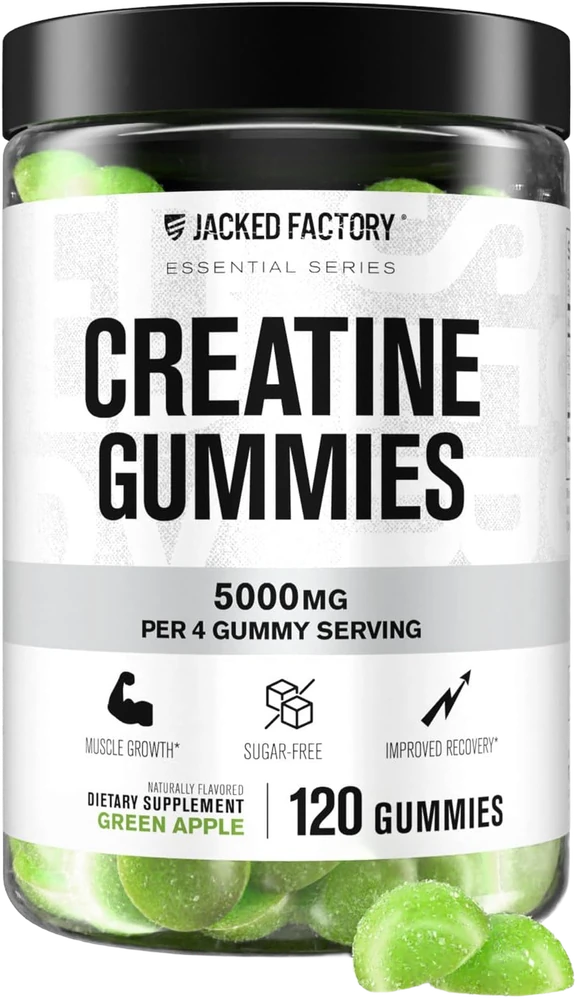
Jacked Factory Creatine Gummies
The pick for someone who wants the label to tell the truth about the dose, and the pick for anyone counting money.
 01
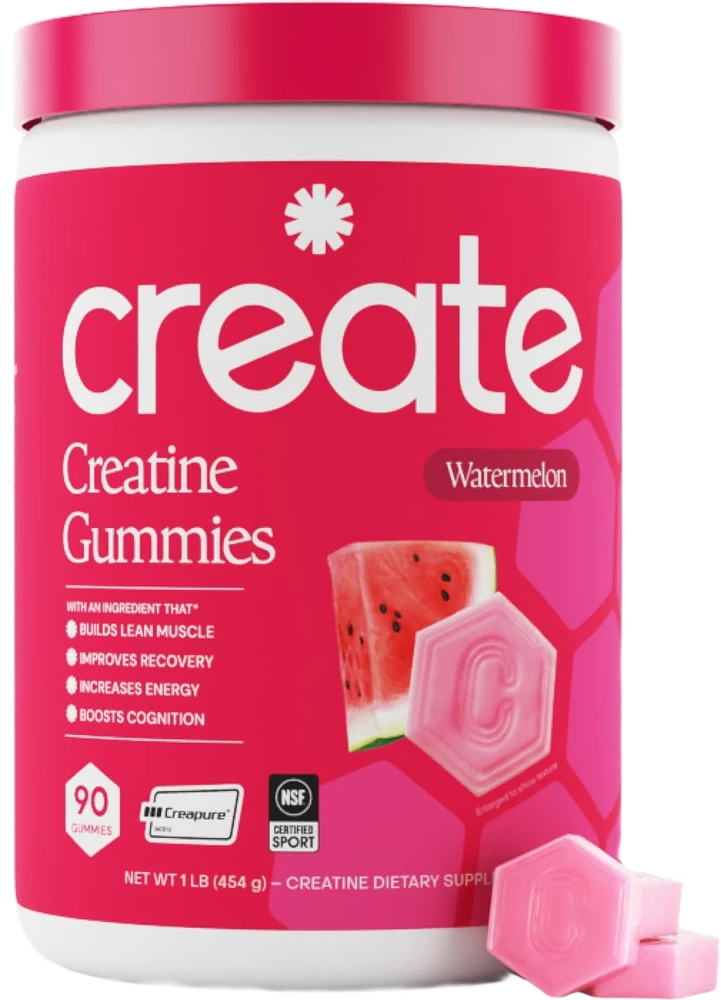
Create Creatine Gummies
The pick we'd point most buyers at, on two things we could actually check.
03Jacked Factory Creatine Gummies
The pick for someone who wants the label to tell the truth about the dose, and the pick for anyone counting money.
Quick Answers
How much creatine is actually in each Animal chew, and how many do I take?
The Supplement Facts panel states the serving, not the piece: 4 chews = 5 g of creatine monohydrate, and a 120-count tub = 30 servings. Divide it out and each chew carries about 1.25 g — that per-chew figure is derived from the label, not printed on it. Labeling the real dose is a genuine point in this product's favor: most gummy brands market a 2-3-piece 'serving' that quietly under-doses you, while Animal puts the full 4-chew, 5 g serving on the panel. The creatine research base (Kreider 2017 ISSN) is built on 3-5 g/day, with 5 g being the standard maintenance dose, so 4 chews lands you right on the trial target with no spin to decode. Take all 4 every day, training or not — creatine works by saturating muscle over time, not by timing.
Does the AstraGin actually do anything?
Honestly, almost certainly not enough to matter for creatine. AstraGin is a branded blend of Panax notoginseng and astragalus extracts marketed as a nutrient-absorption enhancer, and the supporting evidence is thin and largely manufacturer-sponsored — mostly in-vitro and animal work funded by the ingredient maker, with no independent, published human trial showing it meaningfully raises creatine uptake. Here's the deeper reason it's near-pointless on a creatine product specifically: oral creatine monohydrate is already roughly 99% bioavailable. There is almost no absorption headroom for an enhancer to capture. So even if AstraGin nudges uptake of some harder-to-absorb compounds, creatine isn't one that needs help. Treat it as a label flourish, not a functional upgrade — it won't change your saturation, your strength, or your results.
What's the sea salt for — does it help with 'pumps'?
It's a token electrolyte gesture, and the 'pump' framing is mostly marketing. Animal adds a small amount of sea salt and leans on sodium's role in intramuscular water retention and the 'pump' look lifters chase. The kernel of truth: sodium does matter for cell hydration and creatine pulls water into muscle, so the theme isn't nonsense. But the amount of sodium in a few chews is trivial next to what you already eat in a day — a single meal dwarfs it — so it won't meaningfully change your pump, your performance, or your hydration. It's a flavor and positioning choice that lets the label nod at the hardcore-bodybuilding 'pump' culture Animal is built on, not a mechanism that does real work. Don't pay a premium for it; happily, you aren't.
Are these chews the same as the soft creatine gummies everyone reviews?
No — and this is the single most important expectation to set. Animal Creatine Chews are dense, chewable tablets with a firm, tootsie-like, slightly chalky bite, not the soft fruit-chew texture of Create Wellness or Bear Balanced. That difference cuts both ways. If you're leaving creatine powder because the scoop-and-shaker ritual or the gritty water-mix is your friction point, a chew solves that cleanly — no water, no melt, throw the tub in a gym bag. But if you're fleeing powder specifically because you hate the chalky taste, a chew won't fully escape it; you'll get something closer to a firm supplement tablet than candy. Old-school lifters who grew up on Animal Pak tend to love the no-nonsense chew; gummy-seekers chasing a candy experience are often disappointed. Know which camp you're in before you buy.
Are Animal Creatine Chews sugar-free?
No — and an earlier version of this review said they were, which was our error, not a brand claim. Neither Animal's own product page nor the Amazon listing has ever described these as sugar-free. The Supplement Facts panel lists Total Sugars 2 g and Includes 2 g Added Sugars for the 4-chew serving, and in the other-ingredients line 'Sugar' is first and 'Dextrose' is second (NIH Dietary Supplement Label Database, label 339369). In practice that is a couple of grams of sugar a day at the full dose — nutritionally trivial for most lifters, roughly what you'd get from a bite of fruit, and it is part of why the chew tastes like anything at all. But it matters if you're tracking carbs strictly, eating ketogenic, or managing blood glucose, and it matters if you were choosing this product specifically to avoid sugar. If sugar-free is the requirement, Jacked Factory's gummies are the pick on this list that genuinely are: their panel shows 8 g of carbohydrate entirely from sugar alcohols and no sugars.
Is this Creapure, and is it third-party tested?
Creapure is not named anywhere on the Supplement Facts panel, and no independent certification is verifiable. Animal states GMP manufacturing and third-party testing, but we checked the certifiers rather than the marketing: there is no NSF Certified for Sport listing, no Kölner Liste (Cologne List) entry, and no publicly posted certificate of analysis for any lot. That is brand-level assurance — you are trusting the manufacturer's own word. To be clear about what that does and doesn't mean: monohydrate is monohydrate, the molecule that saturates your muscle is the same one in a certified product, and Universal Nutrition is a 40-year manufacturer with its own facility, so this isn't a sketchy no-name listing. What you give up is an independent batch check against the banned-substance list. For a recreational lifter that gap is mostly academic; for a drug-tested athlete it is disqualifying. If you compete under testing, buy a product whose NSF Certified for Sport listing you can look up yourself (Create Wellness, our #1, has one).
Why do these cost less per dose than most creatine gummies?
Three honest reasons, all of them visible on the label. First, a pressed chew is cheaper to manufacture than a soft, anti-melt, candy-textured gummy — you're paying for a functional tablet, not a pleasant fruit-chew experience. Second, the base is unbranded monohydrate: no Creapure is named on the panel, and no certification is being paid for. Third, the bulk of the chew is inexpensive carrier — sugar and dextrose are the first two other ingredients. The numbers, read off the US buy box on 27 July 2026: $31.75 for the 120-count tub, which is 30 full 5 g servings, so $1.06 per real dose. Across our gummy list that puts it second only to Jacked Factory at $0.67, and well under Create Wellness at $1.85 and Bear Balanced at $2.78. Keep the bigger anchor in view anyway — plain micronized powder is about $0.23 for the same 5 g, roughly a quarter of this, so the chew only earns its premium if the no-water format is what actually keeps you consistent.
Should I buy these or just get creatine powder?
Get the chews only if the format genuinely changes whether you take creatine daily. The honest hierarchy is unchanged from every creatine page we write: for raw value and dose accuracy, plain micronized monohydrate powder wins decisively — the same molecule, cheaper per gram in every format comparison, in an exact 5 g scoop with no sugar carrier. The chews make sense for one specific buyer: someone who won't deal with a scoop, shaker, and water (travel, gym bag, an old-school 'pop it and go' preference) and doesn't need a candy-soft texture. For that person, 5 g of creatine actually taken as four chews beats a perfect scoop sitting unused in the cupboard. For everyone else who's fine mixing powder, the chew's convenience premium buys you nothing functional — so save the money and buy the tub.
Sources & Further Reading
6 peer-reviewed sources, each linked to PubMed
- [1] Kreider 2017 PMID 28615996 — International Society of Sports Nutrition position stand: safety and efficacy of creatine supplementation in exercise, sport, and medicine. ISSN position statement after reviewing 500+ studies: creatine monohydrate is the most effective form, with 3-5 g/day chronic dosing established as the safe, effective maintenance protocol. The 5 g/day standard is exactly what Animal's labeled 4-chew serving lands on — stated as a 5 g serving on the panel, with no dose-spin to decode.
- [2] Buford 2007 PMID 17908288 — International Society of Sports Nutrition position stand: creatine supplementation and exercise. Predecessor ISSN position statement establishing creatine monohydrate as the most extensively studied and clinically effective form, driven by muscle phosphocreatine saturation. Confirms the molecule — not the delivery format or any absorption add-on — drives the effect, so an uncertified chew and a branded-raw-material powder are functionally equivalent once dosed equally.
- [3] Cooper 2012 PMID 22817979 — Creatine supplementation with specific view to exercise/sports performance: an update. Comprehensive review noting oral creatine monohydrate is almost completely absorbed (near-99% bioavailable) and that chronic 3-5 g/day shows no adverse kidney or liver effects in healthy adults. The bioavailability point is decisive here: with so little uptake headroom, an AstraGin 'absorption enhancer' has essentially nothing to improve on creatine.
- [4] Antonio 2021 PMID 33557850 — Common questions and misconceptions about creatine supplementation: what does the scientific evidence really show?. Myths-review confirming no alternative creatine form, delivery system, or 'enhancer' has been shown to outperform plain monohydrate at equivalent doses, and that consistent daily intake drives saturation. Directly supports the review's core point: the chews' value is the cheap, correctly-dosed monohydrate — the AstraGin and sea salt add nothing the evidence recognizes.
- [5] Volek 1997 PMID 9216554 — Creatine supplementation enhances muscular performance during high-intensity resistance exercise. Seminal RCT showing creatine supplementation significantly increased peak power and total work during high-intensity resistance exercise at the standard dose. The strength/power benefit Animal markets is real — but it comes from reaching the 5 g monohydrate dose (4 chews), not from the AstraGin or sea-salt add-ons.
- [6] Rae 2003 PMID 14561278 — Oral creatine monohydrate supplementation improves brain performance: a double-blind, placebo-controlled, cross-over trial. Demonstrated creatine monohydrate improved working memory and processing speed vs placebo. A legitimate cognitive co-benefit of the creatine itself — relevant because it underscores that the value of this product is its monohydrate content, not the marketed absorption or 'pump' additives layered on top.
Affiliate disclosure: every Amazon link uses our Associates tag (superachieverclub-20). We earn a small commission at no cost to you; it funds independent reviews. We never accept payment to change a ranking.