
Top 11 Best Creatine for Muscle Growth (2026)
 01 · Best overall✓ Label verified · Supplement Facts read Oct 6, 2026
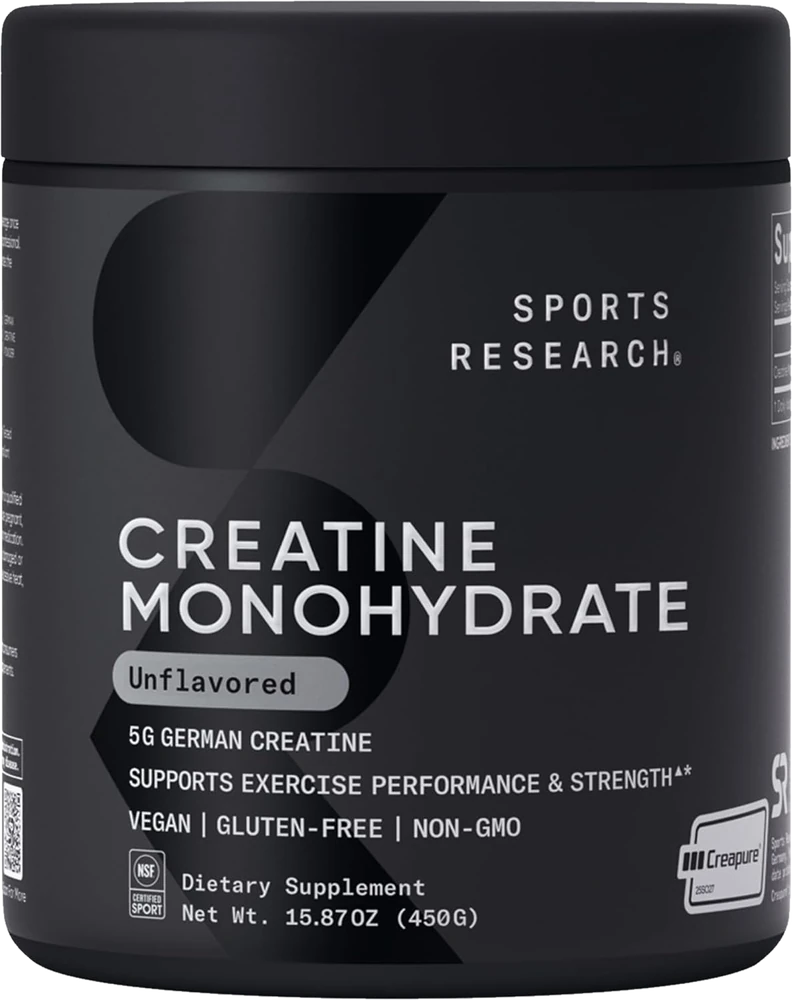
Best overall: Sports Research Creatine Monohydrate (Creapure)
The 5 g daily dose the hypertrophy trials used, from the one tub here with Creapure on the Supplement Facts panel and the NSF Certified for Sport mark on the front. About $0.41 a serving.
$37 / 450 g (90 servings)$0.41 / 5 g scoop
Why it wins: all five scores, pros & cons, full label
- Creapure named on the Supplement Facts panel, the only powder on this list that states its source
- NSF Certified for Sport mark on the tub, confirmed on the nsfsport.com list
- Single ingredient, 5 g per scoop, unflavored
- About $0.41 a serving at the $36.95 list price, less than Thorne
- One certified lot on the NSF list so far; Thorne has 66
- Costs more per serving than Optimum Nutrition
- Sports Research sells a plain creatine in the same tub; look for the Creapure logo
- Per serving
- 5 g creatine monohydrate (Creapure)
- Tub size
- 450 g (90 servings, 3-month supply)
- Testing
- NSF Certified for Sport mark on the tub; nsfsport.com lists one certified lot (26174B, checked Oct 6, 2026); match the lot number on your tub
- Form
- Creatine monohydrate, Creapure named on the Supplement Facts panel

Our take — Muscle growth from creatine comes from taking 5 g of monohydrate every day, and any plain monohydrate on this list does that. What sets this tub apart is documentation: Creapure named on the facts panel and the NSF Certified for Sport mark, confirmed on NSF's list on Oct 6, 2026, for about $0.41 a serving. NSF lists one certified lot so far; drug-tested lifters should match the lot number or take Thorne (#2).
 02
 03
 04
 05
 06
 07
 08
 09
 10
 11
Who Wins Which Aspect
Sorted by overall SAC Product Score™ — the official ranking.
| # | Pick | Score | Form purity25% | Third-party testing25% | Per-serving creatine20% | Cost per active gram20% | Brand QC track record10% | Cost Per Dose | Buy |
|---|---|---|---|---|---|---|---|---|---|
| 01 | | 9.1 | 9.51 | 9.52 | 9.51 | 8.0 | 8.5 | $0.41 / 5 g scoop | Check price |
| Creapure named on the Supplement Facts panel, the only powder on this list that states its sourceOne certified lot on the NSF list so far; Thorne has 66 | |||||||||
| 02 | | 9.0 | 8.52 | 10.01 | 9.51 | 7.5 | 10.01 | $0.50 / 5 g scoop | Check price |
| Same monohydrate form as Optimum Nutrition (#3) — the form with the hypertrophy RCTs$0.50/serving is the highest cost per serving of any plain monohydrate on the list | |||||||||
| 03 | | 8.9 | 8.52 | 8.53 | 9.51 | 9.02 | 9.52 | $0.23 / 5 g scoop | Check price |
| Plain micronized monohydrate — the form with satellite-cell, IGF-1, and lean-mass RCTsNot NSF Certified for Sport — if you're drug-tested, jump to Thorne (#2) | |||||||||
| 04 | | 8.9 | 8.52 | 8.53 | 9.51 | 10.01 | 7.5 | $0.15 / 5 g scoop | Check price |
| Cheapest pick with a legit COA — $0.15/serving, ideal for months of saturationCreapure not stated on the label or listing; plain micronized monohydrate | |||||||||
| 05 | | 8.6 | 8.52 | 7.5 | 9.51 | 9.02 | 8.5 | $0.19 / 5 g scoop | Check price |
| 1 kg pouch = 200 servings — a long supply per bag, with no mid-block re-ordersCreapure is not stated on the label or listing (checked Oct 6, 2026), and no third-party sport certification could be confirmed — drug-tested athletes should choose Thorne (#2) | |||||||||
| 06 | | 8.4 | 8.52 | 7.5 | 9.02 | 8.53 | 9.03 | ~$0.21 / real 5 g dose | Check price |
| NOW's in-house QC is among the most consistent in the industry (30+ years)The label serving is about 4.2 g, so a full 5 g dose is slightly more than one serving | |||||||||
| 07 | | 8.3 | 8.52 | 7.5 | 9.51 | 8.53 | 7.5 | $0.22 / 5 g scoop | Check price |
| Low-cost tub-format pick with a GMP-tested supply chainNo per-batch public COA — only internal GMP QC | |||||||||
| 08 | | 7.9 | 8.52 | 9.52 | 9.02 | 3.5 | 8.5 | $1.67 / scoop | Check price |
| Combines creatine monohydrate (the hypertrophy form) with HMB in one scoopPer-serving cost is 5-10× the standalone monohydrate picks | |||||||||
| 09 | | 7.9 | 8.52 | 7.5 | 9.02 | 6.5 | 8.0 | $0.35 / 5 g scoop | Check price |
| Real 5 g micronized monohydrate at supplement-store-shelf availabilityHigher $/serving than ON #3 ($0.35 vs $0.23) | |||||||||
| 10 | | 6.9 | 8.52 | 5.5 | 9.51 | 5.0 | 5.0 | $0.98 | Check price |
| One ingredient on the panel: creatine monohydrate$0.98 per 5 g serving, more than every plain monohydrate powder we rank | |||||||||
| 11 | | 6.7 | 5.03 | 7.5 | 9.51 | 4.5 | 7.5 | $1.11 / 5 g of creatine | Check price |
| Full 5 g of creatine per scoop$1.11 per 5 g of creatine | |||||||||
The Other 10, Ranked
- 02
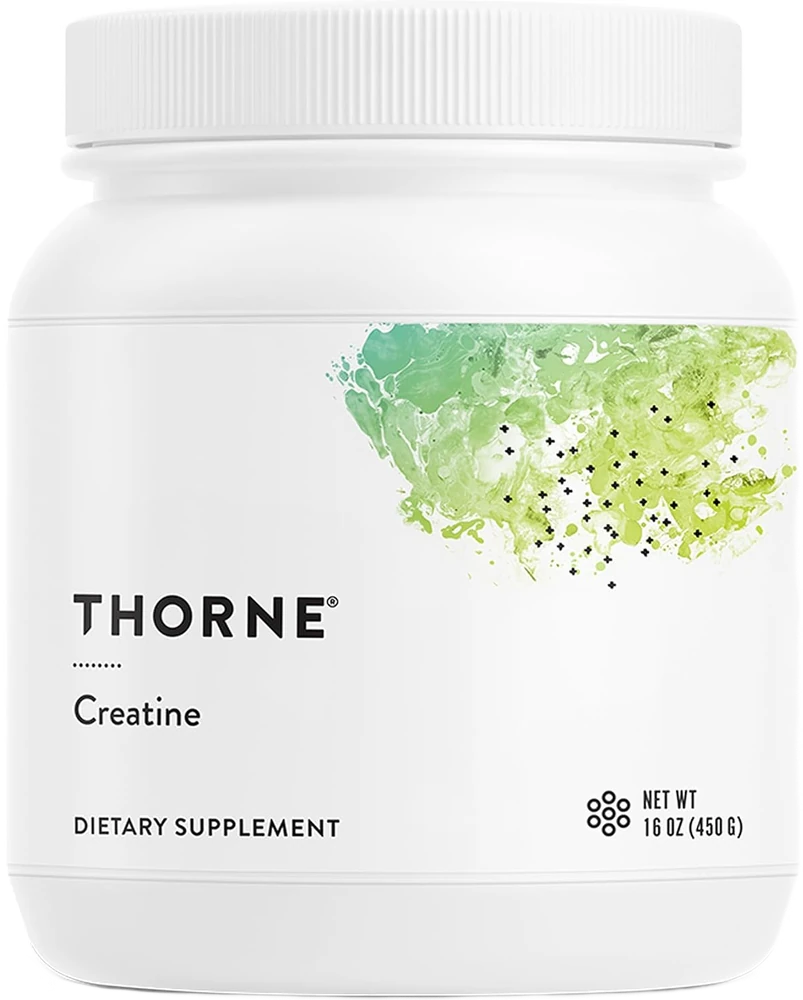
Best for drug-tested athletes: Thorne Creatine
9.0SAC Score™The same monohydrate form driving the lean-mass evidence. NSF Certified for Sport, with by far the longest list of certified lots at nsfsport.com (66; match the lot number on your tub) — the pick for drug-tested athletes.
StrongestThird-party testing10.01WeakestCost per active gram7.5- Per serving
- 5 g creatine monohydrate
- Tub size
- 450 g (90 servings, ~3-month block)
- Form evidence
- Monohydrate — identical evidence base to Optimum Nutrition (#3)
All five scores, pros & cons, full label
What We Like- Same monohydrate form as Optimum Nutrition (#3) — the form with the hypertrophy RCTs
- NSF Certified for Sport — 66 certified lots listed at nsfsport.com, by far the longest list (matters if you compete while you grow)
- Thorne's clinical-grade QC is the industry benchmark for per-scoop purity
- Guaranteed 5 g of pure monohydrate per scoop — saturation you can trust
What You Live With- $0.50/serving is the highest cost per serving of any plain monohydrate on the list
- Smaller tub (450 g vs ON's 600 g) — re-orders sooner during a long block
- The certification doesn't grow more muscle — the molecule is identical to cheaper picks
- Testing
- NSF Certified for Sport — on the NSF list; certified lots are listed at nsfsport.com
Our take — The pick for drug-tested athletes who are also building muscle. The hypertrophy biology is identical to Optimum Nutrition (#3) — same monohydrate form, same satellite-cell and IGF-1 evidence — but Thorne layers NSF Certified for Sport certification on top (certified lots are listed at nsfsport.com; match the lot number on your tub). For building muscle specifically, the certification doesn't add growth; what you're buying is the longest list of certified lots of any powder here (66, against one for Sports Research). Worth it if you compete while you bulk; for pure cost-efficiency, ON (#3) or Bulk Supplements (#4) deliver the same molecule for less.
- 03
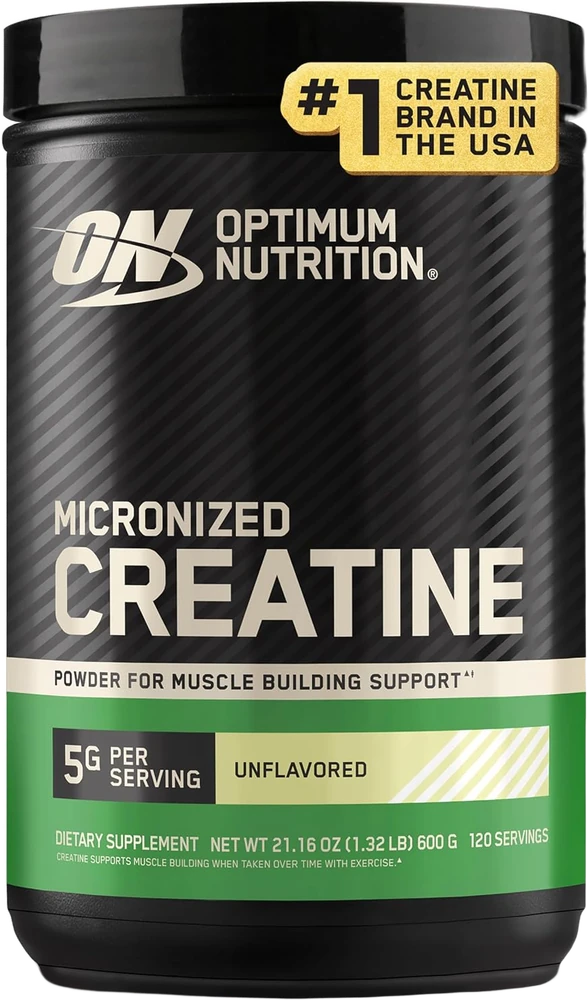
Best household brand: Optimum Nutrition Micronized Creatine Powder
8.9SAC Score™Plain micronized monohydrate — the exact form behind every hypertrophy RCT — from the most-trusted brand in sports nutrition. 5 g per scoop drives saturation; 600 g covers a 4-month growth block at $0.23/serving.
StrongestPer-serving creatine9.51WeakestForm purity8.5- Per serving
- 5 g micronized creatine monohydrate
- Tub size
- 600 g (120 servings, ~4-month hypertrophy block)
- Form evidence
- Monohydrate — the form in Olsen 2006, Burke 2008, Branch 2003
All five scores, pros & cons, full label
What We Like- Plain micronized monohydrate — the form with satellite-cell, IGF-1, and lean-mass RCTs
- 5 g per scoop drives full saturation, the basis of the hypertrophy effect
- 120-serving tub at $0.23/scoop is a long supply for under $30 — covers a 4-month block
- Mixes cleanly into a post-workout protein-carb shake (modest uptake boost)
What You Live With- Not NSF Certified for Sport — if you're drug-tested, jump to Thorne (#2)
- Modest premium over pure generic micronized monohydrate (Bulk Supplements #4)
- Testing
- Label prints 'Banned Substance Tested'; the listing names the Informed Choice program (brand statement, not confirmed by us). Not on the NSF Certified for Sport list (checked Oct 6, 2026)
Our take — The value default for building muscle. You get the monohydrate form that every hypertrophy study used, ON's 40-year QC track record, and a 4-month supply for under $30 — all without paying for marketing forms (HCl, multi-form) that have no lean-mass evidence. Run 5 g/day continuously, anchor it to 10-20 hard sets per muscle per week and 1.6-2.2 g/kg protein, and the +1.2 kg lean-mass effect compounds over 8-12 weeks. The only reasons to pick something else: a long bulk on a tight budget (Bulk Supplements #4) or federation drug-testing (Thorne #2).
- 04
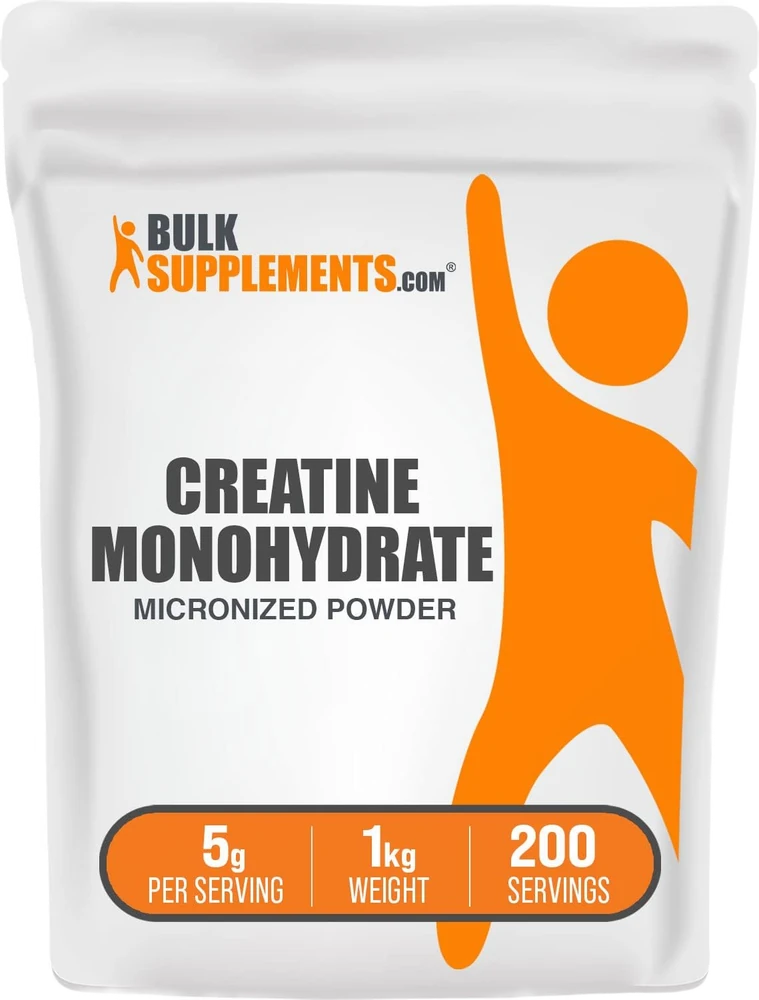
Best value: Bulk Supplements Creatine Monohydrate Micronized
8.9SAC Score™The cheapest legitimate way to stay saturated for months. $0.15 per 5 g serving, 200 servings, COA on request — the same monohydrate molecule (and hypertrophy evidence) as the premium tubs, at a lower price.
StrongestCost per active gram10.01WeakestBrand QC track record7.5- Per serving
- 5 g micronized creatine monohydrate
- Bag size
- 1 kg (200 servings, ~7-month growth phase)
- Form evidence
- Monohydrate — same molecule, same lean-mass RCTs as any monohydrate
All five scores, pros & cons, full label
What We Like- Cheapest pick with a legit COA — $0.15/serving, ideal for months of saturation
- 1 kg bag covers a ~7-month growth phase with no re-orders mid-cycle
- Pure monohydrate, no fillers — the hypertrophy form, full 5 g per scoop
- Same molecule as the premium tubs: same satellite-cell, IGF-1, and lean-mass evidence
What You Live With- Creapure not stated on the label or listing; plain micronized monohydrate
- Bag (not tub) packaging — transfer to a tub for daily scooping
- Only pouches whose lot number is on the nsfsport.com list are NSF Certified for Sport; the Amazon listing and label carry no mark
- Testing
- Per-batch COA on request, third-party lab. nsfsport.com lists certified lots of the unflavored powder; the Amazon listing and label do not carry the mark
Our take — Same molecule as the premium tubs at a lower price, 200 servings per bag. For a long hypertrophy block, the math doesn't favor anything else — you need months of uninterrupted saturation, and $0.15/serving makes that trivially affordable. The bag format is a minor inconvenience (transfer to a tub for daily scooping), but at this price the friction is worth it. Vegan and vegetarian lifters on a budget should default here — you get the biggest absolute hypertrophy response from creatine, and cost shouldn't gate the highest-leverage supplement for size.
- 05
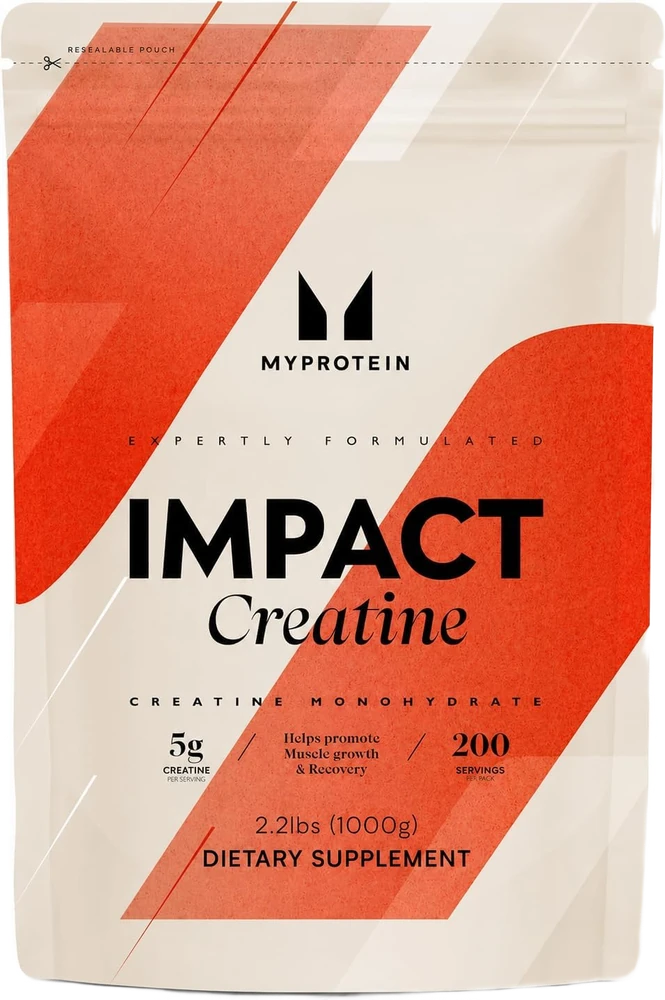
Large 1 kg pouch: MyProtein Creatine Monohydrate
8.6SAC Score™A 1 kg, 200-serving pouch of plain creatine monohydrate — months of saturation per bag, at about $0.19 a serving. Neither the label nor the listing says Creapure (checked Oct 6, 2026), and no third-party sport certification could be confirmed.
StrongestPer-serving creatine9.51WeakestThird-party testing7.5- Per serving
- 5 g micronized creatine monohydrate
- Pouch size
- 1 kg (200 servings, ~6-month block)
- Form evidence
- Monohydrate — the form with the lean-mass RCTs
All five scores, pros & cons, full label
What We Like- 1 kg pouch = 200 servings — a long supply per bag, with no mid-block re-orders
- About $0.19 a serving at a typical $37 price; only Bulk Supplements is cheaper per serving
- Clean 5 g per scoop; vegan, soy-free and gluten-free on the label
- Large, established European brand
What You Live With- Creapure is not stated on the label or listing (checked Oct 6, 2026), and no third-party sport certification could be confirmed — drug-tested athletes should choose Thorne (#2)
- Pouch (not tub) packaging — transfer to a tub for daily scooping
- Amazon US stock can be intermittent — check availability before defaulting here
- Shipping from UK warehouses can add transit time on direct orders
- Testing
- Brand QC; no third-party sport certification confirmed (not NSF Certified for Sport, checked Oct 6, 2026)
Our take — A plain, large-format monohydrate: the same hypertrophy evidence as any monohydrate, in a 1 kg pouch that holds 200 servings. Neither the label nor the listing says Creapure (checked Oct 6, 2026), and we could not confirm any third-party sport certification, so drug-tested athletes should choose Thorne (#2). The catches are the pouch format and intermittent stock on Amazon US — check the listing before defaulting here for your growth block.
- 06
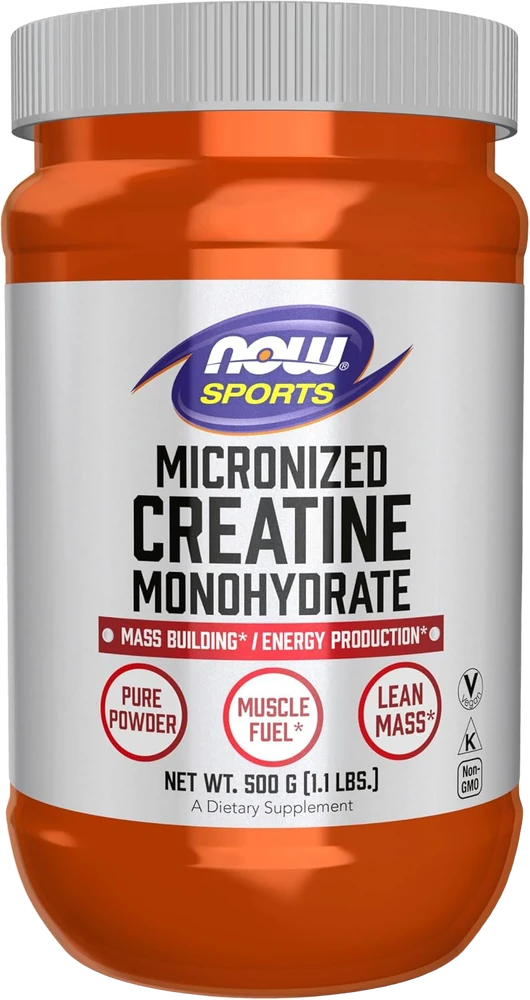
Household-brand pick: NOW Sports Micronized Creatine Monohydrate
8.4SAC Score™NOW's three-decade QC track record applied to plain micronized monohydrate. The best 'grab-it-off-a-shelf' option to keep saturation going when shipping is slow.
StrongestPer-serving creatine9.02WeakestThird-party testing7.5- Per serving
- About 4.2 g creatine monohydrate (1.5 level teaspoons, per label)
- Tub size
- 500 g (about 119 servings of 4.2 g)
- Form evidence
- Monohydrate — the hypertrophy form
All five scores, pros & cons, full label
What We Like- NOW's in-house QC is among the most consistent in the industry (30+ years)
- Fair price for a household brand — about $0.21 per 5 g dose, a little under ON (#3); monohydrate, the form with the lean-mass RCTs
- Easy to source offline so you never break saturation mid-block
What You Live With- The label serving is about 4.2 g, so a full 5 g dose is slightly more than one serving
- Not NSF Certified for Sport (use Thorne #2 if you need that)
- Testing
- NOW in-house QC; the label carries GMP Quality Assured and no Informed Sport seal, and the listing does not mention Informed Sport (checked Oct 6, 2026)
Our take — If you want to grab a tub off a shelf without waiting on shipping — keeping your saturation uninterrupted mid-block — NOW Sports is the answer. At about $0.21 per 5 g dose it costs slightly less than Nutricost (#7), it carries a 30+ year QC pedigree, and it's the same monohydrate form behind the hypertrophy evidence. The cleanest 'walk into a health store and grab one' pick on the list.
- 07
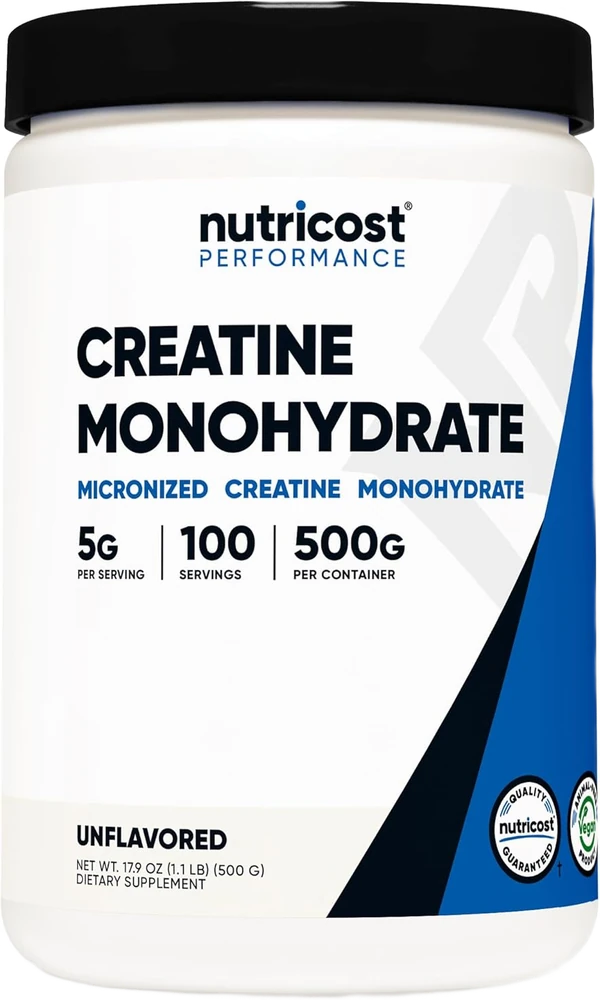
Best alt-value: Nutricost Creatine Monohydrate Micronized
8.3SAC Score™A low-cost tub-format monohydrate when Bulk Supplements is sold out. GMP-tested, $0.22/serving, easier daily scooping than a 1 kg bag — same hypertrophy form.
StrongestPer-serving creatine9.51WeakestThird-party testing7.5- Per serving
- 5 g micronized creatine monohydrate
- Tub size
- 500 g (100 servings, ~3-month block)
- Form evidence
- Monohydrate — the form with the lean-mass RCTs
All five scores, pros & cons, full label
What We Like- Low-cost tub-format pick with a GMP-tested supply chain
- Same micronized monohydrate (and hypertrophy evidence) as Bulk Supplements
- Easier daily-use packaging (tub + scoop) than a 1 kg bag during a block
What You Live With- No per-batch public COA — only internal GMP QC
- Creapure not stated
- Smaller tub than ON #3 at a similar cost per serving
- Testing
- GMP-certified facility, batch QC
Our take — The pick when Bulk Supplements is sold out and you don't want a 1 kg bag. Nutricost is the reliable mid-tier monohydrate — nothing flashy, GMP-tested, consistent batch QC, the same hypertrophy-relevant molecule. At $0.22/serving you pay a small premium over Bulk Supplements (#4) for the convenience of a tub during your growth block. Fair trade.
- 08
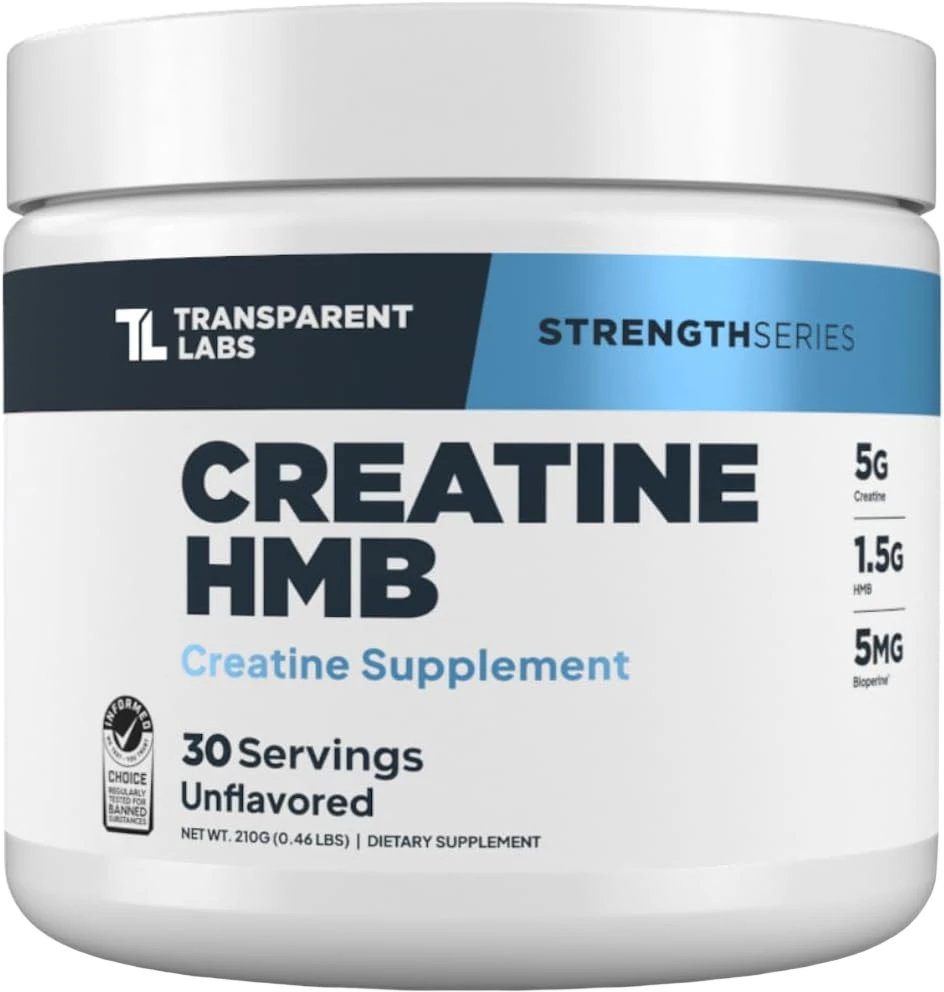
Best combo (advanced): Transparent Labs Creatine HMB
7.9SAC Score™Creatine monohydrate (the hypertrophy form) plus 1.5 g HMB (branded myHMB) per scoop. HMB is anti-catabolic with modest evidence — useful in a deficit, but it doesn't add hypertrophy-RCT weight to the creatine.
StrongestThird-party testing9.52WeakestCost per active gram3.5- Per serving
- 5 g creatine monohydrate + 1.5 g HMB (myHMB calcium HMB) + 5 mg BioPerine
- Tub size
- 30 servings (1-month supply)
- Form evidence
- Monohydrate (the growth driver) + HMB (anti-catabolic)
All five scores, pros & cons, full label
What We Like- Combines creatine monohydrate (the hypertrophy form) with HMB in one scoop
- HMB has modest anti-catabolic evidence — useful for preserving muscle in a deficit
- Creatine HMB is on the NSF Certified for Sport list for specific lots, and the label carries an Informed Choice seal
What You Live With- Per-serving cost is 5-10× the standalone monohydrate picks
- HMB is anti-catabolic, not a hypertrophy driver — it doesn't add lean-mass RCT weight
- Smaller tub (30 servings) means frequent re-orders during a growth block
- Testing
- On the NSF Certified for Sport list (certified lots are listed at nsfsport.com; match the lot number on your tub). Informed Choice seal on the label. Per-batch COAs published
Our take — Convenience over price optimization. The creatine here is the same monohydrate that drives hypertrophy; the HMB is a modest anti-catabolic add (most relevant in a cutting or high-volume phase, not pure mass-building). If you've separately decided to run HMB, this is a tidy single-scoop way to do it. For straight muscle growth, plain monohydrate (#3, #4) costs a fifth as much or less and contains the same hypertrophy-relevant creatine.
- 09
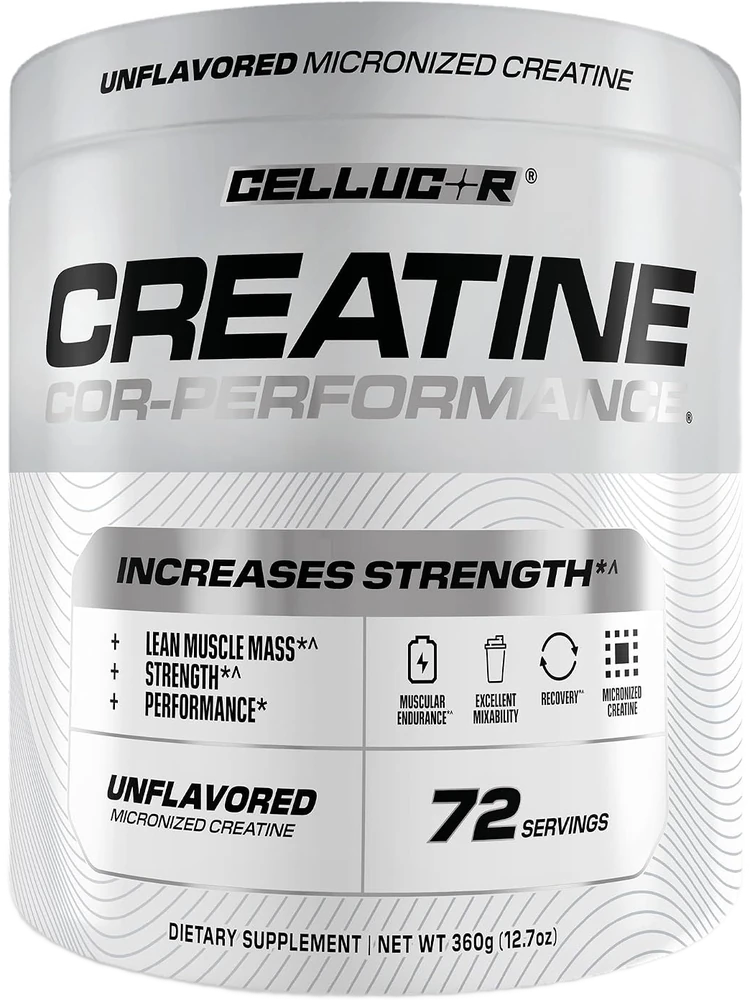
Best mass-market: Cellucor COR-Performance Creatine
7.9SAC Score™Micronized monohydrate at GNC / Vitamin Shoppe shelf availability. Pay a small brand premium for offline convenience during a growth phase.
StrongestPer-serving creatine9.02WeakestCost per active gram6.5- Per serving
- 5 g micronized creatine monohydrate
- Tub size
- 360 g (72 servings, ~2.4-month supply)
- Form evidence
- Monohydrate (micronized) — the hypertrophy form
All five scores, pros & cons, full label
What We Like- Real 5 g micronized monohydrate at supplement-store-shelf availability
- Familiar brand for crossover lifters in a growth phase
- Easy to source offline at GNC and Vitamin Shoppe
What You Live With- Higher $/serving than ON #3 ($0.35 vs $0.23)
- Smaller tub means more frequent re-orders during a block
- Brand placement premium — you're paying for shelf space, not more muscle
- Availability
- GNC, Vitamin Shoppe, most mass-market gym stores
Our take — The 'I just want to grab one off the GNC shelf' pick. Plain micronized monohydrate — the same hypertrophy-relevant molecule — at a brand-placement premium. Fine product, but if you're already on Amazon, ON or Bulk Supplements gets you the same molecule (with better purity documentation) for less over a months-long growth block.
- 10
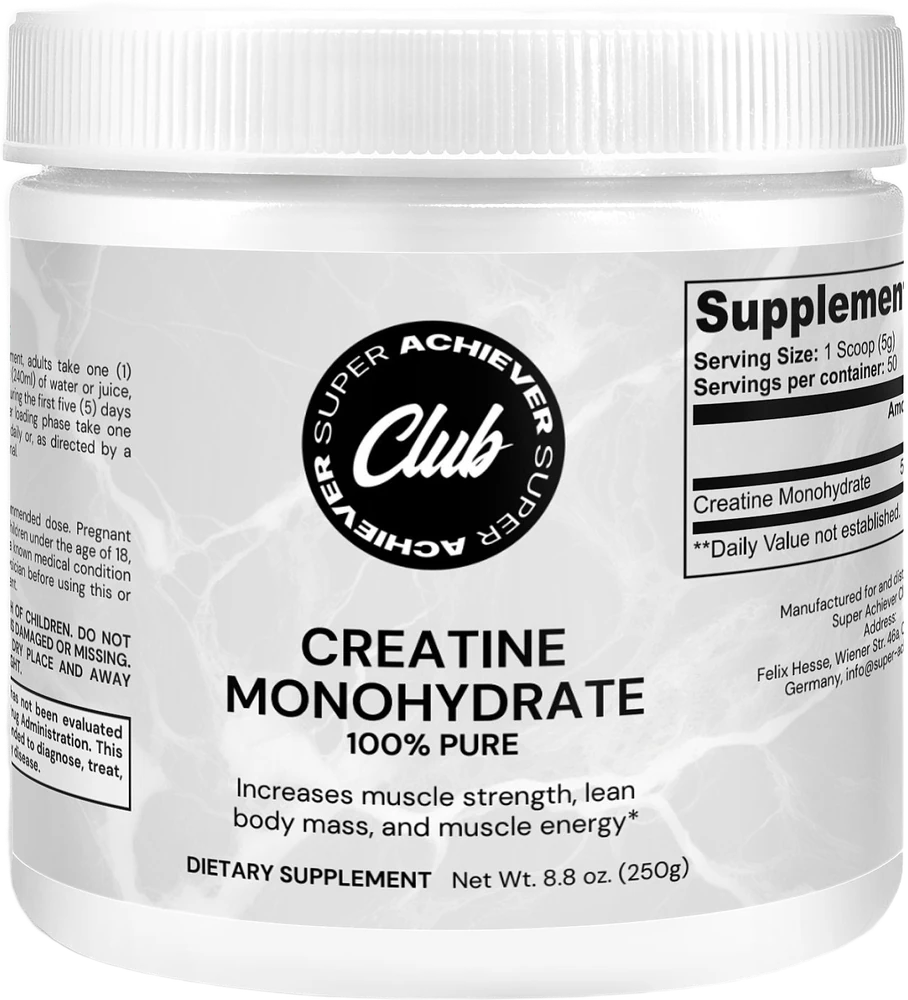
Our own brand: Super Achiever Creatine Monohydrate
6.9SAC Score™Our own creatine: one ingredient and an exact 5 g scoop. It ranks here because it costs $0.98 a serving and has no certificate or lab report to show.
StrongestPer-serving creatine9.51WeakestCost per active gram5.0- Per serving
- 5 g creatine monohydrate (1 scoop)
- Cost per serving
- $0.98
- Tub size
- 250 g · 50 servings
All five scores, pros & cons, full label
What We Like- One ingredient on the panel: creatine monohydrate
- Exact 5 g per scoop, the dose the research standardises on
- Unflavored powder that mixes into anything
What You Live With- $0.98 per 5 g serving, more than every plain monohydrate powder we rank
- No certificate, sport certification or published lab report
- Source
- Not named on the label
- Certifications
- None on the label
Our take — Right molecule and right dose, with nothing on the label you can verify from outside. If price or a sport certificate matters, buy the #1 pick.
- 11
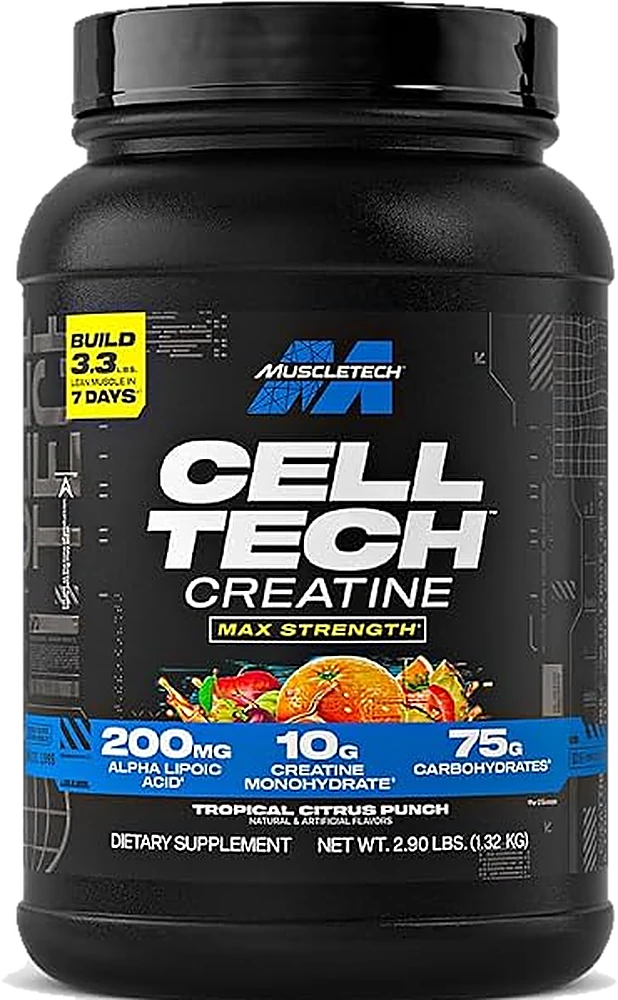
The carb option: MuscleTech Cell-Tech Creatine
6.7SAC Score™Creatine with 38 g of carbohydrate per scoop. Carbs do raise creatine uptake (Green 1996), but the study used far more sugar, and plain creatine with a meal does the same for a fraction of the price.
StrongestPer-serving creatine9.51WeakestCost per active gram4.5- Per serving
- 5 g creatine, 38 g carbohydrate, 160 calories (1 scoop)
- Sugar
- 14 g added sugars per scoop
- Testing
- No testing statement; no NSF listing (checked Oct 14, 2026)
All five scores, pros & cons, full label
What We Like- Full 5 g of creatine per scoop
- Carbs with creatine are backed by Green 1996
- Convenient if you want a carb drink after training
What You Live With- $1.11 per 5 g of creatine
- 14 g of added sugar per scoop
- Sucralose, flavors and colors
- Front-of-tub claims we could not verify
- Form
- Creatine monohydrate in a carbohydrate drink
Our take — On this list because lifters ask whether creatine works better with carbohydrate, and it does. You do not need this tub for it: take plain creatine with a meal. Buy Cell-Tech only if you want the sweet carb drink after training anyway.
Creatine In Four Short Lessons
Why creatine monohydrate is the highest-leverage hypertrophy supplement
- +1.2 kg
- Lean body mass vs placebo at 4-12 weeks of resistance training (Branch meta)
- +100%
- Greater satellite-cell number vs placebo over 16 weeks RT (Olsen 2006)
- +15%
- Higher muscle IGF-1 vs placebo with creatine + RT (Burke 2008)
- 15-40%
- Increase in muscle phosphocreatine stores — biggest in vegetarians
Sources: Kreider 2017 ISSN position statement (PMID 28615996); Branch 2003 body-comp meta (PMID 12945830); Olsen 2006 satellite-cell trial (PMID 16581862); Burke 2008 IGF-1 trial (PMID 18708688); Schoenfeld 2017 training-volume meta (PMID 27433992).
Choose monohydrate; it is the form with the lean-mass studies.
HCl, buffered and multi-form blends have no lean-mass trials. All three studied hypertrophy mechanisms were shown on monohydrate.
Check the creatine per serving.
Per-serving creatine drives saturation and carries a fifth of our score. A scoop that falls short delays the effect.
Expect about 1.2 kg of lean mass, if you train.
That is the average gain versus placebo over 4-12 weeks (Branch 2003). Creatine lets you sustain more training volume; it multiplies the work and does not replace it.
Olsen 2006 (PMID 16581862) · Burke 2008 (PMID 18708688) · Branch 2003 (PMID 12945830) · Schoenfeld 2017 — full scoring below.
Each pick was scored 0-10 across five criteria, then weighted to a final composite. Versus our general creatine list, the weighting here leads with the form's hypertrophy-RCT weight — monohydrate is the only creatine form with published lean-mass, satellite-cell, and IGF-1 trials, so any pick that isn't monohydrate loses the criterion that matters most for growth. Per-serving creatine carries weight because under-dosing (a multi-form blend can deliver ~3 g of actual creatine from a 4 g mix) starves the saturation the muscle-growth mechanism depends on. Cost per active gram matters because hypertrophy requires months of continuous saturation, not a one-off cycle.
Hypertrophy RCT weight of the form · 30%
Does the form have published lean-mass evidence? Monohydrate carries Olsen 2006 (satellite cells), Burke 2008 (IGF-1), and Branch 2003 (+1.2 kg lean mass). HCl, buffered, ethyl ester, and multi-form blends have zero hypertrophy RCTs — they ride monohydrate's coattails. This is the single biggest weighting because it directly predicts muscle growth.
Form purity · 25%
Plain, single-ingredient creatine monohydrate with a clean label vs alternative forms. Relevant because you're ingesting this daily for months during a growth block.
Per-serving creatine (drives saturation) · 20%
Does one scoop deliver a full 5 g of monohydrate to drive saturation, or a 4 g blend of mixed forms carrying ~3 g of actual creatine? The hypertrophy effect tracks muscle creatine saturation, so under-dosed multi-form blends consistently lose here.
Cost per active gram · 15%
Monthly cost divided by total creatine delivered. Hypertrophy needs continuous saturation over months — the honest target for plain monohydrate is $0.15-0.25 per 5 g serving. Above $0.30, you're paying for extras (a brand name, Creapure sourcing, a sport-certification mark), not more muscle.
Brand QC track record · 10%
Years on market, recall history, lot-to-lot consistency. Saturation only works if every scoop actually delivers 5 g — QC is the floor that guarantees it. The safety/consistency check for anything in the top 5.

How creatine builds muscle — the three hypertrophy mechanisms
- 1
Cell volumization → anabolic signal
Creatine draws water into muscle cells, increasing cell volume. That cell swelling isn't just water weight — it acts as an anabolic signal that upregulates protein synthesis and suppresses breakdown. Saturation increases muscle phosphocreatine 15-40% (biggest in vegetarians).
- 2
Satellite-cell proliferation → more myonuclei
Olsen 2006 (PMID 16581862) found creatine + 16 weeks of resistance training roughly doubled satellite-cell number and added more myonuclei per fibre vs placebo. Satellite cells donate nuclei to growing fibres — raising the structural ceiling on how much a fibre can hypertrophy.
- 3
IGF-1 upregulation + volume synergy
Burke 2008 (PMID 18708688) showed creatine + RT raised muscle IGF-1 content vs placebo, an anabolic growth signal. On top of the biology, creatine lets you sustain more hard sets at the same RPE — and training volume is the dominant driver of hypertrophy (Schoenfeld 2017). The result: ~+1.2 kg lean mass vs placebo.
What to expect on a creatine hypertrophy protocol
Cell volumization
1-2 kg scale gain from intramuscular water. Muscles look fuller and harder. The cell swelling is itself an anabolic signal — not fat gain.
More volume at the same effort
Extra 1-2 reps on top working sets, faster between-set recovery. This lets you add hard sets — the lever that actually drives growth.
Lean-mass accrual
Satellite-cell and IGF-1 mechanisms plus compounded training volume produce real contractile muscle — about +1.2 kg lean mass vs placebo across the block (Branch 2003).
The bottom line for muscle growth
The value default for building muscle: Optimum Nutrition (#3).
The monohydrate form every hypertrophy study used, ON's 40-year QC, and a 4-month supply for under $30 — no marketing forms (HCl, multi-form) that have no lean-mass evidence.
Anchor the supplement to the real levers.
Run 5 g/day continuously, hit 10–20 hard sets per muscle per week and 1.6–2.2 g/kg protein — the +1.2 kg lean-mass effect compounds over 8–12 weeks.
Pick something else only in two cases.
A long bulk on a tight budget → Bulk Supplements (#4); federation drug-testing → Thorne (#2).
Quick Answers
How does creatine actually build muscle?
Through three mechanisms, all studied on monohydrate. First, cell volumization: creatine pulls water into muscle cells, and the resulting cell swelling acts as an anabolic signal that upregulates protein synthesis and downregulates breakdown. Second, satellite-cell proliferation: Olsen 2006 (PMID 16581862) found creatine + 16 weeks of resistance training roughly doubled satellite-cell number and added more myonuclei per fibre vs placebo — satellite cells donate nuclei to growing fibres, which is the cellular ceiling on how big a fibre can get. Third, IGF-1 upregulation: Burke 2008 (PMID 18708688) showed creatine + RT raised muscle IGF-1 content vs placebo. On top of all three, creatine lets you train with more volume at the same effort, and training volume is the dominant driver of hypertrophy (Schoenfeld 2017, PMID 28698222). Net effect across trials: about +1.2 kg lean mass vs placebo over 4-12 weeks (Branch 2003, PMID 12945830).
Is monohydrate really better than HCl or buffered creatine for muscle growth?
For hypertrophy specifically, it's not even close — because monohydrate is the only form with lean-mass RCTs behind it. Every hypertrophy study cited here (Olsen 2006 satellite cells, Burke 2008 IGF-1, Branch 2003 body composition, the Chilibeck and Kreider reviews) used creatine monohydrate. HCl, buffered ('Kre-Alkalyn'), ethyl ester, and multi-form blends have zero published lean-mass RCTs. They market 'better absorption' or 'no bloat', but once you're saturated your phosphocreatine ceiling is fixed and the muscle-growth cascade is identical — there's simply no head-to-head trial showing any of them grows more muscle than monohydrate at equivalent doses. The ISSN position statement (Kreider 2017) is explicit that monohydrate is the most effective form. For building muscle, buy the molecule with the evidence.
Should I load creatine to build muscle faster?
No. For hypertrophy, the lean-mass effect tracks total muscle creatine saturation, not how quickly you reach it. Loading (20 g/day × 5-7 days) saturates in about a week; 5 g/day continuously saturates in 3-4 weeks. Both arrive at the same ceiling, and the muscle-growth studies don't show a hypertrophy advantage for the loaders — the extra lean mass accrues over 8-12 weeks of training regardless of how you got saturated. Loading just front-loads the water-retention spike and the GI upset, which is the #1 reason new lifters abandon creatine. Skip it: 5 g/day every day, indefinitely.
Will creatine build muscle on its own, without lifting?
No — creatine is a volume amplifier, not a standalone anabolic. The cell-volumization week-1 water gain happens without training, but the real +1.2 kg lean-mass accrual requires resistance training. The mechanism is synergistic: creatine lets you do more hard sets and recover faster between them, and training volume is the dominant driver of hypertrophy (Schoenfeld 2017 shows growth scales dose-dependently with weekly sets). Without progressive overload, creatine has nothing to amplify — you'd just sit at a saturated-but-untrained baseline. Build the program first (10-20 hard sets per muscle per week, 1.6-2.2 g/kg protein); creatine then compounds it.
When should I take creatine for muscle growth — intra-workout or post-workout?
It barely matters once you're saturated, because hypertrophy benefits come from keeping muscle creatine maximally filled, not from workout-day timing. Some trials show a small post-workout edge over pre-workout (taking it alongside a post-session protein-carb meal), but the effect is minor and swamped by total daily intake. The practical answer: take 5 g every day, on training and rest days alike, whenever is most consistent for you. If you want to optimize the margin, dose it post-workout with your protein-carb shake — the insulin response modestly improves uptake. Consistency to maintain saturation beats any timing window.
Does creatine cause fat gain or just water weight?
Water, not fat — and the water is the point. The 1-2 kg scale gain in week 1 is intramuscular water from cell volumization. That cell swelling isn't cosmetic: it's an anabolic signal that upregulates protein synthesis, which is part of why creatine works for hypertrophy in the first place. It shows up as fuller, harder muscle (intramuscular hydration), not a soft subcutaneous bloat. The longer-term gain — about +1.2 kg lean mass over 4-12 weeks (Branch 2003) — is real contractile muscle accrued from compounded training volume plus the satellite-cell and IGF-1 mechanisms. Creatine does not add fat.
Do vegetarians and vegans build more muscle on creatine?
Yes — they typically see the largest absolute hypertrophy response. Dietary creatine comes from meat and fish, so vegetarians and vegans have muscle creatine stores 20-30% lower at baseline. That means supplementation produces a bigger jump in muscle phosphocreatine (the 15-40% range skews to the top for low-baseline individuals), and a bigger jump drives more of the cell-volumization and satellite-cell cascade. If you're vegan and training for size, creatine is the single highest-leverage supplement you can add — start at 5 g/day on day one of your hypertrophy block.
Every Claim Ranked Above Traces Back To One Of These
6 peer-reviewed sources, each linked to PubMed
- [1] Kreider 2017 PMID 28615996 — International Society of Sports Nutrition position stand: safety and efficacy of creatine supplementation in exercise, sport, and medicine. ISSN position statement synthesizing 500+ studies: creatine monohydrate is the most effective form for increasing high-intensity exercise capacity and lean body mass, with no evidence that alternative forms (HCl, ethyl ester, buffered, multi-form) outperform it at equivalent doses. The basis for ranking monohydrate first for hypertrophy.
- [2] Olsen 2006 PMID 16581862 — Creatine supplementation augments the increase in satellite cell and myonuclei number in human skeletal muscle induced by strength training. 16-week resistance-training RCT: creatine supplementation roughly doubled the increase in satellite-cell number and raised myonuclei per fibre vs placebo. The cellular basis of the hypertrophy effect — satellite cells donate nuclei to growing fibres, raising the structural ceiling on muscle growth.
- [3] Burke 2008 PMID 18708688 — Effect of creatine supplementation and resistance-exercise training on muscle insulin-like growth factor in young adults. 8-week RCT: creatine combined with resistance training produced significantly higher muscle IGF-1 content vs resistance training plus placebo. Establishes IGF-1 upregulation as one of the anabolic signaling mechanisms behind creatine's hypertrophy effect.
- [4] Schoenfeld 2017 PMID 27433992 — Dose-response relationship between weekly resistance training volume and increases in muscle mass: a systematic review and meta-analysis. Meta-analysis establishing that muscle hypertrophy scales with weekly resistance-training volume in a dose-response manner — more hard sets per muscle drive more growth. The synergy partner for creatine: creatine grows muscle largely by letting you sustain higher training volume at the same effort.
- [5] Cooke 2009 PMID 19490606 — Creatine supplementation enhances muscle force recovery after eccentrically-induced muscle damage in healthy individuals. RCT: creatine supplementation improved recovery of muscle force and reduced markers of muscle damage following eccentric exercise vs placebo. Supports the between-session recovery mechanism that lets lifters accumulate more weekly training volume on creatine.
- [6] Branch 2003 PMID 12945830 — Effect of creatine supplementation on body composition and performance: a meta-analysis. Foundational body-composition meta-analysis: creatine supplementation increased lean body mass by an average of +1.2 kg vs placebo across resistance-trained subjects. The headline hypertrophy outcome — and it was generated entirely on monohydrate.
More Creatine Guides
- Best Creatine SupplementsThe definitive creatine buying guide — the single best pick for each kind of buyer across powder, gummies, and HCl. Monohydrate powder wins on raw value; every other form is a situational upgrade for adherence, testing, or tolerance.
- Best Form of Creatine: Why Monohydrate WinsEvery creatine form compared — monohydrate, micronized, Creapure, HCl, buffered, ethyl ester, multi-form. The ISSN-anchored verdict: monohydrate wins, the rest are markups on the same molecule.
- Best Creatine for BrainCreatine raises brain phosphocreatine — biggest cognitive lift for vegetarians + the sleep-deprived (Rae 2003). Monohydrate at 5 g/day; ranked by label purity, dose, and cognitive-trial alignment.
- Best Creatine for MenSame 10-product roster as the general creatine list, reframed for the male-lifter cohort — NSF Certified for Sport leads, then plain monohydrate form, tub size for bulking macros and per-scoop creatine.
- Best Creatine for WomenTen creatine picks re-scored for women: lean-mass preservation, postmenopausal bone-density support (Chilibeck 2015), cognition/mood uplift, no-loading-default, kitchen-friendly tub sizes.
- Best Creatine GummiesCreatine gummies ranked by grams-per-gummy and cost per real 5 g dose — $0.67 to $2.78 across our six picks, read off the Amazon US offer. Most gummies under-deliver and a '3-gummy serving' usually isn't 5 g. Honest picks, including when powder still wins.
- Best Creatine MonohydrateThe most-studied supplement in sports nutrition — and 95% of buyers get it wrong by paying for fancier forms or flavored blends. Ranked by label purity, price per gram, and lab transparency.
- Best Supplements for Muscle GrowthThe supplement categories for muscle growth, ranked by how much each one adds — creatine first, protein powder second, the rest honest margins — with the #1 product of each category. Training, calories and protein beat all of them.
Affiliate disclosure: every Amazon link uses our Associates tag (superachieverclub-20). We earn a small commission at no cost to you; it funds independent reviews. We never accept payment to change a ranking.