
Top 9 Best Glycine Supplements for Sleep & Recovery (2026)
 01 · Best overall✓ Label verified · Supplement Facts read Oct 18, 2026
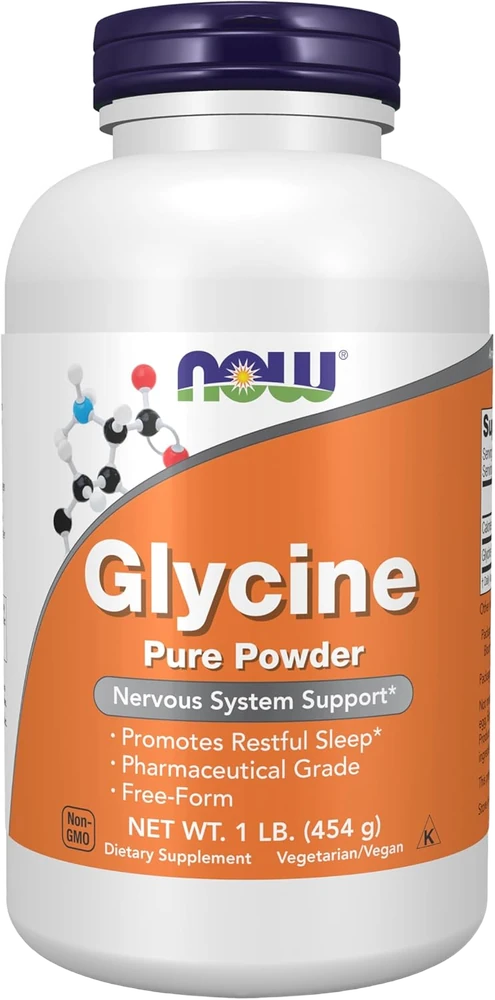
Best overall (household brand): NOW Foods Glycine Pure Powder
Pure glycine powder from a household name with decades of in-house QC. The trusted, widely-stocked powder — the easy offline backup.
About 10 cents per 3 g dose ($14.99 per 1 lb)About 10 cents per 3 g dose (1 lb, US price read 2026-10-18)
Why it wins: all five scores, pros & cons, full label
- Household-name brand with one of the most respected in-house QC operations in the industry
- Pure glycine, vegan, non-GMO, naturally sweet and easy to mix
- Stocked in most health stores — the simplest offline backup if you run out
- About 10 cents per 3 g serving ($14.99, US price read 2026-10-18)
- Label states the studied 3 g serving plainly (3/4 level teaspoon)
- No scoop shown in the listing — you measure 3/4 level tsp yourself for the 3 g dose
- Smaller 454 g bottle than the 1 kg bulk bags
- Label serving
- 3/4 level tsp (approx. 3 g) = 3 g glycine; directions say 1/4 to 3/4 level tsp daily
- Size
- 1 lb (454 g)
- Testing
- NOW in-house analytical labs, GMP, widely audited
- Form
- Pure glycine powder (unflavored)

Our take — If you'd rather buy a name you already recognize — and be able to grab a bottle at a local store — NOW Foods is the powder to get. The glycine is pure, the panel prints the studied 3 g dose as the serving (3/4 level teaspoon), the in-house QC pedigree is excellent, and at about 10 cents a dose it is among the cheapest ways to take it. The practical nuance is that no scoop is shown in the listing, so you measure the spoon yourself. Against the #2 and #3 powders it gives up a built-in 3 g scoop and a larger bag, not quality.
 02
 03
 04
 05
 06
 07
 08
 09
Who Wins Which Aspect
Sorted by overall SAC Product Score™ — the official ranking.
| # | Pick | Score | Purity & form25% | Third-party testing25% | Dose accuracy (3 g)20% | Taste & mixability15% | Value (per 3 g dose)15% | Buy |
|---|---|---|---|---|---|---|---|---|
| 01 | | 9.0 | 9.02 | 8.8 | 9.02 | 9.01 | 9.52 | Check price |
| Household-name brand with one of the most respected in-house QC operations in the industryNo scoop shown in the listing — you measure 3/4 level tsp yourself for the 3 g dose | ||||||||
| 02 | | 8.8 | 9.02 | 7.5 | 9.61 | 8.82 | 9.61 | Check price |
| Plain glycine, non-GMO, gluten-free — and an included scoop that measures the 3 g dose for youMarginally pricier per gram than the largest bulk bags | ||||||||
| 03 | | 8.8 | 8.7 | 9.03 | 8.0 | 9.01 | 9.61 | Check price |
| 100% plain glycine — no fillers, no blend, exactly what the studies usedBulk bag means you measure your own scoop (a small scoop is included, but it's a no-frills bag) | ||||||||
| 04 | | 8.6 | 9.51 | 9.81 | 8.83 | 7.03 | 6.6 | Check price |
| Best-in-class testing and QC reputation — third-party certified, clinician- and athlete-trustedCosts several times more per gram than any of the powders | ||||||||
| 05 | | 8.4 | 9.51 | 9.42 | 8.4 | 6.8 | 6.2 | Check price |
| Among the cleanest labels in supplements — hypoallergenic, free of common allergens and needless excipients500 mg per capsule means the 3 g sleep dose is six capsules — tied with Double Wood and Solgar for the highest pill count | ||||||||
| 06 | | 8.2 | 9.02 | 7.0 | 7.4 | 8.82 | 9.52 | Check price |
| Glycine (Free-Form) is the only ingredient; Other Ingredients: NoneThe scoop is 1 g, so the studied 3 g dose is three scoops | ||||||||
| 07 | | 8.1 | 8.83 | 8.0 | 7.4 | 6.8 | 9.23 | Check price |
| Flexible 500 mg capsules if you also want smaller 1-2 g dosesAt 500 mg per capsule, the 3 g dose is six capsules a night — twice Thorne's count | ||||||||
| 08 | | 8.0 | 9.02 | 8.4 | 7.8 | 6.8 | 7.0 | Check price |
| 1 g per capsule keeps the 3 g dose to three caps100-count bottle is small — only ~33 nights at the full 3 g dose, so you reorder often | ||||||||
| 09 | | 7.6 | 9.02 | 8.2 | 6.6 | 6.8 | 6.4 | Check price |
| Heritage brand with a long-standing Gold Standard QC reputationAt 500 mg per capsule, the studied 3 g sleep dose is six capsules a night | ||||||||
The Other 8, Ranked
- 02
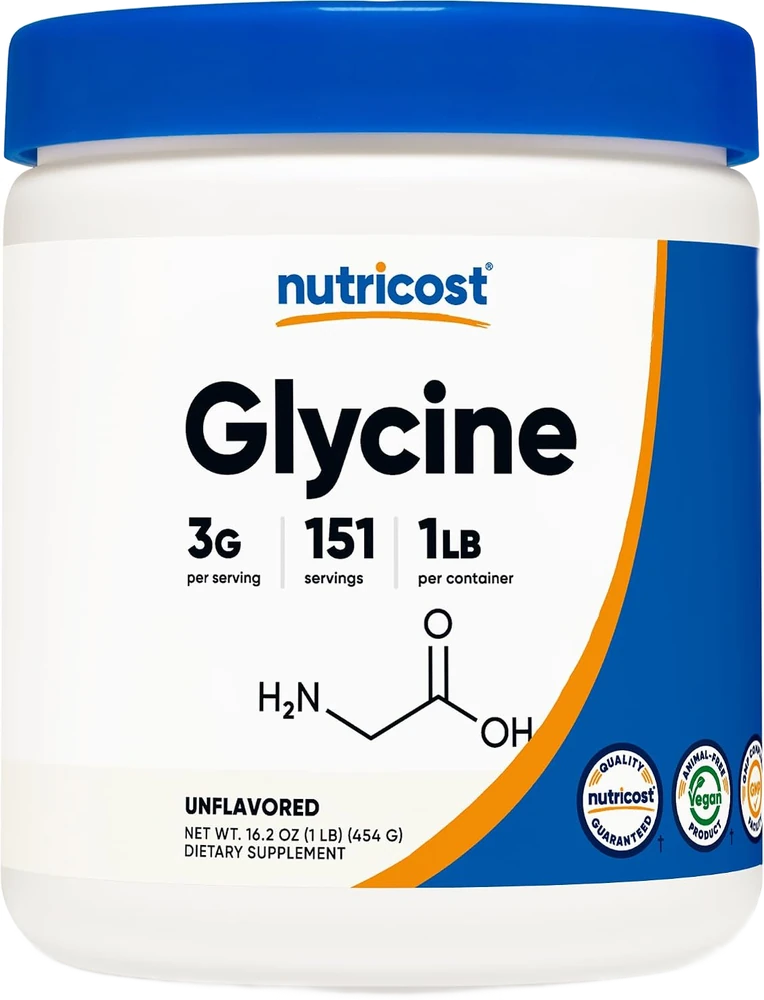
Best with a scoop: Nutricost Glycine Powder
8.8SAC Score™Plain glycine and a 3 g dose from a popular value brand — with the measuring scoop included in the tub, at a low cost per dose.
StrongestDose accuracy (3 g)9.61WeakestThird-party testing7.5- Per serving
- 3 g of free-form glycine (scoop included)
- Size
- 1 lb (≈ 150 servings)
- Testing
- Third Party Tested seal on pack (no lab named); GMP Compliant Facility; FDA-registered facility per nutricost.com
All five scores, pros & cons, full label
What We Like- Plain glycine, non-GMO, gluten-free — and an included scoop that measures the 3 g dose for you
- Third Party Tested and GMP Compliant Facility seals on the pack
- Tub packaging is a little more user-friendly than a bulk bag
- Low cost per dose, close to the #3 pick
What You Live With- Marginally pricier per gram than the largest bulk bags
- Sold mainly in the 1 lb size — heavy nightly users will reorder more often
- Form
- Plain glycine powder (unflavored)
Our take — Nutricost is the easygoing scoop-in-the-tub pick. You get 100% plain glycine, a 3 g scoop that's actually included in the tub, and Third Party Tested and GMP Compliant Facility seals on the pack. It sits at #2 because it scores higher than BulkSupplements on purity and form and on dose accuracy (the included scoop makes the 3 g dose effortless); the trade-offs are slightly higher cost per gram than the biggest bulk bags, a smaller default size, and a testing claim that names no lab. If you want the absolute lowest price or the strictest per-batch testing, BulkSupplements (#3) is the pick; otherwise a measuring scoop in a tidy tub makes this the one to buy.
- 03
Lowest cost per gram: BulkSupplements Glycine Powder
8.8SAC Score™100% plain glycine powder, one scoop is the studied 3 g dose, per-batch tested, and the lowest cost per gram in the category. The pick if lowest cost per gram is your priority.
StrongestValue (per 3 g dose)9.61WeakestDose accuracy (3 g)8.0- Per serving
- 3 g — exactly the studied dose
- Sizes
- 100 g / 500 g / 1 kg (and larger)
- Testing
- Per-batch, multi-stage third-party testing, cGMP
All five scores, pros & cons, full label
What We Like- 100% plain glycine — no fillers, no blend, exactly what the studies used
- One scoop is the 3 g studied dose, so there's zero math at bedtime
- Naturally sweet — dissolves clear in water or tea, genuinely pleasant
- Lowest cost per gram on the list; a 1 kg bag lasts roughly a year at 3 g/night
What You Live With- Bulk bag means you measure your own scoop (a small scoop is included, but it's a no-frills bag)
- Plain warehouse packaging — you're paying for the glycine, not the label
- Form
- Plain glycine powder (unflavored)
Our take — For the lowest cost per gram with real per-batch testing, this is the one to buy. It's 100% plain glycine, a single scoop is the studied 3 g, the per-batch third-party testing is exactly what you want from a commodity ingredient, and the cost per dose is the lowest here by a wide margin. Glycine is naturally sweet, so it's pleasant in water — no flavoring, no fillers. The only 'downside' is that it's a no-frills bulk bag, which is the entire point. It sits at #3 behind Nutricost and NOW Foods on dose accuracy, because no legible Supplement Facts photo in the listing lets us confirm the 3 g serving. If cost per gram is your priority, start here.
- 04
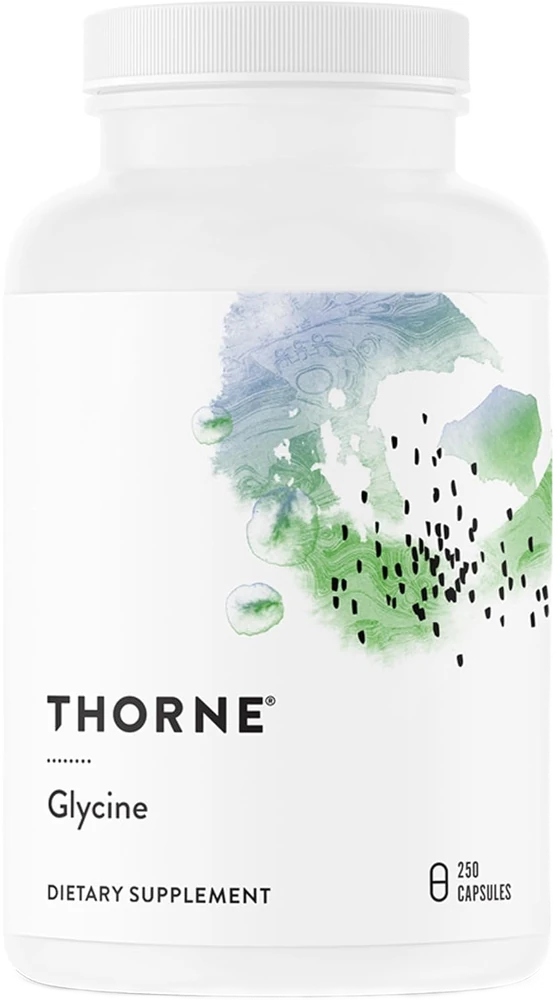
Best tested / best capsules: Thorne Glycine
8.6SAC Score™The most trusted testing pedigree in the category, in a 1 g capsule — so the 3 g dose is three caps, not six. The convenience pick when verification is the priority.
StrongestThird-party testing9.81WeakestValue (per 3 g dose)6.6- Per serving
- 3 g = 3 capsules (label suggests 2 caps, 1-3× daily)
- Bottle
- 250 capsules (125 × 2-cap servings)
- Testing
- Third-party certified; trusted by 100+ pro sports teams
All five scores, pros & cons, full label
What We Like- Best-in-class testing and QC reputation — third-party certified, clinician- and athlete-trusted
- 1 g per capsule means the 3 g dose is just three capsules (most capsule brands need six)
- Plain glycine with a clean, minimal excipient profile
- Convenient and travel-friendly — no scooping or mixing
What You Live With- Costs several times more per gram than any of the powders
- Capsules sidestep glycine's natural sweetness — you lose the pleasant-drink upside
- Form
- Plain glycine capsules (1 g each)
Our take — If you want capsules instead of powder, Thorne is the one to beat — the testing pedigree is the best here, it's a brand clinicians and pro teams actually rely on, and crucially it's a 1 g capsule, so hitting the 3 g dose takes three caps rather than six. The trade-off is inherent to capsules: you pay several times the powder price per gram, and you forfeit glycine's nice natural sweetness in a drink. For travel, convenience, or maximum testing assurance, it's an easy call; for pure cost-efficiency at home, a powder still wins.
- 05
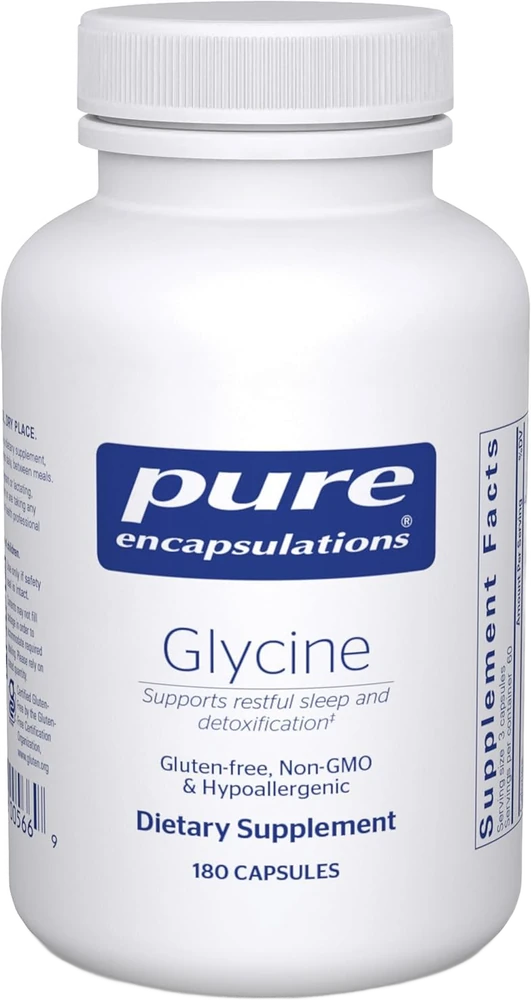
Best clean-label capsules: Pure Encapsulations Glycine
8.4SAC Score™The cleanest, most allergen-conscious label here — hypoallergenic plain glycine for sensitive users. The pick when label purity outranks cost and capsule count.
StrongestPurity & form9.51WeakestValue (per 3 g dose)6.2- Per serving
- 1,500 mg per 3 caps (so 3 g = 6 caps)
- Bottle
- 180 capsules (60 × 3-cap servings)
- Testing
- Clinician-grade, hypoallergenic, third-party verified
All five scores, pros & cons, full label
What We Like- Among the cleanest labels in supplements — hypoallergenic, free of common allergens and needless excipients
- Clinician-preferred brand with a 30+ year QC reputation
- Plain free-form glycine, vegan and gluten-free
- Ideal for chemically-sensitive users who react to fillers
What You Live With- 500 mg per capsule means the 3 g sleep dose is six capsules — tied with Double Wood and Solgar for the highest pill count
- Premium pricing — among the highest cost per gram on the list
- Form
- Plain glycine capsules (hypoallergenic)
Our take — Pure Encapsulations is the pick for one specific buyer: someone who wants the cleanest, most allergen-free label possible and is willing to pay for it. The hypoallergenic formulation and clinician-grade QC are genuinely best-in-class. The catch is purely practical — at 500 mg per capsule, the studied 3 g dose is six capsules a night, and the cost per gram is at the top of the list. If you have allergen sensitivities or simply want the most transparent label, it's worth it; if you just want plain glycine at a fair price, a powder or the 1 g-capsule picks make more sense.
- 06
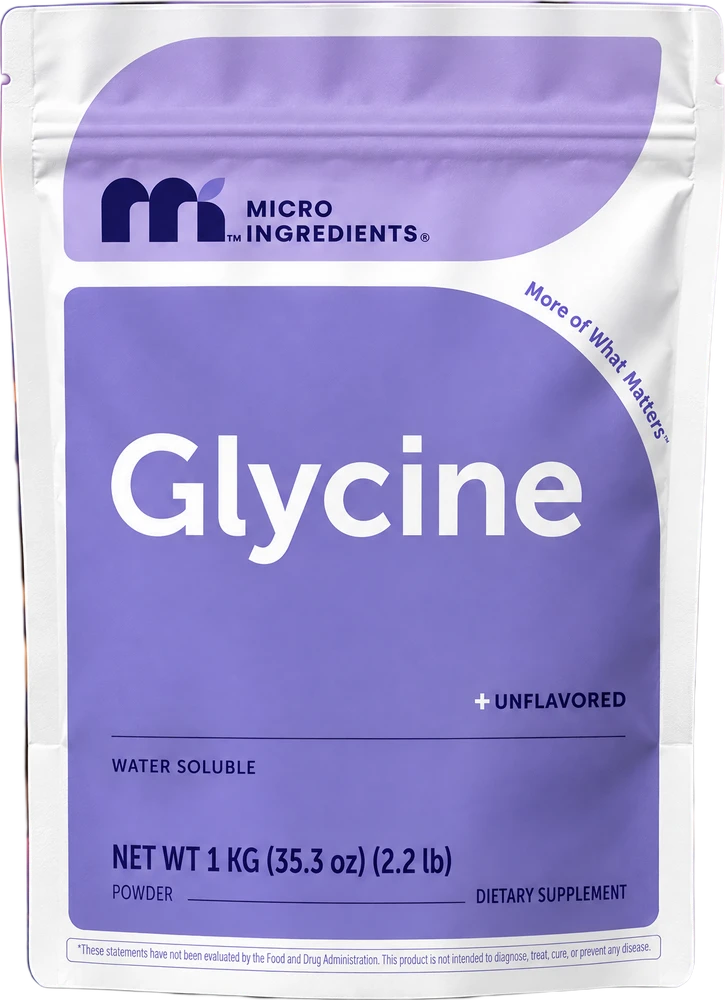
Big 1 kg Pouch: Micro Ingredients Glycine Powder
8.2SAC Score™Free-form glycine and nothing else on the panel, 1,000 servings in a 1 kg pouch, about 9 cents for a 3 g dose. The scoop is 1 g, so the studied dose is three scoops, and the testing claim names no lab.
StrongestValue (per 3 g dose)9.52WeakestThird-party testing7.0- Per serving
- 1,000 mg glycine per 1 scoop (1 g); 3 g = 3 scoops
- Size
- 1 kg (2.2 lb) pouch, 1,000 servings
- Testing
- Third Party Lab Tested printed, no lab named · not in the NSF Certified for Sport listing
All five scores, pros & cons, full label
What We Like- Glycine (Free-Form) is the only ingredient; Other Ingredients: None
- About 9 cents for a 3 g dose; 1,000 servings in the pouch
- Free of soy, dairy and gluten, with a Non-GMO seal on the pack
What You Live With- The scoop is 1 g, so the studied 3 g dose is three scoops
- The label suggests one scoop, a third of the studied dose
- Third Party Lab Tested names no lab and has no NSF listing
- Form
- Free-form glycine powder (unflavored)
Our take — The pick for a buyer who wants plain free-form glycine at a very low price per dose and will count three scoops a night. The panel is one line, Glycine (Free-Form) 1,000 mg per 1 g scoop, with Other Ingredients: None, and about 9 cents for 3 g is cheap. What holds it back is a scoop a third the size of Nutricost's, a label that suggests one scoop, a scoop volume we could not confirm against 1 g, and a testing claim with no lab behind it. If you want one scoop to be the whole dose, Nutricost (8.8) is the easier routine.
- 07
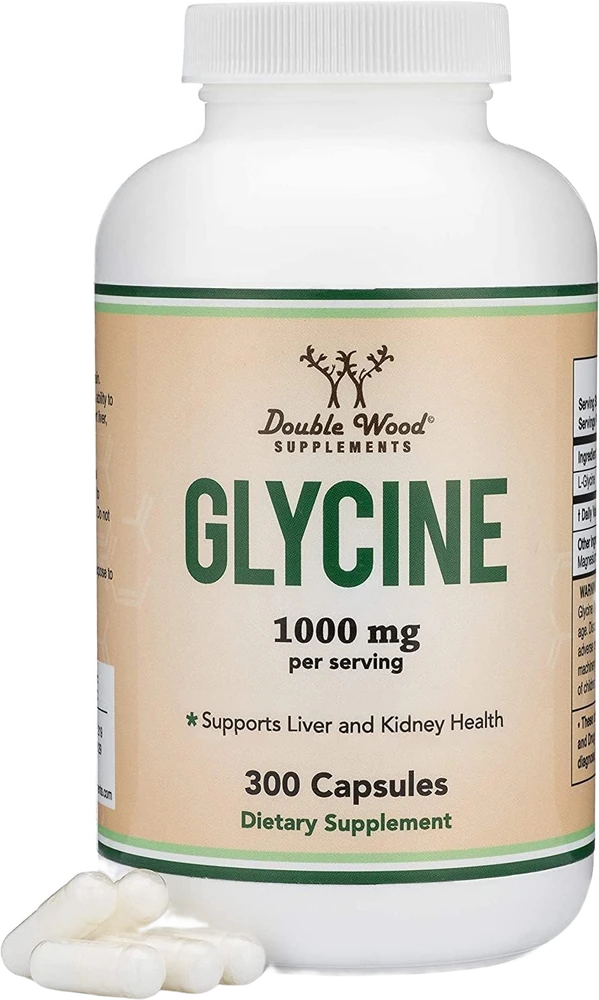
Best budget capsules: Double Wood Glycine
8.1SAC Score™1,000 mg per two-capsule serving, 300 caps per bottle, third-party tested — the cheapest capsule route to the 3 g dose (six caps). The value option if you want capsules over powder.
StrongestValue (per 3 g dose)9.23WeakestTaste & mixability6.8- Per serving
- 1,000 mg per 2 capsules (so 3 g = 6 caps)
- Bottle
- 300 capsules (50 × 6-cap doses)
- Testing
- Third-party tested, non-GMO, gluten-free
All five scores, pros & cons, full label
What We Like- Flexible 500 mg capsules if you also want smaller 1-2 g doses
- 300-capsule bottle = about 50 nights of the full 3 g dose
- Cheapest cost per gram of any capsule here
- Plain glycine, third-party tested, non-GMO and gluten-free
What You Live With- At 500 mg per capsule, the 3 g dose is six capsules a night — twice Thorne's count
- Testing transparency is good but not at the Thorne / Pure Encapsulations tier
- Still costs more per gram than any of the powders
- Form
- Plain glycine capsules (500 mg each)
Our take — If you've decided on capsules and value is your priority, Double Wood is the answer. The 1,000 mg two-capsule serving means the 3 g dose is six caps, the 300-count bottle lasts about 50 nights, and the per-gram cost is the lowest of any capsule on the list. You give up a little of the elite testing pedigree you'd get from Thorne or Pure Encapsulations, and you swallow six caps where Thorne needs three, but for plain, third-party-tested glycine in convenient capsules at the best capsule price, it's the smart budget buy. Powder is still cheaper per gram if you'll mix it.
- 08
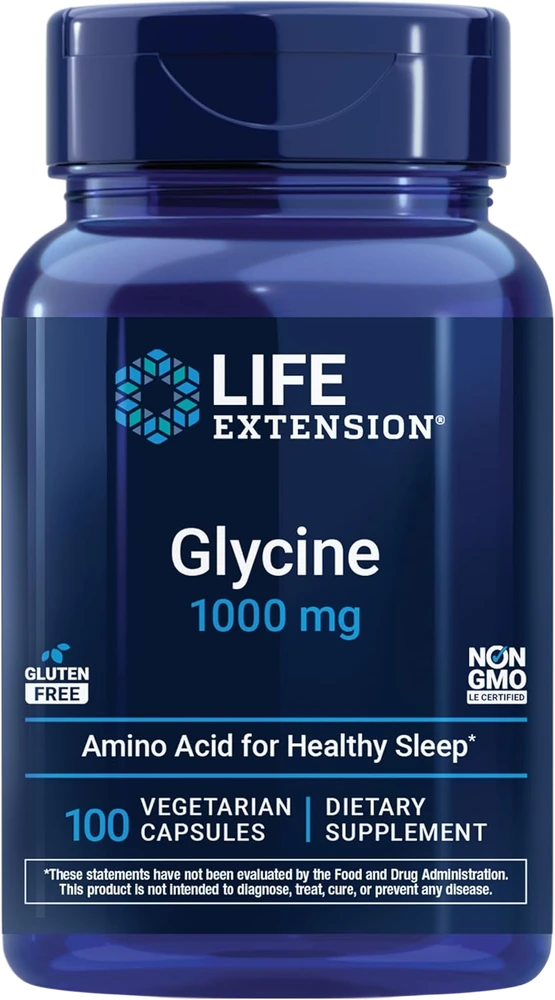
Best premium-brand single cap: Life Extension Glycine
8.0SAC Score™A 1,000 mg single-cap glycine from a QC-respected brand with a COA — but a 100-count bottle covers only ~33 nights at the full 3 g dose.
StrongestPurity & form9.02WeakestTaste & mixability6.8- Per serving
- 1,000 mg per capsule (so 3 g = 3 caps)
- Bottle
- 100 capsules (~33 nights at the 3 g dose)
- Testing
- Life Extension QC, Certificate of Analysis available
All five scores, pros & cons, full label
What We Like- 1 g per capsule keeps the 3 g dose to three caps
- Life Extension's QC pedigree is among the most respected in the industry, with a COA
- Plain glycine, vegetarian, non-GMO, gluten-free
- Brand explicitly positions glycine for healthy sleep — straightforward labeling
What You Live With- 100-count bottle is small — only ~33 nights at the full 3 g dose, so you reorder often
- Cost per gram is higher than Double Wood's budget capsules
- Form
- Plain glycine capsules (1,000 mg each)
Our take — Life Extension makes a perfectly good 1 g glycine capsule, and the brand's QC reputation and published COA give it real credibility. The reason it sits at #8 rather than higher is pure economics: the bottle is only 100 capsules, which is about 33 nights at the 3 g sleep dose, and the cost per gram lands above Double Wood's budget capsules. If you're already a Life Extension loyalist and want a single-cap glycine with a strong QC story, it's a fine choice — but for a cheaper capsule route to the same dose, Double Wood (#7) wins, and any powder beats it on value outright.
- 09
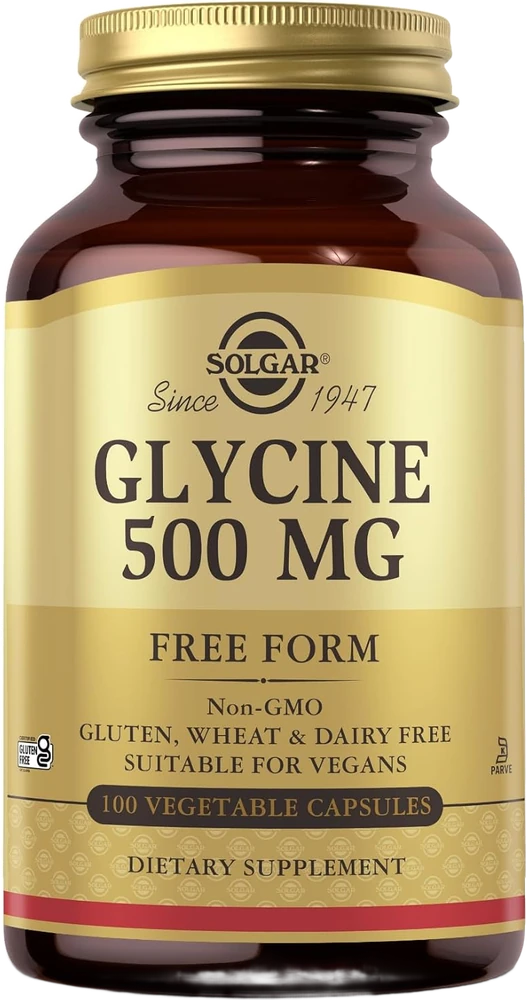
Trusted brand (smallest cap dose): Solgar Glycine 500 mg
7.6SAC Score™A legacy, heritage-brand free-form glycine — clean and trustworthy, but at 500 mg per capsule the 3 g sleep dose means swallowing six, in a 100-count bottle.
StrongestPurity & form9.02WeakestValue (per 3 g dose)6.4- Per capsule
- 500 mg (so 3 g = 6 caps)
- Bottle
- 100 vegetable capsules (label dose: 1 cap 2×/day)
- Testing
- Solgar Gold Standard QC, non-GMO, vegan, kosher
All five scores, pros & cons, full label
What We Like- Heritage brand with a long-standing Gold Standard QC reputation
- Plain free-form L-glycine — clean, non-GMO, vegan, kosher
- Quality and purity of the glycine itself are not in question
- Good fit for someone who only wants Solgar's smaller label dose (500 mg-1 g)
What You Live With- At 500 mg per capsule, the studied 3 g sleep dose is six capsules a night
- 100-count bottle plus 6-caps-per-dose means it empties in ~16 nights at the full dose
- Among the highest cost per 3 g dose on the list
- Form
- Plain free-form glycine capsules
Our take — Solgar is a trustworthy, heritage brand and the glycine itself is clean free-form L-glycine — this is not a quality knock. It ranks last purely on fit for the sleep use case: at 500 mg per capsule, hitting the studied 3 g dose means six capsules every night, and a 100-count bottle disappears in roughly two weeks at that rate, which makes it both inconvenient and expensive per dose. If you specifically want Solgar and you're using glycine at a smaller daily amount, it's perfectly good. For the 3 g sleep dose, a powder (#1-#3) or a 1 g capsule (#4, #7, #8) is the better tool.
The Guide In Four Short Lessons
What the evidence actually shows (and doesn't)
- 3 g
- The pre-bed glycine dose used across the human sleep studies
- ~10-20
- Subjects per human study — the evidence base is small, mostly one lab
- ↓ latency
- Glycine shortened PSG time to fall asleep and to slow-wave sleep (Yamadera 2007)
- ↓ fatigue
- Next-day fatigue + sleepiness improved after 3 g under sleep restriction (Bannai 2012)
Sources: Yamadera 2007 (Sleep Biol Rhythms; subjective + PSG); Bannai 2012 (PMID 22529837; next-day performance); Kawai 2015 (PMID 25533534; NMDA/SCN mechanism, rats).
Buy plain glycine, not a blend.
Magnesium glycinate is a magnesium product and NAC plus glycine is a glutathione product. Vague 'complex' tubs bury the dose.
Check how easily a serving hits 3 g.
The studied dose is about 3 g taken 30-60 minutes before bed. Powder makes that trivial to scoop and cheap per gram; capsules earn their place on convenience.
Expect a gentle aid, not a sedative.
About 3 g shortened the time to fall asleep in a small polysomnography study (Yamadera 2007). The evidence is moderate: small studies, mostly from one research group.
Three glycine sleep studies — Bannai 2012 (PMID 22529837), Kawai 2015 (PMID 25533534), and the canonical Yamadera 2007 PSG study (no PMID). Full scoring in the methodology below.
Each pick was scored 0-10 across five criteria, then weighted to a final composite. Purity and third-party testing carry the most weight (25% each) because glycine is a commodity ingredient — the entire job is making sure you're getting clean, verified, plain glycine and not a blend or an untested powder. Dose accuracy (20%) rewards products that let you hit the studied 3 g dose cleanly: a 3 g powder scoop or a 1 g capsule beats a 500 mg capsule that forces you to swallow six. Taste and mixability (15%) is a real factor here and a rare case where the ingredient helps itself — glycine is naturally sweet, so a good powder is pleasant in water or tea, while capsules sidestep taste entirely. Value (15%) is cost per 3 g dose, where glycine's rock-bottom price means bulk powder usually wins decisively. We do not invent numbers; the only clinical figures we cite are the published glycine sleep studies, and we flag their small size honestly.
Purity & form (plain glycine, no fillers) · 25%
Is it 100% plain glycine, or is it cut with fillers or sold as a blend? Plain, free-form glycine scores highest; anything labeled 'complex,' NAC+glycine, or magnesium glycinate is disqualified outright because the sleep evidence is for glycine by itself. Minimal, necessary capsule excipients are fine and lightly noted.
Third-party testing / quality · 25%
Per-batch third-party testing, a public COA, ISO-accredited labs, or third-party certification (e.g. Thorne's) score highest; a GMP-certified, FDA-registered facility is the baseline. Because glycine is a cheap commodity, verification is the main thing separating a trustworthy powder from an anonymous one.
Dose accuracy (3 g target) · 20%
How cleanly can you hit the studied ~3 g pre-bed dose? A powder where one scoop equals 3 g, or a 1,000 mg capsule (three caps), scores highest. A 500 mg capsule (six caps for 3 g) is penalized for the swallow burden, even if the glycine itself is fine.
Taste & mixability · 15%
Glycine is naturally sweet, which is a genuine advantage for powders — they dissolve clear and taste pleasant in water or tea, no flavoring needed. Powders that mix cleanly score highest. Capsules are scored neutral-to-good here: they avoid taste entirely, which suits people who don't want to mix anything.
Value (cost per 3 g dose) · 15%
Price divided by the number of 3 g doses in the package. Glycine is one of the cheapest amino acids made, so bulk powder lands at a few cents per dose and capsules cost several times more per gram. Tie-breaker — purity and testing do most of the ranking, but value is decisive between otherwise-equal picks.

How glycine nudges you toward sleep
- 1
3 g of free glycine reaches the brain
Glycine is the smallest amino acid and crosses readily. Taken on its own at ~3 g before bed, it raises glycine availability without the fillers or competing ingredients of a blend.
- 2
It acts on NMDA receptors in the SCN
Kawai 2015 (in rats) found glycine acts on NMDA receptors in the suprachiasmatic nucleus — the master circadian clock — increasing blood flow to the skin. Glycine is also an inhibitory neurotransmitter in its own right.
- 3
Core temperature drops, sleep follows
More skin blood flow sheds heat, lowering core body temperature — the same drop that naturally precedes sleep. In humans, 3 g shortened PSG time to fall asleep (Yamadera 2007) and cut next-day fatigue (Bannai 2012). A gentle push, not a sedative.
What to expect on glycine
A subtle settling (maybe)
Some people notice falling asleep a bit easier or feeling slightly warmer-then-cooler at lights-out. It's gentle — if you expect a sedative hit, you'll miss it. No grogginess.
Better mornings after short nights
The most reliable, best-replicated benefit shows here: on days following a poor or short night, less fatigue and brain fog than usual (the Bannai 2012 finding).
Decide if it's a keeper
By two weeks you'll know. If mornings are fresher and sleep onset is easier, keep it (and switch to bulk powder for cost). If nothing moved, you may be a non-responder — fix sleep timing or stack magnesium glycinate + L-theanine.
The bottom line
The answer: NOW Foods Glycine Pure Powder (#1).
It is 100% pure glycine, the panel prints the studied 3 g dose as the serving (3/4 level teaspoon), it comes from a brand with one of the strongest in-house QC records in the industry, and at about 10 cents per dose it is among the cheapest ways to take it. If you are at all willing to mix a powder, start here.
Every buyer has a clear alternative, at its own rank.
Nutricost (#2) is the powder with a measuring scoop included in the tub; BulkSupplements (#3) has the lowest cost per gram in the category and per-batch, multi-stage testing. If you'd rather take capsules, Thorne (#4) has the best testing in a 1 g cap, Pure Encapsulations (#5) is the cleanest allergen-free label, and Double Wood (#7) is the cheapest capsule route.
The rule to leave with: plain glycine, 3 g, give it two weeks.
Skip magnesium glycinate, NAC+glycine, and vague 'complex' tubs — the sleep evidence is for glycine by itself. Take 3 g, 30-60 minutes before bed, and stack it with good sleep timing and a cool room. Glycine is a small, well-tolerated edge, not a cure.
Quick Answers
Does glycine actually help you sleep?
Modestly, and the honest answer is 'the evidence is moderate, not strong.' A small cluster of studies — most with only 10-20 people, most from one research group — found that about 3 g of glycine before bed improved subjective sleep quality, shortened the time to fall asleep and to reach deep (slow-wave) sleep on polysomnography (Yamadera 2007), and reduced next-day fatigue and sleepiness after a short night (Bannai 2012). Those are real, replicated-ish signals, but they're subtle. Glycine is a gentle, well-tolerated aid with a plausible mechanism — not a sedative, and not a fix for chronically bad sleep habits.
How much glycine should I take, and when?
3 grams, 30-60 minutes before bed. That's the dose used across the human sleep studies, and there's no evidence that more works better for sleep. With powder, that's a single 3 g scoop stirred into water or tea. With capsules, it's three 1,000 mg capsules or six 500 mg capsules — which is exactly why, for the sleep dose specifically, powder is so much more practical than a 500 mg capsule.
Powder or capsules — which is better for sleep?
For the 3 g sleep dose, powder wins on almost every axis. It's far cheaper per gram (glycine is one of the cheapest amino acids made), it mixes easily into liquid, and because glycine is naturally sweet it actually tastes pleasant — no flavoring needed. The single 3 g scoop also makes hitting the studied dose effortless. Capsules win only on convenience and travel: no scooping, no glass, easy to pack. If cost and dose-accuracy matter most, buy powder; if grab-and-go matters most, buy 1 g capsules (so it's three, not six).
How does glycine make you sleepy?
The leading explanation comes from Kawai 2015 (a rat study): glycine acts on NMDA receptors in the suprachiasmatic nucleus — the brain's master circadian clock — which increases blood flow to the skin and lowers core body temperature. A falling core temperature is one of the body's natural cues that it's time to sleep, so glycine appears to nudge that drop along. Glycine is also an inhibitory neurotransmitter in its own right. The temperature mechanism is why people who run hot or feel 'wired' at night often notice glycine the most.
Should I buy plain glycine or a blend like NAC + glycine or magnesium glycinate?
For sleep, buy plain glycine. Magnesium glycinate is a magnesium supplement (the glycine is just the carrier) — a fine sleep product, but a different one. NAC + glycine (sometimes sold as 'GlyNAC') is aimed at glutathione and aging research, not sleep. 'Glycine complex' products bury the glycine among other ingredients and make the cost-per-gram impossible to compute. The sleep studies all used plain glycine at 3 g, so that's what this list ranks — every blend was disqualified.
Is glycine safe? Any side effects?
Glycine has a very clean safety profile at the doses used for sleep. 3 g nightly was well tolerated across the human studies, with no meaningful side effects reported; it's a non-essential amino acid your body already makes and that's present in food. Occasional users report mild GI upset or a slightly soft stool at higher doses. As always, if you're pregnant, nursing, on prescription medication, or managing a kidney or liver condition, check with your doctor first. Glycine is not a sedative and doesn't appear to cause next-day grogginess — that gentleness is part of its appeal.
How long until glycine works?
If it's going to help your sleep onset, you may feel a subtle 'settling' the first few nights — but glycine is gentle, so don't expect to be knocked out. The most reliable benefit (less next-day fatigue after a short night) is something you'll notice the morning after, not at bedtime. Give it one to two weeks of nightly use at 3 g before deciding. If nothing has shifted at all by then, you may simply be a non-responder, or your sleep issue may not be the kind glycine addresses — try fixing sleep timing and light exposure, or stack magnesium glycinate and L-theanine.
Every Claim Ranked Above Traces Back To One Of These
3 sources — studies link to PubMed, product specs to the manufacturer
- [1] Bannai 2012 PMID 22529837 — The effects of glycine on subjective daytime performance in partially sleep-restricted healthy volunteers. In healthy volunteers whose sleep was restricted to 75% of normal for three nights, 3 g of glycine before bed significantly reduced subjective daytime fatigue and sleepiness and improved psychomotor vigilance (reaction-time) performance versus placebo. The best-replicated glycine sleep finding — but a small study, and the benefit appeared mainly on the first restricted day. Authors are affiliated with Ajinomoto, a glycine manufacturer (noted for transparency).
- [2] Kawai 2015 PMID 25533534 — The sleep-promoting and hypothermic effects of glycine are mediated by NMDA receptors in the suprachiasmatic nucleus. Mechanistic study in rats: oral glycine promoted sleep and lowered core body temperature by acting on NMDA receptors in the suprachiasmatic nucleus (the master circadian clock), increasing cutaneous blood flow and heat loss; ablating the SCN abolished the effect. Provides the leading biological explanation for glycine's sleep effect — but it is an animal study, so extrapolation to humans is indirect.
- [3] Yamadera 2007 — Glycine ingestion improves subjective sleep quality in human volunteers, correlating with polysomnographic changes. In volunteers with chronic unsatisfactory sleep, 3 g of glycine before bed improved subjective sleep quality and sleep efficacy and, on polysomnography, shortened latency to sleep onset and to slow-wave sleep without altering overall sleep architecture. The canonical human glycine-sleep study and the source of the 3 g dose — but small (~11 subjects), from the Ajinomoto group, and published in a journal that PubMed does not index, so no PMID is available. Cited honestly without a fabricated identifier; PMID to verify only if the journal is ever indexed.
Affiliate disclosure: every Amazon link uses our Associates tag (superachieverclub-20). We earn a small commission at no cost to you; it funds independent reviews. We never accept payment to change a ranking.