
Solgar Glycine 500 mg Review
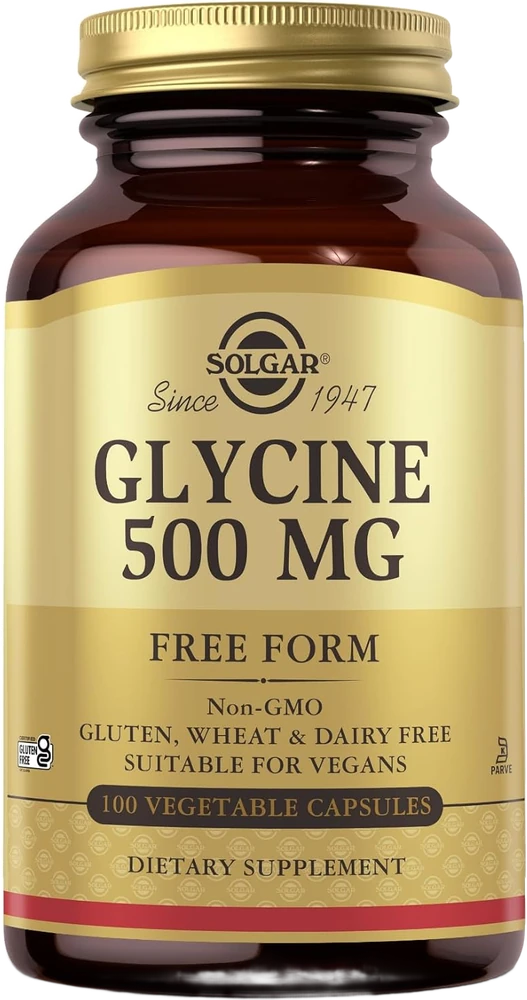 #8 of 8 · Trusted brand✓ Label verified · Supplement Facts read Sep 7, 2026
Real retailer photo, cut out. Label unedited.
Buy it. A clean heritage-brand glycine — but at 500 mg/cap the 3 g sleep dose is six capsules. Solgar's Gold-Standard-QC free-form L-glycine is clean, non-GMO, vegan and kosher — the ingredient is not the issue.
Premium-brand capsule pricing per gramHighest practical per 3 g dose (6 × 500 mg caps)
Why It Scores 7.6 — And The Label Line Behind Each Number
Purity & form
25% of scorePlain free-form L-glycine — non-GMO, vegan and kosher, no blend. Clean and exactly the glycine the sleep studies used; the ingredient scores level with the better capsules on purity. Nothing about the glycine itself is in question anywhere in this pick's ranking — the drawbacks are all about dose fit.
- Form
- Plain free-form glycine capsules
- Per capsule
- 500 mg (so 3 g = 6 caps)
- Diet
- Non-GMO, vegan, kosher
Third-party testing
25% of scoreSolgar's long-standing Gold Standard QC reputation is a genuine strength — a heritage brand with decades of trust behind it. It scores below Thorne's third-party certification and Pure Encapsulations' clinician-grade tier, but comfortably in the trustworthy range for a commodity ingredient.
- Testing
- Solgar Gold Standard QC
Dose accuracy (3 g)
20% of scoreThe worst on the list for the sleep dose. At 500 mg per capsule, the studied 3 g dose is six capsules a night — tied for the most of any pick. The glycine amount is fine; it is the swallow burden that is heavily penalized. A 1 g cap (Thorne, Double Wood) halves the count, and a scooped powder eliminates it.
Taste & mixability
15% of scoreScored neutral, as capsules are throughout this ranking. A capsule avoids taste entirely — good for people who do not want to mix — but forfeits glycine's naturally sweet, pleasant-in-water quality, a genuine upside of the powders. A different trade, not a better or worse one.
Value (per 3 g dose)
15% of scoreAmong the highest cost per 3 g dose on the list. A 100-count bottle plus six caps per dose means it empties in roughly 16 nights at the full sleep dose, so you reorder constantly and the effective cost per dose is high. Premium-brand pricing on a 500 mg cap is simply the wrong economics for the 3 g sleep target.
- Bottle
- 100 vegetable capsules (label dose: 1 cap 2×/day)
- Supply
- ~16 nights at the full 3 g sleep dose
- Value
- Among the highest cost per 3 g dose on the list
- More Specs
- Convenience
- Capsule — but six per 3 g research dose
Label verified. Every figure read from the Supplement Facts photo, Sep 7, 2026.
Marketing Claims Vs. Reality
Plain free-form L-glycine, 500 mg per capsule.
The listing states 500 mg of free-form glycine per capsule. This is the plain glycine this ranking requires, and the 500 mg cap is the honest reason the studied 3 g sleep dose is six capsules a night — the claim holds as stated.
Non-GMO, vegan and kosher, with Solgar's Gold Standard QC.
The product overview states a non-GMO, vegan, kosher formula, and Solgar's Gold Standard QC reputation is well documented. Appropriate, credible verification for a commodity amino acid from a heritage brand — the claim is accurate.
100 vegetable capsules per bottle.
The listing lists 100 vegetable capsules. At the studied 3 g sleep dose (six caps), that is only about 16 nights — the arithmetic behind the review's value and supply concerns. Accurate.
Supports glycine's role in sleep and relaxation.
Directionally supported by the human evidence on glycine — Yamadera 2007 and Bannai 2012 — but that evidence is moderate, drawn from a few small studies mostly from one lab, and describes glycine generally rather than this product. A reasonable category claim, not a proven product-specific outcome; note the label's own suggested use is a smaller daily amount than the 3 g sleep dose.
What Our Test Actually Found
Correction: the label prints 500 mg per capsule, not a 3 g total
An earlier version of this review's Convenience spec read "but six per 3 g dose" without labeling where the 3 g came from. The Supplement Facts panel prints Glycine 500 mg per capsule (serving size: 1 capsule) — it does not print any 3 g figure. We re-read the label on Sep 7, 2026 and corrected the spec to read "3 g research dose," making clear that 3 g is the studied sleep-research target (Yamadera 2007; Bannai 2012, PMID 22529837), not a value on the label.
Clean glycine, wrong tool for the 3 g sleep dose
The most important thing to say up front is that this is not a quality knock. Solgar's free-form L-glycine is clean, non-GMO, vegan and kosher, from a heritage brand with a Gold Standard QC reputation. The problem is purely one of fit: the capsule is 500 mg, so the studied 3 g sleep dose is six capsules a night — tied for the most of any pick. For someone using glycine at the label's smaller daily amount, that is fine; for the 3 g sleep target specifically, it is the wrong tool.
The bottle math is the real dealbreaker
Six capsules per dose against a 100-count bottle means Solgar empties in roughly 16 nights at the full 3 g sleep dose. That is the shortest run of any pick, so you reorder constantly, and the effective cost per dose climbs to among the highest on the list. Premium-brand pricing on a small-dose capsule is simply the wrong economics for a supplement you take nightly at 3 g — which is exactly why it lands at #8 despite clean glycine and a trusted name.
Better tools exist for the same job
If you want the 3 g sleep dose, almost anything on this list serves it better: a scooped powder (#1 to #3) gives you the dose in one scoop at a fraction of the cost, and a 1 g capsule (Thorne #4, Double Wood #6) halves the count to three caps. Solgar makes sense only if you are a brand loyalist using glycine at a smaller daily amount. For the studied sleep dose, choose a powder or a 1 g cap instead.
Same gentle effect, same honest caveat
The dose-fit issues aside, this still delivers just glycine: a gentle aid backed by moderate evidence from a few small studies. About 3 g before bed improved subjective sleep quality and shortened polysomnographic sleep latency (Yamadera 2007), and most reliably reduced next-day fatigue after a short night (Bannai 2012). If you do take six caps nightly, give it one to two weeks before judging and stack it with a cool room and consistent sleep timing. Glycine is a small, well-tolerated edge, not a cure — and for that edge, a better-fitting product will serve you at the 3 g dose.
Full analysis: all pros & cons (7), buy if / skip if
- Heritage brand with a long-standing Gold Standard QC reputation
- Plain free-form L-glycine — clean, non-GMO, vegan, kosher
- Quality and purity of the glycine itself are not in question
- Good fit for someone who wants Solgar at a smaller daily amount (500 mg to 1 g)
- At 500 mg per capsule, the studied 3 g sleep dose is six capsules a night
- 100-count bottle plus 6 caps per dose empties in ~16 nights at the full dose
- Among the highest cost per 3 g dose on the list
- You specifically want Solgar and use glycine at a smaller daily amount (500 mg to 1 g)
- You value a heritage brand with a Gold Standard QC reputation
- You want plain free-form L-glycine that is non-GMO, vegan and kosher
- Brand preference outweighs capsule count for you
- You want the studied 3 g sleep dose without swallowing six capsules a night
- You want a long-running supply — a 100-count bottle is only ~16 nights at 3 g
- You want the best value or fewest capsules — see a powder (#1 to #3) or a 1 g cap (#4, #6)
Solgar's Gold-Standard-QC free-form L-glycine is clean, non-GMO, vegan and kosher — the ingredient is not the issue. It ranks last for the sleep use case because a 500 mg capsule makes the studied 3 g dose six caps a night, and a 100-count bottle lasts only about two weeks at that rate. Fine if you want Solgar at a smaller daily amount; for the 3 g sleep dose a powder or a 1 g cap is the better tool.
Solgar is a trustworthy, heritage brand and the glycine itself is clean free-form L-glycine — non-GMO, vegan and kosher, with the company's long-standing Gold Standard QC behind it. This is not a quality knock: the purity and quality of the glycine are not in question, and for a buyer who specifically wants Solgar at a smaller daily amount it is perfectly good. It ranks last purely on fit for the sleep use case. At 500 mg per capsule, hitting the studied 3 g dose means six capsules every night, and a 100-count bottle disappears in roughly two weeks at that rate — which makes it both inconvenient and expensive per dose for this specific job. If you want Solgar and use glycine at 500 mg to 1 g, it is a fine choice. For the 3 g sleep dose, a powder (#1 to #3) or a 1 g capsule (#4, #6) is the better tool. Here is the full breakdown.
A clean heritage-brand glycine — buy it at a smaller daily amount; for the 3 g sleep dose, a powder or 1 g cap wins.

Solgar Glycine 500 mg is a trustworthy, heritage-brand product and the glycine itself is clean free-form L-glycine — non-GMO, vegan and kosher, with Gold Standard QC behind it. That is worth stating plainly: this is not a quality knock, and for a buyer using glycine at the label's smaller daily amount it is perfectly good. It ranks last purely on fit for the sleep use case. At 500 mg per capsule, the studied 3 g dose means six capsules every night, and a 100-count bottle disappears in roughly two weeks at that rate — inconvenient and expensive per dose for this specific job. If you specifically want Solgar and take glycine at 500 mg to 1 g, it is a fine choice. For the 3 g sleep dose, a powder (#1 to #3) or a 1 g capsule (Thorne #4, Double Wood #6) is the better tool. If you do use it at 3 g, take six caps 30 to 60 minutes before bed, give it one to two weeks, and stack it with good sleep timing and a cool room.
If This Doesn’t Fit — Try These
 03
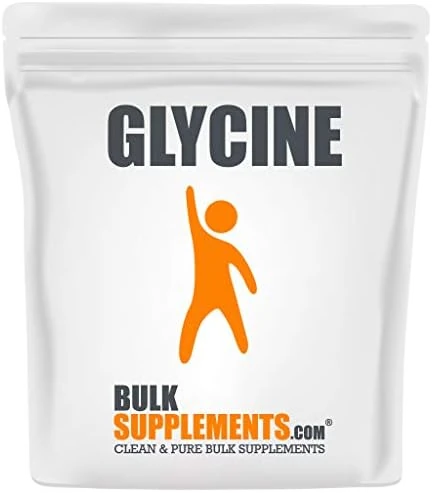
03BulkSupplements Glycine Powder
For the lowest cost per gram with real per-batch testing, this is the one to buy.
 04
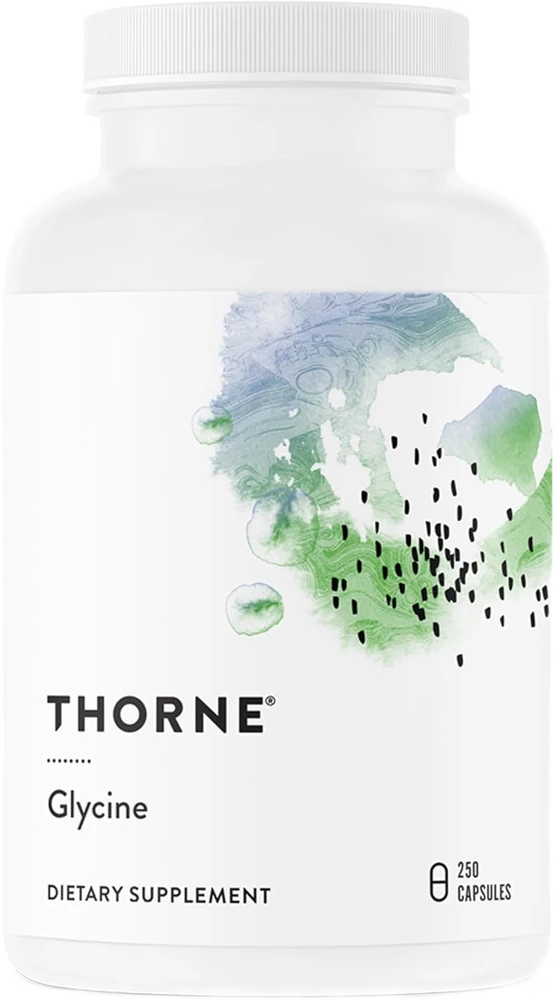
04Thorne Glycine
If you want capsules instead of powder, Thorne is the one to beat — the testing pedigree is the best here, it's a brand clinicians and pro teams actually rely on, and crucially it's a 1 g capsule, so hitting the 3 g dose takes three caps rather than six.
 06
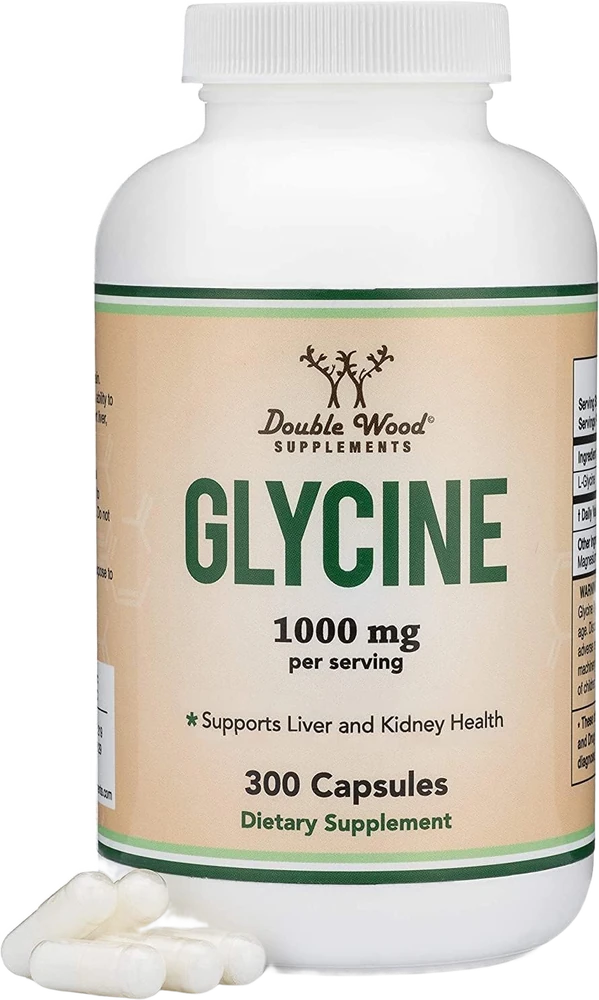
06Double Wood Glycine
If you've decided on capsules and value is your priority, Double Wood is the answer.
Quick Answers
How many Solgar capsules make the 3 g sleep dose?
Six. Solgar's capsule is 500 mg, so the studied 3 g pre-bed dose (Yamadera 2007; Bannai 2012, PMID 22529837) is six capsules a night — tied for the most of any pick on the list. The label's own suggested use is smaller (one capsule twice daily). Six caps a night is the honest reason this ranks last for the sleep use case specifically, despite being a clean, trustworthy product.
Is the glycine itself any good?
Yes — this is not a quality knock. Solgar is a heritage brand with a long-standing Gold Standard QC reputation, and the product is plain free-form L-glycine: clean, non-GMO, vegan and kosher. The purity and quality of the glycine are not in question. What holds it back is entirely the 500 mg capsule size relative to the 3 g sleep dose, not the ingredient.
When would Solgar actually be the right pick?
If you specifically want Solgar and you are using glycine at a smaller daily amount — say the label's 500 mg to 1 g — rather than the full 3 g sleep dose. At that lower intake the 500 mg cap and 100-count bottle are perfectly reasonable. For the 3 g sleep dose, though, a powder (#1 to #3) or a 1 g capsule (Thorne #4, Double Wood #6) is the better tool because it avoids six caps a night.
Is it plain glycine or a blend?
Plain free-form L-glycine — non-GMO, vegan, kosher, no blend. The sleep evidence is for glycine by itself, so 'glycine complex,' NAC+glycine, and magnesium glycinate were disqualified from this ranking. Solgar's capsule is exactly the plain glycine you want; the only issue is that at 500 mg per cap the 3 g dose takes six of them.
Sources & Further Reading
3 sources — studies link to PubMed, product specs to the manufacturer
- [1] Bannai 2012 PMID 22529837 — The effects of glycine on subjective daytime performance in partially sleep-restricted healthy volunteers. In healthy volunteers whose sleep was restricted for three nights, 3 g of glycine before bed significantly reduced subjective daytime fatigue and sleepiness and improved reaction-time performance versus placebo. The best-replicated glycine sleep finding — but a small study, and the authors are affiliated with a glycine manufacturer (noted for transparency).
- [2] Kawai 2015 PMID 25533534 — The sleep-promoting and hypothermic effects of glycine are mediated by NMDA receptors in the suprachiasmatic nucleus. Mechanistic study in rats: oral glycine promoted sleep and lowered core body temperature by acting on NMDA receptors in the suprachiasmatic nucleus (the master circadian clock), increasing skin blood flow and heat loss. Provides the leading biological explanation for glycine's sleep effect — but it is an animal study, so extrapolation to humans is indirect.
- [3] Yamadera 2007 — Glycine ingestion improves subjective sleep quality in human volunteers, correlating with polysomnographic changes. In volunteers with unsatisfactory sleep, 3 g of glycine before bed improved subjective sleep quality and, on polysomnography, shortened latency to sleep onset and to slow-wave sleep. The canonical human glycine-sleep study and the source of the 3 g dose — but small (~11 subjects) and published in a journal PubMed does not index, so no PMID exists. Cited honestly without a fabricated identifier.
Affiliate disclosure: every Amazon link uses our Associates tag (superachieverclub-20). We earn a small commission at no cost to you; it funds independent reviews. We never accept payment to change a ranking.