
4 Foods vs a Statin: A 4-Week Trial Cut LDL Cholesterol by 29 %. The Amounts, and the Catch
In a 2003 trial in JAMA, 46 adults with high cholesterol ate oats and barley, almonds, soy and a plant-sterol margarine every day. After 4 weeks their LDL was 28.6 % lower, against 30.9 % on a starter dose of a statin. The researchers delivered the food. With advice only, people reached about 13 %. Here are the amounts per day, a sample day, and what this doesn't mean.
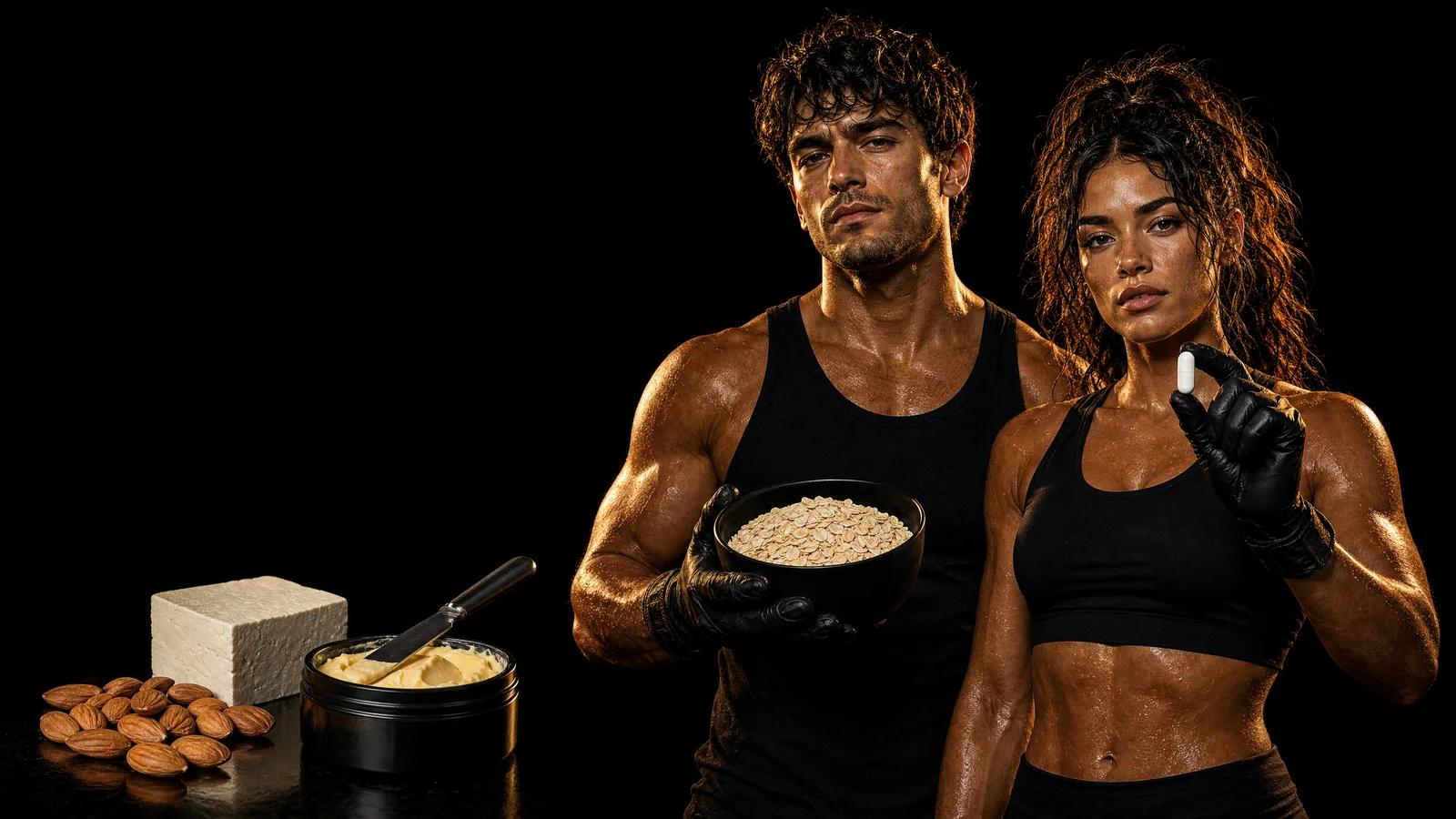
A man holding a black bowl of rolled oats and a woman holding up a single white pill, both in black on pure black; in front of them almonds, a block of tofu and a tub of spread
The amounts our video promised come first. In the 2003 trial, the 4 foods were dosed per 1,000 calories. For a day of 2,000 calories that makes about 20 grams of sticky fiber from oats, barley and psyllium, 28 grams of whole almonds (one ounce, a handful), about 43 grams of soy protein from soy milk, tofu and soy burgers, and 2 grams of plant sterols from a fortified margarine. This is analysis of published research, not medical advice, and no reason to stop a prescribed statin.
Which 4 foods lowered cholesterol in the trial?
- Sticky (viscous) fiber: oats, barley and psyllium, about 20 grams of this fiber a day, plus eggplant and okra on alternate days.
- Almonds: 28 grams a day, whole.
- Soy protein: about 43 grams a day, as soy milk and soy-based meat substitutes; the sample day also has a tofu bake.
- Plant sterols: 2 grams a day, in a margarine enriched with plant sterol esters.
These figures come from the methods section of Jenkins and colleagues in JAMA 2003, which gives them per 1,000 calories: 9.8 g viscous fiber, 14 g almonds, 21.4 g soy protein, 1.0 g plant sterols. All three diets in the trial were vegetarian.
What did a day on the 4 foods look like?
According to the sample menu in the JAMA paper: hot oat bran cereal with a soy drink, strawberries and psyllium for breakfast, with oat bran bread, the sterol margarine and jam. Almonds, a soy drink and fruit as a snack. Spicy black bean soup and a sandwich of soy deli slices on oat bran bread for lunch. Almonds, psyllium and fruit in the afternoon. A tofu bake with eggplant, pearled barley and vegetables for dinner, then fruit, psyllium and a soy drink.
How much did LDL cholesterol fall, compared with the statin?
By 28.6 % on the 4 foods and by 30.9 % on the statin, according to the 2003 trial of 46 adults (25 men, 21 women past menopause, mean age 59). A third group that only ate the low-saturated-fat diet dropped 8 %. The difference between the foods and the statin wasn't statistically significant. Weight barely moved in any group (0.2 to 0.4 kg), so the drop didn't come from getting lighter.
A second trial from the same team in 2005 gave all three months to the same 34 people in random order. There LDL fell 29.6 % on the foods and 33.3 % on the statin, and this time the statin was significantly ahead. Nine of the 34 still reached their lowest LDL on the foods.
What is the catch?
The researchers supplied the food. According to the 2003 paper, everything except fruit and low-calorie vegetables was delivered, first by courier and then at weekly clinic visits, and the participants had already been on a low-saturated-fat diet for a month. When people only get advice, the result is about half: in a 2011 trial of 351 adults LDL fell 13.8 % with 7 clinic visits and 13.1 % with 2, against 3 % on a standard diet, and those who stuck closer to the 4 foods got more. In a one-year follow-up of 66 people the average was 12.8 %, but about a third still reached more than 20 %.
Does this mean food can replace a statin?
No. The statin in these trials was 20 mg of lovastatin, which the authors themselves call a starting dose of an older drug. For people who already have heart disease, the 2018 US cholesterol guideline aims to lower LDL by 50 % or more with a strong statin, more than either group reached here. The trials ran for 4 weeks and measured a blood value. They didn't count heart attacks. If you take a statin, keep taking it and bring the 4 foods to your doctor as an addition.
Is there a shortcut for the fiber part?
Psyllium husk was part of the sticky fiber in the trial, and it's the one item on the list sold as a supplement. It doesn't replace the other three foods. The top 3 from our psyllium ranking are below.
How sure is this?
The headline number rests on 46 people for 4 weeks, with food handed to them, from one research group in Toronto that led every trial on this page. The at-home number rests on 351 people for 6 months. Food companies helped pay: the 2011 trial names a public body, the Canadian Institutes of Health Research, as its main funder, with extra money from a grocery chain (Loblaw), a soy maker (Solae) and Unilever, which also donated the margarine. The paper says they had no part in the design, the data or the manuscript. A long-term study of about 210,000 US health professionals found a 14 % lower risk of heart disease and stroke in those who ate closest to this pattern, but that kind of study can't prove the food was the cause. The two workers in our video are a picture: what was measured is LDL in the blood, not arteries being cleared.
The 25-second version — as seen on TikTok, Reels & Shorts.
SOURCES
- Jenkins DJ, Kendall CW, Marchie A, et al. — "Effects of a dietary portfolio of cholesterol-lowering foods vs lovastatin on serum lipids and C-reactive protein", JAMA 2003;290(4):502-10. 46 adults, 1 month: LDL −8.0 % (control diet), −30.9 % (lovastatin 20 mg), −28.6 % (portfolio) (PMID 12876093)
- Jenkins DJ, Jones PJ, Lamarche B, et al. — "Effect of a dietary portfolio of cholesterol-lowering foods given at 2 levels of intensity of dietary advice on serum lipids in hyperlipidemia: a randomized controlled trial", JAMA 2011;306(8):831-9. 351 adults, 6 months: LDL −13.8 % and −13.1 % vs −3.0 % (PMID 21862744)
- Jenkins DJ, Kendall CW, Marchie A, et al. — "Direct comparison of a dietary portfolio of cholesterol-lowering foods with a statin in hypercholesterolemic participants", Am J Clin Nutr 2005;81(2):380-7. 34 adults, crossover: −8.5 %, −33.3 %, −29.6 % (PMID 15699225)
- Jenkins DJ, Kendall CW, Faulkner DA, et al. — "Assessment of the longer-term effects of a dietary portfolio of cholesterol-lowering foods in hypercholesterolemia", Am J Clin Nutr 2006;83(3):582-91. 66 adults, 1 year: LDL −12.8 %; 31.8 % of them more than −20 % (PMID 16522904)
- Jenkins DJ, Kendall CW, Faulkner D, et al. — "A dietary portfolio approach to cholesterol reduction: combined effects of plant sterols, vegetable proteins, and viscous fibers in hypercholesterolemia", Metabolism 2002;51(12):1596-604. First test of the combination; "as effective as the starting dose of older first-line drugs" (PMID 12489074)
- Glenn AJ, Guasch-Ferré M, Malik VS, et al. — "Portfolio Diet Score and Risk of Cardiovascular Disease: Findings From 3 Prospective Cohort Studies", Circulation 2023;148(22):1750-1763. 3 cohorts, 210,240 adults, up to 30 years: highest vs lowest fifth, HR 0.86 for total cardiovascular disease (PMID 37877288)
- Grundy SM, Stone NJ, Bailey AL, et al. — "2018 AHA/ACC/AACVPR/AAPA/ABC/ACPM/ADA/AGS/APhA/ASPC/NLA/PCNA Guideline on the Management of Blood Cholesterol: A Report of the American College of Cardiology/American Heart Association Task Force on Clinical Practice Guidelines", Circulation 2019;139(25):e1082-e1143. "Use a maximally tolerated statin to lower LDL-C levels by ≥50%" in patients with clinical ASCVD (PMID 30586774)