
Rapture Pre-Workout Recalled for DMAA: The 8 Pre-Workouts We Rank, All Without It
FDA testing found DMAA, an amphetamine-like stimulant that has been illegal in supplements for years, in Rapture Pre-workout, sold nationwide from January 2025 to May 2026. The company recalled one lot in three flavors on October 6, 2026. We read the labels of the 8 pre-workouts we rank: none lists DMAA under any of its 11 names. Here is the ranking, the recall, and how to check your own tub.
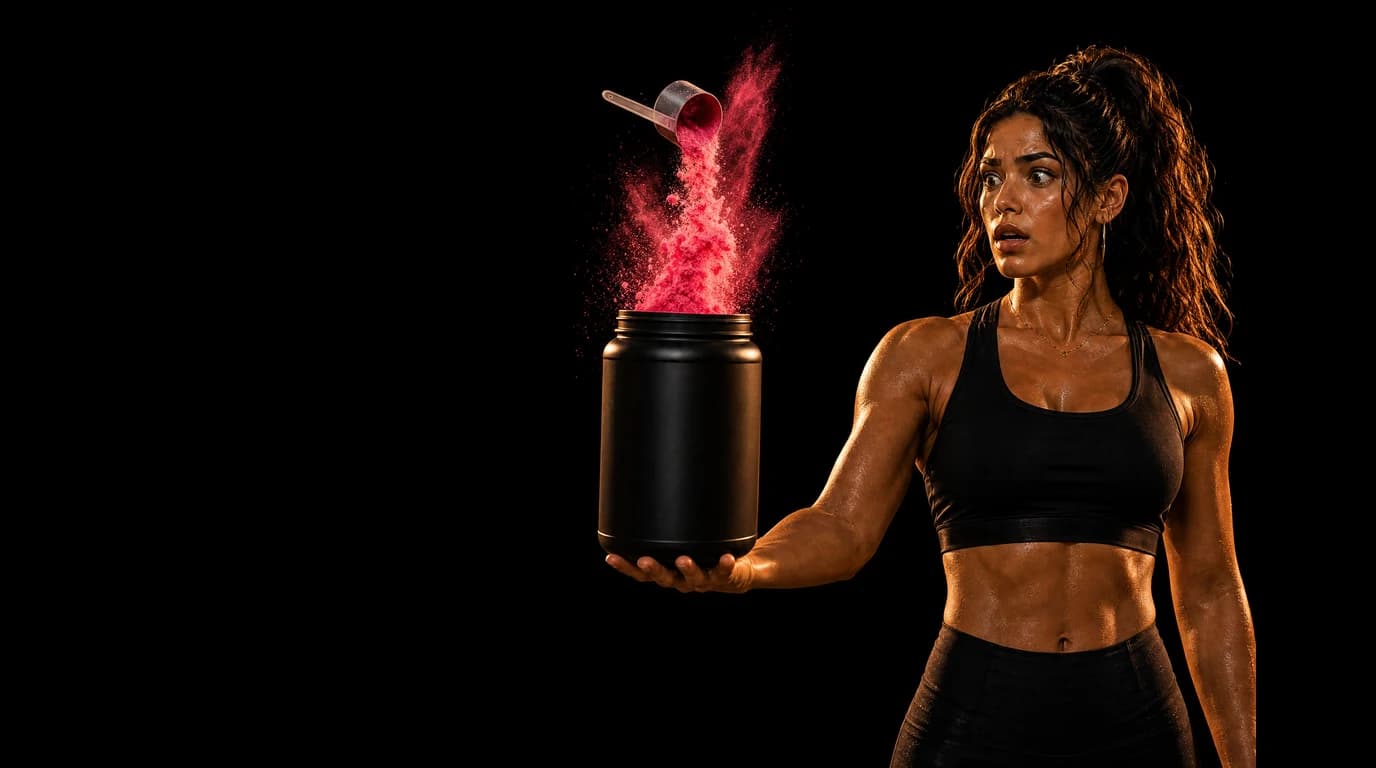
A startled woman lit in gold holds out a plain black supplement tub while bright pink pre-workout powder spills from a scoop on pure black
On October 7, 2026 the FDA posted a recall: testing by the agency had found DMAA, an amphetamine-like stimulant, in Rapture Pre-workout, sold nationwide in stores and online for 16 months. If you are here from our video, the answer it promised comes first: the pre-workouts we rank, and what their labels say.
What are the best pre-workouts without DMAA?
We read the Supplement Facts panel and the other-ingredients line of every pre-workout on our ranking on October 15, 2026. None of the 8 lists DMAA under any of the 11 names the FDA publishes, and none lists geranium or Pelargonium extract. Ranked by our score:
- #1 Transparent Labs BULK, 9.2: every dose on the label, no proprietary blend, 200 mg caffeine
- #2 Legion Pulse, 8.8: fully disclosed, naturally sweetened, 350 mg caffeine
- #3 Kaged Pre-Workout Elite, 8.5: 21 disclosed ingredients including 5 g creatine, 388 mg caffeine
- #4 Nutricost Pre-Workout Complex, 8.0: the lowest cost per serving. It lists DMAE, a different compound from DMAA
- #5 C4 Original, 7.9: gentle 150 mg caffeine, but part of the formula sits in a proprietary blend
- #6 Optimum Nutrition Gold Standard Pre-Workout, 7.8: 175 mg caffeine, 3.3 g creatine
- #7 Gorilla Mode Nitric, 7.7: stimulant-free, no caffeine at all
- #8 RYSE Loaded, 7.5: high-stimulant, about 390 mg caffeine
A clean label is what a buyer can check, and it is not the same as a lab test: a product that hides a drug does not print it. That is why the order above rewards full disclosure, and why the checks further down matter. If you want to act on it, the short list below is the number-one pick from three rankings: the pre-workout, and the two single ingredients most pre-workouts are built on, so you can mix your own and know exactly what is in it.
Which pre-workout was recalled, and why?
According to the FDA notice, Leader Formulas, LLC recalled one lot of RAPTURE Preworkout Dietary Supplement Powder on October 6, 2026, because FDA testing found 1,3-dimethylamylamine (DMAA). The notice covers three flavors, Rainbow Twist (UPC 710154236506), Electric Lemonade and Berry Mojito (UPC 710154236544), lot number 260327-4, in 450 g round plastic tubs. The product was distributed from January 29, 2025 to May 25, 2026, in stores nationwide and online through the company's website.
The notice says DMAA can raise blood pressure and could lead to cardiovascular problems, including heart attack, shortness of breath and chest tightening. The company states it "has not received any reports of adverse events related to this recall." Its instruction to anyone who owns the product: stop using it and return it to the place of purchase for a full refund, and contact a physician if you have experienced any problems.
What are the 11 names DMAA goes by on a label?
The FDA lists these names for DMAA on supplement labels:
- 1,3-DMAA
- 1,3-Dimethylamylamine
- 1,3-Dimethylpentylamine
- 2-Amino-4-methylhexane
- 2-Hexanamine, 4-methyl- (9CI)
- 4-Methyl-2-hexanamine
- 4-Methyl-2-hexylamine
- Dimethylamylamine
- Geranamine
- Methylhexanamine
- Methylhexanenamine
The one that sounds like a flower: the FDA also notes that "geranium extract" or "Pelargonium graveolens extract" on a label may indicate DMAA. And one that sounds similar but is not on the list: DMAE (dimethylaminoethanol) is a different compound.
Is DMAA legal in supplements?
No. The FDA states that DMAA products marketed as dietary supplements are illegal, and it has sent warning letters to companies selling them since April 2012. In 2013 it detained and seized DMAA products; a federal court ruled seized products adulterated in 2017, an appeals court affirmed in 2019, and the Supreme Court declined to hear the case in 2020. Fourteen years after the first letters, the FDA found it in a tub again.
Does a recall take a product off the shelf?
Not always. In a 2014 study in JAMA, researchers bought 27 supplements again that the FDA had recalled between 2009 and 2012, at least six months after the recall. 18 of the 27 still contained a banned drug. A 2018 analysis in JAMA Network Open counted 776 supplements the FDA found to contain unapproved drug ingredients between 2007 and 2016, from 146 companies, most of them sold for sexual enhancement, weight loss or muscle building.
How do you check your own pre-workout?
- Compare the label against the 11 names above, plus geranium and Pelargonium extract.
- Prefer a label that discloses every dose. A proprietary blend shows one total and hides how much of each ingredient is inside.
- If a brand advertises a banned-substance certification, look the exact product up in the certifier's own database rather than trusting the badge on the tub.
- Search the FDA's recall list for the product name before you reorder.
This is analysis of public records, not medical advice. If you took a product on the recall and feel unwell, call your doctor.
The 25-second version — as seen on TikTok, Reels & Shorts.
SOURCES
- FDA — "Leader Formulas, LLC. Issues Voluntary Nationwide Recall of RAPTURE Preworkout Due to Presence of 1,3-Dimethylamylamine (DMAA)", company announcement 2026-10-06, posted 2026-10-07. Verbatim: "The issue was discovered in the product during testing by the FDA." and "Leader Formulas, LLC. has not received any reports of adverse events related to this recall."
- FDA — "DMAA in Products Marketed as Dietary Supplements": DMAA products marketed as dietary supplements are illegal; warning letters since 2012; the 11 names DMAA can appear under on a label, and the note that "geranium extract" may indicate DMAA
- Cohen PA, Maller G, DeSouza R, Neal-Kababick J — "Presence of banned drugs in dietary supplements following FDA recalls", JAMA 2014;312(16):1691-3. 27 supplements recalled by the FDA between 2009 and 2012 were bought again at least six months after the recall; 18 still contained a banned drug (PMID 25335153)
- Tucker J, Fischer T, Upjohn L, et al. — "Unapproved Pharmaceutical Ingredients Included in Dietary Supplements Associated With US Food and Drug Administration Warnings", JAMA Netw Open 2018;1(6):e183337. 776 adulterated supplements identified by the FDA from 2007 to 2016, from 146 companies (PMID 30646238)