
Probiotics: Benefits, Dosage & Side Effects (2026)
Probiotics are live microorganisms that, in adequate doses, confer a health benefit — with the strongest RCT evidence for specific named strains in antibiotic-associated diarrhoea and IBS.
The Probiotics market in numbers
Our independent analysis of 11 probiotics products, scored on three proprietary indices — the SAC Product Score™, Transparency Index™, and real Cost-Per-Effective-Dose™. Updated October 2026.
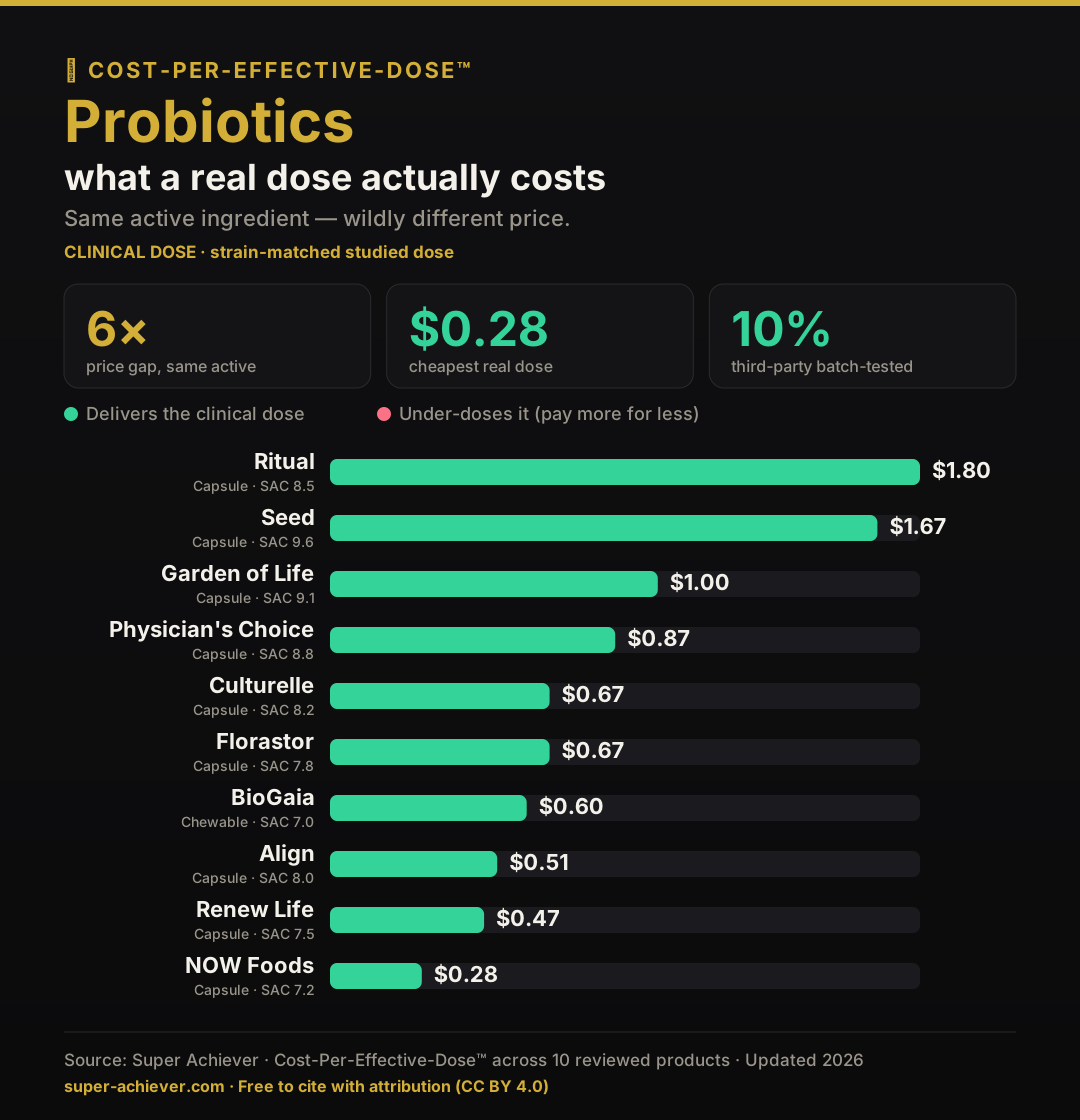
| # | Product | SAC Product Score™ | TXI™ | CPED™ | |
|---|---|---|---|---|---|
| 1 | Seed DS-01 Daily SynbioticCapsule | 9.6 | 20 | $1.67 | |
| 2 | Garden of Life Dr. Formulated Once Daily Women'sCapsule | 9.0 | 65 | $1.00 | Most transparent |
| 3 | Ritual Synbiotic+Capsule | 8.9 | 20 | $1.80 | |
| 4 | Align Probiotic 24/7 Digestive SupportCapsule | 8.1 | 20 | $0.51 | |
| 5 | Florastor Daily ProbioticCapsule | 8.0 | 20 | $0.67 | |
| 6 | Culturelle Daily ProbioticCapsule | 7.8 | 20 | $0.67 | |
| 7 | Renew Life Ultimate Flora Extra Care 50 BillionCapsule | 7.5 | 20 | $0.47 | |
| 8 | NOW Probiotic-10 25 BillionCapsule | 7.3 | 40 | $0.28 | Best value |
| 9 | BioGaia Protectis ChewableChewable | 6.9 | 20 | $0.60 | |
| 10 | Physician's Choice Probiotics 60 Billion CFUCapsule | 6.8 | 20 | $0.87 | |
| 11 | Sunergetic 4-in-1 ProbioticCapsule | 6.6 | 0 | $0.77 | Under-dosed |
Methodology. SAC Product Score™ blends our editorial rating (RCT quality, dose, safety, value) 50/50 with community ratings. Transparency Index™ (0-100) = third-party certification (0-50) + public batch COA (0-30) + dose honesty (0-20). Cost-Per-Effective-Dose™ is the real price of one clinical dose, not one marketed "serving". Free to cite with attribution to Super Achiever.
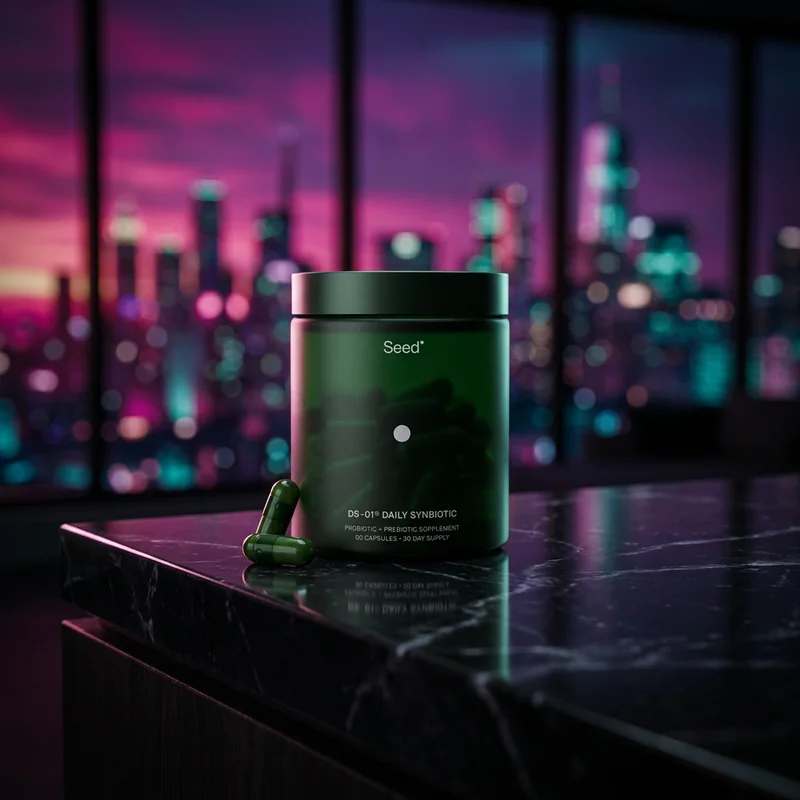
Seed DS-01 Daily Synbiotic
What is Probiotics?
Probiotics are live microorganisms that, when administered in adequate amounts, confer a health benefit on the host — that's the WHO/FAO definition, and the phrase "adequate amounts" matters as much as "live." They're the supplement-form deposits of the same families of bacteria (and one yeast) that make up your gut microbiome: mostly Lactobacillus and Bifidobacterium species, plus the yeast Saccharomyces boulardii. The microbiome itself is the dense community of trillions of microbes living in your gut, and it does real metabolic work — fermenting fibre into short-chain fatty acids, training the immune system, and crowding out pathogens. Probiotic supplements are an attempt to nudge that ecosystem in a helpful direction.
The single most important thing a buyer needs to understand is strain-specificity. A probiotic is not a generic commodity like vitamin C, where one molecule does one job. The clinical evidence attaches to *named strains* — not to "probiotics" in general, not even to a species, but to a specific strain identified by a code. Lactobacillus rhamnosus GG (LGG) is a different product from Lactobacillus rhamnosus in general; Bifidobacterium infantis 35624 is the strain with the IBS trial behind it; Saccharomyces boulardii is the yeast with the strongest antibiotic-associated-diarrhoea data. Two capsules can both say "Lactobacillus" on the front and do completely different things — or nothing — depending on the exact strain inside. This is why "Probiotic, 10 strains, 50 billion CFU" on a budget label tells you almost nothing: the label is naming a category, not the studied product.
So the practical definition of a useful probiotic is: a *named, strain-identified* culture, dosed at the level used in its trials, delivered alive to the gut. The dose is measured in CFU (colony-forming units — the count of viable, reproduction-capable cells). And because the cells are alive, they degrade: many products need refrigeration, while better-engineered ones are shelf-stable. "Live cultures" on the box is only meaningful if they're still live at the end of shelf life, in the part of the gut where they act.
How it works
Probiotics don't permanently "recolonise" your gut — for most strains they're transient passengers, present while you take them and largely gone within weeks of stopping. The benefit comes from what they do *during* that transit. The best-characterised mechanisms are: competitive exclusion (live cultures occupy attachment sites and consume nutrients pathogens would use, crowding bad bugs out); production of short-chain fatty acids and other metabolites that lower gut pH and feed the cells lining the colon; reinforcement of the gut barrier (tightening the junctions between epithelial cells so less inflammatory material leaks through); and immune modulation (signalling to gut-associated immune tissue to damp down inflammatory responses). Different strains lean on different mechanisms, which is exactly why the outcome is strain-specific.
The clearest clinical payoff is antibiotic-associated diarrhoea (AAD). Antibiotics carpet-bomb the microbiome along with the target infection, and the resulting disruption causes diarrhoea in a large minority of people. Taking the right probiotic alongside the antibiotic refills the ecosystem fast enough to blunt this. McFarland's 2006 meta-analysis (PMID 16635227) pooled the RCTs and found probiotics significantly reduced AAD and helped prevent Clostridioides difficile disease; the two strains with the strongest AAD evidence are Saccharomyces boulardii (McFarland 2010, PMID 20458757) and Lactobacillus rhamnosus GG (Szajewska 2015, PMID 26365389). This is the use-case where the data are strong enough that many clinicians actively recommend it.
The second well-studied target is irritable bowel syndrome (IBS) — the abdominal pain, bloating, and irregular bowel habit that affect a large share of adults. Here probiotics modulate the gut-brain axis and the low-grade inflammation thought to drive symptoms. Ford's 2014 systematic review (PMID 25070051) found probiotics as a class improved overall IBS symptoms versus placebo — while explicitly noting that *which* strains work best remains unclear. Whorwell 2006 (PMID 16863564) is the landmark single-strain trial: Bifidobacterium infantis 35624 at 1×10⁸ CFU/day significantly beat placebo for abdominal pain, bloating, and bowel dysfunction. The 2018 Hungin international consensus (PMID 29460487) pulled this together for clinicians: specific probiotics help reduce overall symptom burden and abdominal pain in some IBS patients, and specified strains are useful adjuvants to prevent AAD. The throughline of all of it: the benefit is real, but it's the *strain*, dose, and indication that decide whether you get it.
At-a-glance facts
- What it is
- Live microorganisms (mostly Lactobacillus, Bifidobacterium + the yeast S. boulardii) that confer a benefit in adequate doses
- Strain is everything
- Evidence attaches to named strains — L. rhamnosus GG, B. infantis 35624, S. boulardii — not to 'probiotics' generically
- Dose unit
- CFU (colony-forming units = viable cells). Match the trial dose for the strain, e.g. B. infantis 35624 at 1×10⁸ CFU/day
- Strongest use-case
- Antibiotic-associated diarrhoea — take alongside the antibiotic (S. boulardii or L. rhamnosus GG), then continue a few days after
- Second use-case
- IBS — bloating, abdominal pain, bowel habit; strain-specific benefit (Ford 2014; Whorwell 2006)
- Refrigeration
- Many strains need cold storage to stay alive; shelf-stable products are engineered for it — check the label, not the marketing
- Time to felt effect
- AAD: protective from day one of the antibiotic. IBS: judge over 4 weeks of consistent daily dosing
- Cost range (US)
- $20-45 / month for a strain-identified, properly dosed product from a brand that publishes its strains
Evidence: Strong, consistent RCT evidence — but it's strain- and indication-specific, not a blanket effect. Antibiotic-associated diarrhoea is the best-supported use (McFarland 2006, PMID 16635227; S. boulardii — McFarland 2010, PMID 20458757; L. rhamnosus GG — Szajewska 2015, PMID 26365389). For IBS the class-level benefit is real but strain selection is unsettled (Ford 2014, PMID 25070051), with B. infantis 35624 the standout single strain (Whorwell 2006, PMID 16863564). The 2018 Hungin consensus (PMID 29460487) codifies both for clinical practice. Rated 4 not 5 because efficacy doesn't generalise across strains, and unstudied multi-strain blends carry little of this evidence.
Who it's for — and who it isn't
- Anyone about to take (or taking) a course of antibiotics — the strongest probiotic use-case; S. boulardii or L. rhamnosus GG alongside the antibiotic significantly cuts antibiotic-associated diarrhoea
- People with IBS — bloating, abdominal pain, irregular bowel habit; specific strains (e.g. B. infantis 35624) improve overall symptoms in a meaningful share of patients
- Anyone recovering from a gut infection or a course of strong meds that wiped out their flora — a targeted refill while the ecosystem rebuilds
- Travellers heading somewhere with a high risk of traveller's diarrhoea — certain strains taken prophylactically lower the odds
- People who already eat fermented foods and want a consistent, dose-defined supplement to layer on top — convenient when diet alone is inconsistent
- Anyone severely immunocompromised, critically ill, or with a central venous catheter — live organisms carry a small but real risk of systemic infection; this is the main hard contraindication, clear it with a doctor first
- People expecting a generic 'gut reset' from any random multi-strain capsule — without a matched strain + indication, you're paying for a category, not a studied effect
- Anyone with a healthy gut and no symptoms hoping for a vague wellness boost — the evidence is for specific problems (AAD, IBS), not for everyday supplementation in the well
- Buyers chasing the biggest 'CFU' number on the shelf — a huge count of the wrong, unstudied strains is not better than the trial dose of the right one
Week-by-week, what happens
- Antibiotic course (AAD use)Protective from the first dose. Start the probiotic when you start the antibiotic, space them a couple of hours apart, and continue for several days to a week after the course ends.
- Week 1 (IBS use)Some people notice less bloating and gas early; many feel nothing yet. The gut ecosystem takes time to shift — don't judge it on a few days.
- Week 2-4 (IBS use)The window where IBS abdominal-pain and bowel-habit improvements typically emerge in the trials (e.g. the 4-week B. infantis 35624 study). This is when to assess whether your strain is working.
- After stoppingMost strains are transient — they clear from the gut within days to weeks, and the benefit fades with them. Probiotics manage symptoms while taken; they don't permanently re-engineer your microbiome.
Safety & contraindications
- Do NOT take probiotics if you're severely immunocompromised, critically ill, or have a central venous line without medical sign-off — live organisms have, rarely, caused bloodstream infections (bacteraemia, fungaemia) in these specific high-risk groups. This is the one genuine hard contraindication.
- For almost everyone else they're very well tolerated. The common early side effects are transient gas, bloating, or mild digestive change in the first few days as the gut adjusts — usually settling within a week.
- Match the strain to the goal. The biggest 'mistake' isn't a safety risk, it's wasted money: a random multi-strain blend that doesn't contain the studied strain for your problem won't do what the trials showed.
- Check viability, not just the headline CFU. Because the cells are alive, a count printed 'at time of manufacture' can be far higher than what's live when you swallow it. Prefer brands that guarantee CFU through end of shelf life and state storage requirements (refrigerated vs shelf-stable).
- Space probiotics a few hours apart from the antibiotic dose when using them for AAD, so the antibiotic doesn't kill the probiotic on contact (S. boulardii, being a yeast, is naturally resistant to antibacterials — an advantage for this use).
- Buy strain-identified products from brands that publish the exact strain codes and third-party testing. 'Proprietary blend, 50 billion CFU' with no strain IDs is the form the evidence base did not test.
All articles on Probiotics
Best Digestive Enzyme Supplements
Digestive enzymes ranked by what you actually need — targeted (lactase for dairy) beats broad-spectrum for most — by enzyme activity units, evidence, and value, with an honest take on who doesn't need them.
Read →Best Ginger Supplements
9 ginger supplements ranked on form and standardization, dose against the clinical range, third-party testing, tolerability and value.
Read →Best L-Glutamine Supplements
L-Glutamine ranked by purity (single-ingredient powder beats capsules on dose economics), third-party testing, and value — the gut-lining amino acid for IBS and intestinal permeability.
Read →Best Magnesium for Constipation
Citrate dominates (osmotic) and glycinate sinks (chelated, no laxative effect) — the form ranking is fully inverted vs. magnesium-for-sleep, with acute breakthrough + chronic maintenance protocols spelled out.
Read →Best Peppermint Oil Capsules for IBS
Enteric-coated peppermint oil ranked by coating quality first (it has to survive the stomach to work), dose, and value — one of the best-evidenced OTC options for IBS cramping and bloating.
Read →Best Probiotics Supplements
The 10 best probiotic supplements ranked by strain specificity + verified CFU — matching documented strains to your actual goal (IBS, post-antibiotic, women's, daily), not chasing the biggest number.
Read →Best Psyllium Fiber Supplements
Psyllium husk ranked by form honesty (powder vs capsules vs the dose math), additive load, and value — the most RCT-backed soluble fiber for regularity, cholesterol, and blood sugar.
Read →Align Probiotic 24/7 Digestive Support Review
The evidence-backed strain for IBS — and only for IBS.
Read →Anthony's Organic Psyllium Husk Powder Review
The organic bulk-buy — best per-gram organic value, in a bag not a tub.
Read →BioGaia Protectis Chewable Review
A clean single-strain chewable — L. reuteri DSM 17938 and nothing else.
Read →Carlyle Peppermint Oil, 150ct Review
Cheap and high-count — but a low dose and a less-documented coat hold it back.
Read →Culturelle Daily Probiotic Review
The cleanest, most affordable way to get the most-studied strain (LGG); plain capsule, no potency-through-expiry promise printed. 7.8/10.
Read →Designs for Health Digestzymes Review
The clinical bridge — low-acid support plus gluten/casein peptide coverage, for a specific buyer.
Read →Designs for Health L-Glutamine Powder Review
Clinic-grade free-form glutamine at the best value in the clinical tier.
Read →Enzymedica Digest Gold + ATPro Review
The high-activity broad blend benchmark — for heavy, varied meals, not for everyone.
Read →Florastor Daily Probiotic Review
The yeast antibiotics can't kill — the textbook pick for antibiotic-associated diarrhea.
Read →Garden of Life Dr. Formulated Once Daily Women's Review
The right pick for women caring for digestive AND vaginal flora.
Read →Garden of Life Dr. Formulated Organic Digest+ Review
Organic chewable with 13 enzymes, each with its activity unit, but no amylase on the panel; about $0.26 a tablet. 7.1/10.
Read →Garden of Life Omega-Zyme Ultra Review
The widest plant-based spread, no HCl — best for varied, fiber-heavy diets.
Read →Garden of Life Raw Organic Fiber, Unflavored Review
The deliberate psyllium-FREE pick — for guts that can't tolerate psyllium.
Read →Heather's Tummy Tamers Peppermint Oil, 90ct Review
The reflux-tolerant peppermint for people other softgels burned.
Read →IBgard Peppermint Oil Capsules, 48ct Review
The most-studied IBS peppermint, with the lowest heartburn risk.
Read →Jarrow Formulas L-Glutamine Powder Review
The set-and-forget supply pick — a year of 99%-pure powder at low cost per gram.
Read →Klaire Labs L-Glutamine Powder Review
A full 5 g trial per-dose amount in one hypoallergenic scoop.
Read →Konsyl Daily Psyllium Fiber Powder, Unflavored Review
The high-dose, pure-husk pick when grams matter most.
Read →Lactaid Fast Act Lactase Caplets Review
If dairy is your one problem, this is the single best — and best-evidenced — pick.
Read →Life Extension L-Glutamine Powder Review
A cheap starter tub to test whether you respond before buying bulk.
Read →Mason Natural Peppermint Oil 50mg Enteric, 90ct Review
Genuinely enteric at a bargain price — but 50 mg per softgel is the catch.
Read →Metabolic Maintenance L-Glutamine Powder Review
The titration specialist — fine 1 g dosing for a reactive, IBS-prone gut.
Read →Metamucil 4-in-1 Psyllium Fiber, Sugar-Free, Orange Review
The safe, doctor-trusted default psyllium for first-time buyers.
Read →Metamucil Psyllium Fiber Capsules Review
The convenience pick from the most-trusted brand — bought with eyes open.
Read →Nature's Way CompleteGest Review
The dependable mainstream vegan blend — reliable and available, not a spec leader.
Read →Nature's Way Pepogest Enteric Peppermint Oil, 60ct Review
The clinically validated dose at the best price — the default for most buyers.
Read →Nature's Way Peppermint Soothe, 60ct Review
A trustworthy heritage enteric peppermint — outcompeted by its own sibling.
Read →NOW Peppermint Gels with Ginger & Fennel, Enteric, 90ct Review
A budget brand getting the fundamentals right — the best bulk value.
Read →NOW Probiotic-10 25 Billion Review
The honest value floor — cheap, a code printed on every strain, no frills. 7.3/10.
Read →NOW Psyllium Husk Caps 500 mg Review
The vegan, value-minded capsule — convenient and grit-free, but low-dose.
Read →NOW Psyllium Husk Powder, Non-GMO Review
The lowest-cost honest way to take psyllium — if you'll stir plain husk.
Read →NOW Sports L-Glutamine Pure Powder Review
The value benchmark — genuine free-form glutamine at the lowest cost per gram.
Read →NOW Super Enzymes Review
The best value on the list — real pancreatic + acid support at a third of premium prices.
Read →Nutricost Digestive Enzymes 620mg Review
Maximum enzyme variety per dollar — the low-risk budget experiment.
Read →Nutricost L-Glutamine Powder, Unflavored Review
The bulk-budget sweet spot — exact 5 g scoops at near-benchmark value.
Read →Nutricost Peppermint Oil 50mg, 120ct Review
Well-made and clean — but NON-enteric, the one disqualifying flaw for the gut.
Read →Optimum Nutrition L-Glutamine Powder Review
A fine free-form powder that ranks last on fit, not quality.
Read →Organic India Whole Husk Psyllium Powder, USDA Organic Review
The organic pick that still delivers a real dose.
Read →Physician's Choice Probiotics 60 Billion CFU Review
A low-cost high-CFU generalist whose label names ten species but no strain codes. 6.8/10.
Read →Pure Encapsulations Digestive Enzymes Ultra Review
The cleanest broad blend — the safe pick for a sensitive, allergy-prone gut.
Read →Pure Encapsulations L-Glutamine Powder Review
The cleanest hypoallergenic label for the reactive, IBS-prone gut.
Read →Regimint Peppermint Oil Plus Caraway, 60ct Review
The European peppermint-caraway combo for IBS-plus-dyspepsia overlap.
Read →Renew Life Ultimate Flora Extra Care 50 Billion Review
A broad high-potency blend for sensitive guts — with LGG and delayed-release doing the work.
Read →Ritual Synbiotic+ Review
The most complete formulation on paper, with the best traceability.
Read →Seed DS-01 Daily Synbiotic Review
The survivability-engineered default for general gut health.
Read →Solaray Peppermint Oil, Enteric, 60ct Review
A clinical 250 mg enteric peppermint dose, plus botanicals you're partly paying for.
Read →Sunergetic 4-in-1 Probiotic Review
Spore-based probiotic with enzymes and PreforPro, but only two named strains and 3 billion CFU. 6.6/10.
Read →Thorne Advanced Digestive Enzymes Review
The low-stomach-acid powerhouse — excellent for the right buyer, contraindicated for many.
Read →Thorne L-Glutamine Powder Review
The cleanest, most credible way to run the one glutamine protocol with real human evidence.
Read →Viva Naturals Organic Psyllium Husk Powder Review
The finely-ground organic pick for smoothies and keto baking.
Read →Yerba Prima Psyllium Husks Powder Review
The heritage purist's pure-husk pick — dependable, honest, lower-profile.
Read →Zenwise Digestive Enzymes + Probiotics & Prebiotics Review
Amazon's bestselling all-in-one — convenient, but a compromise on every component.
Read →FAQ
Why does the strain matter so much — isn't a probiotic a probiotic?
No, and this is the single biggest buyer mistake. The clinical evidence attaches to *named strains*, not to 'probiotics' as a category or even to a species. Lactobacillus rhamnosus GG is a specific, studied strain; generic 'Lactobacillus rhamnosus' is not the same thing. Bifidobacterium infantis 35624 is the strain with the IBS trial behind it (Whorwell 2006, PMID 16863564); Saccharomyces boulardii is the yeast with the strongest antibiotic-diarrhoea data. Two capsules can both say 'Lactobacillus' and do completely different things — or nothing. Buy the strain that was studied for *your* problem, dosed the way the trial dosed it, and ignore the generic genus name on the front of the box.
What should I take when I'm on antibiotics?
This is probiotics' strongest use-case. Antibiotics disrupt the microbiome and cause diarrhoea in a sizeable minority of people; the right probiotic alongside them significantly cuts that risk. McFarland's 2006 meta-analysis (PMID 16635227) confirmed the class effect, and the two best-evidenced options are Saccharomyces boulardii (PMID 20458757) and Lactobacillus rhamnosus GG (PMID 26365389). Start it when you start the antibiotic, take the doses a couple of hours apart so the drug doesn't kill the probiotic, and keep going for several days to a week after the course finishes. S. boulardii has a practical edge here: it's a yeast, so antibacterial antibiotics don't kill it.
Do probiotics actually help with IBS, bloating, and abdominal pain?
For a meaningful share of IBS patients, yes — but it's strain-dependent. Ford's 2014 systematic review (PMID 25070051) found probiotics as a class improved overall IBS symptoms versus placebo, while honestly flagging that *which* strains work best isn't settled. The standout single-strain result is Whorwell 2006 (PMID 16863564): Bifidobacterium infantis 35624 at 1×10⁸ CFU/day significantly beat placebo for abdominal pain, bloating, and bowel dysfunction over four weeks. The 2018 Hungin consensus (PMID 29460487) summarised it for doctors: specific probiotics reduce overall symptom burden and abdominal pain in some IBS patients. Give a chosen strain a fair 4-week trial before deciding it doesn't work for you.
What does 'CFU' mean, and is a higher number always better?
CFU stands for colony-forming units — the count of live, reproduction-capable cells in a dose. It's the right unit because only viable cells do anything. But a bigger CFU number is NOT automatically better: 100 billion CFU of unstudied strains is worth less than the trial dose of the right strain for your goal (B. infantis 35624's IBS benefit showed up at 1×10⁸ CFU/day, not at the highest dose tested). Also watch *when* the count is measured — 'CFU at manufacture' can be far above what's alive when you take it. Prefer products that guarantee CFU through the end of shelf life.
Do probiotics need to be refrigerated?
It depends on the product, and the label is the source of truth — not the marketing. Many traditional Lactobacillus/Bifidobacterium products contain fragile live cells that degrade at room temperature and need cold storage to stay viable. Others are engineered to be shelf-stable (spore-forming strains, protective coatings, or specially packaged S. boulardii) and survive without refrigeration. Neither is automatically 'better,' but a refrigerated product that sat warm in shipping may have lost potency. Check the storage instructions and the end-of-shelf-life CFU guarantee; that combination tells you whether the cells are actually alive when they reach your gut.
Do I need probiotic supplements if I'm healthy and eat fermented foods?
Probably not for general wellness. The strong evidence is for specific problems — antibiotic-associated diarrhoea and IBS — not for everyday supplementation in people with no symptoms. If you eat yoghurt, kefir, kimchi, or sauerkraut regularly, you're already feeding your gut live cultures and fibre. Supplements earn their place when you have a defined goal (you're starting antibiotics, you have IBS, you're recovering a wiped-out flora) and you can match a studied strain to it. For a healthy gut with no complaints, diet and fibre do more than a generic capsule.
Sources & further reading
- McFarland 2006 (AAD + C. difficile meta-analysis)Meta-analysis of probiotics for the prevention of antibiotic associated diarrhea and the treatment of Clostridium difficile disease
Pooled the randomised controlled trials and found probiotics significantly reduced the risk of antibiotic-associated diarrhoea and helped in the treatment/prevention of Clostridium difficile disease. The cornerstone meta-analysis behind probiotics' strongest indication.
- Whorwell 2006 (B. infantis 35624 in IBS)Efficacy of an encapsulated probiotic Bifidobacterium infantis 35624 in women with irritable bowel syndrome
Multicenter RCT in 362 IBS patients: Bifidobacterium infantis 35624 at 1×10⁸ CFU/day was significantly superior to placebo for abdominal pain, bloating, bowel dysfunction, incomplete evacuation, straining, and gas over 4 weeks. The landmark single-strain IBS trial and proof that strain + dose decide the effect.
- Ford 2014 (IBS systematic review)Efficacy of prebiotics, probiotics, and synbiotics in irritable bowel syndrome and chronic idiopathic constipation: systematic review and meta-analysis
Systematic review + meta-analysis: probiotics as a class significantly improved overall IBS symptoms versus placebo, but concluded that which individual species and strains are most beneficial remains unclear — the evidence base for the 'strain matters' caveat.
- Szajewska 2015 (L. rhamnosus GG for AAD)Systematic review with meta-analysis: Lactobacillus rhamnosus GG in the prevention of antibiotic-associated diarrhoea in children and adults
Meta-analysis of 12 RCTs (1,499 participants): Lactobacillus rhamnosus GG reduced the risk of antibiotic-associated diarrhoea from 22.4% to 12.3% versus control. Strain-specific evidence for one of the two best-studied AAD options.
- Hungin 2018 (international consensus)Systematic review: probiotics in the management of lower gastrointestinal symptoms - an updated evidence-based international consensus
Updated European Society for Primary Care Gastroenterology consensus over 70 RCTs: specific probiotics reduce overall symptom burden and abdominal pain in some IBS patients (high evidence, 100% agreement), and specified strains are useful adjuvants to prevent/reduce antibiotic-associated diarrhoea. The clinical-practice synthesis.
- McFarland 2010 (S. boulardii meta-analysis)Systematic review and meta-analysis of Saccharomyces boulardii in adult patients
Reviewed 10 adult RCTs of Saccharomyces boulardii for antibiotic-associated diarrhoea: 8 of 10 showed significant efficacy, pooled relative risk 0.47 for AAD prevention. Establishes S. boulardii — a yeast, so antibiotic-resistant — as a leading strain for the AAD use-case.