
NOW Psyllium Husk Caps 500 mg Review
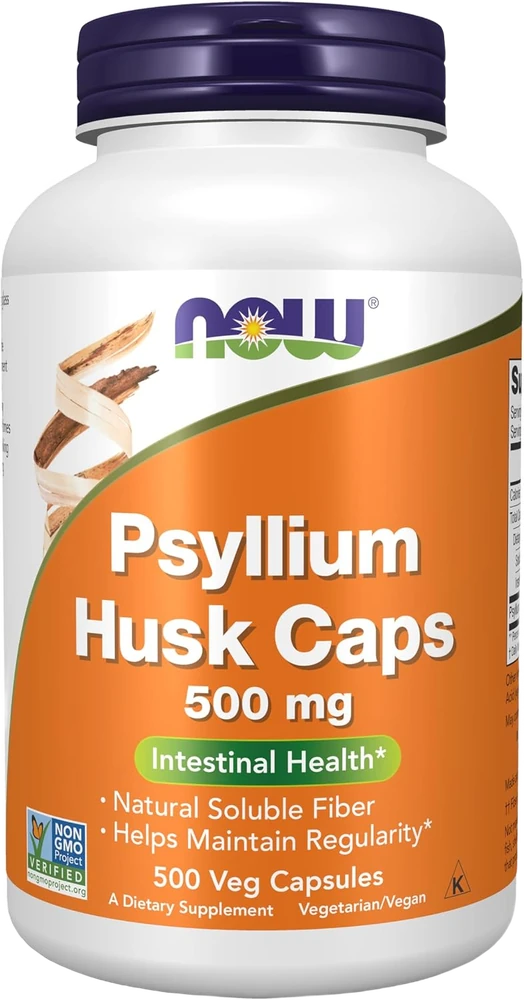 #9 of 10 · Best vegan capsule✓ Label verified · Supplement Facts read Sep 7, 2026
Real retailer photo, cut out. Label unedited.
Consider it. The vegan, value-minded capsule — convenient and grit-free, but low-dose. Pure psyllium in a vegetarian shell with NOW's QC, at a low per-cap price from the 500-count bottle.
$16 / 500 capsules$0.06 / 2-cap serving (~1 g psyllium)
Why It Scores 7.4 — And The Label Line Behind Each Number
Soluble-fiber dose + form fit
30% of scoreThe capsule penalty. Each 2-capsule serving delivers only ~1 g of psyllium, so a regularity dose is 6-10 caps and the Anderson 2000 ~10 g/day LDL dose is ~20 caps — impractical. Fine for light, convenient regularity; poorly suited to the gram-hungry goals where a single powder scoop (#1-#3) does the job. Form fit is convenience-first, efficiency-last.
- Active fiber
- Psyllium husk (Plantago ovata), pure
- Per serving
- ~1 g psyllium per 2 capsules (500 mg each)
- Form
- Vegetarian capsules
Purity + label honesty
25% of scorePure psyllium husk in a vegetarian capsule — no flavors, sweeteners, colors, or fillers beyond the plant-based shell. Honest single-ingredient fiber, and the vegetarian shell is a genuine differentiator versus gelatin-capsule competitors. The 500 mg-per-cap and 2-cap serving are stated plainly, so the low fiber-per-serving is disclosed, not hidden.
Cost per effective gram
20% of scoreThe 500-count bottle keeps the headline serving price low (~$0.06 per 2-cap serving), but cost per effective gram of psyllium is what matters — and because you need so many caps to reach a real dose, capsules are far costlier per gram than powder. Cheap per capsule, expensive per gram. NOW's own powder (#3) delivers the same fiber for a fraction of the per-gram cost.
- Bottle
- 500 capsules
- Price
- $16 / 500 capsules = ~$0.06 per 2-cap (~1 g) serving
Third-party testing + manufacturing
15% of scoreNOW's in-house QC labs are among the most consistent in the industry, the facility is GMP-certified, and the vegetarian shell is a deliberate quality/dietary choice. Strong manufacturing pedigree and household-brand trust — the same QC backbone that makes NOW's powder the value champion, applied here to a capsule format.
- Testing
- NOW in-house QC labs, GMP-certified facility, vegetarian capsule
Mixability + adherence
10% of scoreThe capsule's home turf. No mixing, no grit, no taste, pre-measured and portable — by far the easiest psyllium to actually swallow day to day, and the whole reason to choose caps over powder. For the grit-averse and for travel, adherence is excellent. The only asterisk is that you still need a full glass of water with each dose, so it's not literally effort-free.
- More Specs
- Added ingredients
- None beyond the plant-based capsule shell — no flavors, sweeteners, or fillers
- Take with
- A full glass of water (≥250 ml) per dose — the hydration caveat still applies
- Best for
- Grit-averse users and travelers needing light, convenient regularity
Label verified. Every figure read from the Supplement Facts photo, Sep 7, 2026.
Marketing Claims Vs. Reality
Pure psyllium husk in a vegetarian capsule.
The label lists psyllium husk with a vegetarian (plant-based) capsule shell and no added flavors, sweeteners, or fillers. Both the purity and the vegetarian-shell claims are accurate and verifiable on the supplement-facts panel.
Convenient, no-mixing fiber.
Capsules genuinely remove the mixing and grit of powder — the core convenience claim is true and is the product's main reason to exist. The honest qualifier is the cap count needed for a real dose, which is a dose-efficiency issue, not a convenience one.
Supports regularity and digestive health.
Core, well-evidenced psyllium effect (Ashraf 1995, PMID 8824651) — its water-holding gel softens and bulks stool and normalizes both constipation and loose stool. Deliverable here for light regularity, though you need several capsules to reach even a modest 3-5 g daily dose.
Helps lower cholesterol.
True for psyllium as a fiber but impractical in this format. Anderson 2000 (PMID 10648260) lowered LDL ~7% at ~10.2 g/day — about 20 of these capsules daily. The cholesterol claim is real for the molecule but unrealistic to hit with capsules; a powder is the right tool for that dose.
Trusted NOW quality.
NOW operates extensive in-house QC laboratories in a GMP-certified facility, with decades of household-brand trust. The quality positioning is well-supported and consistent across NOW's psyllium line, powder and caps alike.
What Our Test Actually Found
The cap count is the whole story — do the math before you buy
Everything about this product comes back to ~1 g of psyllium per 2-capsule serving. For light regularity that's a manageable 6-10 capsules a day; for the Anderson 2000 cholesterol dose it's roughly 20 capsules a day, which almost nobody will sustain. This isn't a NOW flaw — it's physics: only so much husk fits in a 500 mg shell, and it's true of every psyllium capsule. The honest framing is to buy caps for what they're good at (convenience, light dosing, travel) and reach for powder the moment your goal needs real grams.
Capsules don't repeal the water rule
The most dangerous misconception about psyllium capsules is that the convenience extends to skipping fluids. It doesn't. Psyllium swells into a gel wherever it meets water, and dry or under-hydrated psyllium can swell in the throat or gut and cause choking or obstruction (McRorie 2015, PMID 25972618) — capsule or powder. So every dose still goes down with a full glass of water, and anyone with swallowing difficulty or a history of gut narrowing should avoid psyllium entirely, caps included.
The vegetarian shell is the real reason to pick this over Metamucil's caps
Both NOW (#9) and Metamucil (#6) caps share the capsule category's inefficiency. The clean differentiator is the shell: NOW uses a vegetarian (non-gelatin) capsule, so the whole product is vegan-friendly, where Metamucil's caps use gelatin. If you avoid gelatin, NOW is the obvious capsule. Add NOW's low per-cap price from the 500-count bottle and its in-house QC, and the value case is solid — for a buyer who has already decided capsules over powder.
Cheap per capsule, expensive per gram
The 500-count bottle makes the per-capsule price look great (~$0.06 a serving), but that's the wrong unit. What matters is cost per effective gram of psyllium, and because you swallow so many caps to reach a real dose, capsules are far costlier per gram than powder. NOW's own Psyllium Husk Powder (#3) is the same fiber at a fraction of the per-gram cost. Buy the caps for convenience you value, not because the per-cap price looks cheap.
Start low and build up — even with capsules
The titration rule applies regardless of format. Jumping to a full dose of capsules on day one invites gas, bloating, and cramping just as powder does. Start with a smaller number of caps, build up over a week or two toward your target, and take each dose with a full glass of water. This matters most for IBS sufferers — psyllium is the soluble fiber the evidence supports for IBS (Moayyedi 2014, PMID 25070054), but too much too soon can feel like a flare.
Full analysis: all pros & cons (8), buy if / skip if
- Zero mixing, zero grit, no taste — the most convenient way to take psyllium, ideal for travel and the office
- Vegetarian (non-gelatin) capsule shell makes the whole product vegan-friendly
- Pure psyllium husk with NOW's trusted in-house QC and a GMP-certified facility
- Large 500-count bottle keeps the per-capsule price low
- Pre-measured capsules make light, consistent regularity dosing simple and portable
- Only ~1 g psyllium per 2-cap serving — reaching a regularity dose takes several caps and a cholesterol dose ~20, inefficient per effective gram
- Far costlier per effective gram than NOW's own powder (#3) despite the low per-cap price
- Still requires a full glass of water — the convenience doesn't remove the hydration/swelling caveat
- You can't stand the grit of powder, or you travel and can't mix a drink
- You want a vegetarian (non-gelatin) capsule shell for dietary or ethical reasons
- You only need light, convenient regularity support, not a cholesterol-range dose
- You want NOW's trusted in-house QC at a low per-capsule price
- Your goal is cholesterol lowering or satiety — you'd swallow ~20 caps a day; a powder (#3) reaches it in one scoop
- You want the lowest cost per effective gram — NOW's own powder (#3) is far cheaper per gram
- You think capsules let you skip the water rule — they don't; the hydration/choking caveat still applies
Pure psyllium in a vegetarian shell with NOW's QC, at a low per-cap price from the 500-count bottle. The win is convenience: no mixing, no grit, travel-friendly, vegan. The catch is efficiency — ~1 g per 2 caps means many capsules to reach a real dose, and a cholesterol intake is impractical. Buy it for grit-averse light regularity and travel, not for high-dose goals — and still take it with a full glass of water.
NOW Psyllium Husk Caps are the pick for the grit-averse traveler who also wants a vegan shell. They're pure psyllium husk in a vegetarian capsule, backed by NOW's in-house QC labs, in a large 500-count bottle that keeps the per-cap price low. The appeal is real: zero mixing, zero grit, pre-measured, and a plant-based shell instead of gelatin. But the honest catch is the one every psyllium capsule shares, only more so — each 2-capsule serving holds only about 1 g of psyllium, so reaching any meaningful dose means swallowing a lot of capsules, which makes caps the least efficient way to take this fiber per effective gram. And the water rule doesn't go away just because there's no powder to stir. We checked the label and pressure-tested the claims. Here's the full breakdown.
The vegan, value-minded convenience capsule.

NOW Psyllium Husk Caps are the pick when convenience and a vegetarian shell outweigh dose efficiency. They're pure psyllium in a plant-based capsule with NOW's trusted in-house QC, at a low per-cap price from the big 500-count bottle — genuinely useful for travel, the office, or anyone who simply won't drink a gritty husk slurry. The vegetarian shell is the clean reason to choose them over Metamucil's gelatin caps (#6). The catch is the same one every psyllium capsule shares, only more so: at ~1 g per two caps you swallow a lot of capsules to reach any meaningful dose, which makes caps the least efficient and, per effective gram, the costliest way to take this fiber — and a cholesterol-range intake of ~20 caps a day is impractical. So this is for grit-averse light regularity and travel, not for hitting a metabolic target. If you need real grams or the lowest cost per gram, NOW's own Psyllium Husk Powder (#3) is the same fiber at a fraction of the per-gram price. And whichever you choose, take it with a full glass of water — capsules don't remove that rule.
If This Doesn’t Fit — Try These
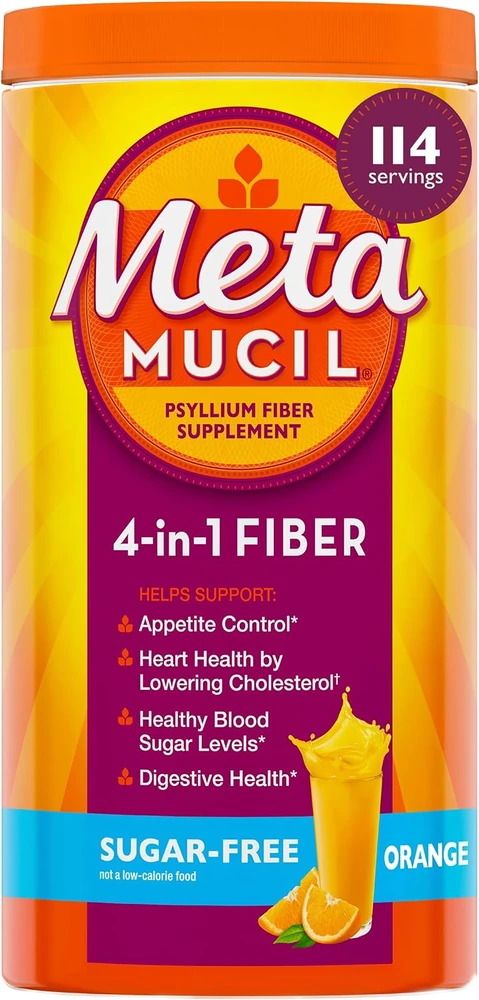 03
Metamucil 4-in-1 Sugar-Free
The default pick for almost everyone.
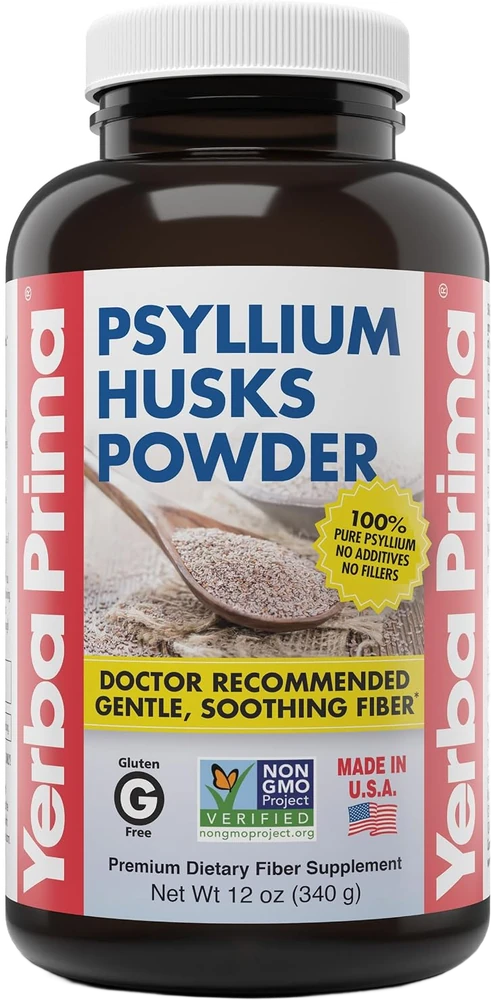 06
Yerba Prima Psyllium Husks
The heritage purist's pick.
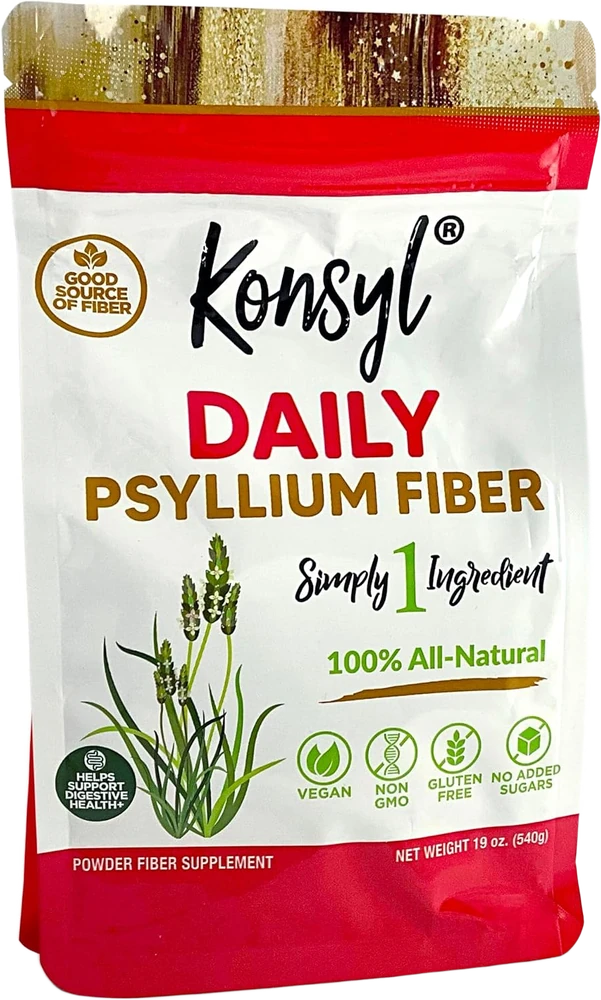 01
Konsyl Daily Psyllium
The pick when grams matter most.
Quick Answers
How many capsules do I actually need to take?
More than you'd hope — that's the central trade-off. Each 2-capsule serving delivers only ~1 g of psyllium. A modest regularity dose of 3-5 g/day therefore means roughly 6-10 capsules, and the ~10 g/day Anderson 2000 (PMID 10648260) used to lower LDL ~7% would take about 20 capsules a day. That's the honest math on every psyllium capsule, NOW's included: the low fiber-per-cap is dictated by how little powder fits in a 500 mg shell. If you only want light regularity support and value the no-mix convenience, the cap count is manageable. If you're chasing a cholesterol or satiety dose, a powder (#1-#3) gets you there in one or two scoops instead of a fistful of capsules.
Do capsules remove the 'take with water' rule?
No — and this is a safety point, not a nicety. Psyllium swells into a gel on contact with water, and that's exactly why dry or under-hydrated psyllium can swell in the throat or gut and cause choking or obstruction (McRorie 2015, PMID 25972618). Capsules don't change the fiber; they just hold it. So you still take NOW Psyllium Caps with a full glass of water (≥250 ml), and keep fluids up through the day. Anyone with swallowing difficulty or a history of gut narrowing should not use psyllium in any form, capsules included. The convenience is no-mixing — it is not a pass on hydration.
What makes these 'vegan' when other capsules aren't?
The capsule shell. Many capsules use gelatin, which is animal-derived; NOW uses a vegetarian (plant-based, cellulose-type) shell here, so the whole product is vegan-friendly — the psyllium husk inside is a plant fiber to begin with. If you avoid gelatin for dietary or ethical reasons, that's the specific reason to choose this cap over a gelatin-shell alternative like Metamucil's capsules (#6). Functionally the fiber and the hydration rules are identical; the shell is the differentiator.
NOW Psyllium Caps vs Metamucil Capsules — which capsule should I buy?
Pick by shell and price vs brand. NOW's caps (#9) have a vegetarian shell and a low per-cap price from the large 500-count bottle, with NOW's in-house QC. Metamucil's caps (#6) come from the most clinically studied, doctor-trusted psyllium brand but use a gelatin shell and cost more per effective gram. Both share the capsule category's core inefficiency — low psyllium per cap, so many caps to reach a dose. If you want vegan and value, NOW wins; if maximum brand trust matters more than the shell or cost, Metamucil. Either way, capsules are for convenience and light dosing, not for hitting a cholesterol target.
Are these worth it, or should I just buy the powder?
Worth it only if convenience is the priority and your dose is light. NOW Psyllium Caps are genuinely useful for travel, the office, or anyone who simply won't drink a gritty husk slurry — no mixing, no grit, pre-measured, and a vegetarian shell. But they're inefficient per effective gram: at ~1 g per 2 caps you swallow a lot to reach any meaningful dose, and a cholesterol-range intake is impractical in capsule form. The same NOW psyllium as a powder (#3) costs far less per gram and reaches a real dose in one scoop. So: caps for grit-averse light regularity and travel; powder for value and any higher-dose goal.
Sources & Further Reading
4 peer-reviewed sources, each linked to PubMed
- [1] Ashraf 1995 PMID 8824651 — Effects of psyllium therapy on stool characteristics, colon transit and anorectal function in chronic idiopathic constipation. RCT: psyllium increased stool frequency and weight and improved consistency in chronic constipation. The regularity effect NOW's caps can deliver — though it takes several capsules to reach even a modest daily dose.
- [2] Anderson 2000 PMID 10648260 — Cholesterol-lowering effects of psyllium intake adjunctive to diet therapy in men and women with hypercholesterolemia: meta-analysis of 8 controlled trials. Meta-analysis of 8 trials: ~10.2 g/day psyllium on top of a low-fat diet lowered LDL ~7%. At ~1 g per 2 caps that's ~20 capsules a day — why capsules are impractical for the cholesterol goal.
- [3] Moayyedi 2014 PMID 25070054 — The effect of fiber supplementation on irritable bowel syndrome: a systematic review and meta-analysis. Systematic review + meta-analysis: soluble psyllium improved IBS symptoms while insoluble bran did not. The right fiber for IBS — but start with fewer capsules and titrate up to avoid a flare.
- [4] McRorie 2015 PMID 25972618 — Evidence-Based Approach to Fiber Supplements and Clinically Meaningful Health Benefits, Part 1 & Part 2. Pharmacology review: psyllium's viscous, non-fermented gel drives its effects — and is why even capsules must be taken with a full glass of water to avoid swelling and choking/obstruction risk.
Affiliate disclosure: every Amazon link uses our Associates tag (superachieverclub-20). We earn a small commission at no cost to you; it funds independent reviews. We never accept payment to change a ranking.