
Psyllium Husk: Benefits, Dosage & Side Effects (2026)
Psyllium husk is a soluble, gel-forming fiber from Plantago ovata seeds that bulks and softens stool, normalizes constipation and diarrhea, lowers LDL cholesterol, and blunts post-meal glucose.
The Psyllium Husk market in numbers
Our independent analysis of 10 psyllium husk products, scored on three proprietary indices — the SAC Product Score™, Transparency Index™, and real Cost-Per-Effective-Dose™. Updated October 2026.
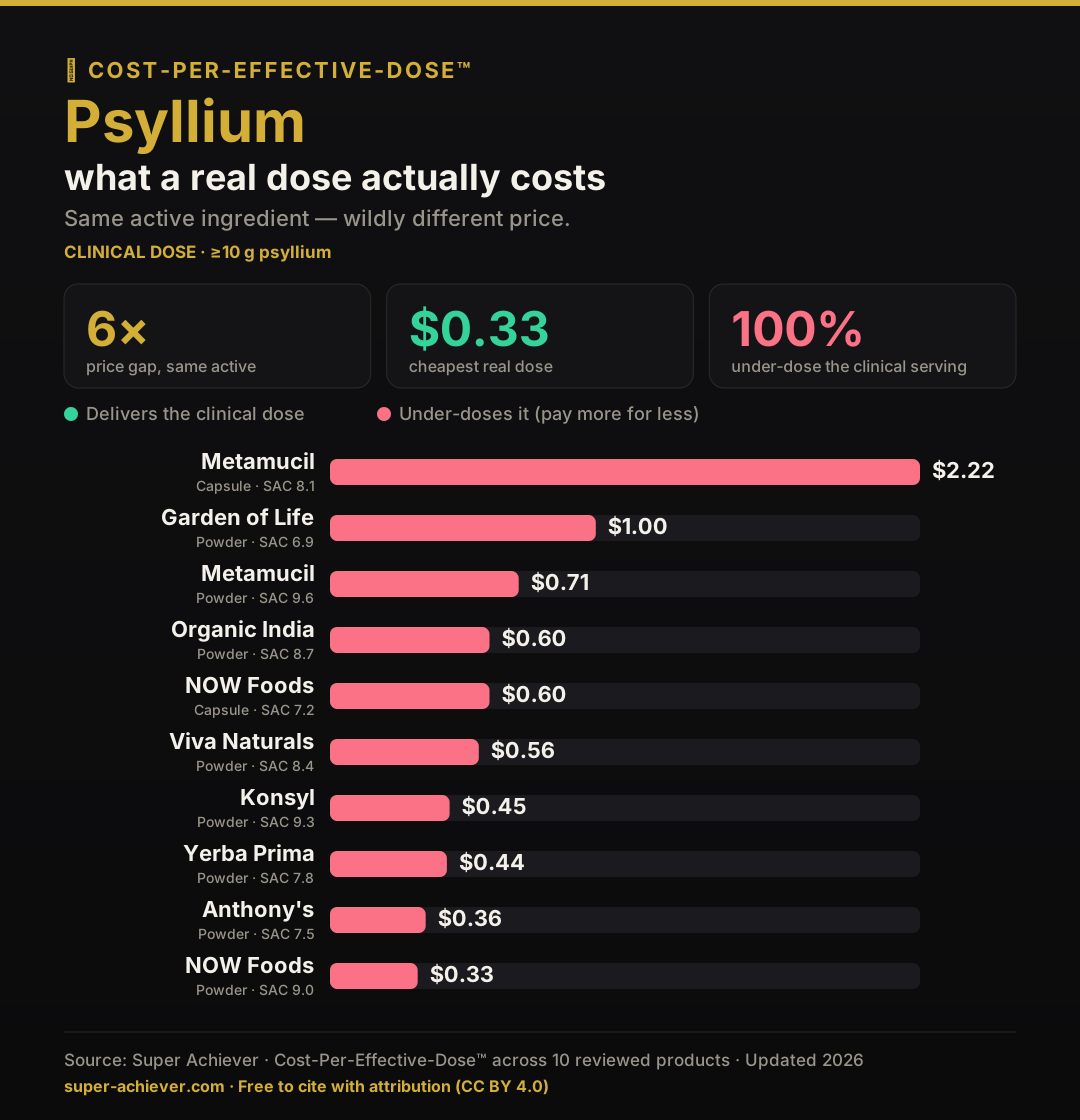
| # | Product | SAC Product Score™ | TXI™ | CPED™ | |
|---|---|---|---|---|---|
| 1 | Metamucil 4-in-1 Psyllium Fiber, Sugar-Free, OrangePowder | 9.6 | 0 | $0.71 | Under-dosed |
| 2 | Konsyl Daily Psyllium Fiber Powder, UnflavoredPowder | 9.3 | 0 | $0.45 | Under-dosed |
| 3 | NOW Psyllium Husk Powder, Non-GMOPowder | 9.0 | 20 | $0.33 | Most transparent |
| 4 | Organic India Whole Husk Psyllium Powder, USDA OrganicPowder | 8.7 | 0 | $0.60 | Under-dosed |
| 5 | Viva Naturals Organic Psyllium Husk PowderPowder | 8.4 | 0 | $0.56 | Under-dosed |
| 6 | Metamucil Psyllium Fiber CapsulesCapsule | 8.1 | 0 | $2.22 | Under-dosed |
| 7 | Yerba Prima Psyllium Husks PowderPowder | 7.8 | 0 | $0.44 | Under-dosed |
| 8 | Anthony's Organic Psyllium Husk PowderPowder | 7.5 | 0 | $0.36 | Under-dosed |
| 9 | NOW Psyllium Husk Caps 500 mgCapsule | 7.2 | 20 | $0.60 | Under-dosed |
| 10 | Garden of Life Raw Organic Fiber, UnflavoredPowder | 6.9 | 0 | $1.00 | Under-dosed |
Methodology. SAC Product Score™ blends our editorial rating (RCT quality, dose, safety, value) 50/50 with community ratings. Transparency Index™ (0-100) = third-party certification (0-50) + public batch COA (0-30) + dose honesty (0-20). Cost-Per-Effective-Dose™ is the real price of one clinical dose, not one marketed "serving". Free to cite with attribution to Super Achiever.
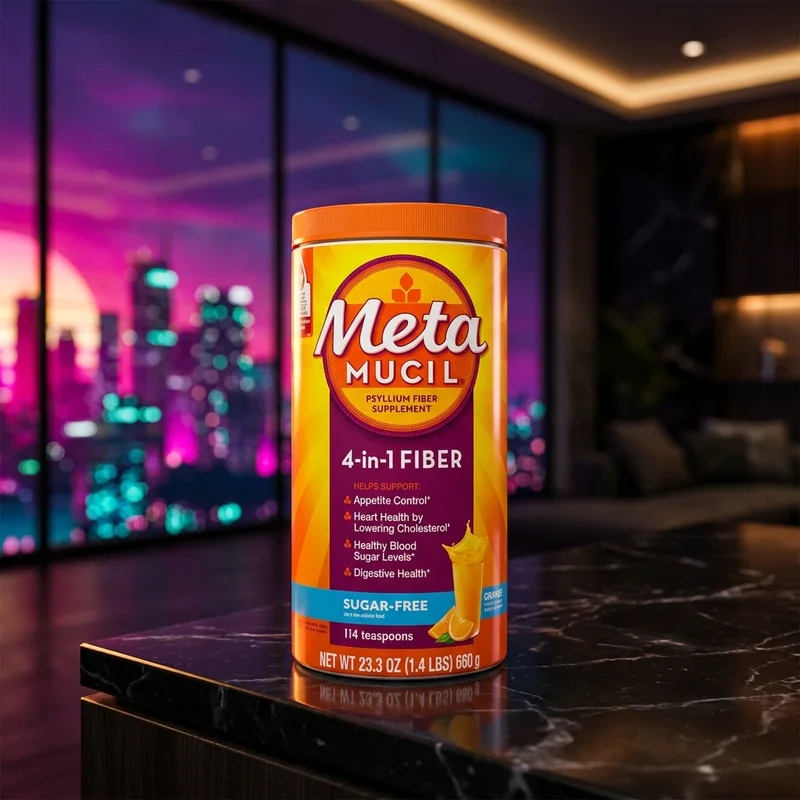
Metamucil 4-in-1 Psyllium Fiber, Sugar-Free, Orange
What is Psyllium Husk?
Psyllium husk is the milled outer coating (husk) of the seeds of Plantago ovata, a plant grown mostly in India — where it's long been known as isabgol. It's the single most clinically validated fiber supplement on the market, and the active ingredient in household brands like Metamucil. Chemically, psyllium is a soluble fiber, but the more important distinction is that it's a gel-forming, viscous fiber that resists fermentation: when it meets water it swells into a thick, slick gel and carries most of that gel intact all the way through the colon.
That combination — soluble + viscous + poorly fermented — is unusual and is exactly what gives psyllium its broad effects. Most "fibers" do only one job: insoluble fibers like wheat bran add bulk but don't form a gel; rapidly fermented soluble fibers like inulin feed bacteria (and produce gas) but are largely digested away before they reach the end of the colon, so they don't survive to soften stool. Psyllium sits in a rare middle ground: gel-forming enough to soften and lower cholesterol/glucose, yet intact enough at the far end of the colon to still bulk and regulate stool.
So the practical definition of psyllium is: a gel-forming soluble fiber that acts as a stool normalizer and a metabolic fiber at the same time. It comes as whole husk, powder, capsules, or wafers — all the same active fiber; the format is just a convenience and dosing choice. The one rule that matters across every format is hydration: psyllium only works as a swollen gel, so it must always be taken with a full glass of water.
How it works
Psyllium's effects all trace back to one physical property: it forms a viscous gel and keeps it. In the gut, that single mechanism produces benefits in four different directions.
For stool, psyllium is a true normalizer — it works in BOTH directions, which is why it helps constipation and diarrhoea alike. In constipation, the gel holds water in the stool that would otherwise be reabsorbed, so the stool stays soft, bulky, and easy to pass; because psyllium resists fermentation, that water-holding gel survives to the end of the colon where it's needed. In diarrhoea, the same gel does the opposite job — it absorbs excess water and adds form, firming up loose stool and slowing transit. One fiber, two opposite problems, same gel.
For the microbiome, psyllium is only modestly fermented, but it still nudges the gut ecosystem and supports production of short-chain fatty acids (SCFAs) such as butyrate, the preferred fuel of colon cells. Crucially, because it ferments slowly and partially rather than fast and completely, it delivers some prebiotic-type benefit with far less gas and bloating than rapidly fermented fibers like inulin.
For cholesterol, the gel binds bile acids in the small intestine and carries them out in the stool. The liver then has to pull cholesterol out of the blood to make replacement bile acids — which lowers circulating LDL. Anderson 2000 (PMID 10648260) showed ~10 g/day of psyllium cut LDL cholesterol by about 7% on top of a low-fat diet. For blood sugar, the same viscous gel slows gastric emptying and the absorption of glucose, blunting the post-meal spike; Gibb 2015 (PMID 26561625) found the glucose-lowering effect scales with how impaired someone's control already is — strong in type-2 diabetes, modest in pre-diabetes, negligible in healthy people. The non-negotiable practical caveat: start with a small dose, build up over a week or two, and always take it with plenty of water — too much too soon causes gas and bloating, and dry psyllium can swell and pose a choking/obstruction risk.
At-a-glance facts
- What it is
- Soluble, gel-forming, poorly-fermented fiber from Plantago ovata seed husk (isabgol)
- Typical dose
- Start ~5 g/day, build to ~10 g/day (one rounded tsp ≈ 5 g); split across meals
- Always take with
- A full glass of water (≥250 ml) per dose — psyllium only works, and is only safe, as a hydrated gel
- Works in BOTH directions
- Softens + bulks for constipation; absorbs water + firms for diarrhoea — a true stool normalizer
- Time to felt effect
- Bowel regularity: 12-72 hours. Cholesterol/glucose: a few weeks of daily use
- Mechanism
- Forms a viscous gel that holds water, binds bile acids, and slows glucose absorption
- Med spacing
- Separate from oral medications by ~2 hours — the gel can slow drug absorption
- Stack synergy
- Pairs with a probiotic (microbiome) and magnesium (osmotic) for gut health; complements omega-3 / berberine on the metabolic side
Evidence: Among the best-evidenced supplements in the gut-health category, with consistent RCT/meta-analysis support across four separate outcomes. Psyllium was the most effective fiber for chronic constipation in van der Schoot 2022 (PMID 35816465) and Christodoulides 2016 (PMID 27170558); soluble fiber improved IBS symptoms in Moayyedi 2014 (PMID 25070054); ~10 g/day cut LDL ~7% in Anderson 2000 (PMID 10648260); and Gibb 2015 (PMID 26561625) showed glucose-lowering proportional to baseline impairment. The mechanism (gel-forming, poorly-fermented fiber) is well characterised by Lambeau & McRorie 2017 (PMID 28252255).
Who it's for — and who it isn't
- Anyone with chronic constipation — psyllium was the single most effective fiber for it in the largest meta-analysis (van der Schoot 2022), softening stool and raising frequency
- People with the opposite problem, loose stool or IBS-D — the same gel firms up watery stool, making psyllium a rare two-way normalizer
- Anyone with IBS — soluble fiber (psyllium specifically) improved overall IBS symptoms in Moayyedi 2014, unlike insoluble bran which can worsen them
- People with high LDL cholesterol wanting a food-first lever — ~10 g/day lowers LDL ~7% (Anderson 2000), stackable with diet or statins
- People with type-2 diabetes or pre-diabetes managing post-meal glucose — psyllium blunts the spike, with benefit proportional to how impaired control is (Gibb 2015)
- Anyone trying to hit a daily fiber target with a low-gas, low-bloat option — psyllium ferments slowly, so it's gentler than inulin or wheat dextrin
- Anyone who won't take it with enough water — dry or under-hydrated psyllium can swell in the throat or gut and cause choking or obstruction; this is the one hard rule
- People with difficulty swallowing (dysphagia) or any known gut stricture, narrowing, or bowel-obstruction history — the gel-forming bulk is a genuine risk here
- Anyone expecting an overnight fix who jumps to a full dose on day one — that's the recipe for gas, cramping and bloating; psyllium must be titrated up over 1-2 weeks
- People who take critical oral medications and can't space them out — psyllium's gel can blunt drug absorption, so meds need a 2-hour buffer from each dose
Week-by-week, what happens
- Day 1-3Bowel regularity often responds first — softer, bulkier, easier stools (or firmer, more formed stools if you started with diarrhoea). Start at a low dose with plenty of water.
- Week 1-2Titration window. Build gradually toward ~10 g/day. Mild gas or bloating early on usually settles as your gut adapts — that's the sign to go slow, not to stop.
- Week 2-4Bowel pattern stabilises at the effective dose. Metabolic effects begin: post-meal glucose blunting and the start of LDL-cholesterol reduction with consistent daily use.
- Week 4+Full cholesterol effect (~7% LDL drop in the trials) and steady glycemic benefit are in place. Effects are maintained only while you keep taking it — stop and they fade.
Safety & contraindications
- Always take psyllium with plenty of water — at least a full glass (≥250 ml) per dose, and more fluid through the day. Dry or under-hydrated psyllium can swell before it's swallowed or in the gut and cause choking or intestinal obstruction. This is the single most important safety rule.
- Do not use psyllium if you have difficulty swallowing, a known narrowing or stricture of the gut, or any history of bowel obstruction — the gel-forming bulk can be dangerous in these situations. Check with a doctor first.
- Separate psyllium from oral medications by about 2 hours. The viscous gel can slow or reduce the absorption of some drugs (and of minerals), so don't take it at the same time as critical medication.
- Start low and build up over 1-2 weeks. Taking a large dose straight away commonly causes gas, bloating and cramping; titrating slowly lets the gut adapt and largely avoids this.
- It's very well tolerated for daily long-term use, but if you have diabetes and take glucose-lowering medication, be aware psyllium can add to the blood-sugar-lowering effect — monitor and discuss dosing with your prescriber.
- If you have an active flare of inflammatory bowel disease, or sudden unexplained changes in bowel habit, see a clinician before self-treating with a bulking fiber rather than adding psyllium on top.
All articles on Psyllium Husk
Best Appetite Suppressant Supplements
The best appetite suppressant supplements, ranked evidence-first - fiber (glucomannan, psyllium) and protein lead because they actually curb hunger; weak herbal pills are flagged honestly.
Read →Best Digestive Enzyme Supplements
Digestive enzymes ranked by what you actually need — targeted (lactase for dairy) beats broad-spectrum for most — by enzyme activity units, evidence, and value, with an honest take on who doesn't need them.
Read →Best Ginger Supplements
9 ginger supplements ranked on form and standardization, dose against the clinical range, third-party testing, tolerability and value.
Read →Best Glucomannan Supplements
8 glucomannan products ranked on dose against the trials, label directions and choking warning, testing, formulation and value — every Supplement Facts panel read by us.
Read →Best L-Glutamine Supplements
L-Glutamine ranked by purity (single-ingredient powder beats capsules on dose economics), third-party testing, and value — the gut-lining amino acid for IBS and intestinal permeability.
Read →Best Magnesium for Constipation
Citrate dominates (osmotic) and glycinate sinks (chelated, no laxative effect) — the form ranking is fully inverted vs. magnesium-for-sleep, with acute breakthrough + chronic maintenance protocols spelled out.
Read →Best Peppermint Oil Capsules for IBS
Enteric-coated peppermint oil ranked by coating quality first (it has to survive the stomach to work), dose, and value — one of the best-evidenced OTC options for IBS cramping and bloating.
Read →Best Probiotics Supplements
The 10 best probiotic supplements ranked by strain specificity + verified CFU — matching documented strains to your actual goal (IBS, post-antibiotic, women's, daily), not chasing the biggest number.
Read →Best Psyllium Fiber Supplements
Psyllium husk ranked by form honesty (powder vs capsules vs the dose math), additive load, and value — the most RCT-backed soluble fiber for regularity, cholesterol, and blood sugar.
Read →Align Probiotic 24/7 Digestive Support Review
The evidence-backed strain for IBS — and only for IBS.
Read →Anthony's Organic Psyllium Husk Powder Review
The organic bulk-buy — best per-gram organic value, in a bag not a tub.
Read →BioGaia Protectis Chewable Review
A clean single-strain chewable — L. reuteri DSM 17938 and nothing else.
Read →Carlyle Peppermint Oil, 150ct Review
Cheap and high-count — but a low dose and a less-documented coat hold it back.
Read →Culturelle Daily Probiotic Review
The cleanest, most affordable way to get the most-studied strain (LGG); plain capsule, no potency-through-expiry promise printed. 7.8/10.
Read →Designs for Health Digestzymes Review
The clinical bridge — low-acid support plus gluten/casein peptide coverage, for a specific buyer.
Read →Designs for Health L-Glutamine Powder Review
Clinic-grade free-form glutamine at the best value in the clinical tier.
Read →Enzymedica Digest Gold + ATPro Review
The high-activity broad blend benchmark — for heavy, varied meals, not for everyone.
Read →Florastor Daily Probiotic Review
The yeast antibiotics can't kill — the textbook pick for antibiotic-associated diarrhea.
Read →Garden of Life Dr. Formulated Once Daily Women's Review
The right pick for women caring for digestive AND vaginal flora.
Read →Garden of Life Dr. Formulated Organic Digest+ Review
Organic chewable with 13 enzymes, each with its activity unit, but no amylase on the panel; about $0.26 a tablet. 7.1/10.
Read →Garden of Life Omega-Zyme Ultra Review
The widest plant-based spread, no HCl — best for varied, fiber-heavy diets.
Read →Garden of Life Raw Organic Fiber, Unflavored Review
The deliberate psyllium-FREE pick — for guts that can't tolerate psyllium.
Read →Heather's Tummy Tamers Peppermint Oil, 90ct Review
The reflux-tolerant peppermint for people other softgels burned.
Read →IBgard Peppermint Oil Capsules, 48ct Review
The most-studied IBS peppermint, with the lowest heartburn risk.
Read →Jarrow Formulas L-Glutamine Powder Review
The set-and-forget supply pick — a year of 99%-pure powder at low cost per gram.
Read →Klaire Labs L-Glutamine Powder Review
A full 5 g trial per-dose amount in one hypoallergenic scoop.
Read →Konsyl Daily Psyllium Fiber Powder, Unflavored Review
The high-dose, pure-husk pick when grams matter most.
Read →Lactaid Fast Act Lactase Caplets Review
If dairy is your one problem, this is the single best — and best-evidenced — pick.
Read →Life Extension L-Glutamine Powder Review
A cheap starter tub to test whether you respond before buying bulk.
Read →Mason Natural Peppermint Oil 50mg Enteric, 90ct Review
Genuinely enteric at a bargain price — but 50 mg per softgel is the catch.
Read →Metabolic Maintenance L-Glutamine Powder Review
The titration specialist — fine 1 g dosing for a reactive, IBS-prone gut.
Read →Metamucil 3-in-1 Psyllium Fiber Capsules Review
The exact psyllium studied in the best-replicated pre-meal satiety trials (Brum 2016), in convenient capsules with a real cholesterol and regularity bonus.
Read →Metamucil 4-in-1 Psyllium Fiber, Sugar-Free, Orange Review
The safe, doctor-trusted default psyllium for first-time buyers.
Read →Metamucil Psyllium Fiber Capsules Review
The convenience pick from the most-trusted brand — bought with eyes open.
Read →Nature's Way CompleteGest Review
The dependable mainstream vegan blend — reliable and available, not a spec leader.
Read →Nature's Way Pepogest Enteric Peppermint Oil, 60ct Review
The clinically validated dose at the best price — the default for most buyers.
Read →Nature's Way Peppermint Soothe, 60ct Review
A trustworthy heritage enteric peppermint — outcompeted by its own sibling.
Read →NOW Foods Psyllium Husk 500 mg Review
The same psyllium pre-meal satiety mechanism (Brum 2016) at the lowest cost per serving on the list, in a Non-GMO Project Verified, vegan 500-count bottle.
Read →NOW Peppermint Gels with Ginger & Fennel, Enteric, 90ct Review
A budget brand getting the fundamentals right — the best bulk value.
Read →NOW Probiotic-10 25 Billion Review
The honest value floor — cheap, a code printed on every strain, no frills. 7.3/10.
Read →NOW Psyllium Husk Caps 500 mg Review
The vegan, value-minded capsule — convenient and grit-free, but low-dose.
Read →NOW Psyllium Husk Powder, Non-GMO Review
The lowest-cost honest way to take psyllium — if you'll stir plain husk.
Read →NOW Sports L-Glutamine Pure Powder Review
The value benchmark — genuine free-form glutamine at the lowest cost per gram.
Read →NOW Super Enzymes Review
The best value on the list — real pancreatic + acid support at a third of premium prices.
Read →Nutricost Digestive Enzymes 620mg Review
Maximum enzyme variety per dollar — the low-risk budget experiment.
Read →Nutricost L-Glutamine Powder, Unflavored Review
The bulk-budget sweet spot — exact 5 g scoops at near-benchmark value.
Read →Nutricost Peppermint Oil 50mg, 120ct Review
Well-made and clean — but NON-enteric, the one disqualifying flaw for the gut.
Read →Optimum Nutrition L-Glutamine Powder Review
A fine free-form powder that ranks last on fit, not quality.
Read →Organic India Whole Husk Psyllium Powder, USDA Organic Review
The organic pick that still delivers a real dose.
Read →Physician's Choice Probiotics 60 Billion CFU Review
A low-cost high-CFU generalist whose label names ten species but no strain codes. 6.8/10.
Read →Pure Encapsulations Digestive Enzymes Ultra Review
The cleanest broad blend — the safe pick for a sensitive, allergy-prone gut.
Read →Pure Encapsulations L-Glutamine Powder Review
The cleanest hypoallergenic label for the reactive, IBS-prone gut.
Read →Regimint Peppermint Oil Plus Caraway, 60ct Review
The European peppermint-caraway combo for IBS-plus-dyspepsia overlap.
Read →Renew Life Ultimate Flora Extra Care 50 Billion Review
A broad high-potency blend for sensitive guts — with LGG and delayed-release doing the work.
Read →Ritual Synbiotic+ Review
The most complete formulation on paper, with the best traceability.
Read →Seed DS-01 Daily Synbiotic Review
The survivability-engineered default for general gut health.
Read →Solaray Peppermint Oil, Enteric, 60ct Review
A clinical 250 mg enteric peppermint dose, plus botanicals you're partly paying for.
Read →Sunergetic 4-in-1 Probiotic Review
Spore-based probiotic with enzymes and PreforPro, but only two named strains and 3 billion CFU. 6.6/10.
Read →Thorne Advanced Digestive Enzymes Review
The low-stomach-acid powerhouse — excellent for the right buyer, contraindicated for many.
Read →Thorne L-Glutamine Powder Review
The cleanest, most credible way to run the one glutamine protocol with real human evidence.
Read →Viva Naturals Organic Psyllium Husk Powder Review
The finely-ground organic pick for smoothies and keto baking.
Read →Yerba Prima Psyllium Husks Powder Review
The heritage purist's pure-husk pick — dependable, honest, lower-profile.
Read →Zenwise Digestive Enzymes + Probiotics & Prebiotics Review
Amazon's bestselling all-in-one — convenient, but a compromise on every component.
Read →FAQ
How can psyllium help BOTH constipation and diarrhea?
Because it works by forming a water-holding gel, not by being a stimulant. In constipation, that gel keeps water in the stool so it stays soft, bulky and easy to pass. In diarrhoea, the same gel does the opposite useful job — it soaks up the excess water in loose stool and adds form, firming things up. One fiber, two opposite problems, same mechanism. That two-way 'normalizing' action is what makes psyllium unusual among fibers and a first-line tool for general bowel regularity.
Is psyllium the same as Metamucil? And is it better than other fibers?
Metamucil is the best-known brand whose active ingredient is psyllium husk — so yes, generic psyllium husk is essentially the same fiber, usually cheaper. And for several jobs it does beat other fibers: in the largest constipation meta-analysis (van der Schoot 2022, PMID 35816465) psyllium was the single most effective fiber type. The reason is that it's gel-forming AND resists fermentation, so it survives intact to the end of the colon. Rapidly fermented fibers like inulin get digested by bacteria long before then (producing gas), and insoluble bran adds bulk but no gel — so neither matches psyllium's range of effects.
How much psyllium should I take, and how do I avoid gas and bloating?
Start low — around 5 g/day (a rounded teaspoon of powder) — and build up over a week or two toward about 10 g/day, which is the dose used in most of the trials. The gas and bloating people complain about almost always comes from jumping straight to a big dose; titrating slowly lets your gut adapt and largely avoids it. Split the dose across the day, and always take each dose with a full glass of water.
Why do I have to take psyllium with so much water?
Psyllium works by swelling into a gel, and it needs water to do that. Taken with too little fluid, it can start swelling before it's fully swallowed or partway down the gut — which is a genuine choking and intestinal-obstruction risk. So every dose should go down with at least a full glass of water (around 250 ml), with more fluid across the day. If you can't reliably take it with enough water, or you have swallowing difficulty, psyllium isn't the right fiber for you.
Does psyllium really lower cholesterol and blood sugar, or just help my gut?
It genuinely does both, through the same gel. For cholesterol, the gel binds bile acids and carries them out in the stool, forcing the liver to pull LDL cholesterol from the blood to make more — Anderson 2000 (PMID 10648260) found about 10 g/day lowered LDL roughly 7%. For blood sugar, the gel slows how fast glucose is absorbed, blunting the post-meal spike; Gibb 2015 (PMID 26561625) showed the effect is biggest in people with type-2 diabetes, modest in pre-diabetes, and negligible if your control is already normal. These are real metabolic effects, but they need consistent daily use over weeks to show up.
Can psyllium interfere with my medications?
It can, because the gel that slows glucose absorption can also slow or reduce the absorption of some oral drugs (and certain minerals). The simple fix is timing: take your medications about 2 hours apart from your psyllium dose. If you take critical prescription medication — or you're on glucose-lowering drugs, where psyllium can add to the effect — confirm the spacing with your pharmacist or prescriber.
Sources & further reading
- van der Schoot 2022 (constipation meta-analysis)The Effect of Fiber Supplementation on Chronic Constipation in Adults: An Updated Systematic Review and Meta-Analysis of Randomized Controlled Trials
Updated systematic review + meta-analysis of fiber RCTs in chronic constipation. Psyllium was the single most effective fiber type, significantly improving stool frequency and consistency; the optimal regimen was a daily dose >10 g for at least 4 weeks. The cornerstone modern evidence for psyllium in constipation.
- Christodoulides 2016 (CIC meta-analysis)Systematic review with meta-analysis: effect of fibre supplementation on chronic idiopathic constipation in adults
Systematic review + meta-analysis: fibre supplementation (predominantly soluble fibre / psyllium) significantly increased stool frequency and improved consistency, treatment success and straining in chronic idiopathic constipation, at the cost of moderate gas/bloating — establishing fibre as a moderately effective first-line therapy.
- Moayyedi 2014 (fiber in IBS)The effect of fiber supplementation on irritable bowel syndrome: a systematic review and meta-analysis
Systematic review + meta-analysis of fiber in IBS. Soluble fiber — specifically psyllium/ispaghula — significantly improved IBS symptoms versus placebo (RR of persistent symptoms 0.83), whereas insoluble fiber (bran) did not. The key trial behind 'use soluble, not insoluble, fiber for IBS.'
- Anderson 2000 (LDL cholesterol)Cholesterol-lowering effects of psyllium intake adjunctive to diet therapy in men and women with hypercholesterolemia: meta-analysis of 8 controlled trials
Meta-analysis of 8 controlled trials: ~10.2 g/day of psyllium, added to a low-fat diet, lowered serum total cholesterol by ~4% and LDL cholesterol by ~7% versus placebo, with no adverse effect on HDL or triglycerides. The reference RCT base for psyllium's cholesterol claim.
- Gibb 2015 (glycemic control)Psyllium fiber improves glycemic control proportional to loss of glycemic control: a meta-analysis of data in euglycemic subjects, patients at risk of type 2 diabetes mellitus, and patients being treated for type 2 diabetes mellitus
Meta-analysis: psyllium significantly improved fasting glucose and HbA1c, with the size of the benefit proportional to baseline impairment — large in people treated for type-2 diabetes, modest in pre-diabetes, and negligible in healthy (euglycemic) people. Explains why psyllium is a metabolic-support fiber, not a glucose drug.
- Lambeau & McRorie 2017 (mechanism / fiber therapy)Fiber supplements and clinically proven health benefits: How to recognize and recommend an effective fiber therapy
Mechanistic review: clinically meaningful fiber benefits come from gel-forming, viscous, non-fermented fibers. Psyllium is the archetype — it forms a viscous gel that resists fermentation, so it survives intact through the colon to normalize stool (both ways), lower LDL, and blunt glucose. The framework for why psyllium outperforms most other fibers.