
Designs for Health L-Glutamine Powder Review
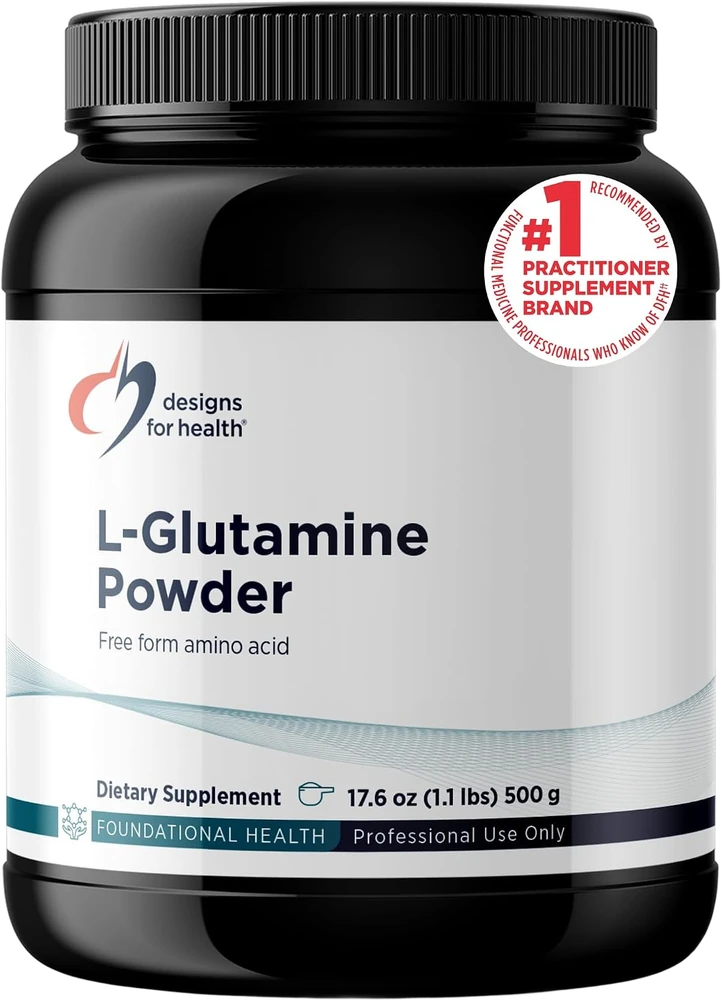 #3 of 10 · Best value clinical✓ Label verified · Supplement Facts read Sep 7, 2026
Real retailer photo, cut out. Label unedited.
Buy it. Clinic-grade free-form glutamine at the best value in the clinical tier. Practitioner-grade single-ingredient free-form L-glutamine in a 500 g tub (~5 months at 3 g/day) at roughly half Thorne's per-gram cost.
$40 / tub (500 g)$0.24 / 3 g serving
Why It Scores 9.0 — And The Label Line Behind Each Number
Purity / form
30% of scorePractitioner-grade single-ingredient free-form L-glutamine — the trial-grade form (Zhou 2019) with no added fillers or sweeteners. Clean and appropriate for a sensitive gut, just without the explicit hypoallergenic certification of Pure Encapsulations (#2).
- Active form
- Practitioner-grade free-form L-glutamine (single-ingredient)
- Inactives
- None — single-ingredient L-glutamine
- Certifications
- Practitioner-channel QC, GMP-manufactured (no NSF Sport mark)
- Manufacturer
- Designs for Health (clinic/practitioner channel)
- Lab transparency
- Practitioner-channel QC; single-ingredient formulation
Third-party testing + manufacturing quality
25% of scoreClinic-channel QC and GMP manufacturing from a brand that supplies practitioners — stricter than mass-market powders, but without the per-batch NSF Certified for Sport mark that Thorne (#1) carries. A solid quality gate, just one tier below the list's best.
Dose-per-scoop + label honesty
20% of score3 g L-glutamine per scoop, clearly stated with no proprietary-blend ambiguity. Two scoops reach ~6 g, near the 5 g per-dose trial amount; the smaller increment helps titration but means more scoops to hit 5 g than a calibrated 5 g scoop.
- Per serving
- 3 g L-glutamine per scoop (scale to ~2 scoops to approach the 5 g trial dose)
- Trial-dose alignment
- Two 3 g scoops ≈ the 5 g Zhou 2019 per-dose amount
Cost per effective gram
15% of scoreAround $0.24 per 3 g serving — roughly half the per-gram cost of Thorne (#1) and excellent for a practitioner-grade brand. A 500 g tub is months of daily dosing, which is exactly what an honest glutamine trial requires. Bested on raw cost only by the mass-market bulk tubs.
- Price
- ~$40 / 500 g tub = ~$0.24 per 3 g serving
Tolerability for sensitive / IBS-prone guts
10% of scoreSingle-ingredient free-form powder with no irritant excipients, and a 3 g scoop that allows gentle titration. Well-tolerated for most, though a very reactive gut may still prefer the explicitly hypoallergenic Pure Encapsulations (#2) or Klaire Labs (#4).
- More Specs
- Tub
- 500 g / 166 servings (~5 months at 3 g/day)
Label verified. Every figure read from the Supplement Facts photo, Sep 7, 2026.
Marketing Claims Vs. Reality
Supports intestinal/gut health and the gut lining.
Mechanistically grounded (Wang 2015, PMID 24965526) and supported by a strong RCT in a narrow population — post-infectious IBS-D with high permeability (Zhou 2019, PMID 30108163). But Abbasi 2024 (PMID 39397201) found no overall permeability effect across mixed adults except at >30 g/day short-term. True for the specific population, oversold as a general gut-lining claim.
Pure free-form L-glutamine, single ingredient.
L-glutamine is the only listed ingredient — the exact free-form used in the human trials. Verified.
Practitioner-grade quality.
Designs for Health is a recognised clinic/practitioner-channel brand with GMP manufacturing and stricter sourcing than mass-market powders. Accurate — though 'practitioner-grade' is not the same as per-batch NSF Certified for Sport.
Supports immune function and recovery.
Glutamine's immune/recovery role is real mainly under physiological stress (the 'conditionally essential' setting; Shariatpanahi 2019). In healthy, well-fed people the recovery evidence is weak. Accurate as a conditional claim, not a reliable everyday benefit.
Well absorbed — no special formulation required.
Plain L-glutamine is well absorbed orally, so a simple free-form powder reaches the trial dose without a special carrier. Accurate.
What Our Test Actually Found
It's the per-gram value leader of the clinical tier
At roughly $0.24 per 3 g serving from a 500 g tub, Designs for Health undercuts Thorne (#1) by about half on cost per gram while keeping practitioner-channel QC and genuine single-ingredient free-form glutamine. For the honest 8-week trial — and the multi-month courses that follow if it works — that value compounds. The mass-market bulk tubs (NOW #5, Nutricost #6, Jarrow #8) are cheaper still, but among clinic-grade brands this is the value pick.
What you trade away is certification, not glutamine quality
The molecule here is the same free-form amino acid as in the NSF-certified #1 pick. What you give up is the per-batch NSF Certified for Sport mark and Pure Encapsulations' explicit hypoallergenic certification. For a drug-tested athlete that gap matters; for a typical gut buyer, practitioner-channel QC plus single-ingredient purity is more than adequate. Decide based on whether you specifically need a certification, not on a difference in the glutamine itself.
The big tub is a feature for a substance that needs a long trial
Glutamine works over weeks, and the Zhou protocol ran 8 weeks — so the substance practically demands a multi-month supply to judge fairly. A 500 g tub (~5 months at 3 g/day) suits that better than a small starter jar, and it keeps the per-dose cost low across the whole course. Just remember the full protocol is 15 g/day, which goes through even a big tub faster than the 3 g/day headline servings suggest.
Same honest ceiling: a specific job, not a generic gut cure
We won't let the affordable clinic-grade framing oversell the science. Abbasi 2024 found no overall effect of glutamine on intestinal permeability across mixed adults, with benefit only at >30 g/day short-term, and Burrin 2006 questioned the 'unique gut fuel' story. Designs for Health is the value way to run a specific protocol — post-infectious IBS-D with high permeability, or clinician-guided barrier support — not a proven fix for everyday bloating or generic 'leaky gut.'
A 3 g scoop is fine — plain glutamine is well absorbed either way
The 3 g scoop means double-scooping to reach the 5 g per-dose amount, which is a minor convenience cost, not an efficacy one. Glutamine is well absorbed as a simple powder regardless of scoop size, and the smaller increment actually helps a reactive gut titrate up. If single-scoop convenience at 5 g matters more to you than per-gram value, Klaire Labs (#4) or Nutricost (#6) are the calibrated 5 g options.
Full analysis: all pros & cons (8), buy if / skip if
- Excellent cost per gram for a practitioner-grade brand — a 500 g tub is months of daily dosing
- Free-form single-ingredient glutamine, the trial form, with no added fillers or sweeteners
- Designs for Health is a clinic-channel staple, so QC sits above mass-market powders
- Large tub suits the long, daily, multi-month course glutamine actually requires to be judged fairly
- Plain glutamine is well absorbed, so the simple powder loses nothing on effectiveness
- Not NSF Certified for Sport like Thorne (#1) — practitioner QC, but no per-batch sport certification
- 3 g scoop means two scoops for the 5 g per-dose trial amount
- Not explicitly hypoallergenic — fine for most, but the most reactive guts may prefer #2 or #4
- You're committed to a long, multi-month daily gut-support course and want the best cost per gram in the clinical tier
- You want practitioner-channel quality without paying the NSF-certified premium of #1
- You have post-infectious diarrhoea-predominant IBS — the population with a striking RCT behind glutamine
- You're fine titrating with a 3 g scoop and don't need a single 5 g scoop
- You need NSF Certified for Sport — only Thorne (#1) carries it on this list
- You want an explicitly hypoallergenic label for a very reactive gut — Pure Encapsulations (#2) or Klaire Labs (#4)
- You want the absolute lowest cost per gram — NOW Sports (#5), Nutricost (#6), and Jarrow (#8) are cheaper still
Practitioner-grade single-ingredient free-form L-glutamine in a 500 g tub (~5 months at 3 g/day) at roughly half Thorne's per-gram cost. The right balance for a committed long daily course where you want clinic-channel quality without clinic-channel pricing. Trade-offs: no NSF certification, and a 3 g scoop rather than a 5 g one. Set expectations correctly — strong for post-infectious IBS-D and barrier support, not a proven generic 'leaky gut' cure.
Designs for Health L-Glutamine is the smart-value entry into the clinical tier. The honest frame first: glutamine's strong human evidence is narrow — one standout RCT (Zhou 2019, in Gut) in post-infectious diarrhoea-predominant IBS with a measured leaky barrier, plus mechanism and critical-illness data, but no overall permeability benefit in a 2024 meta-analysis outside very high short-term doses. So this is a tool for a specific job. What Designs for Health does better than almost anything on the list is make running that job affordable over months: genuine practitioner-grade free-form glutamine in a 500 g tub at roughly half the per-gram cost of the NSF-certified #1 pick. You give up the sport certification and the exact 5 g scoop, but the glutamine itself is the same clean free-form the trials used. Here's the full breakdown.
The smart-value way into the clinical tier.

Designs for Health L-Glutamine is what we recommend to the buyer who's committed to a real multi-month glutamine course and wants clinic-channel quality without clinic-channel pricing. You get genuine practitioner-grade free-form glutamine in a 500 g tub that lasts months, at roughly half the per-gram cost of the NSF-certified #1 pick. The glutamine is the same clean free-form the trials used; what you trade away is the sport certification and the convenience of a single 5 g scoop — neither of which changes how well the amino acid works. Two honest caveats. On positioning: if you specifically need NSF Certified for Sport, only Thorne (#1) has it; if you want an explicitly hypoallergenic label for a very reactive gut, Pure Encapsulations (#2) or Klaire Labs (#4) are the better fits; and if raw cost per gram is everything, the mass-market bulk tubs (#6, #7, #8) go lower still. On expectations: glutamine's strong evidence is specific to post-infectious IBS-D with high permeability and clinical barrier support (Zhou 2019, Shariatpanahi 2019), and a 2024 meta-analysis found no overall permeability benefit outside very high short-term doses (Abbasi 2024). This is the value tool for a specific job, not a generic 'leaky gut' cure. Start at 3 g/day, build toward 5 g (up to three times daily), and give it the full 8 weeks. If you have liver disease, active cancer, a serious GI condition, or are pregnant, clear it with your doctor first.
If This Doesn’t Fit — Try These
 01
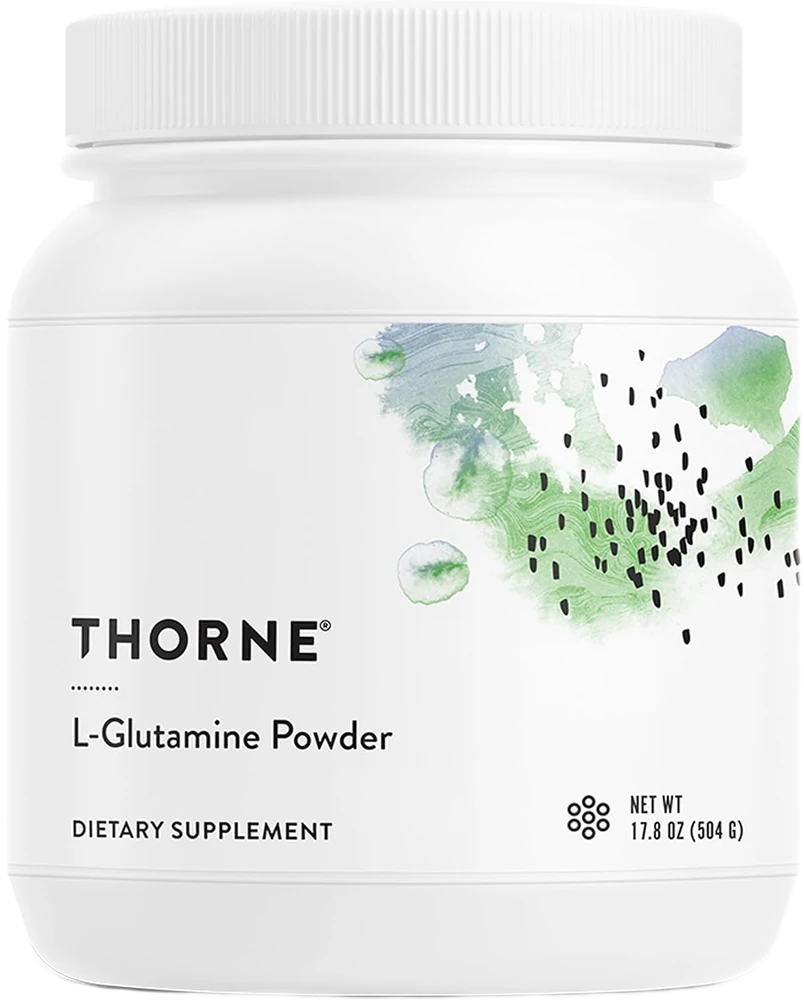
01Thorne L-Glutamine Powder
The default pick for anyone serious about using glutamine for gut-barrier support.
 07
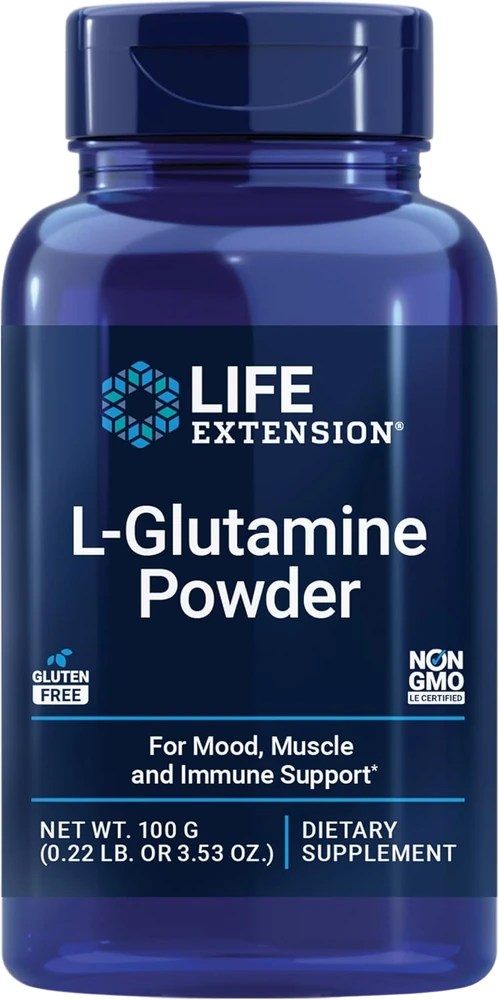
07Life Extension L-Glutamine Powder
The pick for the undecided buyer.
 02
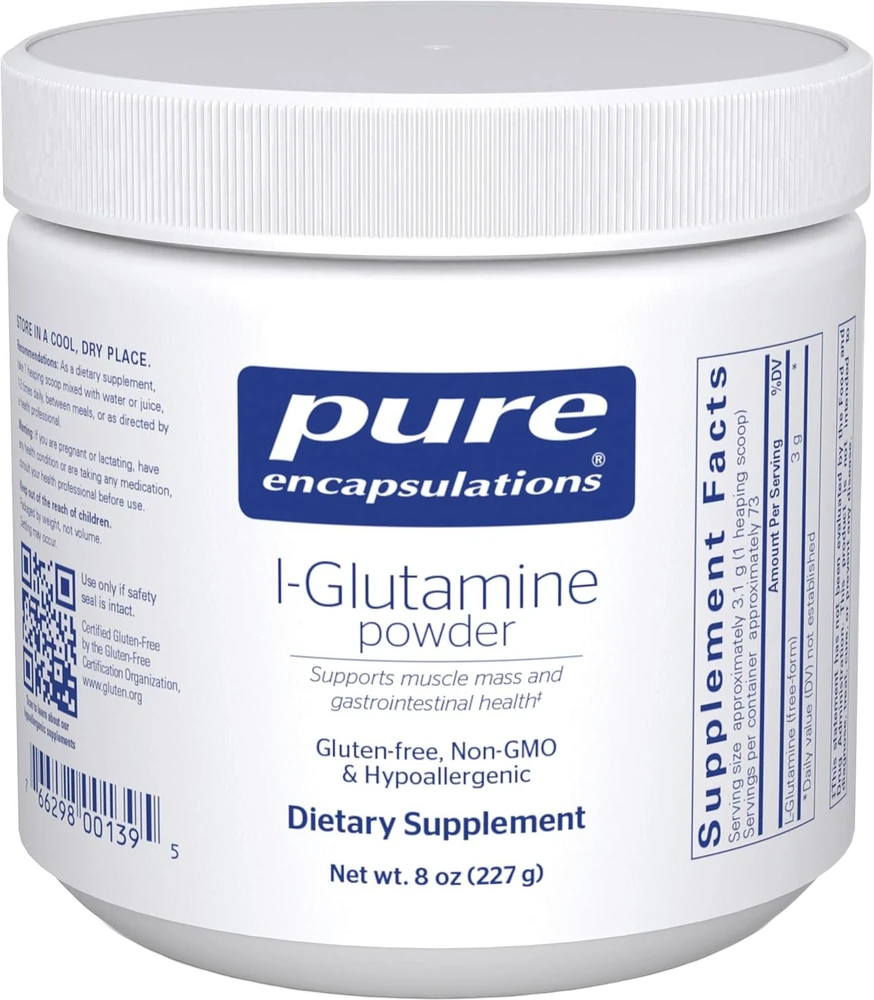
02Pure Encapsulations L-Glutamine
The right pick if your gut is the reason you're here.
Quick Answers
Why pick this over the #1 Thorne or #2 Pure Encapsulations?
Cost per gram for a long course. Designs for Health gives you genuine practitioner-grade free-form glutamine in a 500 g tub — about five months at 3 g/day — at roughly half the per-gram price of Thorne (#1). The glutamine itself is the same clean free-form form the trials used. What you give up versus Thorne is the NSF Certified for Sport mark, and versus Pure Encapsulations the explicit hypoallergenic certification. If you're committed to a long daily gut-support course and want clinic-channel quality without clinic-channel pricing, this is the best balance on the list. If you need sport certification or a hypoallergenic label specifically, go to #1 or #2.
The scoop is 3 g — how do I reach the 5 g trial dose?
Two scoops gets you to 6 g, close to the 5 g per-dose amount Zhou 2019 used. The 3 g increment also lets you titrate gently if your gut is reactive. The best-evidenced protocol is 5 g three times daily (15 g/day) for eight weeks, so on a big 500 g tub you'll go through it faster at the full protocol dose than at 3 g/day — budget accordingly. If you'd rather hit 5 g in a single calibrated scoop, Klaire Labs (#4) or Nutricost (#6) are built for that.
Will it heal 'leaky gut'?
Honestly, not in the broad way it's marketed — and no glutamine bottle will. The mechanism is real (glutamine fuels the gut-lining cells and supports the tight-junction proteins that control barrier leakiness — Wang 2015, PMID 24965526), but a 2024 meta-analysis (Abbasi 2024, PMID 39397201) found no overall effect on intestinal permeability across mixed adults except at very high doses (>30 g/day) short-term. The strong evidence is narrow: post-infectious diarrhoea-predominant IBS with documented hyperpermeability (Zhou 2019, PMID 30108163). This tub is an affordable way to run that specific protocol over months — not a guaranteed fix for generic gut complaints.
Is 'practitioner-grade' meaningfully better than mass-market powder?
It sits above mass-market on QC, below NSF Certified for Sport. Designs for Health is a clinic-channel staple, so manufacturing standards and raw-material sourcing are stricter than a generic tub — but it doesn't carry the per-batch banned-substance certification that Thorne (#1) does. For most gut buyers the practitioner-channel QC plus single-ingredient free-form purity is plenty; for drug-tested athletes, only the NSF-certified pick clears that bar.
How long before I know if it's working?
Give it the full 8 weeks the Zhou 2019 trial ran. Glutamine supports gut-lining turnover over time, not as a fast symptom blocker, so little change in week 1-2 is expected. The big 500 g tub is actually well-suited to this, because the honest test is a multi-week course at an adequate dose. Assess at 8 weeks; if there's no meaningful improvement by then, it's reasonable to stop rather than escalate indefinitely.
Is daily use safe, and what are the cautions?
For most healthy people, yes — glutamine is a dietary amino acid you already eat in grams daily, and trials at 15 g/day for two months were well tolerated. The specific cautions: avoid it or use it only under medical supervision with cirrhosis or significant liver disease (it breaks down into glutamate and ammonia a damaged liver may not clear); clear it with your oncology team if you have active cancer; and start low to avoid the mild bloating or loose stools that can occur at higher doses. A big tub makes a long course convenient — just don't mega-dose on the assumption that more reseals the gut faster.
Sources & Further Reading
5 peer-reviewed sources, each linked to PubMed
- [1] Zhou 2019 PMID 30108163 — Randomised placebo-controlled trial of dietary glutamine supplements for postinfectious irritable bowel syndrome. Double-blind RCT in adults with post-infectious diarrhoea-predominant IBS and increased intestinal permeability: glutamine 5 g three times daily for 8 weeks produced a ≥50-point IBS-SS reduction in ~79.6% of the glutamine group versus 5.8% on placebo, with reduced stool frequency and normalised permeability. The single strongest human trial behind glutamine for gut-barrier support — and the basis for the 5 g per-dose protocol — but in a narrow, high-permeability population.
- [2] Shariatpanahi 2019 PMID 31485104 — Effects of Early Enteral Glutamine Supplementation on Intestinal Permeability in Critically Ill Patients. RCT in 80 ICU patients: early enteral glutamine (0.3 g/kg/day) reduced plasma zonulin (a tight-junction permeability marker) by ~40% over 10 days versus placebo and lowered endotoxin, indicating a tighter barrier — though clinical outcomes did not differ. Supports glutamine's 'conditionally essential under stress' barrier role, a clinical setting distinct from healthy everyday use.
- [3] Wang 2015 PMID 24965526 — Glutamine and intestinal barrier function. Mechanistic review: glutamine fuels enterocyte proliferation and survival and regulates intestinal barrier function — including expression of tight-junction proteins (occludin, claudins) — in injury, infection, weaning stress and other catabolic states. The mechanistic backbone for the gut-barrier rationale behind any free-form glutamine.
- [4] Alpers 2000 PMID 17024034 — Is glutamine a unique fuel for small intestinal cells?. Critical review arguing glutamine is NOT a uniquely essential small-intestinal fuel — glutamate and aspartate are also major mucosal fuels — and that where supplementation helps, the benefit may relate to functions other than gut-fuelling. The honest counterweight to over-stated 'gut fuel' marketing on any glutamine bottle.
- [5] Abbasi 2024 PMID 39397201 — A systematic review and meta-analysis of clinical trials on the effects of glutamine supplementation on gut permeability in adults. Meta-analysis of adult RCTs: glutamine supplementation had no significant overall effect on intestinal permeability; a reduction appeared only in a subgroup using high doses (>30 g/day) over a short period. The key honesty anchor — it sets the limits on glutamine's gut-permeability claims and argues against treating any bottle as a universal 'leaky gut' fix.
Affiliate disclosure: every Amazon link uses our Associates tag (superachieverclub-20). We earn a small commission at no cost to you; it funds independent reviews. We never accept payment to change a ranking.