
L-Glutamine: Benefits, Dosage & Side Effects (2026)
L-Glutamine is the primary fuel for the cells lining the small intestine; it has strong RCT evidence in post-infectious IBS-D and critical illness, but is unproven for general "leaky gut".
The L-Glutamine market in numbers
Our independent analysis of 10 l-glutamine products, scored on three proprietary indices — the SAC Product Score™, Transparency Index™, and real Cost-Per-Effective-Dose™. Updated October 2026.
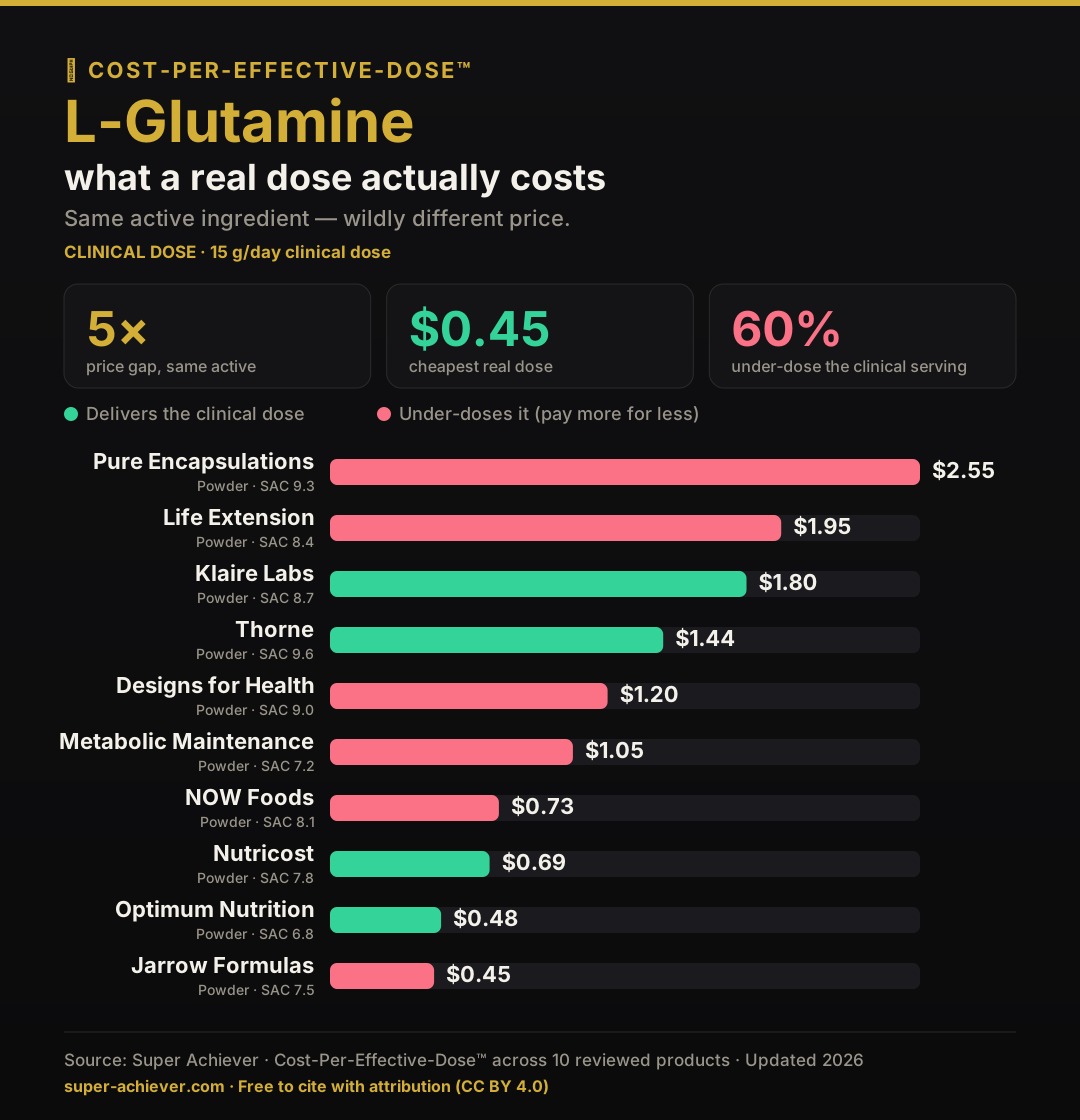
| # | Product | SAC Product Score™ | TXI™ | CPED™ | |
|---|---|---|---|---|---|
| 1 | Thorne L-Glutamine PowderPowder | 9.6 | 70 | $1.44 | Most transparent |
| 2 | Pure Encapsulations L-Glutamine PowderPowder | 9.3 | 20 | $2.55 | Under-dosed |
| 3 | Designs for Health L-Glutamine PowderPowder | 9.0 | 0 | $1.20 | Under-dosed |
| 4 | Klaire Labs L-Glutamine PowderPowder | 8.7 | 20 | $1.80 | |
| 5 | Life Extension L-Glutamine PowderPowder | 8.4 | 0 | $1.95 | Under-dosed |
| 6 | NOW Sports L-Glutamine Pure PowderPowder | 8.1 | 20 | $0.73 | Under-dosed |
| 7 | Nutricost L-Glutamine Powder, UnflavoredPowder | 7.8 | 40 | $0.69 | |
| 8 | Jarrow Formulas L-Glutamine PowderPowder | 7.5 | 0 | $0.45 | Under-dosed |
| 9 | Metabolic Maintenance L-Glutamine PowderPowder | 7.2 | 0 | $1.05 | Under-dosed |
| 10 | Optimum Nutrition L-Glutamine PowderPowder | 6.8 | 20 | $0.48 | Best value |
Methodology. SAC Product Score™ blends our editorial rating (RCT quality, dose, safety, value) 50/50 with community ratings. Transparency Index™ (0-100) = third-party certification (0-50) + public batch COA (0-30) + dose honesty (0-20). Cost-Per-Effective-Dose™ is the real price of one clinical dose, not one marketed "serving". Free to cite with attribution to Super Achiever.
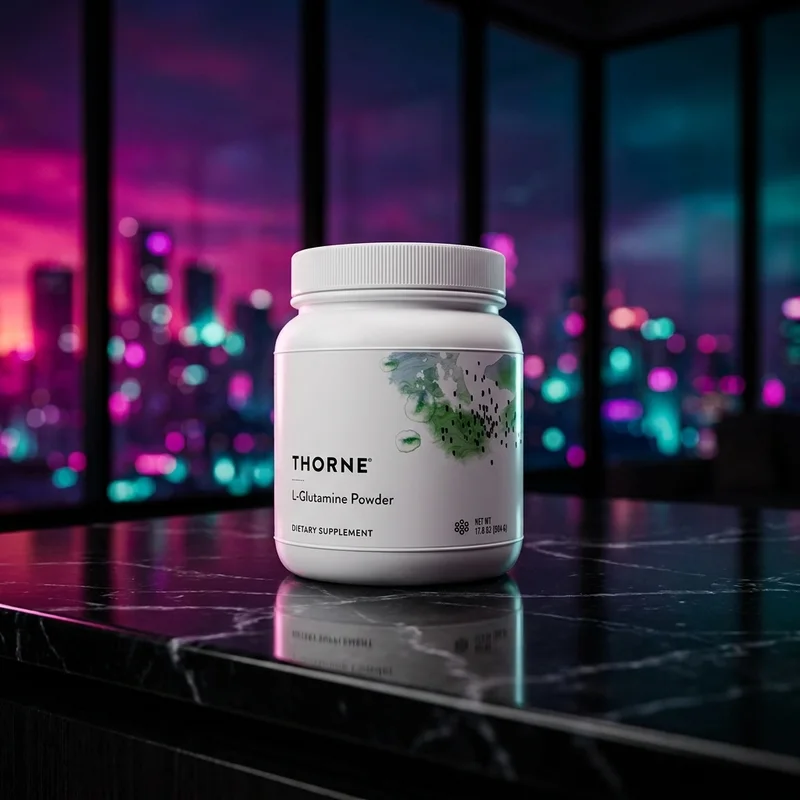
Thorne L-Glutamine Powder
What is L-Glutamine?
L-Glutamine is the most abundant free amino acid in the human body and the one most associated with the gut. Under normal conditions it is "non-essential" — your body makes plenty of it, mainly in skeletal muscle. What makes it interesting for gut health is that it is the preferred metabolic fuel of the enterocytes, the rapidly-dividing cells that form the lining (epithelium) of the small intestine. These cells turn over every few days and burn through glutamine to do it, which is why the gut is one of the body's biggest glutamine consumers.
The key concept for a buyer to understand is "conditionally essential". During major physiological stress — severe burns, trauma, sepsis, surgery, prolonged critical illness — the body's demand for glutamine outstrips what it can produce, blood levels fall, and the gut lining can be among the first tissues to suffer (villus atrophy, weakened barrier). In those clinical settings, supplementing glutamine has measurable effects. That is a very different situation from a generally healthy person with bloating or food sensitivities, and conflating the two is the central marketing problem in this category.
As a supplement, L-glutamine is sold as a cheap, near-tasteless white powder (also capsules) — usually 5 g per scoop, often marketed for "gut repair", "leaky gut", and as a muscle-recovery aid. The form is not the issue here (unlike curcumin, plain L-glutamine is well absorbed); the honest question is whether the dose and your situation match the evidence. The strongest human data sit at the clinical end, with one genuinely impressive trial in diarrhoea-predominant IBS bridging toward everyday use.
How it works
Glutamine's gut role rests on two linked mechanisms. First, fuel: enterocytes oxidise glutamine as their main energy source, so an adequate supply supports the constant renewal of the intestinal lining (Wang 2015, PMID 24965526). Second, barrier integrity: glutamine availability influences the tight junctions — the protein "zippers" (occludin, claudins, ZO-1) between adjacent gut cells that decide how leaky the barrier is. In cell and animal models, glutamine deprivation loosens these junctions and raises permeability, while restoring glutamine tightens them. This is the mechanistic spine of the whole "leaky gut" rationale: a more permeable barrier is thought to let bacterial fragments (endotoxin) cross into circulation and drive low-grade inflammation, and glutamine is positioned as the nutrient that helps keep the barrier sealed.
The most persuasive human evidence is the IBS-D trial by Zhou and colleagues (Zhou 2019, PMID 30108163, Gut). They took patients who developed diarrhoea-predominant IBS *after* an enteric infection — and specifically those with documented increased intestinal permeability — and gave 5 g of glutamine three times daily for eight weeks. The result was dramatic: a ≥50-point drop in IBS symptom severity in about 80% of the glutamine group versus 6% on placebo, alongside reduced stool frequency and normalised permeability. In the critical-illness setting, an ICU RCT found early enteral glutamine cut plasma zonulin (a permeability marker) by roughly 40% versus placebo (Shariatpanahi 2019, PMID 31485104).
The honest counterweight is twofold. The classic skeptical review (Alpers 2000, PMID 17024034) argued that glutamine is not actually a *uniquely* essential small-intestinal fuel — glutamate and aspartate matter too — and that supplement benefits, where real, may not come from the gut-fuel story. And a 2024 meta-analysis across adult trials (Abbasi 2024, PMID 39397201) found no significant overall effect of glutamine on intestinal permeability, with benefit appearing only in a subgroup using high doses (>30 g/day) over a short period. So the picture is: a real mechanism, a striking effect in a specific high-permeability IBS-D population, clinical value under extreme stress — and no good evidence that a few grams a day reseals the gut of an otherwise-healthy person.
At-a-glance facts
- What it is
- Most abundant free amino acid in the body; the preferred fuel for intestinal lining cells (enterocytes)
- Status
- Non-essential normally, 'conditionally essential' under major stress (trauma, sepsis, surgery, critical illness)
- Best-evidenced dose
- 5 g three times daily (15 g/day) for 8 weeks — the post-infectious IBS-D protocol (Zhou 2019)
- Gut mechanism
- Fuels enterocyte renewal + supports tight-junction proteins (occludin, claudins, ZO-1) → barrier integrity
- Time to felt effect
- Weeks, not days — judge a gut trial over ~4-8 weeks of consistent dosing
- Form & absorption
- Plain L-glutamine powder/capsules; well absorbed (no special formulation needed, unlike curcumin)
- Cost range (US)
- ~$10-25 / month — one of the cheaper gut supplements
- Honest caveat
- No proven benefit for general 'leaky gut' in healthy people; meta-analysis shows effect only at >30 g/day short-term (Abbasi 2024)
Evidence: Strong mechanism plus genuinely strong RCT evidence in two narrow settings — post-infectious IBS-D with high permeability (Zhou 2019, PMID 30108163) and critical-illness barrier function (Shariatpanahi 2019, PMID 31485104) — but NOT established for general 'leaky gut'. A 2024 meta-analysis (Abbasi 2024, PMID 39397201) found no overall effect on intestinal permeability except at very high short-term doses, and an older review (Alpers 2000, PMID 17024034) questioned the 'unique gut fuel' framing. Level 3: real and promising in specific populations, not definitive for the broad consumer claim.
Who it's for — and who it isn't
- People with diarrhoea-predominant IBS that began after a gut infection (post-infectious IBS-D) — this is the single population with a striking RCT behind 5 g × 3/day (Zhou 2019)
- Anyone with documented increased intestinal permeability working with a clinician — the trial benefit was concentrated in patients with a measurably leaky barrier, not unselected IBS
- People recovering from major physiological stress (serious illness, surgery, trauma) under medical guidance — the conditionally-essential setting where glutamine clearly does something
- Buyers who want a cheap, well-tolerated, well-absorbed amino acid to trial for gut symptoms — and who will judge it honestly over a few weeks rather than assume it works
- Healthy people hoping to 'fix leaky gut' prophylactically — a 2024 meta-analysis found no overall effect on permeability except at very high (>30 g/day) short-term doses (Abbasi 2024)
- Anyone expecting a proven cure for general bloating, food sensitivities, or constipation-predominant IBS — the strong evidence is specific to post-infectious IBS-D with high permeability
- People with cirrhosis or significant liver disease, or with Reye's-type urea-cycle concerns — glutamine is metabolised to glutamate and ammonia and can be a problem when the liver can't clear it
- Anyone with active cancer using it without oncology sign-off — glutamine is a fuel for some rapidly dividing cells, so clear it with your care team first
Week-by-week, what happens
- Week 1-2Usually little felt change. Glutamine works by supporting gut-lining turnover over time, not as a fast-acting symptom blocker. Take consistently and don't judge it yet.
- Week 3-4In the responsive group (post-infectious IBS-D), early reductions in stool frequency and urgency may begin. No change here is common and doesn't mean you've done it wrong.
- Week 4-8The window where the IBS-D trial's benefits landed (Zhou 2019 ran 8 weeks at 5 g × 3/day). This is when to honestly assess whether your gut symptoms have actually improved.
- Week 8+If it helped, continue and reassess periodically; if there's been no meaningful change by 8 weeks of adequate dosing, it is reasonable to stop — for many gut complaints the evidence simply isn't there.
Safety & contraindications
- Generally very well tolerated at supplement doses; glutamine is a normal dietary amino acid (you eat grams of it daily in protein). Trials up to 15 g/day for 8 weeks reported good tolerability.
- Avoid or use only under medical supervision if you have cirrhosis or significant liver disease: glutamine is metabolised to glutamate and ammonia, and an impaired liver may not clear the extra nitrogen load, risking encephalopathy.
- If you have active cancer, clear glutamine with your oncology team first — it is a fuel substrate for some rapidly dividing cells, so it shouldn't be self-prescribed during treatment.
- Mild GI upset (bloating, loose stools) is the most common complaint, usually at higher doses; start low and take with water, splitting the dose across the day.
- Be wary of mega-dosing on the assumption that 'more reseals the gut faster' — the only meta-analysis signal for permeability came from >30 g/day for under two weeks, a clinical-style protocol, not an open-ended consumer habit (Abbasi 2024).
- Buy plain L-glutamine from brands that publish third-party testing for purity/heavy metals; the molecule is cheap, so there's no reason to accept an untested product.
All articles on L-Glutamine
Best Digestive Enzyme Supplements
Digestive enzymes ranked by what you actually need — targeted (lactase for dairy) beats broad-spectrum for most — by enzyme activity units, evidence, and value, with an honest take on who doesn't need them.
Read →Best Ginger Supplements
9 ginger supplements ranked on form and standardization, dose against the clinical range, third-party testing, tolerability and value.
Read →Best L-Glutamine Supplements
L-Glutamine ranked by purity (single-ingredient powder beats capsules on dose economics), third-party testing, and value — the gut-lining amino acid for IBS and intestinal permeability.
Read →Best Magnesium for Constipation
Citrate dominates (osmotic) and glycinate sinks (chelated, no laxative effect) — the form ranking is fully inverted vs. magnesium-for-sleep, with acute breakthrough + chronic maintenance protocols spelled out.
Read →Best Peppermint Oil Capsules for IBS
Enteric-coated peppermint oil ranked by coating quality first (it has to survive the stomach to work), dose, and value — one of the best-evidenced OTC options for IBS cramping and bloating.
Read →Best Probiotics Supplements
The 10 best probiotic supplements ranked by strain specificity + verified CFU — matching documented strains to your actual goal (IBS, post-antibiotic, women's, daily), not chasing the biggest number.
Read →Best Psyllium Fiber Supplements
Psyllium husk ranked by form honesty (powder vs capsules vs the dose math), additive load, and value — the most RCT-backed soluble fiber for regularity, cholesterol, and blood sugar.
Read →Align Probiotic 24/7 Digestive Support Review
The evidence-backed strain for IBS — and only for IBS.
Read →Anthony's Organic Psyllium Husk Powder Review
The organic bulk-buy — best per-gram organic value, in a bag not a tub.
Read →BioGaia Protectis Chewable Review
A clean single-strain chewable — L. reuteri DSM 17938 and nothing else.
Read →Carlyle Peppermint Oil, 150ct Review
Cheap and high-count — but a low dose and a less-documented coat hold it back.
Read →Culturelle Daily Probiotic Review
The cleanest, most affordable way to get the most-studied strain (LGG); plain capsule, no potency-through-expiry promise printed. 7.8/10.
Read →Designs for Health Digestzymes Review
The clinical bridge — low-acid support plus gluten/casein peptide coverage, for a specific buyer.
Read →Designs for Health L-Glutamine Powder Review
Clinic-grade free-form glutamine at the best value in the clinical tier.
Read →Enzymedica Digest Gold + ATPro Review
The high-activity broad blend benchmark — for heavy, varied meals, not for everyone.
Read →Florastor Daily Probiotic Review
The yeast antibiotics can't kill — the textbook pick for antibiotic-associated diarrhea.
Read →Garden of Life Dr. Formulated Once Daily Women's Review
The right pick for women caring for digestive AND vaginal flora.
Read →Garden of Life Dr. Formulated Organic Digest+ Review
Organic chewable with 13 enzymes, each with its activity unit, but no amylase on the panel; about $0.26 a tablet. 7.1/10.
Read →Garden of Life Omega-Zyme Ultra Review
The widest plant-based spread, no HCl — best for varied, fiber-heavy diets.
Read →Garden of Life Raw Organic Fiber, Unflavored Review
The deliberate psyllium-FREE pick — for guts that can't tolerate psyllium.
Read →Heather's Tummy Tamers Peppermint Oil, 90ct Review
The reflux-tolerant peppermint for people other softgels burned.
Read →IBgard Peppermint Oil Capsules, 48ct Review
The most-studied IBS peppermint, with the lowest heartburn risk.
Read →Jarrow Formulas L-Glutamine Powder Review
The set-and-forget supply pick — a year of 99%-pure powder at low cost per gram.
Read →Klaire Labs L-Glutamine Powder Review
A full 5 g trial per-dose amount in one hypoallergenic scoop.
Read →Konsyl Daily Psyllium Fiber Powder, Unflavored Review
The high-dose, pure-husk pick when grams matter most.
Read →Lactaid Fast Act Lactase Caplets Review
If dairy is your one problem, this is the single best — and best-evidenced — pick.
Read →Life Extension L-Glutamine Powder Review
A cheap starter tub to test whether you respond before buying bulk.
Read →Mason Natural Peppermint Oil 50mg Enteric, 90ct Review
Genuinely enteric at a bargain price — but 50 mg per softgel is the catch.
Read →Metabolic Maintenance L-Glutamine Powder Review
The titration specialist — fine 1 g dosing for a reactive, IBS-prone gut.
Read →Metamucil 4-in-1 Psyllium Fiber, Sugar-Free, Orange Review
The safe, doctor-trusted default psyllium for first-time buyers.
Read →Metamucil Psyllium Fiber Capsules Review
The convenience pick from the most-trusted brand — bought with eyes open.
Read →Nature's Way CompleteGest Review
The dependable mainstream vegan blend — reliable and available, not a spec leader.
Read →Nature's Way Pepogest Enteric Peppermint Oil, 60ct Review
The clinically validated dose at the best price — the default for most buyers.
Read →Nature's Way Peppermint Soothe, 60ct Review
A trustworthy heritage enteric peppermint — outcompeted by its own sibling.
Read →NOW Peppermint Gels with Ginger & Fennel, Enteric, 90ct Review
A budget brand getting the fundamentals right — the best bulk value.
Read →NOW Probiotic-10 25 Billion Review
The honest value floor — cheap, a code printed on every strain, no frills. 7.3/10.
Read →NOW Psyllium Husk Caps 500 mg Review
The vegan, value-minded capsule — convenient and grit-free, but low-dose.
Read →NOW Psyllium Husk Powder, Non-GMO Review
The lowest-cost honest way to take psyllium — if you'll stir plain husk.
Read →NOW Sports L-Glutamine Pure Powder Review
The value benchmark — genuine free-form glutamine at the lowest cost per gram.
Read →NOW Super Enzymes Review
The best value on the list — real pancreatic + acid support at a third of premium prices.
Read →Nutricost Digestive Enzymes 620mg Review
Maximum enzyme variety per dollar — the low-risk budget experiment.
Read →Nutricost L-Glutamine Powder, Unflavored Review
The bulk-budget sweet spot — exact 5 g scoops at near-benchmark value.
Read →Nutricost Peppermint Oil 50mg, 120ct Review
Well-made and clean — but NON-enteric, the one disqualifying flaw for the gut.
Read →Optimum Nutrition L-Glutamine Powder Review
A fine free-form powder that ranks last on fit, not quality.
Read →Organic India Whole Husk Psyllium Powder, USDA Organic Review
The organic pick that still delivers a real dose.
Read →Physician's Choice Probiotics 60 Billion CFU Review
A low-cost high-CFU generalist whose label names ten species but no strain codes. 6.8/10.
Read →Pure Encapsulations Digestive Enzymes Ultra Review
The cleanest broad blend — the safe pick for a sensitive, allergy-prone gut.
Read →Pure Encapsulations L-Glutamine Powder Review
The cleanest hypoallergenic label for the reactive, IBS-prone gut.
Read →Regimint Peppermint Oil Plus Caraway, 60ct Review
The European peppermint-caraway combo for IBS-plus-dyspepsia overlap.
Read →Renew Life Ultimate Flora Extra Care 50 Billion Review
A broad high-potency blend for sensitive guts — with LGG and delayed-release doing the work.
Read →Ritual Synbiotic+ Review
The most complete formulation on paper, with the best traceability.
Read →Seed DS-01 Daily Synbiotic Review
The survivability-engineered default for general gut health.
Read →Solaray Peppermint Oil, Enteric, 60ct Review
A clinical 250 mg enteric peppermint dose, plus botanicals you're partly paying for.
Read →Sunergetic 4-in-1 Probiotic Review
Spore-based probiotic with enzymes and PreforPro, but only two named strains and 3 billion CFU. 6.6/10.
Read →Super Achiever BCAA + Glutamine (Watermelon) Review
Our own BCAA powder, scored like every other tub: a true 2:1:1 ratio with every amount printed, held back by a 4 g dose and no sport certificate.
Read →Thorne Advanced Digestive Enzymes Review
The low-stomach-acid powerhouse — excellent for the right buyer, contraindicated for many.
Read →Thorne L-Glutamine Powder Review
The cleanest, most credible way to run the one glutamine protocol with real human evidence.
Read →Viva Naturals Organic Psyllium Husk Powder Review
The finely-ground organic pick for smoothies and keto baking.
Read →Yerba Prima Psyllium Husks Powder Review
The heritage purist's pure-husk pick — dependable, honest, lower-profile.
Read →Zenwise Digestive Enzymes + Probiotics & Prebiotics Review
Amazon's bestselling all-in-one — convenient, but a compromise on every component.
Read →FAQ
Does L-glutamine actually heal 'leaky gut'?
Honestly: not in the broad way it's marketed. The mechanism is real — glutamine fuels the cells lining your gut and supports the tight junctions that control how leaky the barrier is. But a 2024 meta-analysis of adult trials (Abbasi 2024, PMID 39397201) found no significant overall effect on intestinal permeability, with benefit only in a subgroup taking very high doses (>30 g/day) over a short period. Where glutamine clearly helps the barrier is in specific clinical situations — critical illness and post-infectious IBS-D with documented high permeability — not as a general 'leaky gut' fix for an otherwise-healthy person.
What's the evidence for glutamine and IBS?
The standout study is Zhou 2019 (PMID 30108163), published in Gut. It enrolled people who developed diarrhoea-predominant IBS after a gut infection AND had increased intestinal permeability, then gave 5 g of glutamine three times a day for eight weeks. Around 80% of the glutamine group hit the primary endpoint (a ≥50-point drop in IBS symptom severity) versus about 6% on placebo, with less frequent stools and normalised permeability. That's a striking result — but note how narrow the population was. It is not evidence that glutamine helps every IBS type, especially constipation-predominant IBS, or IBS without a post-infectious, high-permeability profile.
What does 'conditionally essential' mean for glutamine?
Normally your body makes plenty of glutamine, so it's classed as non-essential. But under severe physiological stress — major burns, trauma, sepsis, big surgery, prolonged ICU stays — demand outruns production, blood levels drop, and tissues like the gut lining can suffer. In those settings glutamine becomes 'conditionally essential', and supplementing it has measurable effects (for example, an ICU trial cut a permeability marker, zonulin, by ~40%: Shariatpanahi 2019, PMID 31485104). The catch for shoppers: that's a hospital-level stress state, not the baseline of a healthy adult, so you can't assume the same benefit applies to everyday use.
How much L-glutamine should I take, and for how long?
The best-evidenced gut protocol is the IBS-D trial's: 5 g three times daily (15 g/day total) for eight weeks. Plain L-glutamine is well absorbed, so you don't need a fancy formulation — just split the dose across the day and take it with water. Give any gut trial a fair run of about 4-8 weeks before deciding. If there's no meaningful improvement by then, it's reasonable to stop rather than escalate indefinitely; the evidence doesn't support open-ended mega-dosing for general gut health.
Is L-glutamine safe to take every day?
For most healthy people, yes — it's a normal dietary amino acid you already eat in grams daily, and trials at 15 g/day for two months were well tolerated. The real cautions are specific: avoid it (or use it only under medical supervision) if you have cirrhosis or serious liver disease, since glutamine breaks down into glutamate and ammonia that a damaged liver may not clear; clear it with your oncologist if you have active cancer; and don't assume higher doses are safer or more effective. Mild bloating is the usual side effect — start low.
Isn't glutamine also a muscle / recovery supplement?
It's marketed that way, but the evidence for glutamine improving muscle mass, strength, or recovery in healthy, well-fed athletes is weak — most controlled studies don't show a meaningful benefit, because you already get ample glutamine from dietary protein. Its more defensible role is gut- and immune-related under stress. On this hub we treat glutamine as a gut-health substance, where the mechanism and the strongest (if narrow) human trials actually live — not as a sports-performance aid.
Sources & further reading
- Zhou 2019 (post-infectious IBS-D RCT)Randomised placebo-controlled trial of dietary glutamine supplements for postinfectious irritable bowel syndrome
Double-blind RCT in patients with diarrhoea-predominant, post-infectious IBS and increased intestinal permeability: 5 g glutamine three times daily for 8 weeks produced a ≥50-point IBS-SS reduction in ~79.6% of the glutamine group versus 5.8% on placebo, with reduced stool frequency and normalised permeability. The single strongest human trial behind glutamine's gut claim — but in a narrow, high-permeability population.
- Shariatpanahi 2019 (critical-illness permeability RCT)Effects of Early Enteral Glutamine Supplementation on Intestinal Permeability in Critically Ill Patients
RCT in 80 ICU patients: early enteral glutamine (0.3 g/kg/day) reduced plasma zonulin (a tight-junction permeability marker) by ~40% over 10 days versus placebo, and lowered endotoxin, indicating a tighter intestinal barrier — though clinical outcomes did not differ between groups. Supports the 'conditionally essential under stress' mechanism.
- Wang 2015 (barrier-function review)Glutamine and intestinal barrier function
Mechanistic review: glutamine fuels enterocyte proliferation and survival and regulates intestinal barrier function — including expression of tight-junction proteins (occludin, claudins) — in injury, infection, weaning stress and other catabolic states. The mechanistic backbone for the gut-barrier rationale.
- Alpers 2000 (skeptical review of the fuel claim)Is glutamine a unique fuel for small intestinal cells?
Critical review arguing that glutamine is NOT a uniquely essential small-intestinal fuel — glutamate and aspartate are also major mucosal fuels — and that where glutamine supplementation helps, the benefit may relate to functions other than small-intestinal fuelling. The honest counterweight to over-stated 'gut fuel' marketing.
- Abbasi 2024 (permeability meta-analysis)A systematic review and meta-analysis of clinical trials on the effects of glutamine supplementation on gut permeability in adults
Meta-analysis of adult RCTs: glutamine supplementation had no significant overall effect on intestinal permeability (WMD ≈ −0.00); a reduction appeared only in a subgroup using high doses (>30 g/day) over a short period. The key honesty anchor — it tempers the broad 'glutamine reseals the gut' claim and frames where any permeability benefit actually shows up.