
Life Extension L-Glutamine Powder Review
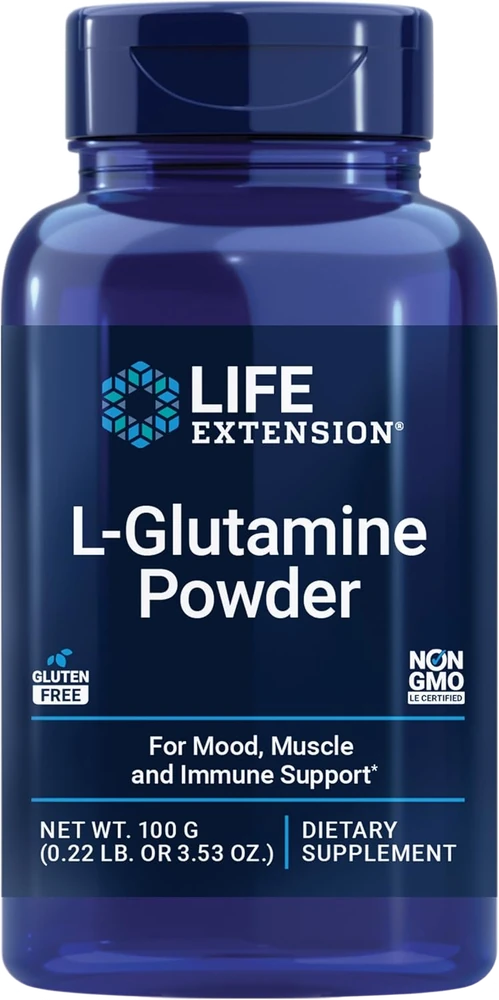 #7 of 10 · Best starter size✓ Label verified · Supplement Facts read Sep 7, 2026
Real retailer photo, cut out. Label unedited.
Consider it. A cheap starter tub to test whether you respond before buying bulk. Genuine free-form single-ingredient L-glutamine in a small, low-cost 100 g tub — the low-commitment way to confirm you tolerate it and watch for an early signal before committing to a full course.
$13 / tub (100 g)$0.13 / ~1 g serving
Why It Scores 8.3 — And The Label Line Behind Each Number
Purity / form
30% of scoreGenuine single-ingredient free-form L-glutamine — the trial-grade form (Zhou 2019), so it's the right form even at starter size. Clean and appropriate, just without the explicit hypoallergenic certification of the dedicated sensitive-gut picks.
- Active form
- Free-form L-glutamine (single-ingredient)
- Inactives
- Single-ingredient free-form L-glutamine
- Certifications
- Life Extension in-house QC, GMP-manufactured
- Manufacturer
- Life Extension (longevity-supplement brand)
- Lab transparency
- In-house QC; single-ingredient formulation
Third-party testing + manufacturing quality
25% of scoreSolid in-house QC and GMP manufacturing from a respected longevity-supplement brand — above bargain-bin powders, but without NSF Certified for Sport (Thorne #1) or an explicit hypoallergenic certification.
Dose-per-scoop + label honesty
20% of score1.95 g per serving (0.5 tsp, exactly as printed on the panel) — a starter/titration increment still below the 5 g per-dose trial amount, but a more substantial scoop than a bare '1 g' suggests, and precisely disclosed rather than rounded. Useful for gentle ramp-up — you'll still need about 2-3 servings to approach the trial dose, and the tub won't sustain it for long.
- Per serving
- 1.95 g L-glutamine per serving (0.5 tsp; 50 servings per 100 g tub)
- Trial-dose alignment
- Starter increment — about 2-3 servings to reach the 5 g Zhou 2019 per-dose amount
Cost per effective gram
15% of scoreCheap up front (~$13) but expensive per gram — a 100 g tub is far less value-dense than the bulk tubs. The point isn't cost per gram; it's the low total commitment to test whether glutamine works for you before buying in bulk.
- Price
- ~$13 / 100 g tub (50 servings) = ~$0.26 per 1.95 g serving
Tolerability for sensitive / IBS-prone guts
10% of scoreThe small ~2 g serving supports cautious titration, which is genuinely helpful for a reactive gut starting out. Single-ingredient free-form powder with no obvious irritants, though not explicitly hypoallergenic like #2 or #4.
- More Specs
- Tub
- 100 g (small starter size; won't last a full 8-week protocol at therapeutic doses)
Label verified. Every figure read from the Supplement Facts photo, Sep 7, 2026.
Marketing Claims Vs. Reality
Supports gut and digestive health.
Mechanistically grounded (Wang 2015, PMID 24965526) and supported by a strong RCT in a narrow population — post-infectious IBS-D with high permeability (Zhou 2019, PMID 30108163). But Abbasi 2024 (PMID 39397201) found no overall permeability effect across mixed adults except at >30 g/day short-term. True for the specific population, oversold as a general gut claim.
Pure free-form L-glutamine.
L-glutamine is the only listed ingredient — the exact free-form used in the human trials. Verified.
Supports immune function.
Glutamine's immune role is real mainly under physiological stress (the 'conditionally essential' setting; Shariatpanahi 2019). In healthy, well-fed people the everyday immune benefit is not well established. Accurate as a conditional claim.
Supports muscle recovery.
The evidence for glutamine improving muscle mass, strength, or recovery in healthy, well-fed people is weak — most controlled studies show no meaningful benefit, since dietary protein already supplies ample glutamine. Not a reliable benefit; we treat this as a gut-health product.
Well absorbed — simple powder.
Plain L-glutamine is well absorbed orally, so a simple free-form powder reaches the trial dose without a special carrier. Accurate.
What Our Test Actually Found
Correction: the label's actual serving size
An earlier version of this review said Life Extension L-Glutamine delivers "~1 g+ per serving." The Supplement Facts panel actually reads 1.95 g L-Glutamine per 0.5 teaspoon serving, with 50 servings per 100 g tub. We re-read the label on Sep 7, 2026 and corrected the serving size, the per-serving price math, and every place in this review that described the starter dose or how many servings it takes to approach a 5 g trial dose.
It's the rational way to test a substance not everyone responds to
Glutamine's standout trial (Zhou 2019) was in a narrow population, and a 2024 meta-analysis found no overall permeability benefit across mixed adults. That means a meaningful share of buyers won't notice anything — so spending ~$13 to find out whether you personally respond, before committing to months of bulk powder, is genuinely smart. Life Extension's 100 g tub is the lowest-commitment genuine free-form glutamine on the list for exactly that test.
Be clear it's a trial size, not a treatment supply
The honest catch: the best-evidenced protocol is 15 g/day for 8 weeks — about 840 g total — and a 100 g tub can't come close. So this won't run a full course at therapeutic doses. Use it for the first couple of weeks to confirm tolerance and catch any early signal, then graduate to a bulk tub (Designs for Health #3 or NOW Sports #5) for the real 8-week trial. It's a first step, deliberately.
The small ~2 g serving doubles as gentle titration
For a reactive gut, the ~2 g serving is actually useful: it lets you start low and ramp up while you confirm you tolerate glutamine. Treat it as a starting increment to build from, not a therapeutic dose — about 2 g is still well below the 5 g per-dose trial amount. Once you're comfortable and want a real trial, scale toward 5 g/day on a larger tub.
Same honest ceiling: a specific job, not a generic gut cure
We won't let the cheap starter framing oversell the science. Abbasi 2024 found no overall effect of glutamine on intestinal permeability across mixed adults, with benefit only at >30 g/day short-term, and Burrin 2006 questioned the 'unique gut fuel' story. The value of this tub is precisely that it lets you test the specific claim cheaply for yourself — post-infectious IBS-D with high permeability is where the evidence is, not generic bloating or 'leaky gut.'
Genuine free-form glutamine even at starter size — the form is right
A cheap starter doesn't mean a compromised form: this is genuine single-ingredient free-form L-glutamine, the same trial-grade form as the pricier tubs, just in a small quantity. Plain glutamine is well absorbed as a simple powder, so the starter tub gives you a fair early read — what it can't give you is enough powder for the full course.
Full analysis: all pros & cons (8), buy if / skip if
- Cheapest entry point on the list — a low-risk way to trial glutamine before committing to a big tub
- Free-form single-ingredient powder, so it's the right form even at starter size
- Small ~2 g serving supports gentle titration for a cautious or sensitive gut
- Respected longevity-supplement brand with solid in-house QC
- Plain glutamine is well absorbed, so even the starter tub gives a fair early read
- Small 100 g tub is expensive per gram and won't last a full 8-week protocol at therapeutic doses
- Not third-party sport-certified or explicitly hypoallergenic like the top picks
- ~2 g serving is still below the 5 g trial per-dose amount — a couple of servings needed to scale up
- You're undecided about glutamine and want a cheap, low-risk way to test whether you respond
- You want to confirm you tolerate glutamine and titrate gently from a small ~2 g serving
- You'd rather spend a little to trial it than commit to a big tub up front
- You're curious whether it helps your gut symptoms before running the full protocol
- You've already decided to run the full 8-week protocol — buy a bulk tub (#3, #6, #7) instead, it's far cheaper per gram
- You need a calibrated 5 g scoop or the trial per-dose amount in one serving — this is a ~2 g starter
- You want NSF certification or an explicitly hypoallergenic label — #1 or #2
Genuine free-form single-ingredient L-glutamine in a small, low-cost 100 g tub — the low-commitment way to confirm you tolerate it and watch for an early signal before committing to a full course. The honest limit: it won't last the 8-week protocol at 5 g/day, so it's a first step, not a long-term supply. Set expectations correctly — glutamine is strong for post-infectious IBS-D, not a proven generic 'leaky gut' cure.
Life Extension L-Glutamine is the pick for the undecided buyer. The honest frame first: glutamine's strong human evidence is narrow — one standout RCT (Zhou 2019, in Gut) in post-infectious diarrhoea-predominant IBS with a measured leaky barrier, and no overall permeability benefit in a 2024 meta-analysis outside very high short-term doses. So not everyone responds, and a small, cheap tub is the rational way to find out whether you personally do before committing to months of bulk powder. Life Extension gives you genuine free-form glutamine in a 100 g starter that costs little up front — just know it's a trial size, not a treatment supply: to run the real 8-week protocol at 5 g/day you'll move to a bigger tub once you confirm it helps. Here's the full breakdown.
The pick for the undecided buyer — a smart first step, not a long-term supply.

Life Extension L-Glutamine is what we recommend to the reader who isn't sure glutamine will help and wants to find out cheaply. Because the substance's strong evidence is narrow (post-infectious IBS-D with high permeability) and not everyone responds, spending a little to confirm you tolerate it and catch any early signal — before committing to months of bulk powder — is the rational move. You get genuine free-form glutamine, the correct trial-grade form, in a 100 g tub that costs little up front. Two honest caveats. On supply: this is explicitly a trial size — the best-evidenced protocol is 15 g/day for 8 weeks, far more than 100 g holds, so you'll graduate to a bulk tub (Designs for Health #3 or NOW Sports #5) for the real course once you confirm it helps. On expectations: glutamine's strong evidence is specific to post-infectious IBS-D with high permeability and clinical barrier support (Zhou 2019, Shariatpanahi 2019), and a 2024 meta-analysis found no overall permeability benefit outside very high short-term doses (Abbasi 2024). This tub's whole value is letting you test that specific claim cheaply for yourself. Start at the ~2 g serving and ramp as tolerated, then run the full 8 weeks on a bigger tub before judging. If you have liver disease, active cancer, a serious GI condition, or are pregnant, clear it with your doctor first.
If This Doesn’t Fit — Try These
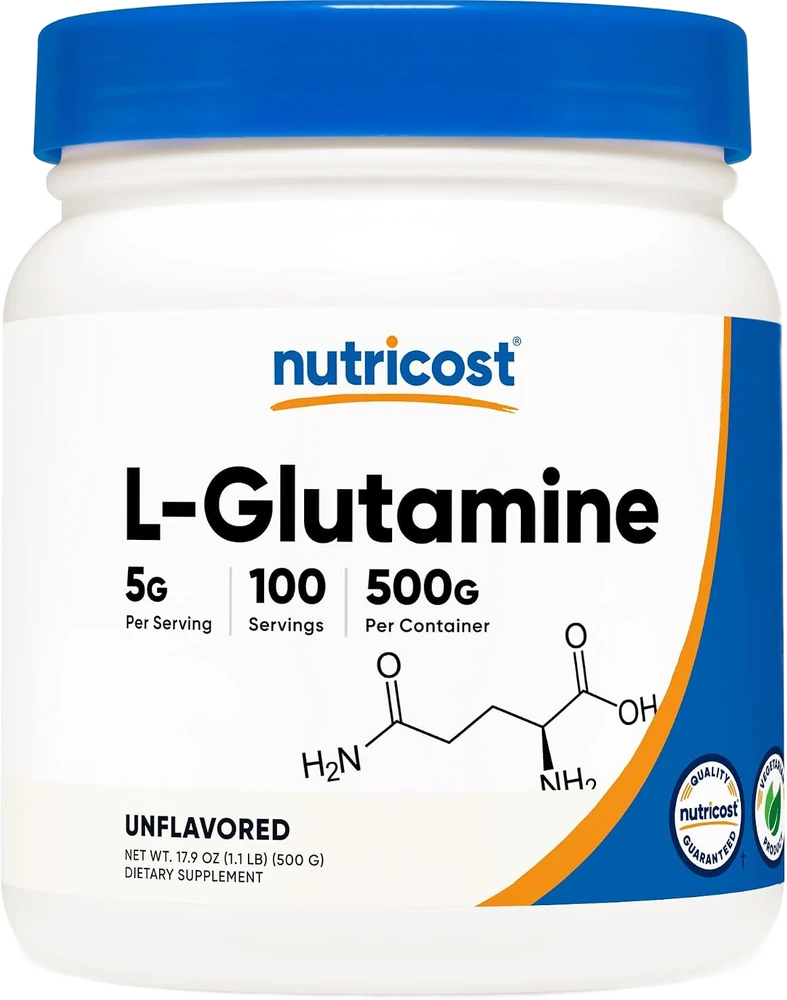 06
Nutricost L-Glutamine Powder
The bulk-budget sweet spot.
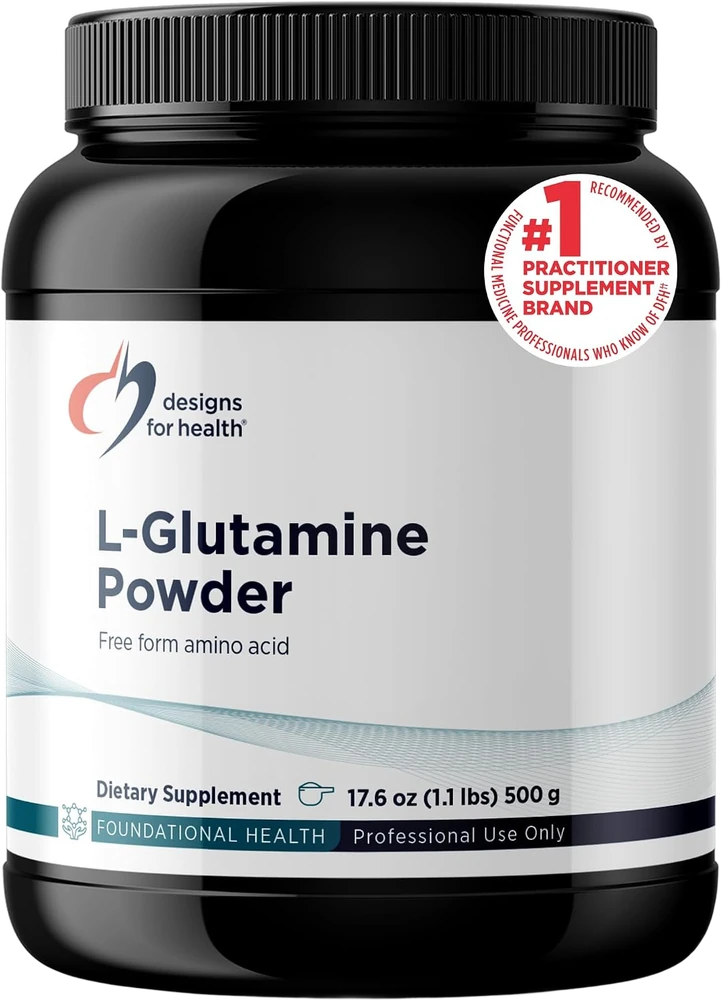 03
Designs for Health L-Glutamine
The smart-value way into the clinical tier.
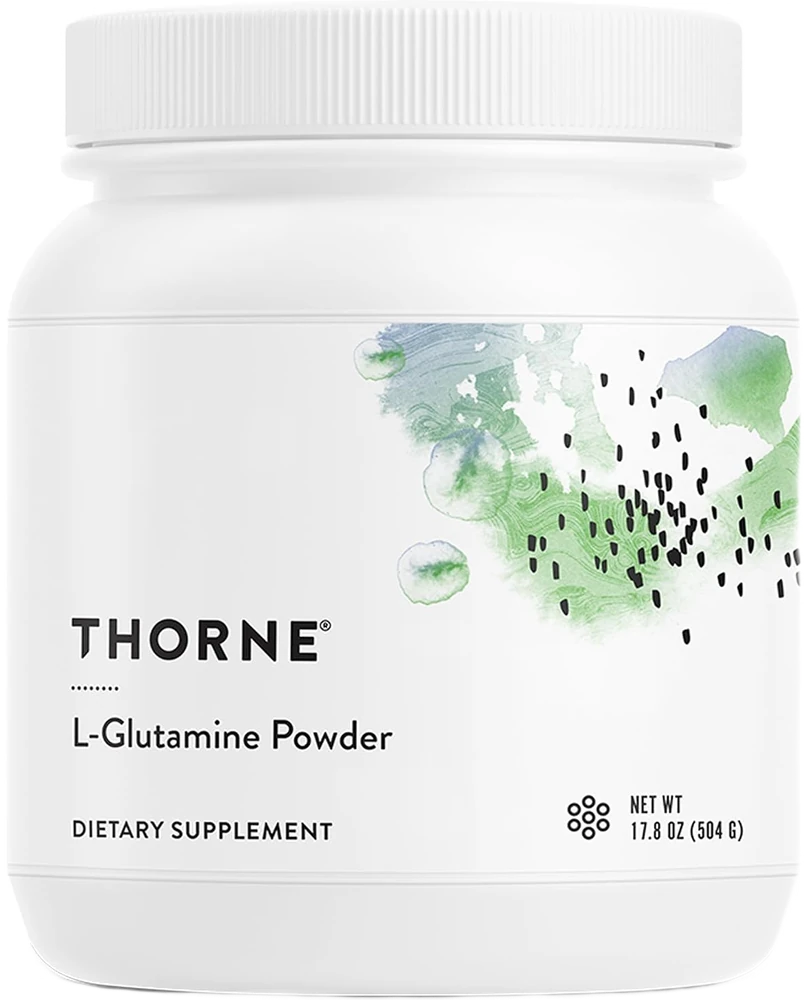 01
Thorne L-Glutamine Powder
The default pick for anyone serious about using glutamine for gut-barrier support.
Quick Answers
Why buy a small starter tub instead of a big one?
Because glutamine's gut evidence is real but specific, and not everyone responds. The strongest human trial (Zhou 2019, PMID 30108163) was in a narrow population — post-infectious diarrhoea-predominant IBS with documented high permeability — and a 2024 meta-analysis found no overall permeability benefit across mixed adults outside very high short-term doses. A small, cheap 100 g tub lets you test whether you personally respond before committing to months of bulk powder. Just know the limit: to actually run the 8-week protocol at 5 g/day you'll move to a bigger tub (Designs for Health #3 or NOW Sports #5) once you confirm it helps.
Can I run the full Zhou protocol on a 100 g tub?
No — and that's the honest catch. The best-evidenced protocol is 5 g three times daily (15 g/day) for eight weeks, which is roughly 840 g total. A 100 g tub won't last a full protocol at therapeutic doses; at ~2 g servings it's a titration-and-trial size, not a treatment supply. Use it to confirm you tolerate glutamine and to get an early read, then graduate to a bulk tub for the real 8-week course. It's a smart first step, not a long-term supply.
Will it heal 'leaky gut'?
Honestly, not in the broad way it's marketed — and no glutamine bottle will. The mechanism is real (glutamine fuels the gut-lining cells and supports the tight-junction proteins that control barrier leakiness — Wang 2015, PMID 24965526), but a 2024 meta-analysis (Abbasi 2024, PMID 39397201) found no overall effect on intestinal permeability across mixed adults except at very high doses (>30 g/day) short-term. The strong evidence is narrow: post-infectious diarrhoea-predominant IBS with documented hyperpermeability (Zhou 2019). A starter tub is exactly the right way to test the claim cheaply for yourself rather than assume it works.
Is the ~2 g serving too small to do anything?
For the trial dose, yes — about 2 g is still well below the 5 g per-dose amount Zhou 2019 used. But the small serving is useful for two things: gently titrating up if your gut is reactive, and stretching a cheap tub far enough to confirm tolerance. Treat the ~2 g serving as a starting increment to build from, not a therapeutic dose. Once you're tolerating it and want a real trial, scale toward 5 g/day on a larger tub.
How long before I know if it's working?
An honest read needs the full 8 weeks the Zhou 2019 trial ran at an adequate dose — which a 100 g tub can't supply on its own. Use the starter tub for the first couple of weeks to confirm tolerance and watch for any early signal, then continue the proper 8-week course on a bigger tub. Glutamine works over weeks, not days, so don't judge it from the starter tub alone; judge it after a full adequately-dosed course.
Is daily use safe, and what are the cautions?
For most healthy people, yes — glutamine is a dietary amino acid you already eat in grams daily, and trials at 15 g/day for two months were well tolerated. The specific cautions: avoid it or use it only under medical supervision with cirrhosis or significant liver disease (it breaks down into glutamate and ammonia a damaged liver may not clear); clear it with your oncology team if you have active cancer; and start low — which the ~2 g serving makes easy — to avoid the mild bloating that higher doses can trigger.
Sources & Further Reading
5 peer-reviewed sources, each linked to PubMed
- [1] Zhou 2019 PMID 30108163 — Randomised placebo-controlled trial of dietary glutamine supplements for postinfectious irritable bowel syndrome. Double-blind RCT in adults with post-infectious diarrhoea-predominant IBS and increased intestinal permeability: glutamine 5 g three times daily for 8 weeks produced a ≥50-point IBS-SS reduction in ~79.6% of the glutamine group versus 5.8% on placebo, with reduced stool frequency and normalised permeability. The single strongest human trial behind glutamine for gut-barrier support — and the protocol a starter tub is meant to test before scaling up — but in a narrow, high-permeability population.
- [2] Shariatpanahi 2019 PMID 31485104 — Effects of Early Enteral Glutamine Supplementation on Intestinal Permeability in Critically Ill Patients. RCT in 80 ICU patients: early enteral glutamine (0.3 g/kg/day) reduced plasma zonulin (a tight-junction permeability marker) by ~40% over 10 days versus placebo and lowered endotoxin, indicating a tighter barrier — though clinical outcomes did not differ. Supports glutamine's 'conditionally essential under stress' barrier role, a clinical setting distinct from healthy everyday use.
- [3] Wang 2015 PMID 24965526 — Glutamine and intestinal barrier function. Mechanistic review: glutamine fuels enterocyte proliferation and survival and regulates intestinal barrier function — including expression of tight-junction proteins (occludin, claudins) — in injury, infection, weaning stress and other catabolic states. The mechanistic backbone for the gut-barrier rationale behind any free-form glutamine.
- [4] Alpers 2000 PMID 17024034 — Is glutamine a unique fuel for small intestinal cells?. Critical review arguing glutamine is NOT a uniquely essential small-intestinal fuel — glutamate and aspartate are also major mucosal fuels — and that where supplementation helps, the benefit may relate to functions other than gut-fuelling. The honest counterweight to over-stated 'gut fuel' marketing on any glutamine bottle.
- [5] Abbasi 2024 PMID 39397201 — A systematic review and meta-analysis of clinical trials on the effects of glutamine supplementation on gut permeability in adults. Meta-analysis of adult RCTs: glutamine supplementation had no significant overall effect on intestinal permeability; a reduction appeared only in a subgroup using high doses (>30 g/day) over a short period. The key honesty anchor — it sets the limits on glutamine's gut-permeability claims and is exactly why testing the claim cheaply for yourself first is sensible.
Affiliate disclosure: every Amazon link uses our Associates tag (superachieverclub-20). We earn a small commission at no cost to you; it funds independent reviews. We never accept payment to change a ranking.