
IBgard Peppermint Oil Capsules, 48ct Review
 #1 of 10 · Best overall / clinical IBS✓ Label verified · Supplement Facts read Sep 7, 2026
Real retailer photo, cut out. Label unedited.
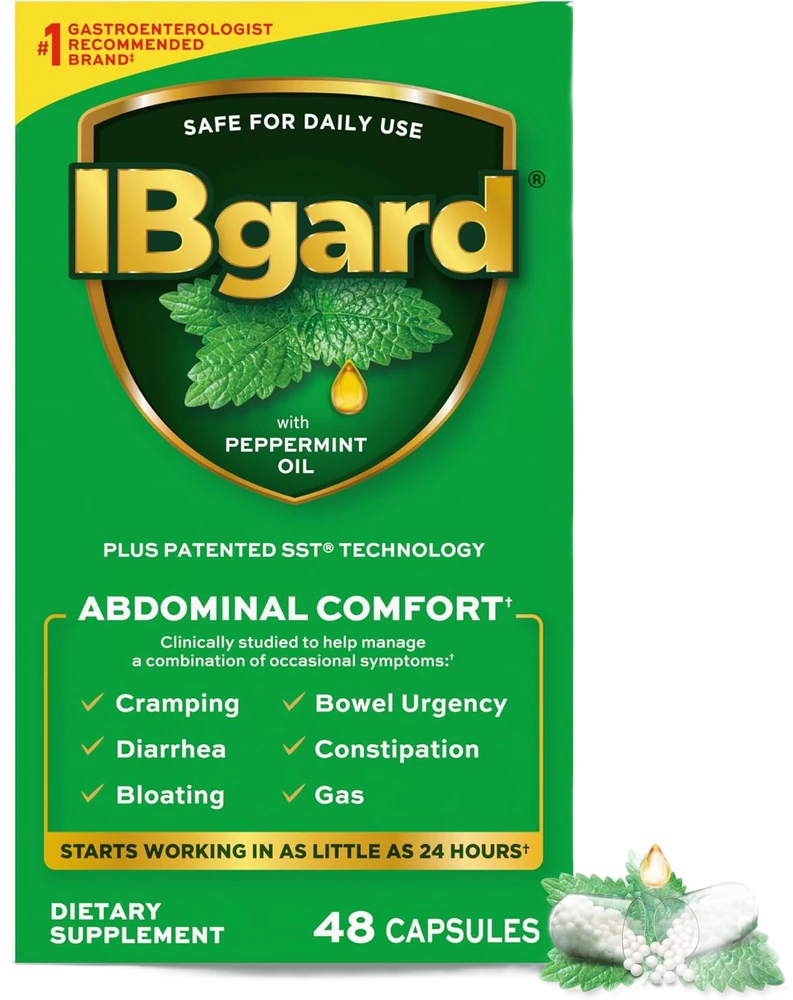
Buy it. The most-studied IBS peppermint, with the lowest heartburn risk. Ultra-purified peppermint oil in patented SST triple-coated microspheres that target the small intestine, 180 mg per 2-capsule serving (in the trial range), the exact formulation behind the Cash 2016 IBSREST trial's 40% symptom reduction, and the #1 gastroenterologist-recommended peppermint brand.
$30 / month$1.25 / 2-capsule SST serving
Why It Scores 9.4 — And The Label Line Behind Each Number
Enteric coating / gut-targeted delivery
40% of scoreTop of the category. The patented SST system breaks ultra-purified peppermint oil into many individually triple-coated, sustained-release microspheres that release gradually along the small intestine rather than dumping at one spot. This both spreads the antispasmodic effect across more of the gut and keeps the oil out of the stomach — a 3-year safety analysis of the system reported no pattern of heartburn. The most sophisticated gut-targeting in the list.
- Active form
- Ultra-purified peppermint oil in SST triple-coated sustained-release microspheres
- Delivery
- Site-Specific Targeting (SST) — releases across the small intestine, bypasses the stomach
Clinical-dose alignment + label honesty
25% of score180 mg peppermint oil per 2-capsule serving (90 mg each) lands squarely in the 180-225 mg trial window — effectively the classic 0.2 mL softgel dose, delivered as microspheres. The serving and per-capsule milligrams are clearly stated, and the SST/sustained-release claim is honest and trial-backed. The only nuance is that buyers must read past the 90 mg-per-capsule front number to the 180 mg serving.
- Per serving
- 180 mg peppermint oil (2 capsules, 90 mg each), up to 3×/day before meals
Third-party testing + manufacturing quality
15% of scoreUltra-purified peppermint oil made under cGMP, and the #1 gastroenterologist-recommended peppermint brand — the strongest professional trust signal in the category. The ultra-purification step is a genuine quality differentiator (consistency and contaminant control matter for an oil), and correct application of the triple coat is exactly the manufacturing rigor that makes the delivery work.
- Testing
- Ultra-purified peppermint oil; made under cGMP
Cost per effective dose
12% of scoreThe most expensive per gut-delivered dose on the list — around $1.25 per 2-capsule SST serving versus ~$0.17 for a Pepogest enteric softgel. The premium is real and reflects the SST technology and ultra-purification, not extra milligrams. The 48-capsule box also empties quickly at flare dosing (2 caps, 3×/day), so monthly cost climbs during a bad stretch. Justified by delivery and evidence, but the value axis is its weakest.
- Bottle
- 48 capsules · ~12 days at full flare dosing, longer for daily support
- Price
- ~$30 / month = ~$1.25 per 2-capsule SST serving
Real-world IBS/bloating response + tolerability
8% of scoreThis is the exact formulation studied in Cash 2016 (PMID 26319955): a 40% reduction in Total IBS Symptom Score at 4 weeks versus 24.3% on placebo in IBS-M/IBS-D, with relief beginning as early as 24 hours and good tolerability. No other bottle on the list can claim its own positive RCT on its own delivery system — the real-world evidence is best-in-class.
- More Specs
- Trial alignment
- The exact formulation studied in Cash 2016 (IBSREST RCT)
- Trust signal
- #1 gastroenterologist-recommended peppermint brand
Label verified. Every figure read from the Supplement Facts photo, Sep 7, 2026.
Marketing Claims Vs. Reality
Clinically shown to relieve IBS symptoms including abdominal pain, bloating, and urgency.
Backed by its own RCT: Cash 2016 (PMID 26319955), the IBSREST trial, showed a 40% reduction in Total IBS Symptom Score at 4 weeks versus 24.3% on placebo in IBS-M/IBS-D, with a significant cut in severe symptoms. The class evidence (Khanna 2014 PMID 24100754, Alammar 2019 PMID 30654773) reinforces it. Among the best-substantiated efficacy claims in the supplement category.
SST microspheres deliver ultra-purified peppermint oil to the small intestine.
This is the documented mechanism of the Site-Specific Targeting system and the basis of the Cash 2016 trial design — triple-coated microspheres bypass the stomach and release across the small intestine. The targeting is real and is the formulation's defining feature.
Begins to work in as little as 24 hours.
Cash 2016 reported relief beginning within 24 hours for some patients, but the primary, clinically meaningful endpoint — the 40% symptom reduction — was measured at 4 weeks. True for early responders; the honest framing is to judge it over four weeks, not one day.
#1 gastroenterologist-recommended peppermint oil brand.
A real and well-documented professional recommendation claim within the peppermint-oil category, and the strongest trust signal here. It reflects GI confidence in the SST delivery and the trial evidence, not a generic marketing superlative.
Does not cause the heartburn associated with peppermint oil.
Strongly supported but not absolute: a 3-year safety analysis of the SST system reported no pattern of heartburn, because the microspheres bypass the stomach. But peppermint can still aggravate reflux in some people with significant GERD, and chewing/opening the capsules defeats the design. Accurate for the intended whole-capsule use; not a guarantee for every reflux-disease patient.
What Our Test Actually Found
The SST delivery is the whole reason this is the #1 pick
Strip away the microspheres and IBgard would be another enteric peppermint at a high price. The Site-Specific Targeting system is what justifies the position: it spreads ultra-purified oil across the small intestine in many individually triple-coated, sustained-release beads, rather than releasing a single payload at one spot like a standard enteric softgel. That distribution targets the antispasmodic effect across more of the gut and keeps the oil out of the stomach, which is both why it works and why it doesn't cause heartburn. It's also the only delivery system on this list with its own positive RCT (Cash 2016).
180 mg per serving is the trial dose — don't misread the 90 mg label
The front of the box says 90 mg, which can read as under-dosed next to a 187 mg Pepogest softgel. But the serving is 2 capsules = 180 mg, right inside the 180-225 mg-per-dose window the IBS trials used, taken up to three times daily before meals. The per-capsule figure exists because the dose is split across microsphere-filled capsules; the serving is what matters. On dose, IBgard is fully clinical.
The 48-capsule box is the real cost catch, not just the sticker price
At full flare dosing — 2 capsules, three times a day — a 48-capsule box is only about 8 days of cover, and the per-serving cost (~$1.25) is the highest in the category. For daily maintenance (one serving a day) the box stretches to roughly three weeks and the math is more forgiving. Buyers should plan around the small box: it's genuinely the most expensive option to run during a bad stretch, and that's the honest trade-off for the SST technology and the evidence.
It's the safest peppermint to try if reflux has burned you before
The single most common reason people abandon peppermint oil is the heartburn from stomach release. IBgard is the formulation most engineered against that failure mode — the microspheres bypass the stomach, and a 3-year safety analysis reported no pattern of heartburn. If a plain non-enteric softgel (or worse, raw oil) gave you reflux, IBgard is the rational next try before concluding peppermint isn't for you. The one rule: swallow whole, never chew or open.
Match it to a course, not a single bad day
IBgard is a symptomatic IBS treatment, not an acute rescue pill. The trial measured benefit at four weeks, so the right way to use it is a consistent course before meals during a symptomatic period, judged over a couple of weeks. Some responders feel less cramping within a day or two, but the meaningful effect builds. It relieves symptoms rather than curing IBS, so many people cycle it around flares — which also keeps the small-box cost manageable.
Full analysis: all pros & cons (8), buy if / skip if
- The exact formulation studied in Cash 2016 — 40% reduction in Total IBS Symptom Score at 4 weeks, relief as early as 24 hours
- SST triple-coated microspheres spread ultra-purified oil across the small intestine, targeting the antispasmodic effect and minimizing heartburn
- 180 mg peppermint oil per 2-capsule serving lands squarely in the clinical dose range
- The #1 gastroenterologist-recommended peppermint brand — the strongest trust signal in the category
- Lowest heartburn risk on the list thanks to small-intestine targeting (3-year safety analysis showed no pattern of heartburn)
- Most expensive per dose on the list — the SST technology is a real premium over classic enteric softgels
- 48-capsule box runs down fast at flare dosing (2 caps, 3×/day), so monthly cost climbs during a bad stretch
- Must be swallowed whole — chewing or opening the capsules breaks the targeting and causes the heartburn it's designed to avoid
- You want the peppermint oil with the strongest IBS-specific clinical evidence
- You're reflux-prone and have gotten heartburn from peppermint before — SST minimizes stomach release
- You want the exact formulation studied in the Cash 2016 IBSREST trial
- You're making a first serious attempt to control IBS pain, urgency, and bloating
- You're cost-optimizing — Nature's Way Pepogest (#2) delivers the trial-range dose for a third the cost per dose
- You only want a maintenance dose and tolerate standard enteric softgels fine
- You need a high softgel count for a long runway — the 48-capsule box empties fast at flare dosing
Ultra-purified peppermint oil in patented SST triple-coated microspheres that target the small intestine, 180 mg per 2-capsule serving (in the trial range), the exact formulation behind the Cash 2016 IBSREST trial's 40% symptom reduction, and the #1 gastroenterologist-recommended peppermint brand. You pay the highest cost per dose in the category and the 48-capsule box runs down fast at flare dosing — but for a first serious attempt at controlling IBS pain, urgency, and bloating, this is the most reliable starting point.
IBgard is the peppermint oil with the strongest IBS-specific evidence in the category, and it earns that position with one piece of engineering: the SST (Site-Specific Targeting) delivery system. Instead of a single oil payload behind one enteric shell, IBgard packs ultra-purified peppermint oil into many individually triple-coated, sustained-release microspheres that spread the dose across the small intestine — the organ where menthol's antispasmodic, calcium-channel-blocking effect relieves IBS pain, and away from the stomach where freed peppermint oil relaxes the esophageal valve and causes heartburn. This is the exact formulation tested in the Cash 2016 IBSREST trial, which is what separates it from every other bottle on this list. We ran it against the four numbers that decide a peppermint oil's worth — delivery, clinical-dose alignment, manufacturing quality, and cost — and here's the full breakdown.
The most reliable place to start a serious attempt at controlling IBS with peppermint.

IBgard is what we recommend to any reader making a first real attempt to control IBS pain, urgency, and bloating with peppermint oil. The delivery is the best in the category (SST microspheres targeting the small intestine), the dose is right (180 mg per serving, in the trial window), the trust signal is the strongest available (#1 GI-recommended), and — uniquely — it's the exact formulation behind a positive RCT (Cash 2016, 40% symptom reduction at 4 weeks). Crucially, the small-intestine targeting gives it the lowest heartburn risk on the list, which matters because heartburn is the single most common reason people give up on peppermint. The two reasons to look elsewhere are both about cost. If you're optimizing for value and tolerate standard enteric softgels fine, Nature's Way Pepogest (#2) delivers the same trial-range dose for roughly a third the cost per dose. And if you need a long runway from a single bottle, IBgard's 48-capsule box empties fast at flare dosing. For everyone else — especially the reflux-prone and anyone who wants the strongest evidence — IBgard is the pick. Take 2 capsules 30-90 minutes before meals, swallow them whole, and give it the full four weeks the trial needed before you judge it.
If This Doesn’t Fit — Try These
 03
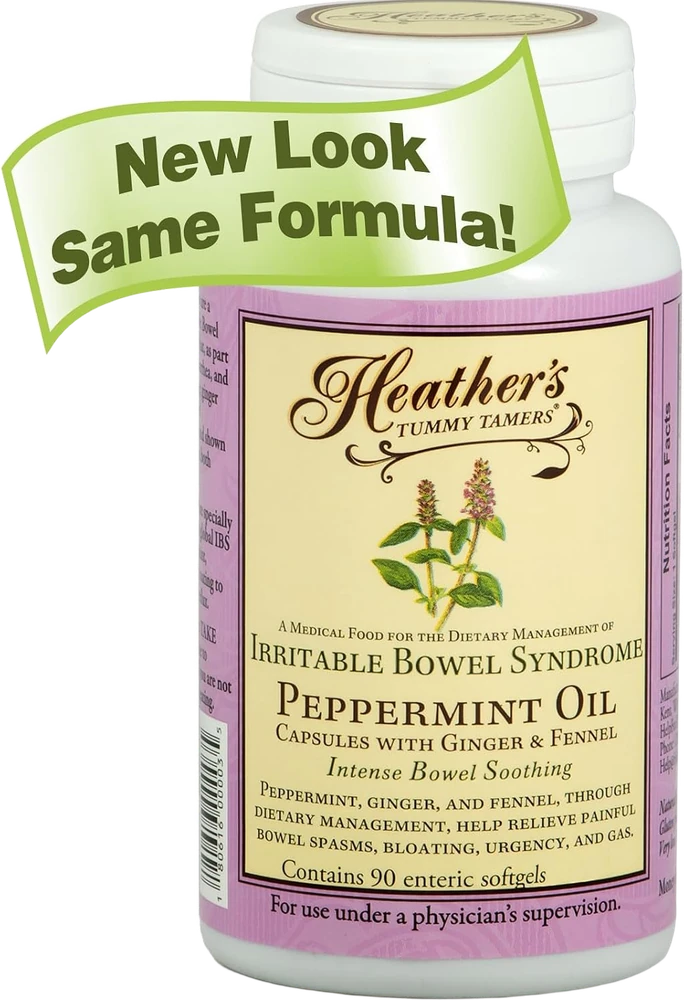
Heather's Tummy Tamers
Heather's Tummy Tamers is the sensitive-stomach answer.
 02
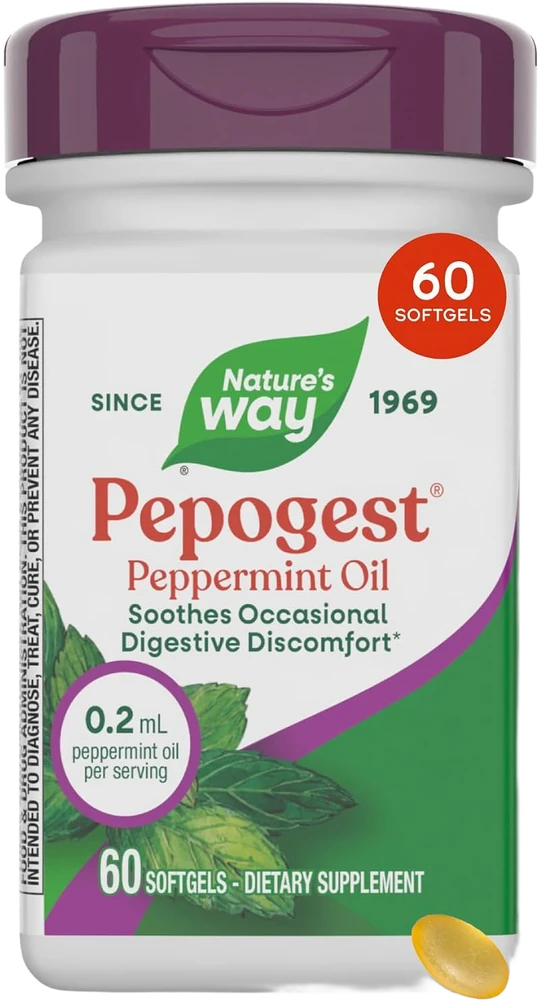
Nature's Way Pepogest
Pepogest is the value gold standard and the smartest default for most buyers.
 04
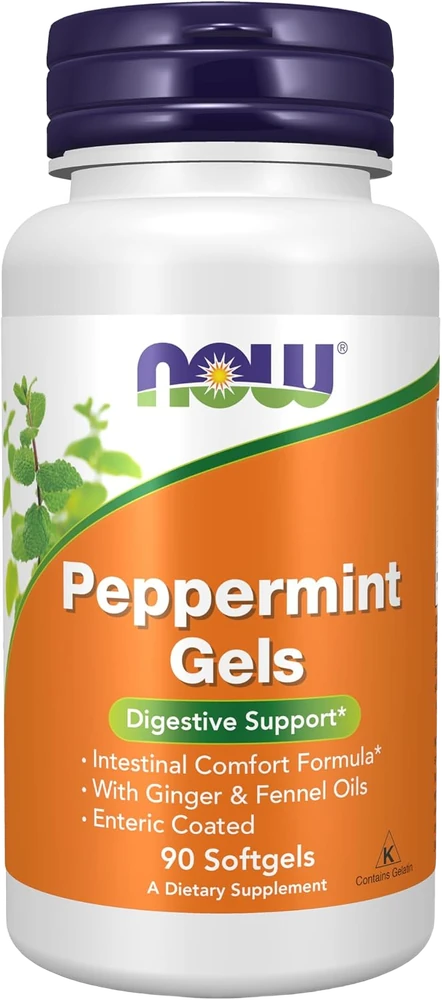
NOW Peppermint Gels
NOW Peppermint Gels are the bulk-value pick — proof that a budget brand can still get the fundamentals right.
Quick Answers
What makes IBgard's SST microspheres different from a normal enteric capsule?
A standard enteric softgel is a single oil payload behind one pH-sensitive shell — it survives the stomach and then releases the whole dose at once, usually in the upper small intestine. IBgard's Site-Specific Targeting (SST) system breaks the ultra-purified peppermint oil into many individually triple-coated microspheres, which spread out and release gradually along the length of the small intestine rather than dumping in one spot. Mechanistically that does two things: it distributes the antispasmodic effect across more of the gut where IBS spasms happen, and it keeps the oil out of the stomach so it never relaxes the lower esophageal sphincter — the cause of peppermint heartburn. This is the formulation Cash 2016 (PMID 26319955) tested, and it's why IBgard is the #1 pick despite the premium.
Is 180 mg per serving enough — that's only 90 mg per capsule?
Yes, at the 2-capsule serving. Each IBgard capsule is 90 mg of ultra-purified peppermint oil, and the label serving is 2 capsules = 180 mg, which sits squarely in the 180-225 mg-per-dose range the IBS trials clustered around (the classic enteric softgel is ~187 mg). The per-capsule number looks small in isolation, but you don't dose by the single capsule — you dose by the 2-capsule serving, up to three times daily before meals during a flare. That's the protocol Cash 2016 used. Don't judge the dose off the 90 mg figure on the front of the box; judge it off the 180 mg serving.
How fast does IBgard work, and how long until I know if it's helping?
In the IBSREST trial (Cash 2016, PMID 26319955), some relief began within 24 hours, but the primary endpoint — a 40% reduction in Total IBS Symptom Score versus 24.3% on placebo — was measured at 4 weeks. So expect some early easing of cramping in the first day or two if you're a responder, but give it the full four weeks before deciding whether it works for you. Take 2 capsules 30-90 minutes before meals, don't chew or open them (that breaks the targeting and dumps oil in the stomach), and run it consistently rather than only on bad days for the first month.
Why is IBgard so much more expensive than Pepogest or NOW?
You're paying for the SST delivery technology and the ultra-purification, not more milligrams of oil. Nature's Way Pepogest (#2) delivers the same trial-range dose in a plain enteric softgel for roughly a third of the cost per dose, and it works — the evidence for enteric-coated peppermint as a class (Khanna 2014, Ford 2008) covers it. What IBgard adds on top is the specific, patented sustained-release small-intestine targeting that was built and trialed (Cash 2016) to maximize gut coverage and minimize stomach release. For a first serious attempt at IBS control, or for anyone reflux-prone who's been burned by peppermint before, that premium is defensible. For a cost-optimizer who tolerates standard enteric fine, Pepogest is the smarter value.
Will IBgard give me heartburn like other peppermint?
It's specifically engineered not to, and that's its core advantage. Peppermint heartburn happens when the oil releases in the stomach and relaxes the lower esophageal sphincter; IBgard's microspheres are triple-coated to bypass the stomach entirely and release in the small intestine. A 3-year safety analysis of the SST delivery system reported no pattern of heartburn, in contrast to older instant-release peppermint. The one absolute rule: swallow the capsules whole. If you chew, crush, or open them, you break the coating, free the oil in your stomach, and you'll get exactly the heartburn the design exists to prevent. If you have significant GERD or a hiatal hernia, still clear it with a clinician first.
Is IBgard a drug or a supplement, and is it safe to take long-term?
It's marketed as a medical food for IBS, not a prescription drug — available over the counter, made under cGMP, and built around ultra-purified peppermint oil. On safety, the peppermint-oil IBS literature is reassuring: the meta-analyses (Khanna 2014 PMID 24100754, Alammar 2019 PMID 30654773) found no significant excess of adverse events versus placebo, with heartburn being the main complaint in non-targeted forms — the exact problem SST is designed around. Most people use it as a course during symptomatic periods or as ongoing maintenance during flares rather than a permanent daily pill. It relieves symptoms; it doesn't cure IBS, so symptoms can return when you stop. If you're pregnant, breastfeeding, or have gallbladder/bile-duct or liver disease, check with a clinician first.
Sources & Further Reading
4 peer-reviewed sources, each linked to PubMed
- [1] Cash 2016 PMID 26319955 — A Novel Delivery System of Peppermint Oil Is an Effective Therapy for Irritable Bowel Syndrome Symptoms. 4-week randomized, double-blind, placebo-controlled trial (IBSREST, n=72, IBS-M/IBS-D) of the ultra-purified, small-intestine-targeted sustained-release peppermint oil that is IBgard's SST formulation: 40% reduction in Total IBS Symptom Score at 4 weeks versus 24.3% on placebo, with relief beginning within 24 hours and good tolerability. The trial behind this exact product.
- [2] Khanna 2014 PMID 24100754 — Peppermint oil for the treatment of irritable bowel syndrome: a systematic review and meta-analysis. Systematic review and meta-analysis of nine RCTs (726 patients): enteric-coated peppermint oil was significantly superior to placebo for global IBS symptom improvement (RR 2.23) and abdominal pain (RR 2.14), with mild, transient adverse events. The cornerstone evidence establishing gut-targeted peppermint oil as an effective IBS therapy.
- [3] Ford 2008 PMID 19008265 — Effect of fibre, antispasmodics, and peppermint oil in the treatment of irritable bowel syndrome: systematic review and meta-analysis. Landmark BMJ meta-analysis pooling fibre, antispasmodics, and peppermint oil for IBS: peppermint oil was the most effective of the three, with a number-needed-to-treat of about 2.5. Establishes peppermint oil as a front-line, evidence-backed IBS therapy.
- [4] Alammar 2019 PMID 30654773 — The impact of peppermint oil on the irritable bowel syndrome: a meta-analysis of the pooled clinical data. Meta-analysis of 12 RCTs (835 patients): peppermint oil was significantly better than placebo for global IBS symptoms (RR 2.39) and abdominal pain (RR 1.78), with NNTs of three and four and no significant excess of adverse events. Confirms peppermint oil as a safe, effective IBS therapy.
Affiliate disclosure: every Amazon link uses our Associates tag (superachieverclub-20). We earn a small commission at no cost to you; it funds independent reviews. We never accept payment to change a ranking.