
Metamucil Psyllium Fiber Capsules Review
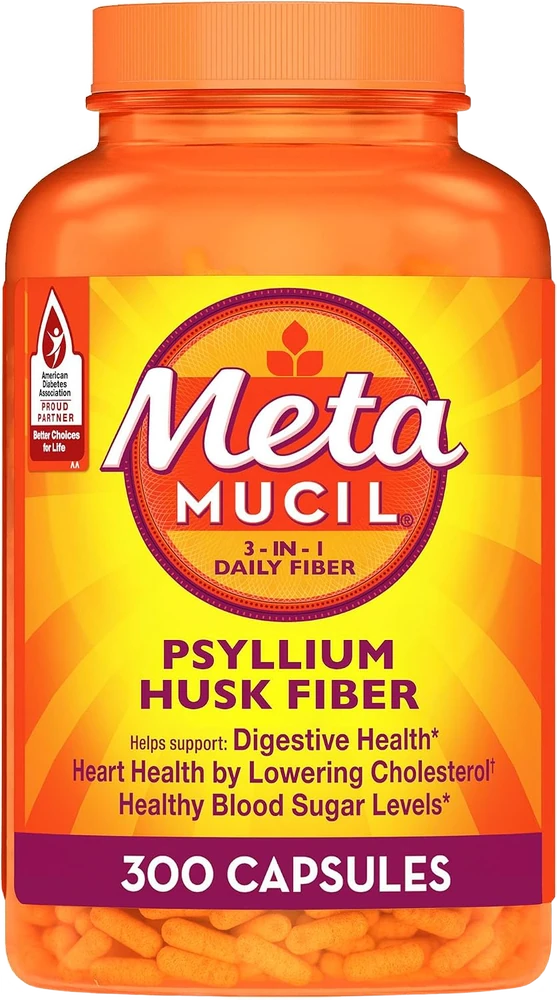 #8 of 10 · Best capsule✓ Label verified · Supplement Facts read Sep 7, 2026
Real retailer photo, cut out. Label unedited.
Buy it. The convenience pick from the most-trusted brand — bought with eyes open. Zero grit, zero mixing, doctor-recommended brand, pre-measured and portable — the easiest way to keep a psyllium habit when you travel or hate the slurry.
$24 / 300 capsules$0.40 / serving (~1.8 g soluble fiber)
Why It Scores 7.7 — And The Label Line Behind Each Number
Soluble-fiber dose + form fit
30% of scoreThe format's weak axis. ~1.8 g of soluble fiber per multi-capsule serving means reaching the Anderson 2000 ~10 g/day cholesterol range takes a large daily handful, and even a modest powder scoop equals several caps. Fine for regularity, poor for the gram-hungry goals — capsules are inherently low grams-per-serving versus any powder here.
- Active fiber
- Psyllium husk (Plantago ovata), in capsules
- Per serving
- ~1.8 g soluble fiber per serving (multiple capsules)
- Form
- Capsules
- Dose reality
- Cholesterol range (~10 g/day) = a large daily handful of capsules
Purity + label honesty
25% of scoreThe active is psyllium husk from a trusted brand, clearly labeled by soluble-fiber content per serving. We dock a little only because the capsule shell and the small per-cap dose mean the 'serving' is several units — buyers should read it as fiber-per-serving, not per-capsule, to avoid under-dosing. Honest, but easy to misjudge the real dose.
Cost per effective gram of psyllium
20% of scoreThe most expensive route per gram of actual psyllium on the list. ~$0.40 per serving for ~1.8 g of soluble fiber — and a cholesterol-range dose multiplies both the cap count and the cost. You're paying a premium for the capsule format and the brand, not for more fiber. For value, any powder wins decisively.
- Bottle
- 300 capsules
- Price
- $24 / 300 capsules = ~$0.40 per serving
Third-party testing + manufacturing quality
15% of scoreThe most clinically studied psyllium brand, made under established large-scale brand QC. Maximum trust — the same pedigree that makes the powder the #1 pick carries over to the capsules. This is the strongest axis for the product and a real reason to choose it over a generic capsule if you want capsules.
- Testing
- Established Metamucil brand QC; clinically studied psyllium
Mixability + real-world adherence
10% of scorePeak convenience — zero mixing, zero grit, zero taste, pre-measured and portable. For travelers, office workers, and the grit-averse, this is the easiest psyllium habit there is, and an effortless habit beats an unpleasant one you quit. The flip side is that 'easy to swallow one cap' masks how many caps a real dose requires.
- More Specs
- Take with
- A full glass of water (≥250 ml) per serving — required, despite the no-mix format
- Best for
- Travel, office, grit-averse — convenience over high-dose value
Label verified. Every figure read from the Supplement Facts photo, Sep 7, 2026.
Marketing Claims Vs. Reality
Convenient capsule form — no mixing required.
Literally true and the product's core strength: no mixing, no grit, no taste, fully portable. For travel and the office it's the most convenient way to take psyllium. We only add that 'no mixing' does not mean 'no water' — see below.
Same trusted psyllium fiber as Metamucil powder.
Accurate — the active fiber is psyllium husk from the most clinically studied, doctor-recommended psyllium brand. The molecule and its evidence base (Ashraf 1995, Anderson 2000, Moayyedi 2014) are identical to the powder; only the delivery format and per-serving dose differ.
Supports digestive health and regularity.
Core psyllium effect, and capsules deliver it fine for regularity at a few caps a day — the water-holding gel softens and bulks stool (Ashraf 1995, PMID 8824651). Regularity is the use case the capsule dose actually fits.
Promotes heart health by lowering cholesterol.
Real but, in capsule form, hard to deliver. Anderson 2000 (PMID 10648260) lowered LDL ~7% at ~10.2 g/day — which in these capsules is a large daily handful most people won't sustain. The claim is true of psyllium; the capsule format makes the cholesterol dose impractical versus a high-dose powder.
Pre-measured for consistent dosing.
True per capsule, but the 'dose' is several capsules, so consistency depends on the user counting out the full serving rather than taking one or two. Easy to under-dose without realizing. Accurate as written; just read it as fiber-per-serving, not per-capsule.
What Our Test Actually Found
Convenience is the product — and the reason to limit expectations
Everything good about these capsules flows from one thing: you don't have to mix or drink a gritty slurry. That makes a daily psyllium habit effortless for travelers, office workers, and the grit-averse, and an effortless habit genuinely beats an unpleasant one people abandon. But that same convenience caps what the product can do, because the only way to keep a capsule small and swallowable is to put little psyllium in it. Buy them for the lifestyle fit; don't expect them to be a high-dose tool.
The cap count is the whole catch
The single number that matters: a serving is several capsules for ~1.8 g of soluble fiber, so matching one powder scoop takes a handful and the Anderson 2000 ~10 g/day cholesterol dose takes a large daily fistful. That makes capsules both the priciest route per effective gram on this list and the hardest to sustain at a real dose. For regularity it's fine; for cholesterol or satiety, the format quietly works against you, and a powder is dramatically more practical.
Capsules do NOT exempt you from the water rule
The most dangerous misconception about psyllium capsules is that skipping the slurry skips the hydration requirement. It doesn't. The caps contain gel-forming psyllium that swells on contact with water, and taken with too little fluid they can swell in the throat or esophagus and cause choking or obstruction (McRorie 2015, PMID 25972618). Take every serving with a full glass of water. And anyone with swallowing difficulty or a history of gut narrowing should avoid psyllium in capsule form just as in powder.
If you want capsules, brand is the reason to pick these over generics
Capsules are never the value play, so the question between capsule products is trust and dose density. Metamucil caps carry the most clinically studied, doctor-recommended psyllium brand and a somewhat higher per-serving dose than the budget vegetarian NOW caps (#9). You pay more, but you're buying the strongest pedigree in the category. If you specifically want capsules and value trust, these are the pick; if you want the cheapest vegetarian capsule, NOW (#9) is the alternative.
Best used as a regularity habit or a powder-day backup
The smart way to own these is to match them to the job they fit: a few caps a day for steady regularity, or a travel/office backup for days you can't mix powder. Used that way, the convenience is pure upside. The mistake is trying to run a cholesterol or satiety protocol on capsules alone — that's where the cost and cap count become punishing. For real grams, keep a powder (#1-#3) as your primary and let capsules cover the gaps.
Full analysis: all pros & cons (8), buy if / skip if
- Zero mixing, zero grit, zero taste — the most convenient way to take psyllium, ideal for travel and the office
- From the most clinically studied and doctor-recommended psyllium brand, so trust is high
- Pre-measured capsules make dosing portable and let you titrate one cap at a time
- Great for grit-averse users who simply won't drink a husk slurry
- 300-count bottle covers a long stretch of regularity-dose use
- Low psyllium per capsule — a serving is several caps and a cholesterol dose is a large handful, by far the highest cost per effective gram here
- Still requires a full glass of water — capsules don't remove the swelling/choking risk if taken with too little fluid
- Impractical and expensive for reaching the ~10 g/day cholesterol or satiety range versus a powder
- You travel or work somewhere you can't mix a drink and want effortless, portable dosing
- You refuse the grit of powder and would otherwise skip psyllium entirely
- Your goal is regularity, where a few caps a day is manageable
- You want the most clinically studied, doctor-recommended brand in capsule form
- Your goal is cholesterol or satiety — reaching ~10 g/day is a large daily handful and the priciest route per gram
- You can mix a drink and want value — powder (NOW #3, Konsyl #1) is far cheaper per effective gram
- You assumed capsules skip the water rule — they don't; they still need a full glass each time
Zero grit, zero mixing, doctor-recommended brand, pre-measured and portable — the easiest way to keep a psyllium habit when you travel or hate the slurry. The honest cost: a serving is several caps and a cholesterol dose is a large handful, making capsules the priciest route per effective gram. And they still need a full glass of water — the convenience is no-mixing, not no-water. Buy for convenience, not high-dose value.
Metamucil Capsules are the convenience pick, and they earn that label honestly — zero mixing, zero grit, zero taste, from the most clinically studied and doctor-recommended psyllium brand. If you travel, work somewhere you can't mix a drink, or simply refuse the grit of powder, they make a daily psyllium habit effortless, and that's a real, underrated advantage because the best fiber is the one you actually take. But the format has an unavoidable cost: each capsule holds only a small amount of psyllium, so a serving is several caps and a cholesterol-range dose is a large handful — which makes capsules the priciest route per gram of actual fiber on this list. And the water rule still applies in full. We counted the caps, ran the per-gram math, and pressure-tested the convenience case. Here's the full breakdown.
The convenience pick, with eyes open.

Metamucil Capsules are the answer when convenience genuinely beats efficiency. If you travel, work somewhere you can't mix a drink, or simply refuse the grit of powder, they make a daily psyllium habit effortless — and from the most clinically studied, doctor-recommended brand, so you're not trading trust for the convenience. For plain regularity, a few caps a day works well and is easy to sustain. The honest cost is efficiency, and it's significant: each capsule holds only a small amount of psyllium, so matching a single powder scoop takes several caps and a cholesterol-range dose takes a large daily handful — which makes capsules the priciest route per gram of actual fiber on this list and the hardest to keep up at a real dose. And the water rule still applies in full: the no-mixing convenience is not no-water, so take every serving with a full glass. Buy these for the travel-and-grit-aversion use case; if your real goal is cholesterol, blood sugar, or satiety, a high-dose powder like Konsyl (#1) reaches the target in one to two scoops at a fraction of the cost.
If This Doesn’t Fit — Try These
 09
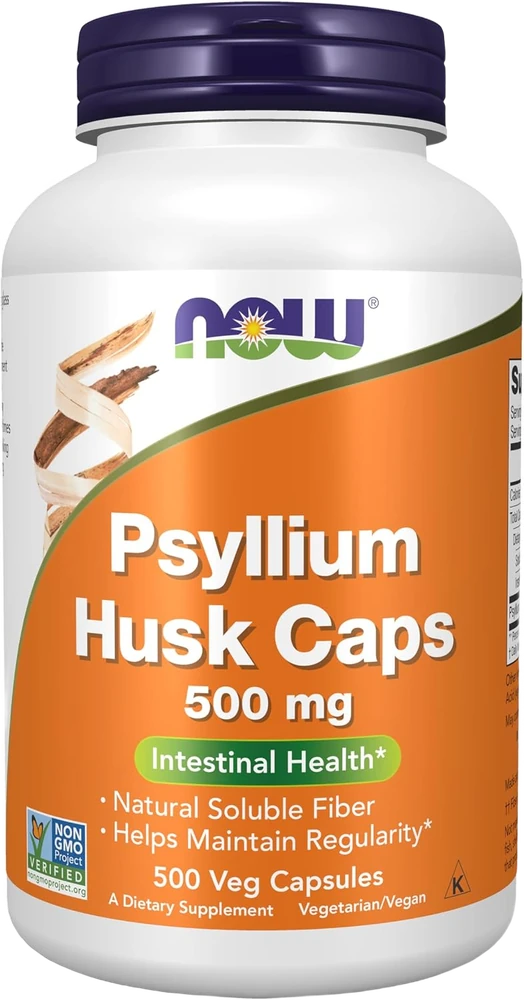
09NOW Psyllium Husk Caps
The vegan, value-minded capsule.
 01
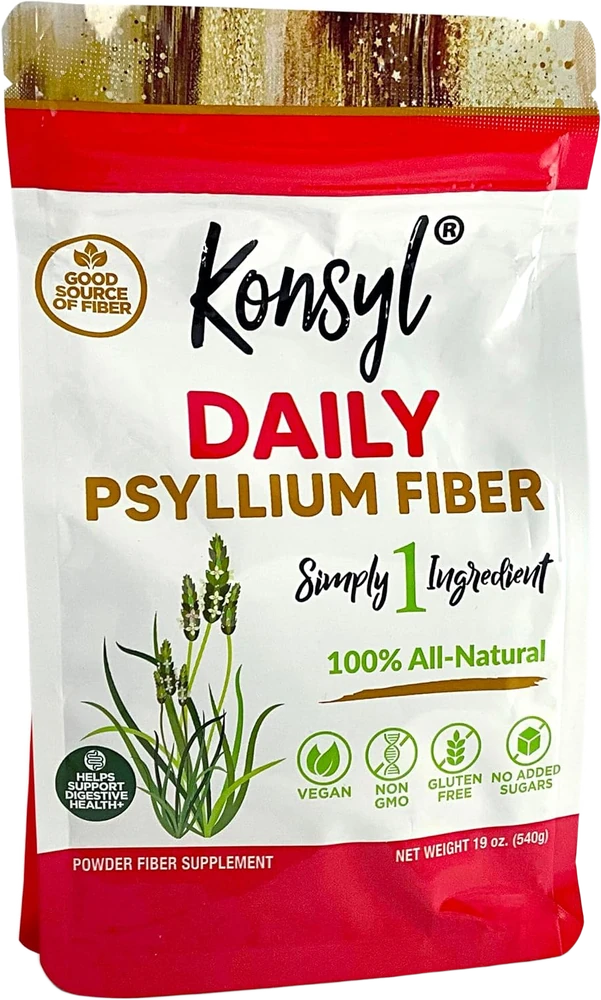
01Konsyl Daily Psyllium
The pick when grams matter most.
 02
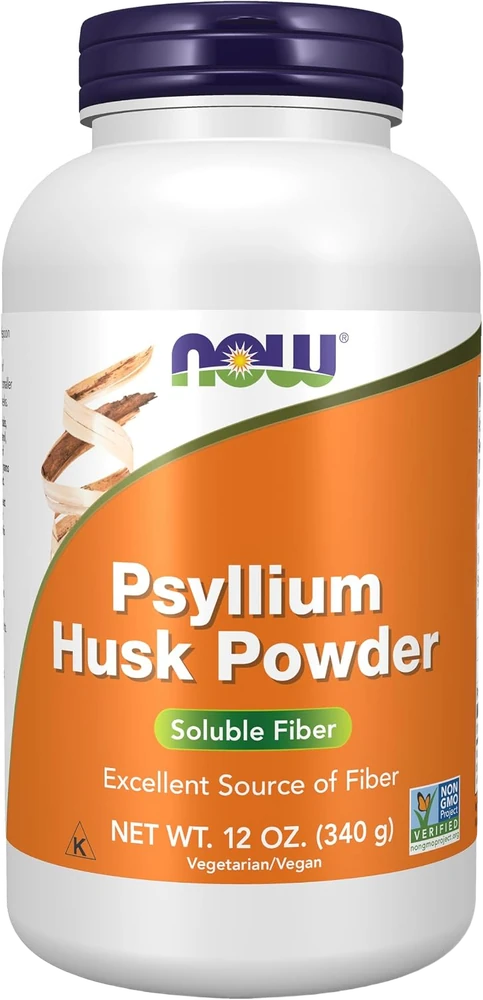
02NOW Psyllium Husk Powder
The value champion.
Quick Answers
How many capsules equal a tablespoon of powder?
A lot — that's the central trade-off. A serving of these capsules delivers roughly 1.8 g of soluble fiber across multiple capsules, whereas a single powder scoop is ~3.4 g (Metamucil powder, #1) up to ~6 g (Konsyl, #1). So matching one modest powder dose already takes several capsules, and reaching the Anderson 2000 (PMID 10648260) ~10 g/day cholesterol range means swallowing a large handful spread through the day. For regularity that's manageable; for a cholesterol or satiety dose it's both inconvenient and expensive. The capsule format trades dose efficiency for not having to mix anything — fine if convenience is what you're buying, costly if grams are.
Do capsules remove the choking/water risk since I'm not drinking a gel?
No — and this is the most important safety point. People assume capsules sidestep psyllium's hydration rule because there's no slurry to drink, but the opposite caution applies: the capsules still contain gel-forming psyllium that swells on contact with water, and taken with too little fluid they can swell in the throat or esophagus and pose a choking or obstruction risk (McRorie 2015, PMID 25972618). You must take them with a full glass of water, every time. The convenience is no-mixing, not no-water. Anyone with swallowing difficulty or a history of gut narrowing should avoid psyllium in any form, capsules included.
Powder or capsules — when are the capsules actually the right call?
When convenience genuinely outranks efficiency for you. Capsules win in three situations: you travel and can't mix a drink, you're somewhere (office, car) where stirring a glass of husk is impractical, or you simply refuse the grit of powder and would otherwise skip psyllium entirely. In all of those, an effortless capsule habit beats a powder you won't take. But if you can mix a drink and your goal needs real grams — cholesterol, blood sugar, satiety — powder (#1, #2, #3) is far cheaper per effective gram and far easier to dose up. Buy capsules for the lifestyle, not the lipid panel.
Are these worth the price versus cheaper psyllium capsules like NOW (#9)?
You're paying for the brand and a slightly higher per-cap dose. NOW Psyllium Caps (#9) are a vegetarian-shell, value-minded capsule at a lower per-cap price, but they hold even less psyllium per cap (~1 g per 2 caps), so you swallow even more of them. Metamucil capsules cost more but carry the most clinically studied, doctor-recommended brand and a somewhat more efficient per-serving dose. Neither is good value per effective gram versus powder — capsules are inherently the priciest route. Choose Metamucil caps for trust, NOW caps for a cheaper vegetarian option, and either only when you specifically want capsules.
Will capsules still help my cholesterol or just my regularity?
They can, but only if you take enough of them consistently — which is where the format fights you. The cholesterol effect is real and dose-dependent: Anderson 2000 (PMID 10648260) lowered LDL ~7% at ~10.2 g/day. Reaching that with capsules means a large daily handful, every day, for weeks. Most people won't sustain that, so in practice capsules deliver regularity reliably and the cholesterol benefit only for the determined who'll swallow the full count. If cholesterol is your real goal, a high-dose powder like Konsyl (#1) gets you there in one to two scoops — far more practical than a fistful of capsules.
I have IBS — are capsules a gentler way to take psyllium?
Not gentler, but they are the same correct fiber, easier to titrate by count. Psyllium is the fiber the IBS evidence supports — Moayyedi 2014 (PMID 25070054) found soluble psyllium improved IBS symptoms while insoluble bran did not. Capsules don't change the fiber or make it gentler on the gut; what they offer is precise, incremental dosing — you can add one capsule at a time as you build up, which helps avoid the gas and bloating that a big dose too soon causes. Start with a couple of caps, increase slowly over one to two weeks, and take each dose with a full glass of water.
Sources & Further Reading
4 peer-reviewed sources, each linked to PubMed
- [1] Ashraf 1995 PMID 8824651 — Effects of psyllium therapy on stool characteristics, colon transit and anorectal function in chronic idiopathic constipation. RCT: psyllium increased stool frequency and weight and improved consistency in chronic constipation — the regularity use case that a few capsules a day actually fits.
- [2] Anderson 2000 PMID 10648260 — Cholesterol-lowering effects of psyllium intake adjunctive to diet therapy in men and women with hypercholesterolemia: meta-analysis of 8 controlled trials. Meta-analysis of 8 trials: ~10.2 g/day psyllium lowered LDL ~7%. Reaching that dose in these capsules is a large daily handful — why capsules are impractical for the cholesterol goal.
- [3] Moayyedi 2014 PMID 25070054 — The effect of fiber supplementation on irritable bowel syndrome: a systematic review and meta-analysis. Systematic review + meta-analysis: soluble psyllium improved IBS symptoms while insoluble bran did not. Capsules deliver the same correct fiber, dosed one cap at a time as you titrate up.
- [4] McRorie 2015 PMID 25972618 — Evidence-Based Approach to Fiber Supplements and Clinically Meaningful Health Benefits, Part 1 & Part 2. Pharmacology review: psyllium is a gel-forming fiber that swells with water — which is why capsules, despite the no-mix format, still require a full glass of water to avoid a swelling/choking risk.
Affiliate disclosure: every Amazon link uses our Associates tag (superachieverclub-20). We earn a small commission at no cost to you; it funds independent reviews. We never accept payment to change a ranking.