
NOW Sports L-Glutamine Pure Powder Review
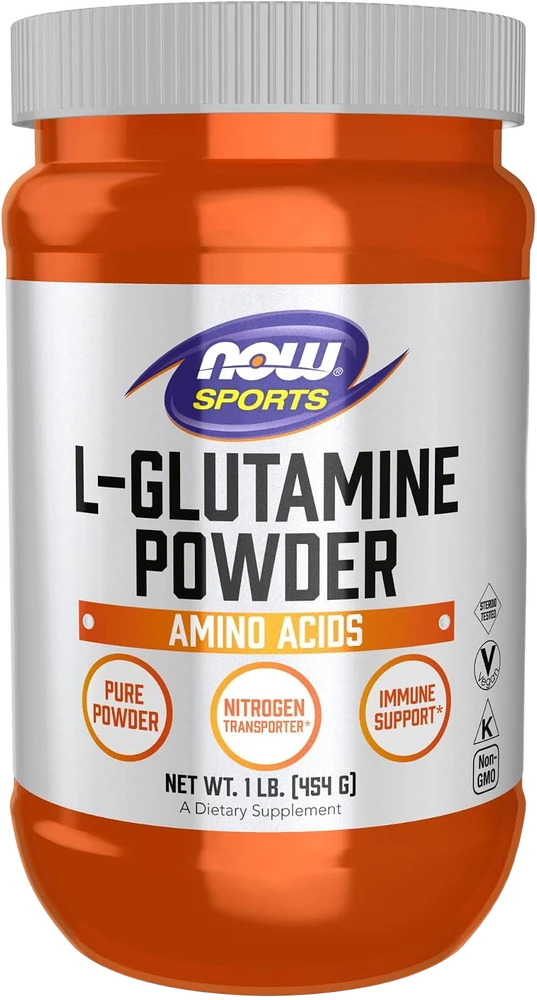 #5 of 10 · Best budget✓ Label verified · Supplement Facts read Sep 7, 2026
Real retailer photo, cut out. Label unedited.
Buy it. The value benchmark — genuine free-form glutamine at the lowest cost per gram. Pure single-ingredient free-form L-glutamine (the trial form) + ~4.5 g per teaspoon + NOW's consistent in-house QC + the best price per gram on the list.
$22 / tub (1 lb)$0.22 / ~4.5 g teaspoon
Why It Scores 8.5 — And The Label Line Behind Each Number
Purity / form
30% of scoreSingle-ingredient pure free-form L-glutamine — the exact form used in Zhou 2019 and the mechanistic literature (Wang 2015, PMID 24965526), with no fillers, dyes, or sweeteners. Functionally identical to the clinical picks on the molecule that matters; it scores just below them only because the brand isn't a hypoallergenic clinician channel.
- Active form
- Pure free-form L-glutamine (single-ingredient, no fillers)
- Inactives
- None — single-ingredient L-glutamine
- Certifications
- GMP-certified facility, identity-tested; NOT NSF or hypoallergenic certified
- Manufacturer
- NOW Foods (Bloomingdale, IL · 30+ years, in-house QC labs)
- Lab transparency
- Extensive NOW in-house QC + raw-material identity testing
Third-party testing + manufacturing quality
25% of scoreNOW runs extensive in-house QC labs in a GMP-certified facility with identity-tested raw materials — among the most consistent QC in the mass-market tier and unusually transparent for the price. But it lacks the NSF Certified for Sport per-batch independent verification that Thorne (#1) and the clinical picks carry, which is the gate for drug-tested athletes.
Dose-per-scoop + label honesty
20% of scoreGrams of glutamine per teaspoon (~4.5 g) are stated plainly with no proprietary-blend ambiguity, and that lands close to the Zhou 5 g per-dose amount. The honest knock is the teaspoon itself — less precise than a calibrated scoop, so hitting exactly 5 g takes a slightly heaped pour or a one-time weigh to calibrate.
- Per serving
- ~4.5 g L-glutamine per rounded teaspoon (close to the 5 g trial per-dose amount)
- Trial-dose alignment
- ~4.5 g/tsp lands just under Zhou 2019's 5 g per-dose amount
Cost per effective gram
15% of scoreThe best price per gram on the entire list — roughly half the per-gram cost of Thorne (#1) and the value benchmark every other pick is measured against. A 1 lb (454 g) tub is ~100 teaspoon servings, so a real 8-week trial at 15 g/day stays genuinely affordable. This is the axis NOW wins outright.
- Price
- ~$22 / 1 lb tub = ~$0.22 per ~4.5 g teaspoon (best cost/gram on the list)
Tolerability for sensitive / IBS-prone guts
10% of scoreAdditive-free single-ingredient powder dissolves cleanly in water with zero irritant excipients — fine for most guts, and you can start with a partial teaspoon and ramp. It isn't explicitly hypoallergenic-certified like Pure Encapsulations (#2) or Klaire Labs (#4), so the most reactive, post-infectious guts may still prefer a clinician brand.
- More Specs
- Tub
- 1 lb / 454 g · ~100 teaspoon servings (~1 month at the 5 g TID protocol)
Label verified. Every figure read from the Supplement Facts photo, Sep 7, 2026.
Marketing Claims Vs. Reality
Pure free-form L-glutamine — single ingredient.
The label lists L-glutamine as the only ingredient, with no fillers, dyes, or sweeteners — the exact free-form used in the human trials and the cleanest profile for the price. Verified and the core of its value proposition.
Supports a healthy gut lining and intestinal barrier.
Mechanistically grounded (Wang 2015, PMID 24965526) and supported by a strong RCT in a narrow population — post-infectious IBS-D with high permeability (Zhou 2019, PMID 30108163). But Abbasi 2024 (PMID 39397201) found no overall permeability effect across mixed adults except at >30 g/day short-term. True for the specific population, oversold as a general gut-lining fix.
Supports muscle recovery and exercise performance.
The 'Sports' framing implies a recovery benefit, but in healthy, well-fed athletes the muscle-recovery evidence for glutamine is weak — you already get ample glutamine from dietary protein. Glutamine's defensible role is gut- and immune-related under physiological stress, not a reliable performance edge for the average buyer.
Highest-grade, GMP-manufactured, identity-tested.
NOW manufactures in a GMP-certified facility and runs extensive in-house QC with raw-material identity testing — well-documented and among the most transparent QC programs in the mass-market tier. Accurate; just note it stops short of independent NSF per-batch certification.
Well absorbed — no special formulation needed.
Plain L-glutamine is well absorbed orally (unlike, say, curcumin), so a simple free-form powder is genuinely all you need to reach the trial dose. Accurate and a point in favour of a no-frills single-ingredient powder.
What Our Test Actually Found
It wins one axis outright — cost per gram — and that's the whole pitch
The Zhou protocol is 5 g three times daily for 8 weeks, which is real volume: an honest trial burns through roughly 840 g of powder. At NOW's price per gram, that course is among the cheapest you can run with a genuine free-form product. Strip away branding and NOW's glutamine is molecularly the same amino acid as the $43 clinical tubs — you're paying for the powder, not a certification or a clinician channel. If your decision is 'I want to run the evidence-based protocol for the least money,' this is the answer.
Teaspoon dosing is the real trade-off versus a calibrated scoop
NOW ships a teaspoon-based dose (~4.5 g/rounded tsp) rather than a precise calibrated scoop like Nutricost's 5 g (#6) or Thorne's ~5 g (#1). For most buyers a slightly heaped teaspoon three times a day is close enough — glutamine has no sharp dose cliff at 5 g. But if you want repeatable precision, weigh one teaspoon on a kitchen scale once to calibrate your pour. It's a minor friction, not a quality problem, and it's the honest reason a same-price calibrated-scoop pick like Nutricost can edge it on convenience.
Be honest about the ceiling: this is for IBS-D and barrier support, not generic 'leaky gut'
The most important thing we can tell you is what no bottle can do. Abbasi 2024 pooled adult RCTs and found no significant overall effect of glutamine on intestinal permeability, with benefit only in a >30 g/day short-term subgroup. Burrin 2006 even questioned whether glutamine is a uniquely essential gut fuel at all. So NOW's cheap powder is the best-value tool for a specific job — post-infectious IBS-D, documented hyperpermeability, clinician-guided recovery from major stress — not a guaranteed fix for everyday bloating or food sensitivities.
In-house QC is solid for the tier, but it's not third-party sport certification
NOW's QC reputation is genuinely strong for a mass-market brand — GMP facility, in-house labs, identity-tested raw materials — and amino-acid adulteration is exactly what identity testing catches. What it isn't is NSF Certified for Sport: independent, per-batch, publicly verifiable banned-substance testing. For a gut buyer that gap is a reassurance you forgo to save money; for a drug-tested athlete it's disqualifying, and Thorne (#1) is the right call instead. Match the certification to your actual situation rather than paying for testing you'll never use.
Plain glutamine is well absorbed, so the no-frills powder is a feature
Unlike fat-soluble or poorly-absorbed compounds, L-glutamine doesn't need a special carrier or formulation to work — it's well absorbed as a plain free-form powder. That means the fanciest 'gut complex' blend has no absorption advantage over NOW's single ingredient, and every added excipient in those blends is just another potential irritant for a sensitive gut. For a budget buyer, simple-and-cheap is genuinely the right call here, not a compromise.
Full analysis: all pros & cons (8), buy if / skip if
- Best price per gram on the entire list — the value benchmark for a long, multi-month daily course
- Genuine single-ingredient free-form L-glutamine — the exact form used in the Zhou 2019 IBS-D trial
- NOW's in-house QC is among the most consistent and transparent in the mass-market tier, with 30+ years of trust
- ~4.5 g per teaspoon lands close to the 5 g trial per-dose amount, with grams stated plainly
- Additive-free powder dissolves cleanly with no irritant excipients — fine for most guts
- Teaspoon dosing is less precise than a calibrated scoop — measure carefully (or weigh once) to hit exactly 5 g
- Not NSF Certified for Sport — disqualifying for drug-tested athletes who need per-batch independent testing
- Not explicitly hypoallergenic-certified, so the most reactive IBS-prone guts may prefer a clinician brand
- Cost per gram is your priority for a long, multi-month daily course
- You've already confirmed glutamine helps your gut and just want the cheapest clean refill
- You want genuine free-form single-ingredient glutamine without paying a clinician-brand premium
- You trust NOW's in-house QC and don't need third-party sport certification
- You're a drug-tested athlete who needs NSF Certified for Sport — go with Thorne (#1)
- You have a very reactive or IBS-prone gut and want a hypoallergenic label — Pure Encapsulations (#2) is cleaner
- You want exact, repeatable dosing from a calibrated scoop rather than a teaspoon — Nutricost (#6) ships a 5 g scoop at a similar price
Pure single-ingredient free-form L-glutamine (the trial form) + ~4.5 g per teaspoon + NOW's consistent in-house QC + the best price per gram on the list. The smart pick once you've decided to run a long daily course and don't need certification. Two honest trade-offs: you measure with a teaspoon rather than a calibrated scoop, and there's no NSF or hypoallergenic mark. Start at 5 g/day, build toward 5 g three times daily, and give it the full 8 weeks the trial used.
NOW Sports L-Glutamine Pure Powder is the bottle we point cost-conscious buyers to once they've decided glutamine is worth a real multi-month trial. Before anything else, the honest frame: glutamine is not a magic gut-healer, and the strong human evidence is narrow. There is exactly one standout RCT (Zhou 2019, in Gut) showing 5 g three times daily for 8 weeks dramatically helped post-infectious diarrhoea-predominant IBS with a measured leaky barrier — and a 2024 meta-analysis found no overall permeability effect outside very high short-term doses. So this is a product for a specific job, not a cure-all. Within that job, NOW's pitch is pure economics: genuine single-ingredient free-form L-glutamine — the exact trial form — at the best price per gram on the entire list, from a brand with 30+ years of mass-market trust. You give up a calibrated scoop (it's teaspoon-dosed) and third-party sport certification. Here's the full breakdown.
The value benchmark — the smart pick once you've committed to the protocol.

NOW Sports L-Glutamine Pure Powder is what we recommend to any reader who has decided glutamine is worth a real multi-month trial and wants to run it for the least money. The form is right (single-ingredient free-form, the trial form), the price is unbeatable (the lowest cost per gram on the list), and NOW's in-house QC is genuinely solid for the mass-market tier. The glutamine itself is molecularly the same as the clinical tubs that cost twice as much. Two honest caveats. First, the trade-offs: you measure with a teaspoon rather than a calibrated scoop (a slightly heaped pour, or a one-time weigh, hits 5 g fine), and there's no NSF or hypoallergenic certification — so drug-tested athletes should choose Thorne (#1) and very reactive guts may prefer Pure Encapsulations (#2). If you want a calibrated 5 g scoop at a similar price, Nutricost (#6) is the close cousin. Second, and more important: be clear on what you're buying it for. Glutamine has strong human evidence in post-infectious IBS-D with high permeability (Zhou 2019) and under major physiological stress (Shariatpanahi 2019) — but a 2024 meta-analysis found no overall permeability benefit outside very high short-term doses (Abbasi 2024). So this is the best-value tool for a specific job, not a cure for the catch-all 'leaky gut.' Buy unflavored, start at 5 g/day, build toward 5 g three times daily, and give it the full 8 weeks before you judge it. If you have a serious GI condition, are pregnant, or have liver disease or active cancer, clear it with your doctor first.
If This Doesn’t Fit — Try These
 01
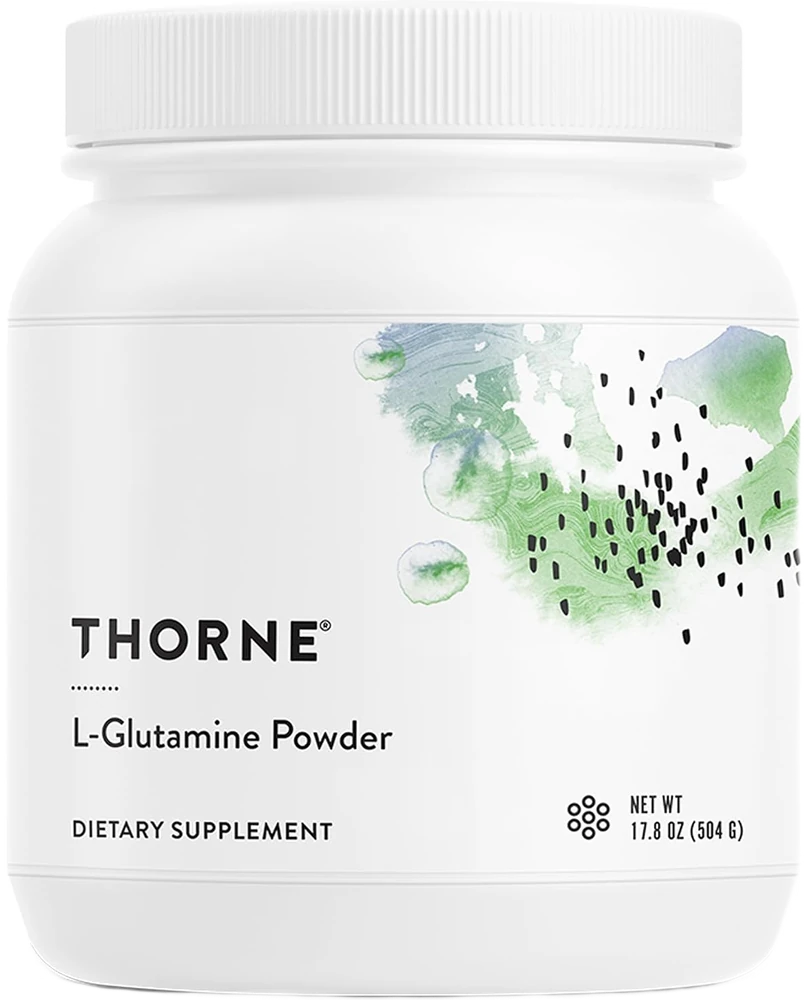
Thorne L-Glutamine Powder
The default pick for anyone serious about using glutamine for gut-barrier support.
 07
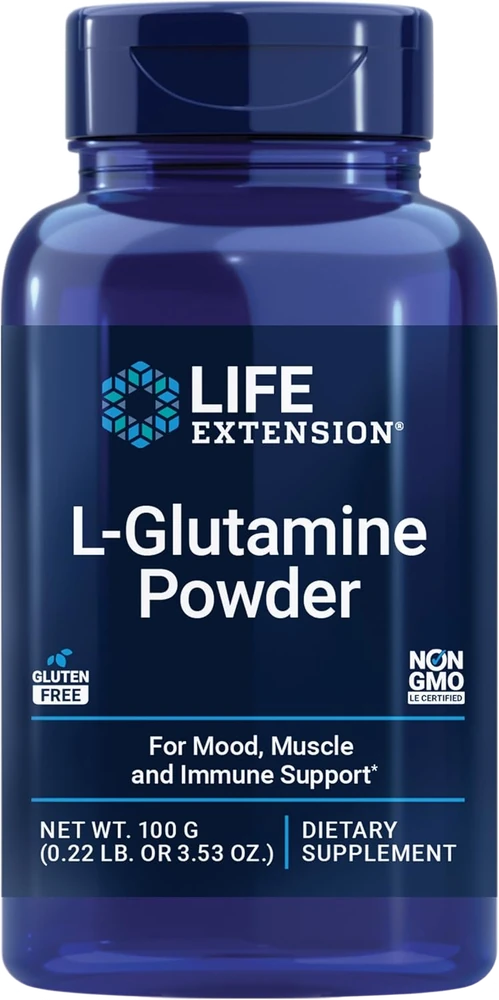
Life Extension L-Glutamine Powder
The pick for the undecided buyer.
 02
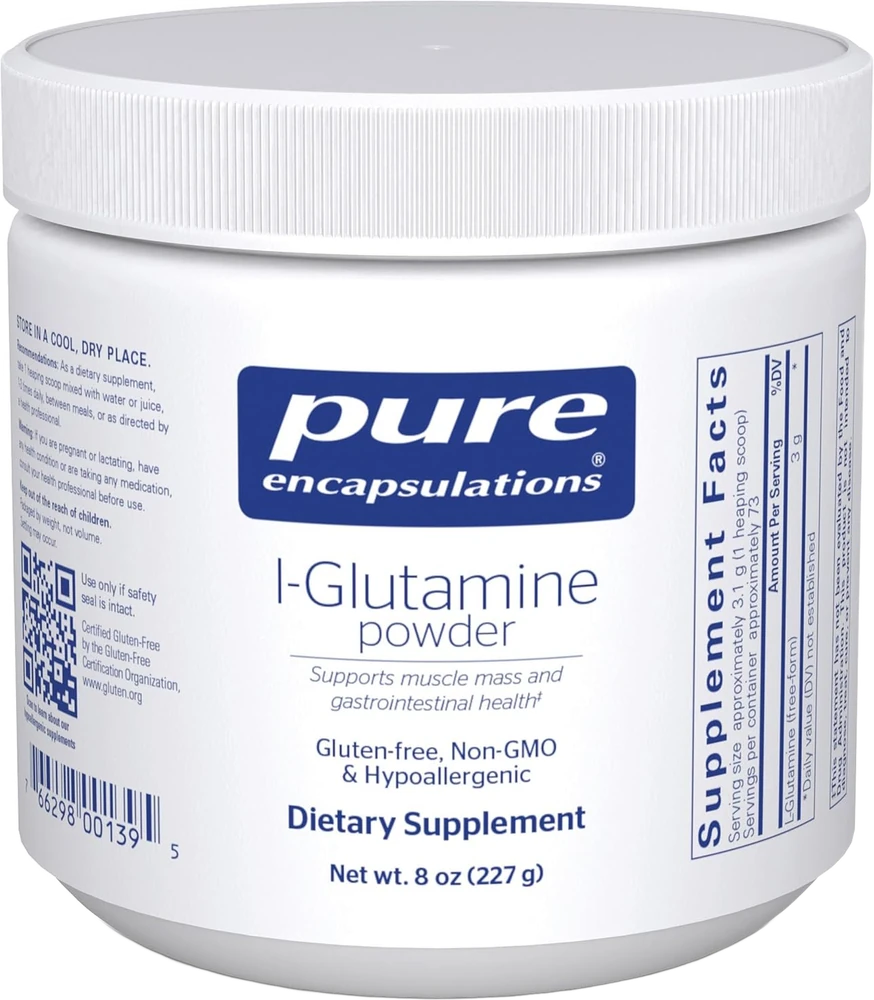
Pure Encapsulations L-Glutamine
The right pick if your gut is the reason you're here.
Quick Answers
Is the cheap NOW powder actually the same glutamine as the $43 Thorne tub?
On the molecule that matters, yes — both are single-ingredient free-form L-glutamine, the exact form used in Zhou 2019 (PMID 30108163). Glutamine is a cheap, well-characterised amino acid, and NOW's identity-tested in-house QC is among the most consistent in the mass-market tier. What you give up versus Thorne (#1) is the NSF Certified for Sport mark (per-batch banned-substance and label-accuracy testing) and the clinician-grade QC layer, plus you measure with a teaspoon rather than a calibrated scoop. For a healthy buyer running a long daily course who doesn't need certification, that's a sensible trade — you're paying for the powder, not the paperwork. For a drug-tested athlete or a very reactive gut, the clinical picks earn their premium.
How do I hit the 5 g trial dose with a teaspoon?
A rounded teaspoon of NOW's powder is about 4.5 g, just under the Zhou 2019 per-dose amount of 5 g — so a slightly heaped teaspoon lands you on target. The honest caveat is that teaspoon measuring is less precise than a calibrated scoop: powder density and how level you scrape it both shift the real grams. If you're running the full 5 g three-times-daily protocol and want it exact, weigh a teaspoon once on a cheap kitchen scale to calibrate your own pour, then repeat it. For most buyers, a rounded-to-heaped teaspoon three times a day is close enough — glutamine doesn't have a sharp dose-response cliff at 5 g.
How should I dose it, and how long before I judge it?
The best-evidenced gut protocol is Zhou 2019's: 5 g three times daily (15 g/day total) for eight weeks, in post-infectious diarrhoea-predominant IBS with a leaky barrier. Plain L-glutamine is well absorbed, so no special formulation is needed — mix a teaspoon into water, split across the day, take consistently. Give it the full 8 weeks before deciding; glutamine works by supporting gut-lining turnover over time, not as a fast symptom blocker, so a quiet first week or two is normal (the hub's timeline says the same). If there's no meaningful change by 8 weeks of adequate dosing, it's reasonable to stop rather than escalate indefinitely.
Does the lack of NSF certification mean it's not tested?
No — it means it's not independently sport-certified, which is a different thing. NOW runs extensive in-house QC labs and manufactures in a GMP-certified facility, with identity testing on raw materials; the company's testing program is unusually transparent for the mass-market tier. What NSF Certified for Sport (which Thorne carries) adds on top is per-batch testing by an accredited third party against 270+ banned substances, with public verification — the gate a drug-tested athlete needs. For a gut buyer, NOW's in-house program is a reasonable quality floor; the certification gap is a reason to pay more for Thorne only if independent per-batch verification matters to you.
Is glutamine worth it for muscle recovery, or just gut health?
Despite the 'Sports' label, we treat this as a gut-health product, because that's where the mechanism and the strongest human trials live. The evidence for glutamine improving muscle mass, strength, or recovery in healthy, well-fed athletes is weak — most controlled studies show no meaningful benefit, since you already get ample glutamine from dietary protein. The NOW Sports branding reflects its origins in the bodybuilding aisle, not a proven performance edge. Buy it to run the Zhou-2019 gut-barrier protocol cheaply — and if you have a serious GI condition, liver disease, or active cancer, clear it with your doctor first.
Sources & Further Reading
5 peer-reviewed sources, each linked to PubMed
- [1] Zhou 2019 PMID 30108163 — Randomised placebo-controlled trial of dietary glutamine supplements for postinfectious irritable bowel syndrome. Double-blind RCT in adults with post-infectious diarrhoea-predominant IBS and increased intestinal permeability: glutamine 5 g three times daily for 8 weeks produced a ≥50-point IBS-SS reduction in ~79.6% of the glutamine group versus 5.8% on placebo, with reduced stool frequency and normalised permeability. The single strongest human trial behind glutamine for gut-barrier support — and the basis for the 5 g per-dose protocol NOW's ~4.5 g teaspoon delivers cheaply — but in a narrow, high-permeability population.
- [2] Shariatpanahi 2019 PMID 31485104 — Effects of Early Enteral Glutamine Supplementation on Intestinal Permeability in Critically Ill Patients. RCT in 80 ICU patients: early enteral glutamine (0.3 g/kg/day) reduced plasma zonulin (a tight-junction permeability marker) by ~40% over 10 days versus placebo and lowered endotoxin, indicating a tighter barrier — though clinical outcomes did not differ. Supports glutamine's 'conditionally essential under stress' barrier role, a clinical setting distinct from healthy everyday use.
- [3] Wang 2015 PMID 24965526 — Glutamine and intestinal barrier function. Mechanistic review: glutamine fuels enterocyte proliferation and survival and regulates intestinal barrier function — including expression of tight-junction proteins (occludin, claudins) — in injury, infection, weaning stress and other catabolic states. The mechanistic backbone for why pure free-form glutamine is the right form for gut-barrier support.
- [4] Alpers 2000 PMID 17024034 — Is glutamine a unique fuel for small intestinal cells?. Critical review arguing glutamine is NOT a uniquely essential small-intestinal fuel — glutamate and aspartate are also major mucosal fuels — and that where supplementation helps, the benefit may relate to functions other than gut-fuelling. The honest counterweight to over-stated 'gut fuel' marketing on any glutamine bottle.
- [5] Abbasi 2024 PMID 39397201 — A systematic review and meta-analysis of clinical trials on the effects of glutamine supplementation on gut permeability in adults. Meta-analysis of adult RCTs: glutamine supplementation had no significant overall effect on intestinal permeability; a reduction appeared only in a subgroup using high doses (>30 g/day) over a short period. The key honesty anchor — it sets the limits on glutamine's gut-permeability claims and argues against treating any bottle as a universal 'leaky gut' fix.
Affiliate disclosure: every Amazon link uses our Associates tag (superachieverclub-20). We earn a small commission at no cost to you; it funds independent reviews. We never accept payment to change a ranking.