
Garden of Life Raw Organic Fiber, Unflavored Review
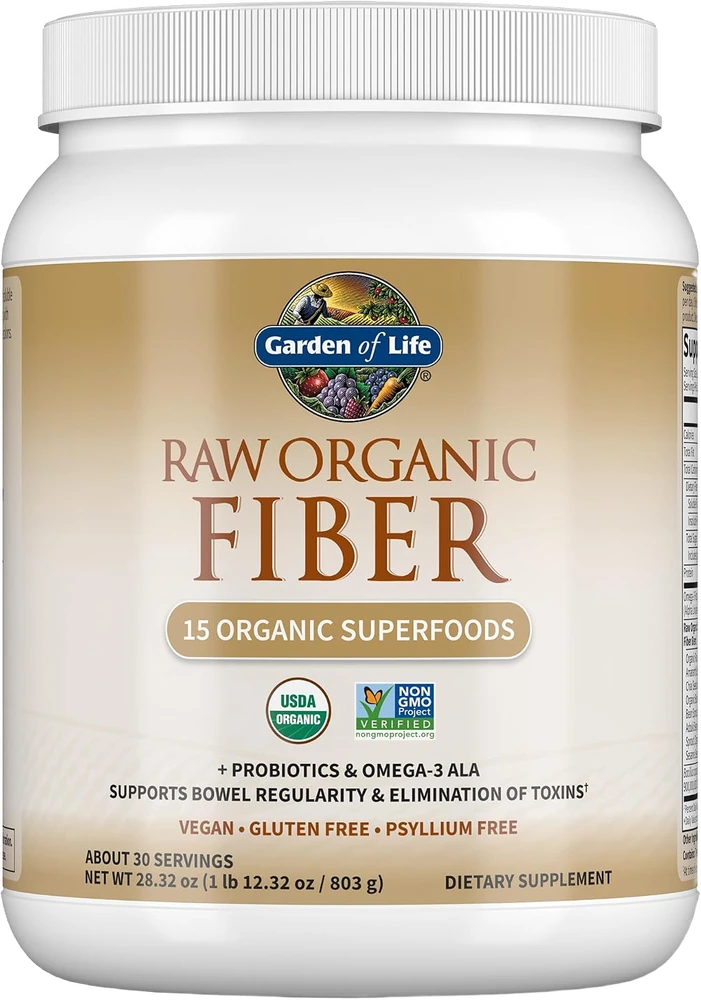 #10 of 10 · Whole-food blend✓ Label verified · Supplement Facts read Sep 7, 2026
Real retailer photo, cut out. Label unedited.
Consider it. The deliberate psyllium-FREE pick — for guts that can't tolerate psyllium. A psyllium-FREE blend of 15 organic whole-food fibers + probiotics, ~9 g fiber/serving, USDA Organic and Non-GMO Verified.
$30 / 30 servings$1.00 / ~9 g fiber serving
Why It Scores 6.6 — And The Label Line Behind Each Number
Soluble-fiber dose + form fit
30% of score~9 g of fiber per serving from 15 organic whole foods plus probiotics — a reasonable total, and as a psyllium SUBSTITUTE its job is to be gentler on intolerant guts, which a spread-out mixed-fiber matrix achieves. But it's scored as a stand-in, not a psyllium: it delivers no concentrated viscous psyllium gel, so the specific gel-driven effects you'd buy psyllium for (Anderson 2000 LDL, the IBS data) don't apply to this blend.
- Active fiber
- Blend of 15 organic whole-food fibers (psyllium-FREE) + probiotics
- Per serving
- ~9 g fiber per serving
- Form
- Whole-food fiber blend powder, unflavored, USDA Organic
Purity + label honesty
25% of scoreUSDA Organic, Non-GMO Project Verified, with a clean whole-food label and a disclosed multi-ingredient blend plus probiotics. The product is also honest about what it is — explicitly a fiber blend, not psyllium — which is exactly why it can sit on this list with integrity. Strong label transparency; the only reason it isn't higher is the inherent complexity of a 15-source blend versus a single ingredient.
Cost per effective gram of psyllium
20% of scoreThe clear weak spot. At ~$1.00 per serving it's by far the most expensive pick on the list — roughly 4-8x the per-serving cost of the pure husks (NOW #3 ~$0.13, Anthony's #7 ~$0.18). You're paying for the multi-ingredient organic blend and probiotics, not for more or better-evidenced fiber. Poor value per gram unless the psyllium-intolerance use case specifically justifies the premium for you.
- Container
- 30 servings
- Price
- $30 / 30 servings = ~$1.00 per serving
Third-party testing + manufacturing quality
15% of scoreUSDA Organic certified and Non-GMO Project Verified, from an established organic whole-food brand, with an added probiotic blend. Solid certifications and a credible clean-label pedigree. It lacks psyllium's single-ingredient simplicity, but for a multi-source whole-food blend the verification stack is reassuring and appropriate.
- Testing
- USDA Organic certified, Non-GMO Project Verified, probiotic blend
Mixability + real-world adherence
10% of scoreGenerally gentler and more varied than concentrated psyllium, which is the point — a spread of soluble and insoluble fibers plus probiotics tends to sit easier on sensitive guts. It's unflavored with a mild earthy character and some texture, so it's not a flavor treat, but it doesn't form the single aggressive gel that makes high-dose psyllium gritty and fast-setting. Best mixed into a smoothie.
- More Specs
- Added ingredients
- Probiotic blend; organic whole-food sources (no psyllium, no added sugar)
- Take with
- A full glass of water or a smoothie — start small and build up
- Best for
- Guts that don't tolerate concentrated psyllium; whole-food fiber + probiotic seekers
Label verified. Every figure read from the Supplement Facts photo, Sep 7, 2026.
Marketing Claims Vs. Reality
Psyllium-free whole-food fiber blend.
The label is explicitly a multi-source organic whole-food fiber blend with no psyllium husk. The psyllium-free claim is accurate and is the entire reason the product belongs on this list as the disclosed alternative for psyllium-intolerant guts.
USDA Organic and Non-GMO Project Verified.
Both certifications are carried on the Garden of Life label and independently verifiable. The organic and Non-GMO verification is a genuine strength and part of what the higher price pays for.
Supports digestive health with added probiotics.
Reasonable in direction: a varied fiber intake plus probiotics broadly supports gut health, and the added probiotic blend is a real differentiator. But it lacks the deep, product-specific RCT base psyllium has for stool normalization (Ashraf 1995, PMID 8824651) — the support is general whole-food/probiotic, not a documented single-ingredient effect.
Supports heart health / cholesterol.
The documented ~7% LDL drop is a PSYLLIUM effect from a specific trial base at ~10 g/day (Anderson 2000, PMID 10648260) and does not transfer to a different, psyllium-free fiber matrix. There is no equivalent product-specific cholesterol RCT for this blend, so any heart-health implication should not be read as psyllium's proven effect.
Gentler than concentrated psyllium for sensitive guts.
Plausible and the product's core rationale: spreading a smaller amount across many fibers plus probiotics is frequently better tolerated than one thick psyllium gel, which triggers bloating/cramping in some people. But tolerance is individual — 'gentler' is a reasonable expectation, not a guarantee, and isn't backed by a head-to-head trial.
What Our Test Actually Found
This is the right pick only if psyllium itself is the problem
The single most important thing to get right here is the use case. Garden of Life earns its slot precisely because some people can't tolerate concentrated psyllium — the thick gel triggers bloating or cramping — and a gentler, varied, psyllium-free blend gives them a real option. That's a genuine and underserved need. But it also means the buying logic is narrow: if plain psyllium agrees with you, this product is both more expensive and less evidenced than a real psyllium, and you should pick #1-#9 instead. Buy it for psyllium intolerance, not as a default fiber.
Psyllium's evidence does NOT come along for the ride
It's tempting to assume any fiber inherits psyllium's résumé, but it doesn't. The ~7% LDL reduction and the IBS benefit are specific to psyllium's particular gel-forming, bile-acid-binding behavior, replicated across dedicated trials (Anderson 2000, PMID 10648260; Moayyedi 2014, PMID 25070054). A different, mixed fiber matrix has no equivalent product-specific RCT, so those exact effects shouldn't be expected here. A varied whole-food fiber blend has its own broad merits — but if you came for psyllium's documented cholesterol or IBS lever, this isn't it.
The price is the second hard caveat
At about $1.00 a serving, this is by far the most expensive pick on the list — several times the per-serving cost of the pure husks. The premium buys an organic, Non-GMO-verified, 15-source blend plus probiotics, not more or better-proven fiber. For the psyllium-intolerant buyer who wants a gentle certified-organic option with probiotics, that can be a fair trade. For everyone else it's a steep price for a product that lacks psyllium's specific evidence — a poor value unless the intolerance case is real for you.
The added probiotics are a genuine, if modest, differentiator
Most picks on this list are fiber and nothing else. Garden of Life folds in a probiotic blend, which broadens the gut-support angle and is a real reason some buyers prefer it — fiber plus live cultures in one scoop. It's a sensible pairing (fiber can act as a substrate for beneficial bacteria), though it's a general wellness benefit rather than a documented single-ingredient effect, and it's part of why the price is higher. Take it consistently to get whatever probiotic benefit it offers.
Start low and hydrate — the universal fiber rules still apply
Even though this isn't concentrated psyllium, the basics of taking any fiber hold: begin with a smaller amount and build up over a week or two so your gut adapts and you avoid early gas and bloating, and take it with plenty of fluid. The acute dry-swelling choking risk is most tied to concentrated gel-forming psyllium (McRorie 2015, PMID 25972618) and is lower for a mixed blend, but plenty of water still makes any fiber work more comfortably. Mixing it into a smoothie is the easiest way to take it daily.
Full analysis: all pros & cons (8), buy if / skip if
- Psyllium-FREE by design — a genuine, underserved alternative for people who bloat or cramp on concentrated psyllium
- ~9 g of fiber per serving from 15 organic whole foods, plus an added probiotic blend for a broader gut-support angle
- USDA Organic and Non-GMO Project Verified with a clean whole-food label
- A spread of soluble and insoluble fibers is often gentler on sensitive guts than one aggressive gel
- Honest about what it is — explicitly not psyllium — so you can choose it for the right reason
- Not psyllium — psyllium's specific cholesterol (Anderson 2000) and IBS (Moayyedi 2014) evidence does NOT transfer to this blend
- By far the most expensive pick on the list at ~$1.00/serving — several times the cost of the pure husks
- A multi-fiber blend lacks psyllium's depth of single-ingredient trial evidence and its documented gel-driven effects
- Concentrated psyllium genuinely doesn't agree with you — it makes you bloat, gas, or cramp
- You want a gentler, more varied whole-food fiber blend rather than a single isolate
- You value an added probiotic blend and USDA Organic / Non-GMO Project verification
- You understand you're trading psyllium's specific proven effects for a broader, gentler approach
- You tolerate psyllium fine — a real psyllium (#1-#9) is cheaper and far better evidenced
- Your specific goal is psyllium's documented ~7% LDL drop (Anderson 2000) — that doesn't transfer here
- You want the lowest cost per serving — this is by far the most expensive pick on the list
A psyllium-FREE blend of 15 organic whole-food fibers + probiotics, ~9 g fiber/serving, USDA Organic and Non-GMO Verified. The real reason to buy: it's gentler and more varied for guts that bloat or cramp on concentrated psyllium gel. The two big caveats: it lacks psyllium's specific cholesterol/IBS evidence, and at ~$1.00/serving it's by far the priciest here. If plain psyllium agrees with you, buy a real psyllium (#1-#9) instead.
Garden of Life is the honest exception on this list, and we include it on purpose. It is psyllium-FREE — a blend of 15 organic whole-food fibers plus probiotics — and it's here for one specific reader: the person whose gut bloats or cramps on concentrated psyllium and deserves a real alternative rather than being told to tough it out. As a gentler, more varied, certified-organic fiber it does that job. But two things must be crystal clear before you buy. First, it is not psyllium, so the specific, well-replicated psyllium evidence — the ~7% LDL drop, the IBS data — does not transfer to this different fiber matrix. Second, it's by far the most expensive pick on the list. We checked the label and pressure-tested the claims with both of those caveats front of mind. Here's the full breakdown.
The honest exception — buy it only if psyllium itself is the problem.

We include Garden of Life precisely because some people can't tolerate concentrated psyllium — the thick gel triggers bloating or cramping for them — and they deserve a real alternative rather than being told to push through. As a psyllium-FREE blend of 15 organic whole-food fibers plus probiotics, gentler and more varied, it does that job, and it's honestly labeled as what it is. But be clear about the trade before you buy. First, this is not psyllium, so psyllium's specific, well-replicated evidence — the ~7% LDL drop, the IBS benefit — does not come with it; you're swapping psyllium's documented effects for a broader, gentler whole-food approach. Second, at about $1.00 a serving it's by far the most expensive pick on the list. Put those together and the buying logic is narrow but real: if concentrated psyllium genuinely doesn't agree with you and you want a gentle, certified-organic, probiotic-containing fiber, this is a defensible choice and worth the premium. If plain psyllium agrees with you, pick a real psyllium (#1-#9) instead — it's cheaper and far better evidenced. Either way, start low, build up, and take it with plenty of water.
If This Doesn’t Fit — Try These
 01
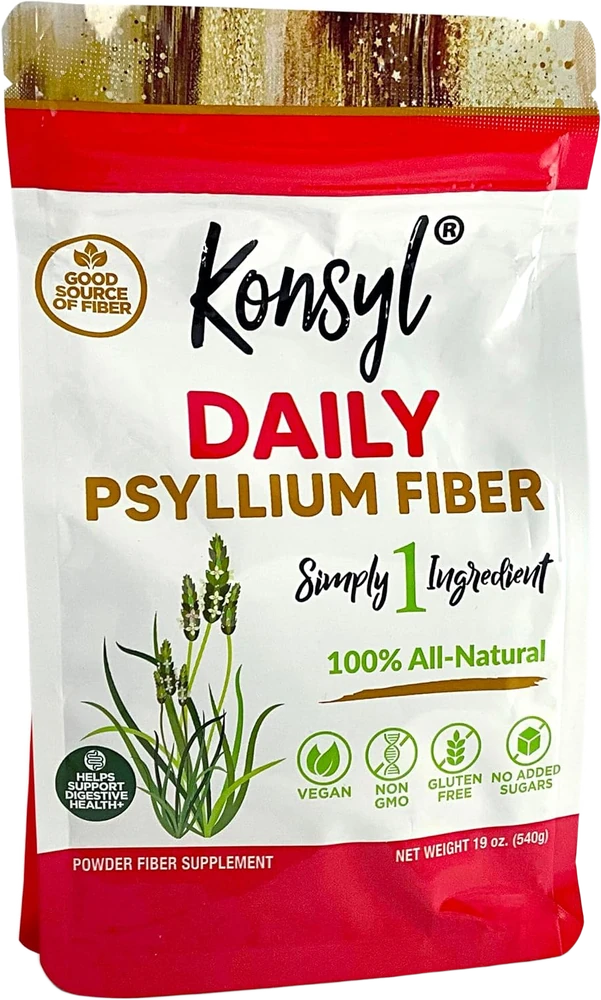
01Konsyl Daily Psyllium
The pick when grams matter most.
 03
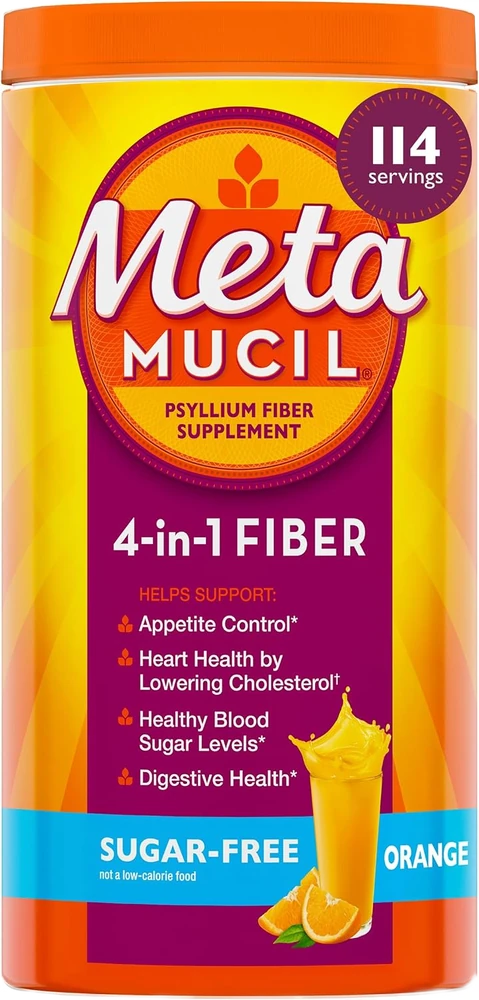
03Metamucil 4-in-1 Sugar-Free
The default pick for almost everyone.
 02
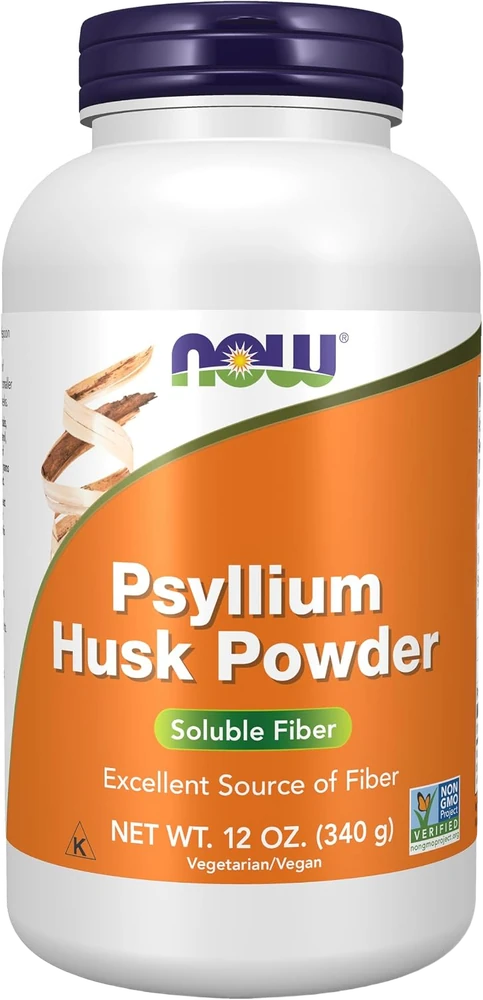
02NOW Psyllium Husk Powder
The value champion.
Quick Answers
Wait — this is on a psyllium list but has no psyllium?
Correct, and that's deliberate. Garden of Life Raw Organic Fiber is psyllium-FREE by design — it's a blend of 15 organic whole-food fibers (from seeds, sprouts, and other plants) plus probiotics, not psyllium husk. We include it as the honest exception because some people genuinely can't tolerate concentrated psyllium: the thick, viscous gel that makes psyllium work also triggers bloating, gas, or cramping for them, and they deserve a real alternative rather than being told to push through. So if plain psyllium agrees with you, this is not the product to buy — pick a real psyllium (#1-#9). It's here specifically for the psyllium-intolerant gut.
Does it lower cholesterol like psyllium does?
We can't claim that — and it's important to be honest about it. Psyllium's ~7% LDL reduction comes from a specific, well-replicated body of trials at ~10 g/day (Anderson 2000, PMID 10648260), and that evidence is about psyllium's particular bile-acid-binding gel, not fiber in general. Garden of Life is a different, mixed fiber matrix with no equivalent product-specific cholesterol RCT, so the bile-acid LDL effect you buy psyllium for does not transfer here. A varied whole-food fiber blend has its own general gut benefits, but if your specific goal is the documented psyllium cholesterol lever, this is the wrong tool — buy a real psyllium powder and reach the ~10 g/day dose.
Why is it so much more expensive than the psyllium powders?
Because you're paying for a multi-ingredient organic blend plus probiotics, not a single bulk fiber. At about $1.00 per serving it's by far the priciest pick on the list — roughly 4-8x the per-serving cost of the pure husks (NOW #3 is ~$0.13, Anthony's #7 ~$0.18). The premium buys USDA Organic certification, Non-GMO Project verification, 15 whole-food fiber sources, and an added probiotic blend. Whether that's worth it depends entirely on why you're here: if concentrated psyllium genuinely doesn't agree with you and you want a gentler, varied, certified-organic option, the cost can be justified. If you tolerate psyllium fine, you're paying a large premium for a product that lacks psyllium's specific evidence.
Is a mixed whole-food fiber blend gentler than psyllium?
Often, yes — and that's the main reason it exists. Concentrated psyllium forms a single, thick, viscous gel, and for some guts that much of one gel-forming fiber at once causes bloating and cramping. A blend that spreads a smaller amount across many different soluble and insoluble fibers, plus probiotics, is frequently better tolerated by sensitive guts. That said, 'gentler' isn't guaranteed for everyone, and more variety isn't automatically better — psyllium's single-ingredient simplicity is exactly why its effects are so well documented. The honest framing: this trades psyllium's specific, proven effects for a broader, generally-gentler whole-food approach.
How do I take it, and do the water rules still apply?
Mix one serving into water or a smoothie, and yes — take any fiber supplement with plenty of fluid. The acute dry-swelling choking risk that makes hydration a hard safety rule is most associated with concentrated gel-forming psyllium (McRorie 2015, PMID 25972618); a mixed whole-food blend is less aggressively gel-forming, but you should still take it with a full glass of water and keep fluids up so the fiber works comfortably and doesn't cause bloating. As with any fiber, start with a smaller amount and build up over a week or two to let your gut adapt, and the added probiotics are a reason to take it consistently rather than occasionally.
Sources & Further Reading
4 peer-reviewed sources, each linked to PubMed
- [1] Anderson 2000 PMID 10648260 — Cholesterol-lowering effects of psyllium intake adjunctive to diet therapy in men and women with hypercholesterolemia: meta-analysis of 8 controlled trials. Meta-analysis of 8 trials: ~10.2 g/day PSYLLIUM lowered LDL ~7%. Cited here to be explicit about what this psyllium-free blend cannot claim — the documented LDL effect is specific to psyllium, not fiber in general.
- [2] Moayyedi 2014 PMID 25070054 — The effect of fiber supplementation on irritable bowel syndrome: a systematic review and meta-analysis. Systematic review + meta-analysis: soluble PSYLLIUM improved IBS symptoms while insoluble bran did not. The IBS evidence is psyllium-specific and does not transfer to this different fiber matrix.
- [3] Ashraf 1995 PMID 8824651 — Effects of psyllium therapy on stool characteristics, colon transit and anorectal function in chronic idiopathic constipation. RCT: PSYLLIUM increased stool frequency and weight and improved consistency in chronic constipation. The depth of single-ingredient regularity evidence psyllium has — and a multi-source whole-food blend does not.
- [4] McRorie 2015 PMID 25972618 — Evidence-Based Approach to Fiber Supplements and Clinically Meaningful Health Benefits, Part 1 & Part 2. Pharmacology review: psyllium's clinically meaningful effects come from its viscous, non-fermented gel — the very property a spread-out whole-food fiber blend doesn't replicate, which is why this is gentler but lacks psyllium's specific gel-driven benefits.
Affiliate disclosure: every Amazon link uses our Associates tag (superachieverclub-20). We earn a small commission at no cost to you; it funds independent reviews. We never accept payment to change a ranking.