
Ginger Root Extract 550 mg (4:1), 240 Capsules Review
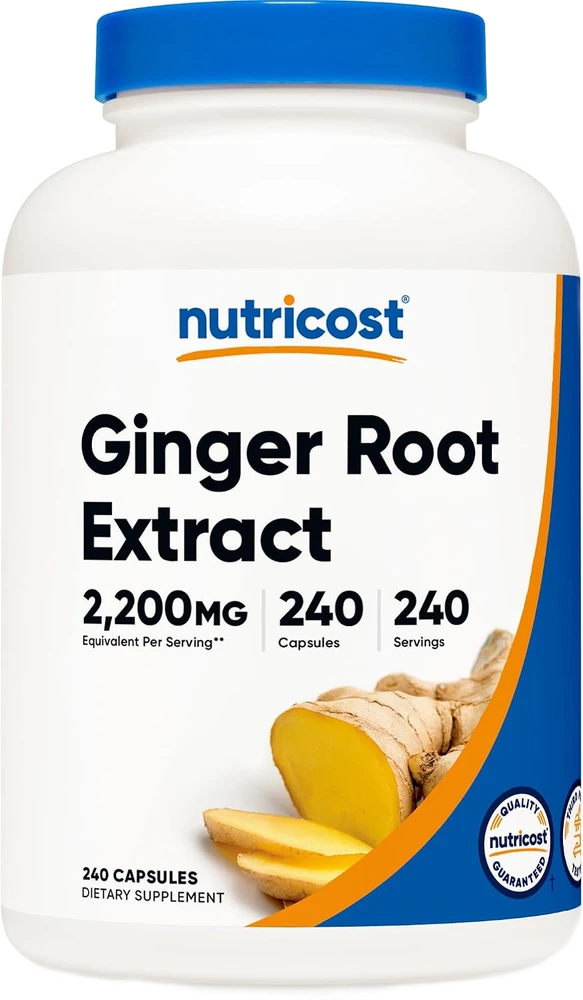 #3 of 9 · Best Bulk Value✓ Label verified · Supplement Facts read Sep 7, 2026
Real retailer photo, cut out. Label unedited.
Consider it. Best bulk economics, but potency is an unlabeled question mark. 240 caps of 4:1 extract is a genuine value for long-term daily use, and it's third-party tested.
$18~$0.15 per 1.1g serving (2 caps)
Why It Scores 7.2 — And The Label Line Behind Each Number
Form, Bioavailability & Standardization
25% of scoreA 4:1 concentrated extract is stronger than raw whole root, delivered in a standard capsule. Better than powder, but without a gingerol figure the real potency edge is unquantified. The weakest link: '4:1' is a concentration ratio with no labeled gingerol percentage. You know it's concentrated; you don't know how much active compound you're getting.
- Form
- Concentrated root extract (4:1) capsule
- Standardization
- 4:1 concentration ratio (no gingerol % labeled)
Dose vs. Clinical Range
25% of score550mg of 4:1 extract per capsule is a reasonable daily dose, and multiple caps easily scale into the clinical range — but mapping the 4:1 ratio to the ~1g whole-root trials is imprecise.
- Dose
- 550mg of 4:1 extract per capsule
Third-Party Testing & Purity
20% of scoreMade in a GMP-compliant, third-party-tested facility, non-GMO and gluten-free. Reasonable QC assurance for the price tier.
- Testing
- GMP-compliant, third-party-tested facility; non-GMO, GF
Tolerability & Safety
15% of scoreGinger is well tolerated, and this is a straightforward non-GMO, gluten-free capsule suited to sustained daily use.
Value
15% of score240 caps for ~$18 is the best cost-per-capsule here — an eight-month supply. If you take ginger daily, the economics are excellent.
- Count
- 240 capsules (~8-month supply)
- Cost per capsule
- ~$0.08
Label verified. Every figure read from the Supplement Facts photo, Sep 7, 2026.
Marketing Claims Vs. Reality
Concentrated 4:1 extract stronger than plain powder
A 4:1 ratio does mean four parts root to one part extract, so it is more concentrated than whole root — but without a gingerol percentage, the effective potency versus a standardized extract can't be verified.
Third-party tested
Made in a GMP-compliant facility with third-party testing, consistent with Nutricost's value-QC positioning.
Delivers a precisely known gingerol dose
No gingerol content is labeled. The '4:1' figure describes concentration, not active-compound quantity, so the exact dose of the compounds that matter is unknown.
What Our Test Actually Found
Value is the whole thesis
At about eight cents a capsule for an eight-month supply, this is built for people who take ginger every day and want to minimize cost. On that axis it's the clear winner of the list.
'4:1' is not standardization
Buyers often read a concentration ratio as a potency guarantee. It isn't. A 4:1 extract with low starting-material gingerols could underperform a lower-ratio standardized product. Treat the strength as an estimate, not a spec.
Full analysis: all pros & cons (6), buy if / skip if
- Best cost-per-capsule on the list — roughly 8-month supply
- 4:1 concentrate is stronger than plain root powder
- Third-party tested in a GMP-compliant facility
- Non-GMO and gluten-free
- No labeled gingerol percentage — true potency is unknown
- '4:1' ratio can be misread as a standardization guarantee
- Best cost-per-capsule on the list — roughly 8-month supply
- 4:1 concentrate is stronger than plain root powder
- Third-party tested in a GMP-compliant facility
- No labeled gingerol percentage — true potency is unknown
- '4:1' ratio can be misread as a standardization guarantee
240 caps of 4:1 extract is a genuine value for long-term daily use, and it's third-party tested. But the 4:1 ratio tells you concentration, not gingerol content, so you can't compare its strength to a standardized product. A solid everyday pick with an honest asterisk.
Nutricost's play is volume: 240 capsules of a 4:1 concentrated extract at the best cost-per-capsule on the list, roughly an eight-month supply. A 4:1 concentrate is meaningfully stronger than plain root powder, it's non-GMO and third-party tested, and for a long-haul daily ginger habit it's economical. The honest limitation is that '4:1' is a concentration ratio, not a gingerol percentage — so the true potency versus a properly standardized extract is unknown. Buy it as a value pick for sustained use, not as a precision instrument.
Consider it for cheap, sustained daily use

If you want an affordable ginger you'll take daily for months and you're comfortable not knowing the exact gingerol content, Nutricost's bulk bottle is a smart value. If verifiable potency matters, spend up for the standardized #1 or #2. This is the value pick with an honest potency caveat.
If This Doesn’t Fit — Try These
 04
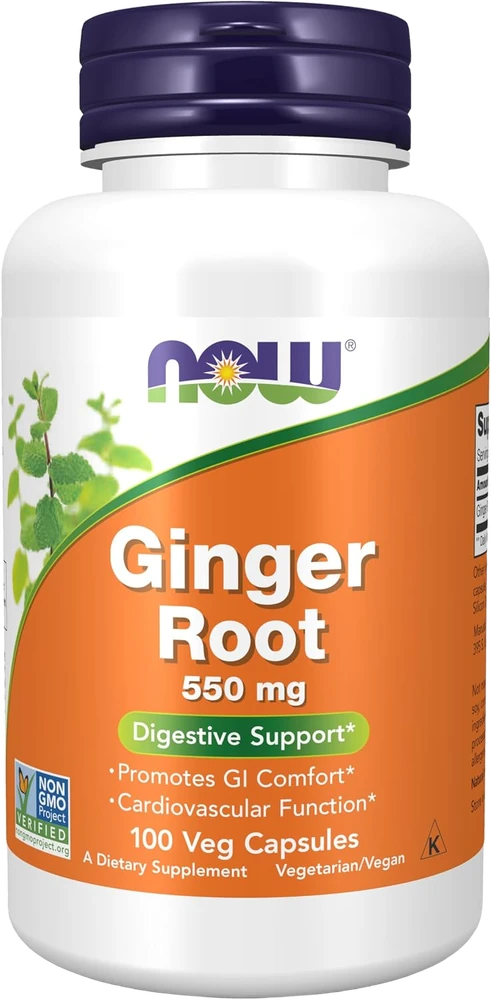
NOW Ginger Root 550 mg
The default budget staple: cheap, clean, and backed by real quality control.
 01
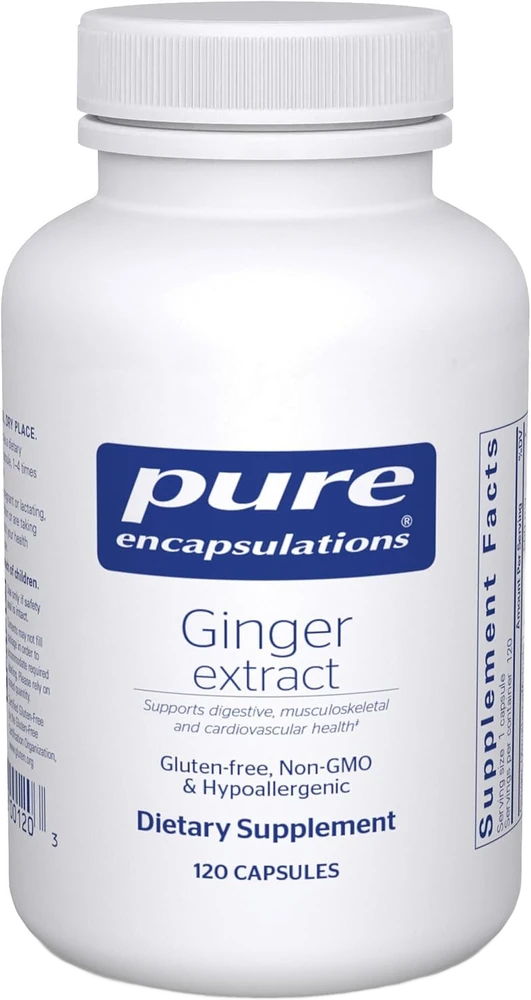
Pure Encapsulations Ginger Extract
If you want the highest confidence that you're taking a real, measurable dose of ginger's active compounds, this is the pick.
Quick Answers
How many capsules equal a clinical dose?
Two 550mg 4:1 caps give ~1.1g of extract, but because the gingerol content isn't labeled, treat that as an approximate, not exact, match to the ~1g whole-root trials.
Why rank it below Nature's Way if it's an extract?
Nature's Way authenticates its botanical identity (TRU-ID) and clearly hits the studied dose. Nutricost wins on price but leaves potency unlabeled, so it edges just below.
Sources & Further Reading
2 peer-reviewed sources, each linked to PubMed
- [1] Nikkhah Bodagh M, et al. Ginger in gastrointestinal disorders: A systematic review of clinical trials. Food Sci Nutr. 2018;7(1):96-108. PMID 30680163 — Ginger in gastrointestinal disorders: A systematic review of clinical trials. Ginger showed benefit for nausea/vomiting and gastric emptying across trials, with generally good tolerability.
- [2] Ernst E, Pittler MH. Efficacy of ginger for nausea and vomiting: a systematic review of randomized clinical trials. Br J Anaesth. 2000;84(3):367-71. PMID 10793599 — Efficacy of ginger for nausea and vomiting: a systematic review of randomized clinical trials. Ginger outperformed placebo for nausea across pooled RCTs at doses near 1g.
Affiliate disclosure: every Amazon link uses our Associates tag (superachieverclub-20). We earn a small commission at no cost to you; it funds independent reviews. We never accept payment to change a ranking.