
Digestive Enzymes: Benefits, Dosage & Side Effects (2026)
Digestive enzymes are oral supplements that help break down food; the evidence is strong for targeted problems (lactose intolerance, bean gas, pancreatic insufficiency) and weak as a general supplement for healthy guts.
The Digestive Enzymes market in numbers
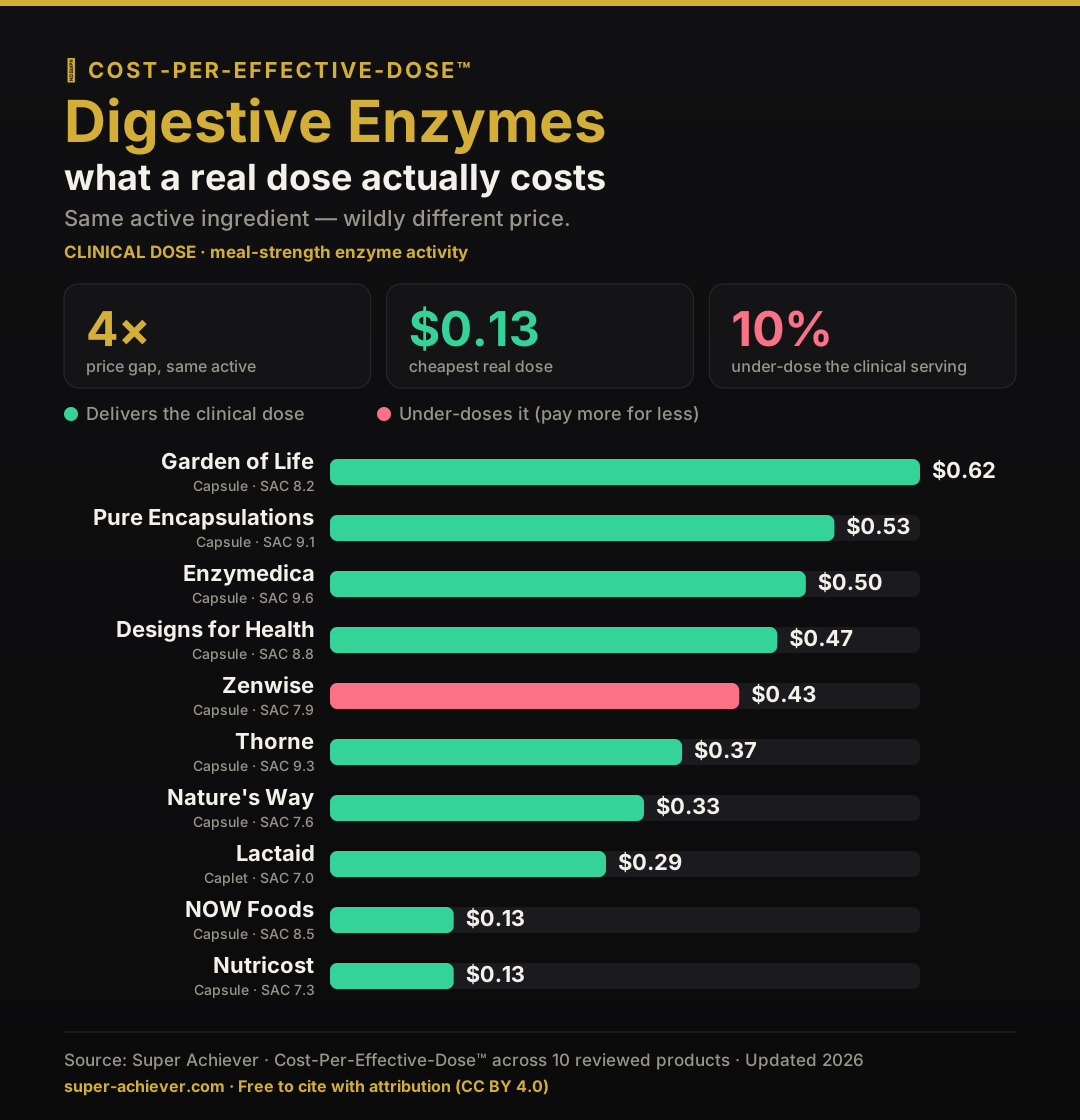
Our independent analysis of 11 digestive enzymes products, scored on three proprietary indices — the SAC Product Score™, Transparency Index™, and real Cost-Per-Effective-Dose™. Updated October 2026.
| # | Product | SAC Product Score™ | TXI™ | CPED™ | |
|---|---|---|---|---|---|
| 1 | Enzymedica Digest Gold + ATProCapsule | 9.6 | 20 | $0.50 | |
| 2 | Thorne Advanced Digestive EnzymesCapsule | 9.3 | 70 | $0.37 | Most transparent |
| 3 | Pure Encapsulations Digestive Enzymes UltraCapsule | 9.1 | 20 | $0.53 | |
| 4 | Designs for Health DigestzymesCapsule | 8.8 | 20 | $0.47 | |
| 5 | NOW Super EnzymesCapsule | 8.5 | 40 | $0.13 | Best value |
| 6 | Garden of Life Omega-Zyme UltraCapsule | 8.2 | 20 | $0.62 | |
| 7 | Zenwise Digestive Enzymes + Probiotics & PrebioticsCapsule | 7.9 | 0 | $0.43 | Under-dosed |
| 8 | Nature's Way CompleteGestCapsule | 7.6 | 20 | $0.33 | |
| 9 | Nutricost Digestive Enzymes 620mgCapsule | 7.3 | 20 | $0.13 | |
| 10 | Garden of Life Dr. Formulated Enzymes Organic Digest+Chewable | 7.1 | 0 | $0.26 | Under-dosed |
| 11 | Lactaid Fast Act Lactase CapletsCaplet | 7.0 | 20 | $0.29 |
Methodology. SAC Product Score™ blends our editorial rating (RCT quality, dose, safety, value) 50/50 with community ratings. Transparency Index™ (0-100) = third-party certification (0-50) + public batch COA (0-30) + dose honesty (0-20). Cost-Per-Effective-Dose™ is the real price of one clinical dose, not one marketed "serving". Free to cite with attribution to Super Achiever.
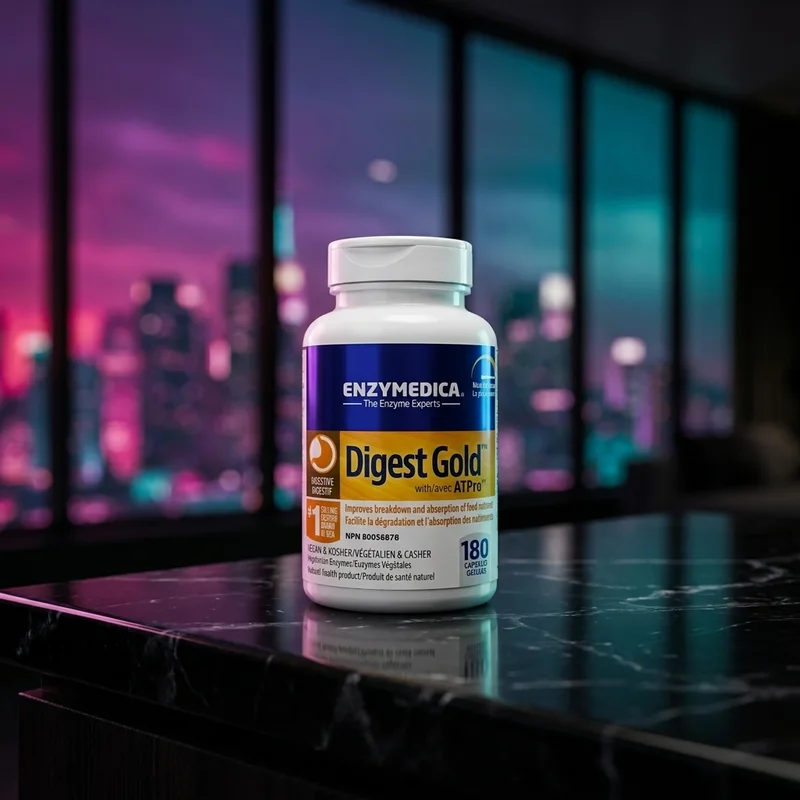
Enzymedica Digest Gold + ATPro
What is Digestive Enzymes?
Digestive enzymes are proteins that break large food molecules into pieces small enough for the gut to absorb. Your body already makes them in abundance: the pancreas secretes amylase (for starches), protease (for proteins) and lipase (for fats), while the small-intestine lining makes brush-border enzymes such as lactase (for the milk sugar lactose). Enzyme supplements simply supply these same enzymes from outside — sourced from animal pancreas (pancreatin/pancrelipase), from fungi and bacteria (microbial enzymes, which survive stomach acid better), or as single specialty enzymes targeted at one food.
It helps to split the category into two very different things. First, the specialty single-enzyme products that match one enzyme to one specific intolerance: lactase for dairy (it does the job your gut can't, pre-digesting lactose so milk and ice cream stop causing bloating, cramps and diarrhoea), and alpha-galactosidase — the enzyme in Beano — for the indigestible oligosaccharides in beans, legumes and cruciferous vegetables that gut bacteria ferment into gas. These are precise tools for precise problems, and they work. Second, the broad-spectrum blends sold as a daily "take with every meal" supplement, typically combining amylase, protease, lipase and a grab-bag of plant enzymes (bromelain, papain) plus sometimes lactase and alpha-galactosidase.
The distinction matters because the evidence behind those two groups is not the same. A targeted enzyme replaces a function you genuinely lack. A broad blend, taken by someone whose pancreas already makes plenty of enzymes, is mostly adding what the body already has — which is why the honest answer to "should everyone take digestive enzymes with meals?" is no. They earn their place when there's a real, identifiable reason: a diagnosed intolerance, a specific trigger food, or true enzyme insufficiency.
How it works
Each enzyme is a lock-and-key catalyst for one type of bond. Lactase splits lactose into glucose and galactose, so an enzyme taken with the first bite of dairy does the digestion your small intestine no longer does — the undigested lactose never reaches the colon where bacteria would otherwise ferment it into gas, acids and an osmotic load that pulls in water (the cramps and diarrhoea of lactose intolerance). Crossover RCT data back this up: Baijal & Tandon 2021 (PMID 33490624) gave lactose-intolerant adults lactase versus placebo and saw both symptoms and breath-hydrogen levels fall significantly, and the Shaukat 2010 systematic review (PMID 20404262) confirms lactase supplements and lactose-reduced dairy as effective management strategies.
Alpha-galactosidase works the same way one rung up the sugar chain: it cleaves the alpha-galactosidic bonds in raffinose, stachyose and verbascose — the oligosaccharides in beans, lentils and cruciferous vegetables that humans can't break down — so they get absorbed in the small intestine instead of fermenting in the colon. Di Stefano 2007 (PMID 17151807) showed the higher enzyme dose cut breath hydrogen and flatulence after a bean meal, and Di Nardo 2013 (PMID 24063420), a paediatric RCT, found it reduced global distress, bloating days and the proportion of children with flatulence versus placebo. This is the mechanism behind Beano: it's preventive, taken with the offending food, not a treatment for gas you already have.
The pancreatic enzymes — amylase, protease, lipase — are the heart of the prescription-strength case. In exocrine pancreatic insufficiency (EPI), where the pancreas can't secrete enough lipase to digest fat (from chronic pancreatitis, cystic fibrosis, pancreatic surgery or cancer), pancreatic enzyme replacement therapy (PERT) is genuinely necessary medicine: de la Iglesia-Garcia 2017 (PMID 27941156) meta-analysed the RCTs and found PERT significantly improved fat absorption, nutritional status and symptoms. For everyone else, the broad-blend story is much thinner. There are encouraging trials — Ullah 2023 (PMID 37976892) found a multi-enzyme blend reduced functional-dyspepsia symptoms and improved sleep versus placebo — but the overall base for routine, everyone-with-every-meal use remains small and mixed, which is why this hub rates the evidence honestly: strong where there's a real deficit or intolerance, weak as a general supplement.
At-a-glance facts
- What they are
- Oral enzymes (amylase/protease/lipase + specialty lactase, alpha-galactosidase) that break food into absorbable pieces
- Best-evidenced uses
- Lactose intolerance (lactase), bean/veg gas (alpha-galactosidase), exocrine pancreatic insufficiency (prescription PERT)
- Weakest use
- Routine 'take with every meal' for a healthy gut — little good evidence of benefit
- Timing
- With the FIRST bite of the trigger food — enzymes must mix with the meal, not be taken after
- Sourcing
- Animal pancreatin/pancrelipase, or acid-stable microbial (fungal/bacterial) enzymes; specialty enzymes are single-target
- Time to felt effect
- Immediate for targeted use (that meal); judge a broad blend over ~2-4 weeks
- Cost range (US)
- $10-25 / month for OTC lactase, Beano or a broad blend; prescription PERT is a separate, dosed medicine
- Key limit
- Enzymes manage intolerances (digestion), NOT allergies or coeliac disease (immune reactions)
Evidence: Evidence is strong but narrow. Lactase for lactose intolerance (Baijal & Tandon 2021, PMID 33490624; Shaukat 2010 review, PMID 20404262) and alpha-galactosidase for bean/veg gas (Di Stefano 2007, PMID 17151807; Di Nardo 2013 paediatric RCT, PMID 24063420) are well-supported, and pancreatic enzyme replacement for exocrine pancreatic insufficiency is established medicine (de la Iglesia-Garcia 2017 meta-analysis, PMID 27941156). As a broad 'everyone with every meal' supplement the case is much weaker — emerging functional-dyspepsia data (Ullah 2023, PMID 37976892) is encouraging but limited. Hence a middling overall rating: excellent for the right problem, unproven as a daily catch-all.
Who it's for — and who it isn't
- Lactose-intolerant people who don't want to give up dairy — lactase taken with the first bite pre-digests the lactose; RCT-proven for symptoms and breath hydrogen (Baijal & Tandon 2021)
- Anyone who gets gassy and bloated from beans, lentils or cruciferous veg — alpha-galactosidase (Beano) cleaves the oligosaccharides before your gut bacteria can ferment them
- People diagnosed with exocrine pancreatic insufficiency (chronic pancreatitis, cystic fibrosis, post-pancreatic surgery/cancer) — prescription pancreatic enzyme replacement is necessary, evidence-based therapy (take it under medical supervision)
- Those with persistent post-meal fullness, bloating or functional dyspepsia who've ruled out red-flag causes — a broad blend is a reasonable, low-risk thing to trial for a few weeks and judge honestly
- People who notice specific heavy, high-fat or rich restaurant meals reliably sit badly — a lipase-containing blend with that meal is a sensible, targeted experiment
- Anyone with a healthy gut hoping enzymes will 'optimise digestion' or boost nutrient absorption generally — a normal pancreas already makes plenty; there's no good evidence of benefit here
- People using enzymes to paper over alarm symptoms — unexplained weight loss, blood in stool, persistent pain, trouble swallowing, or new symptoms after 50 need a doctor, not a supplement
- Anyone expecting enzymes to treat a food allergy or coeliac disease — they manage intolerances (a digestion problem), not immune reactions; 'gluten enzyme' products do NOT make coeliacs safe to eat gluten
- Suspected exocrine pancreatic insufficiency self-treating with OTC blends — true EPI needs diagnosis and correctly dosed prescription PERT, not a low-strength supplement
Week-by-week, what happens
- This meal (targeted use)Lactase or alpha-galactosidase taken with the first bite works immediately — far less gas, bloating and cramping from the trigger food, because the offending sugar is digested before it reaches the colon.
- Week 1-2 (broad blend trial)If a general blend is going to help your post-meal fullness or bloating, early signal usually shows here. Take it consistently with your main meals and track symptoms honestly.
- Week 2-4 (broad blend)The honest decision point for a broad blend. Clear, repeatable improvement → keep it. No noticeable difference → stop; you're likely in the 'healthy gut, no deficit' group that doesn't benefit.
- Ongoing (true insufficiency)For diagnosed exocrine pancreatic insufficiency, enzymes are continuous, dose-matched therapy under medical care — effects (better fat absorption, weight, fewer symptoms) persist only while you keep taking the correct prescription dose.
Safety & contraindications
- OTC enzymes (lactase, alpha-galactosidase, broad blends) are very well tolerated for most people; the worst common issue is mild, transient GI upset. They're a low-risk thing to trial.
- Don't use enzymes to mask warning signs. Unexplained weight loss, blood in the stool, persistent or severe abdominal pain, difficulty swallowing, or new digestive symptoms after age 50 need medical evaluation — not self-treatment.
- Enzymes do NOT make food allergies or coeliac disease safe. 'Gluten-digesting' enzyme products cannot protect someone with coeliac disease from gluten; treat them as comfort aids for mild intolerance only, never as protection against an immune reaction.
- Suspected exocrine pancreatic insufficiency should be diagnosed and treated with correctly dosed prescription pancreatic enzyme replacement (PERT). OTC blends are far weaker and under-dosed for true EPI — see a doctor.
- Alpha-galactosidase (Beano) is typically derived from the mould Aspergillus niger — people with mould allergy should be cautious. Some lactase products are yeast-derived. Check the source if you have relevant allergies.
- If you have diabetes, note that alpha-galactosidase releases galactose from the oligosaccharides it breaks down; this is a minor consideration but worth a mention with your clinician. As always, check enzyme products against your medications and conditions if you take prescription drugs.
All articles on Digestive Enzymes
Best Digestive Enzyme Supplements
Digestive enzymes ranked by what you actually need — targeted (lactase for dairy) beats broad-spectrum for most — by enzyme activity units, evidence, and value, with an honest take on who doesn't need them.
Read →Best Ginger Supplements
9 ginger supplements ranked on form and standardization, dose against the clinical range, third-party testing, tolerability and value.
Read →Best L-Glutamine Supplements
L-Glutamine ranked by purity (single-ingredient powder beats capsules on dose economics), third-party testing, and value — the gut-lining amino acid for IBS and intestinal permeability.
Read →Best Magnesium for Constipation
Citrate dominates (osmotic) and glycinate sinks (chelated, no laxative effect) — the form ranking is fully inverted vs. magnesium-for-sleep, with acute breakthrough + chronic maintenance protocols spelled out.
Read →Best Peppermint Oil Capsules for IBS
Enteric-coated peppermint oil ranked by coating quality first (it has to survive the stomach to work), dose, and value — one of the best-evidenced OTC options for IBS cramping and bloating.
Read →Best Probiotics Supplements
The 10 best probiotic supplements ranked by strain specificity + verified CFU — matching documented strains to your actual goal (IBS, post-antibiotic, women's, daily), not chasing the biggest number.
Read →Best Psyllium Fiber Supplements
Psyllium husk ranked by form honesty (powder vs capsules vs the dose math), additive load, and value — the most RCT-backed soluble fiber for regularity, cholesterol, and blood sugar.
Read →Align Probiotic 24/7 Digestive Support Review
The evidence-backed strain for IBS — and only for IBS.
Read →Anthony's Organic Psyllium Husk Powder Review
The organic bulk-buy — best per-gram organic value, in a bag not a tub.
Read →BioGaia Protectis Chewable Review
A clean single-strain chewable — L. reuteri DSM 17938 and nothing else.
Read →Carlyle Peppermint Oil, 150ct Review
Cheap and high-count — but a low dose and a less-documented coat hold it back.
Read →Culturelle Daily Probiotic Review
The cleanest, most affordable way to get the most-studied strain (LGG); plain capsule, no potency-through-expiry promise printed. 7.8/10.
Read →Designs for Health Digestzymes Review
The clinical bridge — low-acid support plus gluten/casein peptide coverage, for a specific buyer.
Read →Designs for Health L-Glutamine Powder Review
Clinic-grade free-form glutamine at the best value in the clinical tier.
Read →Enzymedica Digest Gold + ATPro Review
The high-activity broad blend benchmark — for heavy, varied meals, not for everyone.
Read →Florastor Daily Probiotic Review
The yeast antibiotics can't kill — the textbook pick for antibiotic-associated diarrhea.
Read →Garden of Life Dr. Formulated Once Daily Women's Review
The right pick for women caring for digestive AND vaginal flora.
Read →Garden of Life Dr. Formulated Organic Digest+ Review
Organic chewable with 13 enzymes, each with its activity unit, but no amylase on the panel; about $0.26 a tablet. 7.1/10.
Read →Garden of Life Omega-Zyme Ultra Review
The widest plant-based spread, no HCl — best for varied, fiber-heavy diets.
Read →Garden of Life Raw Organic Fiber, Unflavored Review
The deliberate psyllium-FREE pick — for guts that can't tolerate psyllium.
Read →Heather's Tummy Tamers Peppermint Oil, 90ct Review
The reflux-tolerant peppermint for people other softgels burned.
Read →IBgard Peppermint Oil Capsules, 48ct Review
The most-studied IBS peppermint, with the lowest heartburn risk.
Read →Jarrow Formulas L-Glutamine Powder Review
The set-and-forget supply pick — a year of 99%-pure powder at low cost per gram.
Read →Klaire Labs L-Glutamine Powder Review
A full 5 g trial per-dose amount in one hypoallergenic scoop.
Read →Konsyl Daily Psyllium Fiber Powder, Unflavored Review
The high-dose, pure-husk pick when grams matter most.
Read →Lactaid Fast Act Lactase Caplets Review
If dairy is your one problem, this is the single best — and best-evidenced — pick.
Read →Life Extension L-Glutamine Powder Review
A cheap starter tub to test whether you respond before buying bulk.
Read →Mason Natural Peppermint Oil 50mg Enteric, 90ct Review
Genuinely enteric at a bargain price — but 50 mg per softgel is the catch.
Read →Metabolic Maintenance L-Glutamine Powder Review
The titration specialist — fine 1 g dosing for a reactive, IBS-prone gut.
Read →Metamucil 4-in-1 Psyllium Fiber, Sugar-Free, Orange Review
The safe, doctor-trusted default psyllium for first-time buyers.
Read →Metamucil Psyllium Fiber Capsules Review
The convenience pick from the most-trusted brand — bought with eyes open.
Read →Nature's Way CompleteGest Review
The dependable mainstream vegan blend — reliable and available, not a spec leader.
Read →Nature's Way Pepogest Enteric Peppermint Oil, 60ct Review
The clinically validated dose at the best price — the default for most buyers.
Read →Nature's Way Peppermint Soothe, 60ct Review
A trustworthy heritage enteric peppermint — outcompeted by its own sibling.
Read →NOW Peppermint Gels with Ginger & Fennel, Enteric, 90ct Review
A budget brand getting the fundamentals right — the best bulk value.
Read →NOW Probiotic-10 25 Billion Review
The honest value floor — cheap, a code printed on every strain, no frills. 7.3/10.
Read →NOW Psyllium Husk Caps 500 mg Review
The vegan, value-minded capsule — convenient and grit-free, but low-dose.
Read →NOW Psyllium Husk Powder, Non-GMO Review
The lowest-cost honest way to take psyllium — if you'll stir plain husk.
Read →NOW Sports L-Glutamine Pure Powder Review
The value benchmark — genuine free-form glutamine at the lowest cost per gram.
Read →NOW Super Enzymes Review
The best value on the list — real pancreatic + acid support at a third of premium prices.
Read →Nutricost Digestive Enzymes 620mg Review
Maximum enzyme variety per dollar — the low-risk budget experiment.
Read →Nutricost L-Glutamine Powder, Unflavored Review
The bulk-budget sweet spot — exact 5 g scoops at near-benchmark value.
Read →Nutricost Peppermint Oil 50mg, 120ct Review
Well-made and clean — but NON-enteric, the one disqualifying flaw for the gut.
Read →Optimum Nutrition L-Glutamine Powder Review
A fine free-form powder that ranks last on fit, not quality.
Read →Organic India Whole Husk Psyllium Powder, USDA Organic Review
The organic pick that still delivers a real dose.
Read →Physician's Choice Probiotics 60 Billion CFU Review
A low-cost high-CFU generalist whose label names ten species but no strain codes. 6.8/10.
Read →Pure Encapsulations Digestive Enzymes Ultra Review
The cleanest broad blend — the safe pick for a sensitive, allergy-prone gut.
Read →Pure Encapsulations L-Glutamine Powder Review
The cleanest hypoallergenic label for the reactive, IBS-prone gut.
Read →Regimint Peppermint Oil Plus Caraway, 60ct Review
The European peppermint-caraway combo for IBS-plus-dyspepsia overlap.
Read →Renew Life Ultimate Flora Extra Care 50 Billion Review
A broad high-potency blend for sensitive guts — with LGG and delayed-release doing the work.
Read →Ritual Synbiotic+ Review
The most complete formulation on paper, with the best traceability.
Read →Seed DS-01 Daily Synbiotic Review
The survivability-engineered default for general gut health.
Read →Solaray Peppermint Oil, Enteric, 60ct Review
A clinical 250 mg enteric peppermint dose, plus botanicals you're partly paying for.
Read →Sunergetic 4-in-1 Probiotic Review
Spore-based probiotic with enzymes and PreforPro, but only two named strains and 3 billion CFU. 6.6/10.
Read →Super Achiever Multi Digestive Enzyme Review
Our own enzyme capsule, scored like every other pick: activity units printed for every enzyme, held back by modest amounts, no amylase and no stated testing.
Read →Thorne Advanced Digestive Enzymes Review
The low-stomach-acid powerhouse — excellent for the right buyer, contraindicated for many.
Read →Thorne L-Glutamine Powder Review
The cleanest, most credible way to run the one glutamine protocol with real human evidence.
Read →Viva Naturals Organic Psyllium Husk Powder Review
The finely-ground organic pick for smoothies and keto baking.
Read →Yerba Prima Psyllium Husks Powder Review
The heritage purist's pure-husk pick — dependable, honest, lower-profile.
Read →Zenwise Digestive Enzymes + Probiotics & Prebiotics Review
Amazon's bestselling all-in-one — convenient, but a compromise on every component.
Read →FAQ
Should everyone take digestive enzymes with meals?
No — and this is the most important thing to understand about the category. A healthy pancreas already secretes plenty of amylase, protease and lipase, so for most people a daily broad-spectrum blend is adding what the body already makes, and the evidence of benefit there is weak. Digestive enzymes shine when there's a real, specific reason: lactose intolerance (lactase), gas from beans and cruciferous veg (alpha-galactosidase), or diagnosed exocrine pancreatic insufficiency (prescription pancreatic enzyme replacement). Match the enzyme to a genuine problem rather than taking a do-everything blend by default.
Do lactase pills actually work for lactose intolerance?
Yes, this is one of the category's best-evidenced uses. Lactase supplements supply the exact enzyme your small intestine is short on, splitting lactose before gut bacteria can ferment it. In a crossover placebo-controlled RCT, Baijal & Tandon 2021 (PMID 33490624) found lactase significantly improved both symptoms and breath-hydrogen levels in lactose-intolerant adults, and the Shaukat 2010 systematic review (PMID 20404262) lists lactase and lactose-reduced dairy among the effective management strategies. The catch is timing: take it with the first bite of dairy so it mixes with the food — taken afterward, it's too late.
What is Beano and does alpha-galactosidase really reduce gas from beans?
Beano is alpha-galactosidase, an enzyme that breaks down the indigestible oligosaccharides (raffinose, stachyose) in beans, lentils and cruciferous vegetables that your gut bacteria otherwise ferment into gas. The evidence is solid: Di Stefano 2007 (PMID 17151807) showed the higher enzyme dose reduced breath hydrogen and flatulence after a bean meal, and a paediatric RCT, Di Nardo 2013 (PMID 24063420), found it cut bloating days and flatulence versus placebo. It's preventive — you take it with the gas-producing food, not after the bloating has already started.
What's the difference between OTC enzyme blends and prescription pancreatic enzymes (PERT)?
They're not the same product or the same purpose. Prescription pancreatic enzyme replacement therapy (PERT — e.g. pancrelipase) is a high-strength, precisely dosed medicine for exocrine pancreatic insufficiency, where the pancreas genuinely can't digest fat (chronic pancreatitis, cystic fibrosis, pancreatic surgery or cancer). It's established, RCT-backed therapy: de la Iglesia-Garcia 2017 (PMID 27941156) found it significantly improves fat absorption and nutrition. OTC supplement blends are far weaker and meant for everyday minor digestive complaints. If you suspect true pancreatic insufficiency, you need a diagnosis and prescription dosing, not a supplement.
Can digestive enzymes help with gluten or food allergies?
No — this is a critical safety point. Enzymes manage intolerances, which are digestion problems, not allergies or coeliac disease, which are immune reactions. 'Gluten-digesting' enzyme products cannot make gluten safe for someone with coeliac disease; relying on one is dangerous. They may offer mild comfort for non-coeliac gluten sensitivity, but they are never protection against an immune-mediated condition. If you have a true food allergy or coeliac disease, strict avoidance — not an enzyme — is the only safe approach.
I get bloated and full after meals — are enzymes worth trying?
If you've ruled out alarm symptoms (weight loss, blood in stool, persistent pain, trouble swallowing), a broad-spectrum blend is a low-risk thing to trial for a few weeks. There's emerging support: Ullah 2023 (PMID 37976892) found a multi-enzyme blend reduced functional-dyspepsia symptoms and improved sleep versus placebo. But be honest in judging it — take it consistently with your main meals for 2-4 weeks, and if you notice no clear, repeatable difference, stop, because you're likely in the healthy-gut group that doesn't benefit. Enzymes are a targeted tool, not a guaranteed fix for everyone's bloating.
Sources & further reading
- Baijal & Tandon 2021 (lactase RCT)Effect of lactase on symptoms and hydrogen breath levels in lactose intolerance: A crossover placebo-controlled study
Randomised, double-blind, crossover placebo-controlled trial in 47 lactose-intolerant adults: lactase significantly improved clinical symptom scores and cut cumulative breath-hydrogen by ~55% versus placebo. Direct evidence that lactase supplements work for lactose intolerance.
- Shaukat 2010 (lactose-intolerance review)Systematic review: effective management strategies for lactose intolerance
AHRQ-commissioned systematic review for the NIH consensus conference: identified lactase supplements and lactose-reduced/hydrolysed dairy among effective strategies for managing lactose intolerance, and that most intolerant people tolerate moderate lactose doses. Anchors the lactase evidence base.
- Di Stefano 2007 (alpha-galactosidase)The effect of oral alpha-galactosidase on intestinal gas production and gas-related symptoms
Placebo-controlled study giving healthy volunteers a bean meal with alpha-galactosidase: the higher enzyme dose (1200 GALU) significantly reduced breath-hydrogen production and flatulence versus placebo. Mechanistic evidence behind Beano for legume-related gas.
- Di Nardo 2013 (paediatric alpha-galactosidase RCT)Efficacy and tolerability of alpha-galactosidase in treating gas-related symptoms in children: a randomized, double-blind, placebo controlled trial
Randomised, double-blind, placebo-controlled trial in 52 children with chronic/recurrent gas symptoms: alpha-galactosidase significantly reduced global distress, days with moderate-to-severe bloating, and the proportion of patients with flatulence, with no adverse events. RCT-level support for the Beano enzyme.
- de la Iglesia-Garcia 2017 (PERT meta-analysis)Efficacy of pancreatic enzyme replacement therapy in chronic pancreatitis: systematic review and meta-analysis
Systematic review and meta-analysis of RCTs (17 studies, 511 chronic-pancreatitis patients): pancreatic enzyme replacement therapy significantly improved the coefficient of fat absorption versus placebo and baseline, plus nutritional parameters, GI symptoms and quality of life. Establishes PERT as effective for exocrine pancreatic insufficiency.
- Ullah 2023 (multi-enzyme dyspepsia RCT)Efficacy of digestive enzyme supplementation in functional dyspepsia: A monocentric, randomized, double-blind, placebo-controlled, clinical trial
Randomised, double-blind, placebo-controlled trial in 120 functional-dyspepsia patients: a multi-enzyme blend over 2 months reduced symptom severity and improved quality of life and sleep versus placebo, with no side effects. Encouraging but limited evidence for broad blends beyond targeted single-enzyme uses.