
Ashwagandha: Benefits, Dosage & Side Effects (2026)
Ashwagandha (Withania somnifera) is an Ayurvedic root standardised by withanolide content, used to lower cortisol, improve sleep depth, and indirectly support free testosterone — backed by 12+ human RCTs on KSM-66 and Sensoril extracts.
The Ashwagandha market in numbers
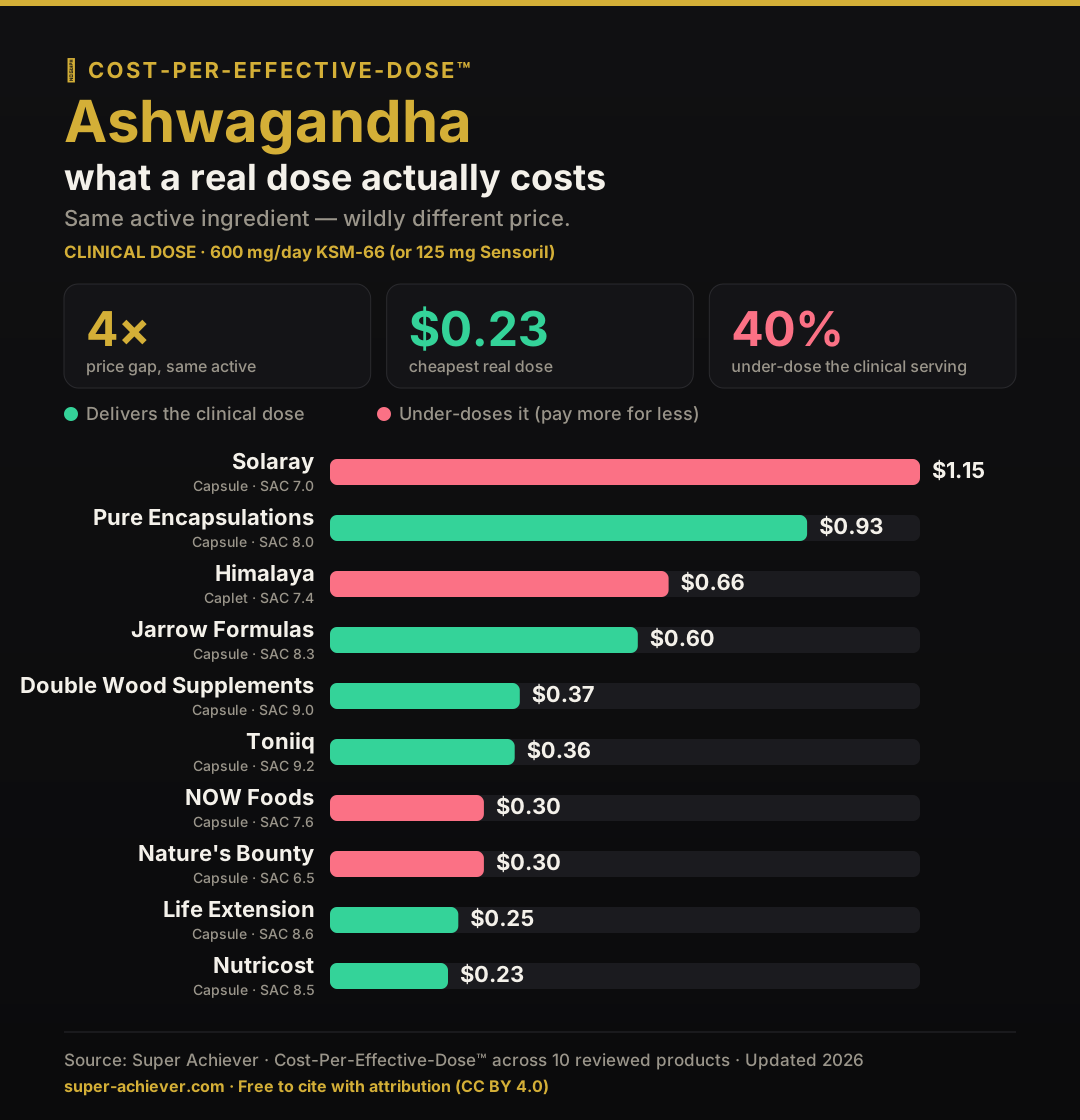
Our independent analysis of 10 ashwagandha products, scored on three proprietary indices — the SAC Product Score™, Transparency Index™, and real Cost-Per-Effective-Dose™. Updated October 2026.
| # | Product | SAC Product Score™ | TXI™ | CPED™ | |
|---|---|---|---|---|---|
| 1 | Toniiq Ultra High Strength KSM-66 AshwagandhaCapsule | 9.2 | 70 | $0.36 | Most transparent |
| 2 | Double Wood KSM-66 Ashwagandha 600 mgCapsule | 9.0 | 70 | $0.37 | |
| 3 | Life Extension Optimized Ashwagandha (Sensoril)Capsule | 8.6 | 40 | $0.25 | |
| 4 | Nutricost KSM-66 Ashwagandha 600 mgCapsule | 8.5 | 20 | $0.23 | Best value |
| 5 | Jarrow Formulas KSM-66 Ashwagandha 300 mgCapsule | 8.3 | 40 | $0.60 | |
| 6 | NOW Foods Ashwagandha 450 mgCapsule | 7.6 | 20 | $0.30 | Under-dosed |
| 7 | Pure Encapsulations Ashwagandha 500 mgCapsule | 7.1 | 20 | $0.93 | Under-dosed |
| 8 | Solaray Ashwagandha 470 mgCapsule | 6.8 | 20 | $1.07 | Under-dosed |
| 9 | Himalaya Organic AshwagandhaCaplet | 6.7 | 20 | $2.20 | Under-dosed |
| 10 | Nature's Bounty Ashwagandha 1000 mgCapsule | 6.5 | 0 | $0.30 | Under-dosed |
Methodology. SAC Product Score™ blends our editorial rating (RCT quality, dose, safety, value) 50/50 with community ratings. Transparency Index™ (0-100) = third-party certification (0-50) + public batch COA (0-30) + dose honesty (0-20). Cost-Per-Effective-Dose™ is the real price of one clinical dose, not one marketed "serving". Free to cite with attribution to Super Achiever.
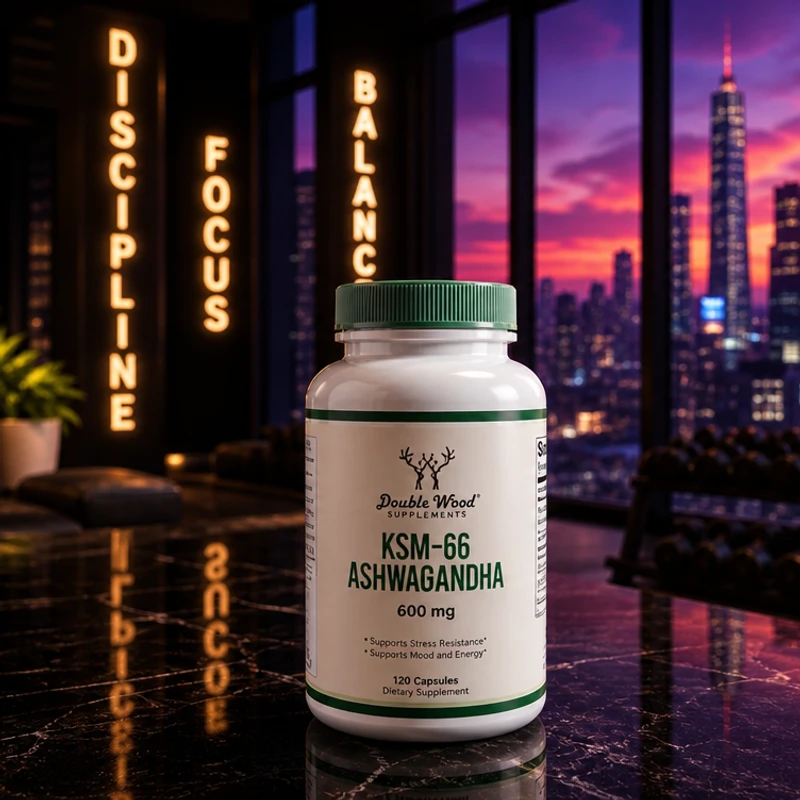
Double Wood KSM-66 Ashwagandha
What is Ashwagandha?
Ashwagandha is the dried root of Withania somnifera, a small evergreen shrub native to India, the Middle East, and parts of Africa. Ayurvedic medicine has used it for at least 3,000 years as a rasayana — a rejuvenative tonic for vitality, recovery, and resilience under stress. The Sanskrit name translates roughly as "smell of the horse," a nod to both the root's odor and the strength it was traditionally believed to confer.
What moved Ashwagandha from herbal-tradition status to evidence-backed supplement was standardisation. Modern extracts concentrate the active compounds — withanolides, a class of steroidal lactones — to between 1.5% and 35% of dry weight, depending on the patent and extraction method. Two patents dominate the published trial record: KSM-66 (Ixoreal, full-spectrum root extract at 5% withanolides) and Sensoril (Natreon, root + leaf extract at 10% withanolides). "Ashwagandha" without a standardisation number is mostly Ayurvedic root powder; "Ashwagandha, standardised to 5% withanolides, KSM-66" is the supplement category that 12+ RCTs have actually measured.
It's the most-studied adaptogen in modern supplement science — and the most-evidenced natural lever for cortisol reduction outside of pharmaceutical intervention. The free-testosterone effect is downstream of the cortisol drop, not direct hormone stimulation. That mechanism matters when picking who it's for and who it isn't.
How it works
Ashwagandha's primary mechanism is HPA-axis modulation. The hypothalamic-pituitary-adrenal axis is the body's stress-response system, ultimately controlling cortisol release. Withanolides appear to lower cortisol by 16-33% in chronically stressed adults across the major RCTs (Chandrasekhar 2012, Salve 2019), with the strongest effects in subjects who started with elevated baseline cortisol. The cortisol drop produces second-order effects on sleep depth, perceived stress, and the testosterone-to-cortisol ratio — the metabolic environment that determines recovery and lean-mass retention.
The free-testosterone effect is real but indirect. In Lopresti 2019, overweight men aged 40-70 on a Shoden extract saw testosterone rise 14.7% and DHEA-S 18% more than on placebo over 8 weeks. The mechanism isn't direct testicular stimulation (like Tongkat's SHBG-displacement action) — it's the cortisol-down → recovery-up → endocrine-environment-improved cascade. This is why Ashwagandha and Tongkat are complementary rather than redundant: they hit testosterone through different upstream levers.
Third-order effects include improved sleep quality (multiple PSQI-based trials show 25-40% sleep score improvements), modest strength + lean-mass gains in trained men (Wankhede 2015 showed +1.4 kg lean mass over placebo in 8 weeks at 600 mg KSM-66/day), and reductions in subjective anxiety scores. The substance isn't anxiolytic in the benzodiazepine sense — you do not get same-day sedation. You get cortisol normalisation that compounds over 2-6 weeks into the felt outcomes the literature catalogues.
The Ashwagandha deep dives
Ashwagandha Benefits
Cortisol, stress, sleep, testosterone and strength — what it actually does, every claim scored against the trials.
Read →SafetyAshwagandha Side Effects
Liver, thyroid, pregnancy, sedation — the honest safety picture. Well-tolerated, with three cautions that matter.
Read →DataAshwagandha by the Numbers
The full data report — cortisol effect sizes, dosing, extracts, cost per dose. The citable stats page behind the guide.
Read →At-a-glance facts
- Active compounds
- Withanolides (steroidal lactones)
- Typical dose
- 300-600 mg/day of standardised extract
- Time to felt effect
- Sleep + stress: 2-3 weeks · Bloodwork: 8-12 weeks
- Cycling
- 8 weeks on / 2 weeks off (most protocols)
- Half-life
- ~7-10 hours — single evening dose or split AM+PM
- Standardisation to look for
- KSM-66 (5% withanolides) or Sensoril (10% withanolides) — patent-licensed
- Cost range (US)
- $12-35 / month at the clinical dose
- Stack synergy
- Tongkat Ali (free T), Magnesium Glycinate (sleep), L-Theanine (acute calm)
Evidence: 12+ placebo-controlled human RCTs on standardised extracts (KSM-66, Sensoril) show consistent cortisol reduction (16-33%), sleep quality improvement (25-40% PSQI), and modest testosterone uplift (+14.7% vs placebo in the Lopresti 2019 Shoden trial). Among non-prescription levers for cortisol-driven testosterone compression, Ashwagandha has the strongest evidence base — comparable to Tongkat Ali in trial count, complementary in mechanism.
Who it's for — and who it isn't
- Chronically stressed men with high baseline cortisol — the population where the effect size is largest.
- Anyone with poor sleep quality whose root cause is stress-related (not sleep apnea, not blue light, not caffeine timing).
- Athletes wanting recovery support without crossing into hormone replacement territory.
- Men 30+ noticing the stress-driven "running on adrenaline" pattern — wired-but-tired, poor sleep, compressed energy windows.
- Anyone stacking with Tongkat Ali — the two lower cortisol + lift free T through complementary mechanisms.
- Men with clinically diagnosed hypogonadism — Ashwagandha's +14.7% T uplift won't close the gap. TRT is the right tool.
- Anyone on thyroid medication — withanolides can increase T3/T4 levels, complicating dosing of synthetic thyroid hormones.
- Anyone on sedatives, anxiolytics, or sleep medication without clinician supervision — additive CNS-depressant effects are possible.
- Pregnant or breastfeeding women — animal data raise concern; human data are insufficient.
- Anyone with an autoimmune condition (Hashimoto's, rheumatoid arthritis, lupus) — Ashwagandha is mildly immunostimulating, which can worsen autoimmune flares.
Week-by-week, what happens
- Days 1-7Subtle calm in the evening for some responders; most feel nothing yet. The HPA axis takes weeks to recalibrate.
- Week 2-3Sleep quality shifts first — deeper sleep onset, fewer night wakings. PSQI scores improve in the published trials by week 3.
- Week 4-6Perceived stress drops measurably. The wired-but-tired pattern starts to resolve. Cortisol bloodwork shows reductions by week 6.
- Week 6-12Testosterone and DHEA-S rise modestly in stressed populations (+10-17% range). Body composition + recovery reflect the hormonal shift.
- Week 12+Plateau. Continue at maintenance dose or cycle off for 2 weeks to reset receptor sensitivity. Most users run continuously without issue; the conservative protocol is 8/2.
Safety & contraindications
- Generally well-tolerated at 300-600 mg/day of standardised extract — most documented side effects are mild GI upset on empty stomach or drowsiness at doses above 1,000 mg.
- Placebo-controlled trials at clinical doses, most of them 8 to 12 weeks long, report few adverse events (Lopresti 2019 reported none in 60 days).
- Avoid if you have thyroid disease or take thyroid medication — withanolides can elevate T3/T4 levels and interact with synthetic thyroid hormone dosing.
- Avoid if you have an autoimmune condition — the mild immunostimulating effect can worsen Hashimoto's, RA, lupus, MS, and other autoimmune flares.
- Avoid combining with sedatives, benzodiazepines, sleep medication, or alcohol without clinician oversight — additive CNS-depressant effects possible.
- Buy from brands with public Certificates of Analysis. The Ashwagandha supply chain has been hit by adulteration scandals (heavy metals, leaf-stalk mixed into root-only extracts); patent-licensed KSM-66 and Sensoril carry the strongest QC discipline.
All articles on Ashwagandha
Best Ashwagandha for Anxiety
The most-evidenced adaptogen for anxiety — KSM-66 600 mg cut anxiety + cortisol (Chandrasekhar 2012). Ranked by extract patent, withanolide standardisation, and daytime-calm vs sedation fit.
Read →Best Ashwagandha for Sleep
Ashwagandha shortens sleep latency by lowering evening cortisol (Langade 2019). Sensoril (more sedating) leads for sleep; ranked by extract, evening-dose practicality, and sleep-trial evidence.
Read →Best Ashwagandha for Testosterone
The ashwagandha extracts with the strongest evidence for free-T support — KSM-66 leaders ranked by trial data and quality markers.
Read →Best Ashwagandha Gummies
Ashwagandha gummies ranked by dose (most sit at the 300 mg floor), KSM-66 vs generic extract, and sugar per serving — plus when capsules are the better call.
Read →Best Ashwagandha Supplements
The definitive ashwagandha buying guide — the single best pick for each buyer across KSM-66 and Sensoril extracts. Standardisation % and extract patent matter far more than milligrams.
Read →Double Wood KSM-66 Ashwagandha 600 mg Review
Eight weeks on the trial-exact KSM-66 dose — what 600 mg/day at the Wankhede 2015 protocol actually delivers in real-world use.
Read →Goli Ashwagandha & Vitamin D Gummies Review
Real KSM-66 at the studied 300 mg dose in the category's most reliable everyday gummy — the adherence pick. SAC Product Score 8.7/10.
Read →Goli Zero Sugar Ashwagandha Gummies Review
300 mg KSM-66 with zero sugar (allulose + stevia) plus a light L-theanine + maca calm stack. 8.4/10.
Read →Harden Essentials KSM-66 Ashwagandha Gummies Review
1,500 mg KSM-66 per serving — the high-dose exception; honest take is that a capsule is cheaper and cleaner at this dose. 7.2/10.
Read →Himalaya Organic Ashwagandha Review
Whole-root Ayurvedic ashwagandha with USDA Organic certification — what the traditional preparation delivers vs. patent extracts.
Read →Jarrow Formulas KSM-66 Ashwagandha 300 mg Review
Titration-friendly KSM-66 — 300 mg/cap matches Wankhede 2015 split-dose protocol exactly. The right bottle for ramp-up users.
Read →Life Extension Optimized Ashwagandha (Sensoril) Review
The Sensoril patent (root + leaf, 10% withanolides) at the Auddy 2008 trial dose. Cortisol-first endpoint, not a KSM-66 substitute.
Read →Nature Made Ashwagandha 125 mg (Sensoril) Review
125 mg of Sensoril per capsule, the low dose from the main Sensoril stress trial, for about 19 cents a day.
Read →Nature Made KSM-66 Ashwagandha Gummies Review
The studied 300 mg KSM-66 wrapped in the cleanest label in the category — no dyes, no artificial flavors or sweeteners. 8.5/10.
Read →Nature's Bounty Ashwagandha Gummies Review
The cheapest legitimate KSM-66 gummy — the same 300 mg studied dose at the lowest price in the category. 8.0/10.
Read →Nature's Bounty Stress Relief Ashwagandha KSM-66 Review
1000 mg root that LOOKS impressive but is non-standardised — marketing label, not pharmacology. Where the gap between mg and active mg shows up.
Read →New Nordic Ashwagandha Gummies Review
A cheaper sugar-free route at 300 mg — but an unbranded 10:1 extract, not KSM-66, so true potency is unknown. 7.3/10.
Read →NOW Foods Ashwagandha 450 mg Review
2.5% withanolides at NOW's household-brand QC — below KSM-66 (5%), above generic root. The half-tier-of-standardisation pick.
Read →Nutricost KSM-66 Ashwagandha 600 mg Review
Floor-price legitimate KSM-66 — same Ixoreal patent as Double Wood at $8/mo cheaper. The cycle-one validation pick.
Read →Organic India Ashwagandha Gummies Review
Certified-organic KSM-66 at the studied 300 mg dose for the organic-first shopper. 7.9/10.
Read →Pure Encapsulations Ashwagandha 500 mg Review
Hypoallergenic clinical-tier ashwagandha — generic 5% standardised at $32/mo. The clean-label premium for sensitive buyers.
Read →Solaray Ashwagandha 470 mg Review
Solaray's non-standardised root extract — 30 years of US brand reputation but the same QC asterisk as Himalaya without organic offset.
Read →Sports Research Ashwagandha with Shoden Review
Two softgels give 120 mg of Shoden, the sleep-trial dose, plus 380 mg of plain ashwagandha powder that adds little.
Read →Thorne Ashwagandha (Shoden) Review
One 120 mg capsule of Shoden, the extract and dose that improved sleep in a 150-person trial. Clean label, but you pay for the brand.
Read →Toniiq Ultra High Strength Ashwagandha Review
Eight weeks on the highest standardised KSM-66 on Amazon — 10% withanolides UHP. What 2x the standard concentration buys vs. the trial-grade 5%.
Read →Ashwagandha vs L-Theanine
Acute calm vs chronic reset: L-theanine's fast non-sedating focus against ashwagandha's weeks-long cortisol and sleep effect.
Read →Ashwagandha vs Rhodiola
Two adaptogens, two jobs: rhodiola for acute fatigue + daytime stamina, ashwagandha for chronic stress, sleep, and cortisol.
Read →Ashwagandha vs Tongkat Ali
Head-to-head on T support, stress recovery, side effects, and stacking — when each one wins.
Read →KSM-66 vs Sensoril
The two dominant standardised ashwagandha extracts compared — root-only KSM-66 vs root+leaf Sensoril, and which to buy.
Read →Shilajit vs Ashwagandha
Mineral resin vs adaptogen — ashwagandha's broad evidence base against shilajit's fulvic-acid energy + purity caveats.
Read →FAQ
Does Ashwagandha actually raise testosterone?
Indirectly, yes. In Lopresti 2019, overweight men aged 40-70 on a Shoden extract saw testosterone rise 14.7% and DHEA-S 18% more than on placebo over 8 weeks; Wankhede 2015 found a rise on KSM-66 in men who lifted weights. The effect is real but smaller than Tongkat Ali's direct SHBG-displacement effect (+10-20% free T) — and the mechanism is cortisol-down → recovery-up, not direct testicular stimulation. Ashwagandha works best for men whose T is suppressed by chronic stress; it works less well for young, low-stress men whose endocrine system is already optimised.
KSM-66 vs Sensoril — which one should I buy?
Both are clinically validated patented extracts. KSM-66 (Ixoreal, 5% withanolides, full-spectrum root extract) has more total trial weight — 24+ published RCTs including the pivotal Chandrasekhar 2012, Salve 2019, and Wankhede 2015 studies. Sensoril (Natreon, 10% withanolides, root + leaf extract) has fewer trials but a higher concentration and a slightly different bioactive profile (more withanolides per cap, less of the broader root compound spectrum). Default to KSM-66 unless you specifically didn't respond to it — then try Sensoril.
How long until I feel something?
Sleep improvements show up first, often within 2-3 weeks. Perceived stress and the wired-but-tired pattern resolve at 3-5 weeks. Testosterone and bloodwork changes need 8-12 weeks. If nothing has shifted by week 6 on a clinical dose of a standardised extract, double-check the brand (no patent = mostly placebo for the T endpoint) before declaring non-response.
Should I cycle Ashwagandha?
The conservative protocol is 8 weeks on, 2 weeks off, mostly to prevent receptor desensitisation. Many users run continuously for months at maintenance dose (300 mg KSM-66/day) without issue. There's no strong human data showing tolerance build-up over 12 months, so 8/2 is the safer default until more long-term studies land.
Can I stack Ashwagandha with Tongkat Ali?
Yes — this is the most-evidenced natural T-support stack in the literature. The two target complementary mechanisms: Tongkat lifts free T directly via SHBG displacement; Ashwagandha lowers cortisol, which raises the free-T-to-cortisol ratio. Many users run KSM-66 600 mg in the evening + Tongkat 200-400 mg in the morning. Track bloodwork — the effects compound over 8-12 weeks.
Is Ashwagandha safe with thyroid medication?
No. Withanolides can elevate T3 and T4 levels, which interacts with synthetic thyroid hormone (levothyroxine, Cytomel) dosing. If you take thyroid medication, do not start Ashwagandha without coordinating with your endocrinologist — they may need to adjust your dose. This is one of the few Ashwagandha contraindications with strong human evidence.
Why shouldn't I take Ashwagandha if I have an autoimmune disease?
Ashwagandha is mildly immunostimulating — it nudges the immune system toward activity. For someone with a healthy immune system this is neutral or beneficial; for someone with an autoimmune condition (where the immune system is already over-active and attacking the body's own tissues), it can worsen flares. Hashimoto's, rheumatoid arthritis, lupus, MS, and IBD are the main contraindications. If you have one of these, skip Ashwagandha entirely.
Does Ashwagandha cause weight gain?
No direct weight-gain effect documented in the trial record. Wankhede 2015 showed +1.4 kg of LEAN mass over placebo at 600 mg KSM-66/day in trained men over 8 weeks — that's muscle, not fat. Body-fat measurements in the trials are flat or slightly improved. The "Ashwagandha made me gain weight" anecdotes online are usually attributable to improved sleep + reduced cortisol leading to better recovery + better appetite regulation, which can result in modest net mass gain that's mostly lean.
Sources & further reading
- Lopresti 2019 (testosterone)A randomized, double-blind, placebo-controlled, crossover study examining the hormonal and vitality effects of ashwagandha (Withania somnifera) in aging, overweight males
57 overweight men aged 40-70 took Shoden (21 mg withanolide glycosides a day) or placebo for 8 weeks each in a crossover trial. Testosterone rose 14.7% and DHEA-S 18% more than on placebo; cortisol, fatigue and sexual well-being did not differ. The extract was Shoden, not KSM-66.
- Lopresti 2019 (stress)An investigation into the stress-relieving and pharmacological actions of an ashwagandha (Withania somnifera) extract: a randomized, double-blind, placebo-controlled study
60 stressed adults took 240 mg of Shoden or placebo once daily for 60 days. Anxiety scores (HAM-A) fell more than on placebo, as did morning cortisol and DHEA-S. Sleep was not an outcome. The extract was Shoden, not KSM-66.
- Wankhede 2015Examining the effect of Withania somnifera supplementation on muscle strength and recovery: a randomized controlled trial
600 mg/day of KSM-66 for 8 weeks increased muscle strength + size, raised testosterone, and reduced exercise-induced muscle damage in trained men. The genre-defining sport-performance trial.
- Chandrasekhar 2012A prospective, randomized double-blind, placebo-controlled study of safety and efficacy of a high-concentration full-spectrum extract of ashwagandha root in reducing stress and anxiety in adults
300 mg twice daily of KSM-66 for 60 days reduced perceived stress score by 44% and serum cortisol by 27.9% in chronically stressed adults. The cornerstone cortisol-reduction trial.
- Auddy 2008 (Sensoril)A standardized Withania somnifera extract significantly reduces stress-related parameters in chronically stressed humans: a double-blind, randomized, placebo-controlled study
125-500 mg/day of Sensoril for 60 days reduced cortisol by up to 32% and improved subjective stress scores in chronically stressed adults. The Sensoril counterpart to the KSM-66 trial base.
- Salve 2019Adaptogenic and Anxiolytic Effects of Ashwagandha Root Extract in Healthy Adults: A Double-Blind, Randomized, Placebo-Controlled Clinical Study
60 stressed adults took 250 or 600 mg a day of ashwagandha root extract, or a placebo, for 8 weeks. Perceived stress and serum cortisol fell at both doses. Sleep quality improved compared with placebo. The authors conclude it eased anxiety, but the abstract gives no anxiety-score numbers.