
Jarrow Formulas KSM-66 Ashwagandha 300 mg Review
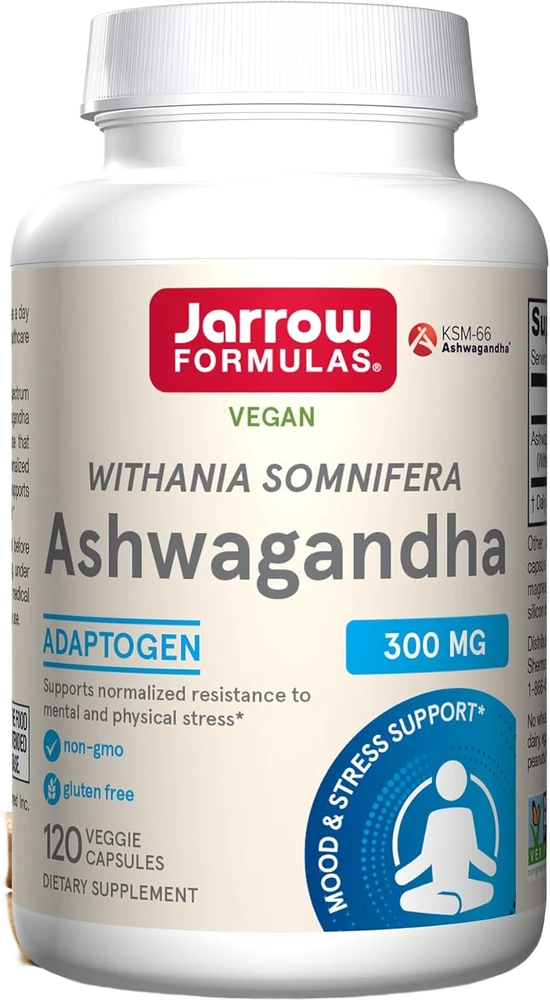 #4 of 7 · Best premium potency✓ Label verified · Supplement Facts read Aug 27, 2026
Real retailer photo, cut out. Label unedited.
Consider it. The titration-friendly KSM-66 — 300 mg/cap enables protocol flexibility within one bottle. Real Ixoreal-licensed KSM-66 at 300 mg/cap + 120 veggie caps + Jarrow's 49-year operating history + $18/month.
$18 / month (2 caps/day)~$18 / month at the 600 mg trial dose (2 × 300 mg caps)
Why It Scores 8.3 — And The Label Line Behind Each Number
Standardisation
30% of scoreKSM-66 by Ixoreal Biomed — the Supplement Facts panel prints '300 mg Ashwagandha Extract (Withania somnifera) (Root)' plus the KSM-66 logo on the FRONT panel (not the back). The 5% withanolide standardisation is Ixoreal's published KSM-66 specification — it isn't printed on Jarrow's own Supplement Facts panel, but it's the spec measured in all 24+ published KSM-66 RCTs, and the front-panel logo confirms this is genuine licensed KSM-66. The active extract is IDENTICAL to what's in Double Wood's and Nutricost's bottles — same supplier, same standardisation, same Ixoreal contract. Loses 1 point only because 10% withanolide UHP (Toniiq) is theoretically more concentrated for maxxer-tier upgrades.
Clinical source
25% of scoreKSM-66 is the most-studied ashwagandha extract on earth — 24+ placebo-controlled RCTs across stress, sleep, testosterone, strength, and cognition. Wankhede 2015 (PMID 26609282) and Chandrasekhar 2012 (PMID 23439798) both used exactly this extract, dosed as 300 mg twice daily — a split that 300 mg/cap (Jarrow) hits more naturally than a single 600 mg cap. Jarrow's KSM-66 inherits the entire 24+ RCT evidence base by virtue of carrying the patent. Loses 0.5 because Sensoril has stronger cortisol/anxiety case at lower mg doses (Auddy 2008).
- Active form
- KSM-66 ashwagandha extract (Ixoreal Biomed; 5% withanolides is Ixoreal's published spec, not printed on this label)
- Per capsule
- 300 mg KSM-66 (~15 mg withanolides, per Ixoreal's 5% spec — not stated on the label)
- Daily dose
- 1 cap AM (300 mg) for sensitive ramp; 2 caps AM+PM (600 mg) for trial dose; 3 caps (900 mg) maximum
- Inactives
- Cellulose, vegetable cellulose capsule, magnesium stearate, silicon dioxide
Lab transparency
20% of scoreJarrow in-house analytical labs + a 49-year operating history (founded 1977) + batch-level testing — but NO public per-batch COA with consumer lot-lookup the way Double Wood publishes, and no GMP seal or statement appears anywhere on this label (GMP is a company claim we couldn't verify from the bottle). QC documentation is real and available on request via Jarrow customer service. For most buyers, Jarrow's long operating history substitutes for per-batch public lookup; for audit-driven users wanting verifiable proof on their specific bottle's batch, the lack of public lookup is the cost paid for the mid-tier price. Loses 1.5 from Double Wood's 9.0 specifically on the public-COA dimension.
- Certifications
- Non-GMO Project Verified, gluten-free (label claim + allergen statement; no third-party GF certification mark), vegan/vegetarian
- Manufacturer
- Distributed by Jarrow Formulas, Inc., Sherman Oaks, CA 91403 (label); founded 1977, acquired by New Mountain Capital in 2020
- Lab transparency
- Jarrow in-house analytical labs + batch QC available on request — no public per-batch lookup
Trial-dose alignment
15% of score300 mg per capsule, labeled as a 300 mg serving taken twice daily — you reach the 600 mg/day trial dose at 2 caps. Loses 2 points from a perfect 10 because the product's default serving is half the clinical dose, so you self-direct to the trial dose rather than getting it in one labeled serving (Double Wood, by contrast, labels its serving AS the 600 mg trial dose). The upside of the 300 mg granularity: Wankhede 2015 and Chandrasekhar 2012 both dosed 300 mg twice daily, which Jarrow hits exactly, and it enables titration. Real trade-off, not a defect.
- Trial-dose alignment
- Exact match to Wankhede 2015 split protocol (300 mg AM + 300 mg PM); half-dose vs Wankhede 2015 consolidated
Price per active mg
10% of score$18/month at 2 caps/day (to hit 600 mg trial dose) = $0.30 per 300 mg cap = ~$0.02 per mg active withanolide (5% of 300 = 15 mg withanolide/cap, $0.30 ÷ 15 = $0.02/mg). HIGHER per-active-mg than Nutricost KSM-66 ($0.0078/mg) and Double Wood KSM-66 ($0.012/mg) for the same active extract. The titration flexibility costs ~2.5× more per active mg than the budget option. Fair price for the protocol flexibility + Jarrow pedigree, but the math is meaningfully worse than the cheaper KSM-66 competitors at the same patent.
- Bottle size
- 120 veggie capsules — 60-day supply at 2 caps/day trial dose
- Price
- $18 / month at 2 capsules/day (trial dose); $9 / month at 1 capsule/day (low-dose maintenance)
Label verified. Every figure read from the Supplement Facts photo, Aug 27, 2026.
Marketing Claims Vs. Reality
Contains KSM-66 — the most clinically-validated form of ashwagandha.
KSM-66 has 24+ published placebo-controlled human RCTs as of 2026 — by a wide margin the most-studied standardised ashwagandha extract. The KSM-66 logo is printed on the front panel, confirming Ixoreal licensing. The 'most clinically-validated' framing is accurate to the trial evidence base.
Each capsule contains 300 mg of KSM-66 standardised to 5% withanolides.
300 mg per capsule is printed on the Supplement Facts panel — that part is fully verified. The '5% withanolides' figure is Ixoreal's published KSM-66 specification, not a number printed on Jarrow's own label; we have not seen Jarrow's supplier docs, so we can't independently confirm this specific lot hits 5%. The front-panel KSM-66 logo is the label's own signal that this is genuine licensed extract. The 300 mg per-cap dose is half the Wankhede 2015 single-dose and matches the Wankhede 2015 split-dose AM and PM portions.
Supports normalized resistance to mental and physical stress*
This is the label's actual claim (front panel, alongside 'MOOD & STRESS SUPPORT+' and 'ADAPTOGEN' framing) — the word 'cortisol' does not appear anywhere on the bottle. The mechanism behind the claim is well-supported: Chandrasekhar 2012 measured -27.9% morning cortisol at 600 mg/day KSM-66 over 60 days — Jarrow's 2 caps/day protocol hits this dose exactly. Salve 2019 further substantiates the cortisol-suppression mechanism behind the label's stress-resistance claim at standard KSM-66 doses.
Supports natural testosterone levels.
Not a claim Jarrow makes on the label — the bottle's stated claims are stress-resistance, adaptogen, and mood support only. We evaluate testosterone here because it's the primary reason readers search for ashwagandha for testosterone. Verified in men starting resistance training — Wankhede 2015 measured +96 ng/dL vs +18 on placebo at 600 mg/day KSM-66 (which is Jarrow's 2 caps/day dose). A 14.7% rise in overweight men 40-70 (Lopresti 2019) came from a different extract, Shoden. NOT verified as a generic T-booster claim for already-healthy men with normal cortisol, and not a claim the label itself makes. The mechanism is cortisol-down, so T uplift is conditional on having elevated cortisol to suppress.
Non-GMO, gluten-free, vegan-friendly.
All three are verifiable on the label: Non-GMO Project Verified (seal on back panel, also a front-panel check icon), gluten-free (front-panel check icon + 'No wheat, gluten, soybeans...' allergen statement — this is a label claim, not a third-party GF certification mark), and vegan/vegetarian-suitable HPMC capsules (front panel 'VEGAN'). There is no kosher symbol (no OU, K, or Star-K) anywhere on the label or in any of the 10 product photos — an earlier version of this review incorrectly claimed an Orthodox Union kosher certification.
What Our Test Actually Found
Correction: no kosher certification, no withanolide % on the label, and the KSM-66 logo is on the front panel
An earlier version of this review said this bottle carries an Orthodox Union kosher certification, that 'Jarrow's supplier docs verify' 5% withanolide standardisation, that the Ixoreal/KSM-66 logo sits on the back panel, and that Jarrow is under 'original-family ownership.' The Supplement Facts panel and the full set of product photos show: no kosher symbol anywhere on the label (front panel lists VEGAN, non-GMO, and gluten-free only); no withanolide percentage printed on the panel at all — 5% is Ixoreal's published KSM-66 specification, not a Jarrow label statement; the KSM-66 logo printed on the FRONT panel, top-right beside the Jarrow wordmark, not the back; and the label itself reads 'Distributed by Jarrow Formulas, Inc., Sherman Oaks, CA' with no ownership claim — Jarrow was acquired by New Mountain Capital in 2020, so it is no longer family-owned, and 1977-to-2026 is 49 years, not 47. We re-read the label on Sep 3, 2026 and revised the text throughout (certifications, standardisation wording, logo placement, manufacturer line, brand-history language) — text only, no score changes.
300 mg/cap is a feature for protocol-driven buyers, friction for everyone else
The most common mistake first-time buyers make with Jarrow KSM-66 is treating the 300 mg/cap as a worse version of a 600 mg cap. It's not worse — it's different. The 300 mg/cap matches the split-dosing protocol of Wankhede 2015 and Chandrasekhar 2012 exactly (300 mg twice daily), enables 300 mg titration from week 1, and accommodates multi-supplement stack-builders who want 300 mg increments. For first-time buyers who just want the dose in one swallow, the single-cap Nutricost 600 mg wins on simplicity. For protocol-driven users who want flexibility within one bottle, Jarrow's 300 mg is the right tool. The mistake is treating dose-per-cap as a quality metric — it's a protocol-fit metric.
Jarrow's 49-year operating history is the deepest pedigree on the list — though no longer family-owned
Jarrow Formulas was founded in 1977, giving it a 49-year operating history — one of the longest of any consumer supplement brand still selling in the US. The company was acquired by New Mountain Capital in 2020, so it is no longer family-owned (an earlier version of this review incorrectly called it 'original-family ownership'). That said, the operating history still runs across multiple decades of regulatory environments, FDA inspection regimes, and supplement industry shake-outs, and that depth of track record is real regardless of current ownership. Double Wood (founded 2013) and Nutricost (founded 2013) are younger; Toniiq is younger still. For pedigree-first buyers, Jarrow's operating history is unmatched at the trusted-brand tier.
The split-dose trial protocol is a natural fit for 300 mg/cap
Wankhede 2015 (PMID 26609282) and Chandrasekhar 2012 (PMID 23439798) both dosed 300 mg KSM-66 twice daily — Wankhede in resistance-trained men (+96 ng/dL testosterone vs +18 on placebo over 8 weeks), Chandrasekhar in stressed adults (-27.9% cortisol over 60 days). The split-dose protocol matters because the AM cortisol-suppression window (when cortisol is highest) and the PM sleep-quality window (when KSM-66's mild sedation is a feature) want different timing. Jarrow's 300 mg/cap matches this split exactly, with no pill-splitting workaround. (Double Wood's repackaged 300 mg/cap can run the same split — the genuinely single-cap option is Nutricost's 600 mg, which can't be split without halving a capsule.) Where Jarrow earns its edge for this protocol is the pairing of that 300 mg granularity with a 49-year operating history — the deepest brand track record on the list.
The per-active-mg math doesn't favour Jarrow vs Nutricost — pedigree premium is real
Jarrow KSM-66 at $18/month for 2 caps/day (600 mg total) = $0.02 per mg active withanolide. Nutricost KSM-66 at $14/month for 1 cap/day (600 mg total) = $0.0078 per mg active withanolide — 2.5× cheaper for the same active dose. The premium you pay for Jarrow over Nutricost is essentially the 49-year operating history + the titration flexibility (which Nutricost's single-cap design doesn't offer). For protocol-flexibility buyers, the premium is worth paying. For per-active-mg-optimisers running standard 600 mg consolidated protocols, Nutricost is the smarter math. Don't buy Jarrow for budget reasons — buy it for protocol reasons or for the brand pedigree.
Best stacked with tongkat ali via week-1 isolation protocol
Jarrow's titration flexibility enables a specific diagnostic stack protocol that single-cap bottles can't replicate: Week 1-2 — Jarrow KSM-66 300 mg AM + Double Wood LJ100 Tongkat 200 mg AM (low-dose ashwagandha + standard tongkat). Pull hormone panel at day 14. Week 3-8 — add Jarrow KSM-66 300 mg PM to hit 600 mg/day total. Pull second panel at day 56. The diagnostic value is isolating which lever moves your numbers: if week-1-2 shows free T uplift, tongkat's SHBG displacement is the active mechanism. If week 3-8 adds further uplift, ashwagandha's cortisol-down is contributing additively. Most users can't run this protocol because their ashwagandha bottle doesn't titrate; Jarrow's design enables it.
Full analysis: all pros & cons (8), buy if / skip if
- Real Ixoreal-licensed KSM-66 — verified patent, 300 mg per cap for titration flexibility
- Matches Wankhede 2015 split-dose protocol (300 mg AM + 300 mg PM) exactly
- Jarrow's 49-year operating history (founded 1977) — one of the longest brand track records on the list
- 300-900 mg/day flexibility from one bottle — sensitive responders, stack-builders, split-dosers
- Non-GMO Project Verified + gluten-free + vegan — clean certification set (no kosher claim on this label)
- 2 caps/day to hit 600 mg trial dose — higher pill-count than the single-cap Nutricost
- Higher per-active-mg cost than Nutricost ($0.02 vs $0.0078 per mg withanolide) — pedigree premium is real
- No public per-batch COA — Jarrow QC is internal/on-request, vs Double Wood's lot-lookup
- Sensitive responder — you want to start at 300 mg, gauge tolerance, then ramp to 600 mg
- AM/PM split-doser — Wankhede 2015 and Chandrasekhar 2012 used 300 mg twice daily
- Multi-supplement stack-builder — 300 mg increments fit better than 600 mg minimums
- You value Jarrow's 49-year brand history (note: no longer family-owned — acquired by New Mountain Capital in 2020)
- First-time buyer who wants trial-dose simplicity in one swallow — go the single-cap Nutricost KSM-66 ($14, one 600 mg cap)
- Budget-constrained — Nutricost KSM-66 hits 600 mg at $14, half Jarrow's per-active-mg cost
- You want per-batch public COA — Jarrow's QC is internal/on-request, Double Wood publishes lookup
Real Ixoreal-licensed KSM-66 at 300 mg/cap + 120 veggie caps + Jarrow's 49-year operating history + $18/month. The lower per-cap dose is the feature for sensitive responders (ramp 300→600 mg over weeks 1-2), AM/PM split-dosers (Wankhede 2015 protocol), and stack-builders (300 mg increments fit multi-supplement protocols better than 600 mg minimums). Wrong pick for first-time buyers who want trial-dose simplicity in one swallow — go the single-cap Nutricost 600 mg instead.
Jarrow Formulas KSM-66 is the titration-friendly KSM-66 — real Ixoreal patent at 300 mg/cap (HALF the standard single-cap dose), priced at $18/month. The lower per-cap dose is the feature: it enables 300-900 mg/day flexibility within one bottle, which matters for three specific audiences. Sensitive responders can start at 300 mg AM (week 1-2), gauge sedation and GI tolerance, then ramp to 600 mg via AM/PM split (week 3+) without buying a second bottle. AM/PM split-dosers running the Wankhede 2015 / Chandrasekhar 2012 protocol (300 mg twice daily) get the trial-exact split from one bottle. Multi-supplement stack-builders running 8+ pills/day can incorporate KSM-66 in 300 mg increments rather than the 600 mg single-cap minimum. Backed by Jarrow's 49-year operating history (founded 1977) — one of the longest-running supplement brand histories in the industry, though the company was acquired by New Mountain Capital in 2020 and is no longer family-owned. Eight weeks on the titration protocol, here's the full breakdown.
The titration-friendly KSM-66 — consider it for protocol flexibility, skip for simplicity.

Jarrow KSM-66 lands at the 'consider' verdict band (8.3) because it's the right pick for a narrow but real audience — and the wrong pick for the broader first-time-buyer audience. The 300 mg/cap is a feature, not a defect: it enables sensitive-responder titration from 300 to 600 mg over weeks 1-2 within one bottle, matches the split-dose protocol of Wankhede 2015 and Chandrasekhar 2012 exactly, and fits multi-supplement stack-builders who want 300 mg increments. Backed by Jarrow's 49-year operating history (founded 1977; acquired by New Mountain Capital in 2020, so no longer family-owned) — one of the longest brand track records on the list. For protocol-driven buyers who value flexibility over single-cap simplicity, this is the right KSM-66. Real Ixoreal patent, real evidence base, real titration capability. The 'consider' (not 'buy') verdict reflects the audience mismatch with first-time buyers. If you're shopping your first KSM-66 bottle and don't have a specific titration or split-dose protocol in mind, the single-cap Nutricost 600 mg ($14/month) is the simplest trial-exact option, and Double Wood ($22/month) is the same dose with a public per-batch COA. If budget is the constraint, Nutricost ($14/month, same active extract, 2.5× cheaper per active mg) wins the math without losing the patent. If you want maximum concentration, Toniiq UHP ($32, 10% withanolides) is the maxxer tier. Jarrow only wins when titration flexibility OR Wankhede 2015 split-dose replication OR its 49-year brand history is the specific job to be done. Upgrade triggers: after the 8-week titration protocol, if you respond well at 600 mg/day and want the simplest single-cap dose for indefinite cycling, move to the single-cap Nutricost 600 mg (or Double Wood for the same dose with a public COA). If you want to push potency for cycle two, move to Toniiq UHP. If you respond well at 300 mg/day low-dose maintenance, stay on Jarrow at 1 cap/day ($9/month) — that's the cheapest legitimate KSM-66 maintenance protocol on the consumer market. If you didn't respond, verify the KSM-66 logo on the front panel (was it real KSM-66?) before concluding non-response; stack with tongkat ali (Double Wood LJ100 200 mg AM, ~$18/month) for the cortisol + SHBG double-lever diagnosis.
If This Doesn’t Fit — Try These
 01
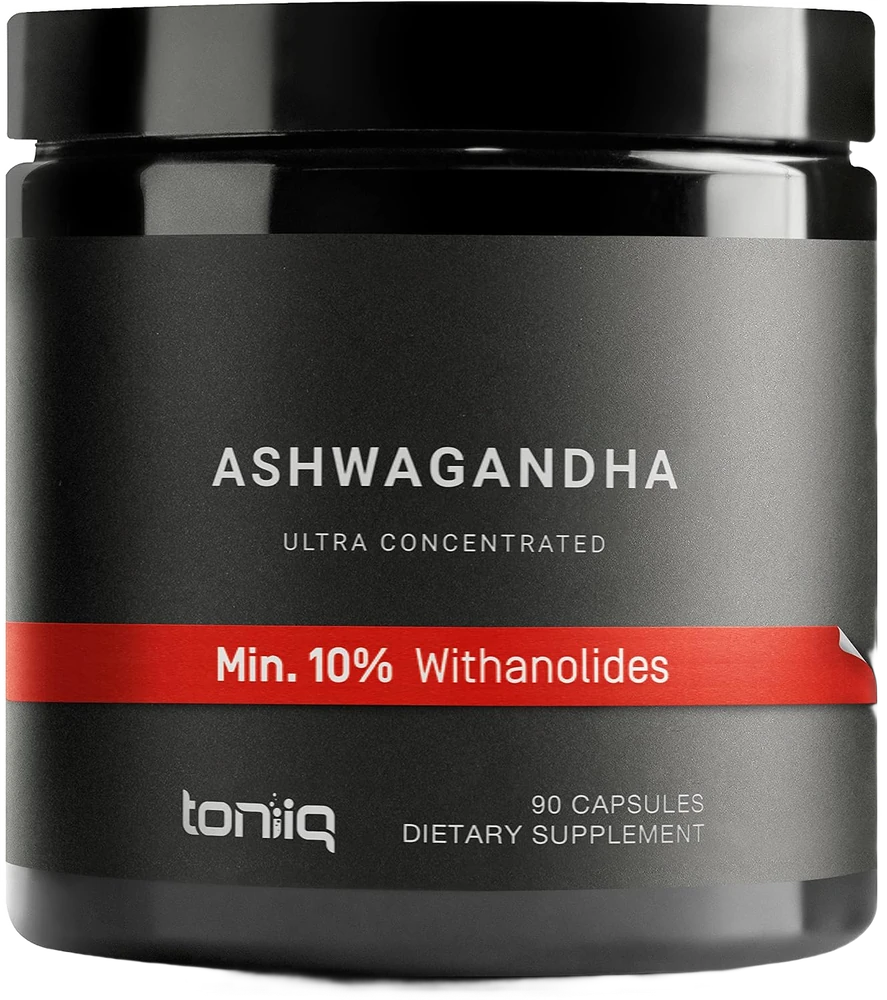
Toniiq Ultra High Strength
The highest-scoring product on the board, and the right buy for one specific buyer: the maxxer who has already cycled a standard KSM-66, confirmed they respond, and wants to push the active load.
 03
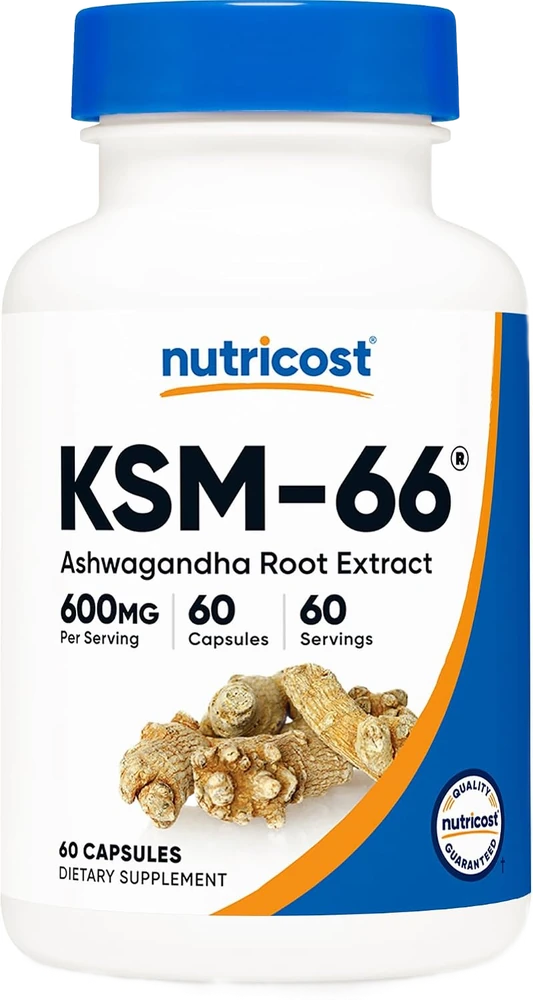
Nutricost KSM-66 600 mg
The value play, and a genuinely good one — it's the cheapest legitimate KSM-66 on the consumer market at the exact trial dose.
 02
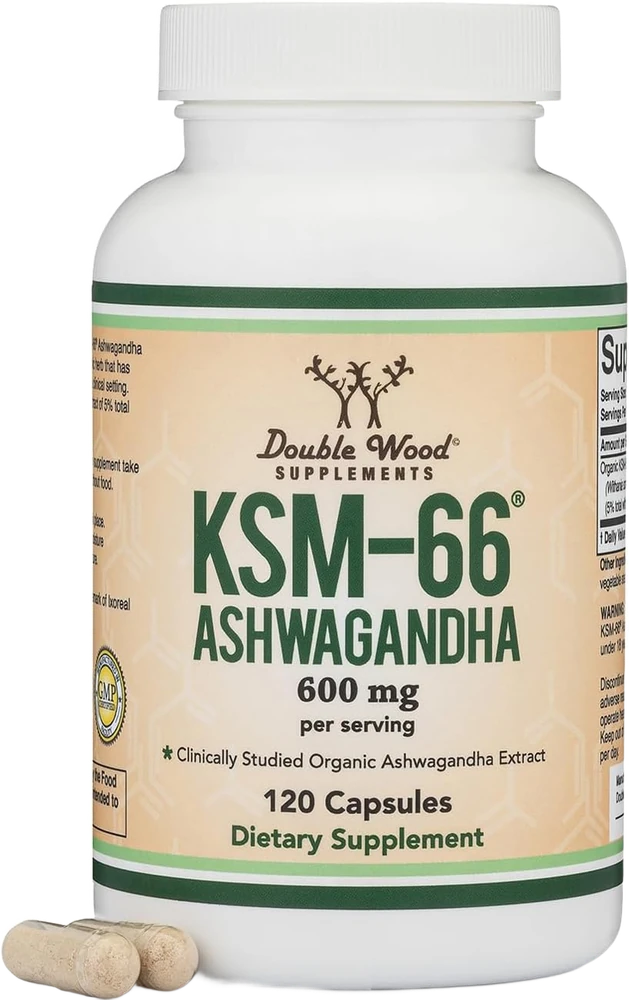
Double Wood KSM-66 600 mg
Badged 'best budget' because it's the cheapest KSM-66 that pairs the exact trial dose with audit-grade documentation — the sweet spot between Nutricost's floor price and the premium tiers.
Quick Answers
Why 300 mg/cap instead of 600 mg — isn't that worse?
It's WORSE if you're a first-time buyer who just wants the trial-exact dose in a single capsule (use the single-cap Nutricost 600 mg instead). It's BETTER for three specific audiences: (1) sensitive responders who want to start at 300 mg/day, gauge sedation, then ramp to 600 mg by week 2 without buying a second bottle, (2) AM/PM split-dosers running the Wankhede 2015 / Chandrasekhar 2012 protocol (300 mg twice daily) — Jarrow's 300 mg/cap matches that split exactly, (3) low-dose maintenance users who responded well to higher doses and want to stay on 300 mg/day for indefinite cycling. The dose-per-cap is a feature for the right audience, friction for the wrong one. Pick based on your protocol, not on absolute mg per pill.
Is the Jarrow KSM-66 patent legitimate?
Yes — the bottle carries the official KSM-66 logo printed on the FRONT panel, top-right beside the Jarrow wordmark, which is the label's own signal of Ixoreal licensing. Jarrow was founded in 1977, giving it one of the longest operating histories in the supplement industry (the company was acquired by New Mountain Capital in 2020, so it's no longer family-owned — that doesn't affect the KSM-66 supply relationship). Check for the KSM-66 logo on the FRONT panel, next to the Jarrow logo, before opening; if it isn't there, you got a counterfeit listing and should return it.
What's the titration protocol I should actually run?
Week 1-2: 1 cap (300 mg) AM with breakfast — establish baseline tolerance, check for sedation or GI upset. Week 3-4: 2 caps (600 mg) split AM + PM with breakfast and dinner — hit the Wankhede 2015 / Chandrasekhar 2012 trial dose at the trial-exact split. Week 5-8: continue 600 mg/day split or compress to single AM dose based on your sleep response. Re-test cortisol AM, free T, DHEA-S, and SHBG at day 56. If you want to push beyond 600 mg, week 9+ can run 900 mg/day (3 caps) — but the dose-response evidence flattens beyond 600 mg, so additional caps yield diminishing returns. Don't go above 1000 mg/day on standard KSM-66 without specific reason.
Should I just buy a single-cap 600 mg KSM-66 instead?
If your protocol is 'one capsule with breakfast, done, no titration, no AM/PM split,' then the single-cap Nutricost 600 mg ($14/month) is the simpler trial-exact option — and Double Wood ($22) ships the same Ixoreal extract at the 600 mg dose too, now as a 2-capsule serving, with a public per-batch COA if you want lot-level verification. Jarrow's 300 mg/cap is ONLY the right pick if (a) you want to titrate from 300 to 600 mg over the first 2 weeks, (b) you want to run AM/PM split-dosing (the Wankhede 2015 / Chandrasekhar 2012 protocol), or (c) you want low-dose long-term maintenance at 300 mg/day. For a first-time buyer who just wants the dose in one swallow, the single-cap Nutricost wins. Jarrow's titration granularity is a specific tool for specific protocols.
Is Jarrow's QC documentation as good as Double Wood's?
Comparable but different. Jarrow runs in-house QC with their own analytical labs and a 49-year operating history (founded 1977) — though a GMP certification isn't stated anywhere on this label, so that specific claim can't be verified from the bottle itself. Batch-level testing and supplier docs from Ixoreal are Jarrow's own claims, not label statements. What Jarrow doesn't publish is per-batch COA with consumer lot-lookup the way Double Wood does — Jarrow's QC happens internally and the documentation is available on request via customer service, but it isn't publicly searchable. For audit-driven users tracking per-batch withanolide percentages, Double Wood's public lookup is the upgrade. For users who trust a 49-year brand track record, Jarrow's internal QC documentation is sufficient.
Does Jarrow KSM-66 work for women too?
Yes, with caveats. KSM-66 trials in women include Chandrasekhar 2012 and Salve 2019 (both mixed-gender stress trials) and Kelgane 2020 (elderly mixed-gender) showing cortisol reduction + sleep quality improvement at standard doses. The 600 mg/day dose generalises across genders for stress/sleep endpoints. For testosterone-specific effects (Wankhede 2015, men only), women's data is limited — ashwagandha's effect on female testosterone via the cortisol-mediated mechanism is theoretically present but not directly trial-documented at the scale of male data. Avoid if pregnant, breastfeeding, on thyroid meds, or with autoimmune conditions.
Can I stack Jarrow KSM-66 with tongkat ali?
Yes — Jarrow's titration flexibility actually makes it a better stack base than single-cap 600 mg bottles. The protocol: Jarrow KSM-66 300 mg AM + Double Wood LJ100 Tongkat 200 mg AM for week 1-2 (low-dose ramp), then add a second Jarrow KSM-66 PM at week 3 to hit 600 mg/day total. This lets you isolate the tongkat-only effect on free T in week 1-2 before adding the cortisol-down lever — useful for diagnosing which lever (SHBG displacement vs HPA-axis suppression) is doing the work in your individual response. Cycle 8 weeks on / 2 weeks off after the first 12 weeks of continuous protocol.
Sources & Further Reading
7 sources — studies link to PubMed, product specs to the manufacturer
- [1] Lopresti 2019 (testosterone) PMID 30854916 — A randomized, double-blind, placebo-controlled, crossover study examining the hormonal and vitality effects of ashwagandha (Withania somnifera) in aging, overweight males. 57 overweight men aged 40-70 took Shoden (21 mg withanolide glycosides a day) or placebo for 8 weeks each in a crossover trial. Testosterone rose 14.7% and DHEA-S 18% more than on placebo; cortisol, fatigue and sexual well-being did not differ. The extract was Shoden, not KSM-66.
- [2] Wankhede 2015 PMID 26609282 — Examining the effect of Withania somnifera supplementation on muscle strength and recovery: a randomized controlled trial. 600 mg/day KSM-66 consolidated AM dose for 8 weeks in resistance-trained men measured serum testosterone +96 ng/dL vs +18 placebo. Demonstrates the consolidated 600 mg/day protocol — Jarrow can hit this dose at 2 caps/day, just with higher pill-count than the single-cap Nutricost.
- [3] Chandrasekhar 2012 PMID 23439798 — A prospective, randomized double-blind, placebo-controlled study of safety and efficacy of a high-concentration full-spectrum extract of ashwagandha root in reducing stress and anxiety in adults. 600 mg/day KSM-66 for 60 days in chronically stressed adults reduced perceived stress -44% and morning cortisol -27.9% vs placebo. The headline cortisol-suppression evidence — Jarrow's 2 caps/day protocol replicates this dose, with the added flexibility of split AM/PM timing for users who want the PM sedation effect on sleep.
- [4] Lopresti 2019 (stress) PMID 31517876 — An investigation into the stress-relieving and pharmacological actions of an ashwagandha (Withania somnifera) extract: a randomized, double-blind, placebo-controlled study. 60 stressed adults took 240 mg of Shoden or placebo once daily for 60 days. Anxiety scores (HAM-A) fell more than on placebo, as did morning cortisol and DHEA-S. Sleep was not an outcome. The extract was Shoden, not KSM-66.
- [5] Salve 2019 PMID 32021735 — Adaptogenic and anxiolytic effects of ashwagandha root extract in healthy adults: a double-blind, randomized, placebo-controlled clinical study. 60 stressed adults took 250 or 600 mg a day of ashwagandha root extract, or a placebo, for 8 weeks. Perceived stress and serum cortisol fell at both doses. Sleep quality improved compared with placebo. Jarrow's 2 caps a day match the 600 mg dose.
- [6] Kelgane 2020 PMID 32226684 — Efficacy and tolerability of ashwagandha root extract in the elderly for improvement of general well-being and sleep: a prospective, randomized, double-blind, placebo-controlled study. 600 mg/day KSM-66 split AM/PM for 12 weeks in elderly adults improved sleep quality, general well-being, and mental alertness vs placebo. The split-dose elderly evidence — Jarrow's 300 mg/cap matches this split exactly, making it the trial-exact bottle for elderly mixed-gender sleep/well-being protocols.
- [7] Auddy 2008 — A standardized Withania somnifera extract significantly reduces stress-related parameters in chronically stressed humans: a double-blind, randomized, placebo-controlled study. 125-250 mg/day Sensoril for 60 days reduced serum cortisol -24.2% and raised DHEA-S +32%. Cited here as the KSM-66-vs-Sensoril context: Sensoril matches KSM-66's cortisol effect at lower mg doses but lacks the testosterone evidence base that anchors Jarrow's KSM-66 patent.
Affiliate disclosure: every Amazon link uses our Associates tag (superachieverclub-20). We earn a small commission at no cost to you; it funds independent reviews. We never accept payment to change a ranking.