

Ashwagandha Benefits: What the Science Shows (2026)
Is ashwagandha right for you?
The benefits, at a glance
Ashwagandha's benefits fall on a clear evidence gradient — strongest for cortisol and stress, strong for sleep, real-but-indirect for testosterone, and solid for strength and endurance in the training trials. Everything below is from placebo-controlled human RCTs on standardised extracts.
The four best-evidenced numbers:
Ashwagandha, scored by goal
How strongly ashwagandha moves each goal on our SAC Efficacy Score™. Tap a goal to see the full ranking.
The ashwagandha we actually recommend
Our best-tested pick at a clinical dose — plus the full ranking by standardisation, quality and cost.
See all ranked ashwagandha picks →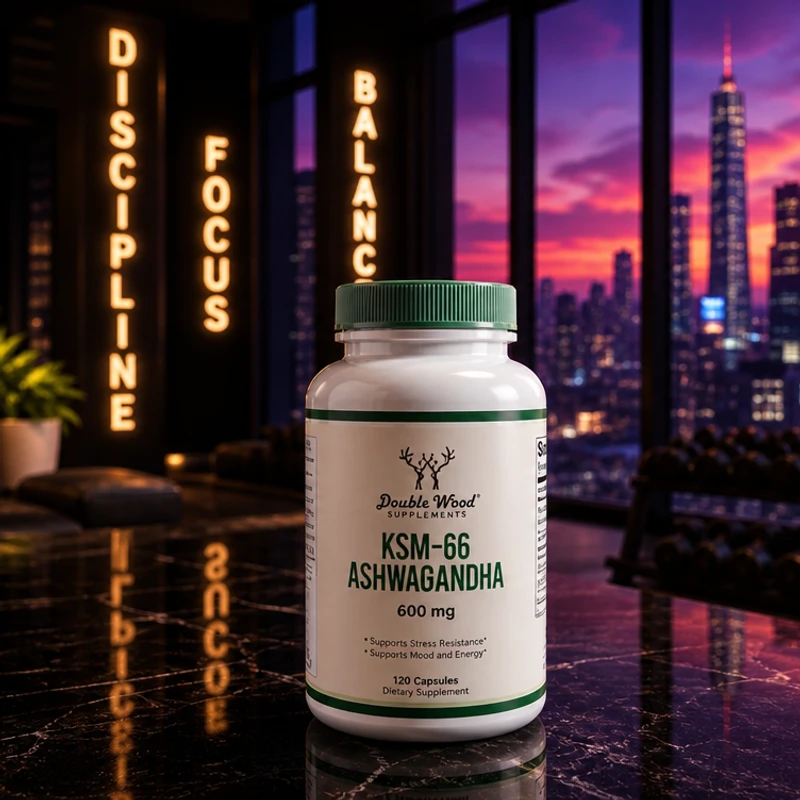
These picks are chosen by our independent editorial ranking; we may earn a commission if you buy through them — it never changes the scores.
Cortisol & stress — the flagship benefit
This is ashwagandha's best-evidenced effect. In the cornerstone RCT, 600 mg/day of KSM-66 for 60 days cut serum cortisol by 27.9% (vs 7.9% on placebo) and perceived stress by 44%[1]. A 2024 meta-analysis of 9 trials pooled a reliable cortisol reduction[6]. One honest caveat: the biochemical cortisol drop is more consistent than the effect on how stressed people report feeling — one 2025 meta-analysis found the pooled subjective-stress effect non-significant[7]. The biggest responders are people with high baseline, stress-driven cortisol.
Cortisol & stress: ashwagandha vs. placebo
reduction from baseline over 60 days · KSM-66 600 mg/day — the biochemical drop is the most-replicated effect
Sleep — the second-strongest benefit
A 5-trial meta-analysis found ashwagandha reliably improves sleep quality, sleep efficiency, and how fast you fall asleep — every confidence interval clears zero[8]. In one 10-week RCT, sleep-onset latency dropped about 12.6 minutes and PSQI scores fell from 13.1 to 9.2[9]. The effect is largest at 600 mg/day for 8 weeks or more.
Sleep: every measure improves, and the intervals clear zero
standardised effect size (|SMD|) with 95% CI vs placebo — bigger is more improvement; the whole interval sits above 0, so the benefit is reliable
Testosterone — real, but indirect
The testosterone lift is genuine but modest, and it works through the cortisol drop rather than direct hormone stimulation. In aging, overweight men it raised testosterone about 14.7% over placebo[3]; combined with 8 weeks of resistance training in younger men it added roughly +96 ng/dL vs +18 on placebo[4]. It helps most where testosterone is suppressed by chronic stress — it will not close a diagnosed deficiency, and it is weaker than the direct SHBG-displacement effect of Tongkat Ali, which is why the two are often stacked.
Testosterone: the effect is real but indirect
change in total testosterone vs. placebo — the rise is downstream of the cortisol drop, not direct hormone stimulation
Fertility & sperm quality
One of ashwagandha's best-evidenced but most-misframed effects. In sub-fertile men — oligospermic (low sperm count) or under chronic stress — a 90-day course of a high-dose root extract markedly improved semen quality: sperm concentration rose +167%, motility +57%, and testosterone +17% in the pivotal RCT[25], and a meta-analysis pooled a reliable +13.6 million/mL concentration and +8.5-point motility gain across trials[24,26]. The honest caveat: these gains are in men who startsub-fertile, on high-dose root extract or powder — not KSM-66 in already-fertile men, and the trial base is small. If fertility is the goal, this is a real reason to consider it; if you're already fertile, don't expect a further boost.
Fertility: big gains — but in sub-fertile men, not everyone
change vs. baseline in oligospermic (low-count) men over 90 days · the large fertility effects are in men who START sub-fertile — this is NOT a general claim for already-fertile men
Strength & muscle
In the same 8-week resistance-training trial, the ashwagandha group added markedly more bench-press strength than placebo on an identical programme, alongside greater arm and chest muscle size and a larger drop in body fat[4].
Strength: bigger 1-RM gains on the same programme
increase in bench-press one-rep max over 8 weeks of identical resistance training
Endurance
In healthy athletic adults, 12 weeks of KSM-66 raised VO₂max — the gold-standard measure of aerobic capacity — significantly more than placebo[10], a result echoed by a Bayesian meta-analysis of physical-performance outcomes.
Endurance: VO₂max climbs vs. placebo
increase in maximal oxygen uptake after 12 weeks · KSM-66 600 mg/day in healthy athletic adults
Focus & memory
The cognition evidence is promising but thinner. An 8-week RCT in adults with mild cognitive impairment found significant improvements in memory, executive function and attention on 600 mg/day of KSM-66[11]. We present this qualitatively on purpose — the specific score changes weren't available to verify, and the population was people with mild impairment, so don't read it as a broad nootropic claim for healthy adults.
Who benefits most
Ashwagandha rewards a specific profile: chronically stressed adults with high baseline cortisol, people whose poor sleep is stress-driven, and men whose testosterone is being compressed by that same stress. It does far less for young, low-stress people whose HPA axis is already well-regulated. If your problem isn't stress-shaped, this isn't your lever. See the honest side-effect & safety picture before you start, and the full data report for every number and source.
How long until it works
Ashwagandha is not a same-day sedative — it recalibrates the HPA (stress) axis over weeks, and the benefits arrive in a staggered order. Sleep quality shifts first, often within 2–3 weeks[9]. Perceived stress and cortisol ease over 4–6 weeks[1]. Testosterone and other bloodwork changes need 8–12 weeks[3,4]. If nothing has shifted by week 6 on a clinical dose of a standardised extract, re-check the brand before deciding it doesn't work for you. Worried about the risks first? See the honest safety picture →
How long until it works
typical time to a felt effect — the benefits arrive in a staggered order, not all at once
Frequently asked questions
What is ashwagandha best for?
Its strongest, most-replicated benefit is lowering cortisol and the felt symptoms of chronic stress — the cornerstone trial cut serum cortisol 27.9% and perceived stress 44% vs placebo. Sleep quality is the next best-evidenced benefit, followed by a modest, indirect testosterone lift in stressed or aging men.
How much does ashwagandha raise testosterone?
Modestly and indirectly: about +14.7% over placebo in aging, overweight men, and roughly +96 vs +18 ng/dL when combined with resistance training in younger men. The lift is downstream of the cortisol drop, so it helps most where testosterone is suppressed by stress — it will not fix a diagnosed deficiency.
Does ashwagandha help you sleep?
Yes. A 5-trial meta-analysis found reliable improvements in sleep quality, efficiency, and how fast you fall asleep (about 12.6 minutes faster in one trial), strongest at 600 mg/day for 8+ weeks.
How long until ashwagandha works?
Sleep usually improves first (2–3 weeks); perceived stress eases over 3–6 weeks; testosterone and other bloodwork changes take 8–12 weeks. It is not a same-day sedative.
Which ashwagandha extract has the best evidence?
KSM-66 (root-only, ~5% withanolides) carries the most trial weight for stress, strength, testosterone and cognition. Sensoril (root + leaf, ~10% withanolides) is more concentrated and sedating at a lower dose, and is better positioned for stress and sleep.
Sources
- Chandrasekhar K, Kapoor J, Anishetty S. A prospective, randomized double-blind, placebo-controlled study of safety and efficacy of a high-concentration full-spectrum extract of ashwagandha root in reducing stress and anxiety in adults. Indian J Psychol Med. 2012;34(3):255–262. PMID 23439798
- Lopresti AL, Smith SJ, Malvi H, Kodgule R. An investigation into the stress-relieving and pharmacological actions of an ashwagandha (Withania somnifera) extract: a randomized, double-blind, placebo-controlled study. Medicine (Baltimore). 2019;98(37):e17186. PMID 31517876
- Lopresti AL, Drummond PD, Smith SJ. A randomized, double-blind, placebo-controlled, crossover study examining the hormonal and vitality effects of ashwagandha (Withania somnifera) in aging, overweight males. Am J Mens Health. 2019;13(2):1557988319835985. PMID 30854916
- Wankhede S, Langade D, Joshi K, Sinha SR, Bhattacharyya S. Examining the effect of Withania somnifera supplementation on muscle strength and recovery: a randomized controlled trial. J Int Soc Sports Nutr. 2015;12:43. PMID 26609282
- Salve J, Pate S, Debnath K, Langade D. Adaptogenic and anxiolytic effects of ashwagandha root extract in healthy adults: a double-blind, randomized, placebo-controlled clinical study. Cureus. 2019;11(12):e6466. PMID 32021735
- Arumugam V, et al. Effects of Ashwagandha (Withania somnifera) on stress and anxiety: a systematic review and meta-analysis. Explore (NY). 2024;20(6):103062. PMID 39348746
- Albalawi AA, et al. Dual impact of Ashwagandha: significant cortisol reduction but no effects on perceived stress — a systematic review and meta-analysis. Nutr Health. 2025. PMID 40746175
- Cheah KL, Norhayati MN, Husniati Yaacob L, Abdul Rahman R. Effect of Ashwagandha (Withania somnifera) extract on sleep: a systematic review and meta-analysis. PLoS One. 2021;16(9):e0257843. PMID 34559859
- Langade D, Kanchi S, Salve J, Debnath K, Ambegaokar D. Efficacy and safety of ashwagandha (Withania somnifera) root extract in insomnia and anxiety: a double-blind, randomized, placebo-controlled study. Cureus. 2019;11(9):e5797. PMID 31728244
- Choudhary B, Shetty A, Langade DG. Efficacy of ashwagandha (Withania somnifera [L.] Dunal) in improving cardiorespiratory endurance in healthy athletic adults. Ayu. 2015;36(1):63–68. PMID 26730141
- Choudhary D, Bhattacharyya S, Bose S. Efficacy and safety of ashwagandha (Withania somnifera (L.) Dunal) root extract in improving memory and cognitive functions. J Diet Suppl. 2017;14(6):599–612. PMID 28471731
- Akhgarjand C, et al. Does Ashwagandha supplementation have a beneficial effect on the management of anxiety and stress? A systematic review and meta-analysis of randomized controlled trials. Phytother Res. 2022;36(11):4115–4124. PMID 36017529
- Tandon N, Yadav SS. Safety and clinical effectiveness of Withania somnifera (Linn.) Dunal root in human ailments. J Ethnopharmacol. 2020;255:112768. PMID 32201301
- Verma N, et al. Safety of ashwagandha root extract: a randomized, placebo-controlled, study in healthy volunteers. Complement Ther Med. 2021;57:102642. PMID 33338583
- Salve J, Langade D, et al. Safety of 12-months administration of ashwagandha (Withania somnifera) root extract: an observational study. Phytother Res. 2025. PMID 41063394
- Björnsson HK, Björnsson ES, Avula B, et al. Ashwagandha-induced liver injury: a case series from Iceland and the US Drug-Induced Liver Injury Network. Liver Int. 2020;40(4):825–829. PMID 31991029
- Philips CA, et al. Ashwagandha-induced liver injury — a case series from India and literature review. Hepatol Commun. 2023;7(10):e0270. PMID 37756041
- Sharma AK, Basu I, Singh S. Efficacy and safety of ashwagandha root extract in subclinical hypothyroid patients: a double-blind, randomized placebo-controlled trial. J Altern Complement Med. 2018;24(3):243–248. PMID 28829155
- Tallon MJ, et al. A systematic and ethnobotanical review of ashwagandha's (Withania somnifera) reproductive and pregnancy safety. Phytother Res. 2025. PMID 40887707
- Prabu PC, Panchapakesan S. Prenatal developmental toxicity evaluation of Withania somnifera root extract in Wistar rats. Drug Chem Toxicol. 2015;38(1):50–56. PMID 24649920
- Ashwagandha. LiverTox: Clinical and Research Information on Drug-Induced Liver Injury. National Institute of Diabetes and Digestive and Kidney Diseases; 2023. Reference
- Mehta AK, Binkley P, Gandhi SS, Ticku MK. Pharmacological effects of Withania somnifera root extract on GABAA receptor complex. Indian J Med Res. 1991;94:312–315. PMID 1660034
- Bani S, et al. Selective Th1 up-regulating activity of Withania somnifera aqueous extract in an experimental system using flow cytometry. J Ethnopharmacol. 2006;107(1):107–115. PMID 16603328
- Durg S, Shivaram SB, Bavage S. Withania somnifera (Indian ginseng) in male infertility: an evidence-based systematic review and meta-analysis. Phytomedicine. 2018;50:247–256. PMID 30466985
- Ambiye VR, et al. Clinical evaluation of the spermatogenic activity of the root extract of ashwagandha (Withania somnifera) in oligospermic males: a pilot study. Evid Based Complement Alternat Med. 2013;2013:571420. PMID 24371462
- Mahdi AA, et al. Withania somnifera improves semen quality in stress-related male fertility. Evid Based Complement Alternat Med. 2011;2011:576962. PMID 19789214
- Durg S, et al. Withania somnifera (Indian ginseng) in diabetes mellitus: a systematic review and meta-analysis of scientific evidence from experimental research to clinical application. Phytother Res. 2020;34(5):1041–1059. PMID 31975514
- Ballesteros-Torres JM, et al. Impact of ashwagandha (Withania somnifera L.) supplementation on serum lipids and glucose: a randomized, double-blind, placebo-controlled pilot study. Nutr Metab (Lond). 2025. PMID 41204297
- Tharakan A, et al. Immunomodulatory effect of Withania somnifera (ashwagandha) extract — a randomized, double-blind, placebo-controlled trial. J Clin Med. 2021;10(16):3644. PMID 34441940
- Ashwagandha. National Center for Complementary and Integrative Health (NCCIH), National Institutes of Health. Reference