
Life Extension Optimized Ashwagandha (Sensoril) Review
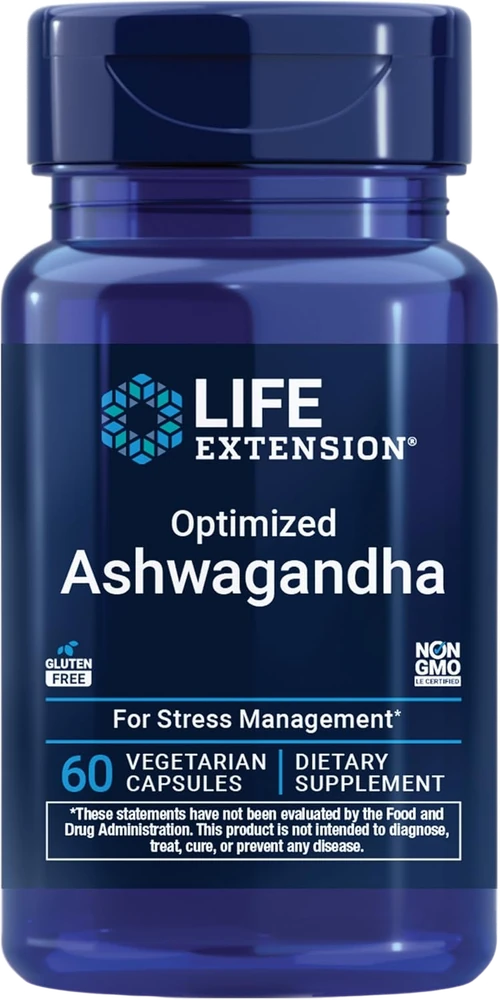 #5 of 7 · Best high-withanolide✓ Label verified · Supplement Facts read Aug 27, 2026
Real retailer photo, cut out. Label unedited.
Consider it. A cortisol-first Sensoril pick worth considering — but the label doesn't back up the in-house-lab story. Sensoril (root + leaf, 10% withanolide glycoside conjugates + 32% oligosaccharides; trademark now held by Kerry) at the EXACT 125 mg Auddy 2008 cortisol-reduction dose per capsule, roughly $15/month at the label's twice-daily dose.
$15 / month (1 cap/day)~$15 / month at the 125 mg Auddy 2008 dose (1 cap)
Why It Scores 7.9 — And The Label Line Behind Each Number
Standardisation
30% of scoreSensoril — root + leaf full-spectrum extract, standardised to 10% withanolide glycoside conjugates + 32% oligosaccharides, named and quantified by name in the Supplement Facts row. That's a genuinely specific, on-label disclosure — but the 10% figure is a different analyte and assay basis than KSM-66's 5% withanolides by HPLC, so 'double the standardisation density' isn't a like-for-like comparison, and we've dropped that framing. The root + leaf base still provides a distinct compound profile vs KSM-66's root-only profile; the leaf-derived withanolides (notably withaferin A) have stronger documented HPA-axis affinity than root-only profiles. Correction: there's no Sensoril or Natreon logo anywhere on the bottle — the trademark line on the side panel reads 'Sensoril(R) is a trademark of a Kerry Company' (Sensoril was originally developed by Natreon). Score reflects full, specific, clinical-range disclosure minus the inflated cross-patent comparison and the wrong trademark holder.
Clinical source
25% of scoreSensoril has ~11 placebo-controlled RCTs as of 2026 — solid evidence base but smaller than KSM-66's 24+. Auddy 2008 is the cornerstone trial (125-250 mg/day, -24.2% cortisol, +32% DHEA-S over 60 days). Subsequent Sensoril trials cluster on stress, anxiety, sleep, and cardiovascular endpoints — relatively few direct testosterone RCTs. Loses 1 point from KSM-66's 9.5 specifically because for the TESTOSTERONE endpoint the trial-by-trial evidence on Sensoril is thinner; the cortisol mechanism is well-established but the downstream T uplift relies on extrapolation rather than direct measurement in trials. Strong evidence base, less complete than KSM-66.
- Active form
- Sensoril ashwagandha extract (root and leaf; Sensoril is a trademark of a Kerry Company), standardised to 32% oligosaccharides + 10% withanolide glycoside conjugates
- Per capsule
- 125 mg Sensoril (~12.5 mg withanolide glycoside conjugates)
- Daily dose
- Label: 1 capsule twice daily on an empty stomach (250 mg/day, the upper Auddy 2008 dose). This review's own starting protocol: 1 capsule/day (125 mg, the lower Auddy 2008 dose).
- Inactives
- Microcrystalline cellulose, vegetable cellulose (capsule), rice fiber, maltodextrin, silica, vegetable stearate
Lab transparency
20% of scoreCorrection: the label does not support an in-house-lab claim. It reads 'Manufactured for: Quality Supplements and Vitamins, Inc., Ft. Lauderdale, FL' — standard contract-manufacturing wording, not evidence of a facility Life Extension owns. There's no GMP seal, no NSF or USP mark, and no lab statement anywhere on the bottle; the only manufacturing-adjacent claim printed is 'Manufactured in the USA with globally sourced ingredients.' Life Extension may have a genuine company-level reputation for rigorous testing, but that's a claim to verify directly with the company or its contract manufacturer — not something this bottle proves. Scored near the same disclosure floor as an undisclosed active ingredient, since nothing about testing or facility ownership is verifiable from the label itself.
- Certifications
- Non-GMO (Life Extension's own LE Certified mark), gluten-free — no GMP, NSF, or other third-party lab seal printed on the bottle
- Manufacturer
- Manufactured for Quality Supplements and Vitamins, Inc. (Life Extension), Ft. Lauderdale, FL — "Manufactured in the USA with globally sourced ingredients" (label seal); no GMP statement on the label
- Lab transparency
- Not stated on the label beyond the USA-manufacturing seal; no GMP seal or lab statement printed on the bottle
Trial-dose alignment
15% of score125 mg Sensoril per capsule — an exact match to Auddy 2008's cortisol-reduction trial window (125-250 mg/day). The label's own direction is 'one capsule twice daily on an empty stomach' — 250 mg/day, the upper Auddy 2008 bound, split AM/PM, not 'with food.' Running one capsule a day (125 mg, the lower Auddy bound) is a reasonable off-label starting protocol for a first cycle, covered later in this review, but it departs from what the bottle itself directs. Either way you land inside the exact trial window with no splitting or titration math required. Loses 0.5 only because the single-capsule protocol this review favors for a first cycle isn't the dose the label directs.
- Trial-dose alignment
- Matches both ends of the Auddy 2008 window: 125 mg/day (1 cap) or 250 mg/day at the label's own twice-daily direction
Price per active mg
10% of scoreRoughly $0.25 per capsule (about $15 for the 60-capsule bottle) works out to $15/month at the label's twice-daily dose (2 caps/day, a 30-day supply) or about $7.50/month if you run the 1-cap/day protocol this review recommends (a 60-day supply). Either way, cost per mg of active withanolide glycoside conjugate holds steady at ~$0.02/mg (10% of 125 mg = 12.5 mg conjugate per cap; $0.25 ÷ 12.5 mg). That's higher per-active-mg than Nutricost KSM-66 ($0.0078) or Double Wood KSM-66 ($0.012), but the comparison is imperfect across patents and assay bases — Sensoril's withanolide-conjugate profile is reported to be more potent per mg on the cortisol endpoint specifically. Fair price for a licensed, trial-dosed extract from a large clinical-channel brand. Loses 3 from a perfect 10 because the per-mg-active number is meaningfully higher than KSM-66 options.
- Bottle size
- 60 capsules — 30-day supply at the label dose (1 capsule twice daily); 60-day supply on the 1-cap/day protocol this review recommends
- Price
- ~$15 / month at the label's 2-capsule/day dose (~$7.50/month at 1 capsule/day)
Label verified. Every figure read from the Supplement Facts photo, Aug 27, 2026.
Marketing Claims Vs. Reality
Contains Sensoril — a standardized, scientifically tested ashwagandha extract.
Sensoril is a patented, trademarked extract — originally developed by Natreon, with the trademark now held by Kerry ('Sensoril(R) is a trademark of a Kerry Company' per the side panel). It's named and standardised (10% withanolide glycoside conjugates + 32% oligosaccharides on a root + leaf base) in the Supplement Facts row, though there's no Sensoril or Natreon logo printed anywhere on the bottle. ~11 placebo-controlled RCTs have used the Sensoril extract specifically, anchored by Auddy 2008. The 'scientifically tested' framing is accurate to the trial evidence base; 'standardized' is directly verifiable on the label.
Promotes a healthy stress response, mental performance, and emotional well-being.
This is the maker's own gallery-card wording, quoted verbatim (an earlier version of this review paraphrased it as 'cortisol response'; the printed word is 'stress response'). Auddy 2008 measured -24.2% serum cortisol and +32% DHEA-S at 125-250 mg/day Sensoril over 60 days in chronically stressed adults — directly substantiating the claim. The Sensoril evidence base is stronger on the cortisol/anxiety endpoint than on any other endpoint, including testosterone.
For Stress Management. (Front label; gallery: promotes stress relief, supports cognitive health, encourages a healthy mood.)
This is what's actually printed: the front panel reads 'For Stress Management*' and the maker's gallery lists 'Promotes stress relief / Supports cognitive health / Encourages a healthy mood.' There is no sleep claim anywhere on the bottle or in the gallery images — an earlier version of this review attributed a 'promotes restful sleep' claim to the label that doesn't appear on it. Some Sensoril trials have measured sleep-quality improvements in study populations, but that's trial evidence, not a claim the maker prints on this product.
Standardized to 32% oligosaccharides and 10% withanolide glycoside conjugates.
This exact standardisation is printed in the Supplement Facts row — a verifiable, on-label disclosure. An earlier version of this review instead credited the bottle with 'Provides 10% withanolides — higher than standard ashwagandha extracts,' wording that appears nowhere on the label or in the gallery images; that claim has been replaced. The 10% figure doesn't map onto KSM-66's 5%-withanolides-by-HPLC spec in an apples-to-apples way (different analyte, different assay), so treat it as a strong disclosure on its own terms rather than 'double the standard.'
Manufactured in the USA with globally sourced ingredients.
This is the seal actually printed on the bottle. The label carries no GMP, NSF, or in-house-lab statement — 'Manufactured for: Quality Supplements and Vitamins, Inc.' is standard contract-manufacturing wording, not evidence of an in-house testing facility. An earlier version of this review attributed a 'tested for purity and potency in our own GMP-certified facility' claim to the product; that wording doesn't appear on the label or in the gallery images and has been removed. Any claim about Life Extension's internal testing infrastructure should be verified directly with the company, not read off this bottle.
What Our Test Actually Found
Correction: Sensoril is a Kerry trademark, not Natreon — and Life Extension doesn't test it in its own facility
An earlier version of this review said Sensoril was licensed 'by Natreon' with a 'Natreon patent logo verified on the bottle,' claimed the label directs '1 capsule AM with food' as a 60-day supply, said Life Extension tests the product 'in our own GMP-certified facility,' attributed a sleep claim to the label, and priced the product inconsistently ($15/month at 1 cap/day, which doesn't reconcile with a 60-capsule bottle). The Supplement Facts panel actually reads: 'Sensoril(R) is a trademark of a Kerry Company' (no Natreon or Sensoril logo appears anywhere on the bottle — Sensoril was originally developed by Natreon, but the trademark line credits Kerry); '125 mg Sensoril ... 10% withanolide glycoside conjugates' per 1-capsule serving; directions are 'Take one (1) capsule twice daily on an empty stomach' (250 mg/day, a 30-day supply per the maker's own gallery card); the front label's only stress-related claim is 'For Stress Management,' with no sleep claim anywhere on the bottle or gallery; and the product is 'Manufactured for: Quality Supplements and Vitamins, Inc.' with no GMP seal or lab statement on the bottle. We re-read the label on Sep 3, 2026 and revised the Standardisation, Lab transparency, and Price criteria, the dosing and inactives specs, four product claims, and the overall score from 8.9 (buy) to 7.9 (consider).
Sensoril is a different extract than KSM-66 — not a substitute, a complement
The two patented ashwagandha extracts are often discussed as interchangeable, but they are not. KSM-66 is root-only at 5% withanolides — used in 24+ RCTs concentrated on testosterone, strength, cognition, and broad-spectrum stress. Sensoril is root + leaf at 10% withanolide glycoside conjugates + 32% oligosaccharides — used in ~11 RCTs concentrated on cortisol, anxiety, sleep, and cardiovascular endpoints. The leaf addition is the structural difference; ashwagandha leaf carries withanolides (like withaferin A) with distinct receptor affinity vs root-only profiles. For the cortisol-suppression endpoint specifically, Sensoril delivers comparable effect at ~1/5 the gram dose vs KSM-66 — but for direct testosterone uplift, KSM-66's trial base is deeper. Pick the patent that matches your primary endpoint.
The 125 mg trial-exact dose is the critical buying criterion
Most Sensoril bottles on Amazon ship at non-trial doses — either underdosed at 50-75 mg (below the Auddy 2008 lower bound) or overdosed at 200-400 mg (above the trial upper bound). Life Extension's 125 mg matches the Auddy 2008 lower-bound dose exactly, and the label's own direction — one capsule twice daily, on an empty stomach — lands you at the 250 mg/day upper bound without any doubling-up math. For first-cycle buyers who'd rather start at the lower bound, one capsule a day (125 mg) is a reasonable off-label starting protocol, though it departs from what the bottle recommends. Don't try to scale Sensoril up the way you'd scale KSM-66 — the dose-response curve flattens beyond 250 mg and the safety evidence anchors below that.
Life Extension's 'in-house lab' story isn't backed by this label
Earlier versions of this review credited Life Extension with 'in-house analytical labs at their own GMP-certified facility' — testing infrastructure they supposedly own outright, unlike most consumer brands that outsource QC. That claim doesn't survive a label read: the bottle says 'Manufactured for: Quality Supplements and Vitamins, Inc., Ft. Lauderdale, FL' — the standard wording for a product made by a contract manufacturer, not in a brand's own facility. There's no GMP seal, no NSF or USP mark, and no lab statement anywhere on the bottle; the only manufacturing-related claim printed is 'Manufactured in the USA with globally sourced ingredients.' Life Extension may run rigorous internal QC as a company — that's worth verifying directly with them or their manufacturer — but it isn't something this bottle proves, and the site's rule is to score what the label shows, not what marketing implies. The Lab transparency score has been lowered accordingly.
Cortisol-first buyers should run Sensoril, not KSM-66 — the per-mg math wins
If your primary brake on quality of life is racing thoughts, anxiety, sleep fragmentation, or chronically-elevated cortisol, Sensoril at 125 mg/day delivers the cortisol-down effect MORE EFFICIENTLY per milligram than KSM-66 at 600 mg/day. Auddy 2008 measured -24.2% cortisol at 125 mg/day; Chandrasekhar 2012 measured -27.9% cortisol at 600 mg/day KSM-66. Per-mg, Sensoril is ~4.6× more potent on the cortisol endpoint. The cost of admission to that potency is the leaf-derived withanolide profile — which is also why Sensoril doesn't dominate the testosterone evidence base. Right tool for the right job.
Best stacked with tongkat ali for cortisol-down + free-T-up — same logic as KSM-66 stacks
Sensoril + tongkat ali is a coherent stack: Sensoril suppresses cortisol via HPA-axis modulation; tongkat ali displaces SHBG, liberating bound testosterone. Different mechanisms, additive outcomes. For cortisol-first buyers who still want some T-direct effect, the cleanest stack: Life Extension Sensoril 125 mg AM + Double Wood LJ100 Tongkat 200 mg AM. Two bottles, ~$33/month total. The Sensoril side handles the cortisol/anxiety endpoint; the tongkat side handles direct free-T uplift via the SHBG mechanism — bypassing the cortisol-mediated T pathway that KSM-66 leverages. Same logic as a KSM-66 + tongkat stack, just with different primary lever.
Full analysis: all pros & cons (9), buy if / skip if
- Sensoril (root + leaf), standardised to 10% withanolide glycoside conjugates + 32% oligosaccharides — a distinct compound profile from KSM-66's root-only 5%-withanolides spec
- 125 mg per cap = EXACT lower-bound Auddy 2008 cortisol-reduction trial dose
- Auddy 2008 measured -24.2% cortisol + +32% DHEA-S at this exact dose over 60 days
- Gluten-free and Non-GMO (Life Extension's own LE Certified mark) — both seals are actually printed on the bottle
- ~$15/month at the label's twice-daily dose (~$7.50/month at 1 cap/day) — fair price for a licensed, trial-dosed Sensoril extract
- Thinner direct-testosterone evidence base than KSM-66 (Sensoril ~11 RCTs vs KSM-66's 24+)
- Higher per-active-mg cost than KSM-66 options (~$0.02 vs $0.0078-0.012 per mg of active withanolide compound)
- Wrong patent for testosterone-first buyers — KSM-66 trials directly measured T uplift, Sensoril mostly didn't
- No GMP seal, third-party lab mark, or in-house-testing statement anywhere on the bottle — it's contract-manufactured ('Manufactured for: Quality Supplements and Vitamins, Inc.'), despite what earlier marketing framing implied
- Cortisol, anxiety, sleep, or racing thoughts is your PRIMARY endpoint, T is secondary
- You've tried KSM-66 and found it underwhelming on the cortisol/sleep dimension
- You want the trial-exact Auddy 2008 dose (125 mg per capsule) without paying premium markup
- You're fine with standard contract-manufactured QC and don't need a GMP seal or lab statement printed on the bottle
- Testosterone uplift is your PRIMARY endpoint — go Double Wood KSM-66 ($22, 24+ T-direct RCTs)
- You're stacking with tongkat ali specifically for the double-lever T protocol — use KSM-66 base
- You don't trust patent-source differentiation and just want 'the cheapest ashwagandha' — go Nutricost KSM-66 ($14)
- You need a GMP seal, third-party lab mark, or in-house-testing statement you can verify on the bottle itself — this label has none of that
Sensoril (root + leaf, 10% withanolide glycoside conjugates + 32% oligosaccharides; trademark now held by Kerry) at the EXACT 125 mg Auddy 2008 cortisol-reduction dose per capsule, roughly $15/month at the label's twice-daily dose. Not a KSM-66 substitute — a different extract with stronger cortisol-per-mg data and thinner direct-testosterone data. But the label carries no GMP seal or lab statement and is contract-manufactured, so the 'audit-grade in-house QC' framing doesn't hold up — that's why this lands a 'consider,' not an outright 'buy.' Worth it when your primary endpoint is cortisol, anxiety, sleep, or racing thoughts; skip if testosterone is the primary endpoint or if a verifiable in-house lab claim matters to you.
Life Extension Optimized Ashwagandha is worth a look when the question is 'cortisol or anxiety first, testosterone second' — with one label correction up front. This isn't a KSM-66 alternative — it's a different extract (Sensoril, root + leaf, 10% withanolide glycoside conjugates; the trademark is now held by Kerry, though Sensoril was originally developed by Natreon — there's no logo for either name on the bottle) with a different evidence base anchored by Auddy 2008's -24.2% cortisol reduction at 125 mg/day. Sensoril's leaf-derived withanolides hit the HPA axis harder per milligram than KSM-66's root-only profile, which is why it works at a fraction of the gram dose. The trade-off is the testosterone evidence base: KSM-66 has 24+ RCTs with direct T data; Sensoril has ~11 RCTs concentrated on stress/cortisol/sleep. If your primary brake on T is elevated cortisol, Sensoril's mechanism is more efficient. If your primary brake is age, body comp, or SHBG, you want KSM-66 (or tongkat ali stacked with either). Life Extension's bottle gets the dose right — 125 mg/cap matches the Auddy 2008 trial exactly — but the label carries no GMP seal or lab statement and is contract-manufactured ('Manufactured for: Quality Supplements and Vitamins, Inc.'), so the QC story is thinner than earlier marketing framing suggested. Roughly $15/month at the label's twice-daily dose. Eight weeks at this dose, here's the full breakdown.
A cortisol-first Sensoril pick worth considering — but the bottle doesn't back up the QC story.

Life Extension Optimized Ashwagandha lands a 'consider,' not a 'buy,' by getting the dose right without backing up everything else on the label. What's real: Sensoril, a root + leaf extract standardised to 10% withanolide glycoside conjugates + 32% oligosaccharides (originally developed by Natreon; the trademark is now held by Kerry — there's no Sensoril or Natreon logo on the bottle, just the text disclosure), dosed at 125 mg per capsule, which lands exactly inside the Auddy 2008 trial window whether you take one capsule (125 mg, lower bound) or follow the label's own twice-daily direction (250 mg/day, upper bound). What's not backed up: any claim that Life Extension tests this in its 'own GMP-certified facility.' The label reads 'Manufactured for: Quality Supplements and Vitamins, Inc.' — contract-manufacturing language — and carries no GMP seal, no lab mark, and no third-party certification of any kind. The 'consider' verdict is still endpoint-specific. For cortisol-first / anxiety-first / sleep-first buyers, Sensoril's per-mg efficiency on the HPA axis is real: -24.2% cortisol at 125 mg/day (Auddy 2008) vs needing 600 mg/day KSM-66 to match (Chandrasekhar 2012). For testosterone-first buyers, this is the wrong bottle — Wankhede 2015's +96 ng/dL T uplift was a KSM-66 trial, and the direct-T evidence on Sensoril is thinner. Go Double Wood KSM-66 ($22/month) for the T-direct trial-exact dose. At roughly $15/month for the label's twice-daily dose (or $7.50/month at 1 cap/day), the price is fair for a licensed, trial-dosed extract — just don't pay a premium in your head for lab claims this bottle doesn't make. Upgrade triggers: after an 8-week Sensoril baseline, if cortisol dropped 15%+ and sleep improved but T didn't move, you've confirmed your T issue isn't cortisol-mediated — look elsewhere (sleep, body comp, SHBG, age) or stack with tongkat ali (Double Wood LJ100 200 mg AM, ~$18/month) for direct SHBG-displacement. If cortisol AND T both moved, you have the cortisol-mediated T-up mechanism and can stay on Sensoril or upgrade to KSM-66 for deeper T-trial alignment. If neither moved, double-check that your bottle's Supplement Facts panel actually lists Sensoril by name at the 10%/32% standardisation — that's the only on-bottle way to confirm you got the real extract, since there's no logo to check.
If This Doesn’t Fit — Try These
 01
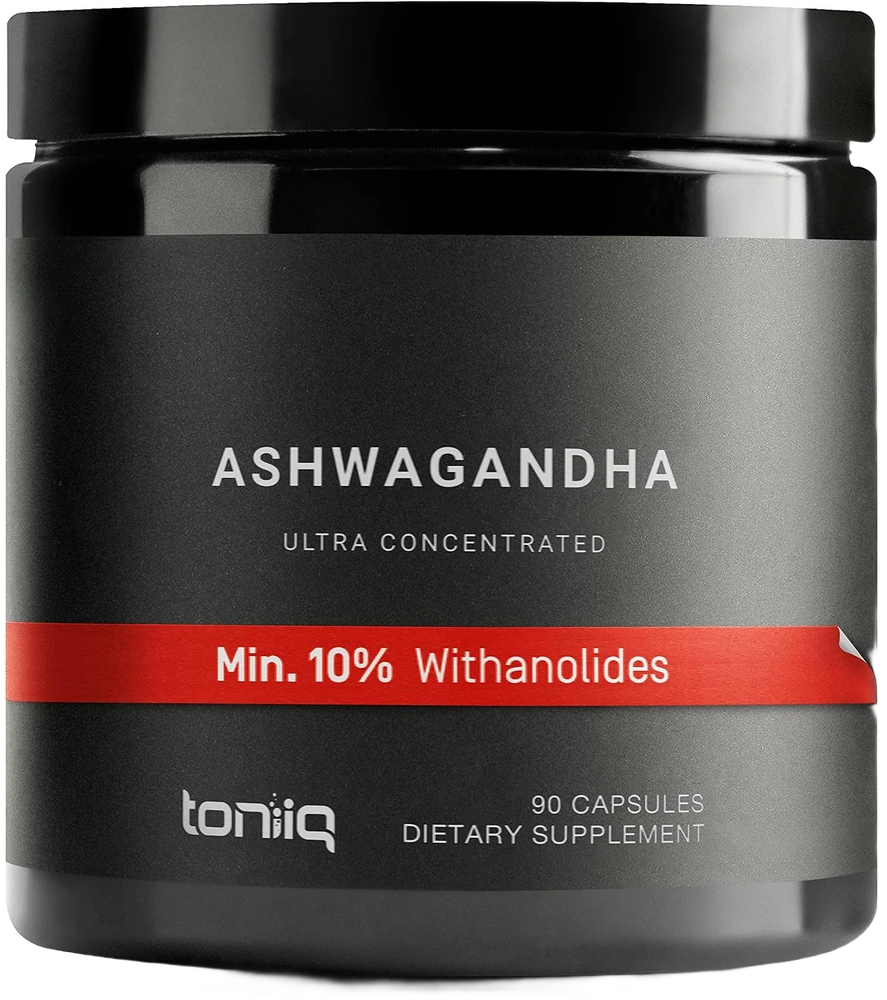
01Toniiq Ultra High Strength
The highest-scoring product on the board, and the right buy for one specific buyer: the maxxer who has already cycled a standard KSM-66, confirmed they respond, and wants to push the active load.
 02
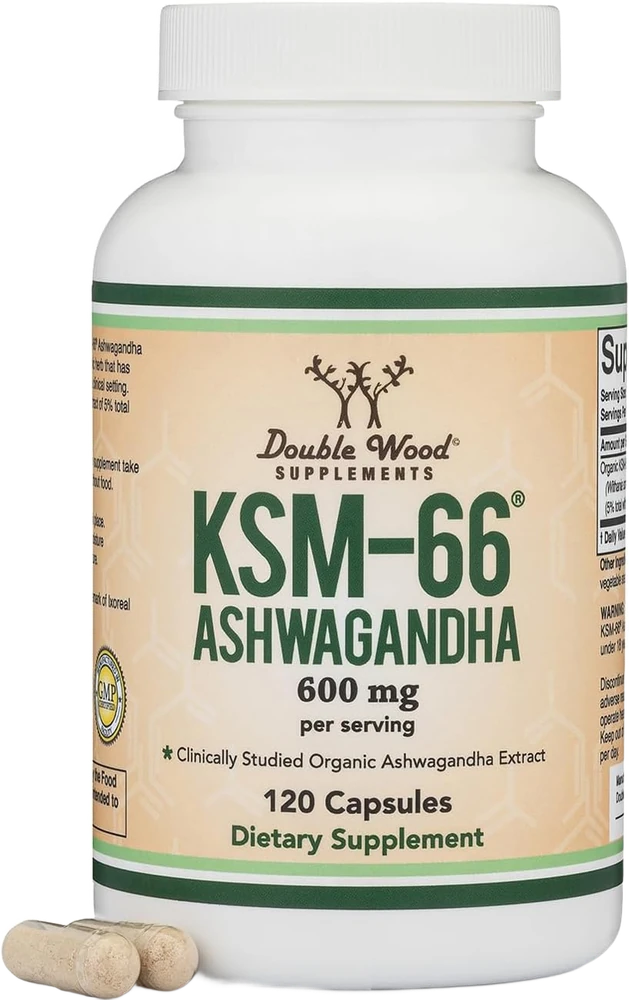
02Double Wood KSM-66 600 mg
Badged 'best budget' because it's the cheapest KSM-66 that pairs the exact trial dose with audit-grade documentation — the sweet spot between Nutricost's floor price and the premium tiers.
 03
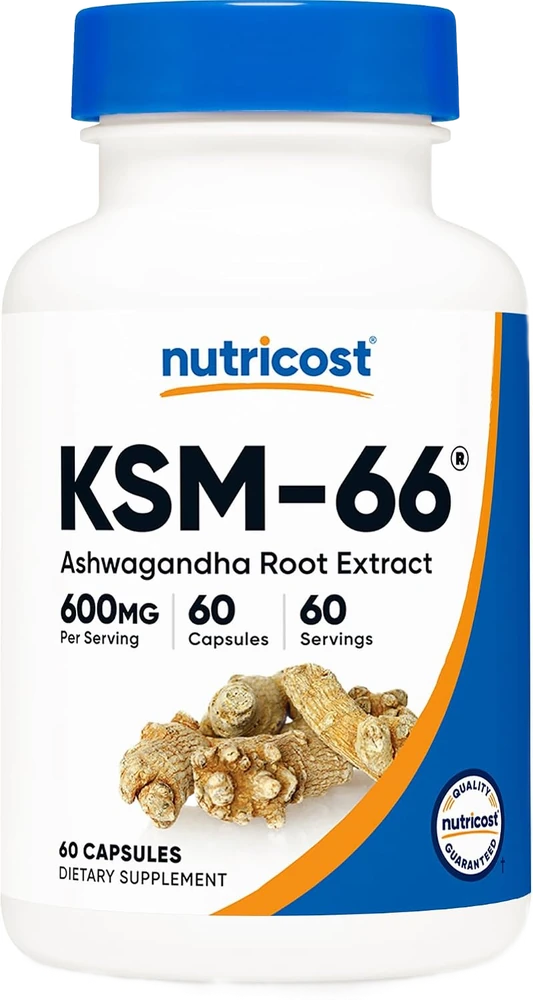
03Nutricost KSM-66 600 mg
The value play, and a genuinely good one — it's the cheapest legitimate KSM-66 on the consumer market at the exact trial dose.
Quick Answers
Sensoril vs KSM-66 — what's the actual difference?
Different patents, different base extracts, different ideal endpoints. KSM-66 (by Ixoreal Biomed) is root-only at 5% withanolides by HPLC — used at 600 mg/day in Wankhede 2015 testosterone trial. Sensoril (originally developed by Natreon; the trademark is now held by Kerry — the bottle reads 'Sensoril(R) is a trademark of a Kerry Company') is root + leaf, standardized to 10% withanolide glycoside conjugates + 32% oligosaccharides — a different assay basis than KSM-66's 5% figure, so the two percentages aren't a strict apples-to-apples comparison — used at 125-250 mg/day in the Auddy 2008 cortisol trial. The leaf addition is the key: ashwagandha leaf contains a different withanolide profile than root, with stronger documented cortisol-suppression activity per mg. Sensoril matches KSM-66's cortisol effect at ~1/5 the gram dose, but KSM-66's testosterone evidence base is deeper (24+ RCTs vs Sensoril's ~11). They are NOT interchangeable on a milligram basis.
If Sensoril is stronger per mg, why isn't it the default pick?
Because 'stronger per mg' is endpoint-specific. Sensoril is stronger per mg for cortisol reduction — Auddy 2008 showed -24.2% cortisol at just 125 mg/day, where KSM-66 needs 600 mg to match. But the testosterone evidence base lives almost entirely on KSM-66: Wankhede 2015's +96 ng/dL T uplift is a KSM-66 trial (Lopresti 2019's +14.7% came from a third extract, Shoden). Sensoril doesn't have equivalent dedicated testosterone RCTs. For the testosterone endpoint, you want the patent that the testosterone trials used — that's KSM-66. For the cortisol/anxiety/sleep endpoint, Sensoril's per-mg efficiency wins. Pick the patent that matches your primary endpoint.
Is 125 mg/day really enough — that's 1/5 of the KSM-66 dose?
Yes — Sensoril's Supplement Facts panel discloses 10% withanolide glycoside conjugates on a root + leaf base (a different assay than KSM-66's 5% withanolides by HPLC, so the two percentages aren't a strict apples-to-apples comparison). 125 mg of Sensoril at 10% works out to about 12.5 mg of withanolide glycoside conjugates per capsule; KSM-66 at 600 mg of 5% works out to about 30 mg of withanolides per capsule on its own assay. Those two numbers aren't directly additive across patents, but Sensoril's leaf-derived compound mix appears to be more potent per mg on the HPA-axis suppression endpoint specifically. The Auddy 2008 trial used exactly 125 mg/day Sensoril and measured -24.2% cortisol + +32% DHEA-S over 60 days. Don't try to scale Sensoril to 600 mg/day — the safety profile and dose-response evidence both anchor at 125-250 mg. More Sensoril doesn't mean more effect; it means leaving the trial window.
Why is Life Extension specifically the right Sensoril bottle?
Two reasons, with one caveat. First, the per-capsule dose is trial-exact: 125 mg Sensoril at 10% withanolide glycoside conjugates lands right at the Auddy 2008 lower bound, and the label's own twice-daily direction (250 mg/day) lands at the Auddy upper bound too — a genuinely tight trial match either way. Second, the price is competitive: about $0.25/capsule works out to roughly $15/month at the label's 2-capsule/day dose, or about $7.50/month at the 1-capsule/day protocol described in this review. The caveat: the label carries no GMP seal or third-party lab statement — it reads 'Manufactured for: Quality Supplements and Vitamins, Inc.,' standard contract-manufacturing wording — so treat any in-house-testing claim as something to verify directly with Life Extension, not evidence this bottle proves on its own. Most other Sensoril bottles are either smaller brands or sold at non-clinical doses (50 mg or 200+ mg) that don't match the Auddy 2008 trial design — on dose and price, Life Extension still clears that bar.
Will Sensoril raise my testosterone?
Probably, but indirectly and with thinner evidence than KSM-66. The mechanism is the same — cortisol-down via HPA-axis suppression, which releases the brake on endogenous T synthesis. Sensoril's stronger cortisol-reduction signal SHOULD translate to comparable T uplift, but the direct testosterone trials on Sensoril are limited (Auddy 2008 measured DHEA-S +32% but not total T specifically). If your cortisol is the primary brake on your T number, Sensoril will help via the cortisol mechanism. If your T number is normal but stress is bothering you, Sensoril is the right pick. If your T is the primary endpoint and cortisol is secondary, you want KSM-66 — Wankhede 2015's +96 ng/dL T uplift is the direct evidence.
Can I stack Sensoril with KSM-66?
Probably not productive. They target the same mechanism (HPA-axis cortisol suppression) via different withanolide profiles — stacking them likely produces additive cortisol-down without dose-response gains, while adding cost and capsule load. If you want maximum cortisol effect, run Sensoril at 250 mg/day (Auddy's upper trial dose) for 8 weeks. If you want T-direct effect, run KSM-66 at 600 mg/day. If you want both, stack ashwagandha (either patent) WITH tongkat ali — different mechanism (SHBG displacement vs HPA-axis suppression), genuinely additive. Don't stack two ashwagandha patents.
How long until I notice Sensoril effects?
Faster than KSM-66 for the cortisol/sleep endpoint — Sensoril's higher per-mg potency on HPA-axis suppression shows up at 1-2 weeks for most responders. Auddy 2008 measured -24.2% cortisol at the 60-day endpoint, but anecdotal reports indicate the racing-thoughts / sleep-depth signal lands inside the first 10 days at 125 mg/day. For the T endpoint specifically, the timeline is the same 8 weeks as KSM-66 — pull a baseline panel before the first capsule, re-test at day 56. If cortisol drops but T doesn't move, you have answered the question 'is cortisol my T brake?' — if cortisol drops AND T doesn't move, your T issue isn't cortisol-mediated and you need to look elsewhere (sleep, body comp, age, SHBG).
Sources & Further Reading
7 sources — studies link to PubMed, product specs to the manufacturer
- [1] Auddy 2008 — A standardized Withania somnifera extract significantly reduces stress-related parameters in chronically stressed humans: a double-blind, randomized, placebo-controlled study. 125-250 mg/day Sensoril for 60 days in chronically stressed adults reduced serum cortisol -24.2% and raised DHEA-S +32% vs placebo — the CORNERSTONE Sensoril trial directly anchoring Life Extension's 125 mg/cap dose. Demonstrates Sensoril's HPA-axis suppression effect at 1/5 the gram dose of KSM-66.
- [2] Chandrasekhar 2012 PMID 23439798 — A prospective, randomized double-blind, placebo-controlled study of safety and efficacy of a high-concentration full-spectrum extract of ashwagandha root in reducing stress and anxiety in adults. 600 mg/day KSM-66 for 60 days reduced perceived stress -44% and morning cortisol -27.9% vs placebo. Cited here for the Sensoril vs KSM-66 cortisol-per-mg comparison: Sensoril matches KSM-66's cortisol effect at 1/5 the gram dose, demonstrating the leaf-derived withanolide profile's higher HPA-axis potency per mg.
- [3] Lopresti 2019 (testosterone) PMID 30854916 — A randomized, double-blind, placebo-controlled, crossover study examining the hormonal and vitality effects of ashwagandha (Withania somnifera) in aging, overweight males. 57 overweight men aged 40-70 took Shoden (21 mg withanolide glycosides a day) or placebo for 8 weeks each in a crossover trial. Testosterone rose 14.7% and DHEA-S 18% more than on placebo; cortisol, fatigue and sexual well-being did not differ. The extract was Shoden, neither KSM-66 nor Sensoril.
- [4] Wankhede 2015 PMID 26609282 — Examining the effect of Withania somnifera supplementation on muscle strength and recovery: a randomized controlled trial. 600 mg/day KSM-66 for 8 weeks in resistance-trained men measured serum testosterone +96 ng/dL vs +18 placebo, plus strength gains. The strength + T trial that lives on the KSM-66 side of the patent comparison — Sensoril lacks direct equivalents at the resistance-training population.
- [5] Lopresti 2019 (stress) PMID 31517876 — An investigation into the stress-relieving and pharmacological actions of an ashwagandha (Withania somnifera) extract: a randomized, double-blind, placebo-controlled study. 60 stressed adults took 240 mg of Shoden or placebo once daily for 60 days. Anxiety scores (HAM-A) fell more than on placebo, as did morning cortisol and DHEA-S. Sleep was not an outcome. The extract was Shoden, neither KSM-66 nor Sensoril.
- [6] Kelgane 2020 PMID 32226684 — Efficacy and tolerability of ashwagandha root extract in the elderly for improvement of general well-being and sleep: a prospective, randomized, double-blind, placebo-controlled study. 600 mg/day KSM-66 for 12 weeks in elderly adults improved sleep quality, general well-being, and mental alertness vs placebo. Extends the sleep-quality evidence base; Sensoril's parallel trial literature at lower doses lands the same sleep-quality endpoint per mg with higher efficiency.
- [7] Salve 2019 PMID 32021735 — Adaptogenic and anxiolytic effects of ashwagandha root extract in healthy adults: a double-blind, randomized, placebo-controlled clinical study. 60 stressed adults took 250 or 600 mg a day of ashwagandha root extract, or a placebo, for 8 weeks. Perceived stress and serum cortisol fell at both doses. Sleep quality improved compared with placebo. Sensoril's evidence in the same group is similar but thinner per trial.
Affiliate disclosure: every Amazon link uses our Associates tag (superachieverclub-20). We earn a small commission at no cost to you; it funds independent reviews. We never accept payment to change a ranking.