
This is rhodiola's home turf. Olsson 2009: 576 mg/day of SHR-5 for 28 days significantly improved fatigue symptoms and attention in stress-fatigued adults. Darbinyan 2000: 170 mg/day cut a mental-fatigue index in night-duty physicians. Spasov 2000: exam-stressed students improved on fatigue and neuro-motor tests. Consistent theme — mental stamina under stress load, often visible fast.
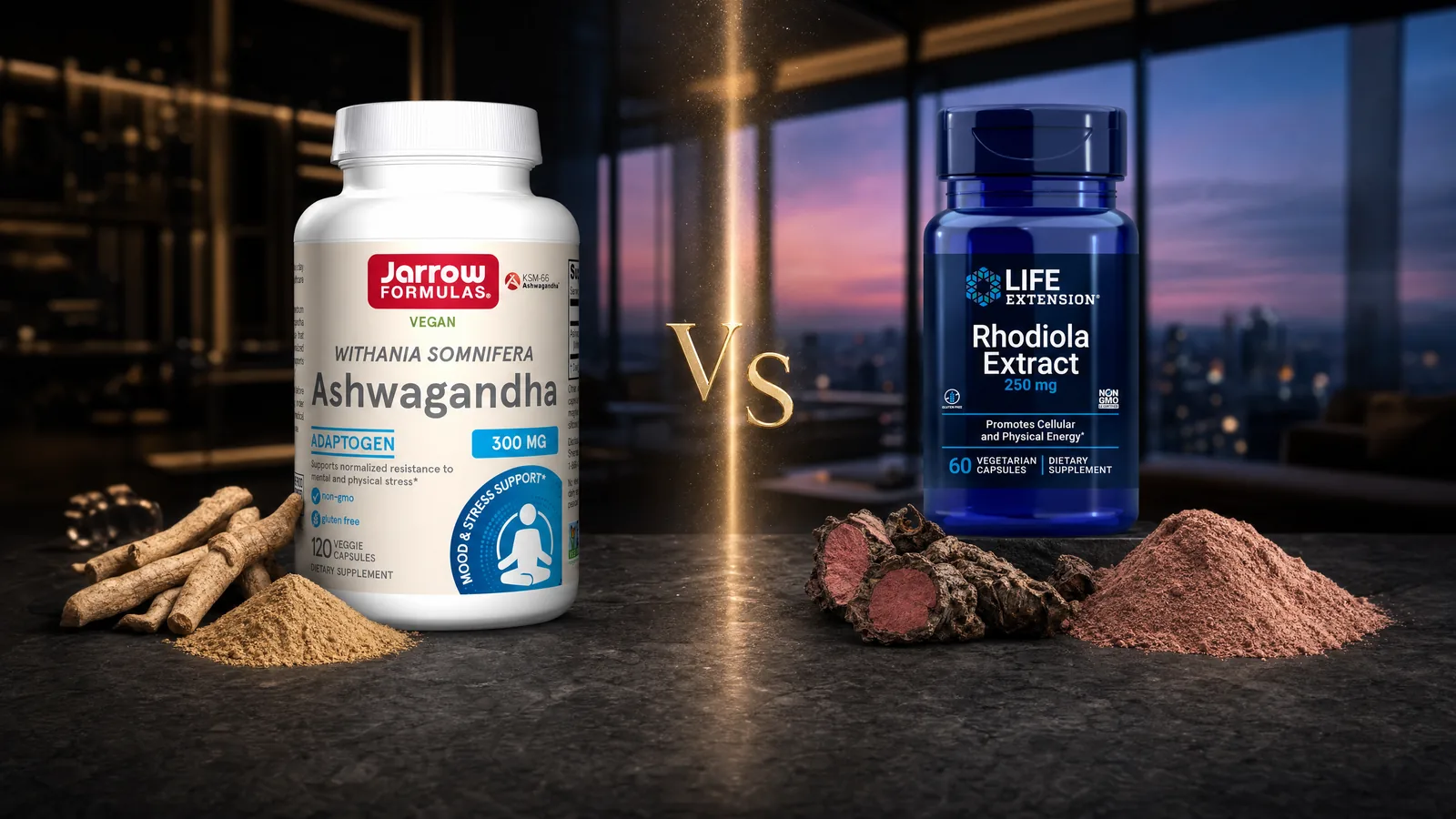
Ashwagandha vs Rhodiola
Updated Oct 15, 2026 · by Felix Hesse · 8 peer-reviewed sources
Ashwagandha and Rhodiola are the two headline adaptogens — and they're constantly framed as rivals. They aren't. Rhodiola rosea (salidroside + rosavins) is for acute, stress-driven FATIGUE and daytime mental stamina: fast, non-sedating, morning. Ashwagandha (withanolides) is for CHRONIC stress: it lowers cortisol 16-33%, deepens sleep, and modestly supports free testosterone — a slow build you take in the evening. Below: 6 rounds head-to-head, an honest note on the lopsided evidence base, and a verdict that lands on a real tie because the winner depends entirely on your goal.
Contender A
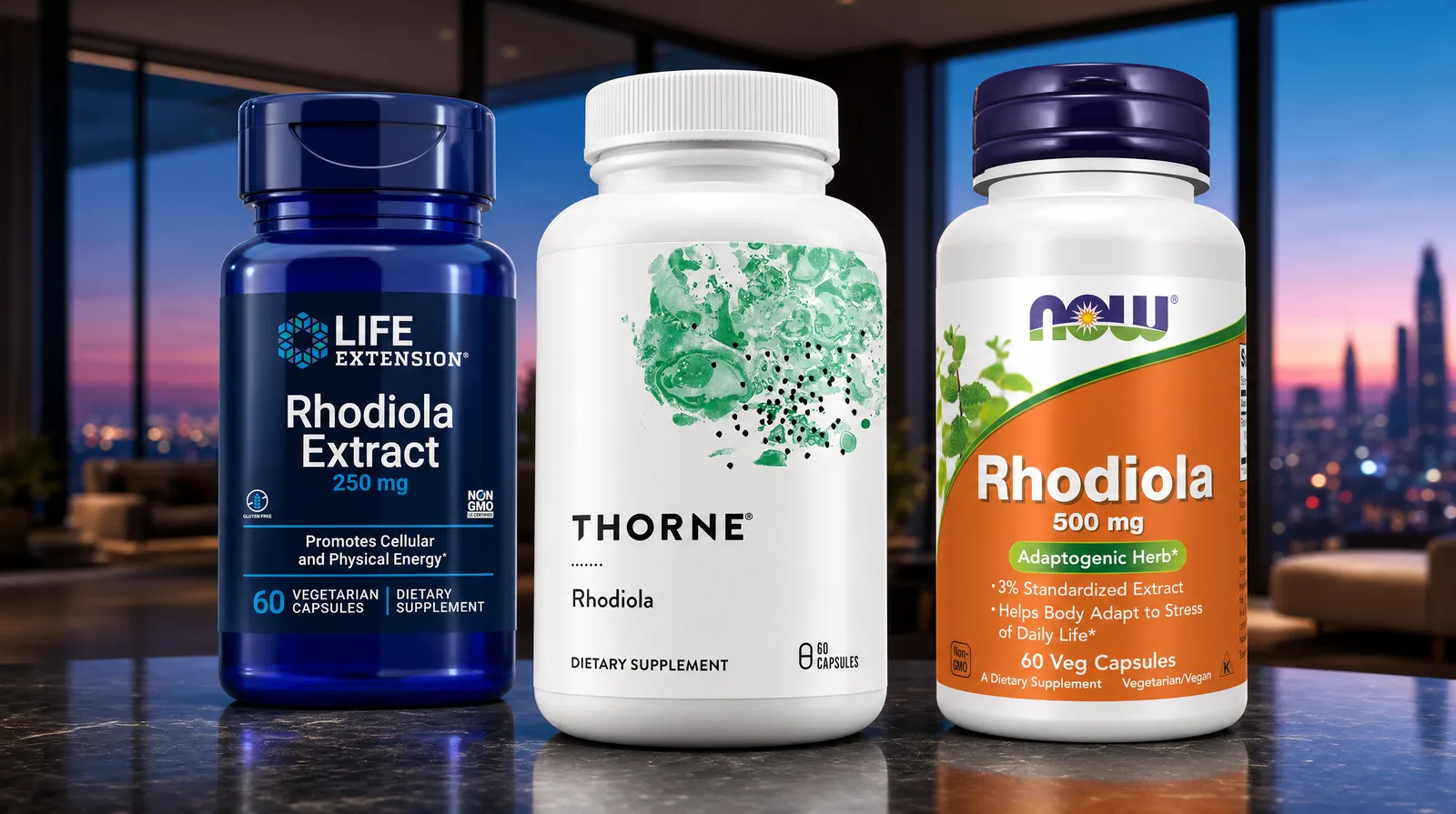
Rhodiola rosea
Salidroside + rosavins · SHR-5 · acute stress-fatigue · daytime
The anti-fatigue adaptogen. Fast, non-sedating, taken in the morning — best for foggy, drained, running-on-empty states under stress. Evidence is promising but modest: small SHR-5 trials rated low-quality by reviews.
7.6/10
Best forAcute stress-fatigue · daytime mental stamina · shift work + exams
Read the full ranking →
Contender B
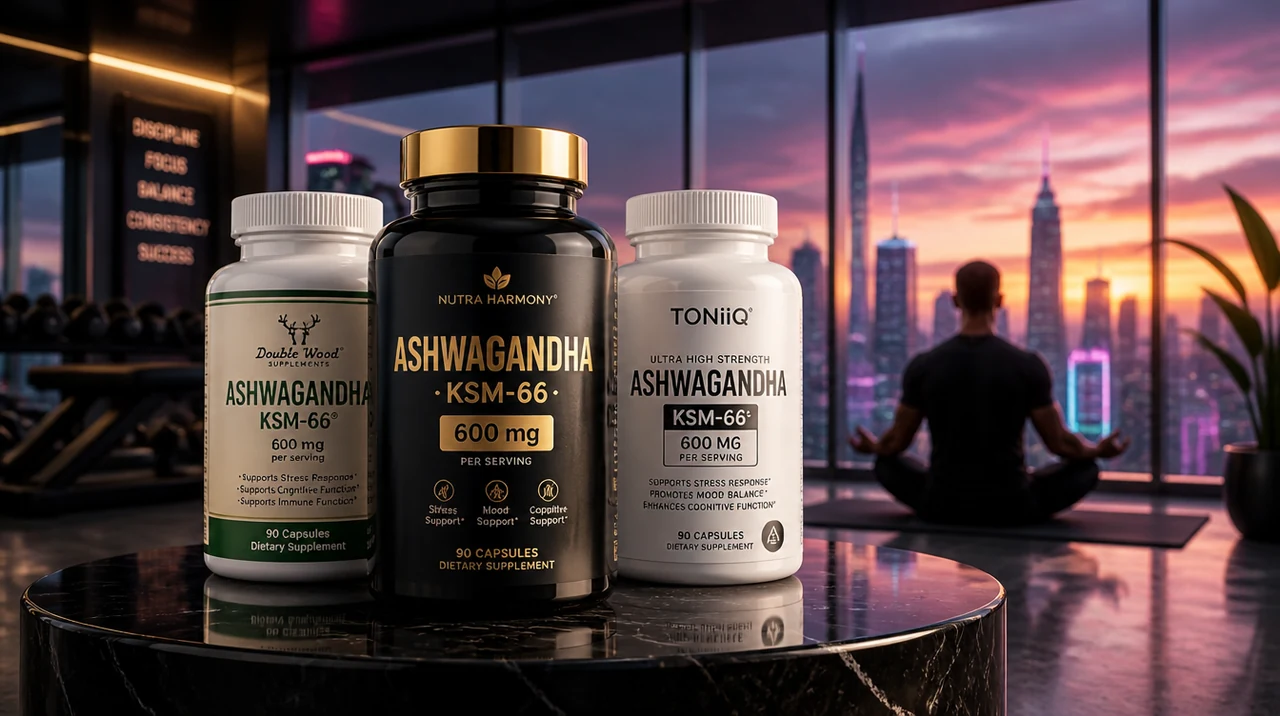
Ashwagandha (KSM-66)
Withanolides · 12+ RCTs · cortisol −14 to −32% · evening
The chronic-stress adaptogen. Lowers cortisol, deepens sleep, and modestly raises free testosterone over weeks. Slow-building and calming — an evening supplement with the deepest trial base of any adaptogen.
8.6/10
Best forChronic stress · poor sleep · cortisol + free-T · evening wind-down
Read the full ranking →
How we scored each round
Six criteria that map to a real decision between these two adaptogens, weighted by what actually drives the choice. Each round, both contenders get a 0-10 score based on the published trials. The winner is whoever scores higher that round; ties are explicit. Because the two herbs are built for opposite ends of the stress curve, the overall scoreboard is expected to land close.
- Acute fatigue + mental stamina20%
Effect on stress-driven fatigue and daytime cognitive performance under load.
- Chronic stress + cortisol20%
Magnitude and consistency of cortisol reduction and chronic-stress relief.
- Sleep + recovery15%
Effect on sleep quality, depth, and downstream recovery.
- Hormonal / body-composition15%
Free-testosterone, DHEA-S, strength, and lean-mass effects.
- Evidence base + quality20%
Number, size, and methodological quality of the placebo-controlled trials.
- Onset + daytime usability10%
Speed of effect and how the activation/sedation profile fits real-life dosing.
6 rounds — head-to-head on the criteria that matter
- Round 1
Round 1 · Acute fatigue + mental stamina
Effect on stress-driven fatigue and daytime cognitive performanceRhodiola rosea8.5 Ashwagandha (KSM-66)6.5 Ashwagandha reduces the chronic-stress state that drives fatigue, but it isn't an acute anti-fatigue or daytime-stamina tool — and it's calming, so daytime dosing can add drowsiness rather than sharpen focus. The fatigue benefit is real but indirect and slow, arriving via better sleep and lower cortisol over weeks.
- Round 2
Round 2 · Chronic stress + cortisol
Cortisol reduction and chronic-stress relief vs placeboRhodiola rosea6.5 Rhodiola modulates the acute cortisol/awakening-stress response (Olsson 2009 noted an effect on the cortisol response to awakening stress), but it isn't a broad baseline-cortisol suppressor, and the trials centre on fatigue rather than chronic-stress cortisol load. The chronic-stress signal is weaker and less directly measured.
Ashwagandha (KSM-66)9.0 Ashwagandha owns this round. Chandrasekhar 2012: KSM-66 300 mg twice daily cut serum cortisol 27.9% and perceived stress 44% over 60 days. Lopresti 2019: 240 mg of Shoden lowered morning cortisol and anxiety scores more than placebo. Across the RCTs the cortisol drop lands in the 16-33% range — the strongest non-prescription cortisol lever documented.
- Round 3
Round 3 · Sleep + recovery
Effect on sleep quality, depth, and recoveryRhodiola rosea4.5 Rhodiola has essentially no sleep-depth evidence, and because it's mildly activating it can disturb sleep if taken late in the day. It's a daytime tool — recovery benefits are limited to reducing daytime fatigue, not improving the night.
Ashwagandha (KSM-66)8.5 Ashwagandha improves sleep quality across multiple PSQI-based trials (roughly 25-40% score improvements), with deeper onset and fewer night wakings appearing by week 2-3. Lower cortisol plus better sleep drives the recovery cascade — the reason it's an evening supplement.
- Round 4
Round 4 · Hormonal / body-composition
Free-T, DHEA-S, strength, and lean-mass effectsRhodiola rosea4.0 Rhodiola has no meaningful testosterone, DHEA-S, or lean-mass evidence — it simply isn't a hormonal or body-composition herb. Any downstream benefit is indirect via reduced fatigue enabling training, not a measured endocrine effect.
Ashwagandha (KSM-66)8.0 Ashwagandha has real, if modest, data here. Lopresti 2019: +14.7% testosterone and +18% DHEA-S vs placebo over 8 weeks in overweight men 40-70 (a Shoden extract). Wankhede 2015: KSM-66 600 mg raised strength and lean mass and reduced exercise-induced muscle damage in trained men. The effect is downstream of the cortisol drop, not direct — but it's measured.
- Round 5
Round 5 · Evidence base + quality
Number, size, and methodological quality of the RCTsRhodiola rosea5.5 Rhodiola's evidence is honestly modest. There are several placebo-controlled SHR-5 trials for stress-fatigue (Olsson 2009, Darbinyan 2000, Spasov 2000), but samples are small and the systematic reviews are blunt: Hung 2011 reviewed the RCTs and rated the methodological quality as low, calling for more rigorous studies. Promising, not proven.
Ashwagandha (KSM-66)8.5 Ashwagandha has the deeper, cleaner base: 12+ placebo-controlled RCTs on standardised extracts (KSM-66, Sensoril, Shoden) across cortisol, stress, sleep, testosterone, and strength endpoints, with replication (Chandrasekhar 2012, both Lopresti 2019 trials, Wankhede 2015). More trials, larger and more consistent effects, better standardisation discipline.
- Round 6
Round 6 · Onset + daytime usability
Speed of effect and how the activation profile fits real dosingRhodiola rosea8.5 Rhodiola is fast and daytime-friendly. Some trials show a same-day anti-fatigue effect, with fuller benefit in 1-4 weeks — ideal for an acute high-stress stretch. It's non-sedating, so it fits a morning routine and supports rather than dulls daytime function. The one caveat: dose it early or it can disturb sleep.
Ashwagandha (KSM-66)6.5 Ashwagandha is a slow build: sleep shifts at week 2-3, cortisol and testosterone at week 6-12 — no help for an immediate crunch. It's calming, which is perfect in the evening but means it's not a daytime-stamina option. Great for a chronic reset, wrong tool for 'I need this to work today'.
After 6 rounds
2
Rhodiola rosea
0
Ties
4
Ashwagandha (KSM-66)
It's a tie on 'which adaptogen' — because the right answer is 'which job'

The round scoreboard reads 4-2 for ashwagandha, and that reflects something real: ashwagandha simply covers more ground — cortisol, sleep, hormones, and a far deeper evidence base — while rhodiola is a specialist. But calling ashwagandha the outright winner would be dishonest, because the two rounds rhodiola wins are exactly the ones that matter for a specific, common problem: acute daytime fatigue and a fast, non-sedating tool for a high-stress stretch. On 'which adaptogen overall', this is a genuine tie — the winner is whichever job you're hiring for.
Hire Rhodiola rosea when you're foggy, drained, and running on empty under pressure — exam blocks, brutal work sprints, shift work. 200-400 mg of a 3% rosavins / 1% salidroside extract in the morning. It's fast and it won't sedate you. Just be honest about the evidence: it's promising for stress-fatigue, not proven, and the trials are small.
Hire Ashwagandha when the problem is chronic — wired-but-tired, poor sleep, high stress, low drive, or you want the modest free-testosterone support. 300-600 mg of KSM-66 in the evening. Sleep shifts in 2-3 weeks; cortisol and testosterone over 6-12. It has the deepest and cleanest trial base of any adaptogen.
And if both apply — drained by day, poorly recovered at night — stack them: morning rhodiola for stamina, evening ashwagandha for cortisol and sleep. The mechanisms don't conflict. Add one at a time so you know which is doing what; direct evidence for the combination specifically is thin, so treat it as two individually-studied herbs run together.
The one wrong move: expecting rhodiola to fix your sleep or raise testosterone (it does neither), or expecting ashwagandha to give you a same-day energy lift (it won't). Match the herb to the symptom and both deliver on their actual lane.
Every claim above traces back to one of these
- [1]Chandrasekhar 2012
A prospective, randomized double-blind, placebo-controlled study of safety and efficacy of a high-concentration full-spectrum extract of ashwagandha root in reducing stress and anxiety in adults
300 mg of KSM-66 twice daily for 60 days reduced perceived stress score by 44% and serum cortisol by 27.9% in chronically stressed adults. The cornerstone ashwagandha cortisol-reduction trial.
- [2]Lopresti 2019 (stress)
An investigation into the stress-relieving and pharmacological actions of an ashwagandha (Withania somnifera) extract: a randomized, double-blind, placebo-controlled study
60 stressed adults took 240 mg of Shoden or placebo once daily for 60 days. Anxiety scores (HAM-A) fell more than on placebo, as did morning cortisol and DHEA-S. Sleep was not an outcome.
- [3]Lopresti 2019 (testosterone)
A Randomized, Double-Blind, Placebo-Controlled, Crossover Study Examining the Hormonal and Vitality Effects of Ashwagandha (Withania somnifera) in Aging, Overweight Males
57 overweight men aged 40-70 took Shoden (21 mg withanolide glycosides a day) or placebo for 8 weeks each in a crossover trial. Testosterone rose 14.7% and DHEA-S 18% more than on placebo; cortisol, fatigue and sexual well-being did not differ.
- [4]Wankhede 2015
Examining the effect of Withania somnifera supplementation on muscle strength and recovery: a randomized controlled trial
600 mg/day of KSM-66 for 8 weeks increased muscle strength and size, raised testosterone, and reduced exercise-induced muscle damage in trained men. The genre-defining ashwagandha performance trial.
- [5]Olsson 2009
A randomised, double-blind, placebo-controlled, parallel-group study of the standardised extract SHR-5 of the roots of Rhodiola rosea in the treatment of subjects with stress-related fatigue
In 60 adults with stress-related fatigue, 576 mg/day of standardized SHR-5 rhodiola extract for 28 days significantly improved fatigue symptoms and attention vs placebo, with an effect on the cortisol response to awakening stress. Rhodiola's cornerstone stress-fatigue trial.
- [6]Darbinyan 2000
Rhodiola rosea in stress induced fatigue--a double blind cross-over study of a standardized extract SHR-5 with a repeated low-dose regimen on the mental performance of healthy physicians during night duty
In physicians on night duty, 170 mg/day of SHR-5 rhodiola for two weeks produced a statistically significant reduction in a fatigue index affecting mental performance vs placebo, though the effect diminished later. Key rhodiola mental-fatigue trial.
- [7]Spasov 2000
A double-blind, placebo-controlled pilot study of the stimulating and adaptogenic effect of Rhodiola rosea SHR-5 extract on the fatigue of students caused by stress during an examination period with a repeated low-dose regimen
A low-dose SHR-5 rhodiola regimen in stressed students during exams improved physical fitness, mental fatigue, and neuro-motor test scores vs placebo, supporting an anti-fatigue effect under stress load.
- [8]Hung 2011
The effectiveness and efficacy of Rhodiola rosea L.: a systematic review of randomized clinical trials
Systematic review of rhodiola RCTs found preliminary evidence of benefit for physical performance and mental fatigue but rated the methodological quality of the trials as low and called for more rigorous studies. The honest ceiling on rhodiola's evidence.