
Rhodiola Rosea: Benefits, Dosage & Side Effects (2026)
A stress-adaptogen herb with small but real evidence for reducing stress-related fatigue at 200-400 mg of a properly standardized extract — not a stimulant and not a magic pill.
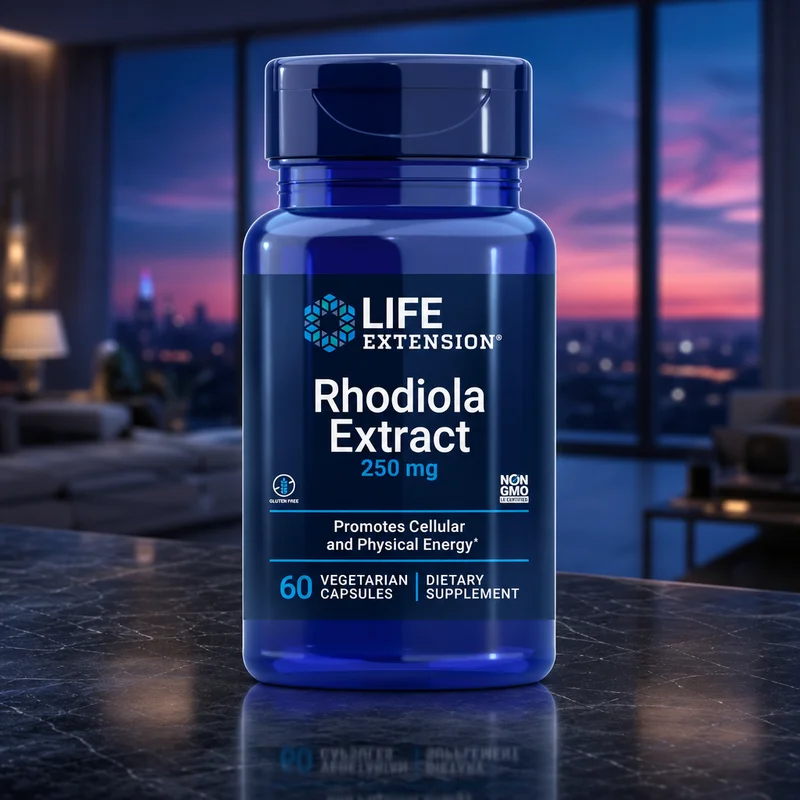
Life Extension Rhodiola Extract (3% Rosavins) 250 mg
What is Rhodiola Rosea?
Rhodiola rosea is an Arctic/alpine root long used in Russian and Scandinavian folk medicine and classed as an "adaptogen" — a plant said to help the body resist physical and mental stress. Its studied activity is tied to two marker groups: rosavins and salidroside. The extract used in nearly all the positive human trials, called SHR-5, is standardized to roughly 3% rosavins and 1% salidroside. That standardization is the whole ballgame: an unstandardized "500 mg of root" tells you the weight of powder, not how much active compound you're getting. Rhodiola's honest lane is stress-related fatigue and burnout-type symptoms — mental tiredness under pressure — not acute pre-workout energy.
How it works
Rhodiola is thought to act on the stress-response system rather than acting as a stimulant. Proposed mechanisms include modulating the hypothalamic-pituitary-adrenal (HPA) axis and cortisol response to stress, influencing monoamine neurotransmitters (serotonin, dopamine, norepinephrine), and supporting cellular energy metabolism and stress-protein (Hsp70) signaling. Practically, this means it may blunt the fatigue and cognitive slowdown that build up when you're stressed, tired, or sleep-deprived — which is why the strongest trials tested students in exam periods and physicians on night shifts. It does not deliver a caffeine-like jolt, so if you expect a stimulant hit you will conclude it "does nothing." Effects are subtle, cumulative, and most visible under stress load rather than at rest.
At-a-glance facts
- Primary use
- Stress-related fatigue & mental burnout
- Clinical dose
- 200-400 mg extract per day
- Standardization to look for
- 3% rosavins / 1% salidroside (SHR-5 style)
- Onset
- Some acute effect same-day; fuller benefit over 1-4 weeks
- Stimulant?
- No — works on stress response, not caffeine-like arousal
- Evidence strength
- Modest — several small RCTs, mixed quality
- Best taken
- Morning / early afternoon on an empty stomach (can be activating)
Evidence: Several small randomized trials of the standardized SHR-5 extract show real reductions in stress-related fatigue, but samples are tiny, results are mixed, and systematic reviews consistently flag the methodological quality as weak.
Who it's for — and who it isn't
- People with stress-related mental fatigue or burnout-type tiredness — the specific state the SHR-5 trials studied
- Shift workers, students, and high-pressure professionals who feel foggy and drained under load rather than physically exhausted
- Anyone who wants a non-stimulant option and reacts badly to caffeine or ashwagandha's sedation
- Supplement buyers willing to read a label and choose a product standardized to 3% rosavins / 1% salidroside
- People expecting a stimulant or pre-workout energy kick — rhodiola is not that and will disappoint
- Anyone with bipolar disorder or a history of mania (its mild activating/mood effect could theoretically trigger agitation) without clinician guidance
- Pregnant or breastfeeding people, where safety data is essentially absent
- People on antidepressants, blood-pressure drugs, or diabetes medication who haven't checked interactions with a pharmacist
Week-by-week, what happens
- Day 1 (acute)Some trials with a single dose report a modest anti-fatigue and mental-performance effect the same day under stress or night-shift conditions.
- Week 1Users typically notice reduced mental fatigue and slightly steadier energy under stress — subtle, not a stimulant surge.
- Weeks 2-4Fuller benefit on stress-related fatigue, mood, and burnout symptoms in the open-label and RCT data; this is the realistic assessment window.
- OngoingLong-term (>3 month) safety and efficacy data are thin; many users cycle it or take it during high-stress stretches rather than continuously.
Safety & contraindications
- Generally well tolerated in trials; the most common side effects are mild — dizziness, dry mouth, and because it can be activating, insomnia or jitteriness if taken late in the day.
- Standardization matters for safety and honesty: products standardized only to salidroside, to an inverted ratio, or not standardized at all are chemically different from the SHR-5 extract the trials used.
- Theoretical caution in bipolar disorder or mania history, since its mild activating/mood effect could aggravate agitation.
- Possible interactions with antidepressants (serotonergic effect), blood-pressure and diabetes medications, and drugs metabolized by CYP enzymes — check with a pharmacist if you take prescriptions.
- Not established as safe in pregnancy or breastfeeding due to lack of data; avoid.
- It is a supplement, not FDA-approved to treat any condition, and label potency depends entirely on third-party testing you can verify.
All articles on Rhodiola Rosea
Best Ashwagandha for Anxiety
The most-evidenced adaptogen for anxiety — KSM-66 600 mg cut anxiety + cortisol (Chandrasekhar 2012). Ranked by extract patent, withanolide standardisation, and daytime-calm vs sedation fit.
Read →Best Ashwagandha Gummies
Ashwagandha gummies ranked by dose (most sit at the 300 mg floor), KSM-66 vs generic extract, and sugar per serving — plus when capsules are the better call.
Read →Best Ashwagandha Supplements
The definitive ashwagandha buying guide — the single best pick for each buyer across KSM-66 and Sensoril extracts. Standardisation % and extract patent matter far more than milligrams.
Read →Best Caffeine Pills
The best caffeine pills, ranked on dose accuracy, L-theanine pairing for smoother energy, purity and value - with honest caveats on tolerance, dosing and sleep.
Read →Best L-Theanine Supplements
L-Theanine ranked by form (Suntheanine / pure L-isomer beats generic racemate + under-dosed blends), the 200 mg trial dose, third-party testing, and value — the calm-focus amino acid.
Read →Best Lion's Mane Supplements
Lion's Mane ranked by form first — 100% fruiting body + verified beta-glucan beats mycelium-on-grain and 'polysaccharide %' label tricks — then extract + dose, testing, and value. The early-but-promising cognition mushroom.
Read →Best Magnesium for Anxiety
Glycinate dominates the anxiety use case harder than the sleep use case — glycine hits the NMDA co-agonist site, magnesium potentiates GABA-A. Ranked for the 300-500 mg anxiety dose window + AM/PM cortisol-smoothing flexibility.
Read →Best Rhodiola Rosea Supplements
9 rhodiola supplements ranked on standardization and extract match, dose against the clinical range, third-party testing, form and value per clinical dose.
Read →Best Vitamin B12 Supplements
9 vitamin B12 supplements ranked on form and bioavailability, dose against the clinical range, third-party testing, value per serving and GI tolerance.
Read →Double Wood Rhodiola Rosea 500 mg Review
Good value and testing, but the standardization ratio is flipped versus the studied extract — read the label carefully.
Read →Gaia Herbs Rhodiola Rosea (Liquid Phyto-Caps) Review
A beloved herbalist brand with real traceability — but it doesn't state a rosavins/salidroside percentage, so you can't verify what you're getting.
Read →Life Extension Rhodiola Extract (3% Rosavins) 250 mg Review
The only cap on this list where one pill lands squarely inside the 200-400 mg window the fatigue trials actually used.
Read →NaturesPlus Rhodiola Extended Release Review
A correctly-dosed 250 mg tablet undermined by an evidence-free 'extended release' claim and a tiny 30-count bottle.
Read →NOW Rhodiola 500 mg Review
A cheap, correctly-standardized cap from a brand you can actually audit — its only real flaw is 500 mg in one pill.
Read →Nutricost Rhodiola Rosea 500 mg Review
The lowest sticker price on a correctly-standardized cap — you trade a little sourcing transparency for the savings.
Read →NutriONN Rhodiola Rosea 500 mg with Black Pepper Review
The lowest true cost-per-dose here thanks to a 180-count bottle — the black-pepper 'absorption' angle is marketing, not evidence.
Read →Thorne Rhodiola Review
NSF contents-certified rhodiola in 100 mg caps that let you dial the dose — you pay for that precision.
Read →Toniiq Triple-Strength Rhodiola Rosea 600 mg Review
A potent, well-priced 5% salidroside extract — but it's standardized to the wrong compound versus the fatigue trials.
Read →Ashwagandha vs L-Theanine
Acute calm vs chronic reset: L-theanine's fast non-sedating focus against ashwagandha's weeks-long cortisol and sleep effect.
Read →Ashwagandha vs Rhodiola
Two adaptogens, two jobs: rhodiola for acute fatigue + daytime stamina, ashwagandha for chronic stress, sleep, and cortisol.
Read →Shilajit vs Ashwagandha
Mineral resin vs adaptogen — ashwagandha's broad evidence base against shilajit's fulvic-acid energy + purity caveats.
Read →Tongkat Ali vs Shilajit
Tongkat ali's direct testosterone lever vs shilajit's mineral/energy resin — what the trials show, and why they stack.
Read →FAQ
Is rhodiola a stimulant like caffeine?
No. It works on your stress-response system rather than acting as a stimulant, so it won't give you a caffeine-style jolt. Its benefit is reducing the fatigue and mental slowdown that build up under stress — a subtle, cumulative effect. If you expect a buzz, you'll think it isn't working.
What dose actually works, and what should the label say?
The human trials used 200-400 mg per day of an extract standardized to about 3% rosavins and 1% salidroside (the SHR-5 profile). If a product only lists '500 mg of root' with no standardized percentages, you can't verify how much active you're getting. Match both the dose and the standardization.
Does the rosavins-to-salidroside ratio really matter?
For matching the evidence, yes. The classic fatigue trials used a 3:1 rosavins-to-salidroside extract. Products standardized only to salidroside (e.g. 5%), or with the ratio inverted, are a different chemical profile than what was studied — they may still do something, but you're extrapolating beyond the trial data.
How strong is the evidence, honestly?
Modest. There are several placebo-controlled trials showing reduced stress-related fatigue, but they're small and systematic reviews (including a Cochrane-style review by Hung/Ernst) rate the methodological quality as low. It's promising for stress-fatigue, not a proven cure, and it's much weaker evidence than something like creatine.
When and how should I take it?
Morning or early afternoon, generally on an empty stomach, because it can be activating and may disturb sleep if taken late. Many people cycle it during high-stress stretches rather than taking it indefinitely, partly because long-term data is limited.
Rhodiola or ashwagandha for stress?
Different lanes. Ashwagandha tends to be calming/anti-anxiety and is often taken in the evening; rhodiola is mildly activating and aimed at stress-related fatigue and mental stamina during the day. People who feel wired-and-tired sometimes stack a daytime rhodiola with an evening ashwagandha, but evidence for the combination specifically is thin.
Sources & further reading
- Hung SK, Perry R, Ernst E. The effectiveness and efficacy of Rhodiola rosea L.: a systematic review of randomized clinical trials. Phytomedicine. 2011;18(4):235-44.The effectiveness and efficacy of Rhodiola rosea L.: a systematic review of randomized clinical trials
Reviewed 11 RCTs and found preliminary evidence that rhodiola may benefit physical performance and mental fatigue, but rated the methodological quality of the trials as low and called for more rigorous studies.
- Olsson EM, von Schéele B, Panossian AG. A randomised, double-blind, placebo-controlled, parallel-group study of the standardised extract SHR-5 of the roots of Rhodiola rosea in the treatment of subjects with stress-related fatigue. Planta Med. 2009;75(2):105-12.A randomised, double-blind, placebo-controlled, parallel-group study of the standardised extract SHR-5 of the roots of Rhodiola rosea in the treatment of subjects with stress-related fatigue
In 60 adults with stress-related fatigue, 576 mg/day of standardized SHR-5 extract for 28 days significantly improved fatigue symptoms and attention versus placebo, with an effect on the cortisol response to awakening stress.
- Spasov AA, Wikman GK, Mandrikov VB, et al. A double-blind, placebo-controlled pilot study of the stimulating and adaptogenic effect of Rhodiola rosea SHR-5 extract on the fatigue of students caused by stress during an examination period. Phytomedicine. 2000;7(2):85-9.A double-blind, placebo-controlled pilot study of the stimulating and adaptogenic effect of Rhodiola rosea SHR-5 extract on the fatigue of students caused by stress during an examination period, with a repeated low-dose regimen
A low-dose SHR-5 regimen in stressed students during exams improved physical fitness, mental fatigue, and neuro-motor test scores versus placebo, supporting an anti-fatigue effect under stress.
- Darbinyan V, Kteyan A, Panossian A, et al. Rhodiola rosea in stress induced fatigue--a double blind cross-over study of a standardized extract SHR-5 with a repeated low-dose regimen on the mental performance of healthy physicians during night duty. Phytomedicine. 2000;7(5):365-71.Rhodiola rosea in stress induced fatigue — a double blind cross-over study of a standardized extract SHR-5 with a repeated low-dose regimen on the mental performance of healthy physicians during night duty
In physicians on night duty, 170 mg/day of SHR-5 for two weeks produced a statistically significant reduction in a fatigue index affecting mental performance versus placebo, though the effect diminished later.
- Ishaque S, Shamseer L, Bukutu C, Vohra S. Rhodiola rosea for physical and mental fatigue: a systematic review. BMC Complement Altern Med. 2012;12:70.Rhodiola rosea for physical and mental fatigue: a systematic review
Systematic review of 11 trials concluded that research on rhodiola for fatigue is contradictory and hampered by methodological flaws, so no firm conclusions could be drawn despite some positive individual studies.
- Kasper S, Dienel A. Multicenter, open-label, exploratory clinical trial with Rhodiola rosea extract in patients suffering from burnout symptoms. Neuropsychiatr Dis Treat. 2017;13:889-898.Multicenter, open-label, exploratory clinical trial with Rhodiola rosea extract in patients suffering from burnout symptoms
In 118 burnout patients, 400 mg/day of rhodiola extract for 12 weeks improved burnout, fatigue, and quality-of-life scores in an open-label design, though the lack of a placebo arm limits certainty.