
Top 7 Best Ashwagandha for Anxiety (2026)
 01 · Best overall for anxiety✓ Label verified · Supplement Facts read Aug 27, 2026
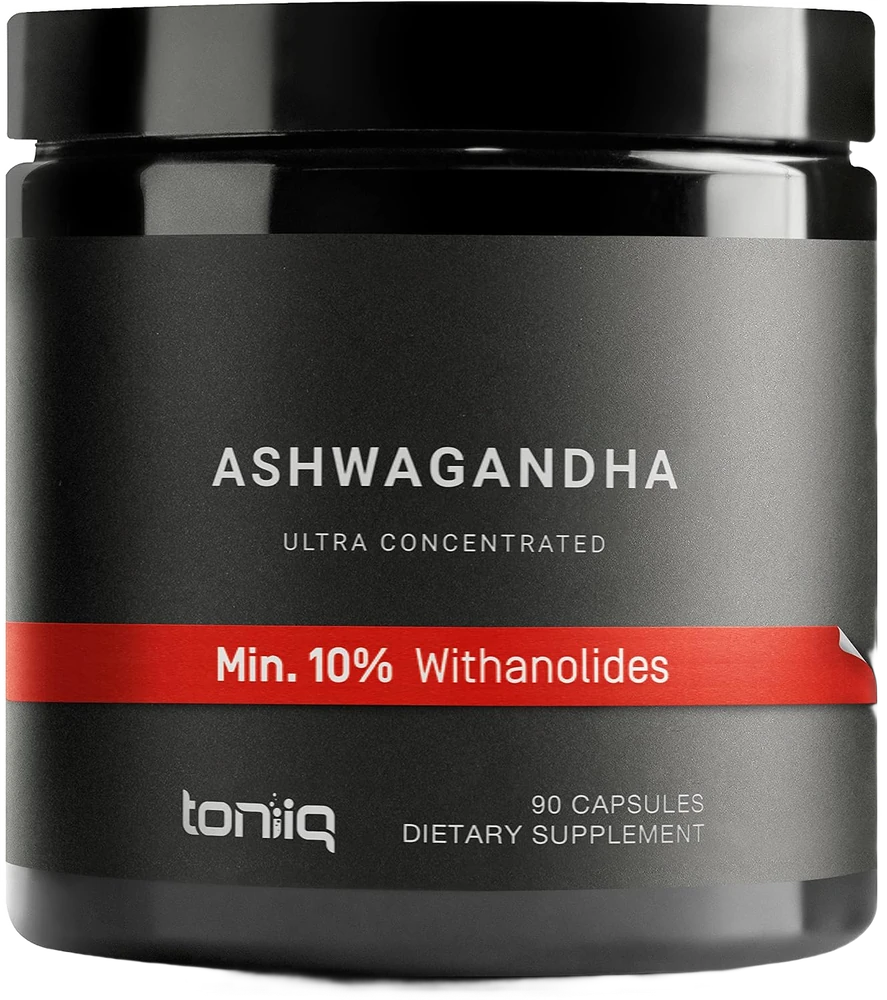
Best overall for anxiety: Toniiq Ultra High Strength Ashwagandha
The validated-responder's high-potency extract: 10% withanolides UHP is the highest standardised concentration on the consumer market — Toniiq's own wild-harvested 20:1 extract (not a patented KSM-66), 2× the standard 5% density, delivering ~130 mg active withanolide per single cap on an NSF-grade facility with public per-lot COAs. The cycle-two anxiety upgrade once you've confirmed a standard KSM-66 calms you — not a first bottle.
$32 / month~$32 / month at 1 cap (~130 mg withanolides)
Why it wins: all five scores, pros & cons, full label
- 10% withanolides UHP — the highest standardised concentration on the consumer market (2× standard KSM-66)
- ~130 mg active withanolides per single cap (4× a standard 5% trial dose)
- NSF-grade facility audit + public per-lot COA — the tightest documentation on the list
- Single-cap dosing + 90-count bottle — simplest protocol, longest supply
- Highest monthly price on the list at $32 — the maxxer premium, overkill for a first-time anxiety buyer
- Toniiq's own extract, not a trialled patent — the concentration isn't the dose the anxiety trials used (they ran on KSM-66 at 5%), and more potency means more sedation
- Extract
- Toniiq's own 20:1 wild-harvested extract — 10% withanolides Ultra High Potency (2× standard KSM-66's 5%); not KSM-66
- Active load
- 1300 mg/cap (~130 mg withanolides) — 4× a standard 600 mg 5% trial dose
- Profile
- High potency — start lower for anxiety, sedation scales with the load
- Testing
- NSF-grade facility audit + public per-lot COA with lookup (the documentation ceiling)

Our take — The highest-scoring bottle on the board on raw quality, but the wrong place to START for anxiety. The differentiator is real — Toniiq's own 20:1 extract is standardised to 10% withanolides, double the standard KSM-66 density, so a single cap delivers ~130 mg of actives versus ~30 mg from a standard 600 mg dose — and the NSF-grade facility plus public per-lot COAs make it the most rigorously documented bottle here. But the anxiety trials (Chandrasekhar 2012, Salve 2019) ran on KSM-66 at standard 5%, not on Toniiq's extract, so the UHP concentration is an extrapolation, not a trial-exact match, and the extra potency means more sedation — exactly what a sensitive first-timer doesn't want to lead with. Validate that you respond to a standard KSM-66 on Nutricost (#3) or Double Wood (#2) first, then upgrade to Toniiq for cycle two if you want maximum potency. For drug-tested athletes who also want the calm, the NSF-grade facility is an added draw. A superb bottle for the right, narrow audience.
 02
 03
 04
 05
 06
 07
Who Wins Which Aspect
Sorted by overall SAC Product Score™ — the official ranking.
| # | Pick | Score | Standardisation30% | Clinical source25% | Lab transparency20% | Trial-dose alignment15% | Price per active mg10% | Cost Per Dose | Buy |
|---|---|---|---|---|---|---|---|---|---|
| 01 | | 9.2 | 10.01 | 9.02 | 9.51 | 8.5 | 8.02 | ~$32 / month at 1 cap | Check price |
| 10% withanolides UHP — the highest standardised concentration on the consumer market (2× standard KSM-66)Highest monthly price on the list at $32 — the maxxer premium, overkill for a first-time anxiety buyer | |||||||||
| 02 | | 8.8 | 9.02 | 9.51 | 6.5 | 10.01 | 9.01 | ~$22 / month at the 600 mg anxiety dose | Check price |
| Real Ixoreal-licensed KSM-66 at the EXACT 600 mg anxiety-trial dose$8/month more than Nutricost (#3) for the identical Ixoreal extract — you pay for the public COA | |||||||||
| 03 | | 8.7 | 9.02 | 9.51 | 7.0 | 10.01 | 7.53 | ~$14 / month at the 600 mg anxiety dose | Check price |
| Real Ixoreal-licensed KSM-66 — the identical extract to Double Wood (#2) at $8/month lessNo public per-batch COA — only internal GMP batch QC and supplier docs (Double Wood #2 publishes lot-lookup) | |||||||||
| 04 | | 8.6 | 8.53 | 9.51 | 8.52 | 9.03 | 6.0 | $0.73 / 120 mg capsule | Check price |
| Own stress trial (Lopresti 2019)Two capsules a day for the stress dose: $1.47 | |||||||||
| 05 | | 8.3 | 9.02 | 9.51 | 7.53 | 8.0 | 5.0 | ~$18 / month at the 600 mg anxiety dose | Check price |
| Real Ixoreal-licensed KSM-66 at a lower per-cap dose — start at 300 mg if you're sedation-sensitive2 caps/day to hit the 600 mg anxiety dose — higher pill-count than the single-cap Nutricost | |||||||||
| 06 | | 8.1 | 7.5 | 8.53 | 7.0 | 9.52 | 9.01 | $0.19 / 125 mg capsule | Check price |
| 125 mg, a Sensoril trial doseWithanolide percentage not printed | |||||||||
| 07 | | 7.9 | 8.53 | 8.53 | 5.5 | 9.52 | 7.0 | ~$15 / month at the 125 mg Auddy 2008 dose | Check price |
| Sensoril hits cortisol harder per milligram — -24.2% cortisol at just 125 mg/day (Auddy 2008)More sedating than KSM-66 — daytime drowsiness is more likely, so this is an evening bottle | |||||||||
The Other 6, Ranked
- 02
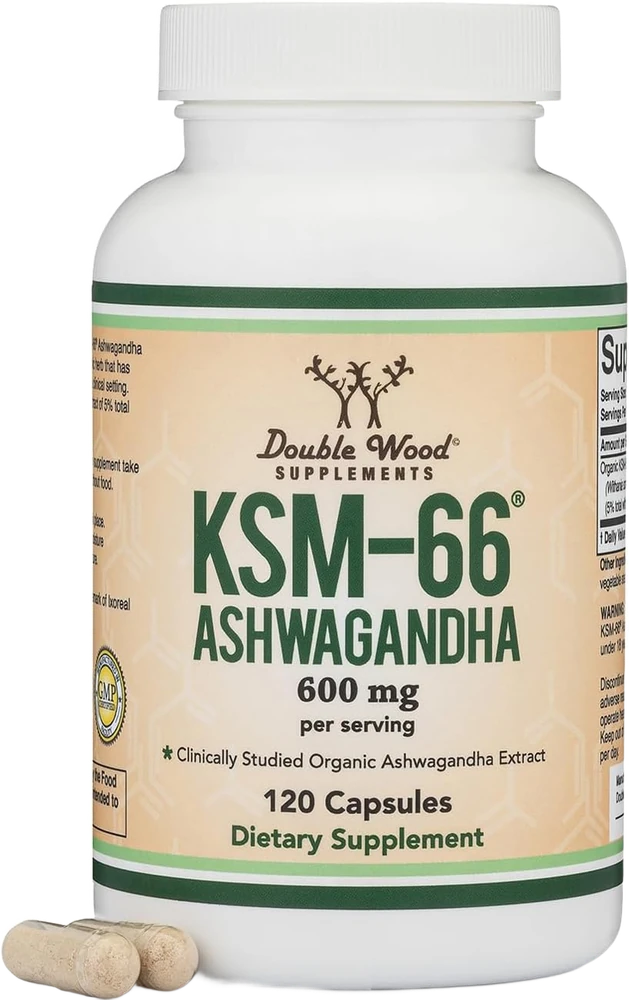
Best premium potency: Double Wood KSM-66 Ashwagandha 600 mg
8.8SAC Score™The default anti-anxiety bottle: real Ixoreal-licensed KSM-66 at the EXACT 600 mg dose the anxiety trials used (Chandrasekhar 2012, Salve 2019), daytime-balanced so it calms without flooring you, with a public per-batch COA you can look up by lot. The no-think first-time anxiety pick.
StrongestTrial-dose alignment10.01WeakestLab transparency6.5- Extract
- KSM-66 by Ixoreal Biomed — root-only, 5% withanolides (the trial-grade extract)
- Anxiety dose
- 300 mg/cap (~15 mg); 600 mg serving (2 caps) — the EXACT Chandrasekhar 2012 / Salve 2019 dose
- Profile
- Daytime-balanced — calms without the heavy sedation Sensoril carries
All five scores, pros & cons, full label
What We Like- Real Ixoreal-licensed KSM-66 at the EXACT 600 mg anxiety-trial dose
- Daytime-balanced — the right calm for general daytime stress, not a knockout
- Public per-batch COA with lot-lookup — verify your own bottle's withanolide %
- Strong Amazon track record — the safe, well-reviewed default KSM-66 with documentation
What You Live With- $8/month more than Nutricost (#3) for the identical Ixoreal extract — you pay for the public COA
- Two 300 mg caps per serving — slightly more pill-load than a one-cap 600 mg bottle (Nutricost #3)
- Testing
- Public per-batch COA with lot-lookup + GMP facility
Our take — The default first-time pick for anxiety, and the bottle most anxious buyers should put in the cart. KSM-66 owns the headline anxiety data — Chandrasekhar 2012 cut perceived stress -44% and morning cortisol -27.9% at exactly this 600 mg dose, and Salve 2019 reproduced the anxiolytic effect — and it's the more daytime-balanced extract, so it calms the over-revved system without the heavy sedation Sensoril carries. Double Wood delivers that real Ixoreal-licensed extract at the trial-exact dose as a 2-capsule serving (300 mg each), with a public per-batch COA you can look up by lot to verify your specific bottle. The only knocks are price (Nutricost #3 ships the identical extract for $8 less) and that you swallow two caps for the 600 mg dose rather than one — though the 300 mg/cap also lets sensitive responders start low and ramp. For anxiety that runs through the day, this is the bottle. If your anxiety is worst at night and wrecks your sleep, the more sedating Sensoril (#2) is the better tool.
- 03
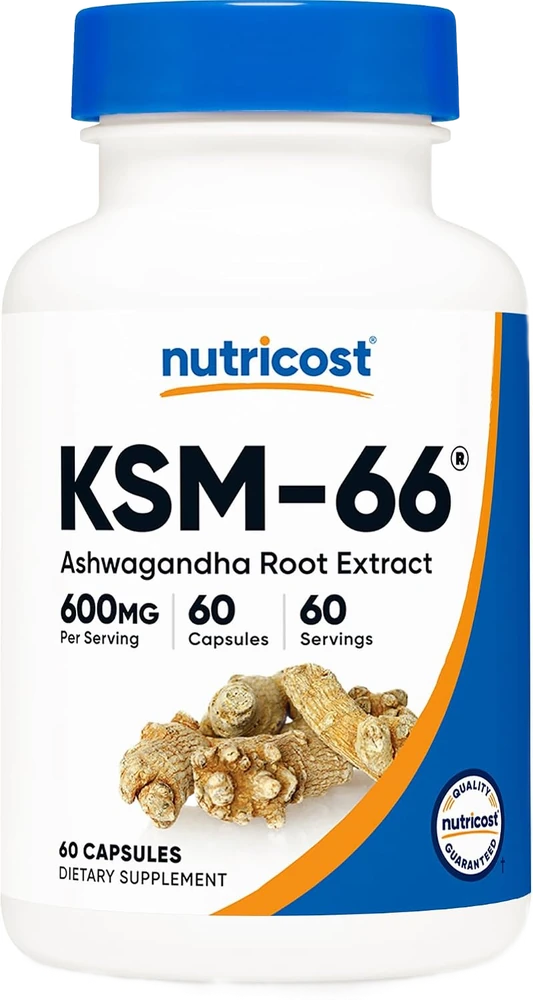
Best budget: Nutricost KSM-66 Ashwagandha 600 mg
8.7SAC Score™The floor-price legitimate KSM-66 for anxiety: the same Ixoreal-licensed extract as Double Wood, at the exact 600 mg Chandrasekhar 2012 anxiety dose, in a single cap, daytime-balanced, for $14/month. The smartest cycle-one bottle for validating whether ashwagandha calms you before committing to anything pricier.
StrongestTrial-dose alignment10.01WeakestLab transparency7.0- Extract
- KSM-66 by Ixoreal Biomed — root-only, 5% withanolides (identical to Double Wood)
- Anxiety dose
- 600 mg/cap (~30 mg withanolides) — the exact Chandrasekhar 2012 dose
- Profile
- Daytime-balanced — one swallow, no titration math
All five scores, pros & cons, full label
What We Like- Real Ixoreal-licensed KSM-66 — the identical extract to Double Wood (#2) at $8/month less
- 600 mg single cap = the EXACT Chandrasekhar 2012 anxiety dose, daytime-balanced
- Best per-active-mg math of any patent-verified KSM-66 — the smart cycle-one anxiety bottle
- $28 over 8 weeks validates whether ashwagandha calms you before you upgrade
What You Live With- No public per-batch COA — only internal GMP batch QC and supplier docs (Double Wood #2 publishes lot-lookup)
- Fewer Amazon reviews and less track record than Double Wood at the KSM-66 tier
- Testing
- GMP facility + Ixoreal supplier docs + internal batch QC (no public COA)
Our take — The value play for anxiety, and a genuinely good one — the cheapest legitimate KSM-66 on the consumer market at the exact anxiety-trial dose. The extract inside the capsule is the same Ixoreal-licensed KSM-66 as Double Wood's, from the same supplier under the same patent contract; what you give up is the consumer-facing per-batch COA. For a first-time anxiety buyer running an 8-week responder test, that's the right trade — $28 total to learn whether ashwagandha actually calms you, and if it does, upgrade to Double Wood (#2) for the audit-grade documentation on cycle two. The honest wrinkle is that Double Wood sits only $8/month higher and adds the public COA, so documentation-driven buyers should pay up. But for the buyer who just wants the real patent at the daytime-balanced anxiety dose for the least money, Nutricost is the answer.
- 04
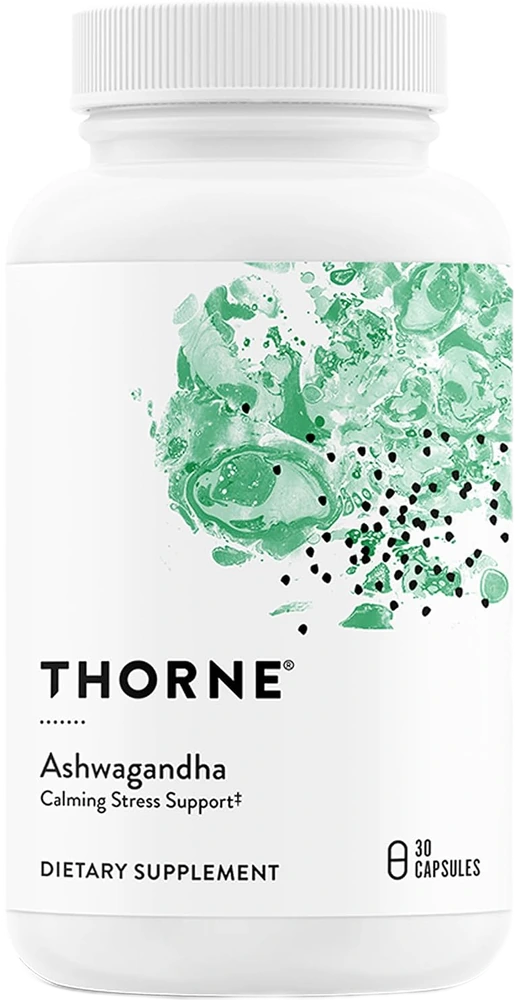
Shoden for stress: Thorne Ashwagandha (Shoden)
8.6SAC Score™Shoden at 240 mg a day, two capsules, lowered anxiety scores and morning cortisol against placebo in 60 stressed adults (Lopresti 2019).
StrongestClinical source9.51WeakestPrice per active mg6.0- Standardization
- 35% withanolide glycosides (gallery card; not on the panel)
- Extract
- Shoden root and leaf extract
- Per capsule
- 120 mg
All five scores, pros & cons, full label
What We Like- Own stress trial (Lopresti 2019)
- Small capsules
- Short ingredient list
What You Live With- Two capsules a day for the stress dose: $1.47
- Standardization not printed on the panel
- Testing
- Thorne in-house; not NSF Certified for Sport (checked Oct 14, 2026)
Our take — Take two capsules a day for the trial dose. It works on the same stress axis as KSM-66 at a much smaller dose, but the KSM-66 capsules above it cost less per day.
- 05
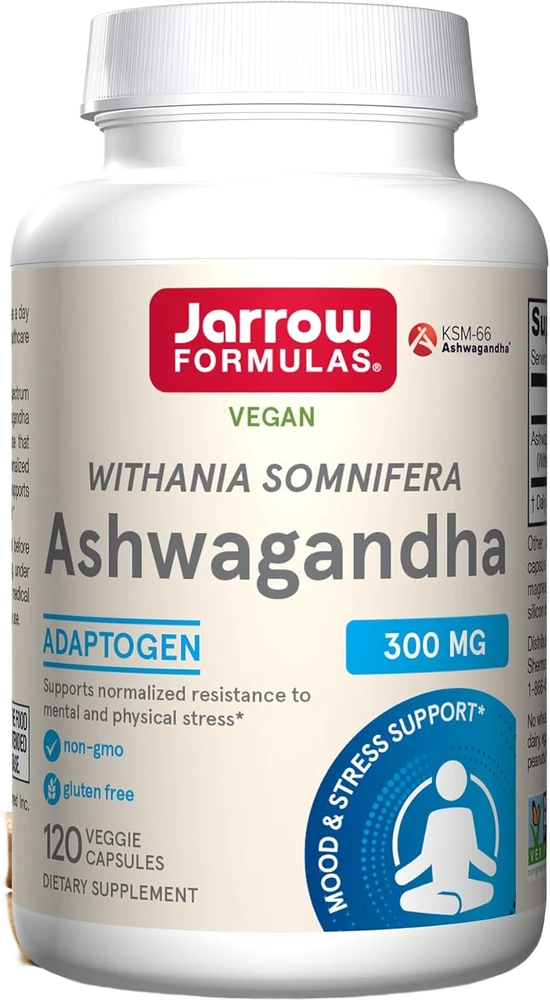
Best for sensitive responders: Jarrow Formulas KSM-66 Ashwagandha 300 mg
8.3SAC Score™Real KSM-66 at half the per-cap dose — the titration-friendly anxiety pick for sensitive responders. Start at 300 mg, gauge the sedation, and ramp to the 600 mg anxiety dose without buying a second bottle. From Jarrow's 47-year QC pedigree.
StrongestClinical source9.51WeakestPrice per active mg5.0- Extract
- KSM-66 by Ixoreal Biomed — root-only, 5% withanolides (the most-studied extract)
- Anxiety dose
- 300 mg/cap (~15 mg withanolides); 600 mg anxiety dose = 2 caps, split AM/PM
- Profile
- Daytime-balanced — and the easiest dose to ease into at 300 mg
All five scores, pros & cons, full label
What We Like- Real Ixoreal-licensed KSM-66 at a lower per-cap dose — start at 300 mg if you're sedation-sensitive
- Titrate from 300 to 600 mg, and run the 300 mg AM + 300 mg PM split, from one bottle
- Jarrow's 47-year QC pedigree (founded 1977) — the strongest brand track record on the list
- Non-GMO + gluten-free + vegan + kosher — the cleanest certification set of any KSM-66 bottle
What You Live With- 2 caps/day to hit the 600 mg anxiety dose — higher pill-count than the single-cap Nutricost
- Higher per-active-mg cost than Nutricost (#3) for the same Ixoreal extract — the pedigree premium is real
- Testing
- Jarrow in-house analytical labs + GMP + batch QC (no public per-batch COA)
Our take — The pick for the anxious buyer who's new to ashwagandha or worried about feeling sedated or flat. The 300 mg/cap design is the feature: it lets you start at a gentle 300 mg, gauge how the sedation hits you, and ramp to the full 600 mg anxiety dose without committing to a second bottle — the gentlest on-ramp on the list, from the brand with the deepest QC pedigree (47 years, founded 1977). It's the same real Ixoreal KSM-66 as the top picks; the only trades are a slightly higher per-active-mg cost than Nutricost (#3) and a 2-cap trial dose. If you already know you tolerate ashwagandha and want the simplest single-cap dose, the single-cap Nutricost (#3) wins on convenience. But for the sensitive, first-time anxiety buyer who wants to titrate, this is the smart way in.
- 06
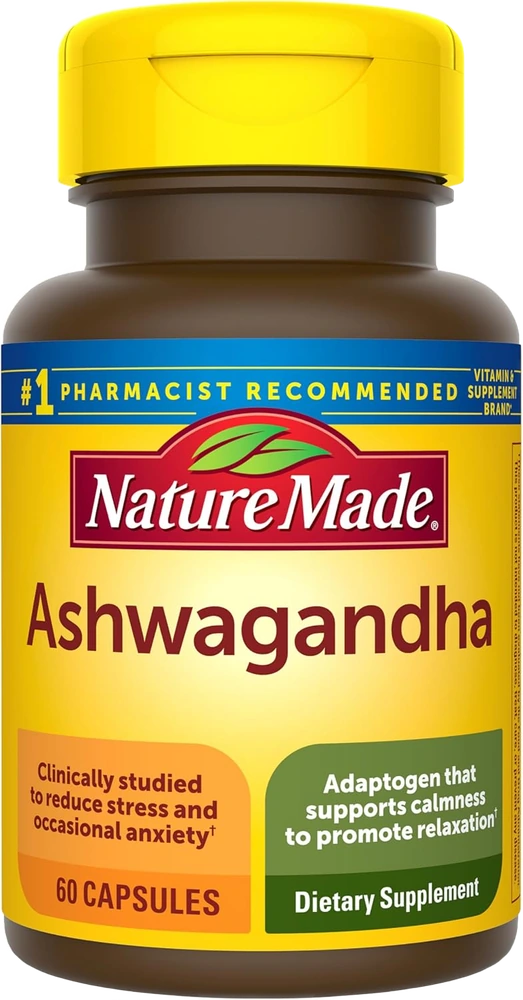
Budget Sensoril: Nature Made Ashwagandha 125 mg (Sensoril)
8.1SAC Score™125 mg of Sensoril per capsule, the low dose of that extract's stress trial, for about 19 cents a day. The cheapest branded extract on this list.
StrongestTrial-dose alignment9.52WeakestLab transparency7.0- Standardization
- Not printed on the panel
- Extract
- Sensoril root and leaf extract
- Per capsule
- 125 mg
All five scores, pros & cons, full label
What We Like- 125 mg, a Sensoril trial dose
- 19 cents a day
- One capsule a day
What You Live With- Withanolide percentage not printed
- Fewer, harder-to-check trials than KSM-66
- Testing
- Maker's own; no outside seal
Our take — The low-cost way to try ashwagandha for stress. KSM-66 at 600 mg a day has the deeper anxiety evidence; Life Extension's Sensoril below prints its standardization on the label.
- 07
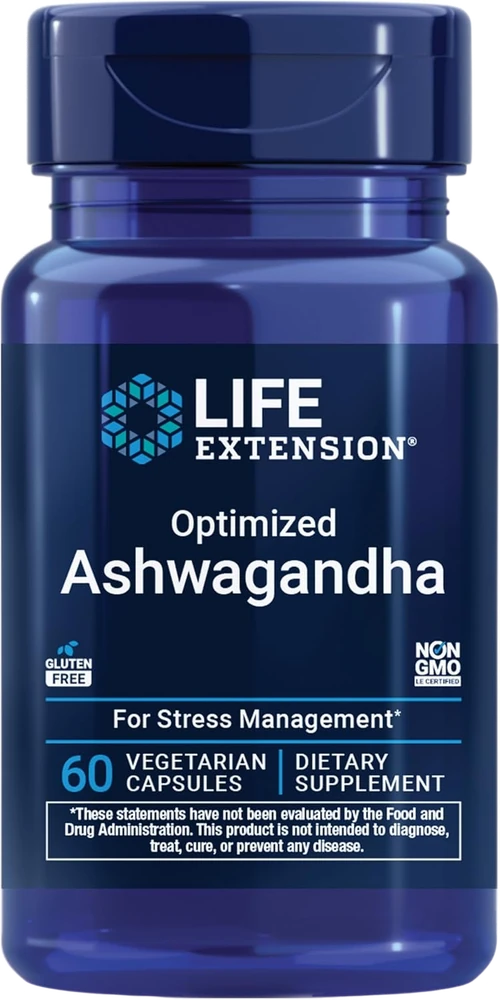
Best for racing thoughts + sleep: Life Extension Optimized Ashwagandha (Sensoril)
7.9SAC Score™The pick for the buyer whose anxiety is worst at night: Sensoril by Natreon — a root + leaf extract at 10% withanolides that hits cortisol harder per milligram (Auddy 2008: -24.2% at just 125 mg) and is MORE SEDATING. Taken in the evening, the sedation becomes a sleep aid. The racing-thoughts-at-night tool.
StrongestTrial-dose alignment9.52WeakestLab transparency5.5- Extract
- Sensoril by Natreon — root + leaf, 10% withanolides + 32% oligosaccharides (≠ KSM-66)
- Anxiety dose
- 125 mg/cap (~12.5 mg withanolides) — the exact Auddy 2008 cortisol dose
- Profile
- More sedating — best taken PM for anxiety-with-poor-sleep
All five scores, pros & cons, full label
What We Like- Sensoril hits cortisol harder per milligram — -24.2% cortisol at just 125 mg/day (Auddy 2008)
- More sedating — the right tool for racing thoughts at night, taken in the evening as a sleep aid
- 10% withanolides root + leaf — double KSM-66's density at a quarter of the gram dose
- Life Extension's in-house analytical labs — among the strictest QC in the category at $15/month
What You Live With- More sedating than KSM-66 — daytime drowsiness is more likely, so this is an evening bottle
- Direct anxiety-trial base is thinner than KSM-66's, and built mostly on the cortisol endpoint
- Testing
- Life Extension in-house analytical labs + per-lot QC
Our take — The pick for the buyer whose anxiety and insomnia travel together — racing thoughts at night, can't switch off, sleep wrecked. Sensoril is not a stronger KSM-66; it's a fundamentally different extract (root + leaf vs root-only, 10% withanolides vs 5%, a more sedating compound profile). For the cortisol endpoint its per-milligram efficiency genuinely wins: Auddy 2008 measured -24.2% cortisol at just 125 mg/day, where KSM-66 needs 600 mg. Taken in the evening, the sedation everyone warns about with Sensoril becomes the feature — it quiets the mental chatter and deepens sleep. Life Extension hits the Sensoril sweet spot: the real Natreon patent at the trial-exact dose, in-house-lab QC, $15/month. The catch is the flip side of its strength: it's the wrong bottle for daytime anxiety (the sedation), and its direct anxiety-trial base is thinner than KSM-66's. For daytime stress, go Double Wood (#2) or Nutricost (#3); for night-time racing thoughts, this is it.
Ashwagandha In Four Short Lessons
Why ashwagandha is the most-evidenced adaptogen for anxiety
- −44%
- Perceived stress at 600 mg KSM-66 / 60 d in chronically stressed adults (Chandrasekhar 2012)
- −27.9%
- Morning cortisol drop at 600 mg KSM-66 over 60 days (Chandrasekhar 2012)
- −24.2%
- Cortisol at just 125 mg/day Sensoril — the per-mg cortisol lever (Auddy 2008)
- ≥ 5%
- Withanolide threshold separating a working anti-anxiety extract from inert root powder
Sources: Chandrasekhar 2012 (PMID 23439798); Salve 2019 (PMID 32021735); Lopresti 2019 stress (PMID 31517876); Auddy 2008.
Do not take it with an autoimmune condition.
Ashwagandha is mildly immunostimulating, so it is the wrong tool with Hashimoto's, lupus or RA. Clear it with a doctor before adding it to an SSRI, SNRI or thyroid medication.
Read the extract name before the dose.
The anxiety trials ran on two standardised patent extracts. The patent name and the withanolide percentage tell you more than the gram weight on the front.
Choose KSM-66 for the day, Sensoril for the night.
KSM-66 at 600 mg a day carries the headline anxiety data (Chandrasekhar 2012) and suits daytime stress. Sensoril is more sedating and lowered cortisol at just 125 mg (Auddy 2008), which fits racing thoughts at night.
Chandrasekhar 2012 (PMID 23439798), Salve 2019 (PMID 32021735), Auddy 2008 — scored on extract patent, withanolide standardisation, third-party testing, daytime-calm vs sedation fit, and anxiety-trial evidence.
Each pick was re-scored 0-10 across five anxiety-specific criteria, then weighted to a composite. Extract patent and withanolide standardisation carry the most weight because they directly predict whether your capsule delivers the cortisol effect the trials measured — generic root powder inherits none of the anxiety RCT base. Third-party testing acts as a fraud filter, since counterfeit 'KSM-66' is the #1 adulteration vector on Amazon. Daytime-calm vs sedation fit is the axis that distinguishes the anxiety use-case from the testosterone one — it's why Sensoril (more sedating) ranks at the top for racing-thoughts-at-night while KSM-66 (balanced) is the daytime default. Anxiety-trial evidence rewards the extracts the direct anxiety/cortisol RCTs actually ran on.
Extract patent · 25%
Is it a named, verifiable patent extract — KSM-66 (Ixoreal, root-only 5%) or Sensoril (Natreon, root + leaf 10%) — the only forms with a real anxiety RCT base? Patent-verified extracts score highest because they inherit the trial evidence (Chandrasekhar 2012, Salve 2019, Auddy 2008). Generic 'standardised root' is marked down hard: however clean the QC, it carries none of the extract-specific anxiety data.
Withanolide standardisation · 25%
What's the guaranteed withanolide percentage — the cortisol-effect lever — and is it honestly labeled? 10% Sensoril and Toniiq's own 10% UHP extract score top on density; standard 5% KSM-66 scores well; sub-tier 2.5% generic root is marked down; unstandardised 'high-strength root' with a vague percentage scores worst regardless of its gram weight. This number, not the raw mg, determines the real anti-anxiety dose.
Third-party testing · 20%
The documentation tier: public per-batch COA with lot-lookup (Double Wood, Toniiq) > in-house analytical labs (Life Extension, NOW) > GMP facility + internal QC (Nutricost, Jarrow). Decisive against counterfeiting — the #1 ashwagandha fraud on Amazon — and the only way to verify YOUR specific bottle's withanolide % matches the declared standardisation.
Daytime-calm vs sedation fit · 15%
Does the extract's sedation profile match the buyer's anxiety pattern? KSM-66 is more daytime-balanced (the default for general daytime stress); Sensoril is more sedating (the tool for racing-thoughts-at-night and anxiety-with-poor-sleep). This is the axis that makes the anxiety ranking different from the testosterone one — Sensoril rises on it for the night-time buyer.
Anxiety-trial evidence · 15%
Did a direct anxiety or cortisol RCT run on the exact extract? KSM-66 owns the headline anxiety data (Chandrasekhar 2012's -44% perceived stress / -27.9% cortisol; Salve 2019's anxiolytic effect); Sensoril owns the per-milligram cortisol data (Auddy 2008's -24.2% at 125 mg). Generic root scores lowest — its anxiety evidence at the relevant concentration simply does not exist.

How ashwagandha actually lowers anxiety
- 1
HPA-axis suppression
The withanolides — whether from KSM-66 root or Sensoril root + leaf — dampen the hypothalamic-pituitary-adrenal stress response. Sensoril's higher 10% standardisation and leaf-derived profile hit this lever harder per milligram, which is why it's more sedating at a lower gram dose.
- 2
Cortisol down
Morning cortisol drops measurably at the trial dose — -27.9% at 600 mg KSM-66 over 60 days (Chandrasekhar 2012), -24.2% at 125 mg Sensoril (Auddy 2008). Lower cortisol is the proximate cause of the calmer mood, quieter racing thoughts, and steadier stress tolerance buyers actually feel.
- 3
Felt anxiety + sleep improve
With cortisol lowered, perceived stress and anxiety fall (Chandrasekhar 2012 measured -44% perceived stress; Salve 2019 reproduced the anxiolytic effect) and sleep depth improves — the sedation is a feature at night. The effect is largest where elevated cortisol was driving the anxiety.
What to expect on an 8-week anxiety protocol
Sleep depth + morning calm
Sleep deepens and racing thoughts quiet down — usually the first signal. Sensoril responders often notice the racing-thoughts effect inside 10 days; KSM-66 a touch slower. This is the cortisol mechanism engaging.
Daytime stress tolerance
Day-to-day stress reactivity drops and a steadier baseline mood settles in. Perceived-stress scores fall measurably in this window across the anxiety trial literature.
Cortisol measurably lower
The HPA-axis effect lands fully — cortisol down 24-28% at the trial dose. The anxiety reduction is most durable here. Re-assess your anxiety/sleep log and decide on cycling.
The bottom line
For general daytime anxiety, buy Double Wood KSM-66 (#2).
It delivers real Ixoreal-licensed KSM-66 at the exact 600 mg dose the anxiety trials used, daytime-balanced so it calms without flooring you, with a public per-batch COA you can look up by lot — $22/month.
Match the alternative to your pattern: Shoden (#4) for one small dose, Nutricost (#3) for budget, Sensoril (#6, #7) for low cost.
Thorne (#4) is Shoden, which lowered anxiety scores and morning cortisol at 240 mg a day (Lopresti 2019). Nutricost KSM-66 (#3) if money is tight but you want the real patent; Jarrow KSM-66 (#5) if you want to start low and titrate up. Nature Made (#6) and Life Extension (#7) are Sensoril at 125 mg, the low-dose stress extract; Nature Made is the cheapest, Life Extension prints its standardization.
It works over weeks, not day one — match the extract, dose to the trial load, and clear the hard stops first.
Match the extract to your pattern (KSM-66 for daytime, Sensoril for night-time racing thoughts), dose to the trial load (600 mg/day KSM-66 or 125-250 mg/day Sensoril), and run a real 8-week cycle. And rule out the hard stops before the first capsule: no autoimmune condition (Hashimoto's, lupus, RA), and clear it with your doctor before stacking on an SSRI/SNRI or thyroid medication.
Quick Answers
KSM-66 or Sensoril — which ashwagandha is better for anxiety?
Both work for anxiety, but they fit different patterns, so pick by yours. KSM-66 (by Ixoreal, root-only, 5% withanolides) carries the headline anxiety data and is the more DAYTIME-BALANCED default: Chandrasekhar 2012 cut perceived stress -44% and morning cortisol -27.9% at 600 mg/day, and Salve 2019 reproduced the anxiolytic effect in healthy-but-stressed adults. It calms without flooring most people during the day, which is why it's the right default for general daytime anxiety and tension. Sensoril (by Natreon, root + leaf, 10% withanolides) is the more SEDATING and calming extract — it hits cortisol harder per milligram (Auddy 2008: -24.2% cortisol at just 125 mg/day) and a single small cap is more likely to quiet racing thoughts. If your anxiety is worst at night and it's wrecking your sleep, Sensoril taken in the evening is the better tool; the sedation becomes a feature. They are NOT interchangeable on a milligram basis, and stacking the two isn't productive — they target the same HPA-axis mechanism.
How much ashwagandha should I take for anxiety?
Dose to the trial load for whichever extract you chose, not to the biggest number on the bottle. For KSM-66 that's 600 mg/day — the exact dose Chandrasekhar 2012 and Salve 2019 used for the anxiety and cortisol endpoints — taken as one 600 mg cap or split 300 mg AM + 300 mg PM with food. For Sensoril it's 125-250 mg/day (the Auddy 2008 window); do NOT scale Sensoril up to 600 mg, you'll just leave the studied range and amplify the sedation. If the dose makes you drowsy during the day, move all of it to the evening — for the anxiety-with-poor-sleep buyer that's the point. More is not better here; the cortisol effect plateaus and oversized unstandardised doses mostly add side effects, not calm.
How long until ashwagandha actually helps my anxiety?
Expect a staged response over an 8-week cycle, not a day-one effect — ashwagandha is not a fast-acting anxiolytic like a benzodiazepine. Sleep depth and morning calm tend to shift first; many responders notice quieter mornings and fewer racing thoughts inside 1-2 weeks. Daytime stress tolerance and a steadier baseline mood stabilise around weeks 3-5. The measurable cortisol drop needs the full 8 weeks — Chandrasekhar 2012 and the other anxiety trials ran 60-day windows. The honest protocol: run a single patented bottle at the trial dose (600 mg KSM-66 or 125 mg Sensoril) for 8 weeks and keep a simple anxiety/sleep log. If nothing has shifted by week 4, verify the patent logo on your specific bottle before concluding you're a non-responder — counterfeit or unstandardised extract is the more common reason it 'didn't work.'
Will ashwagandha make me drowsy or sedated during the day?
It can, and the answer depends on which extract and when you dose it. Sensoril is the more sedating of the two (higher withanolide density, leaf-derived profile), so daytime drowsiness is more likely with it — which is exactly why it's the recommendation for racing-thoughts-at-night and is best taken in the evening. KSM-66 is more daytime-balanced and most people tolerate a morning dose fine, but a minority still feel a mild calm-bordering-on-flat effect. The fix is the same for both: if you feel sedated during the day, move the dose (or the larger half of a split dose) to the evening. Used that way, the sedation stops being a nuisance and becomes a sleep aid — useful for the large overlap of buyers whose anxiety and insomnia travel together.
Can I take ashwagandha for anxiety if I have an autoimmune condition?
No — this is the most important caveat for the anxiety buyer, because anxiety and autoimmune conditions overlap heavily. Ashwagandha is mildly IMMUNOSTIMULATING: it can up-regulate parts of the immune response, which is the last thing you want with an autoimmune disease where the immune system is already over-active. The standard guidance is to avoid it if you have Hashimoto's thyroiditis, lupus, rheumatoid arthritis, or another autoimmune condition. It can also raise thyroid hormone, so if you're on thyroid medication, only use it under a doctor's supervision. None of this is extract-specific — it applies to KSM-66, Sensoril, and generic root alike. If you have an autoimmune diagnosis and anxiety, ashwagandha is the wrong tool; magnesium glycinate and L-theanine are safer adaptogenic-adjacent options to discuss with your doctor instead.
Is it safe to take ashwagandha with an SSRI or other anxiety medication?
Don't combine them without clearing it with your prescriber first. Ashwagandha is mildly sedating and acts on the stress/HPA system, so layering it on top of an SSRI, SNRI, benzodiazepine, or other sedative can be additive — most often that just means more drowsiness, but it's a conversation to have with the doctor who manages your medication, not a DIY stack. There's no well-characterised dangerous interaction in the trial literature, but the anxiety-medication population is exactly the group that should be cautious, because you're already modulating the same systems pharmacologically. Practical rule: if you're on any prescription for anxiety, depression, sleep, thyroid, or immune conditions, ask your doctor before starting ashwagandha — and never stop or change a prescribed medication on your own to make room for a supplement.
Every Claim Ranked Above Traces Back To One Of These
6 sources — studies link to PubMed, product specs to the manufacturer
- [1] Chandrasekhar 2012 PMID 23439798 — A prospective, randomized double-blind, placebo-controlled study of safety and efficacy of a high-concentration full-spectrum extract of ashwagandha root in reducing stress and anxiety in adults. 600 mg/day KSM-66 for 60 days in chronically stressed adults reduced perceived stress -44% and morning serum cortisol -27.9% vs placebo. The headline anxiety + cortisol evidence at the standard KSM-66 dose — the cornerstone trial behind the 600 mg anxiety recommendation and the daytime-balanced default in this guide.
- [2] Salve 2019 PMID 32021735 — Adaptogenic and anxiolytic effects of ashwagandha root extract in healthy adults: a double-blind, randomized, placebo-controlled clinical study. 60 stressed adults took 250 or 600 mg a day of ashwagandha root extract, or a placebo, for 8 weeks. Perceived stress and serum cortisol fell at both doses. Sleep quality improved compared with placebo. The authors conclude it eased anxiety, but the abstract gives no anxiety-score numbers.
- [3] Auddy 2008 — A standardized Withania somnifera extract significantly reduces stress-related parameters in chronically stressed humans: a double-blind, randomized, placebo-controlled study. 125-250 mg/day Sensoril for 60 days in chronically stressed adults reduced serum cortisol -24.2% and raised DHEA-S +32% vs placebo. The cornerstone Sensoril trial anchoring Life Extension's 125 mg dose (#7) — demonstrates Sensoril's higher per-milligram HPA-axis potency, matching KSM-66's cortisol effect at roughly a fifth of the gram dose.
- [4] Lopresti 2019 PMID 31517876 — An investigation into the stress-relieving and pharmacological actions of an ashwagandha (Withania somnifera) extract: a randomized, double-blind, placebo-controlled study. 60 stressed adults took 240 mg of Shoden or placebo once daily for 60 days. Anxiety scores (HAM-A) fell more than on placebo, as did morning cortisol and DHEA-S. Sleep was not an outcome.
- [5] Kelgane 2020 PMID 32226684 — Efficacy and tolerability of ashwagandha root extract in the elderly for improvement of general well-being and sleep: a prospective, randomized, double-blind, placebo-controlled study. 600 mg/day KSM-66 for 12 weeks in elderly adults improved sleep quality, general well-being, and mental alertness vs placebo. Extends the sleep-quality evidence base that pairs with anxiety relief — relevant because anxiety and disrupted sleep so often travel together.
- [6] Lopresti 2019 (hormonal) PMID 30854916 — A randomized, double-blind, placebo-controlled, crossover study examining the hormonal and vitality effects of ashwagandha (Withania somnifera) in aging, overweight males. 57 overweight men aged 40-70 took Shoden (21 mg withanolide glycosides a day) or placebo for 8 weeks each in a crossover trial. Testosterone rose 14.7% and DHEA-S 18% more than on placebo; cortisol, fatigue and sexual well-being did not differ. The extract was Shoden, not KSM-66.
More Ashwagandha Guides
- Best Ashwagandha SupplementsThe definitive ashwagandha buying guide — the single best pick for each buyer across KSM-66 and Sensoril extracts. Standardisation % and extract patent matter far more than milligrams.
- Best Ashwagandha for SleepAshwagandha shortens sleep latency by lowering evening cortisol (Langade 2019). Sensoril (more sedating) leads for sleep; ranked by extract, evening-dose practicality, and sleep-trial evidence.
- Best Ashwagandha for TestosteroneThe ashwagandha extracts with the strongest evidence for free-T support — KSM-66 leaders ranked by trial data and quality markers.
- Best Ashwagandha GummiesAshwagandha gummies ranked by dose (most sit at the 300 mg floor), KSM-66 vs generic extract, and sugar per serving — plus when capsules are the better call.
Affiliate disclosure: every Amazon link uses our Associates tag (superachieverclub-20). We earn a small commission at no cost to you; it funds independent reviews. We never accept payment to change a ranking.