
New Nordic Ashwagandha Gummies Review
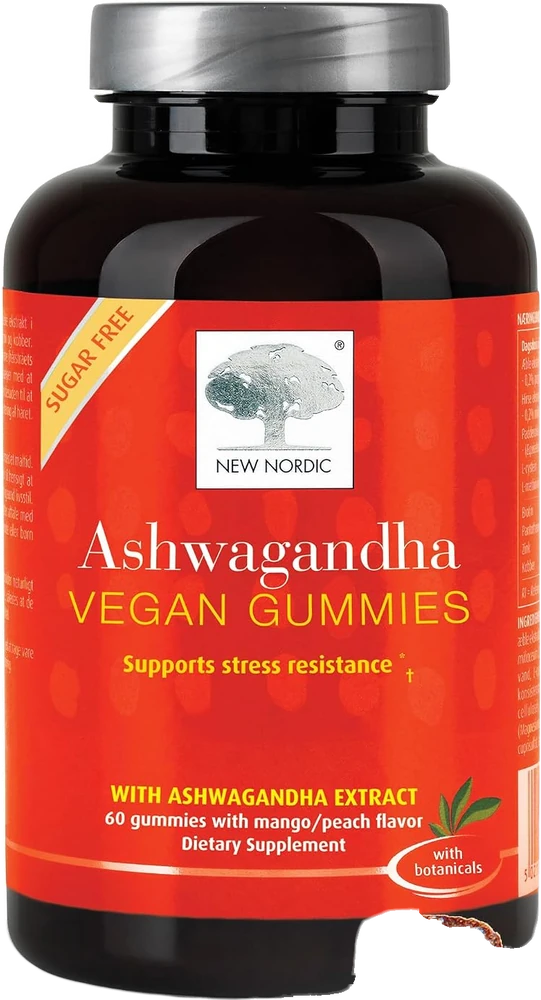 #6 of 7 · Best sugar-free alternative✓ Label verified · Supplement Facts read Aug 27, 2026
Real retailer photo, cut out. Label unedited.
Consider it. A fair sugar-free fallback — but it's an unbranded extract, not KSM-66. Goli Zero Sugar is the better buy for a few dollars more. 300 mg of ashwagandha per serving (floor of the 300-600 mg range), genuinely sugar-free, vegan, mango-peach, and cheaper than Goli Zero Sugar at $0.57/serving.
$17 / 60 gummies (30 servings)$0.57 / 2-gummy serving (300 mg extract)
Why It Scores 7.3 — And The Label Line Behind Each Number
Extract form & standardisation
30% of scoreThe weakest link and the reason this sits at #6. The label declares '300 mg ashwagandha root extract (10:1)' — an UNBRANDED extract that is NOT KSM-66 and NOT Sensoril, with NO stated withanolide percentage. '10:1' is a concentration ratio (a process spec), not a potency guarantee, and withanolides are the active markers the trials measured. Because the published RCTs ran on standardised extracts (KSM-66 at ≥5%, Sensoril at ≥10%), the studied potency cannot be assumed here: a milligram of unbranded 10:1 extract is not guaranteed to match the withanolide load of a milligram of KSM-66. It's a genuine concentrated extract (not raw root powder), which keeps the score off the floor — but the missing standardisation marker is exactly what the 30%-weighted criterion penalises.
- Active form
- Ashwagandha root extract (Withania somnifera), 10:1 — UNBRANDED (not KSM-66 / Sensoril)
- Daily dose
- 2 gummies (one serving); one chew = only 150 mg
- Flavor / diet
- Mango-peach · vegan · sugar-free / low-carb friendly
- Trial-dose context
- 300 mg = floor of the 300-600 mg/day evidence range (established on standardised extract)
Dose vs clinical range
25% of score300 mg per 2-gummy serving sits at the FLOOR of the 300-600 mg/day evidence range — a legitimate dose. Salve 2019 showed 250 mg already beat placebo on stress; Chandrasekhar 2012 used 300 mg twice daily for its headline cortisol effect. So the milligram target is in the right place and matches the mainstream KSM-66 gummies on the list. The asterisk that holds the score below the KSM-66 picks: that range was established on STANDARDISED extract, so a milligram here isn't guaranteed to deliver the same active load. One serving a day puts you at the low end of the range, as with every other gummy in the category.
Label cleanliness & testing
20% of scoreGenuinely sugar-free (the headline selling point), vegan, with a short, clean ingredient panel and a single mango-peach flavor from an established supplement brand with GMP-tier manufacturing. The two things that keep it from scoring higher: it's sweetened with maltitol + erythritol — sugar alcohols that can cause bloating/GI upset (maltitol especially), a real downside versus Goli Zero Sugar's allulose + stevia — and there's no published third-party COA, no withanolide standardisation declared, and no NSF/USP-tier certification. Clean and honest as a sugar-free label; short of the verification documentation the top picks carry.
- Certifications
- GMP-tier manufacturing; no published third-party COA, no NSF/USP, no withanolide standardisation
Format & adherence
15% of scoreThis is where the gummy format earns its keep. Ashwagandha works by lowering the cortisol baseline over 4-8 weeks of DAILY dosing, so the format you'll actually take every day matters — and a pleasant mango-peach, sugar-free gummy is about as low-friction as it gets. Easy to take, no water needed, no capsule fatigue, widely available so re-ordering is simple. Loses a little only because it doses on two gummies (one chew is half a dose) and the sugar-alcohol load caps how many you'd comfortably take in a day. Strong adherence profile overall.
Value per serving
10% of scoreAt roughly $17 for 60 gummies (30 servings), that's about $0.57 per 2-gummy serving — cheaper than Goli Zero Sugar (#3) at ~$0.73/serving, which is its whole reason for existing on the list. Good value for a sugar-free gummy on a pure price basis. The honest caveat: cheap per serving only counts if the active content is there, and the unbranded, unstandardised extract means you're paying a lower price for an unverified withanolide dose. The few extra dollars for Goli Zero Sugar buy you a known, standardised extract — which is why 'cheaper' doesn't automatically mean 'better buy' here.
- Per serving
- 300 mg ashwagandha root extract (2 gummies, 150 mg each)
- Bottle size
- 60 gummies — 30-day supply at 2 gummies/day
- Price
- ~$17 / 60 gummies (~$0.57 per 2-gummy serving)
- More Specs
- Withanolide %
- Not stated on label — true potency unknown
- Sugar
- 0 g — sweetened with maltitol + erythritol (sugar alcohols)
Label verified. Every figure read from the Supplement Facts photo, Aug 27, 2026.
Marketing Claims Vs. Reality
300 mg ashwagandha — the clinically studied amount.
The milligram number does sit at the floor of the 300-600 mg studied range, but the clinical evidence was built on STANDARDISED extracts (KSM-66 ≥5% withanolides, Sensoril ≥10%). New Nordic uses an unbranded 10:1 extract with no stated withanolide percentage, so we cannot verify the active content matches the studied material. Claiming the dose equals the clinical evidence is not verified — the milligram weight aligns, the standardised potency behind it does not.
Supports a healthy stress response / calm.
Ashwagandha as a category has solid placebo-controlled evidence for lowering cortisol and perceived stress at 300-600 mg/day of standardised extract. The generic adaptogen claim is mechanistically defensible at 300 mg/day, but this specific unbranded extract has no published trial, and its withanolide content is unstated — so the claim is plausible but not directly evidenced for this product.
Sugar-free.
Confirmed on the Supplement Facts panel: 0 g sugar, sweetened with maltitol + erythritol (sugar alcohols). The sugar-free claim is accurate. Note that 'sugar-free' is not 'sweetener-free' — the sugar alcohols can cause bloating/GI upset in some people, with maltitol the more troublesome.
Vegan.
Pectin-based gummy with no animal-derived ingredients — verifiable from the ingredient panel. The vegan claim is accurately stated and orthogonal to the efficacy question.
High-strength / concentrated extract (10:1).
The 10:1 ratio is a real concentration step — this is an extract, not raw root powder — so 'concentrated' is technically accurate. But '10:1' is a process ratio, not a potency measure, and without a stated withanolide percentage 'high-strength' overstates what's verifiable. The concentration is real; the implied potency parity with standardised extracts is not established.
What Our Test Actually Found
The '300 mg' matches a KSM-66 gummy on the label — but not necessarily in the bottle
On the front of the bottle, New Nordic's 300 mg looks identical to the 300 mg in Goli, Nature Made, or Nature's Bounty. The difference is hidden in the extract line: those competitors name KSM-66 — a patented extract standardised to ≥5% withanolides, and the exact material the trials used. New Nordic names an unbranded '10:1 root extract' with no withanolide percentage at all. The milligram weight is the same; the verified active content is not. A reader comparing front labels would never see this, which is exactly why it's the headline finding: the number that looks equivalent is backed by very different evidence. We do not treat New Nordic's 300 mg as equivalent to a standardised 300 mg KSM-66 dose, and neither should a buyer.
'10:1' is a concentration ratio, not a potency guarantee
It's worth being precise about what '10:1' does and doesn't tell you, because it's the spec doing the marketing work here. A 10:1 ratio means 10 parts raw root were concentrated into 1 part extract — a real process that produces a genuine extract rather than raw powder. What it does NOT tell you is the withanolide content, which is what actually drives the cortisol and stress effects. Two 10:1 extracts can carry very different withanolide loads depending on the raw material and process. KSM-66 and Sensoril solve this by standardising to a guaranteed percentage (5% and 10%); New Nordic's unbranded extract gives you a ratio and asks you to trust the rest. The ratio is reassuring at a glance and uninformative on the metric that matters.
The sugar-free win comes with a sugar-alcohol asterisk
The genuine selling point is that this gummy is sugar-free — a real advantage over the 4 g of cane sugar in Goli (#1) or Nature's Bounty (#4). But 'sugar-free' isn't 'sweetener-free': New Nordic gets there with maltitol + erythritol. Erythritol is usually well tolerated (mostly absorbed before the colon), but maltitol is only partially absorbed and ferments in the gut, which can cause bloating, gas, or a laxative effect — especially at higher amounts or in sensitive people. This is a concrete difference from Goli Zero Sugar (#3), which uses allulose + stevia and avoids sugar alcohols entirely. For most people one serving is fine; for anyone with a sensitive gut or IBS, the sweetener choice is a real consideration, not a footnote.
It's genuinely cheaper than Goli Zero Sugar — but 'cheaper' isn't 'better buy'
At ~$0.57 per serving against Goli Zero Sugar's ~$0.73, New Nordic's price advantage is real and is the entire basis for its place on the list. But cheap-per-serving only counts when the active content is verified, and here it isn't — you're paying a lower price for an unbranded extract of unknown withanolide content and a sweetener system some stomachs won't like. The few dollars more for Goli Zero Sugar buy a known, standardised KSM-66 extract plus gentler sweeteners. So the honest framing is a small premium for a meaningfully better product, not a like-for-like price comparison. New Nordic wins on the sticker; Goli Zero Sugar wins on what you actually get.
A fair fallback in a narrow case — not the one we'd point most readers to
There is a legitimate buyer for this gummy: someone who specifically wants sugar-free, finds New Nordic clearly cheaper where they shop, doesn't care about KSM-66 branding, and tolerates sugar alcohols fine. For that person, at $0.57/serving with a pleasant mango-peach flavor, it's a reasonable pick. But that's a narrow set of conditions, and for everyone outside it the recommendation is clear: pay a little more for Goli Zero Sugar's real KSM-66 if you want sugar-free, take Goli (#1) or Nature's Bounty (#4) if a few grams of sugar are fine, or switch to a KSM-66 capsule if you want a high dose. That's why this is a 'consider,' not a 'buy' — a fair budget sugar-free fallback that earns its spot without earning the top recommendation.
Full analysis: all pros & cons (9), buy if / skip if
- Genuinely sugar-free at the same 300 mg dose — and cheaper than Goli Zero Sugar (#3) at ~$0.57/serving
- Pleasant mango-peach flavor, vegan, and widely available
- 300 mg per serving lands at the floor of the 300-600 mg clinical range — a legitimate starter dose
- Low-friction daily format from an established supplement brand — good for adherence
- A reasonable low-carb / keto option if KSM-66 branding genuinely isn't a priority for you
- Uses an UNBRANDED 10:1 root extract — NOT the standardised KSM-66/Sensoril the trials used
- No stated withanolide percentage, so the true potency is unknown and can't be assumed to match the studied material
- Sweetened with maltitol + erythritol (sugar alcohols) — can cause bloating/GI upset, maltitol especially
- Goli Zero Sugar (#3) gives you real KSM-66 sugar-free for a few dollars more — the better buy for most readers
- You specifically want a sugar-free gummy and it's clearly cheaper than Goli Zero Sugar where you shop
- KSM-66 / Sensoril branding genuinely isn't a priority for you
- Sugar alcohols (maltitol/erythritol) don't bother your stomach
- You want a low-carb / keto-friendly 300 mg starter dose in an easy daily format
- You want the standardised, trial-validated extract — buy Goli Zero Sugar (#3) for real KSM-66 sugar-free
- You have a sensitive gut or IBS — maltitol can cause bloating or a laxative effect
- You're running a high-dose 600 mg+ protocol — buy a KSM-66 capsule, not gummies
300 mg of ashwagandha per serving (floor of the 300-600 mg range), genuinely sugar-free, vegan, mango-peach, and cheaper than Goli Zero Sugar at $0.57/serving. The honest weakness: the '300 mg' is an UNBRANDED 10:1 root extract with no stated withanolide percentage — not the standardised KSM-66/Sensoril the trials used — so the true potency is unknown. It's also sweetened with maltitol + erythritol (sugar alcohols), which can cause bloating/GI upset. Buy it only as the cheaper sugar-free fallback when KSM-66 branding isn't a priority; otherwise pay a little more for Goli Zero Sugar's real KSM-66.
New Nordic Ashwagandha Gummies are the cheaper sugar-free option on our best-ashwagandha-gummies list — and the #6 pick precisely because of one honest weakness. The good part is real: 300 mg of ashwagandha per 2-gummy serving lands at the floor of the 300-600 mg clinical range, it's genuinely sugar-free, it's vegan, the mango-peach flavor is pleasant, it's widely available, and at roughly $17 for 60 gummies ($0.57/serving) it undercuts Goli Zero Sugar (#3). The catch is the extract. New Nordic's label reads '300 mg ashwagandha root extract (10:1)' — an UNBRANDED extract, not KSM-66 and not Sensoril, with NO stated withanolide percentage. The trials that built ashwagandha's evidence base ran on those standardised extracts, so the studied potency can't be assumed here: a milligram of unbranded 10:1 extract is not guaranteed to deliver the same withanolide load as a milligram of KSM-66. On top of that, the sugar-free formula leans on maltitol + erythritol — sugar alcohols that can cause bloating or GI upset in some people, with maltitol the more troublesome of the two. So this is a fair budget sugar-free fallback, not a category leader. For a few dollars more, Goli Zero Sugar gives you REAL KSM-66 sugar-free with gentler sweeteners — and for most readers that's the better buy.
A fair budget sugar-free fallback — but Goli Zero Sugar gives you real KSM-66 sugar-free for a few dollars more, and that's the better buy.

New Nordic Ashwagandha Gummies do the headline job they're bought for: they're genuinely sugar-free, vegan, pleasant (mango-peach), widely available, and at ~$0.57 per serving they undercut Goli Zero Sugar (#3). The 300 mg per 2-gummy serving lands at the floor of the 300-600 mg clinical range — a legitimate, if minimal, starter dose. As a low-friction daily format for someone who specifically wants sugar-free and finds this cheaper where they shop, it's a reasonable pick. That's the case for it, and it's why it earns a spot on the list at #6. The reason it ranks behind the KSM-66 gummies — and the reason this is a 'consider,' not a 'buy' — is the extract. New Nordic's label reads '300 mg ashwagandha root extract (10:1),' an UNBRANDED extract that is NOT KSM-66 and NOT Sensoril, with NO stated withanolide percentage. The clinical evidence for ashwagandha's cortisol and stress effects was built on those standardised extracts, so the studied potency cannot be assumed here: '10:1' is a concentration ratio, not a potency guarantee, and a milligram of unbranded extract is not guaranteed to deliver the withanolide load of a milligram of KSM-66. The milligram number matches a KSM-66 gummy on the front of the bottle; the verified active content behind it does not. On top of that, the sugar-free formula relies on maltitol + erythritol — sugar alcohols that can cause bloating or GI upset in some people, with maltitol the more troublesome — a real difference from Goli Zero Sugar's gentler allulose + stevia. So the honest bottom line: if you want sugar-free ashwagandha, Goli Zero Sugar (#3) is the better buy for a few dollars more — you get the real, standardised KSM-66 extract the trials used, plus gentler sweeteners. If a few grams of sugar don't bother you, Goli (#1) or Nature's Bounty (#4) deliver the same KSM-66 dose for less. And if you want a high dose (600 mg+), gummies are the wrong tool — buy a KSM-66 capsule. New Nordic is a fair budget sugar-free fallback for a narrow buyer; it is not the one we'd point most readers to. We do not treat its unbranded extract as equivalent to KSM-66, and neither should you.
If This Doesn’t Fit — Try These
 03
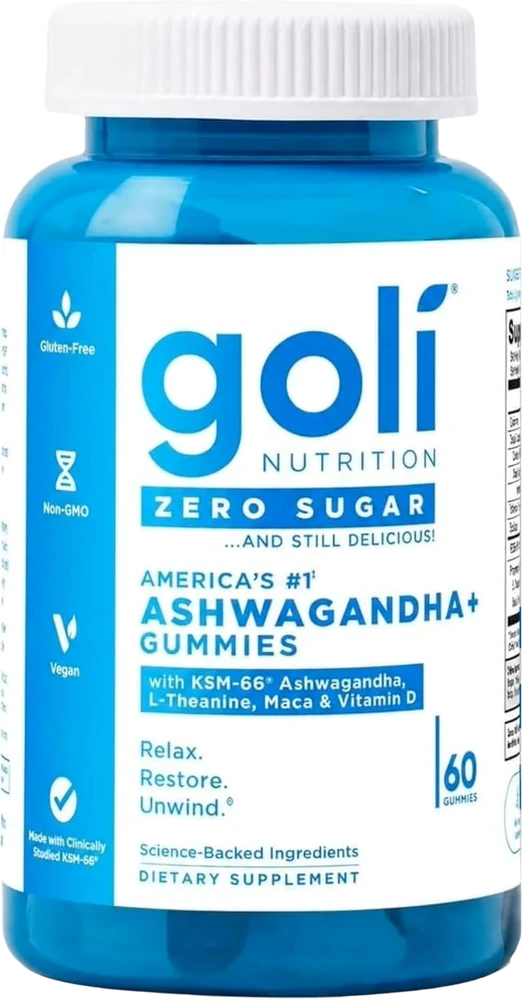
Goli Zero Sugar Gummies
The pick the moment sugar is a dealbreaker.
 01
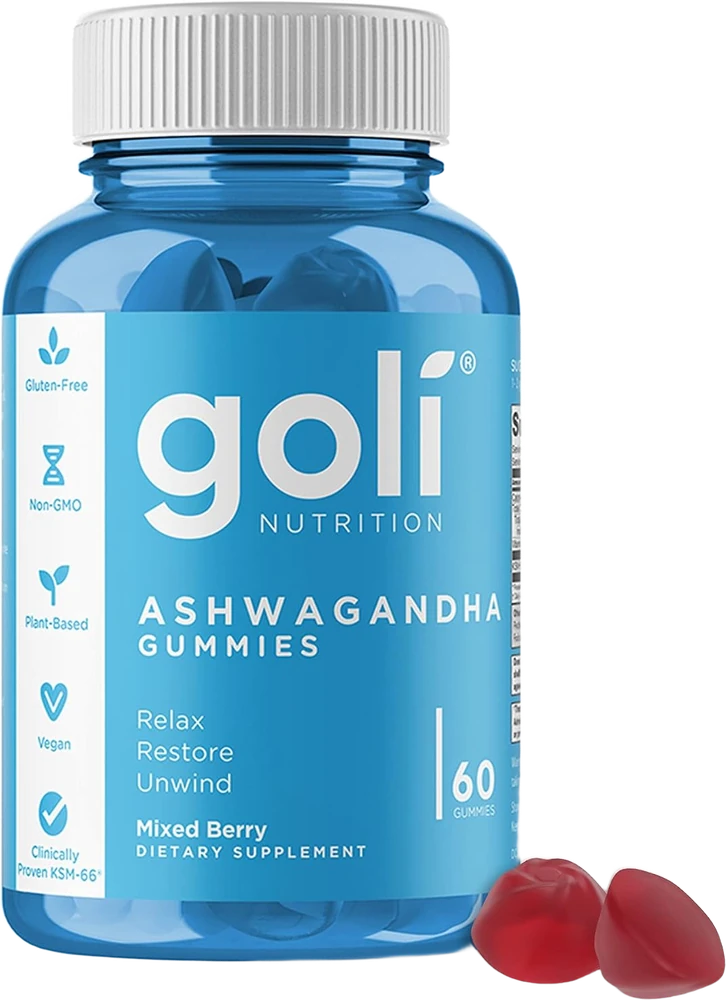
Goli Ashwagandha Gummies
The default pick for the person a gummy is actually built for: someone who has tried capsules and didn't stick with them.
 04
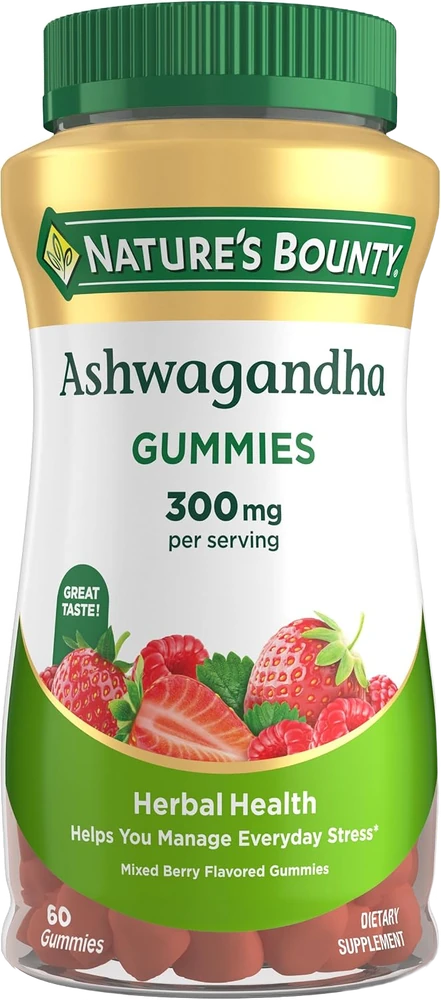
Nature's Bounty Ashwagandha Gummies
When you want a real KSM-66 gummy and the lowest price, this is it.
Quick Answers
Is New Nordic's 300 mg the same as the 300 mg KSM-66 in Goli or Nature Made?
No — and this is the single most important thing to understand before buying. The clinical trials that established ashwagandha's cortisol- and stress-lowering effect (Chandrasekhar 2012, Lopresti 2019, Salve 2019) ran almost entirely on STANDARDISED extracts — overwhelmingly KSM-66 (≥5% withanolides) or Sensoril (≥10%). New Nordic's label says '300 mg ashwagandha root extract (10:1)' with no brand and no stated withanolide percentage. '10:1' tells you the concentration ratio (10 kg of root makes 1 kg of extract), but it does NOT tell you the withanolide content — and withanolides are the active markers the trials measured. So while the milligram number matches a KSM-66 gummy, you can't assume the potency does. It might be comparable; it might be lower. The honest position is that the true potency is unknown.
What does '10:1 extract' actually mean, and why isn't it as good as KSM-66?
A 10:1 ratio means the manufacturer started with 10 parts raw root and concentrated it down to 1 part extract. That's a real concentration step — it's not raw root powder — but the ratio is a process spec, not a potency spec. Two different 10:1 extracts can have very different withanolide content depending on the raw material, the solvent, and the process. KSM-66 and Sensoril are different: they're patented, batch-controlled extracts STANDARDISED to a guaranteed withanolide percentage (5% and 10% respectively), and they're the exact materials the published RCTs used. With New Nordic's unbranded 10:1, you're trusting that the concentration delivered a meaningful withanolide dose, but there's no number on the label to verify it. That uncertainty is the core reason this gummy ranks behind the KSM-66 picks.
What are maltitol and erythritol, and will they upset my stomach?
They're sugar alcohols — the sweeteners New Nordic uses to make this gummy sugar-free. Erythritol is generally the better-tolerated of the two; it's mostly absorbed and excreted before reaching the colon, so it causes less GI trouble for most people. Maltitol is the one to watch: it's only partially absorbed, and the rest ferments in the gut, which can cause bloating, gas, or a laxative effect — especially at higher amounts or if you're sensitive. Whether you notice anything depends on your tolerance and how many gummies you take. This is a genuine difference from Goli Zero Sugar (#3), which uses allulose + stevia (no sugar alcohols) and is gentler on the gut. If you have a sensitive stomach or IBS, that distinction matters.
New Nordic vs Goli Zero Sugar — which sugar-free gummy should I buy?
Goli Zero Sugar (#3) is the better buy for most people, and it's only a few dollars more. Here's the honest comparison: both are sugar-free and both dose 300 mg of ashwagandha per serving. But Goli Zero Sugar uses REAL KSM-66 — the standardised, trial-validated extract — and sweetens with allulose + stevia (no sugar alcohols, gentler on the gut). New Nordic uses an unbranded 10:1 extract of unknown withanolide content and sweetens with maltitol + erythritol. So you're trading a known, studied extract and better GI tolerability for a slightly lower price. New Nordic makes sense if it's meaningfully cheaper where you shop, if KSM-66 branding genuinely isn't a priority for you, and if sugar alcohols don't bother your stomach. For everyone else, pay the small premium for Goli Zero Sugar.
Does the dose at least land in the clinically studied range?
Yes — the 300 mg per 2-gummy serving sits at the FLOOR of the 300-600 mg/day range the trials used, which is a legitimate (if minimal) dose. Salve 2019 showed 250 mg already beat placebo on stress; Chandrasekhar 2012 used 300 mg twice daily (600 mg total) for the headline 27.9% cortisol reduction. So the milligram target is fine. The asterisk is the same one as before: that range was established on STANDARDISED extract, and a milligram of unbranded 10:1 extract isn't guaranteed to deliver the same withanolide load as a milligram of KSM-66. The dose number is in the right place; the uncertainty is whether the active content behind that number matches the studied material. If you take only one serving a day, you're at the low end either way.
Is New Nordic a legitimate brand, and is this gummy safe?
New Nordic is an established Scandinavian-heritage supplement brand sold widely in pharmacies and online, so this isn't a fly-by-night product — the issue is the unbranded extract, not the company. The gummy is vegan, sugar-free, and pleasant (mango-peach). On safety, ashwagandha itself has a good record at these doses in healthy adults, but the standard caveats apply: it's not recommended in pregnancy, it can interact with thyroid medication and sedatives, and there are rare case reports of liver injury, so don't megadose. The sugar-alcohol sweeteners add one product-specific caveat — maltitol can cause bloating or a laxative effect in sensitive people. Talk to a physician if you have a thyroid condition, take sedatives, or are pregnant or breastfeeding.
Who should actually buy this, and who should skip it?
Buy it if you specifically want a sugar-free gummy, it's clearly cheaper than Goli Zero Sugar where you shop, KSM-66 branding genuinely isn't a priority for you, and sugar alcohols don't bother your stomach — it's a fair budget-minded sugar-free fallback at $0.57/serving. Skip it if you want the standardised, trial-validated extract (buy Goli Zero Sugar #3 for KSM-66 sugar-free, or Goli #1 / Nature's Bounty #4 if a little sugar is fine), if you have a sensitive gut or IBS (the maltitol is a real consideration), or if you're running a high-dose 600 mg+ protocol (gummies are the wrong tool — buy a KSM-66 capsule). The verdict is 'consider,' not 'buy': it's a reasonable option in a narrow case, but it's not the one we'd point most readers to.
Sources & Further Reading
5 sources — studies link to PubMed, product specs to the manufacturer
- [1] Chandrasekhar 2012 PMID 23439798 — A prospective, randomized double-blind, placebo-controlled study of safety and efficacy of a high-concentration full-spectrum extract of ashwagandha root in reducing stress and anxiety in adults. The headline trial. 300 mg KSM-66 twice daily (600 mg/day) for 60 days reduced serum cortisol 27.9% and lowered stress scores vs placebo — establishing the 300-600 mg/day STANDARDISED-extract dose. New Nordic's 300 mg matches the floor on milligrams, but uses an unbranded 10:1 extract whose withanolide content is unstated, so it doesn't directly inherit this evidence.
- [2] Salve 2019 PMID 32021735 — Adaptogenic and anxiolytic effects of ashwagandha root extract in healthy adults: A double-blind, randomized, placebo-controlled clinical study. 60 stressed adults took 250 or 600 mg a day of ashwagandha root extract, or a placebo, for 8 weeks. Perceived stress and serum cortisol fell at both doses. Sleep quality improved compared with placebo. Both doses worked, so 250-300 mg a day is a real dose. New Nordic sits there, but on an unstandardised extract, not the high-concentration extract this trial used.
- [3] Lopresti 2019 PMID 31517876 — An investigation into the stress-relieving and pharmacological actions of an ashwagandha (Withania somnifera) extract: A randomized, double-blind, placebo-controlled study. 60 stressed adults took 240 mg of Shoden or placebo once daily for 60 days. Anxiety scores (HAM-A) fell more than on placebo, as did morning cortisol and DHEA-S. Sleep was not an outcome.
- [4] Langade 2019 PMID 31728244 — Efficacy and safety of ashwagandha (Withania somnifera) root extract in insomnia and anxiety: A double-blind, randomized, placebo-controlled study. 300 mg KSM-66 twice daily improved sleep onset, quality, and efficiency vs placebo over 10 weeks in insomnia. The basis for evening dosing — and a reminder that the sleep evidence, like the stress evidence, was generated on standardised KSM-66, not an unbranded extract.
- [5] Auddy 2008 — A standardized Withania somnifera extract significantly reduces stress-related parameters in chronically stressed humans: A double-blind, randomized, placebo-controlled study. The foundational Sensoril trial: a STANDARDISED root-and-leaf extract (~10% withanolides) at 125-500 mg/day reduced cortisol, CRP, and stress dose-dependently. Establishes Sensoril as the second validated standardised extract — and underlines that standardisation, not raw milligram weight, is the trial-relevant variable New Nordic's label omits.
Affiliate disclosure: every Amazon link uses our Associates tag (superachieverclub-20). We earn a small commission at no cost to you; it funds independent reviews. We never accept payment to change a ranking.