
Goli Ashwagandha & Vitamin D Gummies Review
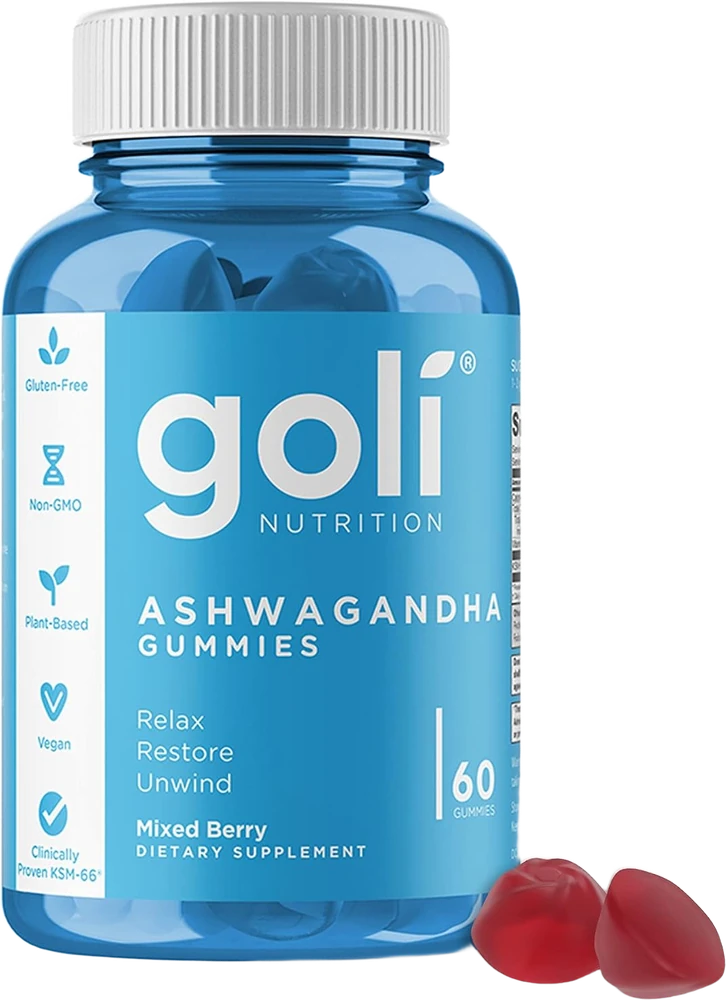 #1 of 7 · Best overall✓ Label verified · Supplement Facts read Aug 27, 2026
Real retailer photo, cut out. Label unedited.
Buy it. The best everyday KSM-66 gummy — buy it if adherence, not dose, is your real problem. Real KSM-66 at the studied 300 mg dose, in the most reliable, best-tasting gummy in the category, from the brand that defined it.
$19 / 60 gummies (30 servings)$0.63 / 2-gummy serving (300 mg KSM-66)
Why It Scores 8.4 — And The Label Line Behind Each Number
Extract form & standardisation
30% of scoreReal KSM-66 — named explicitly on the Supplement Facts panel at 300 mg, not buried in a proprietary 'calm blend' or sold as an unnamed 'ashwagandha root extract' — and the exact material the headline cortisol and sleep trials used (Chandrasekhar 2012, Langade 2019). Its maker, Ixoreal Biomed, specifies the extract at ≥5% withanolides; that percentage is the ingredient's published spec, not a figure printed on Goli's own label. On the criterion that carries the most weight — does the product deliver a real dose of the studied material — Goli is essentially best-in-class for the category. The only thing keeping it off a perfect 10 is that KSM-66 is the lower-standardisation of the two clinical extracts (5% withanolides vs Sensoril's 10%), a marginal note rather than a real knock. This is the score that anchors the whole review.
- Active form
- KSM-66 ashwagandha (Withania somnifera root; maker Ixoreal specifies ≥5% withanolides — not printed on Goli's own label)
- Per gummy
- 150 mg KSM-66 — one gummy is half a dose
- Daily dose
- 2 gummies/day (split AM/PM or both with food); 1-2 hours before bed for sleep
Dose vs clinical range
25% of score300 mg per 2-gummy serving lands at the FLOOR of the 300-600 mg/day evidence range. It's a legitimate, studied dose — it matches the lower arms of Salve 2019 (250 mg beat placebo) and a single day's serving of Chandrasekhar's 300 mg ×2/day protocol — but it's the minimum, not the optimum. The honest framing: enough to be active and a fair starting dose for a first-timer, but a reader chasing the stronger stress/sleep effect (the 600 mg arms) would need two servings, doubling the sugar to 8 g, where a capsule becomes the right tool. We dock real points here because 'floor of the range' is exactly the gummy-format compromise a buyer needs to understand, and we won't let the marketing dress the minimum up as the optimum.
- Dose vs clinical range
- 300 mg = floor of the 300-600 mg/day standardised-extract evidence range
Label cleanliness & testing
20% of scoreVegan, gelatin-free, non-GMO, gluten-free, with no high-fructose corn syrup, no sugar alcohols, and no artificial sweeteners, colors, or flavors — a genuinely clean allergen and ingredient profile by gummy standards. Rescored down from an earlier 8.5 because two things don't hold up against the actual panel: there is no third-party-testing seal, no cGMP/NSF certification mark, and no withanolide standardisation percentage anywhere on the packaging, so 'clinically proven KSM-66' rests on the brand's word rather than an independent check — and every serving carries 4 g of added sugar (organic tapioca syrup + organic cane sugar), the format's defining downside. We're not penalizing Goli for claims it never made; we're scoring only what the label actually shows, and an unverified-testing product with real sugar sits in the 'clean but unproven' tier rather than the top of the category.
- Diet / label
- Vegan, gelatin-free, non-GMO, gluten-free (brand-declared; no third-party-testing seal on this label)
- Manufacturer
- Goli Nutrition (manufacturer/facility details not printed on this label)
Format & adherence
15% of scoreThis is the criterion the whole 'buy' rests on, and it's where Goli is strongest. Ashwagandha works by lowering the cortisol baseline over 4-8 weeks of DAILY dosing — adherence isn't a nice-to-have, it's the mechanism. Goli is the best-tasting, most reliable everyday gummy in the category and the brand that effectively created it; it's the ashwagandha product people actually finish the bottle of. For the buyer this format exists to serve — someone who tried capsules and didn't stick with them — that everyday reliability is worth more than the dose or sugar tradeoffs it carries. Near-perfect on the axis that actually determines whether the supplement does anything for you.
Value per serving
10% of score$19 for 60 gummies (30 servings) works out to about $0.63 per 300 mg KSM-66 serving — reasonable for a name-brand gummy, and cheaper than Goli's Zero Sugar variant ($0.73) and the organic picks. But measured the way value really should be measured — cost per active milligram — the gummy format is expensive: a KSM-66 capsule delivers 300-600 mg for less, with no sugar. So the score is honest-middle: fair within the gummy category, clearly beaten by capsules on a pure cost-per-mg basis. Nature's Bounty undercuts it (~$0.43/serving) for the same KSM-66 dose if absolute lowest price is the goal; Goli's premium buys the better taste and brand consistency.
- Per serving
- 300 mg KSM-66 (2 gummies) — the label lists no vitamin D or any other vitamin/mineral
- Bottle size
- 60 gummies — 30-day supply at the 2-gummy serving
- Price
- $19 / 60 gummies (~$0.63 per 2-gummy serving, ~$0.63/day)
- More Specs
- Sugar
- 4 g added sugar per serving — organic tapioca syrup + organic cane sugar (no HFCS, no sugar alcohols)
Label verified. Every figure read from the Supplement Facts photo, Aug 27, 2026.
Marketing Claims Vs. Reality
Made with clinically studied KSM-66 ashwagandha.
The KSM-66 name and 300 mg dose are confirmed on the Supplement Facts panel — the same extract used in Chandrasekhar 2012, Langade 2019, and Salve 2019. (The ≥5% withanolides figure is Ixoreal's published spec for KSM-66; Goli's own label doesn't print a standardisation percentage.) This is the strongest thing the product has going for it, and the claim is literally true.
Helps reduce stress and supports a calm mood.
Directionally supported by the KSM-66 trial evidence, but at the FLOOR dose. The 27.9% cortisol drop in Chandrasekhar 2012 came from 600 mg/day; Goli's single daily serving is 300 mg, the lower end. Plausible stress benefit over 4-8 weeks of daily use, strongest if you take both servings — but the marketing implies the studied effect at a dose that sits at the bottom of the studied range.
Vegan, gluten-free, and made with no artificial sweeteners.
Verifiable from the ingredients panel — pectin-based (gelatin-free/vegan), gluten-free, sweetened with organic tapioca syrup and organic cane sugar rather than artificial sweeteners. All accurate. Note that 'no artificial sweeteners' is true precisely because it uses 4 g of real added sugar per serving — the cleanliness and the sugar are two sides of the same choice.
What Our Test Actually Found
Correction: this is Goli's Ashwagandha Gummies — the label has no vitamin D
An earlier version of this review named the product 'Goli Ashwagandha & Vitamin D Gummies' and credited every serving with 25 mcg (1000 IU) of vitamin D2. The Supplement Facts panel for this ASIN (B091TNV24N) reads: Serving Size 2 Gummies, Servings Per Container 30, and exactly one active ingredient — KSM-66 Ashwagandha Root Extract 300 mg. There is no vitamin D row, and no vitamins or minerals of any kind. We re-read the label on Sep 3, 2026 and corrected the product name, brand line, specs, claims, pros, and every mention of vitamin D throughout this review to text-only fixes, with one exception: Label cleanliness & testing dropped from 8.5 to 7.0 (overall score 8.7 to 8.4) after also removing an unsourced 'third-party tested' claim that the label does not support. The KSM-66 name, the 300 mg dose, and the 4 g of sugar were already accurate and are unchanged.
The extract is the real thing — and that's what carries the score
The single most important question for any ashwagandha gummy is whether it delivers a real dose of the standardised material the trials used, or just sugar with a trace of unnamed root powder. Goli clears that bar cleanly: named KSM-66, listed explicitly on the Supplement Facts panel at 300 mg per serving — the same family of material as Chandrasekhar 2012, Langade 2019, and Salve 2019. (Ixoreal, KSM-66's maker, specifies the extract at ≥5% withanolides; that percentage doesn't appear on Goli's own label, only the KSM-66 name and dose do.) It's why Goli sits above several cheaper and sugar-free competitors that lean on unbranded '10:1 root extract' with no withanolide percentage — you simply can't know what those deliver. With Goli you at least know the named extract and the dose. The standardisation is the foundation the whole 'buy' is built on.
300 mg is the floor of the evidence range — a legitimate dose, not the optimum
The honest dose story: the stress and sleep trials ran on 300-600 mg/day of standardised extract, and Goli's 2-gummy serving delivers 300 mg — the bottom of that band. It matches the lower-effect arms (Salve 2019's 250 mg beat placebo; one day of Chandrasekhar's 300 mg ×2/day protocol), so it's genuinely active and a fair starting point. But it is the minimum, not the optimum, and the marketing's 'clinically studied' framing quietly borrows the credibility of the 600 mg results for a 300 mg product. A reader chasing the stronger effect would need two servings — 8 g of sugar — at which point a capsule is the right tool. We name the floor on the product and the whole list precisely so nobody mistakes the minimum for the studied optimum.
Sugar is the format tax — 4 g of added sugar a serving, about a quarter pound over the bottle
Every standard ashwagandha gummy carries a sugar load a capsule never has, and Goli is no exception: 4 g of added sugar — organic tapioca syrup and organic cane sugar — per 2-gummy serving. For one serving that's about a teaspoon — trivial. Taken daily, it compounds: ~28 g a week, about 120 g (roughly a quarter pound) over the bottle's 30-day supply (30 servings per container). For most people that's an acceptable price for actually taking the supplement every day. For keto, diabetic, or sugar-counting buyers it's a real cost, and the honest answer is Goli's own Zero Sugar variant (same 300 mg KSM-66, allulose + stevia, no sugar alcohols) or a capsule. The cleanliness of the label and the sugar are the same decision: no artificial sweeteners because it uses real sugar. Read the panel and budget for it.
Adherence is the entire case — and it's a real one
It's tempting to dismiss a 300 mg sugared gummy next to a 600 mg sugar-free capsule, but that misreads what determines whether ashwagandha works. This is a chronic-dosing adaptogen: the cortisol, stress, and sleep effects in every trial built over 4-8 weeks of DAILY use. The best dose you don't take is zero. Goli is the most reliable, best-tasting gummy in the category — the one people actually finish — so for the buyer whose genuine obstacle is consistency (tried capsules, didn't stick with them), it's the highest-leverage choice on the shelf. That's not a consolation-prize argument; adherence is the mechanism. It's the specific, defensible reason a floor-dose gummy earns the #1 gummy slot and a 'buy.'
If you want dose or sugar-free, the upgrade path is short and we name it
The 'buy' is conditional, and the off-ramps are explicit. Want a higher dose for sleep or testosterone support? Stop eating gummies — a KSM-66 capsule delivers 300-600 mg with zero sugar at a lower cost per active mg, and four gummies plus 8 g of sugar to chase 600 mg is absurd. Want the same convenience without the sugar? Goli's Zero Sugar variant keeps the real 300 mg KSM-66 and swaps the added sugar for allulose + stevia (no sugar alcohols). Want the lowest price for the same dose? Nature's Bounty's KSM-66 gummy undercuts Goli at ~$0.43/serving. Goli wins the default everyday slot on taste and brand consistency — but the honest review hands you the exits for the cases where it isn't the right buy.
Full analysis: all pros & cons (9), buy if / skip if
- Real KSM-66 extract, named on the Supplement Facts panel — the exact form the cortisol/sleep trials used (Ixoreal, its maker, specifies ≥5% withanolides; that figure isn't printed on Goli's own label)
- The best-tasting, most reliable everyday gummy in the category — adherence is its entire value, and it delivers it
- 300 mg per serving is a legitimate, studied dose from the brand that effectively created the ashwagandha-gummy category
- Vegan, gelatin-free, non-GMO, gluten-free — a clean allergen profile by gummy standards
- 300 mg is the FLOOR of the 300-600 mg evidence range — a legitimate dose, but the minimum, not the optimum
- 4 g of added sugar per serving — tapioca syrup + cane sugar (~120 g, a quarter pound, over the bottle's 30-day supply if taken daily)
- No third-party-testing seal or standardisation percentage anywhere on the label
- Costs far more per active mg than a KSM-66 capsule
- Wrong tool for high-dose protocols — you'd need 4 gummies (8 g sugar) to reach 600 mg; buy a capsule instead
- Adherence is your real obstacle — you've let capsules die in a drawer and want a gummy you'll actually take daily
- You want the studied KSM-66 dose, not an unnamed 'ashwagandha blend' — Goli names the real extract on the panel
- First-time ashwagandha user testing the stress/sleep effect before committing to a higher-dose protocol
- You're fine with 4 g of sugar per serving as the price of taking it every single day
- You want 600 mg+ for sleep or testosterone support — a KSM-66 capsule delivers it with no sugar at lower cost
- You're keto, diabetic, or sugar-conscious — Goli Zero Sugar (same 300 mg KSM-66, 0 g sugar) is the better pick
- You already take supplements reliably and want the best cost per active mg — a capsule wins on the numbers
Real KSM-66 at the studied 300 mg dose, in the most reliable, best-tasting gummy in the category, from the brand that defined it. The honest catches: 300 mg is the FLOOR of the 300-600 mg evidence range, 4 g of added sugar (organic tapioca syrup + organic cane sugar) per serving, and a far higher cost per active mg than a capsule. It earns 'buy' for exactly one buyer — the person who tried capsules and didn't stick with them — because ashwagandha only works on 4-8 weeks of DAILY dosing, and this is the gummy you'll actually take daily. Want 600 mg+ or zero sugar? Buy a KSM-66 capsule or Goli's Zero Sugar variant instead.
Goli Ashwagandha Gummies is the #1 pick on our best-ashwagandha-gummies list, and the reasoning is narrow and honest: it's the best-tasting, most reliable everyday gummy in the category, it uses REAL KSM-66 — the exact standardised extract the cortisol and sleep trials ran on — at the studied 300 mg dose, and it comes from the brand that effectively created the ashwagandha-gummy category. None of that makes it the highest-dose or cheapest-per-milligram way to take ashwagandha. A KSM-66 capsule delivers 300-600 mg with zero sugar at a lower cost per active mg, and we say so plainly throughout this review. What earns Goli the top gummy spot — and a 'buy' — is the one variable that actually determines whether ashwagandha works for you: adherence. This is a chronic-dosing adaptogen whose cortisol, stress, and sleep effects build over 4-8 weeks of DAILY use. A perfect capsule you forget does nothing; a real KSM-66 dose you'll genuinely take every day does. Goli is the gummy people actually finish the bottle of. The honest tradeoffs are named on every pick: 300 mg is the FLOOR of the 300-600 mg evidence range (a legitimate dose, but the minimum), every serving carries 4 g of added sugar (organic tapioca syrup + organic cane sugar), and you pay a premium per active mg for the format. If you tried capsules and didn't stick with them, this is the one to buy. If you want a higher dose or zero sugar, we route you to a capsule or to Goli's own Zero Sugar variant.
Buy it if adherence is your real problem — it's the best everyday KSM-66 gummy, with the floor dose and the sugar named honestly.

Goli Ashwagandha Gummies earns the #1 gummy spot and a 'buy' for a narrow, honest reason: it's the best-tasting, most reliable everyday gummy in the category, it uses real KSM-66 — the studied extract — at a legitimate 300 mg dose, and it comes from the brand that defined the format. For the specific buyer a gummy exists to serve — someone who tried ashwagandha capsules and let them die in a drawer — that everyday reliability is the whole game. Ashwagandha works by lowering the cortisol baseline over 4-8 weeks of DAILY dosing, so the real KSM-66 dose you'll actually take every day beats the perfect capsule you forget. That's not a consolation argument; consistency is the mechanism, and Goli is the gummy people finish. The tradeoffs are real and we name them on every pick rather than dress them up. 300 mg is the FLOOR of the 300-600 mg evidence range — active and a fair starting dose, but the minimum, not the optimum, and the 'clinically studied' framing quietly borrows the credibility of the 600 mg trial arms for a 300 mg product. Every serving carries 4 g of added sugar — organic tapioca syrup and organic cane sugar — (about 120 g, a quarter pound, over the bottle's 30-day supply taken daily). The label also carries no third-party-testing seal and no withanolide standardisation percentage, so treat 'clinically proven KSM-66' as the brand's own word rather than an independently verified claim. And measured by cost per active milligram, the gummy format is expensive next to a capsule. None of that disqualifies it for the adherence buyer; all of it matters if you're someone else. So the recommendation is conditional, with explicit exits. Buy Goli if you want a convenient, genuinely studied 300 mg/day that you'll actually take — that's most people who reach for a gummy, and it's the right call for them. Buy a KSM-66 capsule instead if you want 600 mg+ for sleep or testosterone support, or you're managing sugar, or you already take supplements reliably and want the best value per mg. And if you want this exact convenience without the sugar, Goli's own Zero Sugar variant keeps the real 300 mg KSM-66 and loses all 4 g. The extract is what works. Goli's job is to get a real dose of it into you every single day — and at that one job, it's the best gummy on the shelf.
If This Doesn’t Fit — Try These
 03
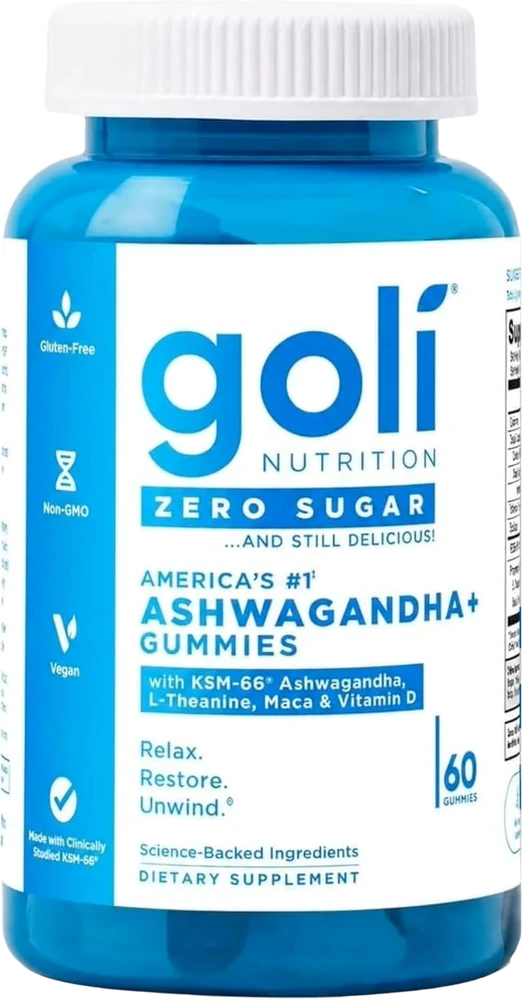
Goli Zero Sugar Gummies
The pick the moment sugar is a dealbreaker.
 02
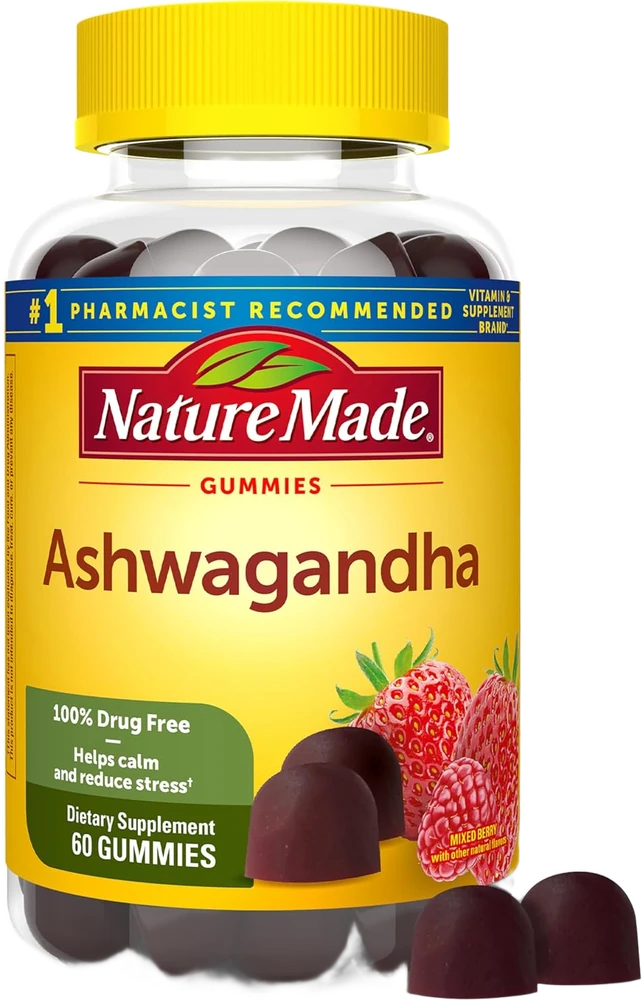
Nature Made KSM-66 Gummies
If your hesitation about gummies is the additive list — the dyes, the artificial sweeteners — Nature Made answers it.
 04
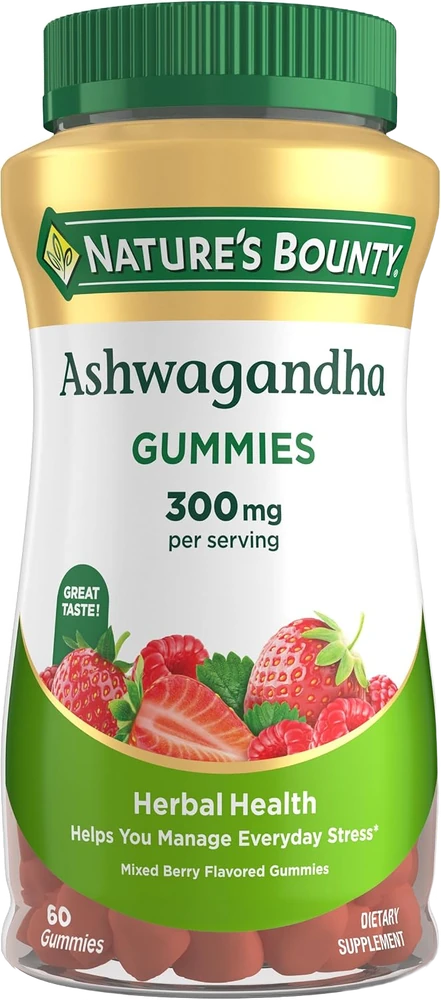
Nature's Bounty Ashwagandha Gummies
When you want a real KSM-66 gummy and the lowest price, this is it.
Quick Answers
Is 300 mg of KSM-66 actually enough to do anything?
Yes — it's a legitimate, studied dose, but it's the floor of the evidence range, not the optimum. The cortisol and stress trials ran on 300-600 mg/day of standardised extract. Chandrasekhar 2012 used 300 mg KSM-66 twice daily (600 mg total) and measured a 27.9% serum cortisol drop; Salve 2019 showed 250 mg already beat placebo on stress, with the 600 mg arm doing more. Goli's 2-gummy serving delivers 300 mg — the same as the lower-effect arms of those studies. So if you take one serving a day you're at the bottom of the studied range: enough to be active, especially for a first-timer testing the effect, but not the high-dose protocol. If you want the stronger effect you'd take two servings (which doubles the sugar to 8 g) — at which point a capsule is the better tool.
Why is a 300 mg gummy your #1 pick when capsules deliver 600 mg with no sugar?
Because the question a gummy answers isn't 'which format has the best numbers' — it's 'which format will you actually take every day?' Ashwagandha is a chronic-dosing adaptogen: the cortisol, stress, and sleep effects in the trials showed up at 4-8 weeks of DAILY use, not from a single dose. A capsule that delivers a perfect 600 mg is worthless if it dies in a drawer. Goli is the most reliable, best-tasting gummy in the category, so for the person whose real obstacle is adherence, it's the highest-leverage choice — a real KSM-66 dose they'll genuinely take daily. We're explicit that capsules win on dose accuracy, sugar, and cost per mg. The gummy wins on the one variable that actually determines whether ashwagandha works for you: consistency.
How much sugar is in Goli Ashwagandha, and does it matter?
4 g of added sugar per 2-gummy serving — organic tapioca syrup and organic cane sugar, roughly one teaspoon combined — with no high-fructose corn syrup and no sugar alcohols. For one serving that's trivial, about one bite of a cookie. But it's daily: ~28 g a week, about 120 g (roughly a quarter pound) over the bottle's 30-day supply (30 servings per container) if you take it every day. For most people that's an acceptable price for adherence. If you're low-carb, keto, diabetic, or counting every gram, it's a real cost — and the honest move is Goli's own Zero Sugar variant (same 300 mg KSM-66, sweetened with allulose and stevia, no sugar alcohols) or a capsule. Don't pretend the sugar isn't there; budget it into your day or pick a sugar-free option.
What's KSM-66, and is Goli's the real thing?
KSM-66 is the most-studied branded ashwagandha extract — a root-only extract made under an Ixoreal Biomed patent, which Ixoreal specifies at ≥5% withanolides (that percentage is the maker's published spec for the ingredient; Goli's own label doesn't print a standardisation number). It's the material used in the headline cortisol, stress, and sleep trials (Chandrasekhar 2012, Langade 2019). Goli's gummy uses real KSM-66, named on the Supplement Facts panel, at 300 mg per 2-gummy serving — not an unnamed 'ashwagandha root extract' or a proprietary 'calm blend.' That matters: named, standardised extract is the single biggest predictor of whether a gummy does anything. Goli clears that bar, which is why it sits above the unbranded picks in our ranking even though several of them are cheaper or sugar-free.
One gummy or two — can I take just one to cut the sugar?
You can, but understand what you're doing: Goli doses on TWO gummies. The 300 mg KSM-66 on the Supplement Facts panel is the 2-gummy serving (the front of the bottle doesn't print a dose at all), so each gummy is 150 mg. Chew one and you're at 150 mg — half a clinical dose and below the 250-300 mg that beat placebo in the trials. If your goal is to halve the sugar (down to 2 g), a single gummy is a sub-clinical dose that may do little. The cleaner solution if sugar is the concern is the Zero Sugar variant at the full 300 mg, or a capsule. Take both gummies if you want the studied dose.
Who should buy Goli Ashwagandha — and who should buy something else?
Buy it if your real problem is adherence: you've bought ashwagandha capsules before and let them die in a drawer, and a tasty gummy you'll actually take daily is the better choice at 300 mg/day. It's also a fair first-timer pick for testing the stress/sleep effect before committing to a protocol. Buy something else if (1) you want 600 mg+ for sleep or testosterone support — you'd be eating 4 gummies and 8 g of sugar to get there, so a KSM-66 capsule is strictly better; (2) you're keto, diabetic, or sugar-conscious — go to Goli Zero Sugar or a capsule; or (3) you already take supplements reliably and want the best cost per active mg — a capsule wins. The gummy is built for one job, and it does it better than anything else in the category.
Sources & Further Reading
5 sources — studies link to PubMed, product specs to the manufacturer
- [1] Chandrasekhar 2012 PMID 23439798 — A prospective, randomized double-blind, placebo-controlled study of safety and efficacy of a high-concentration full-spectrum extract of ashwagandha root in reducing stress and anxiety in adults. The headline trial. 300 mg KSM-66 twice daily (600 mg/day) for 60 days reduced serum cortisol by 27.9% and significantly lowered stress-scale scores vs placebo in chronically stressed adults — establishing the 300-600 mg/day standardised-extract range. Goli's single 300 mg serving sits at the floor of this band.
- [2] Salve 2019 PMID 32021735 — Adaptogenic and anxiolytic effects of ashwagandha root extract in healthy adults: A double-blind, randomized, placebo-controlled clinical study. 60 stressed adults took 250 or 600 mg a day of ashwagandha root extract, or a placebo, for 8 weeks. Perceived stress and serum cortisol fell at both doses. Sleep quality improved compared with placebo. Both doses worked, so 250-300 mg a day is a real dose. The abstract does not say whether 600 mg worked better. That is why we call Goli's 300 mg a real but minimum dose.
- [3] Langade 2019 PMID 31728244 — Efficacy and safety of ashwagandha (Withania somnifera) root extract in insomnia and anxiety: A double-blind, randomized, placebo-controlled study. 300 mg KSM-66 twice daily improved sleep onset latency, sleep quality, and sleep efficiency vs placebo over 10 weeks in adults with insomnia — the basis for taking the evening serving 1-2 hours before bed, and a reason high-dose sleep users should prefer a capsule over a double gummy serving and its 8 g of sugar.
- [4] Lopresti 2019 PMID 31517876 — An investigation into the stress-relieving and pharmacological actions of an ashwagandha (Withania somnifera) extract: A randomized, double-blind, placebo-controlled study. 60 stressed adults took 240 mg of Shoden or placebo once daily for 60 days. Anxiety scores (HAM-A) fell more than on placebo, as did morning cortisol and DHEA-S. Sleep was not an outcome.
- [5] Auddy 2008 — A standardized Withania somnifera extract significantly reduces stress-related parameters in chronically stressed humans: A double-blind, randomized, placebo-controlled study. The foundational Sensoril trial: a standardised root-and-leaf extract (~10% withanolides) at 125-500 mg/day reduced cortisol, C-reactive protein, and stress scores dose-dependently — establishing Sensoril as the second clinically validated standardised extract alongside the KSM-66 that Goli uses.
Affiliate disclosure: every Amazon link uses our Associates tag (superachieverclub-20). We earn a small commission at no cost to you; it funds independent reviews. We never accept payment to change a ranking.