
CoQ10: Benefits, Dosage & Side Effects (2026)
CoQ10 (Coenzyme Q10) is a lipid-soluble coenzyme essential to the mitochondrial electron transport chain — sold as ubiquinone (oxidised) or ubiquinol (reduced, better-absorbed after 40) — with the strongest trial evidence in statin users and heart-failure patients.
The CoQ10 market in numbers
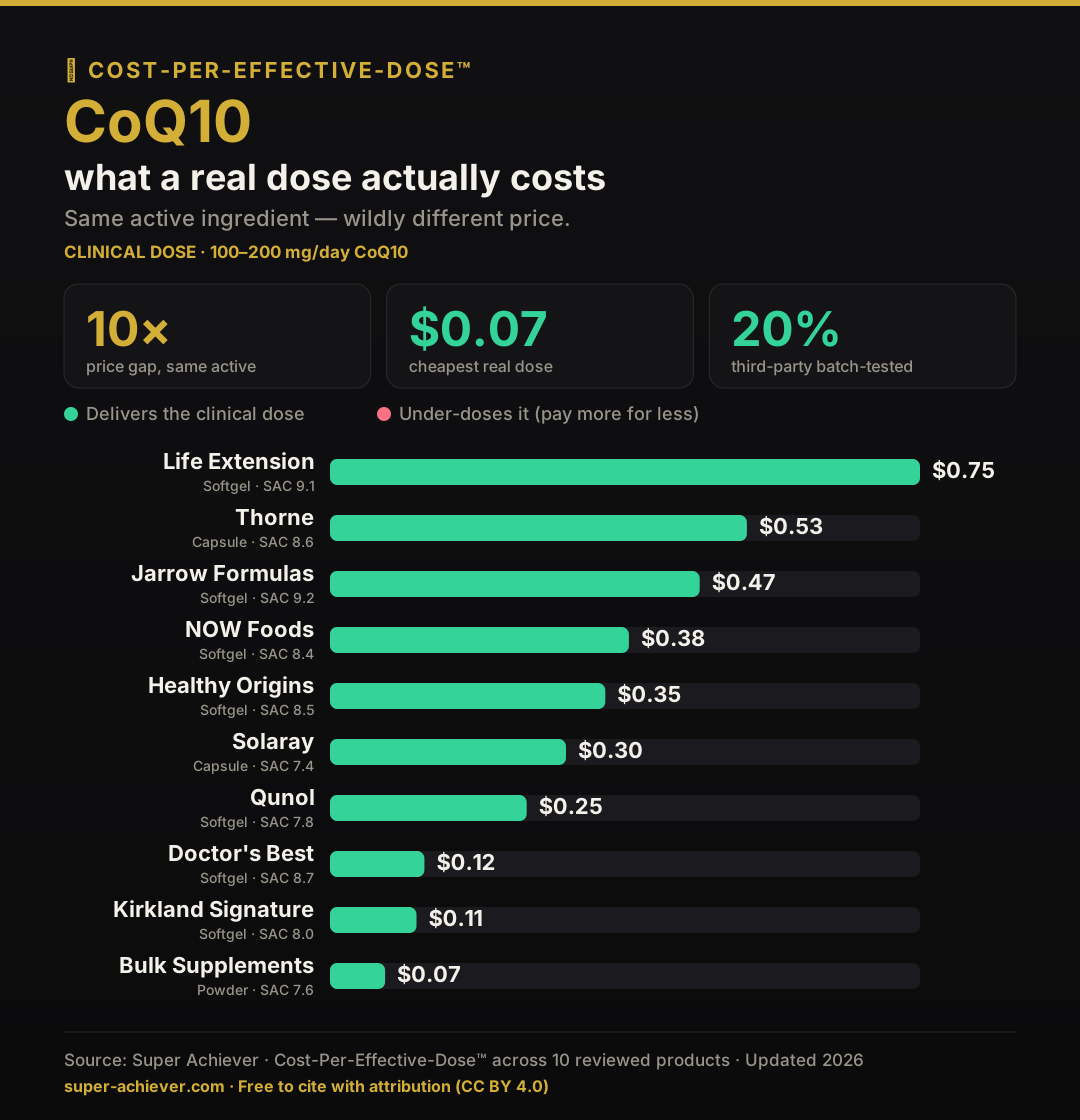
Our independent analysis of 10 coq10 products, scored on three proprietary indices — the SAC Product Score™, Transparency Index™, and real Cost-Per-Effective-Dose™. Updated October 2026.
| # | Product | SAC Product Score™ | TXI™ | CPED™ | |
|---|---|---|---|---|---|
| 1 | Jarrow Formulas Ubiquinol QH-Absorb 100 mgSoftgel | 9.2 | 40 | $0.45 | |
| 2 | Qunol Mega Ubiquinol CoQ10 100 mgSoftgel | 9.0 | 20 | $0.36 | |
| 3 | Life Extension Super Ubiquinol CoQ10 100 mgSoftgel | 8.9 | 40 | $0.55 | |
| 4 | Healthy Origins Ubiquinol (Kaneka QH) 100 mgSoftgel | 8.9 | 40 | $0.50 | |
| 5 | NOW Foods Ubiquinol 100 mgSoftgel | 8.9 | 40 | $0.46 | |
| 6 | Doctor's Best High Absorption CoQ10 100 mg with BioPerineSoftgel | 8.2 | 20 | $0.16 | Best value |
| 7 | Thorne CoQ10 100 mgSoftgel | 8.0 | 100 | $0.88 | Most transparent |
| 8 | Qunol Ultra CoQ10 100 mgSoftgel | 7.7 | 20 | $0.25 | |
| 9 | Bulk Supplements CoQ10 PowderPowder | 7.4 | 70 | $0.18 | |
| 10 | Solaray CoQ10 100 mgCapsule | 7.1 | 20 | $0.47 |
Methodology. SAC Product Score™ blends our editorial rating (RCT quality, dose, safety, value) 50/50 with community ratings. Transparency Index™ (0-100) = third-party certification (0-50) + public batch COA (0-30) + dose honesty (0-20). Cost-Per-Effective-Dose™ is the real price of one clinical dose, not one marketed "serving". Free to cite with attribution to Super Achiever.
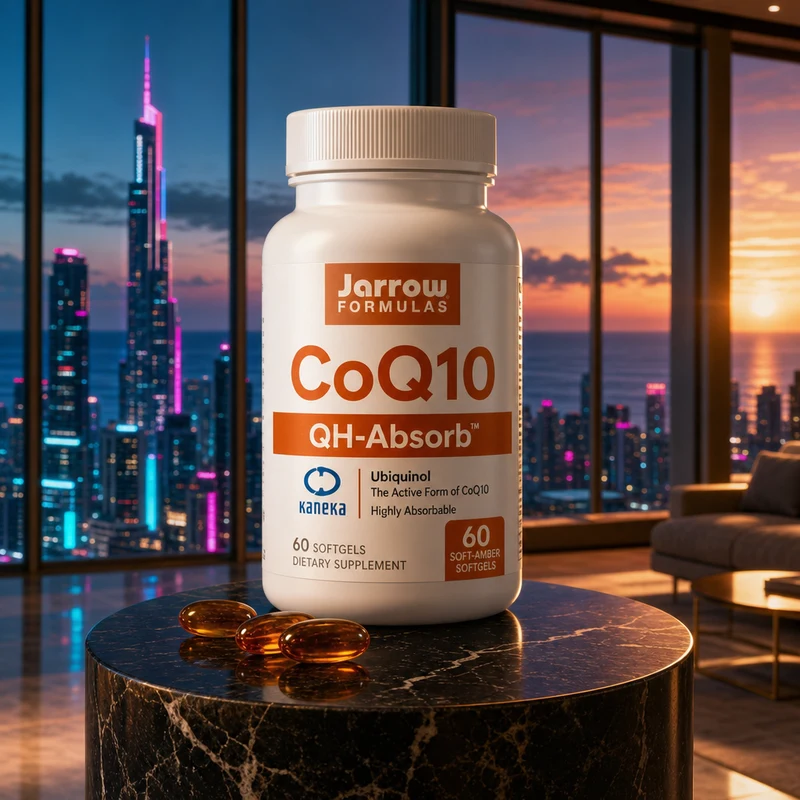
Jarrow Formulas Ubiquinol QH-Absorb 100 mg
What is CoQ10?
Coenzyme Q10 — CoQ10, sometimes called ubiquinone or ubiquinol depending on its redox state — is a small lipid-soluble molecule that sits inside the inner mitochondrial membrane of nearly every cell in the body. It's not a vitamin in the formal sense (the body synthesises its own), but the synthesis pathway is long, complex, and starts to slow measurably after age 40. By age 60, endogenous Q10 levels in heart, brain, and skeletal muscle drop by roughly 50% versus a 20-year-old baseline.
The substance exists in two interconvertible forms. Ubiquinone is the oxidised form — the cheaper, more stable version that dominates the supplement-industry shelf and the older RCT literature. Ubiquinol is the reduced form — the version that actually does the electron-transport work inside mitochondria, and the version with measurably better bioavailability in adults over 40 (Hosoe 2007, Failla 2014). Healthy younger adults can convert ubiquinone to ubiquinol efficiently; older adults, statin users, and people with chronic conditions cannot. "CoQ10" without specifying the form is mostly ubiquinone — for buyers under 40 in good metabolic health, that's fine; for everyone else, ubiquinol is the better dollar.
The gold-standard sourcing is Kaneka Q10 — a Japanese fermentation-derived ubiquinone (and Kaneka Ubiquinol for the reduced form) from Kaneka Corporation, used in the majority of academic trials including the pivotal Q-SYMBIO heart-failure study. Kaneka-licensed brands carry the trademark and the fermentation-purity spec (versus tobacco-leaf-derived Q10, which is structurally identical but historically riskier on contamination). The Mortensen 2014 Q-SYMBIO trial — the closest thing CoQ10 has to a phase-3 outcome trial — used Kaneka ubiquinone.
How it works
CoQ10's primary role is as the electron shuttle between Complex I/II and Complex III of the mitochondrial electron transport chain. Every ATP molecule your body produces aerobically (>95% of total ATP at rest) flows through CoQ10. Tissues with the highest ATP demand — heart, brain, kidney, liver, skeletal muscle — carry the highest Q10 concentrations. When endogenous synthesis drops with age or is suppressed by statins, the cells with the largest mitochondrial density feel the deficit first: that's why CoQ10 trials cluster around cardiovascular outcomes, statin-induced myopathy, and aerobic endurance.
The secondary mechanism is lipid-soluble antioxidant action. Ubiquinol — the reduced form — donates electrons to neutralise lipid peroxyl radicals inside membranes, regenerating itself back to ubiquinone in the process. Unlike water-soluble antioxidants (vitamin C, glutathione), CoQ10 is one of the few molecules that protects mitochondrial and cell-membrane lipids from oxidative damage in situ. This is the mechanism behind the modest blood-pressure-lowering effect (Rosenfeldt 2007 meta) and the migraine-prophylaxis effect (Sandor 2005).
The statin angle is the most clinically actionable. Statins inhibit HMG-CoA reductase, which is also the first committed step in the body's CoQ10 synthesis pathway. After 6+ months on a statin, endogenous Q10 drops measurably — and the Banach 2015 meta-analysis showed that supplementation reduces statin-induced muscle symptoms (myalgia, cramping, fatigue) in the population that often quits statins for tolerability reasons. CoQ10 doesn't fix the statin's effect on cholesterol; it fixes the off-target depletion that drives the side-effect burden.
The CoQ10 deep dives
CoQ10 Benefits
Heart failure, migraine, blood sugar, fertility — the real benefits vs the hype (statins, blood pressure), every claim scored.
Read →SafetyCoQ10 Side Effects
One of the safest supplements there is — the honest picture: the warfarin interaction, forms, and taking it with fat.
Read →DataCoQ10 by the Numbers
The full data report — Q-SYMBIO mortality, the statin-myalgia debate, ubiquinol-vs-ubiquinone, cost per dose. The citable stats page.
Read →At-a-glance facts
- Active forms
- Ubiquinone (oxidised, standard) · Ubiquinol (reduced, 2-4× more bioavailable after age 40)
- Typical dose
- 100-200 mg/day general · 200-400 mg/day for statin users + CHF · 300 mg/day for migraine prophylaxis
- Age threshold for ubiquinol
- Ubiquinol > ubiquinone after age 40 — endogenous conversion declines with age
- Time to felt effect
- Blood Q10 levels rise in 2-4 weeks · Energy + fatigue 4-8 weeks · CHF outcomes 12+ weeks
- How to take it
- With a fat-containing meal — CoQ10 is lipid-soluble and absorption drops 3-5× when taken fasted
- Half-life
- ~33 hours — once-daily dosing is sufficient
- Gold-standard sourcing
- Kaneka Q10 / Kaneka Ubiquinol — Japanese fermentation-derived, used in the Q-SYMBIO trial
- Cost range (US)
- $15-40 / month for ubiquinone · $30-70 / month for Kaneka ubiquinol
Evidence: Strongest evidence wedge is statin-induced myopathy (Banach 2015 meta, PMID 25440725) and chronic heart failure (Mortensen 2014 Q-SYMBIO, PMID 25282031). Modest but reproducible evidence on blood pressure (Rosenfeldt 2007 meta), migraine prophylaxis (Sandor 2005), and aerobic endurance (Zhang 2018). General-population benefit in healthy under-40 adults is controversial and probably small. The hub anchors on the populations where the effect size justifies the spend — statin users, CHF patients, adults 40+, and athletes.
Who it's for — and who it isn't
- Statin users — the population where the evidence is strongest. Statins deplete endogenous Q10, and supplementation measurably reduces statin-induced myopathy (Banach 2015 meta).
- CHF and heart-failure patients under cardiologist supervision — the Mortensen 2014 Q-SYMBIO trial showed reduced cardiovascular mortality at 100 mg × 3/day over 2 years.
- Adults 40+ pursuing longevity — endogenous Q10 declines ~50% by age 60 in heart and skeletal muscle. Ubiquinol form recommended over ubiquinone in this group.
- Endurance athletes — modest but real performance benefit on aerobic capacity + recovery in trained populations (Zhang 2018 review).
- Chronic migraine sufferers — Sandor 2005 RCT and follow-on trials show meaningful frequency reduction at 300 mg/day across 12 weeks.
- Healthy adults under 30 not taking statins — endogenous Q10 production is robust, supplementation effect size is small to negligible, and the budget is better spent elsewhere (creatine, magnesium glycinate, omega-3).
- Anyone on warfarin — CoQ10 is structurally similar to vitamin K and may reduce warfarin's anticoagulant effect. Coordinate with the prescribing physician before starting.
- Pregnant or breastfeeding women — human safety data are insufficient at supplemental doses (>100 mg/day).
- Buyers chasing acute energy boost — CoQ10 is not a stimulant. Effects show up at the bloodwork + mitochondrial-function level over weeks, not on day one.
Week-by-week, what happens
- Days 1-7Most users feel nothing. CoQ10 is not a stimulant and the body pool takes weeks to repopulate. Don't draw conclusions from week 1.
- Week 2-4Serum CoQ10 levels measurably rise on bloodwork. Statin users with prior myalgia start to notice reduced muscle soreness + cramping. The first felt-effect window for the strongest-evidence indication.
- Week 4-8Energy + fatigue improvements show up in deficient populations (older adults, CHF patients, statin users with depleted baseline). Endurance athletes notice modest improvements in aerobic recovery + VO2-related markers.
- Week 8-12Steady-state. Migraine frequency reduction emerges in chronic-migraine populations (Sandor 2005 timeline). Blood pressure shows modest reduction in hypertensive subgroups (Rosenfeldt meta). For statin users, the side-effect-burden picture is largely settled by this point.
- Week 12+Plateau. Continue at maintenance dose indefinitely — no tolerance, no down-regulation. CHF mortality benefit (Q-SYMBIO) requires 2-year continuous use; longevity-driven supplementation runs continuously without cycling.
Safety & contraindications
- Generally well-tolerated at 100-400 mg/day. Most documented side effects are mild GI upset (nausea, loose stools) and only appear at the upper end of dosing or when taken on empty stomach.
- Warfarin interaction is the biggest concern — CoQ10's structural similarity to vitamin K can reduce warfarin's anticoagulant effect. Anyone on warfarin should coordinate with the prescribing physician before starting Q10 and monitor INR closely.
- Modest hypotension risk at doses above 300 mg/day, particularly in users already on antihypertensive medication. Track blood pressure during the first 4 weeks and adjust if symptoms (dizziness, light-headedness on standing) appear.
- Take with a fat-containing meal. CoQ10 is lipid-soluble — fasted absorption drops 3-5× versus dosing with breakfast eggs, dinner with olive oil, or a fatty-fish meal.
- Pregnancy and breastfeeding: insufficient human safety data at supplemental doses (>100 mg/day). Avoid unless under obstetric supervision.
- Buy from brands with public Certificates of Analysis and (ideally) the Kaneka trademark on the label. Generic Q10 from undisclosed sources has had purity + contamination issues; bottles that print Kaneka on the supplement-facts panel (Qunol Mega Ubiquinol, NOW Foods Ubiquinol, Healthy Origins Ubiquinol) give you a named supplier you can check.
All articles on CoQ10
Best CoQ10 for Fertility
Nine CoQ10 supplements ranked for fertility — egg quality, IVF adjunct, sperm health. Ubiquinol leads at high fertility doses; an adjunct to medical care.
Read →Best CoQ10 for Statins
Statins deplete CoQ10 and drive muscle pain; CoQ10 reduces statin myalgia (Banach 2015). Ubiquinol is the form for the 40+ statin user — ranked by form, the 100-200 mg dose, Kaneka sourcing, and fat-paired absorption.
Read →Best CoQ10 Supplements
CoQ10 ranked by ubiquinol vs ubiquinone form (critical after 40), Kaneka patent verification, dose, fat-meal protocol — the bottles statin users and CHF patients actually need.
Read →Best Form of CoQ10: Ubiquinol vs Ubiquinone
Ubiquinol (reduced) vs ubiquinone (oxidized) — which CoQ10 form to buy. Under-40 healthy adults convert ubiquinone fine; 40+ and statin users absorb ubiquinol better. All forms compared by bioavailability + cost.
Read →Bulk Supplements CoQ10 Powder Review
CoQ10 vs Ubiquinol audit — form bioavailability, statin-depletion context, and the verdict for the age bracket that needs each.
Read →Doctor's Best High Absorption CoQ10 100 mg with BioPerine Review
CoQ10 vs Ubiquinol audit — form bioavailability, statin-depletion context, and the verdict for the age bracket that needs each.
Read →Healthy Origins Ubiquinol (Kaneka QH) 100 mg Review
CoQ10 vs Ubiquinol audit — form bioavailability, statin-depletion context, and the verdict for the age bracket that needs each.
Read →Jarrow Formulas Ubiquinol QH-Absorb 100 mg Review
CoQ10 vs Ubiquinol audit — form bioavailability, statin-depletion context, and the verdict for the age bracket that needs each.
Read →Kirkland Signature CoQ10 300 mg Review
CoQ10 vs Ubiquinol audit — form bioavailability, statin-depletion context, and the verdict for the age bracket that needs each.
Read →Life Extension Super Ubiquinol CoQ10 100 mg with PrimaVie Shilajit Review
CoQ10 vs Ubiquinol audit — form bioavailability, statin-depletion context, and the verdict for the age bracket that needs each.
Read →NOW Foods Ubiquinol 100 mg Review
CoQ10 vs Ubiquinol audit — form bioavailability, statin-depletion context, and the verdict for the age bracket that needs each.
Read →Qunol Mega Ubiquinol CoQ10 100 mg Review
Kaneka ubiquinol, named on the panel, in a water+fat-soluble base at $0.36 per softgel. Score 9.0, #3 of our CoQ10 picks for statin users. No batch certificate of analysis.
Read →Qunol Ultra CoQ10 100 mg Review
CoQ10 vs Ubiquinol audit — form bioavailability, statin-depletion context, and the verdict for the age bracket that needs each.
Read →Solaray CoQ10 100 mg Review
CoQ10 vs Ubiquinol audit — form bioavailability, statin-depletion context, and the verdict for the age bracket that needs each.
Read →Super Achiever CoQ10 (Ubiquinone 200 mg) Review
Our own CoQ10, scored like every other bottle: 200 mg of ubiquinone in one capsule, held back by a dry-powder capsule, an unnamed source and no test report.
Read →Thorne CoQ10 100 mg Review
CoQ10 vs Ubiquinol audit — form bioavailability, statin-depletion context, and the verdict for the age bracket that needs each.
Read →FAQ
Ubiquinol vs ubiquinone — which one should I buy?
Depends on age + metabolic status. Ubiquinone is the cheaper, more stable oxidised form. Healthy adults under 40 convert it to the active ubiquinol form efficiently inside the body, so ubiquinone is the right call — same bioactive endpoint at half the price. Ubiquinol is the pre-reduced form with 2-4× better bioavailability in adults over 40, in statin users (statins also blunt the conversion enzyme), and in chronic-illness populations. Above age 40 or on a statin, the price premium for ubiquinol pays off. Below 40 in good health, generic Kaneka ubiquinone at 100-200 mg/day is the right starting form.
Should I take CoQ10 if I'm on a statin?
It's a reasonable, low-risk try — but be honest, the evidence is mixed. Statins inhibit HMG-CoA reductase, the first step in the body's own CoQ10 synthesis, so measurable Q10 depletion occurs on statins. Whether replacing it eases muscle symptoms is genuinely unsettled: Banach 2015 (PMID 25440725, 6 RCTs) found no significant benefit, while a later meta (Qu 2018, PMID 30371340, 12 RCTs) did — but only on subjective symptom scales, not the objective muscle-damage marker (CK), and blinded statin-rechallenge trials suggest much 'statin muscle pain' is nocebo. A sensible try: 100-200 mg/day with a fat-containing meal for 12 weeks. It does not interfere with the statin's cholesterol-lowering effect.
What is Kaneka Q10 and should I pay the premium?
Kaneka Q10 is Japanese fermentation-derived CoQ10 from Kaneka Corporation — the patent-grade source used in the majority of academic trials including Mortensen 2014 Q-SYMBIO. The premium pays for: (1) fermentation versus tobacco-leaf-derived synthesis (cleaner contamination profile), (2) consistent 99%+ purity, (3) trial-validated bioequivalence to the published evidence base. For statin users and CHF patients where the trial evidence drives the buying decision, bottles that name Kaneka on the panel (Qunol Mega Ubiquinol, NOW Foods Ubiquinol, Healthy Origins Ubiquinol) are worth the premium over generic. For general-population buyers, generic CoQ10 from a reputable brand with a CoA is acceptable.
What dose should I take based on my age?
General longevity-driven supplementation: 100-200 mg/day from age 40 onwards, scaling toward 200 mg by age 60. Statin users or CHF patients (under cardiologist supervision): 200-400 mg/day. Migraine prophylaxis: 300 mg/day across 12 weeks (Sandor 2005 protocol). Endurance athletes: 100-200 mg/day with a fat-containing meal. Healthy adults under 40 not on a statin: probably no supplementation needed — endogenous synthesis is sufficient and the literature does not show meaningful benefit in this population.
What meal should I take CoQ10 with?
Any meal containing ~10g+ of fat dramatically improves absorption — CoQ10 is lipid-soluble, and fasted absorption drops 3-5× versus dosed-with-fat. Best practical choices: breakfast eggs with avocado or butter, dinner with olive oil or fatty fish, or any meal with nuts. Don't take CoQ10 on an empty stomach with water — you'll waste 60-80% of the dose. Splitting larger doses (>200 mg/day) across two meals also improves total absorption versus single-dose loading.
Will CoQ10 fix statin-induced muscle pain?
Maybe — the evidence is genuinely mixed, so don't count on it. Banach 2015 (PMID 25440725, 6 RCTs) found no significant benefit; a later, larger meta (Qu 2018, PMID 30371340, 12 RCTs) did find less muscle pain — but only on subjective scales, with no change in the objective CK marker, and blinded rechallenge trials suggest much 'statin muscle pain' isn't statin-specific. It's a cheap, low-risk 12-week try at 100-200 mg/day with food; if it doesn't clearly help, the cause probably isn't Q10 depletion — talk to your cardiologist about a different statin or dose.
Can I stack CoQ10 with other heart-health supplements?
Yes — CoQ10 is one of the most stackable supplements in the cardiovascular category. Common stacks: CoQ10 + omega-3 (the most-evidenced cardiovascular pairing — different mechanisms, complementary endpoints); CoQ10 + magnesium glycinate (both mitochondrial cofactors, HRV improvement); CoQ10 + vitamin K2 (paradoxical synergy on arterial calcification). Avoid stacking with warfarin without physician supervision. Avoid relying on multi-ingredient 'heart health' formulas with sub-clinical 30-50 mg CoQ10 doses at premium prices — buy CoQ10 standalone in the 100-200 mg range.
Does CoQ10 have side effects?
Side effects are uncommon and mild. The most-reported are GI symptoms (nausea, loose stools) at doses above 300 mg/day, particularly on empty stomach. A small subset of users report insomnia when dosing in the evening — switching to morning resolves this. The warfarin interaction is the only clinically meaningful concern: CoQ10's structural similarity to vitamin K can blunt warfarin's effect, so anyone on anticoagulation must coordinate with their physician before starting. Long-term safety data extends to multi-year continuous use at 100-300 mg/day without significant adverse markers (Q-SYMBIO 2-year follow-up, multiple replication studies).
Sources & further reading
- Mortensen 2014 (Q-SYMBIO)The effect of coenzyme Q10 on morbidity and mortality in chronic heart failure: results from Q-SYMBIO: a randomized double-blind trial
420 chronic heart failure patients randomised to 100 mg × 3/day CoQ10 vs placebo for 2 years. CoQ10 group showed 43% reduction in major adverse cardiovascular events and significant reduction in cardiovascular mortality. The pivotal outcome trial for CoQ10 in CHF.
- Banach 2015 (statin myopathy meta)Effects of coenzyme Q10 on statin-induced myopathy: a meta-analysis of randomized controlled trials
Meta-analysis of 6 RCTs (n=302) on CoQ10 for statin-associated muscle symptoms. It found NO significant benefit — only a non-significant trend toward less muscle pain (SMD −0.53, 95% CI −1.33 to 0.28), and no change in creatine kinase. A later, larger meta-analysis reached the OPPOSITE conclusion (Qu 2018, PMID 30371340; 12 RCTs, n=575: less subjective muscle pain, but still no CK change). The two disagree — the honest read is that CoQ10 for statin myalgia is a cheap, low-risk try, not a proven fix.
- Rosenfeldt 2007 (BP meta)Coenzyme Q10 in the treatment of hypertension: a meta-analysis of the clinical trials
Meta-analysis of 12 clinical trials (n=362) on CoQ10 in hypertensive subjects. Pooled effect showed mean systolic BP reduction of ~17 mmHg and diastolic ~10 mmHg. Effect size larger than expected; subsequent trials have shown smaller but consistent modest BP reduction.
- Sandor 2005 (migraine)Efficacy of coenzyme Q10 in migraine prophylaxis: a randomized controlled trial
42 migraine patients randomised to 100 mg × 3/day CoQ10 vs placebo for 3 months. CoQ10 group showed significant reduction in migraine attack frequency, headache days, and days with nausea versus placebo. The foundational migraine-prophylaxis RCT for CoQ10.
- Zhang 2018 (ubiquinol vs ubiquinone, older men)Ubiquinol is superior to ubiquinone to enhance Coenzyme Q10 status in older men
Head-to-head comparison of ubiquinol vs ubiquinone in older men: ubiquinol produced higher plasma CoQ10 levels at equivalent oral doses — a blood-LEVEL (status) advantage of the reduced form in adults over 40. Note this is a bioavailability marker, not a clinical-outcome trial.
- Hosoe 2007 (bioavailability)Study on safety and bioavailability of ubiquinol (Kaneka QH) after single and 4-week multiple oral administration to healthy volunteers
Pharmacokinetic study of Kaneka ubiquinol in healthy adults. Established the dose-response curve, safety profile up to 300 mg/day for 4 weeks, and bioavailability advantage of the reduced form. The reference safety + pharmacokinetic paper for Kaneka Ubiquinol.
- Hernández-Camacho 2018 (review)Coenzyme Q10 supplementation in aging and disease
Comprehensive review of CoQ10 in aging, cardiovascular disease, neurodegeneration, and statin-induced complications. Establishes the age-related decline curve (~50% drop by age 60 in heart and skeletal muscle) and the rationale for supplementation in adults over 40.