

CoQ10 Side Effects: Is It Safe?
Is CoQ10 safe? The bottom line
The honest summary: for almost everyone, CoQ10 is remarkably low-risk — no established toxic dose, side effects mild and rare[14]. The reasons to be careful are specific: warfarin, and a few situations below.
Should you be cautious with CoQ10?
Tick anything that applies to you:
Our own CoQ10
Our in-house ubiquinone at a high 200 mg dose — the stable, trial-proven form. Want to compare every brand, ubiquinol included? The full independent ranking is one tap down.
See all ranked CoQ10 picks →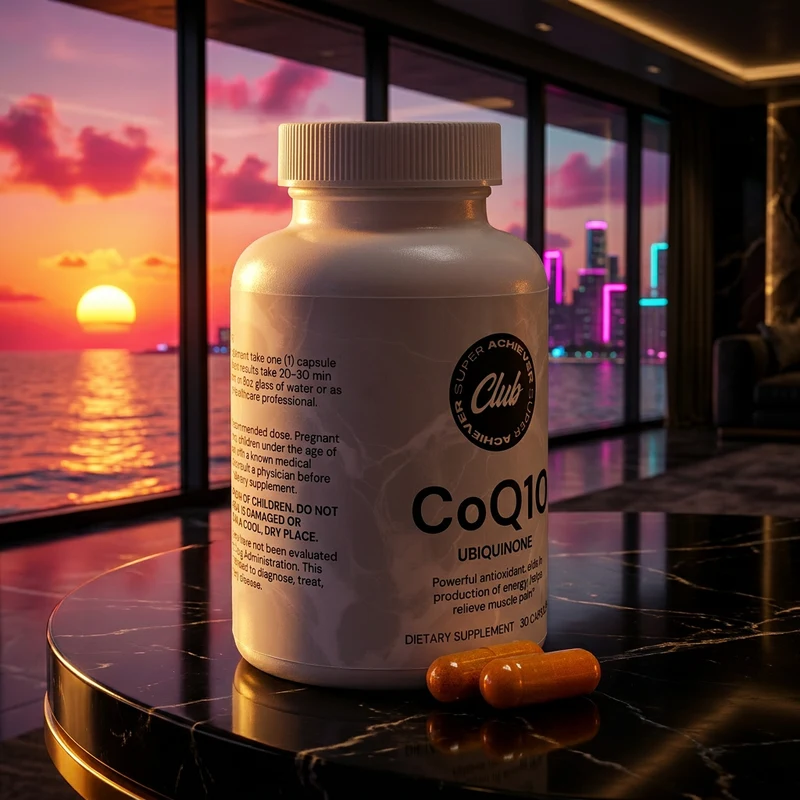
Super Achiever CoQ10 is our own product (a sponsored placement) — scored 6.7 by the same criteria as every brand, and shown at that score. See the full independent ranking for the competitors.
Common side effects
There barely are any. The effects that occur are mild and uncommon — occasional nausea, loose stools or stomach discomfort, usually only at higher doses. In a formal risk assessment, GI adverse events stayed under 1% even at 1,200 mg/day — no more common than at a low 60 mg dose[14]. Splitting the dose and taking it with food removes most of the little that remains.
Side effects stay rare even at 20× the usual dose
gastrointestinal adverse-event rate · CoQ10 at 1,200 mg/day was no more likely to cause GI upset than a low 60 mg dose — both under 1%
Can you take too much?
It's hard to. A risk assessment set the observed safe level at 1,200 mg/day — roughly 6–12× the typical dose — with no established toxic threshold in humans[14]. The practical limit is cost and, at very high doses, mild GI upset — not danger. Most people never need more than 100–200 mg/day (200–400 mg for heart-failure or statin protocols, under a doctor).
How much is safe — a wide margin
the typical supplemental dose sits far below the observed safe level · CoQ10 is one of the best-tolerated supplements, with GI effects under 1% even at high doses
Warfarin — the one interaction that matters
This is the single caution worth taking seriously. Because CoQ10 is structurally similar to vitamin K, it can in theory blunt warfarin's blood-thinning effect. A randomized crossover trial in stable warfarin patients found no significant change in INR or warfarin dose[15]— reassuring, but the interaction is biologically plausible and has been reported. So if you take warfarin, don't avoid CoQ10 outright — just monitor your INR when you start or stop it, and tell your clinician. CoQ10 is otherwise very low-interaction.
Forms & absorption
CoQ10 comes as ubiquinone (oxidised, cheaper, trial-proven) and ubiquinol(reduced, better-absorbed). Ubiquinol raises blood levels more — about 4.3 vs 2.5 µg/mL at the same dose[11] — especially in adults over 40[12]. But that's a blood-level difference, not a proven better outcome: no head-to-head trial shows ubiquinol works better, and the pivotal trials used ubiquinone. Whichever form, the biggest absorption lever is simply taking it with a fatty meal. See the full forms comparison.
Ubiquinol vs ubiquinone: a blood-level difference, not a proven better result
plasma total CoQ10 after 4 weeks at 200 mg/day · ubiquinol (the reduced form) raises blood levels more — BUT no clinical-outcome trial shows it beats ubiquinone, and the pivotal trials (Q-SYMBIO) used ubiquinone
Pregnancy
CoQ10 has been studied in pregnancy (e.g. for pre-eclampsia risk) and is generally considered low-risk, but the human safety data are limited. As with any supplement in pregnancy, use it only with your obstetrician's guidance rather than self-prescribing.
Myths vs. facts
| The myth | What the evidence shows | Source |
|---|---|---|
| You should take CoQ10 on an empty stomach | No — that wastes most of it. CoQ10 is fat-soluble; taken fasted with water, absorption drops several-fold. Always take it with a meal containing some fat. | [13] |
| CoQ10 has no drug interactions | Mostly true, with one caveat: because CoQ10 is structurally similar to vitamin K, it can theoretically blunt warfarin's blood-thinning effect. A crossover trial found no significant change, but the interaction is plausible — if you take warfarin, monitor your INR when starting or stopping CoQ10. | [15] |
Frequently asked questions
Is CoQ10 safe?
Very — it's one of the best-tolerated supplements there is. A formal risk assessment set the observed safe level at 1,200 mg/day, and gastrointestinal side effects stay under 1% even at high doses, no more common than placebo. The one real caution is a possible interaction with warfarin.
What are the side effects of CoQ10?
They're mild and uncommon: occasional nausea, loose stools, or stomach upset, usually at higher doses. Splitting the dose and taking it with food helps. Serious effects are essentially not seen at normal doses — CoQ10 has a very wide safety margin.
Does CoQ10 interact with warfarin?
It can. CoQ10 is structurally similar to vitamin K, so in theory it can blunt warfarin's blood-thinning effect. A crossover trial found no significant change in INR, but the interaction is plausible and reported — so if you take warfarin, monitor your INR when you start or stop CoQ10, and tell your clinician.
Can you take too much CoQ10?
It's hard to. The observed safe level is 1,200 mg/day — far above the typical 100–200 mg dose — and even at that level GI side effects stayed under 1%. There's no established toxic dose in humans; the practical limit is cost and mild GI upset, not danger.
Should CoQ10 be taken with food?
Yes, always with a fat-containing meal. CoQ10 is fat-soluble, and taken fasted with water its absorption drops several-fold. Pair it with eggs, avocado, olive oil, fatty fish or nuts, and split doses above 200 mg across two meals.
Sources
- Mortensen SA, Rosenfeldt F, Kumar A, et al. The effect of coenzyme Q10 on morbidity and mortality in chronic heart failure: results from Q-SYMBIO, a randomized double-blind trial. JACC Heart Fail. 2014;2(6):641–649. PMID 25282031
- Banach M, Serban C, Sahebkar A, et al. Effects of coenzyme Q10 on statin-induced myopathy: a meta-analysis of randomized controlled trials. Mayo Clin Proc. 2015;90(1):24–34. PMID 25440725
- Qu H, Guo M, Chai H, Wang WT, Gao ZY, Shi DZ. Effects of coenzyme Q10 on statin-induced myopathy: an updated meta-analysis of randomized controlled trials. J Am Heart Assoc. 2018;7(19):e009835. PMID 30371340
- Rosenfeldt FL, Haas SJ, Krum H, et al. Coenzyme Q10 in the treatment of hypertension: a meta-analysis of the clinical trials. J Hum Hypertens. 2007;21(4):297–306. PMID 17287847
- Ho MJ, Li ECK, Wright JM. Blood pressure lowering efficacy of coenzyme Q10 for primary hypertension. Cochrane Database Syst Rev. 2016;3(3):CD007435. PMID 26935713
- Sándor PS, Di Clemente L, Coppola G, et al. Efficacy of coenzyme Q10 in migraine prophylaxis: a randomized controlled trial. Neurology. 2005;64(4):713–715. PMID 15728298
- Parohan M, Sarraf P, Javanbakht MH, Ranji-Burachaloo S, Djalali M. Effect of coenzyme Q10 supplementation on clinical features of migraine: a systematic review and dose-response meta-analysis of randomized controlled trials. Nutr Neurosci. 2020;23(11):868–875. PMID 30727862
- Lin G, et al. Clinical evidence of coenzyme Q10 pretreatment for women with diminished ovarian reserve undergoing IVF/ICSI: a systematic review and meta-analysis. Ann Med. 2024;56(1):2389469. PMID 39129455
- Lafuente R, González-Comadrán M, Solà I, et al. Coenzyme Q10 and male infertility: a meta-analysis. J Assist Reprod Genet. 2013;30(9):1147–1156. PMID 23912751
- Zhang SY, Yang KL, Zeng LT, Wu XH, Huang HY. Effectiveness of coenzyme Q10 supplementation for type 2 diabetes mellitus: a systematic review and meta-analysis. Int J Endocrinol. 2018;2018:6484839. PMID 30305810
- Langsjoen PH, Langsjoen AM. Comparison study of plasma coenzyme Q10 levels in healthy subjects supplemented with ubiquinol versus ubiquinone. Clin Pharmacol Drug Dev. 2014;3(1):13–17. PMID 27128225
- Zhang Y, Liu J, Chen XQ, Oliver Chen CY. Ubiquinol is superior to ubiquinone to enhance coenzyme Q10 status in older men. Food Funct. 2018;9(11):5653–5659. PMID 30302465
- Hosoe K, Kitano M, Kishida H, Kubo H, Fujii K, Kitahara M. Study on safety and bioavailability of ubiquinol (Kaneka QH) after single and 4-week multiple oral administration to healthy volunteers. Regul Toxicol Pharmacol. 2007;47(1):19–28. PMID 16919858
- Hathcock JN, Shao A. Risk assessment for coenzyme Q10 (ubiquinone). Regul Toxicol Pharmacol. 2006;45(3):282–288. PMID 16814438
- Engelsen J, Nielsen JD, Winther K. Effect of coenzyme Q10 and Ginkgo biloba on warfarin dosage in stable, long-term warfarin treated outpatients. A randomised, double blind, placebo-crossover trial. Thromb Haemost. 2002;87(6):1075–1076. PMID 12772396
- Deng H, et al. Coenzyme Q10 supplementation increases blood concentrations but shows little effect on exercise performance: a systematic review and meta-analysis. Br J Nutr. 2025. PMID 41457257
- Hernández-Camacho JD, Bernier M, López-Lluch G, Navas P. Coenzyme Q10 supplementation in aging and disease. Front Physiol. 2018;9:44. PMID 29459830