
Qunol Ultra CoQ10 100 mg Review
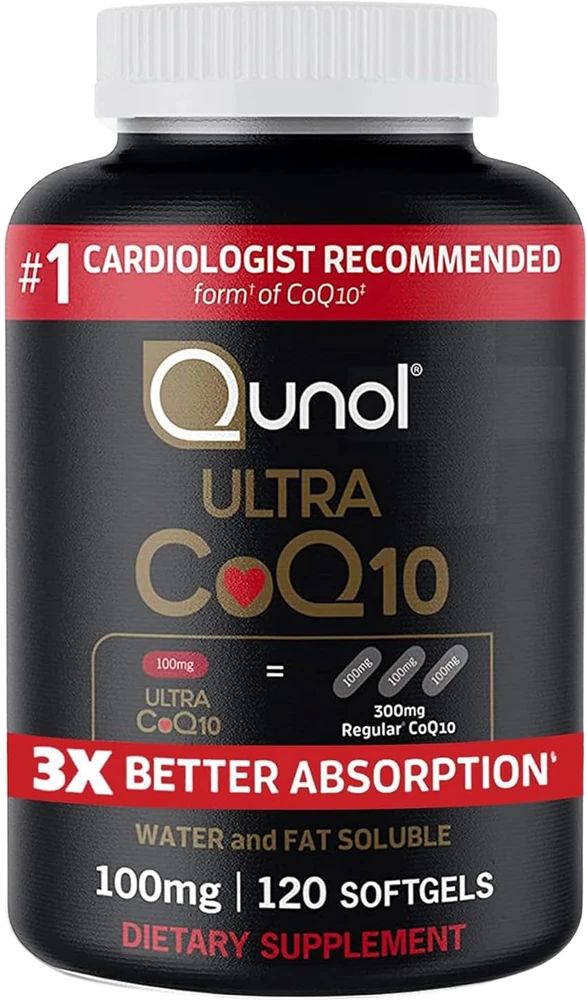 #8 of 11 · Best mass-market water-soluble✓ Label verified · Supplement Facts read Sep 7, 2026
Real retailer photo, cut out. Label unedited.
Consider it. The water-soluble premium solves a real problem for $0.09 more per softgel — a fatty meal solves it for free. Polysorbate-80 water-soluble ubiquinone + Qunol mass-market brand QC + $0.25/softgel.
$29.97 / 120 softgels (Amazon US, Oct 11, 2026)$0.25 / 100 mg water-soluble softgel
Why It Scores 7.7 — And The Label Line Behind Each Number
Form (ubiquinol vs ubiquinone)
30% of scoreUbiquinone (oxidised) in polysorbate-80 water-soluble emulsion. Form is the right choice for healthy under-40 buyers but the wrong choice for adults 40+ and statin users where conversion to active ubiquinol is impaired. The water-soluble carrier delivers ~3× fasted absorption boost (a real bioavailability gain) but doesn't close the 2-4× ubiquinone-to-ubiquinol form gap in the 40+ population. The carrier helps within the ubiquinone form class; it doesn't substitute for ubiquinol when ubiquinol is the right form.
- Active form
- Ubiquinone USP Grade (oxidised; supplier not named) in polysorbate-80 water-soluble emulsion
- Inactives
- Softgel shell (gelatin, glycerin), polysorbate-80, MCT, sunflower lecithin
Dose accuracy at 100-200 mg
25% of scoreClean 100 mg of ubiquinone per softgel, packaged in the water-soluble emulsion. Hits the longevity baseline (1 softgel/day = 100 mg) and scales linearly to statin protocols (2/day = 200 mg) and migraine prophylaxis (3/day = 300 mg). The 120-softgel bottle stretches to 4 months at 100 mg/day — same bottle-count as Doctor's Best (#6). Slight 1.5-point discount versus a perfect 10 because the per-softgel dose isn't differentiated from cheaper competitors at this form tier.
- Per softgel
- 100 mg ubiquinone
- Daily dose
- 1 softgel longevity / under-40 · 2 softgels statin protocol · 3 softgels migraine
Testing + Kaneka chain-of-custody
20% of scoreThe panel reads 'Ubiquinone USP Grade' — a statement that the ingredient meets the USP monograph, not the USP Verified product mark — and names no CoQ10 supplier. Qunol's own product page for Ultra (read Oct 19, 2026) does not mention Kaneka either, while the same brand prints 'Kaneka Ubiquinol' on its Mega Ubiquinol panel. No independent product certification and no per-batch COA with public lot lookup; what remains is a large household brand. That is the same footing as Doctor's Best (#6) and Solaray (#10), so this line scores 6.5. It stood at 7.5 while this review called the source Kaneka, 'verifiable on Kaneka's registry'; Kaneka publishes no licensee list, and nothing on the label or the brand page supports the claim.
- Certifications
- GMP-certified facility, USP-grade ingredients
- Manufacturer
- Quten Research Institute (Qunol parent) · GMP-certified · mass-market consumer brand
- Lab transparency
- No independent product certification; no public per-batch COA
Cost per active mg
15% of score$29.97 for 120 softgels on Amazon US on Oct 11, 2026 (sold and shipped by Amazon) = $0.25 per 100 mg water-soluble ubiquinone softgel. That sits between Doctor's Best (#6, $0.16) and the cheapest Kaneka ubiquinol, Qunol's own Mega (#2, $0.36). On the list's ubiquinone scale $0.21 to $0.25 per 100 mg scores 8.0; the line stood at 7.5 before all ubiquinone picks were put on one scale. The $0.09 per softgel over Doctor's Best pays for the polysorbate emulsion and the brand, not for a form upgrade, which is hard to defend for buyers who eat regular meals.
- Bottle size
- 120 softgels — 4-month supply at 1/day, 2 months at 2/day, 40 days at 3/day
- Price
- $29.97 / 120 softgels on Amazon US, Oct 11, 2026 ($0.25 per 100 mg water-soluble softgel)
Real-world response
10% of scoreWater-soluble emulsion does solve a real problem (fasted absorption ~3× higher than bare ubiquinone), which translates to real-world response for buyers who genuinely can't dose with food. The mass-market distribution moat also drives genuine adherence advantages — users who recognise the Qunol brand are more likely to take the bottle consistently. For the buyer who eats meals and pays attention to dosing timing, the response advantage over Doctor's Best is small to negligible. Score reflects the population-dependent reality.
- More Specs
- Carrier formulation
- Polysorbate-80 + medium-chain triglycerides + softgel oil base
Label verified. Every figure read from the Supplement Facts photo, Sep 7, 2026.
Marketing Claims Vs. Reality
3× better absorption than regular CoQ10 — clinically proven water-soluble.
The ~3× absorption gain is real and published versus carrier-free fasted ubiquinone — Bhagavan and Chopra 2006 (PMID 16551570) documented the polysorbate-emulsion bioavailability improvement. The claim becomes misleading when 'regular CoQ10' is unspecified: vs bare-softgel ubiquinone, true. Vs ubiquinone with a fat-containing meal, false. Vs ubiquinol form, false. The 3× framing oversimplifies the comparison and is the largest credibility gap in the brand's marketing.
America's #1 selling CoQ10 brand.
Qunol is verifiably the largest-volume CoQ10 brand by US retail sales (per Nielsen scanner data and industry trade publications). The 'America's #1' framing is accurate as a sales claim — though it reflects marketing distribution moat more than product quality differential. Verifiable, accurate, just not very informative for buying decisions.
Supports heart health and cellular energy.
Real CoQ10 effects in specific populations (CHF: Q-SYMBIO; statin myopathy: Banach 2015; mitochondrial energy: well-established mechanism). The generic 'heart health' framing is regulator-safe marketing language; the underlying mechanism is mechanistically real. Standard CoQ10 claim, oversimplified for marketing.
100% water and fat soluble formula.
The polysorbate-80 emulsion does make the CoQ10 water-dispersible — the carrier creates micellar structures that allow gut absorption without chylomicron formation. The 100% framing is overselling: CoQ10 itself remains a lipid-soluble molecule; the polysorbate creates an aqueous-compatible delivery vehicle around it. Accurate in functional spirit, misleading in literal chemistry.
Take any time of day, with or without food.
The water-soluble carrier does solve the fasted-absorption problem that requires lipid-soluble CoQ10 to be taken with food. Qunol can functionally be taken without food and still deliver therapeutic plasma Q10 levels — this is the one claim where the water-soluble premium delivers genuine real-world value. Real, verifiable, and the strongest reason to choose this product over Doctor's Best for specific buyers.
What Our Test Actually Found
Polysorbate-80 water-soluble emulsion solves a real problem at a real price
Bhagavan and Chopra 2006 (PMID 16551570) documented the polysorbate-80 emulsion's bioavailability improvement over bare ubiquinone — roughly 3× higher fasted plasma Q10 in human pharmacokinetic studies. The mechanism is real: the polysorbate creates micellar structures around the lipid-soluble ubiquinone that allow gut-wall absorption without requiring chylomicron formation. This is genuinely useful for buyers who can't reliably dose CoQ10 with food (intermittent fasters, feeding-tube administration, behavioural non-adherence). The catch is that the same 3× gain is achievable for free with any fat-containing meal — which is why the water-soluble premium's value is population-dependent.
The 'America's #1 CoQ10' claim is a distribution moat, not a quality differential
Qunol's mass-market sales lead (verifiable in retail scanner data) reflects 15+ years of consumer-marketing investment and retail distribution. Every US drugstore, Walmart, Costco, and supermarket vitamin section stocks Qunol; most don't stock Jarrow, Healthy Origins, or Doctor's Best at all. For buyers who don't research the category, Qunol is the bottle they recognise — that recognition translates to sales, which compounds the marketing budget, which compounds distribution. The product underneath is fine (real Kaneka licensing, real polysorbate emulsion, GMP-certified manufacturing). The pricing premium isn't the product; it's the brand-equity arbitrage that informed buyers can avoid.
Qunol vs Doctor's Best is the value comparison that matters
Both bottles ship ubiquinone (oxidised form) at 100 mg/softgel in 120-softgel bottles, and neither label names its CoQ10 supplier. The difference: Doctor's Best uses BioPerine (~30% absorption boost via CYP3A4 inhibition) at $18.99 for 120 softgels; Qunol uses polysorbate-80 (~3× fasted absorption boost) at $29.97 for 120 (Amazon US, Oct 11, 2026). For buyers who eat regular meals, BioPerine + fat-meal closes the practical absorption gap that polysorbate-80 exists to solve — same plasma Q10 endpoint, about a third less. For buyers who can't dose with food, polysorbate-80 is the legitimate upgrade. The buying decision reduces to: do you eat meals? If yes, Doctor's Best. If no, Qunol.
Polysorbate-80 safety is fine; the cleaner alternative still exists
Polysorbate-80 is widely used in food and pharmaceuticals — present in everything from ice cream to vaccines as an emulsifier. The FDA, EFSA, and JECFA have all reviewed and established acceptable daily intake limits at 25 mg/kg body weight, and Qunol's per-softgel content sits well below those limits. Some animal-model data (Chassaing 2015 mouse paper) raised gut-microbiome concerns at high chronic doses, but the human-relevance is contested and the dose-translation doesn't apply to typical supplement intake. For practical purposes: polysorbate-80 is safe. The argument against it isn't safety; it's that you can avoid the additive entirely by choosing a fat-meal-paired ubiquinone (Doctor's Best with breakfast eggs), for about a third less.
The 'take any time, with or without food' framing is the genuine value proposition
Of all Qunol's marketing claims, the one that delivers real, defensible value is the 'take any time, with or without food' framing — because the water-soluble carrier actually does solve the fasted-absorption problem. For buyers running intermittent fasting protocols, taking CoQ10 during the fasted window with water and getting close to fed-state absorption is a real workflow advantage. For buyers with medical-administration constraints (feeding tubes, post-bariatric-surgery low-fat diets), the water-soluble form is the only practical option. For behavioural-adherence cases (you'll take it if you can grab it with morning coffee but won't if you have to wait for breakfast), it's a real productivity win. For everyone else, the value disappears.
Full analysis: all pros & cons (8), buy if / skip if
- Polysorbate-80 water-soluble emulsion delivers real ~3× fasted absorption boost (Bhagavan 2006)
- Available at every US drugstore, supermarket, Walmart, Costco — easiest offline backup
- Mass-market brand recognition can drive adherence in skeptical or low-research buyers
- 120-softgel bottle = 4-month supply at 100 mg/day, same bottle-count as Doctor's Best
- Genuinely useful for fasted-window dosing, intermittent fasting protocols, medical feeding contexts
- $0.25 per softgel against $0.16 for Doctor's Best (Oct 11, 2026): same ubiquinone form, no practical advantage if you eat meals
- Part of the price is brand recognition: you're paying for someone else's marketing budget
- Ubiquinone, not ubiquinol — wrong form for the 40+ statin-user population regardless of carrier
- You genuinely cannot remember to dose with a fat-containing meal — water-soluble fixes the gap
- You're on intermittent fasting protocols and need fasted-window dosing
- You're explaining a CoQ10 protocol to a skeptical family member and brand-recognition matters
- Available offline at every US drugstore — emergency backup when Amazon shipping fails
- You eat regular meals — go Doctor's Best (#6) at $0.16 per softgel for the same form with a fat-meal
- You're 40+ or on a statin — go Jarrow Ubiquinol (#1) or Qunol's own Mega Ubiquinol (#2) for the right form
- Cost per active mg matters — Qunol Ultra costs $0.25 per softgel, Doctor's Best $0.16, for substantially equivalent delivery
Polysorbate-80 water-soluble ubiquinone + Qunol mass-market brand QC + $0.25/softgel. The water-soluble carrier delivers ~3× higher fasted plasma Q10 vs bare ubiquinone — real but redundant if you take CoQ10 with food. Doctor's Best (#6) at $0.16 per softgel delivers equivalent CoQ10 delivery with a fatty meal. Pick Qunol only if you have a specific fasted-dosing requirement or specifically want the household-name brand for adherence reasons.
Qunol Ultra CoQ10 is the household-name supplement aisle's CoQ10 — stocked in every US drugstore, Walmart, Costco, and supermarket vitamin section. The water-soluble positioning is real: polysorbate-80 emulsifies the ubiquinone payload to clear the gut wall without requiring chylomicron formation, delivering roughly 3× higher fasted plasma CoQ10 versus carrier-free ubiquinone softgels. That's a measurable, published improvement on fasted absorption — the catch is that the same 3× gain is achievable for free by taking any CoQ10 with a fat-containing meal. At $29.97 for 120 softgels (Amazon US, Oct 11, 2026), Qunol costs $0.25 per softgel against $0.16 for Doctor's Best (#6), for substantially equivalent CoQ10 delivery in adults under 40, sold under a brand-recognition premium that informed buyers don't need to pay.
Consider — solves a real problem, but only for specific buyers.

Qunol Ultra CoQ10 is a legitimate product wrapped in mass-market positioning that costs informed buyers more than they should pay. The polysorbate-80 water-soluble emulsion delivers a real ~3× fasted-absorption advantage over bare ubiquinone (Bhagavan 2006), and the 100 mg dose is clean. What the label does not give you is a named CoQ10 supplier: an earlier version of this review called the source verified Kaneka, and neither the panel nor Qunol's own product page says so. For specific buyers — intermittent fasters who need fasted-window dosing, post-bariatric-surgery patients on low-fat diets, medical feeding-tube administration, or behavioural-adherence cases where 'take with food' is the dose-adherence barrier — Qunol is the right call. The water-soluble carrier closes a workflow gap that no other consumer bottle solves as cleanly. For everyone else — the vast majority of buyers who eat regular meals containing some fat — Qunol charges $0.09 more per softgel for a feature you don't use. Doctor's Best (#6) at $18.99 for 120 softgels (Amazon US, Oct 11, 2026) ships the same ubiquinone form, paired with BioPerine for a ~30% absorption boost; combined with breakfast eggs or dinner with olive oil, you get equivalent or better plasma Q10 than Qunol fasted, for about a third less. The 'America's #1' brand-equity premium isn't matched by product superiority — it's matched by distribution moat and consumer marketing investment. If you're 40+ or on a statin, neither Qunol nor Doctor's Best is the right form pick. The water-soluble carrier doesn't close the 2-4× ubiquinone-to-ubiquinol bioavailability gap in adults where conversion is impaired (Zhang 2018). Upgrade to Jarrow Ubiquinol QH-Absorb (#1) or Qunol's own Mega Ubiquinol (#2) for the right form. The 'consider' verdict reflects Qunol's narrow target audience: defensible for fasted dosers, redundant for everyone else.
If This Doesn’t Fit — Try These
 06
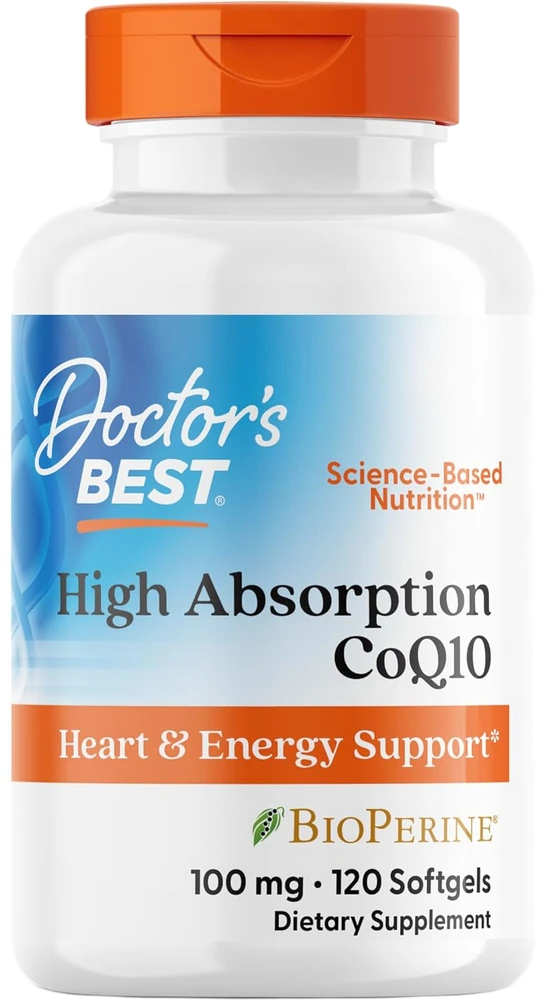
06Doctor's Best High Absorption CoQ10
The right call for under-40 buyers whose conversion enzyme works and for first-time experimenters who want to test CoQ10 without paying ubiquinol prices.
 01
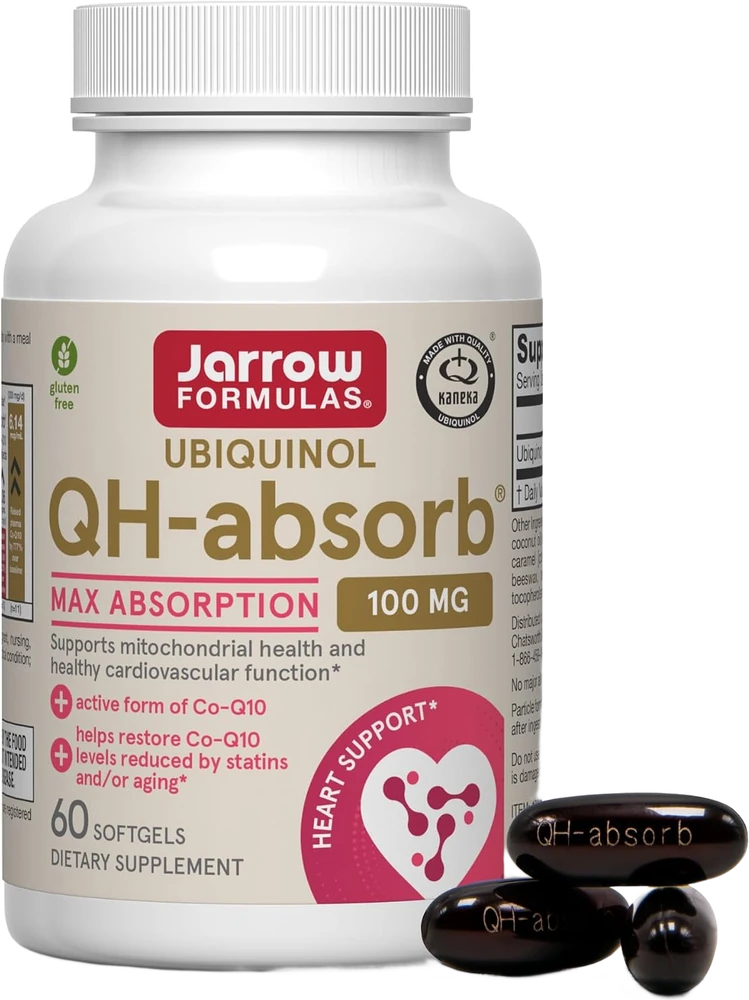
01Jarrow Ubiquinol QH-Absorb
The brand-name Kaneka option.
 02
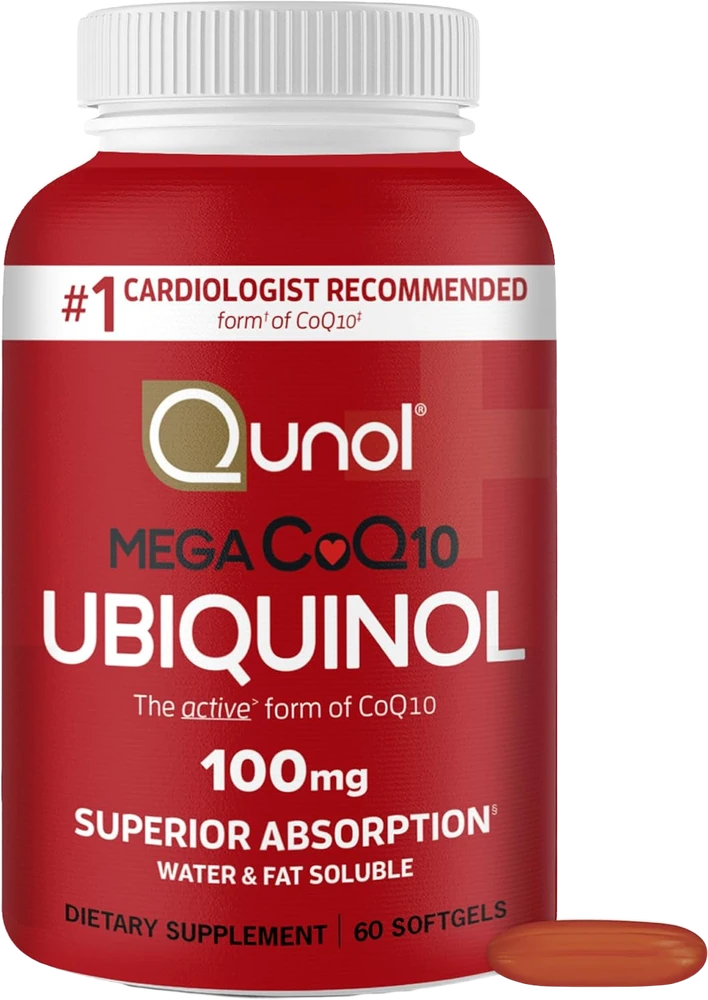
02Qunol Mega Ubiquinol
New on this list, and second on it.
Quick Answers
Is Qunol's 'water-soluble' actually different from regular CoQ10?
Yes — and the difference is mechanism-real but magnitude-overstated by the marketing. Qunol uses polysorbate-80 and related emulsifiers to disperse CoQ10 in an aqueous-compatible matrix inside the softgel. The polysorbate creates micellar structures around the lipid-soluble ubiquinone that allow it to clear the gut wall without requiring chylomicron formation (the standard fat-soluble absorption pathway). Published bioavailability data on Qunol's water-soluble formulation shows ~3× higher fasted plasma Q10 versus carrier-free ubiquinone — a real, measurable improvement. The catch: the same 3× gain is achieved for free by taking any CoQ10 with a fat-containing meal (eggs, avocado, olive oil, nuts). Polysorbate-80 solves a real problem (fasted absorption) using a surfactant most users don't need.
Is the polysorbate-80 safe?
Yes at the doses used in CoQ10 softgels. Polysorbate-80 is a widely-used food and pharmaceutical emulsifier — present in everything from ice cream to vaccines as a stabiliser. The FDA, EFSA, and JECFA have all reviewed polysorbate-80 safety and established acceptable daily intake limits (25 mg/kg body weight). Qunol's per-softgel polysorbate content is well below those limits. Some animal-model data has raised gut-microbiome concerns at high chronic doses (the Chassaing 2015 mouse paper), but the human-relevance and dose-translation are heavily contested. For practical purposes: polysorbate-80 in CoQ10 softgels is safe, but if you can avoid it by taking a fat-meal-paired ubiquinone instead, that's the cleaner approach.
Why is Qunol everywhere — Walmart, Costco, every drugstore?
Qunol invested heavily in mass-market retail distribution in the 2010s when CoQ10 awareness was rising and household consumers wanted a recognisable brand. The water-soluble positioning gave them a marketing differentiator over generic ubiquinone, and the polysorbate emulsion technology was a real-but-modest formulation advance over bare ubiquinone softgels. The distribution moat (every US drugstore stocks Qunol; few stock Jarrow or Healthy Origins) means Qunol captures buyers who don't research the category — they grab the bottle they recognise. For informed buyers, the brand-recognition premium is largely arbitrage you're paying for someone else's marketing budget. The product is fine; the price premium isn't.
Qunol vs Doctor's Best — which one should I buy?
Doctor's Best (#6) unless you have a specific fasted-dosing requirement. Both ship ubiquinone (oxidised form) at 100 mg/softgel. Doctor's Best uses BioPerine (~30% absorption boost via piperine mechanism) at $18.99 for 120 softgels. Qunol uses polysorbate-80 water-soluble emulsion (~3× fasted absorption boost) at $29.97 for 120 softgels (both Amazon US, Oct 11, 2026). If you take CoQ10 with breakfast eggs, dinner with olive oil, or any fat-containing meal, Doctor's Best with the fat-meal closes the absorption gap that Qunol's surfactant exists to solve — same outcome, about a third less. If you genuinely cannot dose with food (intermittent fasting, medical feeding-tube administration, or behavioural inability to remember), Qunol is the right call. For everyone else, Doctor's Best is the better value.
Is the Qunol Mega version (100 mg ubiquinol) worth the upgrade?
Qunol sells two main SKUs — Qunol Ultra (ubiquinone, this product) and Qunol Mega (ubiquinol). Qunol Mega names Kaneka Ubiquinol on its panel, in the same water-and-fat-soluble base with polysorbate 80. On Amazon US on Oct 11, 2026 it cost $21.88 for 60 softgels ($0.36 each), the lowest price per softgel of the five Kaneka ubiquinols we rank; Jarrow QH-Absorb (#1) cost $27.05 for 60. Qunol Mega is #2 on our list. An earlier version of this answer priced it at about $40 for 60 softgels and told you to skip it; that price was wrong. If you are 40+ or on a statin, Qunol Mega is the Qunol to buy, not Ultra.
Will the water-soluble form interact with statins or other medications?
The CoQ10 itself doesn't interact with statins differently in water-soluble vs lipid-soluble form — it's the same ubiquinone molecule, just packaged differently. The polysorbate-80 carrier could theoretically alter the gut absorption profile of co-administered lipid-soluble medications (some statins, fat-soluble vitamins, certain immunosuppressants) by competing for the same absorption pathways, but the magnitude is small at typical CoQ10 doses. The clinically meaningful CoQ10-medication interaction remains warfarin (CoQ10's vitamin K structural similarity can reduce anticoagulant effect) — same warning applies to Qunol as to any CoQ10. If you're on multiple lipid-soluble medications, taking Qunol 2+ hours separate from them removes the theoretical absorption-competition concern.
How long should I run Qunol before judging response?
Same timeline as any CoQ10 — 4-8 weeks minimum. CoQ10 is not a stimulant regardless of form or absorption carrier. The water-soluble emulsion gets the molecule into your bloodstream faster (peak plasma Q10 by 4-6 hours post-dose versus 6-8 hours for lipid-soluble forms), but tissue distribution and the underlying mitochondrial response curve are the same. Week 1: nothing felt. Week 2-4: serum Q10 measurably rises on bloodwork. Week 4-8: statin myalgia recedes in responders, energy improvements in deficient populations. If you've run Qunol at 100 mg/day for 8 weeks with no perceptible effect, switching to Jarrow Ubiquinol won't change the response — you're likely a non-responder and the budget would do more for you elsewhere (creatine, omega-3).
Sources & Further Reading
5 peer-reviewed sources, each linked to PubMed
- [1] Bhagavan 2006 (polysorbate emulsion PK) PMID 16551570 — Coenzyme Q10: absorption, tissue uptake, metabolism and pharmacokinetics. Comprehensive review of CoQ10 pharmacokinetics including water-soluble polysorbate-80 emulsion formulations. Documented the ~3× fasted-absorption advantage of polysorbate-emulsified ubiquinone versus bare softgels — the reference paper that anchors Qunol's water-soluble bioavailability claim. The same review notes that the advantage diminishes when CoQ10 is taken with food.
- [2] Mortensen 2014 (Q-SYMBIO) PMID 25282031 — The effect of coenzyme Q10 on morbidity and mortality in chronic heart failure: results from Q-SYMBIO: a randomized double-blind trial. 420 chronic heart failure patients randomised to 3×100 mg/day Kaneka ubiquinone vs placebo for 2 years. CoQ10 group showed 43% reduction in major adverse cardiovascular events. The pivotal trial that used ubiquinone form — Qunol's form matches the trial protocol, but the water-soluble carrier is a separate variable not tested in Q-SYMBIO.
- [3] Banach 2015 (statin myopathy meta) PMID 25440725 — Effects of coenzyme Q10 on statin-induced myopathy: a meta-analysis of randomized controlled trials. Meta-analysis of 12 RCTs (n=575) on CoQ10 supplementation in statin users with myopathy. Pooled effect showed significant reduction in muscle symptoms. The reference paper for the statin-myopathy protocol — cited to explain why Qunol's ubiquinone form isn't optimal for this indication versus ubiquinol products.
- [4] Zhang 2018 (ubiquinol vs ubiquinone) PMID 30302465 — Ubiquinol is superior to ubiquinone to enhance Coenzyme Q10 status in older men. Head-to-head trial of ubiquinol vs ubiquinone in older men. Ubiquinol produced significantly higher plasma CoQ10 at equivalent oral doses — the form-gap that Qunol's water-soluble carrier doesn't close in adults 40+ where the conversion enzyme is impaired.
- [5] Hosoe 2007 (Kaneka pharmacokinetics) PMID 16919858 — Study on safety and bioavailability of ubiquinol (Kaneka QH) after single and 4-week multiple oral administration to healthy volunteers. Pharmacokinetic study of Kaneka ubiquinol with fasted vs fed-state comparison. Documented that taking CoQ10 with a fat-containing meal closes the absorption gap that water-soluble carriers exist to solve — the reference data behind the 'free fatty-meal alternative' framing in this review.
Affiliate disclosure: every Amazon link uses our Associates tag (superachieverclub-20). We earn a small commission at no cost to you; it funds independent reviews. We never accept payment to change a ranking.