

4 CoQ10 Benefits That Actually Have Evidence
The 4 benefits, ranked by evidence
- Heart failure — the flagship: added to standard therapy it cut all-cause mortality to 10% vs 18% (Q-SYMBIO).
- Migraine — 48% vs 14% responders (≥50% fewer attacks) — number-needed-to-treat of 3.
- Blood sugar — a modest HbA1c and fasting-glucose improvement in type-2 diabetes.
- Fertility — better IVF pregnancy odds in women with low ovarian reserve; improves sperm quality (but not pregnancy) in men.
And the ones it's hyped for but doesn't reliably deliver: statin muscle pain, blood pressure and energy. Each benefit below has its own chart and sources.
The four numbers that anchor the honest picture:
Is CoQ10 right for you?
CoQ10, scored by goal
How strongly CoQ10 moves each goal on our SAC Efficacy Score™. Tap a goal to see the full ranking.
Our own CoQ10
Our in-house ubiquinone at a high 200 mg dose — the stable, trial-proven form (Q-SYMBIO used ubiquinone). Want to compare every brand, ubiquinol included? The full independent ranking is one tap down.
See all ranked CoQ10 picks →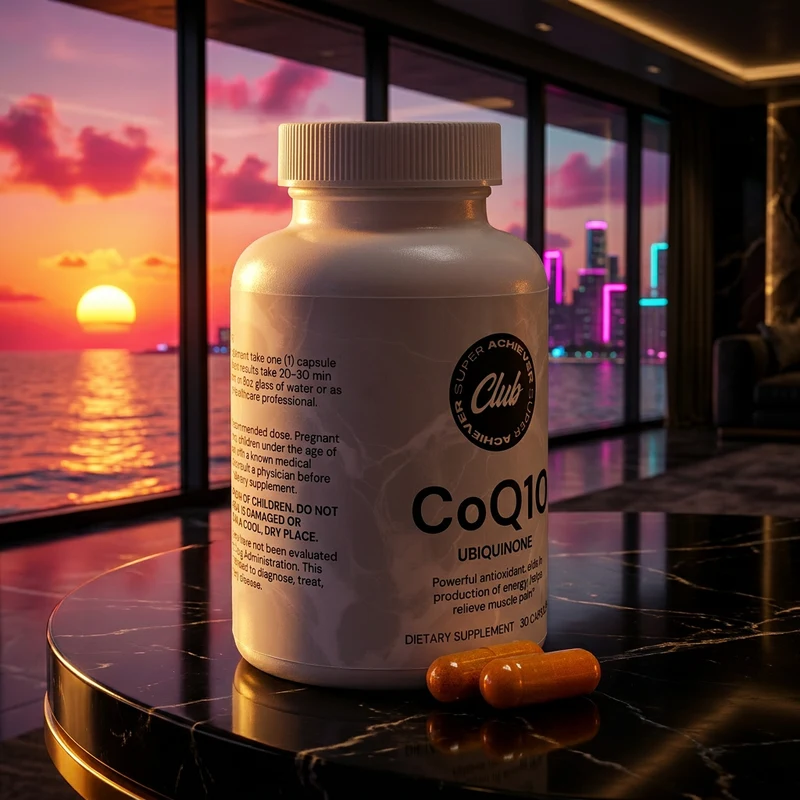
Super Achiever CoQ10 is our own product (a sponsored placement) — scored 6.7 by the same criteria as every brand, and shown at that score. See the full independent ranking for the competitors, ubiquinol brands included.
Heart failure — the flagship benefit
This is CoQ10's strongest, most genuinely positive result. In the Q-SYMBIO trial, adding CoQ10 300 mg/day to standard heart-failure therapy cut all-cause mortality to 10% vs 18% on placebo over two years, halved major adverse cardiac events, and improved NYHA class[1]. The honest caveat: it's a single 420-patient trial, not replicated at that scale, and heart-failure care has since evolved — so it's a supported add-on for diagnosed heart failure (under a cardiologist), not a general heart-health supplement.
Heart failure: the strongest CoQ10 evidence
outcomes over 2 years in moderate-to-severe chronic heart failure, CoQ10 300 mg/day added to standard therapy vs placebo · this is CoQ10's best, genuinely positive result — lower is better
Migraine — genuinely fewer attacks
CoQ10 is one of the better-supported migraine-prevention supplements. In the pivotal RCT, 300 mg/day tripled the responder rate — 47.6% vs 14.4% of patients had at least half as many attacks, a number-needed-to-treat of just 3[6], and a dose-response meta-analysis pooled about 1.9 fewer attacks per month[7]. Give it about 12 weeks.
Migraine: genuinely fewer attacks
share of patients whose attack frequency dropped by at least half (responder rate) over 3 months · 3×100 mg/day
Blood sugar
In type-2 diabetes, a meta-analysis found CoQ10 modestly improved HbA1c and fasting glucose[10]— a helpful metabolic adjunct, though the effect is small and insulin itself didn't change much. It's not a blood-sugar treatment on its own.
Fertility — real, but case-specific
For women with diminished ovarian reserve doing IVF, CoQ10 pre-treatment improved clinical pregnancy odds (about 1.84×) and the number of eggs retrieved[8]. In men, it improves sperm concentration and motility — but the honest limit is that a meta-analysis found it did not increase actual pregnancy rates[9]. So it's a reasonable adjunct within fertility treatment, not a stand-alone fix.
What CoQ10 is hyped for — but doesn't reliably do
Three of the most-marketed CoQ10 uses don't hold up. Statin muscle pain: the evidence is genuinely mixed — one meta-analysis found no significant benefit, a later one found less subjectivepain but no change in the objective muscle-damage marker (CK)[2,3]; it's a cheap, low-risk try, not a proven fix. Blood pressure:the “up to −17 mmHg” figure comes from mostly open-label studies; the Cochrane review of blinded trials found no significant effect[4,5]. Energy / exercise: in healthy people CoQ10 reliably raises blood levels but has small, inconsistent performance effects — the fatigue benefit is mainly in deficiency or disease[16].
Who benefits most
CoQ10 rewards a specific profile: people with diagnosed heart failure, migraine sufferers, people who are CoQ10-deficient (age 40+, statin users, chronic illness), and women with low ovarian reserve in fertility treatment. In healthy, younger, non-statin people the effect is small — the body makes enough. See the honest safety picture(it's very safe) and the full data report.
How long until it works
CoQ10 repletes slowly and its benefits build over weeks to months. Blood levels plateau by about two weeks[13]; any energy benefit (if you're deficient) shows up around four weeks; the migraine benefit emerged in the third month[6]; and the heart-failure outcomes were measured over up to two years. Always take it with a fatty meal.
How long until it works
typical time to a felt or measured effect — CoQ10 repletes slowly and its benefits build over weeks to months
Benefit myths vs. facts
| The myth | What the evidence shows | Source |
|---|---|---|
| CoQ10 fixes statin muscle pain | The evidence is genuinely mixed — don't count on it. Banach 2015 (6 RCTs) found no significant benefit; a later meta (Qu 2018, 12 RCTs) did find less muscle pain, but only on subjective scales, with no change in the objective damage marker (CK). It's a cheap, low-risk 12-week try, not a proven fix. | [2,3] |
| Ubiquinol is worth paying extra for | Usually not. Ubiquinol raises blood CoQ10 more than ubiquinone (a surrogate marker), but no clinical-outcome trial shows it produces better results — and the pivotal trials used ubiquinone. It's a reasonable upgrade for over-60 or statin users who don't respond to ubiquinone, not a blanket must-buy. | [11,12] |
| CoQ10 lowers blood pressure | Overhyped. The famous 'up to −17 mmHg' figure comes from Rosenfeldt 2007, pooling mostly open-label studies. The Cochrane review of properly blinded trials found NO significant blood-pressure effect. Don't take CoQ10 for hypertension. | [4,5] |
| CoQ10 boosts athletic performance | Not in healthy people. It reliably raises blood CoQ10, but meta-analyses find performance effects small and inconsistent — the benefit is mainly in deficiency or disease states, not for otherwise healthy athletes. | [16] |
| CoQ10 restores fertility | Partly, and only in specific cases. In women with diminished ovarian reserve doing IVF it improved clinical pregnancy odds (OR ~1.84). In men it improves sperm concentration and motility — but a meta-analysis found it did NOT increase actual pregnancy rates. Helpful adjunct in fertility treatment, not a stand-alone cure. | [8,9] |
Frequently asked questions
What is CoQ10 best for?
Heart failure, by a wide margin. In the Q-SYMBIO trial, CoQ10 added to standard therapy cut all-cause mortality to 10% vs 18% on placebo over two years. It's also genuinely effective for migraine prevention. The popular statin-muscle-pain use has conflicting evidence, and the blood-pressure benefit didn't hold up in the Cochrane review.
Does CoQ10 help with statin muscle pain?
Maybe — the evidence is mixed, so don't count on it. One meta-analysis (Banach 2015) found no significant benefit; a later one (Qu 2018) found less muscle pain, but only on subjective scales and with no change in the objective muscle-damage marker. It's cheap and very safe, so a 12-week trial is reasonable — just not a guaranteed fix.
Does CoQ10 give you more energy?
Only if you're deficient. In healthy people, meta-analyses find CoQ10 reliably raises blood levels but has small, inconsistent effects on energy and exercise performance. The fatigue benefit shows up mainly in deficiency, statin use, or chronic illness — not as a general energy booster.
Does CoQ10 help fertility?
In specific cases. In women with diminished ovarian reserve doing IVF it improved clinical pregnancy odds (about 1.84×). In men it improves sperm concentration and motility — but a meta-analysis found it did not increase actual pregnancy rates. A useful adjunct in fertility treatment, not a stand-alone cure.
How much CoQ10 should I take?
100–200 mg/day for general use, 200–400 mg/day for heart-failure or statin protocols under a doctor, and 300 mg/day for migraine. Always take it with a fat-containing meal — CoQ10 is fat-soluble and fasted absorption is poor.
Sources
- Mortensen SA, Rosenfeldt F, Kumar A, et al. The effect of coenzyme Q10 on morbidity and mortality in chronic heart failure: results from Q-SYMBIO, a randomized double-blind trial. JACC Heart Fail. 2014;2(6):641–649. PMID 25282031
- Banach M, Serban C, Sahebkar A, et al. Effects of coenzyme Q10 on statin-induced myopathy: a meta-analysis of randomized controlled trials. Mayo Clin Proc. 2015;90(1):24–34. PMID 25440725
- Qu H, Guo M, Chai H, Wang WT, Gao ZY, Shi DZ. Effects of coenzyme Q10 on statin-induced myopathy: an updated meta-analysis of randomized controlled trials. J Am Heart Assoc. 2018;7(19):e009835. PMID 30371340
- Rosenfeldt FL, Haas SJ, Krum H, et al. Coenzyme Q10 in the treatment of hypertension: a meta-analysis of the clinical trials. J Hum Hypertens. 2007;21(4):297–306. PMID 17287847
- Ho MJ, Li ECK, Wright JM. Blood pressure lowering efficacy of coenzyme Q10 for primary hypertension. Cochrane Database Syst Rev. 2016;3(3):CD007435. PMID 26935713
- Sándor PS, Di Clemente L, Coppola G, et al. Efficacy of coenzyme Q10 in migraine prophylaxis: a randomized controlled trial. Neurology. 2005;64(4):713–715. PMID 15728298
- Parohan M, Sarraf P, Javanbakht MH, Ranji-Burachaloo S, Djalali M. Effect of coenzyme Q10 supplementation on clinical features of migraine: a systematic review and dose-response meta-analysis of randomized controlled trials. Nutr Neurosci. 2020;23(11):868–875. PMID 30727862
- Lin G, et al. Clinical evidence of coenzyme Q10 pretreatment for women with diminished ovarian reserve undergoing IVF/ICSI: a systematic review and meta-analysis. Ann Med. 2024;56(1):2389469. PMID 39129455
- Lafuente R, González-Comadrán M, Solà I, et al. Coenzyme Q10 and male infertility: a meta-analysis. J Assist Reprod Genet. 2013;30(9):1147–1156. PMID 23912751
- Zhang SY, Yang KL, Zeng LT, Wu XH, Huang HY. Effectiveness of coenzyme Q10 supplementation for type 2 diabetes mellitus: a systematic review and meta-analysis. Int J Endocrinol. 2018;2018:6484839. PMID 30305810
- Langsjoen PH, Langsjoen AM. Comparison study of plasma coenzyme Q10 levels in healthy subjects supplemented with ubiquinol versus ubiquinone. Clin Pharmacol Drug Dev. 2014;3(1):13–17. PMID 27128225
- Zhang Y, Liu J, Chen XQ, Oliver Chen CY. Ubiquinol is superior to ubiquinone to enhance coenzyme Q10 status in older men. Food Funct. 2018;9(11):5653–5659. PMID 30302465
- Hosoe K, Kitano M, Kishida H, Kubo H, Fujii K, Kitahara M. Study on safety and bioavailability of ubiquinol (Kaneka QH) after single and 4-week multiple oral administration to healthy volunteers. Regul Toxicol Pharmacol. 2007;47(1):19–28. PMID 16919858
- Hathcock JN, Shao A. Risk assessment for coenzyme Q10 (ubiquinone). Regul Toxicol Pharmacol. 2006;45(3):282–288. PMID 16814438
- Engelsen J, Nielsen JD, Winther K. Effect of coenzyme Q10 and Ginkgo biloba on warfarin dosage in stable, long-term warfarin treated outpatients. A randomised, double blind, placebo-crossover trial. Thromb Haemost. 2002;87(6):1075–1076. PMID 12772396
- Deng H, et al. Coenzyme Q10 supplementation increases blood concentrations but shows little effect on exercise performance: a systematic review and meta-analysis. Br J Nutr. 2025. PMID 41457257
- Hernández-Camacho JD, Bernier M, López-Lluch G, Navas P. Coenzyme Q10 supplementation in aging and disease. Front Physiol. 2018;9:44. PMID 29459830