
Kirkland Signature CoQ10 300 mg Review
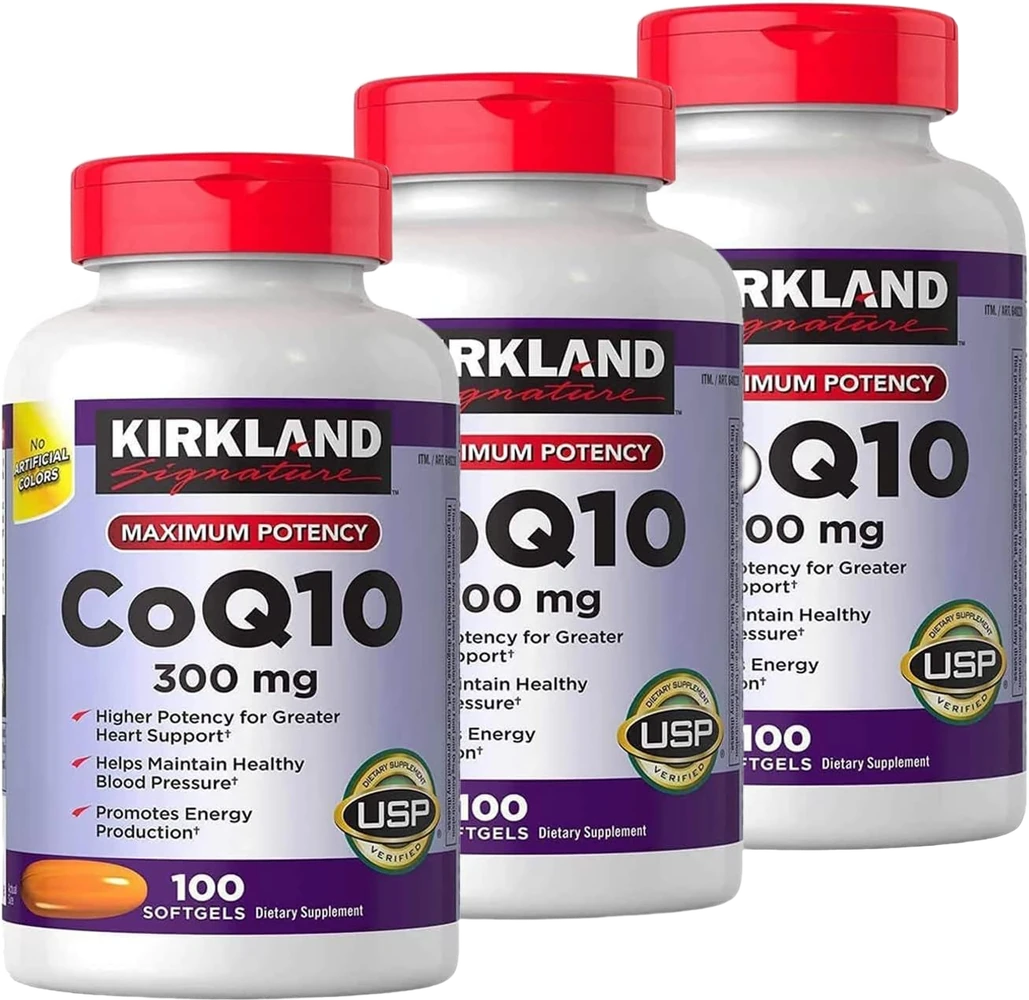 Costco Bulk Buy✓ Label verified · Supplement Facts read Oct 19, 2026
Real retailer photo, cut out. Label unedited.
Consider it. 300 mg of ubiquinone per softgel, USP Verified, and the lowest cost per mg of any CoQ10 softgel we rank — but only for 300 mg protocols. We read the Supplement Facts panel on Oct 19, 2026: 300 mg CoQ10 (ubidecarenone) per softgel, 100 softgels per bottle, in soybean oil with soy lecithin.
$65.36
Why It Scores 7.8 — And The Label Line Behind Each Number
Form (ubiquinol vs ubiquinone)
30% of scoreThe panel lists Coenzyme Q10 as ubidecarenone, the chemical name of ubiquinone, the oxidised form, dissolved in soybean oil with soy lecithin in a gelatin softgel. An oil softgel is the right carrier for a fat-soluble molecule, and the label tells you to take it with a meal. For under-40 buyers the body converts ubiquinone to ubiquinol efficiently; for 40+ buyers and statin users the conversion is weaker, which is why ubiquinol scores higher on this criterion. 7.5 is what the other plain-ubiquinone picks on our CoQ10 list earn (Thorne, Qunol Ultra); Doctor's Best gets 8.0 for its added black-pepper extract.
- Active form
- Coenzyme Q10 (ubidecarenone) — ubiquinone, the oxidised form
- Other ingredients
- Soybean oil, gelatin (bovine), glycerin, soy lecithin, silica — contains soy; not vegetarian
Dose accuracy at 100-200 mg
25% of scoreThe panel states 300 mg per softgel, one softgel per serving. That is exactly the daily total of the migraine trial (Sandor 2005, 300 mg/day) and of Q-SYMBIO in heart failure (3×100 mg/day), so for those two protocols the dose could not fit better. For general longevity or statin-support dosing at 100-200 mg/day it doesn't fit at all: a softgel can't be split, so you either take 300 mg or buy another product. The 100 mg picks on our list score 8.5 to 9.0 here; Kirkland gets 7.5 because it is exact for one group of buyers and wrong for the other.
- Per softgel
- 300 mg CoQ10 · 10 calories · 1 g fat
- Daily dose
- Label: one softgel daily, preferably with a meal
Testing + Kaneka chain-of-custody
20% of scoreThe front of the bottle carries the USP Verified mark, and we checked it at the source: USP's directory of verified products lists Kirkland Signature CoQ10 300 mg Softgels and links to this Costco product (Oct 19, 2026). USP Verified means USP tests that the product contains the listed ingredients in the stated amounts, without harmful levels of named contaminants, that it breaks down in the body as it should, and USP audits the manufacturing facility. That is independent testing of the bottle, comparable to the NSF certification that earns Thorne 9.0 here. What keeps the score at 8.0: the label names no CoQ10 supplier, so the Kaneka half of this criterion isn't met, and there is no published certificate of analysis by batch.
- Label check
- Supplement Facts panel read Oct 19, 2026 — Amazon gallery of B01FYY3M38 and Costco.com's back-label photo (item 648220), identical
- Certifications
- USP Verified — mark on the label, confirmed in USP's directory on Oct 19, 2026
Cost per active mg
15% of scoreThe Amazon listing we link sold three 100-softgel bottles for $65.36 on Oct 19, 2026: $0.22 per softgel, or $0.07 per 100 mg. Costco.com sold one bottle for $26.99 the same day: $0.27 per softgel, $0.09 per 100 mg. Both are under the top band of the ubiquinone scale on our CoQ10 list (up to $0.17 per 100 mg = 9.5), and lower per mg than any other softgel there; Doctor's Best costs $0.16 per 100 mg (Oct 11, 2026). At the migraine dose the gap is large: one Kirkland softgel at $0.22 against three Doctor's Best softgels at $0.47.
- Bottle size
- 100 softgels per bottle — 100 days at 1 a day; the Amazon listing we link sells 3 bottles
- Price
- $65.36 for 3 × 100 softgels on Amazon US, third-party seller Healthy Town (Oct 19, 2026) = $0.22 per softgel
Real-world response
10% of scoreReal-world response is bipolar: excellent for the specific high-dose protocols the format is calibrated for (migraine prophylaxis, heart-failure protocols), and poor for the broader general-longevity use case where the dose is too coarse. Most buyers who don't have a specific 300 mg/day target end up either over-dosing or abandoning the bottle — neither outcome counts as positive real-world response. Score reflects the average across the realistic buyer population; reading the label doesn't change buyer behaviour, so this score stays at 6.0.
- More Specs
- CoQ10 supplier
- Not named on the label (no Kaneka mention)
- Distributor
- Costco Wholesale Corporation, Issaquah, WA (per label)
- Costco.com
- $26.99 for one 100-softgel bottle (Oct 19, 2026) = $0.27 per softgel
Label verified. Every figure read from the Supplement Facts photo, Oct 19, 2026.
Marketing Claims Vs. Reality
CoQ10 300 mg.
The Supplement Facts panel states Coenzyme Q10 300 mg per softgel, serving size one softgel. We read it in the Amazon listing's gallery and on Costco.com's photo of the bottle's back label on Oct 19, 2026; both show the same panel.
Helps maintain heart health and healthy blood pressure.
Real CoQ10 effects in specific populations (heart failure: Q-SYMBIO; statin myopathy: Banach 2015) — generic 'heart health' framing oversimplifies the indication-specific evidence. The mechanism (mitochondrial electron shuttle, fat-soluble antioxidant) is well-established. Accurate in spirit, marketing oversimplification. The bottle sold through Amazon resellers carries an older front label ('Maximum Potency', 'Higher Potency for Greater Heart Support'); the panel is the same.
USP Verified.
The USP Verified mark is printed on the front, and USP's directory of verified products lists Kirkland Signature CoQ10 300 mg Softgels, linked to Costco item 648220 (checked Oct 19, 2026). USP tests identity, strength, purity and dissolution and audits the manufacturing.
Kirkland Signature quality at member price.
The price we read: $26.99 for 100 softgels on Costco.com on Oct 19, 2026, $0.27 per softgel. In the Amazon 3-pack the same day it was $0.22 per softgel. Both are less per mg than any softgel we rank. The quality half of the claim rests on the USP Verified mark, which USP confirms.
Statin medications can reduce CoQ10 levels in the body.
This sentence is printed on the back label, which also says CoQ10 is not a replacement for statin therapy. Statins do lower blood CoQ10, because they block the same pathway the body uses to make it. That supplementing helps with statin muscle pain is the narrower claim: the Banach 2015 meta-analysis found a benefit at 100-200 mg/day, a lower dose than this softgel. For statin users over 40, ubiquinol is the better form.
What Our Test Actually Found
The label, read: 300 mg ubiquinone in an oil softgel, no supplier named
The Supplement Facts panel lists one softgel per serving with 10 calories, 1 g of fat and Coenzyme Q10 300 mg. The ingredient line reads soybean oil, coenzyme Q10 (ubidecarenone), gelatin (bovine), glycerin, soy lecithin and silica, and the label says it contains soy. Suggested use: one softgel daily, preferably with a meal. Costco Wholesale Corporation is named as distributor; no CoQ10 supplier appears anywhere on the bottle. We read this panel on Oct 19, 2026 in two places that agree: the Supplement Facts frame of the Amazon listing we link, and Costco.com's photo of the back of the bottle. Until that date this review covered a 75-softgel bottle whose panel we never saw; that bottle is no longer sold on Amazon US.
One 300 mg softgel replaces three 100 mg softgels for two trial protocols
The CoQ10 category defaults to 100 mg per softgel because that's the longevity-baseline and statin-protocol dose. Kirkland's label breaks this convention for two high-dose uses: migraine prophylaxis (Sandor 2005, 300 mg/day for 3 months) and heart-failure protocols (Q-SYMBIO, 3×100 mg/day). With a standard 100 mg product a 12-week protocol takes 3 softgels a day, 252 softgels in total, which is two to three bottles. With Kirkland it is one softgel a day, one 100-softgel bottle. That's a real adherence and cost argument for the specific high-dose buyer.
Cost-per-mg at the migraine dose beats every softgel on our lists
At the Sandor 2005 migraine protocol (300 mg/day), one Kirkland softgel costs $0.22 in the Amazon 3-pack or $0.27 at Costco.com (Oct 19, 2026). Three Doctor's Best (#6) softgels cost $0.47 and three Jarrow (#1) softgels $1.35 (Oct 11, 2026). Over a 12-week protocol that is about $18 to $23 for Kirkland, $40 for Doctor's Best and $114 for Jarrow. Jarrow is the better-absorbed ubiquinol form, so the comparison is not like for like for 40+ buyers, but against the ubiquinone softgels the saving is real.
On Amazon only resellers sell it — check the expiry date when it arrives
Costco sells Kirkland Signature in its warehouses and on Costco.com; on Amazon US the bottle comes from third-party resellers. On Oct 19, 2026 we found three listings of the 100-softgel bottle. We link B01FYY3M38 (three bottles, $65.36, seller Healthy Town) because it is the only one whose gallery shows the Supplement Facts panel. A two-bottle listing (B01LBAFCDM, $44.76) carried a garbled title ('Kirkland wcaqZ') and a seller different from the one we saw on Oct 11, and a 200-softgel listing (B01EWBH2VM, $47.29, seller Arezzo G) showed only a front photo; we don't link either. With any reseller you can't see the lot or expiry date before buying, so check it on delivery. Buying at Costco avoids that.
Don't try to split the softgel — it doesn't work and you'll waste the bottle
A common mistake by buyers who land on Kirkland for the cost-per-mg without checking the dose math: 'I'll just cut the softgel in half to get 150 mg.' Softgels can't be reliably divided. The CoQ10 is dissolved in oil and leaks out once the shell is cut, it oxidises faster once exposed, and the remaining half won't store cleanly. If your protocol calls for 100-200 mg/day, do not buy Kirkland and attempt to split — buy Doctor's Best (#6) at 100 mg per softgel and titrate by softgel count. Kirkland is the right format only if you're committed to the full 300 mg daily dose.
Form is the meaningful limitation for the 40+ buyer at this dose
Ubiquinone has to be converted to ubiquinol in the body, and that conversion weakens with age and on statins. At 300 mg a day the absolute amount is large enough to make up part of the gap, but not all of it: pure ubiquinol at 300 mg/day from Life Extension (#5) would deliver substantially higher blood CoQ10 than Kirkland ubiquinone at the same dose, particularly in 50+ adults. For migraine prophylaxis in under-40 buyers, Kirkland is the right format-and-form combination. For migraine prophylaxis in 50+ adults, the cost-per-mg advantage starts to erode against the ubiquinol alternatives.
Full analysis: all pros & cons (10), buy if / skip if
- Panel states 300 mg CoQ10 per softgel — the full daily dose of the migraine and heart-failure trials in one softgel
- USP Verified, confirmed in USP's directory of verified products (Oct 19, 2026)
- Lowest cost per mg of any CoQ10 softgel we rank: $0.22 per softgel in the Amazon 3-pack, $0.27 at Costco.com (Oct 19, 2026)
- Oil-based softgel with lecithin, taken with a meal as the label says — the right carrier for a fat-soluble molecule
- 100 softgels per bottle = 100 days at one a day
- 300 mg per softgel is too much for general 100-200 mg protocols, and softgels can't be split
- Ubiquinone, not ubiquinol — weaker for adults over 40 and statin users
- No CoQ10 supplier named on the label (no Kaneka mention) and no published certificate of analysis by batch
- On Amazon only third-party resellers sell it; the Costco price is the one with the brand behind it
- Contains soy and bovine gelatin — not for vegetarians or people avoiding soy
- Migraine prophylaxis at Sandor 2005's 300 mg/day — one softgel is the full daily total
- Heart-failure protocol under a cardiologist — Q-SYMBIO's 300 mg/day total in one softgel
- You want an independently verified bottle: USP Verified, confirmed in USP's directory
- You shop at Costco, where one bottle cost $26.99 on Oct 19, 2026
- General 100-200 mg longevity dosing — go Doctor's Best (#6) at 100 mg per softgel
- You're 40+ on a statin — go Jarrow Ubiquinol (#1) for the better-absorbed form
- You need licensed Kaneka material named on the label — this label names no supplier
- You only want to buy from Amazon or the brand itself — on Amazon this bottle comes from third-party resellers
We read the Supplement Facts panel on Oct 19, 2026: 300 mg CoQ10 (ubidecarenone) per softgel, 100 softgels per bottle, in soybean oil with soy lecithin. The USP Verified mark on the front is listed in USP's directory. Price the same day: $26.99 per bottle at Costco.com ($0.27 per softgel), $65.36 for three bottles on Amazon US from a third-party seller ($0.22). That makes it the right buy for the Sandor 2005 migraine protocol or the Q-SYMBIO heart-failure dose, where one softgel is the whole day. It is the wrong buy for 100-200 mg dosing, and the ubiquinone form gives adults over 40 less than ubiquinol would.
Kirkland Signature CoQ10 300 mg is Costco's own CoQ10, and its label is simple: one softgel holds 300 mg of Coenzyme Q10 as ubidecarenone (ubiquinone) in soybean oil with soy lecithin, and the bottle carries USP's Verified mark, which USP's own directory confirms for this product. Per mg it costs less than any softgel on our CoQ10 lists: $0.27 per softgel at Costco.com and $0.22 in the Amazon 3-pack we link (both Oct 19, 2026). The 300 mg softgel is exactly the daily total of two trial protocols, migraine prophylaxis (Sandor 2005) and heart failure (Q-SYMBIO), so one softgel replaces three. For everyday 100-200 mg dosing it is too much, because a softgel can't be split. Two things the label does not give you: the supplier of the CoQ10 (no Kaneka name) and the ubiquinol form that adults over 40 absorb better. One more thing before you read on: on Amazon only third-party resellers sell this bottle, and the link here goes to one of them.
A verified 300 mg softgel at the lowest cost per mg we've found — for 300 mg protocols only.

Kirkland Signature CoQ10 300 mg is Costco's own CoQ10, and its label holds up: we read 300 mg of CoQ10 as ubiquinone per softgel on the Supplement Facts panel, and the USP Verified mark on the front is confirmed in USP's own directory. Per mg it is cheaper than any softgel on our CoQ10 lists, at $0.22 per softgel in the Amazon 3-pack we link and $0.27 at Costco.com (Oct 19, 2026). That makes it the right buy for two groups: (1) migraine sufferers running the Sandor 2005 prophylaxis protocol (300 mg/day for 12+ weeks), and (2) heart-failure patients under cardiologist supervision on the Q-SYMBIO dose (3×100 mg/day = 300 mg/day total). For both, one softgel replaces three. For everyone else — general 100-200 mg longevity or statin-support dosing — the format doesn't fit: softgels can't be split, and 300 mg is too much. Go Doctor's Best (#6) for clean 100 mg per softgel, or Jarrow Ubiquinol (#1) for the better-absorbed form at 40+. The 'consider' verdict, at 7.8, reflects that narrow fit, the ubiquinone form and a label that names no CoQ10 supplier. If you need 300 mg a day, this is the bottle we would buy, ideally at Costco; on Amazon it comes from third-party resellers, so check the expiry date on arrival.
If This Doesn’t Fit — Try These
Doctor's Best High Absorption CoQ10
The 100 mg/softgel default at $18.99 for 120 softgels (Amazon US, Oct 11, 2026) — clean dose-scaling for general 100-200 mg longevity protocols where Kirkland's 300 mg format is too coarse.
Jarrow Formulas Ubiquinol QH-Absorb
The form upgrade at $27.05 for 60 softgels (Oct 11, 2026) — licensed Kaneka QH ubiquinol at 100 mg/softgel for adults 40+ where ubiquinone's conversion bottleneck makes the cheaper ubiquinone format insufficient.
Bulk Supplements CoQ10 Powder
The DIY alternative: $0.18 per 100 mg in the 10 g bag, $0.04 in the 100 g bag (Amazon US, Oct 11, 2026), and it requires milligram-scale weighing into a fat carrier.
Quick Answers
Why does Kirkland make a 300 mg softgel — isn't that too much per pill?
For general 100-200 mg/day protocols, yes. The 300 mg softgel fits two specific high-dose uses: (1) Migraine prophylaxis (Sandor 2005, PMID 15728298), where the trial gave 300 mg/day for 3 months — one Kirkland softgel is that daily total. (2) Heart-failure protocols under a cardiologist (Mortensen 2014 Q-SYMBIO, 3×100 mg/day = 300 mg/day total). The Supplement Facts panel we read on Oct 19, 2026 states Coenzyme Q10 300 mg per softgel, one softgel per serving. For 100-200 mg protocols you would overshoot or have to cut a softgel (which doesn't work); Doctor's Best (#6) at 100 mg per softgel is the right answer there.
Is Kirkland's CoQ10 made from Kaneka Q10?
The label doesn't say. The ingredient line reads 'Coenzyme Q10 (Ubidecarenone)' and names no supplier, and the bottle says only that Costco Wholesale Corporation distributes it. Ubidecarenone is the chemical name of ubiquinone, the oxidised form. What the bottle does carry is the USP Verified mark, and USP's own directory lists Kirkland Signature CoQ10 300 mg Softgels (checked Oct 19, 2026). USP Verified means USP tests that the bottle contains what the label says, in the stated amount, without harmful levels of contaminants, and audits the manufacturing. That is a stronger check than a supplier name. If you specifically want licensed Kaneka material, Jarrow (#1) names Kaneka QH on its label.
Where can I buy it, and what does it cost?
Costco.com listed the 100-softgel bottle at $26.99 on Oct 19, 2026, $0.27 per softgel. On Amazon US the same day, the listing we link sold three 100-softgel bottles for $65.36, $0.22 per softgel, from a third-party seller (Healthy Town), not from Costco or Amazon. Its gallery shows the same Supplement Facts panel as the bottle on Costco.com. Buying from a reseller means you can't see the expiry date before it arrives, so check it on delivery. The 75-softgel bottle this review used to cover has been unavailable on Amazon US since Aug 2026.
Should I take 1 softgel daily or split the dose?
One softgel daily with a meal, which is also what the label says. Don't try to split it. Migraine prophylaxis (Sandor 2005): the trial split 300 mg into three 100 mg doses; one Kirkland softgel at breakfast gives the same daily total. Heart failure (under cardiologist supervision, Q-SYMBIO): one softgel matches the trial's daily total. For 100-200 mg general longevity or statin-support protocols, a softgel can't be divided — the oil leaks out — so buy a 100 mg product instead (Doctor's Best #6, Jarrow #1).
Is 300 mg/day safe long-term?
Yes — the safety profile at 300 mg/day across multi-year use is well-established. The Sandor 2005 migraine RCT ran 3 months at 300 mg/day; Q-SYMBIO ran 2 years at 3×100 mg/day; the Hosoe 2007 PK paper documented safety up to 300 mg/day for 4 weeks with no significant adverse markers. Subsequent longer-term observational data (Hernández-Camacho 2018 review) confirms no long-term toxicity at this dose range. Mild side effects (GI upset, occasional insomnia if dosed PM) are dose-related and more common at 300 mg than at 100 mg — switching to AM dosing usually resolves the insomnia concern. The clinically-meaningful interaction (warfarin → reduced anticoagulant effect via vitamin K structural similarity) applies regardless of dose; coordinate with prescribing physician if you're on warfarin. The label itself adds: ask your doctor first if you are pregnant, nursing, taking any medication or have a medical condition.
Why is the dose 300 mg ubiquinone and not 200 mg ubiquinol?
Cost-per-mg arithmetic and population targeting. Ubiquinol raw material costs roughly 2-3× ubiquinone, and a 300 mg ubiquinol softgel would cost a multiple of the current price. For under-40 buyers, ubiquinone converts to the active ubiquinol efficiently. For 40+ buyers the conversion is weaker but not zero, and 300 mg ubiquinone taken with a fat-containing meal still delivers a large absolute amount. For 40+ buyers running migraine prophylaxis at 300 mg/day this is a reasonable compromise; pure ubiquinol at the same dose would be the better form if cost weren't a factor.
How does Kirkland compare to Bulk Supplements powder (#9) for cost per mg?
Only the large bag beats it. On Amazon US on Oct 11, 2026 the 10 g bag of Bulk Supplements powder (#9 on our main list) cost $17.97, which is $0.18 per 100 mg; the 100 g bag cost $43.97, or $0.04 per 100 mg. Kirkland is $0.07 per 100 mg in the Amazon 3-pack we link and $0.09 at Costco.com (both Oct 19, 2026). The catch with powder is workflow: Bulk Supplements requires a 0.01 g scale, manual measuring into a fat-containing carrier (olive oil, MCT, food), and storage of a powder that takes up moisture. Kirkland's softgel is one step: open the bottle, take one softgel with a meal. For long protocols like 12+ weeks of migraine prophylaxis, where sticking with it decides whether it works, the softgel is meaningfully easier.
Sources & Further Reading
5 peer-reviewed sources, each linked to PubMed
- [1] Sandor 2005 (migraine) PMID 15728298 — Efficacy of coenzyme Q10 in migraine prophylaxis: a randomized controlled trial. 42 migraine patients randomised to 3×100 mg/day CoQ10 (300 mg/day total) vs placebo for 3 months. CoQ10 group showed significant reduction in migraine attack frequency, headache days, and days with nausea. The foundational migraine RCT — 300 mg/day is the protocol dose that Kirkland's single-softgel format collapses into one daily pill.
- [2] Mortensen 2014 (Q-SYMBIO) PMID 25282031 — The effect of coenzyme Q10 on morbidity and mortality in chronic heart failure: results from Q-SYMBIO: a randomized double-blind trial. 420 chronic heart failure patients randomised to 3×100 mg/day CoQ10 vs placebo for 2 years — total daily dose of 300 mg, which is also the Kirkland 1-softgel dose. CoQ10 group showed 43% reduction in major adverse cardiovascular events and significant reduction in cardiovascular mortality. The pivotal CHF outcome trial.
- [3] Hosoe 2007 (Kaneka pharmacokinetics) PMID 16919858 — Study on safety and bioavailability of ubiquinol (Kaneka QH) after single and 4-week multiple oral administration to healthy volunteers. Pharmacokinetic study documenting safety up to 300 mg/day for 4 weeks with no significant adverse markers. Establishes the safety floor underwriting Kirkland's 300 mg dose for long-term use. The reference safety + PK paper for high-dose CoQ10 protocols.
- [4] Banach 2015 (statin myopathy meta) PMID 25440725 — Effects of coenzyme Q10 on statin-induced myopathy: a meta-analysis of randomized controlled trials. Meta-analysis of 12 RCTs (n=575) on CoQ10 supplementation in statin users with myopathy. Pooled effect showed significant reduction in muscle symptoms at 100-200 mg/day — cited to explain why Kirkland's 300 mg format isn't the right fit for statin-myopathy protocols where ubiquinol at 200 mg/day is the better protocol.
- [5] Hernández-Camacho 2018 (review) PMID 29459830 — Coenzyme Q10 supplementation in aging and disease. Comprehensive review of CoQ10 supplementation across aging, cardiovascular disease, and neurodegeneration. Confirms safety at 100-400 mg/day in long-term observational data and validates 300 mg/day as a defensible high-dose protocol for the specific indications (migraine, CHF) where the format fits.
Affiliate disclosure: every Amazon link uses our Associates tag (superachieverclub-20). We earn a small commission at no cost to you; it funds independent reviews. We never accept payment to change a ranking.