
Zinc: Benefits, Dosage & Side Effects (2026)
Zinc is an essential trace mineral required by 300+ enzymes — a critical cofactor for testosterone synthesis, aromatase inhibition, immune function, and skin keratinocyte turnover, with strong RCT evidence at 25-30 mg/day in deficient men.
The Zinc market in numbers
Our independent analysis of 9 zinc products, scored on three proprietary indices — the SAC Product Score™, Transparency Index™, and real Cost-Per-Effective-Dose™. Updated October 2026.
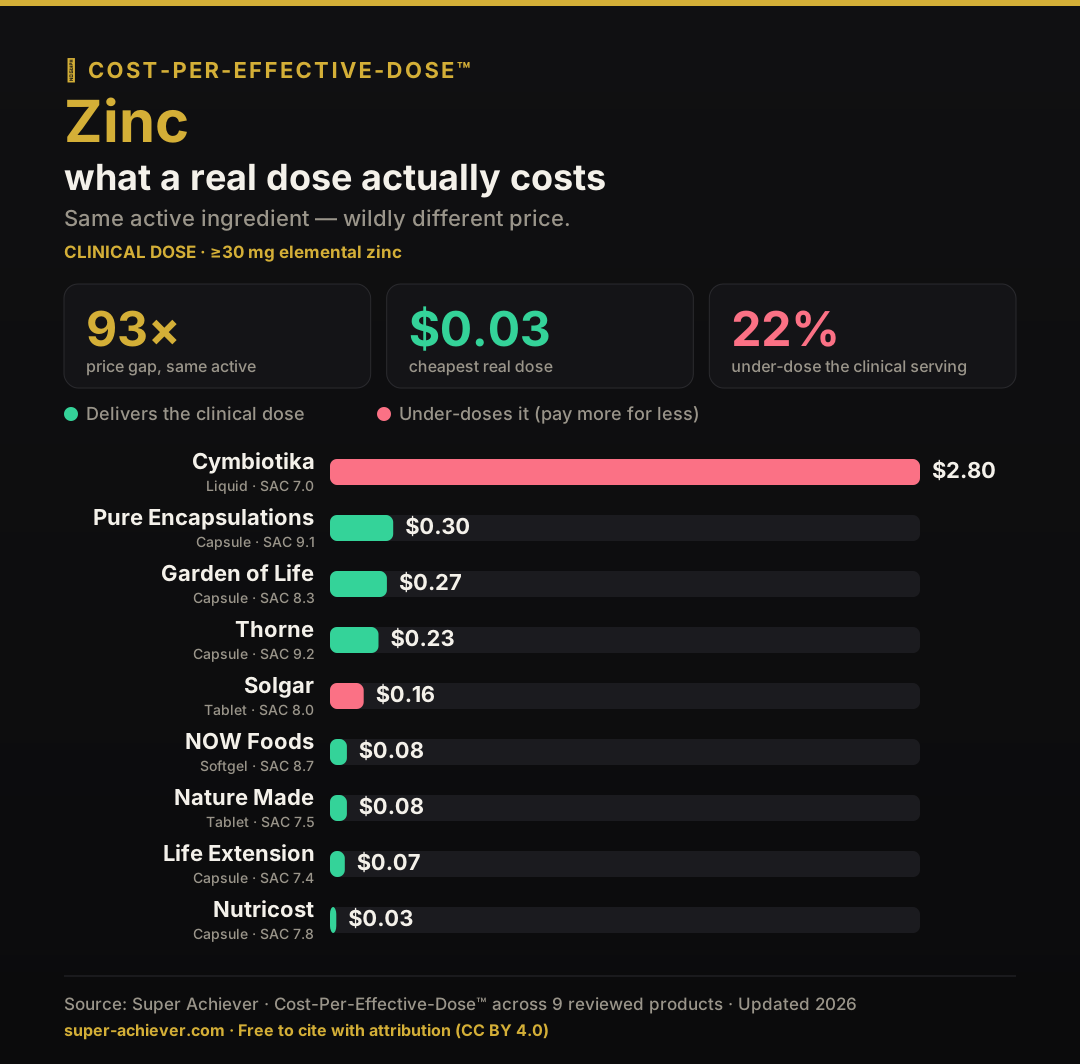
| # | Product | SAC Product Score™ | TXI™ | CPED™ | |
|---|---|---|---|---|---|
| 1 | Thorne Zinc Picolinate 30 mgCapsule | 9.2 | 70 | $0.23 | Most transparent |
| 2 | Pure Encapsulations Zinc 30Capsule | 9.1 | 40 | $0.30 | |
| 3 | NOW Foods Zinc Glycinate 30 mgSoftgel | 8.7 | 40 | $0.08 | |
| 4 | Garden of Life Vitamin Code Raw Zinc 30 mgCapsule | 8.3 | 20 | $0.27 | |
| 5 | Solgar Chelated Zinc 22 mgTablet | 8.0 | 20 | $0.16 | Under-dosed |
| 6 | Nutricost Zinc Picolinate 50 mgCapsule | 7.8 | 20 | $0.03 | Best value |
| 7 | Nature Made Zinc 30 mgTablet | 7.5 | 65 | $0.08 | |
| 8 | Life Extension Zinc Caps 50 mgCapsule | 7.4 | 40 | $0.07 | |
| 9 | Nutricost Zinc Gluconate 50 mgCapsule | 7.0 | 20 | $0.04 |
Methodology. SAC Product Score™ blends our editorial rating (RCT quality, dose, safety, value) 50/50 with community ratings. Transparency Index™ (0-100) = third-party certification (0-50) + public batch COA (0-30) + dose honesty (0-20). Cost-Per-Effective-Dose™ is the real price of one clinical dose, not one marketed "serving". Free to cite with attribution to Super Achiever.
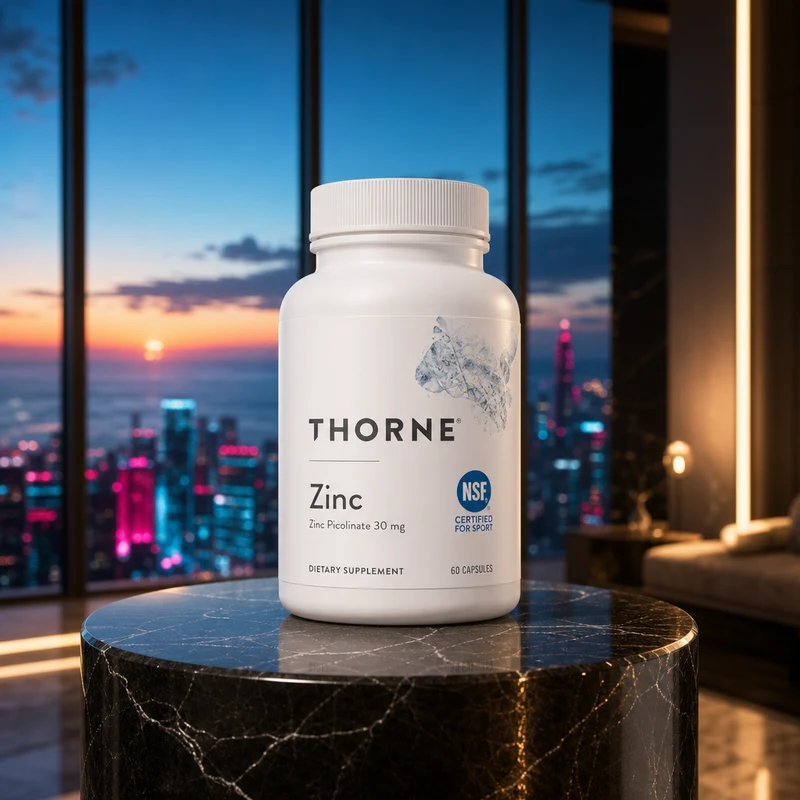
Thorne Zinc Picolinate 30 mg
What is Zinc?
Zinc is an essential trace mineral — the second most abundant trace element in the human body after iron, and a required cofactor for more than 300 enzymes spanning DNA synthesis, protein folding, immune cell maturation, and steroid hormone production. The body holds roughly 2-3 g of zinc total, distributed across muscle, bone, prostate, and the testes (which carry one of the highest tissue concentrations in the male body — not an accident).
Deficiency is far more common than mainstream nutrition coverage suggests. The Wessells & Brown 2012 prevalence estimate (PMID 23209782) put global zinc-deficiency risk at ~17% of the world population; in plant-based diets, the figure is substantially higher because phytates in grains and legumes bind zinc and block absorption. Vegetarians, vegans, athletes losing zinc through sweat, men over 60, and anyone with absorption disorders (Crohn's, celiac, gastric bypass) sit in the structurally-deficient bucket — and the symptoms of subclinical deficiency map almost exactly to the symptoms men come to SAC trying to solve: fatigue, suppressed libido, slow wound healing, hair shedding, persistent acne, and recurrent infections.
The complication, as with magnesium, is FORM. Zinc oxide (the cheapest form, dominant in big-box multivitamins) has roughly 50% the absorption of zinc bisglycinate or picolinate. "Zinc" without a form label is mostly oxide; "Zinc bisglycinate" or "Zinc picolinate, 15-30 mg elemental" is the supplement category that the trial record has actually measured. Maares & Haase 2020 (PMID 32183116) cataloged the form-by-form absorption gap in detail — bisglycinate and picolinate consistently outperform sulfate, gluconate, and especially oxide.
How it works
Zinc's testosterone effect runs through two main mechanisms. First, zinc inhibits aromatase — the enzyme that converts testosterone to estradiol. In zinc-deficient men, aromatase activity is up-regulated; supplementation restores baseline and preserves more free testosterone from estrogenic conversion. Prasad 1996 (PMID 8875519) measured this in the cornerstone trial: 30 mg/day for 6 months in marginally zinc-deficient men nearly doubled serum testosterone (from 8.3 to 16.0 nmol/L). The effect size is enormous — but it only manifests in deficient subjects. Replete men show negligible T uplift from supplementation, which is the most-misunderstood point in the zinc-and-testosterone literature.
Second, zinc is a direct cofactor for steroidogenic enzymes in the Leydig cells — the testicular cells that synthesize testosterone from cholesterol. Without adequate zinc, the synthesis pathway is rate-limited. This is why zinc deficiency reliably produces measurable hypogonadism in animal and human studies, and why repletion restores it.
The immune mechanism is independent: zinc is required for thymic output of T-lymphocytes and for the binding pocket of zinc-finger transcription factors that regulate cytokine production. Zinc lozenges (specifically zinc acetate or zinc gluconate at ~80 mg/day in lozenge form) reduce cold duration by roughly 33% in the Hemilä 2017 meta-analysis (PMID 28515951) — the mechanism is local virucidal action in the throat plus systemic immune modulation. The lozenge dose is far higher than the daily-supplement dose because it's acute, short-duration, and meant to bathe the throat in zinc ions, not to enter the blood.
Third, zinc supports skin via keratinocyte function — keratinocytes are zinc-dependent for proliferation, and zinc has direct anti-androgenic + anti-inflammatory effects on sebaceous glands. The Cervantes 2018 review (PMID 29193602) catalogued the RCT base for zinc in acne: 30-50 mg/day of elemental zinc reduces inflammatory acne lesion counts comparable to low-dose oral antibiotics, without antibiotic resistance risk. The skin-radiance effect compounds slowly — 8-12 weeks for visible change — but the mechanism is well-mapped.
The Zinc deep dives
Zinc Benefits
Testosterone (in deficient men), acne, immunity, fertility — the real benefits vs the hype (COVID, mega-dosing), every claim scored.
Read →SafetyZinc Side Effects
Safe at 25–30 mg — the honest picture: the 40 mg copper ceiling, nausea, antibiotic timing, and the nasal-zinc warning.
Read →DataZinc by the Numbers
The full data report — the testosterone effect, acne vs antibiotics, cold-duration, the copper ceiling, COVID, cost per dose. The citable stats page.
Read →At-a-glance facts
- Best forms
- Bisglycinate ≈ Picolinate > Citrate > Sulfate >> Oxide
- Adult RDA
- 11 mg/day men · 8 mg/day women (US RDA)
- Trial dose for T support
- 25-30 mg elemental/day in deficient men (Prasad 1996)
- Tolerable Upper Intake (UL)
- 40 mg/day chronic — above this, monitor copper
- Time to felt effect
- Immune: 24-48 h · T-shifts: weeks 4-8 · Acne: 8-12 weeks
- Timing
- With food (reduces nausea), away from calcium + iron + tetracyclines by 2-4 h
- Cost range (US)
- $6-18 / month at the clinical dose
- Stack synergy
- Magnesium glycinate (mineral cofactor pair), Vitamin D (T + immune), Copper 2 mg if dosing above 40 mg zinc long-term
Evidence: Strongest evidence in zinc-deficient populations: Prasad 1996 (PMID 8875519) nearly doubled serum testosterone in marginally deficient men at 30 mg/day for 6 months. Hemilä 2017 cold-duration meta-analysis (PMID 28515951) pooled zinc-lozenge RCTs and found colds ~33% shorter (95% CI 21–45%). Cervantes 2018 (PMID 29193602) catalogued head-to-head acne RCTs where 30-50 mg elemental zinc matched oral antibiotic outcomes. Effect sizes plateau in replete subjects — zinc is a cofactor-restoration play, not a stimulant.
Who it's for — and who it isn't
- Athletes — zinc is lost in sweat at meaningful rates, and exercise turns over zinc-dependent recovery enzymes faster than sedentary baseline
- Vegetarians and vegans — phytates in grains and legumes block 30-50% of dietary zinc absorption; structural deficiency is the default state, not the exception
- Men 30+ chasing testosterone preservation — even mild zinc deficiency up-regulates aromatase and bleeds free T into estradiol
- Anyone with persistent inflammatory acne — 30-50 mg/day matched low-dose oral antibiotics in head-to-head RCTs without resistance risk
- Adults with frequent colds + upper-respiratory infections — lozenge protocols (80 mg acute) cut cold duration ~33% in meta-analysis
- Low-meat eaters generally — red meat and oysters are the densest zinc sources; non-omnivore diets need supplemental support for clinical sufficiency
- Anyone already taking >25 mg/day in a multivitamin or stack — additive zinc above 40 mg/day chronically blocks copper absorption and risks anemia
- People on antibiotics (tetracyclines, quinolones) — zinc chelates these molecules in the gut and blocks both substances; separate doses by 2-4 hours minimum
- Anyone with HFE-hemochromatosis or iron-overload disorders — zinc and iron compete for the same intestinal transporter (DMT1); zinc supplementation can worsen iron-handling dynamics
- Replete men chasing testosterone — Prasad 1996's near-doubling effect only manifested in deficient subjects; zinc-sufficient men see negligible T uplift from supplementation
Week-by-week, what happens
- Hours 24-48Immune response: if dosing acutely for a cold, lozenges every 2-3 hours cut symptom duration; daily supplementation slowly raises baseline thymus + T-cell function.
- Week 1-2Most users feel no acute shift on daily dosing — zinc is a cofactor, not a stimulant. Athletes report subtle recovery improvements first.
- Week 4-8Testosterone trends start to show on bloodwork in deficient men (Prasad 1996 timeline). Aromatase normalises, free T → estradiol leak slows. Replete men: no measurable T shift.
- Week 8-12Skin: acne lesion counts drop measurably (Cervantes 2018 RCT timeline). Keratinocyte turnover normalises. Wound healing accelerates.
- Week 12+Maintenance phase. Drop to 15 mg/day if dietary zinc is now adequate, or hold 25-30 mg if structural deficiency factors (vegan diet, athletic load, age) remain.
Safety & contraindications
- Tolerable Upper Intake Level (UL) is 40 mg/day for chronic dosing. Above this, zinc competitively blocks copper absorption — long-term excess causes copper-deficiency anemia and neurological symptoms (the documented failure mode in denture-cream zinc-toxicity cases).
- If dosing above 40 mg/day chronically (e.g. 50 mg picolinate protocols), co-supplement 2 mg copper bisglycinate at a separate meal to prevent the antagonism — or cycle off after 8-12 weeks back to RDA-range maintenance.
- Zinc on an empty stomach causes nausea in roughly 30% of users — take with a meal containing protein + fat. Liquid zinc sulfate and zinc gluconate are the most nausea-prone forms; bisglycinate and picolinate are markedly gentler.
- Drug interactions: zinc chelates tetracycline + quinolone antibiotics, blocking both. Separate doses by 2-4 hours. Penicillamine, bisphosphonates, and ACE inhibitors also interact — coordinate with your prescriber.
- Mineral interactions: zinc competes with iron, calcium, and copper for absorption. Don't co-dose with a multimineral that contains high-dose iron or calcium; the bioavailability of all three drops. The cleanest protocol is zinc-alone with food, separated from other mineral supplements by 2 hours.
- Anosmia warning: intranasal zinc gels (Zicam-type products) have caused permanent loss of smell in some users via olfactory-nerve toxicity. Oral zinc and lozenges do NOT carry this risk — but never use intranasal zinc products.
- Buy from brands with public Certificates of Analysis. Heavy-metals contamination has hit budget mineral supplements; Thorne, Pure Encapsulations, and NOW Foods publish lab data.
All articles on Zinc
Best Form of Zinc: Absorption Ranked by Use Case
Every zinc form mapped to a use case — picolinate + bisglycinate for daily absorption, acetate lozenges for colds, oxide to skip. Ranked by bioavailability with the best product for each form.
Read →Best Zinc for Acne
Oral zinc reduces inflammatory acne (anti-inflammatory + sebum + C. acnes), strongest in deficient skin. Ranked by the 30-50 mg dose, form, copper safety, and acne-trial evidence.
Read →Best Zinc for Immune Support
Zinc lozenges (acetate/gluconate, 75 mg/day) cut cold duration ~33% (Hemilä 2017); daily 15-30 mg supports baseline immunity in deficiency. Ranked by form, dose, and the acute-vs-daily distinction.
Read →Best Zinc for Men
Ten zinc supplements ranked for men — testosterone (aromatase + Leydig support in deficient men), prostate, fertility, immune recovery — by form bioavailability + copper safety.
Read →Best Zinc for Testosterone
Zinc only raises testosterone in deficient men (Prasad 1996: 30 mg/day ~doubled T) — ranked by the trial 30 mg dose, bioavailable form (picolinate/bisglycinate), and copper balance.
Read →Best Zinc for Women
Ten zinc supplements ranked for women — hormonal acne, hair shedding, immune, and PCOS — by form bioavailability, gut tolerance, testing, and price.
Read →Best Zinc Supplements
Zinc forms ranked by bioavailability (picolinate ≈ bisglycinate >> gluconate > oxide), dose, copper-balance, third-party testing — picks that actually move T and immune markers.
Read →Garden of Life Vitamin Code Raw Zinc 30 mg Review
Zinc chelate review — form bioavailability, copper-balance call-outs, and the verdict for first-time and clinician-grade buyers.
Read →Jarrow Zinc Balance Review
The only zinc in our reviews with copper in the same capsule: 15 mg of zinc as L-methionine sulfate and 1 mg of copper, for $0.10 a capsule.
Read →Life Extension Enhanced Zinc Lozenges Review
A zinc acetate lozenge for the first days of a cold: 18.75 mg of zinc per lozenge, the form used in the lozenge trials. Not a daily supplement.
Read →Life Extension Zinc Caps 50 mg Review
Zinc chelate review — form bioavailability, copper-balance call-outs, and the verdict for first-time and clinician-grade buyers.
Read →Nature Made Zinc 30 mg Review
Zinc chelate review — form bioavailability, copper-balance call-outs, and the verdict for first-time and clinician-grade buyers.
Read →NOW Foods Zinc Glycinate 30 mg Review
Zinc chelate review — form bioavailability, copper-balance call-outs, and the verdict for first-time and clinician-grade buyers.
Read →NOW Sports ZMA Review
30 mg of zinc, 450 mg of magnesium and 15 mg of vitamin B-6 per serving. Two controlled studies of ZMA found no rise in testosterone.
Read →Nutricost Zinc Gluconate 50 mg Review
50 mg zinc as gluconate per capsule at about 6 cents, above the 40 mg upper limit for daily long-term use. 7.0/10.
Read →Nutricost Zinc Picolinate 50 mg Review
Zinc chelate review — form bioavailability, copper-balance call-outs, and the verdict for first-time and clinician-grade buyers.
Read →Pure Encapsulations Zinc 30 Review
Zinc chelate review — form bioavailability, copper-balance call-outs, and the verdict for first-time and clinician-grade buyers.
Read →Solgar Chelated Zinc 22 mg Review
Zinc chelate review — form bioavailability, copper-balance call-outs, and the verdict for first-time and clinician-grade buyers.
Read →Thorne Zinc Picolinate 15 mg Review
The half-dose version of our top zinc pick: 15 mg of zinc picolinate per capsule, a label that allows one or two capsules a day, and an NSF contents listing.
Read →Thorne Zinc Picolinate 30 mg Review
Zinc chelate review — form bioavailability, copper-balance call-outs, and the verdict for first-time and clinician-grade buyers.
Read →FAQ
Bisglycinate vs picolinate vs citrate vs oxide — which form should I buy?
Bisglycinate and picolinate are the two top-tier forms — both chelated, both 20-30% absorbable depending on the study and the gut environment. Bisglycinate is gentler on the stomach; picolinate has a slight edge in some absorption trials. Citrate is the value pick — meaningfully better than oxide, often under $0.10 per dose. Sulfate is the historical research form (early trials like Netter 1981 used zinc sulfate; Prasad 1996 used zinc gluconate), bioavailable but more nausea-prone. AVOID oxide — it's the cheapest form, dominant in big-box multivitamins, and has roughly half the absorption of the chelated forms. "Zinc oxide, 50 mg" delivers less elemental zinc than "zinc bisglycinate, 15 mg."
Does zinc actually raise testosterone?
Yes — but only in deficient men. Prasad 1996 (PMID 8875519) measured a near-doubling of serum testosterone (8.3 → 16.0 nmol/L) at 30 mg/day for 6 months in marginally zinc-deficient men. The mechanism is aromatase inhibition (less T leaks into estradiol) plus restored Leydig-cell synthesis. In zinc-replete men, the effect is essentially zero — zinc is a cofactor-restoration play, not a stimulant. Get a serum zinc test before assuming you need it: if you're already at 90+ μg/dL, supplementation isn't going to move your T much. If you're below 80 μg/dL, especially with a low-meat or vegan diet, the upside is real.
RDA is 11 mg — why do supplement protocols recommend 25-30 mg?
The RDA is the minimum to prevent symptomatic deficiency in 97% of the population, not the optimal therapeutic dose. The testosterone, acne, and immune trials all used doses meaningfully above RDA — Prasad 1996 used 30 mg, Cervantes 2018 catalogued 30-50 mg for acne, Hemilä's cold meta-analysis used 80+ mg acute via lozenges. The Tolerable Upper Intake Level (40 mg/day chronic) is the safety ceiling for daily long-term use; 25-30 mg sits comfortably within it and matches the trial record. If you're running a multivitamin that already contains 15 mg zinc, factor that into your total — don't stack to 50+ mg/day chronically without copper co-supplementation.
What's the deal with zinc and copper?
Zinc and copper compete for the same intestinal transporter (DMT1 / Menkes protein), so chronic high-dose zinc (>40 mg/day) competitively blocks copper absorption. Long-term excess causes copper deficiency, which manifests as anemia, neutropenia, and in extreme cases neurological symptoms (the documented failure mode in long-term denture-cream zinc-toxicity cases at gram-level doses). The protocol fix: if dosing 50+ mg zinc chronically, co-supplement 2 mg copper bisglycinate at a separate meal. If dosing 15-30 mg, no copper supplementation needed — the antagonism is dose-dependent and clinically negligible at sub-40 mg/day.
Lozenges vs tablets — when do I use which?
Different protocols, different mechanisms. Tablets/capsules (15-30 mg/day with food) are for chronic supplementation — testosterone support, acne, structural deficiency repletion. Lozenges (zinc acetate or zinc gluconate, 75-80 mg/day total dissolved slowly in the mouth) are for ACUTE cold symptoms — they work by bathing the throat in zinc ions that inactivate rhinovirus locally, plus systemic immune support. The Hemilä 2017 meta-analysis (PMID 28515951) of 18 RCTs found cold duration cut ~33% when lozenges were started within 24 hours of symptom onset and dosed every 2-3 hours while awake. Don't take lozenges chronically (the daily dose is far above the UL) and don't expect tablets to shorten an active cold meaningfully — they're different tools.
Should I take zinc with food or empty stomach?
With food, always — specifically a meal containing protein and fat. Zinc on an empty stomach causes nausea in roughly 30% of users (the rate is higher with sulfate and gluconate, lower with bisglycinate). The trade-off: food slightly reduces absorption (calcium and phytates in the meal bind some zinc), but the tolerability gain massively outweighs the absorption hit for sustained dosing. Separate zinc from your highest-calcium meal (don't co-dose with a large dairy serving) and from iron supplements by 2 hours minimum — the three minerals all compete for the same transporter.
Did zinc help with COVID? Should I still take it for viral infections?
The COVID-specific zinc story turned out weaker than the early 2020 hype. The initial mechanistic case was strong — zinc inhibits RNA-dependent RNA polymerase, the enzyme SARS-CoV-2 replicates with — but the controlled trials (notably the COVID A to Z study) didn't find meaningful clinical benefit at the doses tested. The broader cold + URI evidence remains intact: Hemilä's lozenge meta-analysis is robust for rhinovirus-driven colds. For COVID specifically, the data don't support zinc as a primary intervention. For routine cold prevention + duration reduction, zinc lozenges started early remain one of the most-evidenced over-the-counter tools.
How do I know if I'm zinc-deficient?
Three approaches, in order of reliability. (1) Serum zinc test — most accurate single marker. Aim for >90 μg/dL; below 80 is functional deficiency. Available through any standard blood panel; cheap to add. (2) Dietary audit — if you're vegetarian/vegan, eat <2 servings of red meat per week, or are an endurance athlete, you're statistically likely deficient even with a multivitamin. (3) Symptom cluster — persistent acne, slow wound healing, frequent colds, hair shedding, suppressed libido in younger men, white spots on fingernails (leukonychia), reduced sense of taste/smell. None of these are zinc-specific in isolation, but the cluster suggests trial supplementation is reasonable. The cheapest path: 8-week trial at 25 mg/day with food, recheck symptoms; if no shift, you weren't deficient.
Sources & further reading
- Prasad 1996 (testosterone)Zinc status and serum testosterone levels of healthy adults
30 mg/day zinc for 6 months in marginally zinc-deficient men raised serum testosterone from 8.3 to 16.0 nmol/L — nearly doubling baseline. Zinc-replete subjects showed no T uplift. The cornerstone trial for zinc's mechanism in deficient populations and the anchor of the testosterone-zinc evidence base.
- Hemilä 2017 (cold meta-analysis)Zinc lozenges and the common cold: a meta-analysis comparing zinc acetate and zinc gluconate, and the role of zinc dosage
Meta-analysis of zinc-lozenge cold trials: mean cold duration 33% shorter (95% CI 21–45%). Zinc acetate lozenges shortened colds ~40%, zinc gluconate ~28% (difference not significant). The reference paper for acute-zinc immune protocols at 80+ mg/day dissolved slowly.
- Cervantes 2018 (acne)The role of zinc in the treatment of acne: A review of the literature
Comprehensive review of zinc-in-acne RCTs: 30-50 mg elemental zinc daily reduced inflammatory acne lesion counts comparable to low-dose oral antibiotics across multiple trials, without antibiotic-resistance risk. The reference review for zinc's skin/looksmaxxing mechanism.
- Wessells & Brown 2012 (deficiency prevalence)Estimating the global prevalence of zinc deficiency: results based on zinc availability in national food supplies and the prevalence of stunting
Global prevalence model: ~17% of the world population is at risk of inadequate zinc intake. Risk concentrated in plant-based-diet populations where phytate-zinc binding blocks absorption. The reference paper for understanding why structural deficiency is the default state in vegetarian + vegan diets.
- Maares & Haase 2020 (absorption + form)A guide to human zinc absorption: general overview and recent advances of in vitro intestinal models
Catalogues bioavailability by zinc form: bisglycinate and picolinate consistently outperform sulfate and gluconate, which both outperform oxide by roughly 2×. The reference paper for form-selection in supplemental zinc — the foundation of the 'bisglycinate > picolinate > citrate >> oxide' hierarchy.
- Chandrasekhar 2012 (cortisol — comparator context)A prospective, randomized double-blind, placebo-controlled study of safety and efficacy of a high-concentration full-spectrum extract of ashwagandha root in reducing stress and anxiety in adults
Referenced as the comparator for stacking context — the ashwagandha cornerstone trial that anchors the cortisol-down + zinc-up combination protocol for chronically stressed men with suppressed testosterone.
- Netter 1981 (early zinc-testosterone work)Effect of zinc administration on plasma testosterone, dihydrotestosterone, and sperm count
Early controlled trial: 220 mg zinc sulfate (50 mg elemental) daily for 45-50 days raised plasma testosterone and improved sperm count in men with idiopathic infertility. Predates Prasad 1996; established the zinc-T-fertility connection that the 1996 paper formalised mechanistically.