

Zinc Side Effects: Is It Safe?
Is zinc safe? The bottom line
The honest summary: at the dose that works, zinc is low-risk. The reasons to be careful are specific and manageable — chronic over-dosing (copper), a couple of drug/mineral interactions, GI nausea, and one product category (nasal zinc) to avoid entirely[10,14].
Should you be cautious with zinc?
Tick anything that applies to you:
Our top-rated zinc
We don't make a zinc yet, so here's the highest-scoring independent pick — a picolinate chelate at the 30 mg trial dose, NSF Certified for Sport, gentle on the stomach with food.
See all ranked zinc picks →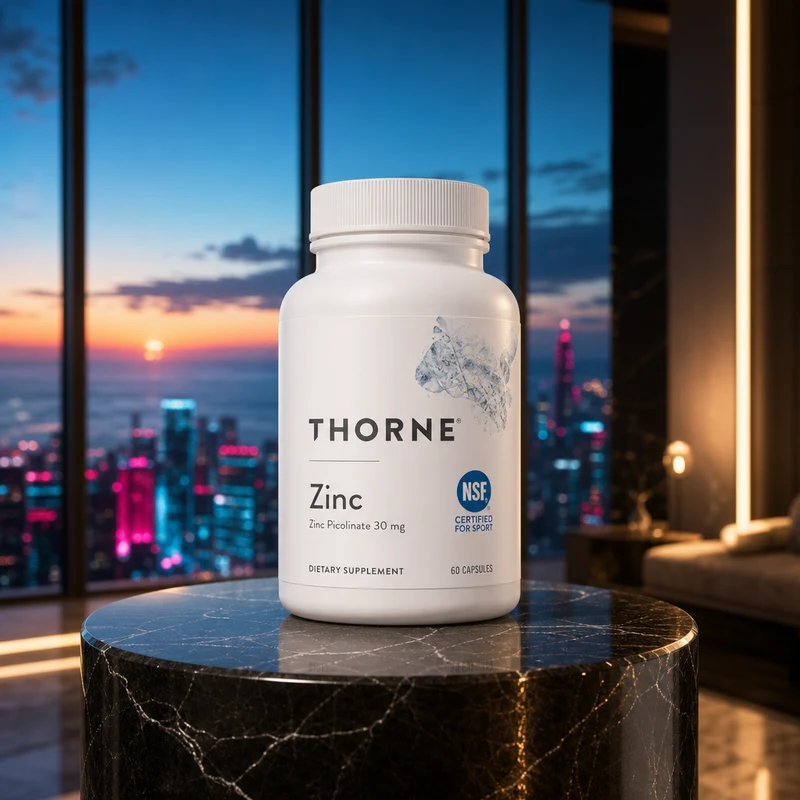
This is an affiliate pick — the highest scorer on our independent 50/50 criteria, not a paid placement. We earn a commission if you buy through it, at no cost to you.
Common side effects — nausea, and how to avoid it
The one common side effect is gastrointestinal: nausea, sometimes a metallic taste, mostly on an empty stomach or from high-dose lozenges. In a controlled trial, nausea hit 20% on zinc lozenges vs 4% on placebo[12] — and 29% vs 16% in a children's trial[13]. The fix is simple: take a 25–30 mg capsule with food, and choose bisglycinate or picolinate over the more nausea-prone sulfate and gluconate.
The one common side effect: nausea
share of users reporting nausea on zinc lozenges vs placebo · zinc on an empty stomach upsets the gut — taking it with a meal is the fix · lower is better
Can you take too much? The copper ceiling
Yes — this is zinc's one real toxicity, and it's entirely about dose. The Tolerable Upper Intake Level is 40 mg/day, set precisely because zinc competitively blocks copperabsorption[10]. Stay under it and you're fine; run 80+ mg/day for months and copper deficiency follows — anemia and neutropenia are documented in the case literature[11]. The effective dose (25–30 mg) sits comfortably below the ceiling. If you deliberately run higher, co-supplement 2 mg copper at a separate meal, or cycle back down after 8–12 weeks.
How much is too much — mind the copper ceiling
where the common zinc doses sit against the tolerable upper limit · the effective dose is comfortably safe; the danger is chronic mega-dosing, which starves copper · lower is safer above the limit
Drug & mineral interactions
Zinc's interactions are mostly about timing, not danger. It chelates tetracycline and quinolone antibiotics in the gut — it cut ciprofloxacin absorption about 22% in a pharmacokinetic study[15] — and it competes with iron and calcium for the same transporter. None of this means avoid zinc; it means separate the doses by 2–4 hours. If you have hemochromatosis or iron-overload disorder, coordinate with your clinician, since zinc and iron interact at the same intestinal transporter.
Zinc blocks some antibiotics
ciprofloxacin exposure (blood AUC) taken alone vs with a zinc-containing supplement · zinc chelates fluoroquinolone and tetracycline antibiotics in the gut, cutting how much drug you absorb · higher is better
The one thing to never do: nasal zinc
This is the single hard “no” in the zinc story. Intranasal zinc gluconate gels (marketed for colds) caused permanent loss of smell — a case series defined the zinc-induced anosmia syndrome, with smell loss often perceived within 48 hours of use[14], and the products were pulled from the market. Oral zinc and lozenges carry no such risk. If you want zinc for a cold, use an oral lozenge — never a nasal gel or spray.
Zinc & COVID — the honest null
Worth stating plainly because the hype was loud: high-dose zinc did not shorten COVID symptoms. In the COVID A-to-Z randomized trial, time to a 50% symptom reduction was essentially the same on zinc as on usual care, and the trial was stopped early for futility[16]. The robust immune evidence is for rhinovirus colds (lozenges, started early) — not COVID.
COVID: the honest null result
days to a 50% reduction in symptoms — high-dose zinc vs usual care · the two are effectively the same; the trial was stopped early for futility · lower is better
Pregnancy
Zinc is an essential nutrient in pregnancy, but the goal is adequacy, not therapy: stay near the RDA (11–12 mg/day, usually covered by a prenatal) rather than the 25–30 mg supplemental dose, and use higher amounts only with your obstetrician's guidance. Chronic high-dose zinc in pregnancy risks the same copper antagonism it does in anyone else.
Myths vs. facts
| The myth | What the evidence shows | Source |
|---|---|---|
| Zinc prevents or cures COVID | The controlled data say no. The COVID A-to-Z randomized trial found high-dose zinc did not shorten symptoms and was stopped early for futility. The solid immune evidence is for rhinovirus colds (lozenges, started early), not COVID. | [16] |
| More zinc is better | No — above 40 mg/day it backfires. Chronic high-dose zinc competitively blocks copper absorption; copper-deficiency anemia and neutropenia are documented at 80+ mg/day for months. Stay at 25–30 mg, and if you run higher, add 2 mg copper. | [10,11] |
| Nasal zinc is a safe cold remedy | It isn't. Intranasal zinc gluconate gels caused permanent loss of smell (anosmia) via olfactory-nerve toxicity and were pulled from the market. Oral zinc and lozenges carry no such risk — never use intranasal zinc. | [14] |
| You can take zinc with anything, any time | No. Zinc chelates tetracycline and quinolone antibiotics — it cut ciprofloxacin absorption ~22% in a PK study — and competes with iron and calcium. Separate zinc from those by 2–4 hours, and take it with food to avoid nausea. | [15,12] |
Frequently asked questions
Is zinc safe?
Oral zinc is safe at the dose that matters — 25–30 mg/day with food. The cautions are specific, not general: don't exceed 40 mg/day long-term (it blocks copper), separate it from tetracycline/quinolone antibiotics and from iron and calcium by 2–4 hours, and never use intranasal zinc gels. Nausea on an empty stomach is the most common complaint, and food fixes it.
What are the side effects of zinc?
The common one is gastrointestinal — nausea, sometimes a metallic taste — mostly when taken on an empty stomach or as high-dose lozenges. Nausea hit 20% on zinc lozenges vs 4% on placebo in one trial. The serious risk is only from chronic over-dosing: above 40 mg/day for months, zinc depletes copper and can cause anemia.
How much zinc is too much?
The Tolerable Upper Intake Level is 40 mg/day for adults, set on zinc's effect on copper metabolism. Below that you're fine; above it long-term, zinc competitively blocks copper absorption — copper-deficiency anemia and neutropenia are documented at 80+ mg/day for months to years. If you run high doses, add 2 mg copper or cycle back to 25–30 mg.
Does zinc interact with medications?
Yes — mainly by binding them in the gut. Zinc chelates tetracycline and quinolone antibiotics (it cut ciprofloxacin absorption ~22% in a PK study), reducing their effect, and it competes with iron and calcium. The fix is timing: take zinc 2–4 hours apart from antibiotics and other minerals.
Is nasal zinc safe for colds?
No — never use intranasal zinc. Zinc gluconate nasal gels caused permanent loss of smell (anosmia) via olfactory-nerve toxicity and were pulled from the market. Oral zinc and lozenges carry no such risk. If you want zinc for a cold, use an oral lozenge, not a nasal product.
Sources
- Prasad AS, Mantzoros CS, Beck FW, Hess JW, Brewer GJ. Zinc status and serum testosterone levels of healthy adults. Nutrition. 1996;12(5):344–348. PMID 8875519
- Netter A, Hartoma R, Nahoul K. Effect of zinc administration on plasma testosterone, dihydrotestosterone, and sperm count. Arch Androl. 1981;7(1):69–73. PMID 7271365
- Hemilä H. Zinc lozenges and the common cold: a meta-analysis comparing zinc acetate and zinc gluconate, and the role of zinc dosage. JRSM Open. 2017;8(5):2054270417694291. PMID 28515951
- Dréno B, Moyse D, Alirezai M, et al. Multicenter randomized comparative double-blind controlled clinical trial of the safety and efficacy of zinc gluconate versus minocycline hydrochloride in the treatment of inflammatory acne vulgaris. Dermatology. 2001;203(2):135–140. PMID 11586012
- Verma KC, Saini AS, Dhamija SK. Oral zinc sulphate therapy in acne vulgaris: a double-blind trial. Acta Derm Venereol. 1980;60(4):337–340. PMID 6163281
- Cervantes J, Eber AE, Perper M, Nascimento VM, Nouri K, Keri JE. The role of zinc in the treatment of acne: A review of the literature. Dermatol Ther. 2018;31(1):e12576. PMID 29193602
- Wessells KR, Brown KH. Estimating the global prevalence of zinc deficiency: results based on zinc availability in national food supplies and the prevalence of stunting. PLoS One. 2012;7(11):e50568. PMID 23209782
- Maares M, Haase H. A guide to human zinc absorption: general overview and recent advances of in vitro intestinal models. Nutrients. 2020;12(3):762. PMID 32183116
- Lamberti LM, Walker CLF, Chan KY, Jian WY, Black RE. Oral zinc supplementation for the treatment of acute diarrhea in children: a systematic review and meta-analysis. Nutrients. 2013;5(11):4715–4740. PMID 24284615
- Yadrick MK, Kenney MA, Winterfeldt EA. Iron, copper, and zinc status: response to supplementation with zinc or zinc and iron in adult females. Am J Clin Nutr. 1989;49(1):145–150. PMID 2912000
- Wahab A, Mushtaq K, Borak SG, Bellam N. Zinc-induced hypocupremia and pancytopenia, from zinc supplementation for age-related macular degeneration. J Community Hosp Intern Med Perspect. 2021;11(6):860–863. PMID 34804403
- Mossad SB, Macknin ML, Medendorp SV, Mason P. Zinc gluconate lozenges for treating the common cold. A randomized, double-blind, placebo-controlled study. Ann Intern Med. 1996;125(2):81–88. PMID 8678384
- Macknin ML, Piedmonte M, Calendine C, Janosky J, Wald E. Zinc gluconate lozenges for treating the common cold in children: a randomized controlled trial. JAMA. 1998;279(24):1962–1967. PMID 9643859
- Alexander TH, Davidson TM. Intranasal zinc and anosmia: the zinc-induced anosmia syndrome. Laryngoscope. 2006;116(2):217–220. PMID 16467707
- Polk RE, Healy DP, Sahai J, Drwal L, Racht E. Effect of ferrous sulfate and multivitamins with zinc on absorption of ciprofloxacin in normal volunteers. Antimicrob Agents Chemother. 1989;33(11):1841–1844. PMID 2610494
- Thomas S, Patel D, Bittel B, et al. Effect of high-dose zinc and ascorbic acid supplementation vs usual care on symptom length and reduction among ambulatory patients with SARS-CoV-2 infection: the COVID A to Z randomized clinical trial. JAMA Netw Open. 2021;4(2):e210369. PMID 33576820