
4 Zinc Benefits That Actually Have Evidence (2026)
The 4 benefits, ranked by evidence
- Testosterone — in deficient men, ~30 mg/day nearly doubled serum T (8.3 → 16.0 nmol/L). Replete men: no effect.
- Acne & skin — real but weaker than antibiotics: 31% vs 63% clinical success against minocycline; beats placebo.
- Immunity & colds — high-dose lozenges cut cold duration ~33% (an acute protocol, not a daily capsule).
- Fertility — raises testosterone, DHT and sperm count in sub-fertile men with low baseline T.
And the ones it's hyped for but doesn't reliably deliver: COVID, and mega-dosing for “more testosterone”. Every benefit runs through one rule — zinc corrects a deficit; it doesn't super-charge a replete body. Each benefit below has its own chart and sources.
The four numbers that anchor the honest picture:
Is zinc right for you?
Zinc, scored by goal
How strongly zinc moves each goal on our SAC Efficacy Score™. Tap a goal to see the full ranking.
Our top-rated zinc
We don't make a zinc yet, so here's the highest-scoring independent pick — a picolinate chelate at the 30 mg trial dose, NSF Certified for Sport. The full ranking (bisglycinate, value picks) is one tap down.
See all ranked zinc picks →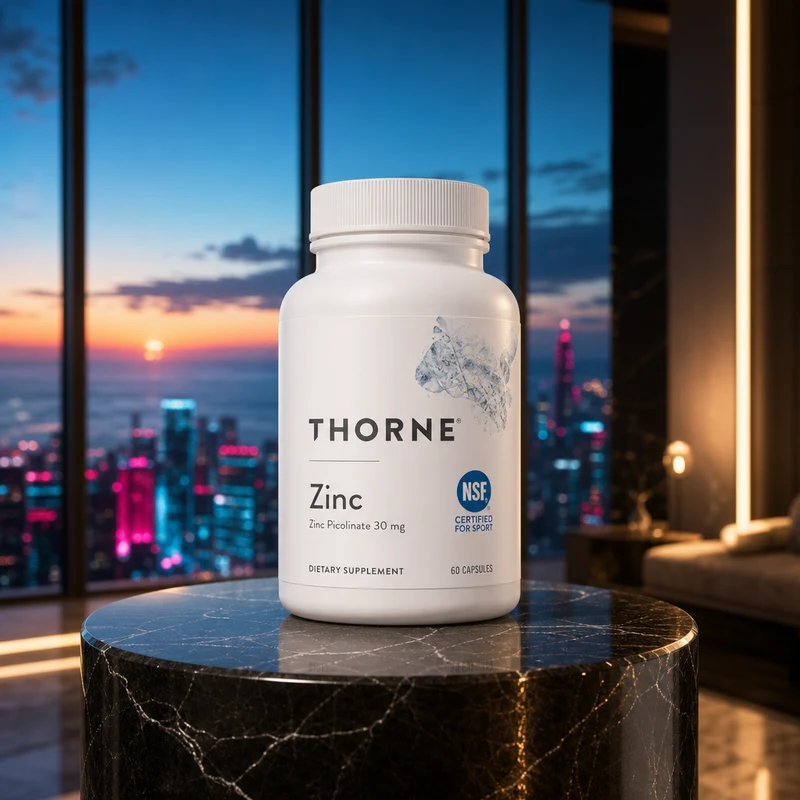
This is an affiliate pick — the highest scorer on our independent 50/50 criteria, not a paid placement. We earn a commission if you buy through it, at no cost to you.
Testosterone — real, but only if you're deficient
This is zinc's most-searched benefit and its most-misunderstood. In marginally zinc-deficient men, ~30 mg/day for six months nearly doubled serum testosterone — 8.3 to 16.0 nmol/L[1]. The mechanism is real: zinc inhibits aromatase (less testosterone leaks into estradiol) and is a direct cofactor for Leydig-cell synthesis. But the same study showed the flip side — inducing deficiency in healthy young men droppedtheir testosterone by three-quarters. The honest takeaway: zinc restores a deficit, it doesn't push a replete system higher. If you eat red meat or oysters regularly, you're probably already topped up — get a serum zinc test before assuming zinc will move your T.
Testosterone: a real jump — but only in deficient men
serum testosterone in marginally zinc-deficient elderly men, before vs after 6 months of zinc · replete men saw essentially no change — this is deficiency correction, not a booster · higher is better
Acne & skin — a real, antibiotic-sparing option
Zinc genuinely reduces inflammatory acne — it's anti-androgenic and anti-inflammatory on the sebaceous glands. In a placebo-controlled trial, 58% of zinc patients improved significantly vs 0% on placebo[5]. But keep it in proportion: in the largest head-to-head, zinc's clinical success rate was 31% vs minocycline's 63%[4] — it works, but the antibiotic worked about twice as well. The upside is no antibiotic-resistance risk, which makes zinc a reasonable first step or adjunct[6]. Give it 8–12 weeks.
Acne: zinc works — but minocycline worked better
clinical success (more than a two-thirds drop in inflammatory lesions at 3 months) in a 332-patient head-to-head · zinc is a real antibiotic-sparing option, not an antibiotic equal · higher is better
Immunity & colds — the lozenge protocol
Zinc shortens an active cold, but only with a specific protocol: high-dose lozenges (zinc acetate or gluconate, 80+ mg/day, dissolved slowly in the mouth, started within 24 hours of symptoms) cut cold duration about 33%[3]. Acetate edged out gluconate. Crucially, this is an acute throat-bathing tool — a daily 30 mg capsule does not treat a cold. In children, zinc is one of the best-evidenced interventions for acute diarrhea, cutting the risk of it lasting beyond three days by ~26%[9].
Colds: lozenges shorten them by about a third
reduction in common-cold duration vs placebo, by lozenge salt · this is the ACUTE high-dose lozenge protocol (80+ mg/day, started within 24 h) — daily capsules do NOT treat an active cold · higher is better
Fertility — for men with low baseline testosterone
In sub-fertile men with low baseline testosterone, oral zinc raised testosterone, DHT and sperm count[2]— an early finding that the later Prasad work formalised mechanistically. As with testosterone generally, the benefit concentrates in men who are actually short on zinc; it's a repletion effect, not a universal fertility booster.
What zinc is hyped for — but doesn't reliably do
Two of the loudest zinc claims don't hold up. COVID: the mechanistic case was appealing — zinc inhibits viral RNA polymerase — but the COVID A-to-Z randomized trial found high-dose zinc did not shorten symptoms and was stopped early for futility[16]. The solid immune evidence is for rhinovirus colds, not COVID. “More is more” for testosterone:the T benefit only appears in deficient men, so mega-dosing a replete body does nothing for testosterone — and above 40 mg/day it backfires by depleting copper[10]. See the full safety picture.
Who benefits most
Zinc rewards a specific profile: vegans, vegetarians, and low-meat eaters (phytates block absorption), heavy-sweating athletes, men over 60, and anyone with an absorption disorder — the structurally-deficient groups where an estimated 17.3% of the world already sits[7]. In replete, meat-eating people the effect is small. See the honest safety picture and the full data report.
How long until it works
Zinc is a cofactor, not a stimulant — you won't feel a daily dose. Acute cold lozenges act within 1–2 days; testosterone shifts show on bloodwork by weeks 4–8 in deficient men[1]; acne lesion counts drop by weeks 8–12[4]. Always take it with food.
How long until it works
typical time to a felt or measured effect · zinc is a cofactor — it corrects a deficit rather than delivering an acute kick
Benefit myths vs. facts
| The myth | What the evidence shows | Source |
|---|---|---|
| Zinc raises testosterone in everyone | Only in deficient men. Prasad 1996 nearly doubled serum T (8.3→16.0 nmol/L) — but that was in marginally zinc-deficient men. In replete men the T effect is essentially zero. Get a serum zinc test before assuming you need it; zinc corrects a deficit, it doesn't super-charge a healthy system. | [1] |
| Zinc clears acne as well as antibiotics | It helps, but it's weaker. In the largest head-to-head (Dréno 2001, n=332) zinc's clinical success rate was 31% vs minocycline's 63%. Zinc clearly beats placebo (Verma 1980: 58% vs 0%) and avoids antibiotic resistance — a reasonable first or adjunct step, not an antibiotic equal. | [4,5] |
| Zinc prevents or cures COVID | The controlled data say no. The COVID A-to-Z randomized trial found high-dose zinc did not shorten symptoms and was stopped early for futility. The solid immune evidence is for rhinovirus colds (lozenges, started early), not COVID. | [16] |
| Any zinc supplement is the same | Form matters a lot. Oxide — the cheapest, most common form — has roughly half the absorption of bisglycinate or picolinate. "Zinc oxide, 50 mg" can deliver less usable zinc than a 15 mg chelate. Buy bisglycinate or picolinate. | [8] |
Frequently asked questions
What is zinc best for?
Correcting a deficiency — and the benefits that flow from that. In marginally zinc-deficient men it nearly doubled serum testosterone (Prasad 1996); it reduces inflammatory acne (though less than antibiotics); and high-dose lozenges shorten colds by about a third. The common thread: zinc helps most where there's a deficit to fix.
Does zinc raise testosterone?
Only if you're deficient. Prasad 1996 measured a near-doubling of serum testosterone (8.3→16.0 nmol/L) at ~30 mg/day for six months in marginally zinc-deficient men. In replete men — anyone eating red meat or oysters regularly — the effect is essentially zero. A serum zinc test tells you which group you're in.
Is zinc good for acne?
Yes, but it's weaker than antibiotics. In the largest head-to-head trial (Dréno 2001) zinc's clinical success rate was 31% vs minocycline's 63%. It clearly beats placebo (Verma 1980: 58% vs 0%) and avoids antibiotic resistance — a reasonable first or adjunct step, not an antibiotic replacement. Give it 8–12 weeks.
Do zinc lozenges work for colds?
For an active cold, yes — with the right protocol: high-dose lozenges (80+ mg/day, dissolved slowly, started within 24 hours) cut duration about 33% in meta-analysis. A daily 30 mg capsule does not treat a cold. And zinc did not help COVID in the A-to-Z randomized trial.
How much zinc should I take?
25–30 mg elemental per day with food matches the trial dose. The RDA is only 11 mg (men) / 8 mg (women), but the benefit trials used more. Stay under 40 mg/day long-term unless you add copper — chronic high-dose zinc depletes it. Use bisglycinate or picolinate, not oxide.
Sources
- Prasad AS, Mantzoros CS, Beck FW, Hess JW, Brewer GJ. Zinc status and serum testosterone levels of healthy adults. Nutrition. 1996;12(5):344–348. PMID 8875519
- Netter A, Hartoma R, Nahoul K. Effect of zinc administration on plasma testosterone, dihydrotestosterone, and sperm count. Arch Androl. 1981;7(1):69–73. PMID 7271365
- Hemilä H. Zinc lozenges and the common cold: a meta-analysis comparing zinc acetate and zinc gluconate, and the role of zinc dosage. JRSM Open. 2017;8(5):2054270417694291. PMID 28515951
- Dréno B, Moyse D, Alirezai M, et al. Multicenter randomized comparative double-blind controlled clinical trial of the safety and efficacy of zinc gluconate versus minocycline hydrochloride in the treatment of inflammatory acne vulgaris. Dermatology. 2001;203(2):135–140. PMID 11586012
- Verma KC, Saini AS, Dhamija SK. Oral zinc sulphate therapy in acne vulgaris: a double-blind trial. Acta Derm Venereol. 1980;60(4):337–340. PMID 6163281
- Cervantes J, Eber AE, Perper M, Nascimento VM, Nouri K, Keri JE. The role of zinc in the treatment of acne: A review of the literature. Dermatol Ther. 2018;31(1):e12576. PMID 29193602
- Wessells KR, Brown KH. Estimating the global prevalence of zinc deficiency: results based on zinc availability in national food supplies and the prevalence of stunting. PLoS One. 2012;7(11):e50568. PMID 23209782
- Maares M, Haase H. A guide to human zinc absorption: general overview and recent advances of in vitro intestinal models. Nutrients. 2020;12(3):762. PMID 32183116
- Lamberti LM, Walker CLF, Chan KY, Jian WY, Black RE. Oral zinc supplementation for the treatment of acute diarrhea in children: a systematic review and meta-analysis. Nutrients. 2013;5(11):4715–4740. PMID 24284615
- Yadrick MK, Kenney MA, Winterfeldt EA. Iron, copper, and zinc status: response to supplementation with zinc or zinc and iron in adult females. Am J Clin Nutr. 1989;49(1):145–150. PMID 2912000
- Wahab A, Mushtaq K, Borak SG, Bellam N. Zinc-induced hypocupremia and pancytopenia, from zinc supplementation for age-related macular degeneration. J Community Hosp Intern Med Perspect. 2021;11(6):860–863. PMID 34804403
- Mossad SB, Macknin ML, Medendorp SV, Mason P. Zinc gluconate lozenges for treating the common cold. A randomized, double-blind, placebo-controlled study. Ann Intern Med. 1996;125(2):81–88. PMID 8678384
- Macknin ML, Piedmonte M, Calendine C, Janosky J, Wald E. Zinc gluconate lozenges for treating the common cold in children: a randomized controlled trial. JAMA. 1998;279(24):1962–1967. PMID 9643859
- Alexander TH, Davidson TM. Intranasal zinc and anosmia: the zinc-induced anosmia syndrome. Laryngoscope. 2006;116(2):217–220. PMID 16467707
- Polk RE, Healy DP, Sahai J, Drwal L, Racht E. Effect of ferrous sulfate and multivitamins with zinc on absorption of ciprofloxacin in normal volunteers. Antimicrob Agents Chemother. 1989;33(11):1841–1844. PMID 2610494
- Thomas S, Patel D, Bittel B, et al. Effect of high-dose zinc and ascorbic acid supplementation vs usual care on symptom length and reduction among ambulatory patients with SARS-CoV-2 infection: the COVID A to Z randomized clinical trial. JAMA Netw Open. 2021;4(2):e210369. PMID 33576820