
Pure Encapsulations Zinc 30 Review
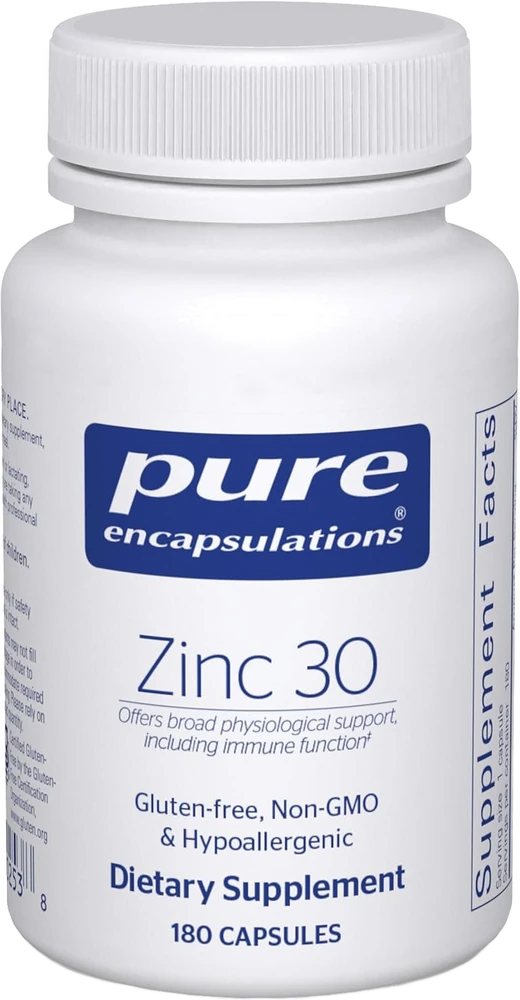 #2 of 10 · Best premium✓ Label verified · Supplement Facts read Sep 7, 2026
Real retailer photo, cut out. Label unedited.
Buy it. The clinician-grade zinc for allergen-sensitive and label-conscious buyers. Zinc picolinate at 30 mg elemental + hypoallergenic clinician-brand label (vegan, gluten-free, soy-free, dairy-free, non-GMO marks) + a short excipient list + 30+ year integrative-medicine pedigree + a 180-capsule bottle.
Price varies — 180-capsule bottle (~6 months at 30 mg/day)Price varies
Why It Scores 8.9 — And The Label Line Behind Each Number
Form bioavailability
30% of scoreZinc picolinate — zinc bound to picolinic acid, as printed on the Supplement Facts panel. One of the two top-tier consumer chelates (alongside bisglycinate) at ~25-30% absorbability vs ~10% for oxide; Maares & Haase 2020 (PMID 32183116) catalogued the absorption parity between the two. It is the same form Thorne (#1) uses, so form does not separate the top two picks — the label does.
- Active form
- Zinc picolinate (as printed on the panel)
- Inactives
- Hypoallergenic plant fiber (cellulose), vegetarian capsule (cellulose, water), ascorbyl palmitate
Dose accuracy + cofactor compatibility
25% of scoreSingle-cap 30 mg elemental zinc — matches the Prasad 1996 testosterone trial dose exactly. No competing minerals, no calcium, no iron, no copper antagonist mixed in. The excipient list is short: plant fiber (cellulose), the vegetarian capsule and ascorbyl palmitate — no magnesium stearate or silicon dioxide on the panel. Sits cleanly inside the 25-30 mg productive window.
- Per serving
- 30 mg elemental zinc (1 vegetarian capsule)
- Trial-dose alignment
- Matches Prasad 1996 (30 mg/day, 6 months) exactly
Third-party testing
20% of scoreThe label carries GFCO gluten-free certification plus non-GMO, vegan, soy-free and dairy-free marks; the brand describes USP-style purity standards and a GMP-certified facility. Pure Encapsulations publishes Certificate of Analysis data on request and runs internal testing for heavy metals, microbial contamination, and label-claim verification. The certification chain is strong but doesn't include NSF Certified for Sport — the relevant gap if you're a drug-tested athlete.
- Certifications
- Gluten-free (GFCO), non-GMO, vegan, soy-free and dairy-free marks on the label; GMP facility per the brand
- Manufacturer
- Pure Encapsulations (Sudbury, MA · Atrium Innovations · Nestlé Health Science)
- Lab transparency
- COA available on request + internal heavy-metals, microbial, label-claim testing
Cost per active mg
15% of scoreThe linked bottle is 180 capsules — about six months at one capsule a day — so the up-front cost is higher than Thorne's 60-capsule or NOW's 120-softgel bottle. We could not confirm a current price, so this line is directional; Pure Encapsulations has typically priced above both per capsule. The premium reflects the hypoallergenic clinician-brand positioning — real value for chemically sensitive buyers, less compelling for cost-optimisers.
- Bottle
- 180 capsules · ~6 months at 30 mg/day
- Price
- Price varies — 180-capsule bottle
Real-world response evidence
10% of scoreThe 30 mg single-capsule dose matches the Prasad 1996 testosterone trial dose exactly and lands inside the Cervantes 2019 acne RCT range (30-50 mg). Picolinate is a well-tolerated chelate for daily dosing with food — relevant for users who get nauseous on cheaper sulfate or gluconate bottles.
Label verified. Every figure read from the Supplement Facts photo, Sep 7, 2026.
Marketing Claims Vs. Reality
Hypoallergenic — free from common allergens, fillers, and excipients.
The ingredient panel lists three non-active items: hypoallergenic plant fiber (cellulose), the vegetarian capsule (cellulose, water) and ascorbyl palmitate. No magnesium stearate or silicon dioxide appears, and the label carries gluten-free (GFCO), non-GMO, soy-free, dairy-free and vegan marks. The claim matches the panel — and it's the meaningful differentiator vs Thorne or NOW.
Supports immune function, skin integrity, and antioxidant defense.
All three claims trace to zinc's documented mechanisms (Cervantes 2019 PMID 29193602 for skin, broader literature for immune + antioxidant function) — but the marketing collapses two distinct mechanisms (zinc-dependent SOD enzyme = antioxidant; zinc cofactor for thymic T-cells = immune) into one bullet. Accurate in spirit, oversimplified in copy.
Hypoallergenic clinician-grade quality — used by integrative medicine practices for 30+ years.
Pure Encapsulations has been a clinician-channel brand since 1991 and is stocked by integrative medicine practices, naturopaths, and functional-medicine clinicians as a default hypoallergenic supplement line. The clinician-trust claim is genuine and the 30+ year track record is real. Reflected in distribution patterns and brand pedigree.
Zinc picolinate — a highly absorbable chelated form.
The panel prints 30 mg zinc as zinc picolinate. Picolinate sits in the top tier of consumer chelates, with absorption on par with bisglycinate (~25-30% absorbability per Maares & Haase 2020, PMID 32183116). 'Highly absorbable' is fair relative to oxide; no trial shows it beating bisglycinate.
Made in an FDA-registered GMP-certified facility.
Pure Encapsulations manufactures in Sudbury, MA at an FDA-registered, GMP-certified facility. Standard at the clinician-grade tier and verifiable via FDA facility registration data.
What Our Test Actually Found
The hypoallergenic label is the real differentiator vs Thorne or NOW
What you're paying the premium for here vs Thorne or NOW is the ingredient panel — and it's noticeably cleaner. Pure Encapsulations' panel lists only plant fiber, the capsule and ascorbyl palmitate; Thorne's lists silicon dioxide and leucine, and NOW's softgel uses bovine gelatin, beeswax and soy lecithin. For most buyers this doesn't matter; those excipients are well-tolerated. For the few with documented reactivity to common supplement excipients — gut-symptom flares, histamine-driven skin reactions, autoimmune-protocol restrictions — Pure Encapsulations is the clinical answer. That's the buyer segment the premium is designed for.
Picolinate vs bisglycinate is a tie — the label is the tiebreaker
At 30 mg elemental, both forms clear ~25-30% absorption and both deliver the Prasad 1996 trial dose effectively; the published gap is small enough that head-to-head trials don't reliably separate them. Pure Encapsulations and Thorne (#1) both use picolinate; NOW (#3) uses bisglycinate. So the choice between the top picks comes down to the label and the testing, not the chelate: Thorne for NSF Certified for Sport, Pure Encapsulations for the hypoallergenic vegan capsule, NOW for price. If picolinate has made you nauseous even with food, try a bisglycinate.
No NSF Certified for Sport — the relevant gap if you're drug-tested
Pure Encapsulations carries strong clinician-grade certifications (hypoallergenic, USP-style purity, GMP) but doesn't run NSF Certified for Sport on the zinc SKU. For NCAA, IOC, NFL, MLB, NHL, or military athletes who require NSF certification, that's a hard miss — Thorne (#1) is the right pick instead. For everyone else the gap is irrelevant; Pure Encapsulations' internal QC is among the strongest in the industry, just not packaged with the federation-grade certification stamp.
The 180-capsule bottle is a six-month commitment
The linked listing is the 180-capsule bottle: at one capsule a day that is about six months of zinc in one purchase. That suits a long protocol (the Prasad 1996 testosterone trial ran six months) and a buyer who already knows the hypoallergenic label is what they need. If you are trying zinc for the first time, a smaller bottle — Thorne's 60 capsules or NOW's 120 softgels — is the lower-commitment way to find out whether you respond. We could not confirm a current price, so compare the per-capsule cost on the listings.
Run with breakfast or dinner — never on an empty stomach
Any zinc chelate, picolinate included, can cause nausea on an empty stomach. The protocol is simple: one cap with a meal containing protein and fat, ideally breakfast or dinner. Avoid co-dosing with high-calcium meals (large dairy serving) or with iron supplements — the three minerals compete for the same intestinal transporter. Separate by 2 hours minimum if stacking.
Full analysis: all pros & cons (9), buy if / skip if
- Hypoallergenic label — no magnesium stearate or silicon dioxide on the panel; gluten-free (GFCO), soy-free, dairy-free, vegan
- Zinc picolinate — a top-tier chelate, printed on the panel
- 180-capsule bottle — about six months at one capsule a day
- Single-cap 30 mg elemental dose matches the Prasad 1996 testosterone trial protocol exactly
- 30+ year clinician-grade pedigree — the default integrative-medicine brand
- USP-style purity standards + GMP-certified FDA-registered facility
- Priced above Thorne (#1) and NOW (#3) per capsule for the same elemental dose, and sold here as a 180-capsule bottle
- No NSF Certified for Sport — not the right pick for drug-tested athletes
- Clinician-brand premium isn't justified for buyers without sensitivity issues
- You have known reactivity to common supplement fillers or allergens
- Your integrative doctor, naturopath, or dietitian recommends Pure Encapsulations specifically
- You want a hypoallergenic clinician-grade label and aren't price-sensitive
- You want a vegan capsule with gluten-free, soy-free and dairy-free marks on the label
- You're on a tight budget — NOW Foods Zinc Glycinate (#3) ships the same 30 mg as a bisglycinate chelate for less
- You're a drug-tested athlete — Thorne (#1) has NSF Certified for Sport, Pure Encapsulations doesn't
- You're a first-time buyer with no GI sensitivity — Thorne or NOW are both better value
Zinc picolinate at 30 mg elemental + hypoallergenic clinician-brand label (vegan, gluten-free, soy-free, dairy-free, non-GMO marks) + a short excipient list + 30+ year integrative-medicine pedigree + a 180-capsule bottle. The cleanest zinc label on the list. Worth the premium if you have allergen concerns, react to common excipients, or want maximum label transparency.
Pure Encapsulations Zinc 30 is the clinician-grade bottle on this list — the one your integrative-medicine doctor stocks behind the counter and the one your dietitian recommends for allergen-sensitive patients. It is the premium-priced bottle among the top three picks, but the premium buys you something the cheaper bottles don't deliver: a hypoallergenic label: besides the zinc picolinate, the panel lists only plant fiber (cellulose), the vegetarian capsule and ascorbyl palmitate. No magnesium stearate, no GMOs, no gluten, no dairy, no soy. The form is zinc picolinate — a top-tier chelate, the same form Thorne (#1) uses — at the Prasad 1996 trial dose, in a 180-capsule bottle. Here's what the bottle actually delivers.
The clinician-grade zinc for allergen-sensitive and label-conscious buyers.

Pure Encapsulations Zinc 30 is what we recommend to readers who have a documented sensitivity to common supplement fillers, who run an autoimmune protocol with strict ingredient discipline, who react to common excipients in cheaper mineral bottles, or who simply want the cleanest possible label and aren't price-sensitive. The form is right (zinc picolinate, a top-tier chelate), the dose is right (30 mg single-cap, matches Prasad 1996 exactly), the label is genuinely cleaner than any competitor on the list, and the brand pedigree is the integrative-medicine gold standard. For most readers, though, this isn't the right first pick. If you have no documented sensitivity, Thorne Zinc Picolinate (#1) gets you the same form and elemental dose with NSF Certified for Sport on top. If you're cost-optimising, NOW Foods Zinc Glycinate (#3) ships the same 30 mg as a bisglycinate chelate for less. Pure Encapsulations is the right answer for a specific buyer — the allergen-sensitive, clinician-recommended buyer — and a wrong answer for everyone else who'd be over-paying for label discipline they don't use.
If This Doesn’t Fit — Try These
 01
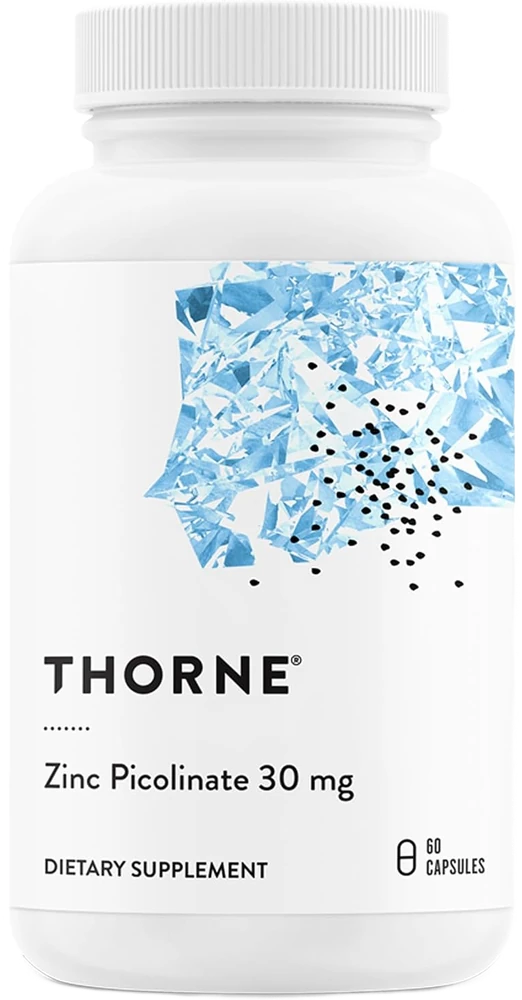
Thorne Zinc Picolinate
The default first-time pick.
 03
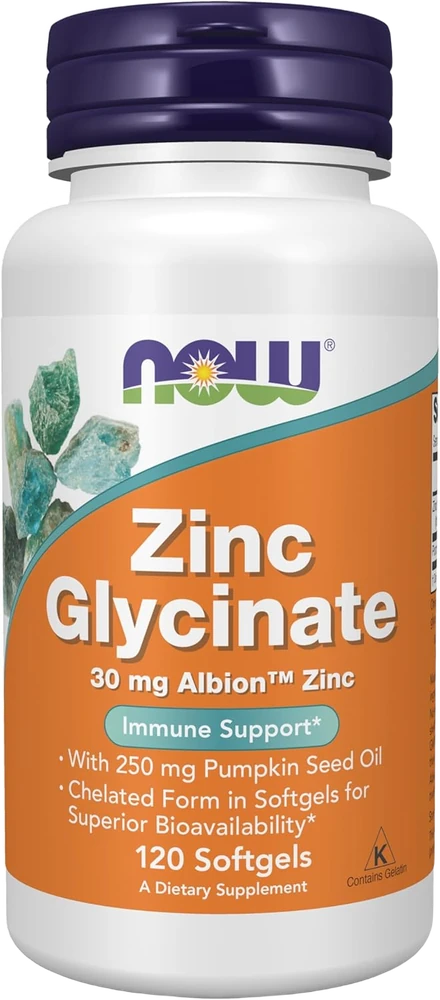
NOW Zinc Glycinate
If you want to test a real chelated zinc without committing $14+/month, NOW Foods is the right starting point.
 05
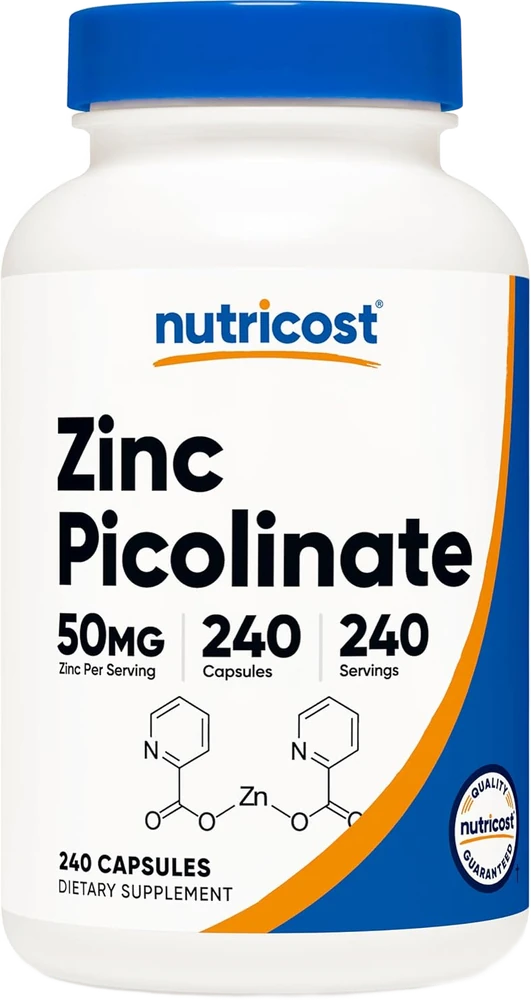
Nutricost Zinc Picolinate 50 mg
High-dose picolinate has a specific niche: short-term repletion in verified-deficient adults.
Quick Answers
What does 'hypoallergenic' actually mean on a supplement label?
Specifically: no magnesium stearate or silicon dioxide on the panel, no GMOs, no gluten, no dairy, no soy. The Pure Encapsulations panel lists three non-active items — hypoallergenic plant fiber (cellulose), the vegetarian capsule shell and ascorbyl palmitate — and the label carries gluten-free (GFCO), non-GMO, soy-free, dairy-free and vegan marks. Compare Thorne (#1), whose panel lists silicon dioxide and leucine, and NOW (#3), a bovine-gelatin softgel with beeswax and soy lecithin. For most buyers, those excipients are well-tolerated and irrelevant. For the few with documented reactivity (autoimmune-protocol patients, gut-symptom flares from supplement excipients, histamine-driven skin reactions), the hypoallergenic discipline is the entire reason to pay the premium. It's a real differentiator for the buyer who actually uses it.
Is picolinate a good form, and is it gentle on the stomach?
Yes on form. The panel prints zinc picolinate, one of the two top-tier consumer chelates alongside bisglycinate; both clear roughly 25-30% absorption per Maares & Haase 2020 (PMID 32183116), and no head-to-head trial reliably separates them. On tolerance, any zinc can cause nausea on an empty stomach, so take the capsule with a meal. If picolinate has upset your stomach before, a bisglycinate such as NOW Foods Zinc Glycinate (#3) is the usual alternative to try.
Why not just buy NOW Foods Zinc Glycinate for half the price?
If you have no documented sensitivity to excipients or animal-derived shells, you reasonably can — NOW delivers the same 30 mg of elemental zinc as a bisglycinate chelate for less. The differences are the form (bisglycinate vs picolinate, two top-tier chelates with no trial separating them) and the label: NOW's is a bovine-gelatin softgel with beeswax and soy lecithin, Pure Encapsulations' is a vegan capsule with a hypoallergenic excipient list. The premium is justified for buyers who actually use that label: people running strict autoimmune protocols (AIP), people with mast cell activation syndrome or histamine intolerance, vegans, people whose integrative-medicine clinician specifically recommends Pure Encapsulations, or people who've reacted to common supplement excipients in the past. Be honest about which buyer you are.
Should I run 30 mg/day for testosterone, immune, or skin?
Depends on your endpoint. For testosterone (Prasad 1996, PMID 8875519), 30 mg/day for 6 months is the trial-validated protocol — but the effect only manifests in marginally deficient men (serum <70 μg/dL). Get a baseline serum zinc test before committing to the 6-month protocol. For acne (Cervantes 2019, PMID 29193602), 30 mg/day sits at the lower bound of the RCT range (30-50 mg) and works across 8-12 week protocols regardless of baseline status. For chronic immune support (broader literature), 15-30 mg/day chronic dosing is the maintenance range. Pure Encapsulations' 30 mg single-cap fits all three protocols cleanly — pick the endpoint, run the protocol, retest as needed.
Why doesn't Pure Encapsulations carry NSF Certified for Sport?
Brand positioning — Pure Encapsulations targets the clinician channel (integrative medicine, naturopathy, functional medicine) rather than the drug-tested-athlete channel. The brand's QC discipline is genuinely strong (USP-style purity, internal heavy-metals + microbial testing, COA on request), but it doesn't run banned-substance certification on its products. For drug-tested athletes (NCAA, IOC, NFL, MLB, NHL, military), that's a non-starter — switch to Thorne (#1) for NSF Certified for Sport specifically. For everyone else, Pure Encapsulations' internal QC is among the strongest in the industry, just packaged without the federation-grade certification stamp.
Can I take this with my multivitamin or do I need to space them out?
Space them by 2+ hours. Most multivitamins contain calcium, iron, and copper in the same tablet — all three compete with zinc for the same intestinal DMT-1 transporter and bind in roughly inverse proportion to their dose. Co-administration significantly reduces zinc absorption from the chelate. Practical protocol: take Pure Encapsulations Zinc with breakfast (with protein + fat), take your multivitamin at lunch or dinner. If your multivitamin already contains 15 mg zinc, you can skip standalone supplementation entirely or run Pure Encapsulations only for an 8-12 week active repletion protocol, then drop back to multivitamin-only maintenance. Don't stack 30+ mg of additional zinc on top of a 15-mg multivitamin chronically.
Sources & Further Reading
5 peer-reviewed sources, each linked to PubMed
- [1] Prasad 1996 PMID 8875519 — Zinc status and serum testosterone levels of healthy adults. 30 mg/day zinc for 6 months in marginally zinc-deficient men nearly doubled serum testosterone (8.3 → 16.0 nmol/L). The dose-and-duration template Pure Encapsulations' single-cap 30 mg matches exactly.
- [2] Maares & Haase 2020 PMID 32183116 — A guide to human zinc absorption: general overview and recent advances of in vitro intestinal models. Catalogues bisglycinate and picolinate as absorption-equivalent top-tier chelates at ~25-30% absorbability vs ~10% for oxide. Validates Pure Encapsulations' picolinate form as one of the two best consumer-zinc options.
- [3] Cervantes 2019 PMID 29193602 — The role of zinc in the treatment of acne: A review of the literature. RCT review: 30-50 mg elemental zinc daily matched low-dose oral antibiotics for inflammatory acne. Pure Encapsulations' 30 mg single-cap sits at the lower bound of the trial range.
- [4] Hemilä 2017 PMID 28515951 — Zinc acetate lozenges for treating the common cold: an individual patient data meta-analysis. Lozenge meta-analysis: 75-80 mg/day acute cut cold duration ~33%. Pure Encapsulations' daily 30 mg supports chronic immune baseline, not acute cold protocols — different tools.
- [5] Wessells & Brown 2012 PMID 23209782 — Estimating the global prevalence of zinc deficiency. ~17% global zinc-deficiency risk, concentrated in plant-based diets. The structural-deficiency baseline that Pure Encapsulations' hypoallergenic clinician-grade formulation targets in sensitive vegetarian and vegan populations.
Affiliate disclosure: every Amazon link uses our Associates tag (superachieverclub-20). We earn a small commission at no cost to you; it funds independent reviews. We never accept payment to change a ranking.