
Nutricost Zinc Picolinate 50 mg Review
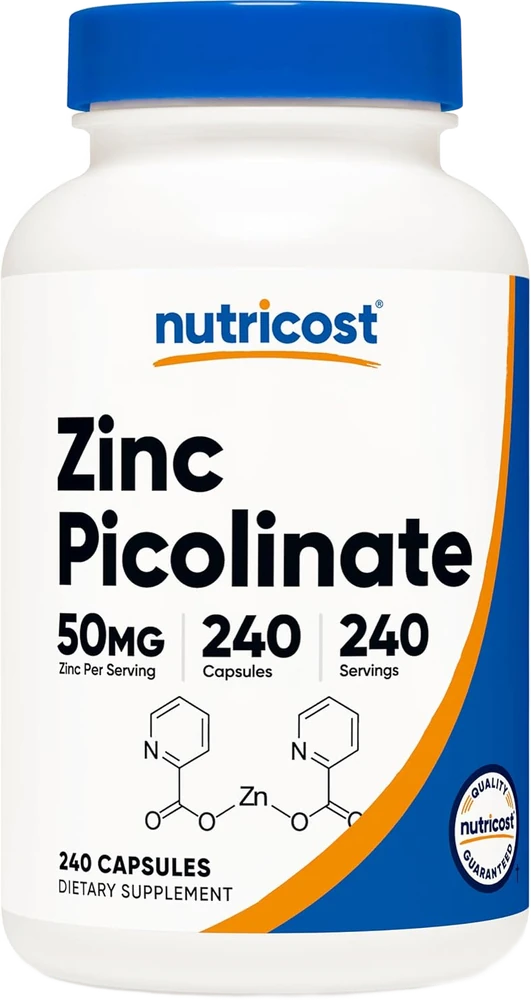 #5 of 10 · Best high-dose budget✓ Label verified · Supplement Facts read Sep 7, 2026
Real retailer photo, cut out. Label unedited.
Consider it. High-dose picolinate at the lowest cost-per-mg — for repletion only, not chronic maintenance. Zinc picolinate at 50 mg elemental + 240-capsule bottle (8-month supply) + $0.05 per active cap — the cheapest cost-per-elemental-mg in the category.
$11 / month$0.05 / 50 mg elemental cap
Why It Scores 8.2 — And The Label Line Behind Each Number
Form bioavailability
30% of scoreZinc picolinate — same top-tier chelate as Thorne (#1) at ~25-30% absorbability. Picolinic acid clamps zinc through the gut wall intact via amino-acid uptake pathways. Maares & Haase 2020 (PMID 32183116) catalogues picolinate as absorption-equivalent to bisglycinate at the top of the chelate hierarchy. The form is right; Nutricost ships real picolinate, verifiable on the ingredient panel.
- Active form
- Zinc picolinate (chelate)
- Inactives
- Microcrystalline cellulose, vegetable cellulose capsule, magnesium stearate, silicon dioxide
Dose accuracy + cofactor compatibility
25% of score50 mg elemental zinc per cap — exceeds the 40 mg/day Tolerable Upper Intake Level for chronic use. Productive for short-term deficiency repletion (the Cervantes 2019 acne RCT range was 30-50 mg) but not appropriate as a chronic maintenance dose without copper co-supplementation. The cap can't easily be split — single-cap dosing forces 50 mg/day unless you skip days. Dose precision is sacrificed for cost.
- Per serving
- 50 mg elemental zinc (1 vegetarian capsule)
- Trial-dose alignment
- Above Prasad 1996 (30 mg). At top of Cervantes 2019 acne range (30-50 mg). Above 40 mg UL for chronic use.
Third-party testing
20% of scoreNutricost manufactures in a GMP-certified, FDA-registered facility and runs third-party testing on every batch, publishing COA data on request. The brand is a competent mid-tier Amazon-native player with consistent QC over multiple years. No NSF Certified for Sport, no USP verification — gaps relevant for drug-tested athletes and buyers wanting third-party label-claim auditing on top of brand QC.
- Certifications
- GMP-certified, FDA-registered facility, third-party tested, non-GMO, gluten-free, vegetarian capsules
- Manufacturer
- Nutricost (Vineyard, UT)
- Lab transparency
- Third-party COA available on request
Cost per active mg
15% of score$0.05 per 50 mg elemental cap = ~$0.001 per active mg. Cheapest cost-per-elemental-mg of any product on this list — by a meaningful margin. The 240-cap bottle is an 8-month supply at 50 mg/day, or 16 months at 25 mg/day if you split protocols. For verified-deficient adults running short-term repletion, the cost-per-mg ratio is uniquely strong.
- Bottle
- 240 capsules · ~8 months at 50 mg/day, ~16 months at 25 mg/day every other day
- Price
- $11 / 240-cap bottle = $0.05 per active cap
Real-world response evidence
10% of score50 mg/day for 8-12 weeks lands inside the Cervantes 2019 acne RCT therapeutic range (30-50 mg) and above the Prasad 1996 testosterone trial dose (30 mg). Real-world response is strong for short-term repletion protocols in verified-deficient adults. Chronic use without copper co-supplementation produces predictable failure modes — copper-deficiency anemia documented in long-term high-dose-zinc literature.
Label verified. Every figure read from the Supplement Facts photo, Sep 7, 2026.
Marketing Claims Vs. Reality
50 mg elemental zinc per capsule — high-dose support.
50 mg elemental zinc per cap is verified on the supplement facts panel. The 'high-dose support' framing is accurate — the dose exceeds the 11 mg RDA, exceeds the 30 mg Prasad 1996 trial dose, and sits at the top of the 30-50 mg Cervantes 2019 acne therapeutic range. Real high-dose chelate.
Zinc picolinate — highly bioavailable chelate form.
Picolinate is one of the two top-tier zinc chelates at ~25-30% absorbability (Maares & Haase 2020 PMID 32183116). The 'highly bioavailable' framing is accurate vs the oxide and gluconate forms that dominate cheaper bottles. Nutricost ships real picolinate.
Supports immune health, antioxidant function, and hormone metabolism.
All three claims trace to zinc's documented mechanisms — but the marketing collapses three distinct effects (immune via T-cell support, antioxidant via SOD enzyme cofactor, hormone via Leydig-cell steroidogenesis + aromatase inhibition) into one bullet. Accurate in spirit; oversimplified in copy. The hormone effect specifically requires deficiency for measurable T uplift (Prasad 1996).
Third-party tested for purity and potency.
Nutricost publishes per-batch COA data on request — verifiable third-party testing for elemental zinc content and heavy-metals contamination. Standard for the mid-tier Amazon-native brands; sufficient to confirm label accuracy even without NSF or USP layered on top.
240 capsules — a long-lasting supply.
240 vegetarian capsules per bottle is verified on the label. At the labelled 50 mg/day dose that's an 8-month supply — accurate. At a reduced 25 mg/day every-other-day dose (which we'd recommend for chronic use to stay under the UL), it stretches to 16 months. Real value on supply length.
What Our Test Actually Found
Cheapest cost-per-elemental-mg on the list — but the dose is the catch
On pure cost-per-active-mg math, Nutricost wins by a wide margin: $0.05 per 50 mg cap = roughly $0.001 per mg of elemental zinc. The next-cheapest options (NOW Foods #3 at $0.003/mg, Nature Made #7 at $0.003/mg) are 3× more expensive. For a buyer running an 8-12 week repletion protocol with copper co-supplementation, the cost math is unbeatable. The catch: the 50 mg/cap forces a dose that exceeds the 40 mg chronic UL, so this isn't the right bottle for set-it-and-forget-it daily use without protocol structure.
50 mg/day chronic = copper-deficiency anemia in 6-12 months without copper co-supp
Zinc and copper share the same intestinal transporter (DMT1 / Menkes protein). Chronic zinc above 40 mg/day competitively blocks copper absorption, and over 6-12 months produces clinically relevant copper deficiency: anemia, neutropenia, and in extreme cases neurological symptoms (the documented failure mode in long-term denture-cream zinc-toxicity cases). The protocol fix is simple: if you're running 50 mg/day chronically, co-supplement 2 mg copper bisglycinate on a separate meal (not the same meal as zinc — they'll compete in the gut). Or cycle 8-12 weeks on, then drop to a 25-30 mg maintenance bottle.
The right use case is verified-deficient acute repletion, not lifestyle dosing
This bottle exists for a specific scenario: you've tested serum zinc (<80 μg/dL functional deficiency), you're running an 8-12 week repletion protocol to bring serum back to 90+ μg/dL, and you're tracking the protocol with re-testing at week 8. The 50 mg dose accelerates repletion vs the standard 30 mg, and the Cervantes 2019 acne literature specifically validates 30-50 mg as the therapeutic range. For lifestyle / 'just want some zinc' users, this is the wrong product — Thorne (#1) or NOW (#3) at 30 mg is the correct floor.
Cap can't be split — single-cap dosing forces 50 mg unless you skip days
Unlike powder or smaller-dose bottles, you can't titrate Nutricost's 50 mg cap downward without splitting the capsule (messy, imprecise) or alternating dose days (every-other-day = effective ~25 mg/day average). For maintenance use, the dose flexibility is the gap. For repletion protocols, the single-cap simplicity is fine. Match the bottle to the protocol; don't expect the bottle to fit every protocol.
Take with breakfast or dinner, separate from copper supplement by one meal
Protocol: one cap with breakfast or dinner (with food, protein + fat). If running copper co-supplementation, take 2 mg copper bisglycinate at a different meal (lunch works) — never at the same meal as zinc, because they'll compete for the same intestinal transporter. Re-test serum zinc at week 8. If repleted (90+ μg/dL), drop to a 15-30 mg maintenance bottle (Thorne, NOW). If still deficient, continue another 4-8 weeks. Never run this product as a permanent floor without checkpoints.
Full analysis: all pros & cons (8), buy if / skip if
- Cheapest cost-per-elemental-mg on the entire list — $0.05 per 50 mg cap
- Real picolinate chelate — same form as Thorne, third-party tested with COA on request
- 240-cap bottle is an 8-month supply at the listed dose — best raw runway in the category
- Vegetarian capsules — works for plant-based buyers
- Hits the Cervantes 2019 acne therapeutic range (30-50 mg) at the top of the trial window
- 50 mg/day exceeds the 40 mg Tolerable Upper Intake Level for chronic use — requires copper co-supplementation
- Single-cap dose can't be easily titrated down — must skip days for sub-50 mg average
- Wrong bottle for first-time buyers or set-it-and-forget-it maintenance users
- You've tested serum zinc and confirmed deficiency (<80 μg/dL) — running an 8-12 week repletion protocol
- You're stacking 2 mg copper bisglycinate on a separate meal to offset the antagonism
- Cost-per-elemental-mg is your top buying criterion and you understand the cycling protocol
- You're a verified-deficient acne patient running the Cervantes 2019 30-50 mg therapeutic range
- You're a first-time buyer or chronic maintenance user — Thorne (#1) or NOW (#3) at 30 mg is the right floor
- You're not testing serum zinc and don't know your status — high-dose without monitoring is risky
- You don't want to stack copper or run cycles — this isn't the bottle for set-it-and-forget-it dosing
Zinc picolinate at 50 mg elemental + 240-capsule bottle (8-month supply) + $0.05 per active cap — the cheapest cost-per-elemental-mg in the category. Real chelate, real value, wrong dose for chronic daily use. Built for 8-12 week deficiency repletion protocols with copper co-supplementation. Do not use as a permanent zinc floor.
Nutricost Zinc Picolinate is the high-dose repletion bottle on the list — and that framing is the whole story. At $11 for 240 capsules of 50 mg elemental picolinate, the cost-per-active-mg ($0.05 per cap, roughly $0.001 per mg) is the cheapest in the entire category. The form is real picolinate, the brand has a serious enough catalog (Nutricost sells in volume on Amazon with consistent COA documentation), and the 240-cap bottle is an 8-month supply at 50 mg/day. But here's the catch: 50 mg/day chronic exceeds the 40 mg Tolerable Upper Intake Level. Run this as your permanent floor and you'll competitively block copper absorption over 6-12 months, producing measurable copper-deficiency anemia. The right use case for this bottle is short-term 8-12 week deficiency repletion in serum-zinc-confirmed deficient adults, with 2 mg copper bisglycinate co-supplemented on a separate meal. Used correctly, it's a high-value specialty tool. Used wrong, it's a long-term problem.
High-dose chelate at the cheapest cost-per-mg — repletion-protocol bottle only.

Nutricost Zinc Picolinate 50 mg is the right bottle for one specific buyer: the verified-zinc-deficient adult running an 8-12 week repletion protocol with copper co-supplementation and serum re-testing. In that context, the cost-per-mg math is unbeatable, the picolinate form is real, and the 240-cap bottle gives you enormous runway. The Cervantes 2019 acne literature specifically validates 30-50 mg/day for inflammatory acne, and this product lands at the top of that therapeutic range. For everyone else — first-time buyers, lifestyle daily-dose users, maintenance protocols — this is the wrong bottle. 50 mg/day chronic exceeds the 40 mg UL and over 6-12 months produces clinically relevant copper deficiency without explicit copper supplementation. The cap can't be easily split, so you can't titrate down without skipping days. If you don't have a serum zinc test confirming deficiency and a clear cycling-off plan, pick Thorne (#1) or NOW Foods (#3) at 30 mg instead. Used correctly with monitoring, Nutricost is a high-value specialty tool. Used as a daily maintenance bottle without copper, it's a long-term problem.
If This Doesn’t Fit — Try These
 01
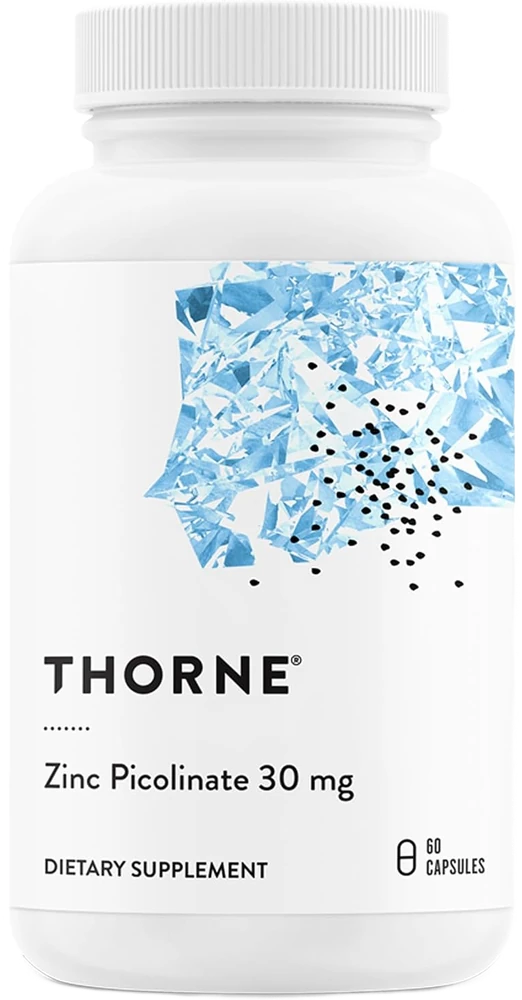
Thorne Zinc Picolinate
The default first-time pick.
 03
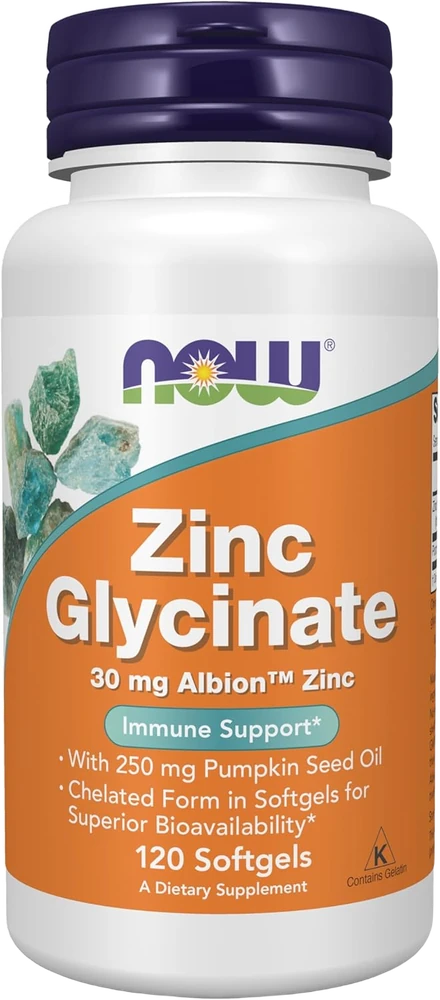
NOW Zinc Glycinate
If you want to test a real chelated zinc without committing $14+/month, NOW Foods is the right starting point.
 08
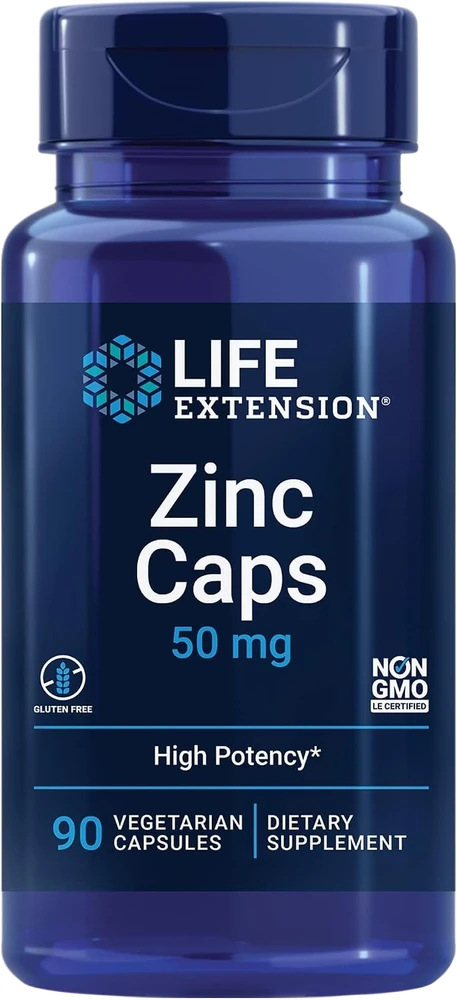
Life Extension Zinc Caps
Life Extension Zinc Caps are a respectable middle-tier option — better than the oxide / gluconate mass-market picks, less efficient than the picolinate or bisglycinate top tier.
Quick Answers
Isn't 50 mg per day above the safety limit?
Above the 40 mg/day Tolerable Upper Intake Level for chronic use — but not above the documented therapeutic range for short-term repletion protocols. The Cervantes 2019 acne RCT (PMID 29193602) specifically validates 30-50 mg/day for 8-12 week protocols for inflammatory acne, and the Netter 1981 zinc-T trial (PMID 7271365) used 50 mg/day for 45-50 days. The 40 mg UL is set for chronic indefinite use without medical supervision. The correct use case for Nutricost's 50 mg cap is verified deficiency + 8-12 week protocol + 2 mg copper bisglycinate co-supplemented on a separate meal + serum re-testing at week 8. Used outside that framework (set-and-forget daily dosing for years), it produces copper-deficiency anemia in 6-12 months.
Why does copper deficiency matter, and how do I co-supplement correctly?
Zinc and copper share the same intestinal DMT-1 transporter, and chronic zinc above 40 mg/day competitively blocks copper absorption. Over 6-12 months, this produces measurable copper-deficiency anemia, neutropenia, and in extreme cases neurological symptoms (the documented failure mode in long-term high-dose denture-cream zinc-toxicity cases from the late 2000s). The fix: add 2 mg copper bisglycinate daily — and crucially, take it at a different meal than the zinc, never at the same meal. Co-administration in the same meal defeats the point because they'll compete in the gut. Practical protocol on Nutricost: 50 mg zinc with breakfast, 2 mg copper bisglycinate with lunch. Pure Encapsulations and Thorne both make clean copper bisglycinate SKUs at $0.10/cap.
Can I just split the capsule in half to dose 25 mg/day?
Technically possible but messy and imprecise. The capsule is a vegetarian hypromellose shell — you can open it and split the powder, but you'll lose 5-10% of the dose to the workspace, and the dose-to-dose consistency drops to ~75-80% precision. The better protocol if you want a 25 mg/day average is alternate-day dosing: one 50 mg cap every other day = effective 25 mg/day, no splitting needed. Or just buy NOW Foods Zinc Glycinate (#3) or Thorne Zinc Picolinate (#1) at 30 mg/cap — clean single-cap dosing at the maintenance dose, no math required. Match the bottle to the protocol.
How does Nutricost's QC compare to Thorne's NSF Sport certification?
One tier below. Nutricost runs GMP-certified, FDA-registered manufacturing with third-party batch testing and COA-on-request transparency — competent mid-tier discipline. Thorne adds NSF Certified for Sport on top: every batch tested against 270+ WADA-banned substances at an NSF-accredited lab. For drug-tested athletes the gap matters absolutely (NCAA, IOC, NFL, MLB, NHL all require NSF Sport). For non-athletes the gap is a fraud filter you don't directly use — but for high-dose zinc specifically, where you're potentially running 8-12 weeks of 50 mg/day, having that extra layer of contamination assurance isn't worthless. The Nutricost QC tier is adequate for the use case; not federation-grade.
What serum zinc level should I aim for after the 8-12 week repletion?
Target the 90-120 μg/dL range (or 1.4-1.8 mg/L, depending on your lab's units) — the functional sufficiency band for healthy adults. Baseline deficiency for protocol qualification is typically defined as serum zinc below 80 μg/dL or below the lab's reference range floor. After 8-12 weeks of 50 mg/day Nutricost + copper co-supp, retest serum zinc — if you've climbed to 90+, drop to a 15-30 mg/day maintenance bottle (NOW Foods #3 or a multivitamin top-up via Solgar #6). If you're still under 80 after 8-12 weeks, extend another 4-8 weeks before dropping. The Prasad 1996 testosterone effect specifically required moving from marginally deficient back into the replete band — that's the protocol target, not 'maximum possible serum zinc.'
Why pick Nutricost over Life Extension Zinc Caps 50 mg at a similar dose?
Form quality. Nutricost ships picolinate (top-tier chelate, ~25-30% absorbability per Maares & Haase 2020); Life Extension Zinc Caps 50 mg uses citrate (mid-tier form, ~15-20% absorbability). At the same elemental dose, you absorb more from Nutricost. Life Extension wins on brand pedigree (longer-tenured supplement specialist) and may be gentler on stomach for picolinate-sensitive users — citrate is often better tolerated empty-stomach than picolinate. If you're picolinate-tolerant and want maximum absorption per cap at the lowest price, Nutricost wins. If you have a sensitive stomach and want the citrate form's gentler GI profile, Life Extension is the alternate path at a similar cost point.
Sources & Further Reading
5 peer-reviewed sources, each linked to PubMed
- [1] Cervantes 2019 PMID 29193602 — The role of zinc in the treatment of acne: A review of the literature. 30-50 mg elemental zinc daily matched low-dose oral antibiotics for inflammatory acne across multiple RCTs. Nutricost's 50 mg cap lands at the top of this therapeutic range — the specific use case the high-dose format is designed for.
- [2] Prasad 1996 PMID 8875519 — Zinc status and serum testosterone levels of healthy adults. 30 mg/day zinc for 6 months in marginally deficient men nearly doubled serum testosterone. Nutricost's 50 mg exceeds the trial dose — appropriate for acute repletion, excessive as a chronic T-maintenance floor.
- [3] Maares & Haase 2020 PMID 32183116 — A guide to human zinc absorption: general overview and recent advances of in vitro intestinal models. Form-by-form catalogue: picolinate at ~25-30% absorbability, top tier. Validates Nutricost's picolinate form as the same molecular grade as the premium Thorne bottle.
- [4] Netter 1981 PMID 7271365 — Effect of zinc administration on plasma testosterone, dihydrotestosterone, and sperm count. Predecessor zinc-T trial: 50 mg elemental zinc/day for 45-50 days raised plasma testosterone and improved sperm count in idiopathic infertility. The original high-dose repletion protocol Nutricost's 50 mg cap mirrors exactly.
- [5] Wessells & Brown 2012 PMID 23209782 — Estimating the global prevalence of zinc deficiency. ~17% global zinc-deficiency risk. Establishes the verified-deficient population that Nutricost's high-dose repletion bottle is appropriate for.
Affiliate disclosure: every Amazon link uses our Associates tag (superachieverclub-20). We earn a small commission at no cost to you; it funds independent reviews. We never accept payment to change a ranking.