

Vitamin D: Benefits, Dosage & Side Effects (2026)
Vitamin D (cholecalciferol, D3) is a fat-soluble secosteroid hormone produced by UVB on skin or absorbed from food, hydroxylated twice to active 1,25-(OH)2D, binding VDR receptors that regulate 1,000+ genes across bone, immune, endocrine, and CNS tissue.
The Vitamin D market in numbers
Our independent analysis of 10 vitamin d products, scored on three proprietary indices — the SAC Product Score™, Transparency Index™, and real Cost-Per-Effective-Dose™. Updated October 2026.
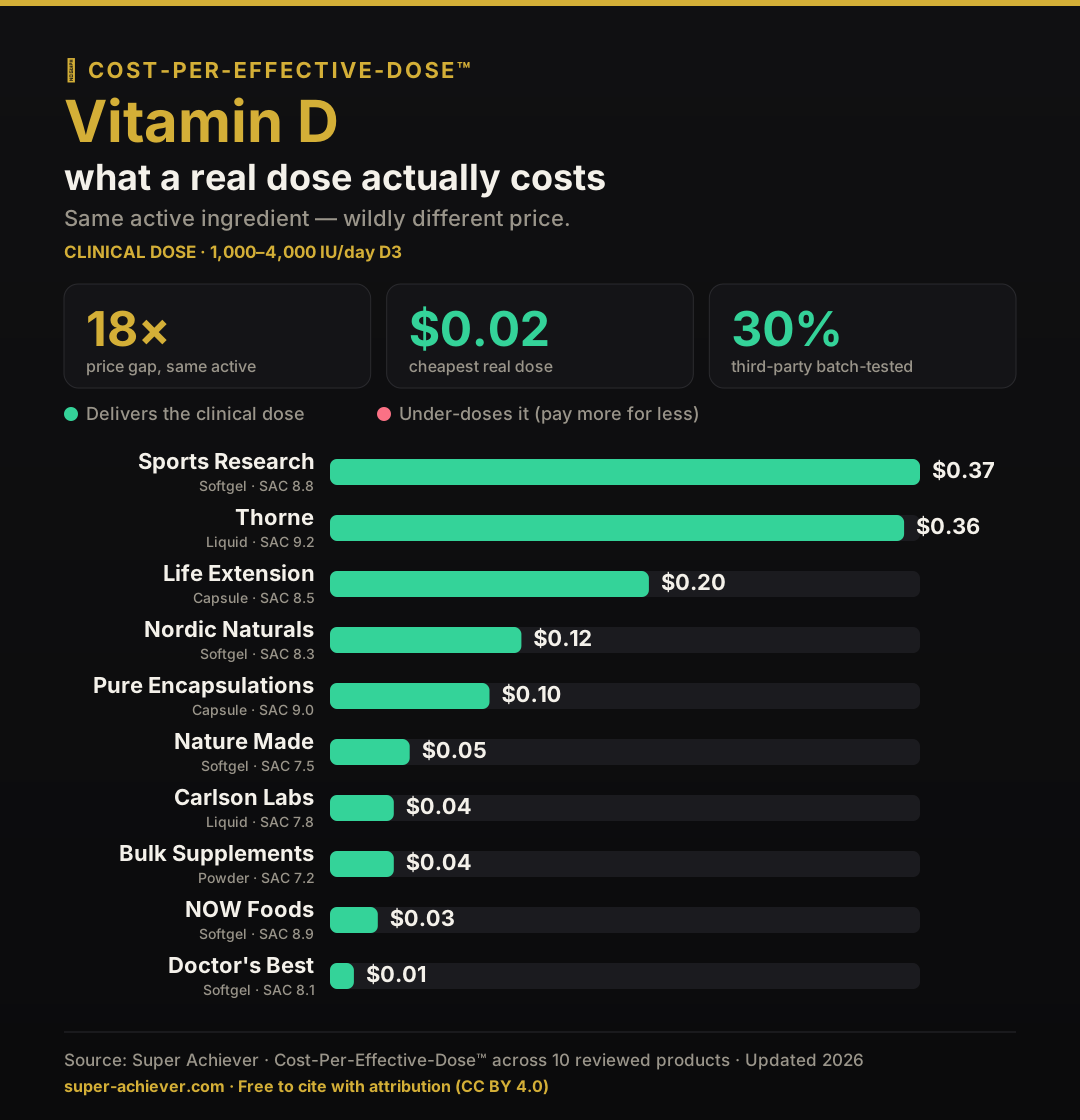
| # | Product | SAC Product Score™ | TXI™ | CPED™ | |
|---|---|---|---|---|---|
| 1 | Thorne Vitamin D + K2 LiquidLiquid | 8.9 | 70 | $0.36 | Most transparent |
| 2 | Pure Encapsulations Vitamin D3 5,000 IUCapsule | 8.9 | 20 | $0.10 | |
| 3 | NOW Foods Vitamin D-3 5,000 IUSoftgel | 8.9 | 40 | $0.03 | |
| 4 | Sports Research Vitamin D3 5,000 IU + K2Softgel | 8.9 | 40 | $0.37 | |
| 5 | Life Extension Vitamin D3 with Sea-IodineCapsule | 8.5 | 20 | $0.20 | |
| 6 | Nordic Naturals Vitamin D3 1,000 IUSoftgel | 8.3 | 50 | $0.12 | |
| 7 | Doctor's Best Vitamin D3 5,000 IUSoftgel | 8.1 | 20 | $0.01 | Best value |
| 8 | Carlson Vitamin D3 Drops 2,000 IULiquid | 7.8 | 20 | $0.04 | |
| 9 | Nature Made Vitamin D3 2,000 IUSoftgel | 7.5 | 65 | $0.05 | |
| 10 | Bulk Supplements Vitamin D3 PowderPowder | 7.2 | 50 | $0.04 |
Methodology. SAC Product Score™ blends our editorial rating (RCT quality, dose, safety, value) 50/50 with community ratings. Transparency Index™ (0-100) = third-party certification (0-50) + public batch COA (0-30) + dose honesty (0-20). Cost-Per-Effective-Dose™ is the real price of one clinical dose, not one marketed "serving". Free to cite with attribution to Super Achiever.
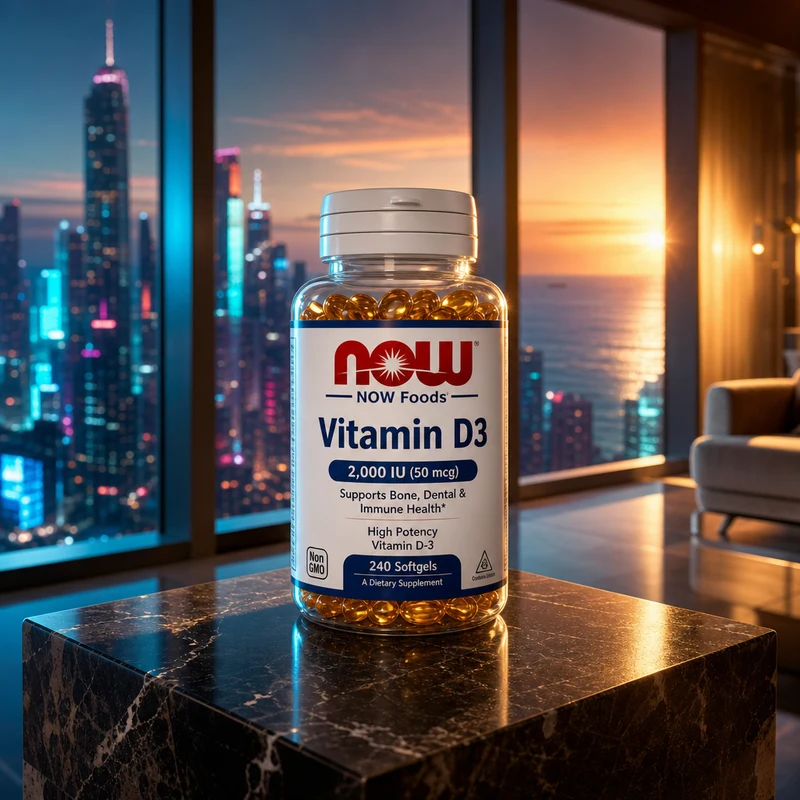
NOW Foods Vitamin D-3 5000 IU
What is Vitamin D?
Vitamin D is not, strictly speaking, a vitamin — it's a secosteroid hormone the body manufactures when UVB photons (290-315 nm) hit 7-dehydrocholesterol in skin keratinocytes. The misnomer stuck because the molecule was discovered during the rickets era, when researchers thought they were chasing a dietary deficiency. They were chasing a sunlight deficiency. The dietary version exists but is the minority pathway in evolutionary terms.
Two forms matter clinically. Vitamin D3 (cholecalciferol) is the animal/sunlight-derived form, produced by skin synthesis or absorbed from oily fish, egg yolks, and liver. Vitamin D2 (ergocalciferol) is the fungal-derived form, present in irradiated mushrooms and most prescription vitamin D in the US. D3 raises and maintains serum 25(OH)D roughly 1.7× more efficiently than D2 across the published comparison trials (Tripkovic 2012 meta-analysis). The supplement category has converged on D3 for this reason — "vitamin D" without a form is usually D3 today, but checking the label is worth the 5 seconds.
The metabolic pathway has three steps, two of which matter for dosing. First, skin or oral D3 travels to the liver and is hydroxylated to 25-hydroxyvitamin D (calcidiol) — the storage form, the form you measure on a blood test, the form with a 2-3 week half-life. Second, the kidney hydroxylates 25(OH)D to 1,25-dihydroxyvitamin D (calcitriol) — the active hormonal form with a 4-15 hour half-life. The second step requires magnesium as obligate cofactor; magnesium-deficient adults activate D less efficiently, which is why "I'm taking 5,000 IU and my serum 25(OH)D won't move" is usually a magnesium problem dressed up as a D problem.
How it works
The active hormone 1,25-(OH)2D binds the vitamin D receptor (VDR), a nuclear receptor present in roughly every tissue in the body — bone, intestine, immune cells, parathyroid, skin, brain, prostate, vascular endothelium, pancreatic beta cells. VDR binding regulates the transcription of 1,000+ target genes, which is why D deficiency produces such a sprawling symptom list (bone pain, immune dysregulation, low mood, muscle weakness, insulin resistance, low testosterone). It's not that vitamin D "does" all those things — it's that VDR signalling is upstream of all those tissue programs, and the absence of the ligand decompensates them collectively.
The most-replicated endpoints in human trials cluster around three axes. First, bone + mineral metabolism: D regulates intestinal calcium absorption and parathyroid hormone, and the deficiency phenotype is rickets in children / osteomalacia in adults. The Bischoff-Ferrari 2009 fall-prevention trial (PMID 19797342) is the cleanest signal — 700-1000 IU/day reduced falls in older adults by 19%, mediated by muscle + balance effects of VDR activation. Second, immune modulation: D is a tolerogenic immune signal that dampens excessive inflammation while supporting innate antimicrobial response. Multiple meta-analyses link low serum 25(OH)D to autoimmune disease incidence, respiratory infection risk, and severity of acute viral illness. Third, endocrine: low D associates with low total + free testosterone in observational data, with a modest RCT signal (Pilz 2011, PMID 21154195) showing ~25% testosterone uplift over 12 months at 3,332 IU/day in deficient men.
The cofactor story is where most consumers get it wrong. D activation requires magnesium. D's calcium-mobilising effect — pulling calcium from the gut into the bloodstream — requires vitamin K2 (specifically MK-7) to direct that calcium into bone matrix rather than vascular tissue, where it would calcify arteries. "Vitamin D alone at high dose" is the protocol that produces arterial calcification anecdotes; "Vitamin D3 + K2 MK-7 + magnesium glycinate" is the protocol that delivers the endpoint benefits without the soft-tissue calcification risk. The full triplet stack is what the Pludowski 2018 (PMID 28216084) clinical recommendations document codified.
At-a-glance facts
- Active compound
- Cholecalciferol (D3) — hydroxylated to 25(OH)D in liver, then to 1,25-(OH)2D in kidney
- Best form
- Vitamin D3 (cholecalciferol) — ~1.7× more efficient than D2 at raising serum 25(OH)D
- Typical maintenance dose
- 1,000-4,000 IU/day for most adults; 5,000-10,000 IU/day for short-term repletion in deficient subjects
- Target serum 25(OH)D
- 40-60 ng/mL (100-150 nmol/L) per Endocrine Society and Pludowski 2018 consensus
- Time to felt effect
- Bloodwork: 4-8 weeks · Mood + immune: 8-12 weeks · Testosterone: 12+ months in deficient men
- Half-life
- Serum 25(OH)D: 2-3 weeks · Active 1,25-(OH)2D: 4-15 hours
- Obligate cofactors
- Magnesium (activation), Vitamin K2 MK-7 (directs mobilised calcium to bone vs arteries)
- Cost range (US)
- $5-15 / month for D3 + K2 combo; standalone D3 is even cheaper
Evidence: Vitamin D is one of the most-studied molecules in human nutrition science — 90,000+ PubMed entries, 200+ RCTs covering bone, immune, mood, infection, fall prevention, testosterone, and metabolic endpoints. The dose-response and toxicity threshold are quantitatively well-characterised (Heaney 2003, PMID 12499343). The replication is strongest where deficiency is most likely (bone, immune, falls, T in deficient men); weaker where modern populations are typically non-deficient (cardiovascular mortality, cancer prevention as primary endpoint). Treat "correct deficiency" as evidence-grade A and "chase further benefits past sufficiency" as evidence-grade C.
Who it's for — and who it isn't
- Anyone with serum 25(OH)D below 30 ng/mL (75 nmol/L) — the operational deficiency threshold. Test before supplementing high-dose; 30-50% of US adults qualify.
- Indoor workers, night-shift workers, and anyone whose midday sun exposure is sub-15 minutes/day in the summer half of the year — sunlight-driven D synthesis is the evolutionary default that modern life has eliminated.
- People with darker skin pigmentation at latitudes above ~35° — melanin filters UVB, requiring 3-6× longer sun exposure to produce equivalent D, which most populations no longer get.
- Men 30+ with low testosterone whose stack hasn't already corrected serum 25(OH)D — the Pilz 2011 trial showed +25% testosterone over 12 months in D-deficient men at 3,332 IU/day.
- Older adults (60+) at fall risk — Bischoff-Ferrari's meta showed 700-1,000 IU/day reduces fall incidence ~19%, mediated by muscle/balance VDR effects.
- Anyone with autoimmune disease, recurrent respiratory infections, or treated SAD/winter depression — D is tolerogenic-immunomodulatory and the deficiency phenotype overlaps these conditions.
- Anyone whose serum 25(OH)D is already 50+ ng/mL (125+ nmol/L) — additional supplementation does not improve endpoints and increases hypercalcemia risk.
- Anyone with sarcoidosis, granulomatous disease (TB, histoplasmosis, berylliosis), or lymphoma — granuloma macrophages convert 25(OH)D to active 1,25-D extrarenally, producing hypercalcemia even at moderate D doses.
- Anyone with a history of hypercalcemia, hyperparathyroidism, or recurrent calcium-oxalate kidney stones — D's calcium-mobilising effect can worsen all three; clinician oversight required.
- People taking thiazide diuretics, digoxin, or high-dose calcium supplements without coordinated dosing — D potentiates calcium absorption and the interactions are real, not theoretical.
- Anyone planning to dose 10,000+ IU/day for months without serum monitoring — the body cannot regulate exogenous D the way it regulates skin-synthesised D, and chronic high-dose without bloodwork is the protocol that produces the toxicity case reports.
Week-by-week, what happens
- Days 1-14Nothing felt subjectively. Serum 25(OH)D begins climbing but is still below most thresholds. The body is filling depleted hepatic + adipose D stores first.
- Week 4-6Serum 25(OH)D rises measurably on a repeat blood test — expect roughly +1 ng/mL per 100 IU/day chronic dosing in deficient adults, with diminishing returns above 40 ng/mL. The repletion phase is happening even if you feel nothing.
- Week 8-12Mood + immune shifts become detectable in deficient responders — winter-mood + recurrent-infection sufferers feel it most. PSQI sleep scores improve in subsets. Energy + bone-pain endpoints respond.
- Month 3-6Muscle strength, balance, and bone-mineral markers respond. Older adults see fall-risk reduction. Insulin sensitivity + lipid markers shift modestly in metabolic-syndrome subgroups.
- Month 6-12Testosterone uplift in deficient men (Pilz 2011: +25% over 12 months at 3,332 IU/day, D-deficient cohort). Plateau on the bloodwork side — maintain dose to hold serum 25(OH)D in the 40-60 ng/mL band indefinitely.
Safety & contraindications
- Do not chronically exceed 10,000 IU/day without serum 25(OH)D monitoring. The upper-limit-without-bloodwork-supervision (UL) per the IOM is 4,000 IU/day; the safe-without-bloodwork-monitoring ceiling in clinical practice is closer to 10,000 IU/day, but past that, individuals diverge wildly in how they handle the dose.
- Always pair high-dose D3 with K2 (MK-7 form, 100-200 mcg/day) and magnesium glycinate (200-400 mg elemental/day). D mobilises calcium from the gut into the bloodstream; K2 directs that calcium to bone matrix rather than arterial walls. "Vitamin D alone at high dose" is the protocol that produces the arterial-calcification anecdotes.
- Hypercalcemia is the meaningful adverse effect — symptoms: nausea, polyuria, confusion, kidney stones. Test calcium + 25(OH)D every 3-6 months if dosing 5,000+ IU/day chronically.
- Contraindicated in sarcoidosis, granulomatous disease (TB, histoplasmosis, berylliosis), lymphoma — granuloma macrophages bypass normal renal regulation of D activation, producing hypercalcemia even at moderate D doses.
- Drug interactions: D potentiates thiazide diuretics (additive calcium retention), digoxin (hypercalcemia can trigger arrhythmia), and high-dose calcium supplements. D absorption is reduced by orlistat, cholestyramine, and some anticonvulsants (phenytoin, phenobarbital) — separate dosing by 4+ hours.
- Take with a fat-containing meal. D is fat-soluble; absorption on an empty stomach is 30-50% lower than with a meal containing 10+ g of fat. The Holick-era "take it with breakfast" advice has direct pharmacokinetic backing.
- Pregnancy + breastfeeding: D is required for fetal skeletal development and maternal serum 25(OH)D directly determines neonatal status. 1,000-2,000 IU/day is the obstetric-society consensus; higher doses require monitoring.
- Buy D3 from brands with public Certificates of Analysis. The D3 supplement supply chain has had label-accuracy problems (Tarn 2013 ConsumerLab analysis found dose deviation from label of -52% to +99% across off-the-shelf bottles). Thorne, NOW Foods, and Pure Encapsulations consistently lab-accurate.
All articles on Vitamin D
Best Vitamin D for Men
Ten vitamin D picks for men — the testosterone-status correlation, higher dose for larger body mass, D+K2 calcium routing, and aging-male muscle + strength.
Read →Best Vitamin D for Testosterone
Vitamin D lifts testosterone mainly in deficient men (Pilz 2011: 3,332 IU/day, +25% T over 12 months) — ranked by D3 form, the 3,000-5,000 IU correction dose, and K2 + magnesium cofactors.
Read →Best Vitamin D for Women
Ten vitamin D supplements re-scored for women — post-menopausal bone density, D+K2 calcium routing, seasonal mood, pregnancy adequacy, and the Hashimoto's status link.
Read →Best Vitamin D Supplements
Vitamin D3 forms with the strongest evidence for testosterone, mood, and immune-resilience — ranked by form (D3 > D2), dose accuracy, K2 cofactor, third-party testing.
Read →Bulk Supplements Vitamin D3 Powder Review
Cofactor-aware vitamin D3 review — what the bottle actually delivers, score breakdown, and the verdict for your stack.
Read →Carlson Vitamin D3 Drops 2,000 IU Review
Cofactor-aware vitamin D3 review — what the bottle actually delivers, score breakdown, and the verdict for your stack.
Read →Doctor's Best Vitamin D3 5,000 IU Review
Cofactor-aware vitamin D3 review — what the bottle actually delivers, score breakdown, and the verdict for your stack.
Read →Life Extension Vitamin D3 with Sea-Iodine Review
Cofactor-aware vitamin D3 review — what the bottle actually delivers, score breakdown, and the verdict for your stack.
Read →Nature Made Calcium 600 mg with Vitamin D3 Review
600 mg calcium and 400 IU D3 per tablet, the same pairing as the large Women's Health Initiative trial. USP Verified, about 7 cents a tablet.
Read →Nature Made Vitamin D3 2,000 IU Review
Cofactor-aware vitamin D3 review — what the bottle actually delivers, score breakdown, and the verdict for your stack.
Read →Nordic Naturals Vitamin D3 1,000 IU Review
Cofactor-aware vitamin D3 review — what the bottle actually delivers, score breakdown, and the verdict for your stack.
Read →NOW Foods Vitamin D-3 5,000 IU Review
Cofactor-aware vitamin D3 review — what the bottle actually delivers, score breakdown, and the verdict for your stack.
Read →Pure Encapsulations Vitamin D3 5,000 IU Review
Cofactor-aware vitamin D3 review — what the bottle actually delivers, score breakdown, and the verdict for your stack.
Read →Sports Research Vegan D3 + K2 Review
Plant-based D3 from lichen with K2 as MK-7, at a moderate 2,500 IU a day. The vegan way to get the D3 + K2 pairing.
Read →Sports Research Vitamin D3 5,000 IU + K2 Review
Cofactor-aware vitamin D3 review — what the bottle actually delivers, score breakdown, and the verdict for your stack.
Read →Thorne Vitamin D + K2 Liquid Review
Cofactor-aware vitamin D3 review — what the bottle actually delivers, score breakdown, and the verdict for your stack.
Read →FAQ
Vitamin D2 vs D3 — does it actually matter which form I take?
Yes, materially. Tripkovic 2012's meta-analysis pooled the head-to-head trials and found D3 raises serum 25(OH)D roughly 1.7× more efficiently than D2 at equivalent oral doses. The mechanism: D3 binds vitamin D binding protein (DBP) more tightly than D2, so circulating half-life is longer and conversion to the active 1,25-D form is more efficient. D2 is still widely prescribed in the US because it's the prescription-strength form (50,000 IU capsules) — clinically inferior to D3 at the same numerical IU, but adequate at the much higher dose. For self-directed supplementation, default to D3.
Do I really need to add K2 with my D3?
If you're dosing above ~2,000 IU/day chronically, yes. D3 increases intestinal calcium absorption; K2 (MK-7 form preferred — longer half-life than MK-4) activates the matrix-Gla-protein that directs that calcium to bone rather than letting it deposit in vascular tissue. The Rotterdam Study and the Geleijnse 2004 K2 trial both linked higher K2 intake to lower coronary-calcification scores. At 1,000 IU/day or less of D3, the cofactor is less critical — the calcium-mobilisation effect is modest. At 5,000+ IU/day, running the D-only protocol for years is a documented mechanism for arterial calcification in some users. The K2 add is cheap (~$5/month) and a strict upside-side bet.
What's the right dose for someone deficient?
Depends on baseline. The Heaney 2003 dose-response data give the operational rule: roughly +1 ng/mL of serum 25(OH)D per 100 IU/day of chronic dosing, with diminishing returns past 40 ng/mL. So someone starting at 15 ng/mL aiming for 40 ng/mL needs ~2,500 IU/day for 8-12 weeks to fill the gap, then can drop to 1,000-2,000 IU/day maintenance. Severe deficiency (under 12 ng/mL) often warrants short-term loading at 5,000-10,000 IU/day for 4-8 weeks under bloodwork monitoring, then de-escalation to maintenance. Don't guess — retest 25(OH)D 8 weeks after starting a new dose and adjust from there.
Can I just get vitamin D from sunlight instead of supplementing?
Theoretically yes — that's how the system evolved. Practically, no, for most modern adults. The dose-response rule is roughly: 10-15 minutes of midday sun on uncovered face + arms + legs at latitudes below ~35° produces ~3,000-10,000 IU of D3, depending on skin pigmentation, age, and season. Above ~35° latitude (most of the US and Europe), the UVB angle from October through March is too oblique to produce meaningful D, regardless of how long you stand outside. People with darker skin pigmentation need 3-6× the sun exposure to make equivalent D. Indoor workers in northern latitudes are functionally guaranteed to be deficient by February. Supplement.
What blood-test target should I aim for?
40-60 ng/mL (100-150 nmol/L) serum 25(OH)D — the band where the bone, immune, T, and mood endpoint signals are strongest and the hypercalcemia tail risk is still near-zero. The IOM threshold of 20 ng/mL is too low — it's the rickets-prevention floor, not the optimal-function target. The Endocrine Society's clinical guideline puts the floor at 30 ng/mL. The Pludowski 2018 expert consensus (D-cardiac authorities, EU rheumatology + endocrinology bodies) settled on 40-60 ng/mL as the optimal-function range. Above 80 ng/mL, additional supplementation produces no demonstrated additional benefit and starts raising hypercalcemia signal.
Will Vitamin D actually raise my testosterone?
In deficient men, yes — modestly. The Pilz 2011 trial (PMID 21154195) gave 3,332 IU/day to D-deficient men for 12 months and measured ~25% rises in total testosterone, bioactive T, and free T vs placebo (which moved nothing). In men who are not D-deficient at baseline, the trial signal vanishes — there's nothing to correct. The 50/50 expectation: if your 25(OH)D is below 30 ng/mL and your testosterone is low, repleting D over 12 months is one of the highest-leverage natural moves available. If your D is already at 40+ ng/mL, adding more D will not move T further — switch tools to Tongkat Ali, Ashwagandha, or address sleep + body composition.
How fast does Vitamin D actually work?
Bloodwork moves fastest — serum 25(OH)D climbs measurably by week 4-6, near-final by week 8-12 on a stable dose. Subjective effects depend on which deficiency-driven symptom is dominant. Winter mood + recurrent infections shift in 8-12 weeks. Muscle weakness + bone discomfort in 12+ weeks. Testosterone uplift in deficient men requires 6-12 months. If you've been on 2,000 IU/day for 8 weeks and your 25(OH)D didn't move, the issue is usually magnesium deficiency (Mg is the cofactor for D activation) — add 300 mg elemental magnesium glycinate at night and retest at month 4.
Is it possible to take too much Vitamin D?
Yes, and the threshold is well-characterised. Chronic dosing above 10,000 IU/day for months without bloodwork can drive serum 25(OH)D above 100 ng/mL, where hypercalcemia risk rises substantially. The toxicity case-reports cluster at sustained intake of 40,000-100,000 IU/day for months. Acute single-dose toxicity is extremely rare below 300,000 IU. The honest framing: 1,000-4,000 IU/day is universally safe; 5,000-10,000 IU/day is safe with periodic bloodwork (every 6 months); past 10,000 IU/day without bloodwork is the protocol that produces the published toxicity cases. The asymmetry favours staying at clinical doses and testing serum.
Sources & further reading
- Holick 2007Vitamin D deficiency
Landmark review establishing the modern clinical case that vitamin D deficiency is a global, vastly under-diagnosed condition with metabolic, immune, endocrine, and skeletal consequences. The reference that shifted vitamin D from "prevent rickets" to "correct hormonal deficiency."
- Pludowski 2018Vitamin D supplementation guidelines
Expert-consensus clinical recommendations codifying target serum 25(OH)D at 40-60 ng/mL, daily dosing 1,000-4,000 IU for general adults, and cofactor pairing with K2 + Mg. The reference protocol that synthesised 20 years of trial data into actionable dosing.
- Heaney 2003Human serum 25-hydroxycholecalciferol response to extended oral dosing with cholecalciferol
The foundational dose-response paper for vitamin D3 — established the operational rule of roughly +1 ng/mL serum 25(OH)D per 100 IU/day chronic dosing in adults, with diminishing returns past sufficiency. The pharmacokinetic backbone of every modern dosing recommendation.
- Bischoff-Ferrari 2009Fall prevention with supplemental and active forms of vitamin D: a meta-analysis of randomised controlled trials
Meta-analysis of 8 high-quality RCTs (n=2,426) showing 700-1,000 IU/day vitamin D reduced fall risk in older adults by 19%, with effects mediated by VDR-driven muscle + balance improvements. The cornerstone fall-prevention trial set.
- Pilz 2011Effect of vitamin D supplementation on testosterone levels in men
3,332 IU/day vitamin D3 for 12 months raised total testosterone by ~25%, bioactive T by 19%, and free T by 21% in D-deficient overweight men vs no movement in placebo. The reference trial for the vitamin D → testosterone effect in deficient subjects.
- Tripkovic 2012Comparison of vitamin D2 and vitamin D3 supplementation in raising serum 25-hydroxyvitamin D status: a systematic review and meta-analysis
Pooled meta-analysis of head-to-head D2-vs-D3 trials showed D3 raises serum 25(OH)D roughly 1.7× more efficiently than D2 at equivalent IU doses. The reference paper that ended the D2-vs-D3 debate in favour of cholecalciferol.
- Martineau 2017Vitamin D supplementation to prevent acute respiratory tract infections: systematic review and meta-analysis of individual participant data
Individual-patient-data meta-analysis of 25 RCTs (n=10,933) showed daily/weekly vitamin D supplementation reduced acute respiratory tract infection risk, with strongest effect in subjects with baseline 25(OH)D below 25 nmol/L. The reference trial set for D's respiratory-immune effect.
- Wang 2008Vitamin D deficiency and risk of cardiovascular disease
Framingham Offspring Study (n=1,739) found vitamin D deficiency associated with ~62% higher incident cardiovascular event risk over 5.4 years follow-up. Observational, not interventional — but the signal that anchored a decade of follow-up trials.