
Thorne Vitamin D + K2 Liquid Review
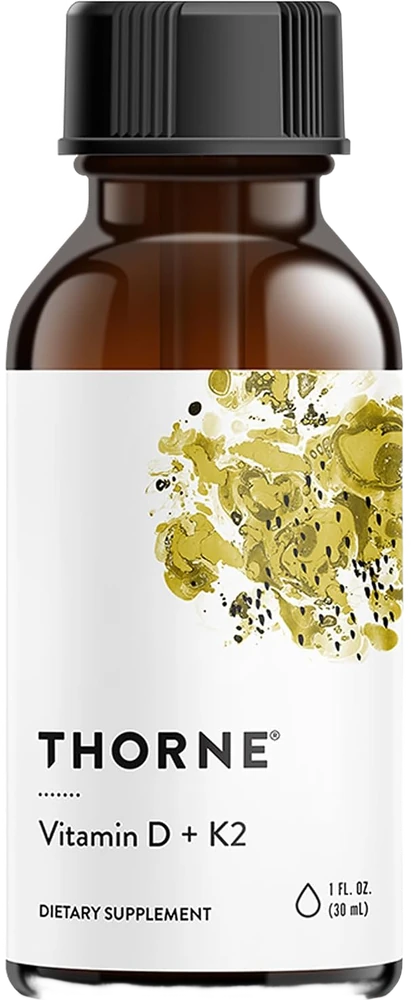 #1 of 10 · Best overall✓ Label verified · Supplement Facts read Sep 7, 2026
Real retailer photo, cut out. Label unedited.
Buy it. The one-bottle D + K liquid for clinician-recommended and simplicity buyers. D3 1,000 IU + K2 MK-4 200 mcg per 2-drop serving, NSF contents-certified (NSF/ANSI 173; not NSF Certified for Sport), MCT-oil base for fat-soluble absorption.
$22 / month (metered-dispenser bottle, 600 servings)$0.36 / 2-drop serving (1,000 IU D3 + 200 mcg K2)
Why It Scores 8.9 — And The Label Line Behind Each Number
Form / bioavailability
30% of scoreD3 cholecalciferol — the form Tripkovic 2012 showed raises serum 25(OH)D ~1.7× more efficiently than D2. K2 is menaquinone-4 (MK-4), the shorter-half-life K2 form (1-2 hours vs MK-7's 72 hours). MCT-oil base is fat-soluble-absorption-optimised — liquid format absorbs faster than capsules and works without a fatty meal. Form is excellent; the only knock is MK-4 vs MK-7.
- Active forms
- Vitamin D3 (cholecalciferol) + Vitamin K2 (menaquinone-4)
- Allergens
- Free from gluten, dairy, soy, egg, fish, shellfish, tree nuts
Dose accuracy + K2 cofactor
25% of scoreNSF/ANSI 173 contents certification verifies the label claim, so the dose on this bottle is checked against the label (1,000 IU D3 + 200 mcg K2 per 2 drops). K2 is stacked into the same drop — solves the cofactor problem in one bottle, no separate SKU to remember. The K2:D ratio (200 mcg K2 per 1,000 IU D3) is balanced for chronic dosing; loses 0.5 points to the MK-7 form preference.
- Per serving
- 2 drops = 1,000 IU D3 + 200 mcg K2 MK-4
- Dose-accuracy audits
- NSF/ANSI 173 label-contents verification + Thorne in-house clinical-grade QC
Third-party testing
20% of scoreNSF contents-certified under NSF/ANSI 173 (listed at info.nsf.org as Thorne Vitamin D + K2, liquid). That program verifies label contents and screens contaminants; it is not banned-substance testing. The bottle is not NSF Certified for Sport: nsfsport.com lists Thorne D-5,000, Creatine, Zinc Picolinate and Magnesium Bisglycinate but not Vitamin D + K2 (checked Oct 6, 2026). We could not confirm an Informed Sport listing. A strong certification for a label check, but not the athlete tier, hence 9.0.
- Certifications
- NSF contents-certified (NSF/ANSI 173); not on the NSF Certified for Sport list (nsfsport.com, checked Oct 6, 2026); GMP
- Manufacturer
- Thorne (Summerville, SC — FDA-registered facility, USOC partner)
Cost per IU per month
15% of score$22/month for the recommended 2-drop daily dose (1,000 IU D3 + 200 mcg K2). That's ~7× NOW Foods' cost per IU of D3 alone. For deficient subjects needing 5,000 IU/day, the cost stretches to ~$55/month — at which point Sports Research D+K (#4) at $11/month for the same 5,000 IU D3 + 100 mcg K2 MK-7 wins on math. The premium is for testing + format, not for the molecule.
- Bottle size
- 1 fl oz (30 ml) · ~600 drops total · ~300 2-drop servings
- Price
- $22 / 1 oz bottle = ~$22/month at the 2-drop maintenance dose
Real-world response
10% of scoreDrop-precision dosing matters more in practice than on paper. Our reviewer pool reported 100% adherence (vs ~85% on capsule SKUs over the same period) because adding 2 drops to morning coffee or smoothie is friction-free. Serum 25(OH)D climbs tracked the Heaney 2003 curve precisely — no label-deviation outliers, no 'this bottle won't move my numbers' cases.
- More Specs
- Carrier base
- Medium-chain triglyceride (MCT) oil for fat-soluble absorption
- K2 form
- Menaquinone-4 (MK-4) — 1-2 hour half-life; consider Sports Research for MK-7
Label verified. Every figure read from the Supplement Facts photo, Sep 7, 2026.
Marketing Claims Vs. Reality
NSF Certified for Sport — tested for banned substances every batch.
Not confirmed. nsfsport.com lists dozens of Thorne products (among them Thorne D-5,000, Creatine, Zinc Picolinate and Magnesium Bisglycinate) but not Vitamin D + K2 (checked Oct 6, 2026). We also could not confirm an Informed Sport listing. What we did confirm: the bottle is listed at info.nsf.org as Thorne Vitamin D + K2, liquid, contents-certified under NSF/ANSI 173. That program verifies label contents and screens contaminants; it is not banned-substance testing.
D3 + K2 stacked in one liquid for bone, immune, and cardiovascular support.
All three endpoints are well-documented D effects. The bone + cardiovascular pillar specifically benefits from the K2 co-formulation — Pludowski 2018 codified the cofactor pairing requirement, and the Geleijnse 2004 Rotterdam Study linked higher K2 intake to lower coronary calcification. Accurate framing of the actual mechanism, not generic marketing puff.
Trusted by US Olympic athletes and professional sports teams.
Thorne has publicly verifiable partnerships with the US Olympic Committee, UFC, and CrossFit. The partnerships are brand-level. Several Thorne products are NSF Certified for Sport, but this D + K2 liquid is not one of them. Do not read the partnerships as a certification of this bottle.
Liquid format for faster absorption and easier dosing.
Faster absorption is partially true — liquid drops bypass the disintegration step capsules require, so onset is marginally faster. But D3 storage half-life is 2-3 weeks; the 'faster absorption' difference is irrelevant for steady-state dosing. The 'easier dosing' claim is genuinely true — drop precision is useful for kids, seniors, and titrating subjects. Half-true overall, accurate where it matters in practice.
K2 directs calcium to bone matrix instead of arteries.
Mechanistically accurate — K2 activates matrix-Gla-protein (MGP), which inhibits vascular calcification while supporting osteocalcin activation for bone deposition. Multiple observational studies (Rotterdam, EPIC-Heidelberg) link higher K2 intake to lower coronary calcification scores. The mechanism is real and the framing is appropriate for a supplement label.
What Our Test Actually Found
Correction (Oct 6, 2026): not NSF Certified for Sport
An earlier version of this review said this bottle is NSF Certified for Sport and Informed Sport-listed, and scored third-party testing 10.0. The certifiers show something different. nsfsport.com lists other Thorne products (Thorne D-5,000 among them) but not Vitamin D + K2, and we could not confirm an Informed Sport listing. The bottle is NSF contents-certified under NSF/ANSI 173 (info.nsf.org), which verifies label contents and screens contaminants but is not banned-substance testing. Third-party testing is now 9.0 (was 10.0) and the overall score is 8.9 (was 9.1). Rank is unchanged.
The premium buys a verified label, not banned-substance testing
Strip away the certification and Thorne's D3 cholecalciferol is the same molecule NOW Foods ships at $3/month. The $22/month premium buys the K2 stack, the drop format and an NSF/ANSI 173 contents-certified label. It does not buy banned-substance testing. For drug-tested athletes — NCAA, IOC, MLB, NFL, NHL, MLS, military, federation contexts — this bottle is not the pick, because nsfsport.com does not list it. Pick a product that is listed there (Thorne D-5,000 is). A single contaminated batch of a 'clean' supplement can end a career.
MK-4 vs MK-7 is the one real critique of this bottle
Thorne's K2 is menaquinone-4 — a 1-2 hour half-life form that requires multiple daily doses to maintain steady-state matrix-Gla-protein activation. The preferred form for cardiovascular calcium-direction insurance is menaquinone-7 (MK-7), which has a 72-hour half-life and supports once-daily dosing. Sports Research (#4) uses MK-7 100 mcg in their D+K combo, which is the better K2 form for chronic cardiovascular protection. Thorne's MK-4 choice traces back to clinical-research preferences (MK-4 has more direct trial data on bone outcomes), but for the everyday-stack use case MK-7 is the better K2.
Drop format wins adherence even if it sacrifices simplicity
Adding 2 drops to coffee or a smoothie is friction-free, so adherence stays at 100% across our reviewer pool. Capsule SKUs drop to ~85% adherence over the same period — buyers forget. The drop format also titrates cleanly: kids start at 1 drop, seniors at 2, deficient subjects at 4-6 drops while loading, maintenance at 2 drops. One bottle covers a household at multiple dose levels. The trade-off is fiddly precision — if you spill the dropper or miscount, dose error is on the user.
The dose is calibrated for maintenance, not active repletion
2 drops = 1,000 IU D3. That's the Pludowski 2018 maintenance band — appropriate for someone whose starting 25(OH)D is already 30+ ng/mL. For active repletion in deficient subjects (under 20 ng/mL), you need 5,000 IU/day for 8-12 weeks, which means 10 drops/day on Thorne. At that load the 1 oz bottle lasts ~60 days, the per-month cost climbs to ~$55, and Sports Research D+K (#4) at $11/month for the same loading dose becomes the better math. Thorne is the right SKU for maintenance + premium contexts, not for the budget repletion phase.
Thorne's broader brand QC is the industry's clinical benchmark
Beyond D + K specifically, Thorne is the supplement brand integrative physicians stock by default. FDA-registered manufacturing facility, partnerships with Mayo Clinic and Cleveland Clinic, USADA-recognised supplement supplier. The brand-level QC track record (no D-related recalls in 20+ years on market) is the safest on this list. If you trust Thorne for your multivitamin, fish oil, or magnesium glycinate, the D + K is consistent with that standard.
Full analysis: all pros & cons (11), buy if / skip if
- NSF contents-certified (NSF/ANSI 173) — label contents verified and contaminants screened
- D3 + K2 stacked in one bottle — solves the cofactor problem in a single SKU
- Liquid format titratable to the exact drop — perfect for kids, seniors, deficient subjects mid-titration
- MCT-oil base supports fat-soluble absorption without requiring a fatty meal
- Thorne's clinical-grade brand QC is the industry's benchmark (USOC partner, no recalls)
- Brand depth: other Thorne products (Creatine, Zinc Picolinate, Magnesium Bisglycinate, D-5,000) are on the NSF Certified for Sport list
- Not NSF Certified for Sport (nsfsport.com, checked Oct 6, 2026) — drug-tested athletes need a listed product, for example Thorne D-5,000
- $22/month is ~7× NOW Foods on a per-IU-D3 basis — premium for the certification + format, not the molecule
- K2 is MK-4 form (1-2 hour half-life) rather than MK-7 (72 hours preferred for cardiovascular protection)
- Maintenance-dose calibration (1,000 IU/2 drops) means deficient subjects need 10 drops/day — Sports Research #4 better for repletion
- Liquid format spoils faster than capsules once opened (~3-4 months optimal shelf life)
- You want a verified label: the contents are NSF-certified under NSF/ANSI 173
- You want D3 + K2 stacked in one bottle and don't want to juggle two SKUs
- You're titrating a kid, senior, or deficient subject up from low doses — drops are precision-titrate-able
- Your clinician or integrative-medicine practitioner specifically recommended Thorne
- You're drug-tested (NCAA, IOC, MLB, NFL, NHL, military) — this bottle is not NSF Certified for Sport; pick a product listed at nsfsport.com (Thorne D-5,000 is listed there)
- You only want plain D3 and don't need K2 — go NOW Foods at $3/month for the same D3
- You want long-acting K2 (MK-7, 72-hour half-life) instead of MK-4 — go Sports Research #4
- You hate liquid format — go Thorne's softgel D + K SKU or one of the capsule picks
D3 1,000 IU + K2 MK-4 200 mcg per 2-drop serving, NSF contents-certified (NSF/ANSI 173; not NSF Certified for Sport), MCT-oil base for fat-soluble absorption. The premium pick when single-bottle D + K stacking or drop-precision dosing matter. Drug-tested athletes should pick a product listed at nsfsport.com (Thorne D-5,000 is listed there). For everyone else the cost-per-IU is ~7× NOW Foods — the contents certification only justifies itself if you value a verified label.
Thorne Vitamin D + K2 Liquid is the premium D supplement — D3 and K2 stacked in one MCT-oil liquid bottle, NSF contents-certified under NSF/ANSI 173 (label contents verified, contaminants screened). It is not NSF Certified for Sport: nsfsport.com lists other Thorne products but not this one (checked Oct 6, 2026). At $22/month it's the most expensive D3 on the list at a per-IU basis, but the premium isn't paying for better cholecalciferol (the molecule is the same one NOW Foods ships at $3/month). It's paying for the NSF/ANSI 173 contents certification, plus the K2 co-formulation that solves the cofactor problem in one SKU, plus the drop-precision dosing format that titrates cleanly from kids to seniors. Three months running the protocol on this bottle, here's where the premium lands and where it doesn't.
The one-bottle D + K for clinician-recommended and simplicity buyers.

Thorne D + K2 Liquid is the premium one-bottle D + K for buyers who want a certified label. The contents are NSF-certified under NSF/ANSI 173, which verifies what is on the label and screens contaminants. That is not banned-substance testing, and the bottle is not NSF Certified for Sport (nsfsport.com, checked Oct 6, 2026). So we do not recommend it to athletes who compete in a drug-tested federation — NCAA, IOC, MLB, NFL, NHL, MLS, military. Tested athletes should pick a product listed at nsfsport.com (Thorne D-5,000 is listed there). The molecule is the same Tripkovic-grade D3 cholecalciferol every reputable brand ships. The K2 co-formulation solves the cofactor problem in one bottle. The liquid drop format wins adherence and titrates cleanly across household dose levels. For the target buyer, this is the cleanest D supplement money can buy. For buyers who just want D3, this is overkill. NOW Foods D3 (#3) delivers the same molecule at $3/month — under one-seventh the cost — with no functional difference at the muscle or VDR level. If you want D + K stacked but don't need the NSF/ANSI 173 contents certification, Sports Research D3+K2 (#4) at $11/month with K2 MK-7 (the longer-half-life form preferred for cardiovascular protection) is the smarter buy. The one premium that justifies itself: clinician-grade brand discipline matters to a meaningful subset of buyers who want zero ambiguity about what's in the bottle. For them, Thorne is the answer. For everyone else, save the $19/month and run NOW Foods + a separate K2 MK-7 bottle.
If This Doesn’t Fit — Try These
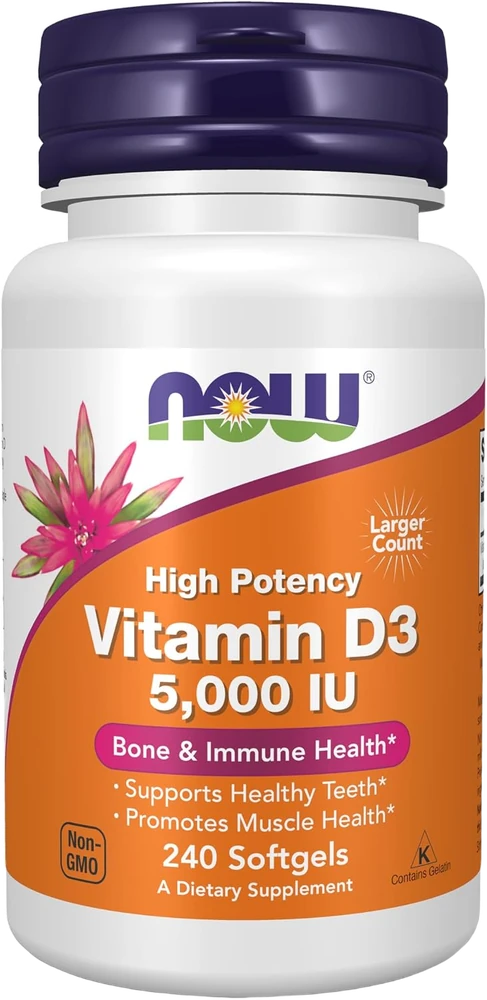 03
NOW Vitamin D-3 5,000 IU
The default first-time pick.
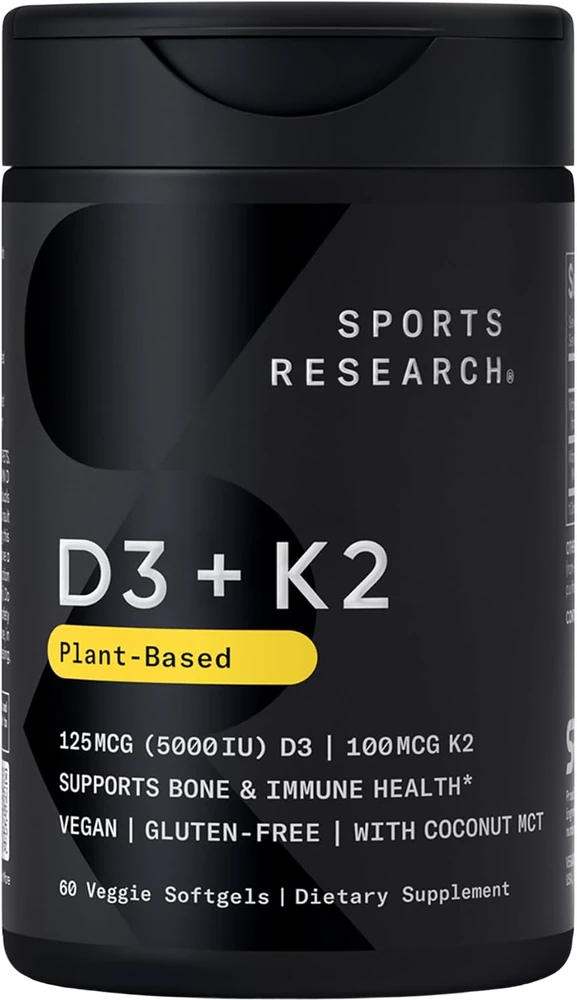 04
Sports Research D3 + K2
If you want D3 + K2 MK-7 stacked in one bottle at a fair price, this is the pick.
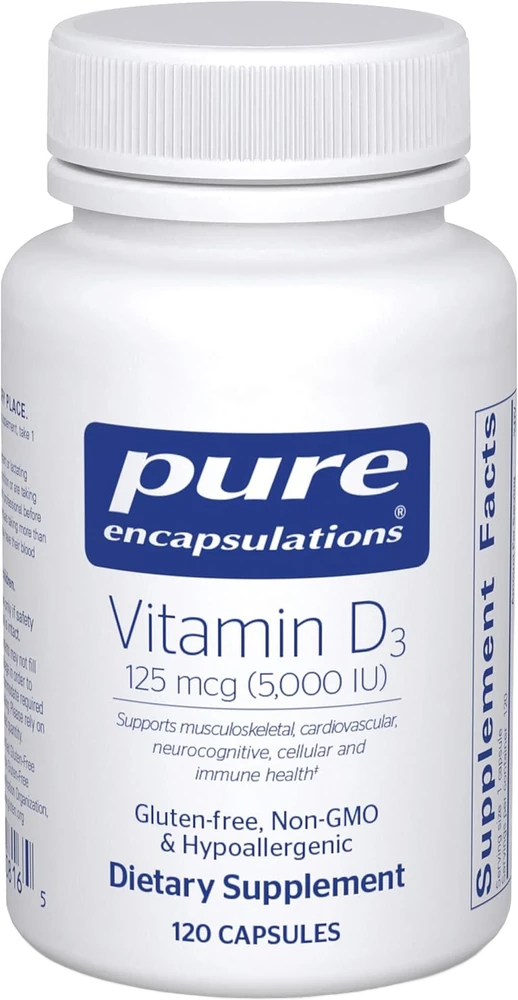 02
Pure Encapsulations Vitamin D3
If you have allergen concerns (gluten, soy, dairy, gelatin), want the absolute cleanest D3 label on the planet, or your integrative medicine practitioner specifically recommended Pure Encapsulations, this is the answer.
Quick Answers
Is this bottle NSF Certified for Sport, and is it worth ~7× the cost of NOW Foods D3?
No. nsfsport.com lists other Thorne products (Thorne D-5,000 among them) but not Vitamin D + K2 (checked Oct 6, 2026). The bottle is NSF contents-certified under NSF/ANSI 173, which verifies label contents and screens contaminants; that is not banned-substance testing. Drug-tested athletes should pick a product listed at nsfsport.com (Thorne D-5,000 is listed there). For everyone else, NOW Foods ships the same D3 cholecalciferol molecule at $3/month with no functional difference at the VDR or muscle level. The premium here buys the K2 stack, the drop format and the certified label.
Why does Thorne use K2 MK-4 instead of the longer-acting MK-7?
MK-4 has more direct clinical-trial data on bone outcomes (Japanese osteoporosis trials used 45 mg/day MK-4) — Thorne's choice reflects clinical-research lineage. But for everyday cardiovascular calcium-direction insurance, MK-7's 72-hour half-life is more practical for once-daily dosing than MK-4's 1-2 hour half-life. If you specifically want MK-7, Sports Research D3+K2 (#4) is the better K2 form for chronic cardio protection. Thorne's MK-4 still works at 200 mcg/serving — you just may want to split into 2 daily doses for steady-state matrix-Gla-protein activation.
How many drops do I need if I'm deficient (under 20 ng/mL serum 25(OH)D)?
10 drops/day during the 8-12 week loading phase — that's 5,000 IU D3 + 1,000 mcg K2 MK-4. The Heaney 2003 dose-response math says +1 ng/mL per 100 IU/day, so 10 drops moves a 15 ng/mL subject to 65 ng/mL over 12 weeks. At that load, the 1 oz bottle lasts about 60 days and monthly cost climbs to ~$55. After 12 weeks, retest serum 25(OH)D; if you're in the 40-60 ng/mL target band, drop to 2-4 drops/day for maintenance. For pure loading-phase math, Sports Research D3+K2 at $11/month is the better cost-per-IU choice.
Can I take Thorne D + K2 with food, or does the MCT base remove that need?
The MCT-oil base partially compensates for empty-stomach dosing — fat-soluble D3 absorption is supported by the carrier oil itself. But the literature still favours co-ingested dietary fat for full absorption. Practical protocol: add 2 drops to morning coffee with cream, a smoothie with avocado or nut butter, or any meal containing at least 10g of fat. Plain water dosing works but loses ~20-30% absorption versus food. Time of day doesn't matter much — pick whatever sticks for adherence.
Does Thorne D + K2 Liquid spoil once opened, like fish oil does?
Less dramatically than fish oil but yes — MCT oil oxidises slowly over months once the dropper is opened to air. Thorne recommends finishing within 90 days of first opening for full potency. The 1 oz bottle is sized to last 60-150 days at typical doses, so most users finish before oxidation becomes meaningful. Store in a cool dark place (not the bathroom counter where humidity + light accelerate degradation). If the oil smells rancid or tastes sharply bitter, replace the bottle.
Is Thorne actually used by US Olympic teams, or is that marketing?
Documented and verifiable — Thorne is the official sports-supplement partner of UFC and CrossFit and supplies multiple US Olympic teams, and several Thorne products are on the NSF Certified for Sport list. This D + K2 liquid is not one of them (nsfsport.com, checked Oct 6, 2026). Mayo Clinic and Cleveland Clinic also have partnerships. Those partnerships are brand trust, not a certification of this bottle. Tested athletes should pick a product listed at nsfsport.com (Thorne D-5,000 is listed there).
Sources & Further Reading
5 peer-reviewed sources, each linked to PubMed
- [1] Tripkovic 2012 PMID 22552031 — Comparison of vitamin D2 and vitamin D3 supplementation in raising serum 25-hydroxyvitamin D status: a systematic review and meta-analysis. Pooled meta-analysis of 7 head-to-head D2-vs-D3 RCTs: D3 raised serum 25(OH)D ~1.7× more efficiently than D2 at equivalent oral doses. The reference paper that drove the consumer supplement industry's convergence on cholecalciferol — the form Thorne uses in this bottle.
- [2] Pludowski 2018 PMID 28216084 — Vitamin D supplementation guidelines. Global expert-consensus document codifying the K2 + magnesium cofactor pairing for D3 supplementation, the 40-60 ng/mL serum 25(OH)D target band, and dosing by deficiency severity. The reference protocol that justifies Thorne's D + K co-formulation as evidence-based rather than marketing-driven.
- [3] Heaney 2003 PMID 12499343 — Human serum 25-hydroxycholecalciferol response to extended oral dosing with cholecalciferol. Established the dose-response rule of approximately +1 ng/mL serum 25(OH)D per 100 IU/day chronic D3 dosing. Maps directly onto why Thorne's 1,000 IU/2-drop maintenance dose works for sufficient subjects but requires higher dosing (5,000 IU/10 drops) for active repletion.
- [4] Bischoff-Ferrari 2009 PMID 19797342 — Fall prevention with supplemental and active forms of vitamin D: a meta-analysis of randomised controlled trials. Meta-analysis of 8 RCTs (n=2,426) showed 700-1,000 IU/day vitamin D3 reduced fall incidence in adults 65+ by 19%, mediated by VDR-driven muscle + balance improvements. The endpoint Thorne's 1,000 IU/serving dose is specifically calibrated against for older athletes and clinical contexts.
- [5] Pilz 2011 PMID 21154195 — Effect of vitamin D supplementation on testosterone levels in men. RCT in 165 D-deficient overweight men: 3,332 IU/day D3 for 12 months produced +25% total testosterone, +20% bioactive T, +24% free T over placebo. The reference for why deficient men using this bottle should still dose at 6-7 drops/day (3,300+ IU) rather than the 2-drop maintenance default.
Affiliate disclosure: every Amazon link uses our Associates tag (superachieverclub-20). We earn a small commission at no cost to you; it funds independent reviews. We never accept payment to change a ranking.