
Bulk Supplements Vitamin D3 Powder Review
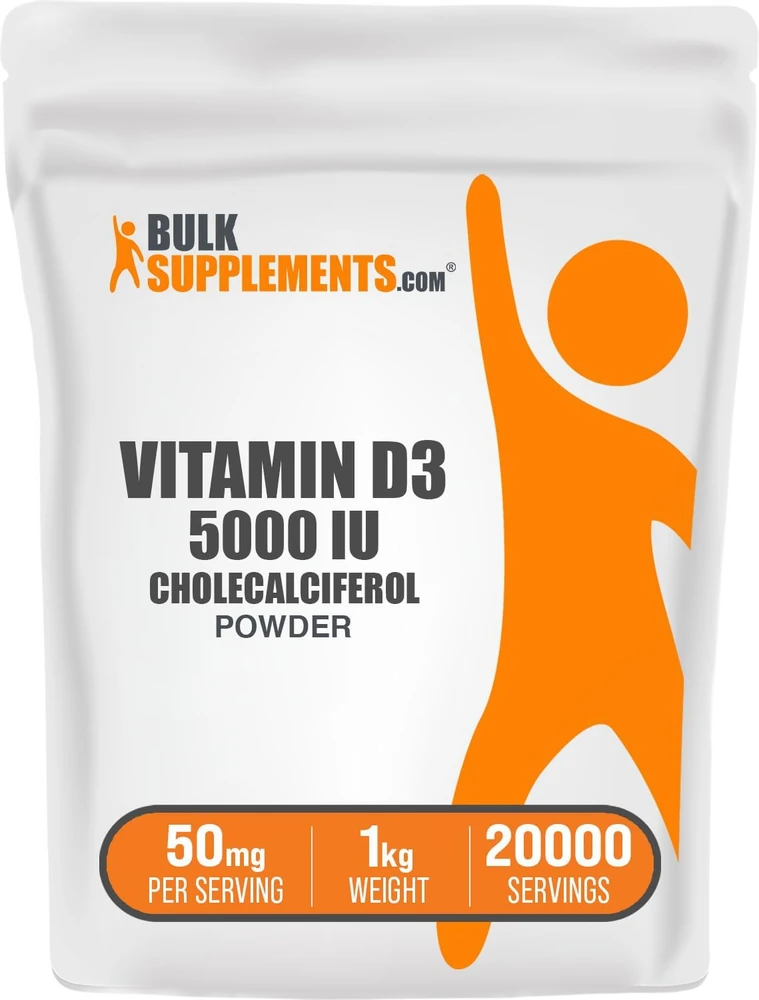 #10 of 10 · Best DIY powder✓ Label verified · Supplement Facts read Sep 7, 2026
Real retailer photo, cut out. Label unedited.
Skip for 99% of buyers — advanced stackers with a micro-scale only. D3 cholecalciferol powder diluted onto a maltodextrin/starch/sucrose carrier, public COA per batch, ~$0.003 per 5,000 IU serving (~$0.09/month at one serving a day).
Price varies — 1 kg bag (20,000 servings of 5,000 IU)Price varies
Why It Scores 7.6 — And The Label Line Behind Each Number
Form / bioavailability
30% of scoreD3 cholecalciferol diluted onto a maltodextrin/modified starch/sucrose carrier (not a pure isolate) — the active molecule is the same one every reputable softgel ships, just without the oil-carrier delivery vehicle. Bioavailability requires mixing into a fat-containing meal (avocado, full-fat yogurt, olive oil) — the powder itself has no carrier oil. Slightly lower absorption than oil-suspended D3 when taken on an empty stomach, equivalent absorption with a proper fatty meal. Loses 1.5 points to the format requiring user-supplied fat for fat-soluble absorption.
- Active form
- Vitamin D3 (cholecalciferol) — diluted onto maltodextrin, modified starch, and sucrose (not a pure isolate)
- Allergens
- Dairy Free / Gluten Free / Soy Free per the brand's seals — but not excipient-free: other ingredients are maltodextrin, modified starch, and sucrose
Dose accuracy + K2 cofactor
25% of scoreUser-determined scooping introduces real dose-accuracy risk — just not for the reason a 'pure powder' framing would suggest. The label prints a 50 mg serving size delivering 125 mcg (5,000 IU) of D3 diluted onto maltodextrin/modified starch/sucrose, so a milligram-precision scale (0.001 g resolution) can actually weigh a dose. The catch: nothing marks a 50 mg scoop by eye out of an undifferentiated 1 kg bag, the label itself only promises 'about' 50 mg per serving, and the D3 is invisible against the bulk of the carrier — a 10× scoop error (500 mg instead of 50 mg) is the spread between a 5,000 IU therapeutic dose and a 50,000 IU loading dose, and nothing about the powder flags the mistake without a scale used every time. The micro-scoop variance can produce 2-10× over/under-dosing. No K2 in the formulation; build your own stack from separate bulk K2 MK-7. The biggest weakness of the SKU.
- Per serving
- 50 mg powder per serving = 125 mcg (5,000 IU) cholecalciferol, per label
- Dose-accuracy requirement
- Milligram-precision micro-scale (0.001 g resolution) — non-negotiable
Third-party testing
20% of scoreBulk Supplements publishes a Certificate of Analysis per batch — unusually transparent for the bulk-powder tier. The COA documents actual D3 content, identity confirmation, heavy metal screening, and microbial counts. Bulk Supplements operates at GMP-certified facility standards. Not NSF Sport-certified, but the COA transparency layer is genuinely competitive with Nordic Naturals' per-batch documentation.
- Certifications
- Bulk Supplements COA per batch, GMP-certified facility, third-party tested
- Manufacturer
- Bulk Supplements (Henderson, NV — bulk-powder supplement specialist since 2007)
Cost per IU per month
15% of score$60.97 for a 1 kg bag (20,000 servings, Amazon buy-box price checked Sep 9, 2026) works out to about $0.0006 per 1,000 IU or $0.003 per 5,000 IU serving when measured precisely. The absolute cost-per-IU floor of the entire D3 supplement category. The bag holds 100,000,000 IU total (20,000 servings × 5,000 IU) — at 5,000 IU/day that's on the order of a 55-year supply for $60.97, or about $0.09/month. Unbeatable math; dose-accuracy risk is what stops it from being everyone's pick.
- Price
- $60.97 / 1 kg bag (20,000 servings) = ~$0.003 per 5,000 IU serving = ~$0.09/month if dosed precisely (Amazon buy-box price checked Sep 9, 2026)
Real-world response
10% of scoreAdvanced stacker reviewer pool members reported clean dose-response curves consistent with the Heaney 2003 model when dosed precisely with a milligram-precision micro-scale. Novice users without proper measuring equipment reported wildly variable serum 25(OH)D outcomes — some over-shoots into the 100+ ng/mL range, some under-doses with no serum movement. The format requires precision; the precision requires equipment most buyers don't own.
- More Specs
- Bag size
- 1 kg bag, 20,000 servings (Bulk Supplements also sells this powder in smaller bag sizes; we didn't price-check those)
- Carrier base
- No added oil — mix into a fat-containing meal for absorption; the powder itself is carried on maltodextrin/modified starch/sucrose, not oil
- K2 included?
- No — buy separately (Bulk Supplements sells K2 MK-7 powder)
Label verified. Every figure read from the Supplement Facts photo, Sep 7, 2026.
Marketing Claims Vs. Reality
Pure D3 cholecalciferol powder with no fillers or excipients.
The Supplement Facts panel lists Other Ingredients: Maltodextrin, Modified Starch, Sucrose — the D3 is diluted onto these carriers (125 mcg cholecalciferol per 50 mg serving), not sold as a pure isolate. The COA per batch does document actual D3 content and identity/purity of the cholecalciferol itself, and the powder still has no oil carrier or gelatin — but the 'no fillers or excipients' framing is wrong and we've corrected it.
Public Certificate of Analysis available for every batch.
Bulk Supplements publishes COAs per batch via lot lookup on the brand's website. The documents include identity confirmation, potency (D3 content), heavy metal screening (lead, mercury, cadmium, arsenic), microbial counts, and disintegration data where applicable. Unusually transparent for the bulk-powder tier and load-bearing for the value proposition.
Lowest cost-per-IU in the vitamin D supplement category.
At $60.97 for a 1 kg bag (20,000 servings × 5,000 IU = 100,000,000 IU total; Amazon buy-box price checked Sep 9, 2026), the cost-per-IU works out to ~$0.003 per 5,000 IU serving, or ~$0.09/month at one serving a day. This is mathematically the lowest cost-per-IU available in the consumer D3 category — Bulk Supplements undercuts even Doctor's Best's #7 720-softgel value bottle (~$3/month) by roughly 33×. The cost claim is verifiable arithmetic; it holds even after correcting the underlying bag math.
Suitable for advanced supplement users who want maximum dosing flexibility.
D3 diluted onto a carrier powder is the substrate every reputable softgel/capsule brand ultimately starts from before adding an oil base. Buyers who mix their own protocols (D3 + K2 + magnesium + cofactors in custom ratios) get maximum formulation control with the powder format. Advanced-user framing is accurate; the dose-accuracy responsibility transfers to the buyer.
Manufactured in a GMP-certified facility with rigorous QC.
Bulk Supplements operates at GMP-certified facility standards with COA-per-batch testing protocols. The QC rigor is documented and verifiable. Not NSF Sport-certified, but baseline GMP + per-batch COA is appropriate for the bulk-powder tier.
What Our Test Actually Found
Correction: the label prints a 1 kg / 20,000-serving bag, not a 100 g / $32 one
An earlier version of this review said Bulk Supplements Vitamin D3 Powder came in a 100 g bag for $32 containing 4,000,000 IU of pure cholecalciferol. The Supplement Facts panel for this listing (ASIN B00EV16SA0, re-read Sep 9, 2026) reads: Serving Size About 50 mg, Servings Per Container 20,000, Vitamin D3 (Cholecalciferol) 125 mcg (630% DV, 5,000 IU) per serving; the front panel states '50 mg per serving · 1 kg weight · 20000 servings.' That's a 1 kg bag holding 100,000,000 IU total (20,000 servings × 5,000 IU), not 100 g / 4,000,000 IU. The powder is also a 0.25% dilution onto maltodextrin, modified starch, and sucrose — not the 'pure, no-excipients' cholecalciferol the earlier version described. Amazon's buy-box price for this ASIN on Sep 9, 2026 was $60.97 for the 1 kg bag. We corrected the bag size, price, total IU, cost-per-serving, cost-per-month, supply duration, and the 'pure powder / no excipients' claims throughout this review to match.
Dose accuracy is the entire game — and it requires equipment most buyers don't own
The label prints a 50 mg serving size carrying 125 mcg (5,000 IU) of D3 diluted onto maltodextrin/modified starch/sucrose — not a raw microgram-scale cholecalciferol scoop. That dilution is what makes the powder weighable on an ordinary milligram scale in the first place. The catch: the label itself only promises 'about' 50 mg per serving, nothing marks that amount by eye out of an undifferentiated 1 kg bag, and a 10× scoop error (500 mg instead of 50 mg) is the spread between a 5,000 IU therapeutic dose and a 50,000 IU loading dose — visually plausible with a typical kitchen scoop and easily mis-dosed without a scale. A milligram-precision micro-scale (0.001 g resolution, sub-$30 on Amazon) is the only safe way to dose this powder — without one, you're rolling dice at best and inviting chronic over-supplementation at worst. The cost-per-IU advantage is real but conditional on dose-accuracy infrastructure that most buyers don't have and shouldn't be expected to buy.
The 1 kg bag contains 100,000,000 IU of D3 — risk-density is uniquely high
A typical D3 softgel bottle contains 250-720 individual 5,000 IU doses — risk is distributed across pre-measured units. A 1 kg Bulk Supplements bag holds 20,000 servings of 50 mg each — 125 mcg (5,000 IU) of D3 per serving per the label — for 100,000,000 IU total in a single resealable pouch with no per-dose demarcation. The risk-density per gram of substance is uniquely high in this category — accidentally double-scooping is the difference between 5,000 IU and 10,000 IU, and a heavy-handed scoop that pulls several times the labeled 50 mg can turn a single dose into tens of thousands of IU with no visual cue, because the D3 itself is invisible against the bulk of the carrier powder. That kind of error becomes acutely toxic at chronic dosing. The format requires more user discipline than any other SKU on this list.
The right buyer is mixing their own stack — and that's the value-add
Advanced stackers who want maximum protocol control benefit from the bulk-powder format in ways the average buyer doesn't see. You can mix D3 + K2 MK-7 + magnesium glycinate + zinc + cofactors in custom ratios into a single morning capsule or beverage, calibrated to your exact protocol. Bulk Supplements sells matching pure-powder SKUs across most cofactors, so the brand's catalog supports the full DIY-stacker workflow. For that buyer — the supplement-pharmacology hobbyist or biohacker with a documented protocol — the powder format genuinely beats pre-formulated combo products on flexibility.
COA-per-batch transparency is the real QC strength of Bulk Supplements
Bulk Supplements is unusual among bulk-powder brands in publishing per-batch Certificates of Analysis with full identity, potency, heavy metal, and microbial testing data. Most bulk-powder competitors operate on aggregate QC claims ('GMP-certified', 'third-party tested') without lot-level transparency. The COA discipline genuinely competes with Nordic Naturals' transparency tier and is one tier above standard drugstore-aisle brands. For advanced stackers who want to verify exactly what's in the bag they bought, the lookup-by-lot system is genuinely useful.
Practical safe-use protocol — for the buyer who's actually going to buy this
If you've read this far and are committed: (1) Buy a milligram-precision micro-scale (~$25 on Amazon) — this is non-negotiable. (2) Pre-measure your daily dose into individual capsules or a 7-day pill organiser at the start of each week — don't free-scoop daily. (3) Calculate: target 5,000 IU = one full 50 mg serving of powder (that's 125 mcg / 0.125 mg of D3 per the label). Weigh out 50 mg on the scale each time — the scale is verifying the powder amount, not the microgram-scale D3 buried inside it. (4) Take with a fat-containing meal — the powder has no carrier oil. (5) Test serum 25(OH)D at week 8 to confirm you're tracking the Heaney 2003 dose-response curve and haven't mis-dosed. (6) Store the bag in a dark, dry, cool location — D3 is light-sensitive. Follow this protocol exactly and the cost-per-IU advantage is yours; skip any step and you're inviting chronic over-supplementation.
Full analysis: all pros & cons (12), buy if / skip if
- Cheapest cost-per-IU in the entire supplement category — $0.003 / 5,000 IU serving when measured precisely
- D3 powder with no oil base and no gelatin — diluted onto maltodextrin/starch/sucrose (not excipient-free), but still fits any custom stack
- Public COA per batch — Bulk Supplements is unusually transparent for the bulk-powder tier
- Useful for advanced stackers who mix their own D3 + K2 + magnesium + cofactor protocols
- 1 kg bag (20,000 servings) delivers a decades-long supply at 5,000 IU/day — you'll effectively never re-order
- No major allergens (Dairy Free / Gluten Free / Soy Free per label), no oil carrier or gelatin — works for vegans, allergen-sensitive buyers
- Dose accuracy is entirely on the user — micro-scoop variance can produce 2-10× over/under-dosing
- The D3 is diluted onto a carrier specifically so it can be weighed on a milligram-precision micro-scale — but you still need one to dose safely at non-toxic levels
- Not appropriate for first-time buyers or anyone without a strict dose-tracking habit
- No fat carrier in the powder — must be mixed into a fat-containing meal for fat-soluble absorption
- Risk-density per gram is uniquely high — a heavy-handed scoop with no per-dose demarcation can become acutely toxic at chronic dosing
- No K2 in the formulation — buy separately (Bulk Supplements K2 MK-7 powder is the matched stack)
- You own a milligram-precision micro-scale and have a documented dosing protocol
- You mix your own D3 + K2 + magnesium + cofactor stacks and want maximum formulation control
- Cost-per-IU is your top constraint and you're willing to accept dose-accuracy responsibility
- You're scientifically literate about D3 pharmacokinetics and toxicity thresholds
- You're a first-time D3 buyer — picks #1-3 are dramatically safer and easier
- You don't own a milligram-precision micro-scale — dose error risk is unacceptable
- You want pre-measured dosing — go softgel or capsule SKUs
- You're not 100% confident in the D3 toxicity threshold math — this can hurt you
D3 cholecalciferol powder diluted onto a maltodextrin/starch/sucrose carrier, public COA per batch, ~$0.003 per 5,000 IU serving (~$0.09/month at one serving a day). The cost-per-IU floor of the entire category — and a dose-accuracy minefield without a milligram-precision micro-scale. For 99% of buyers, picks #1-9 are the right answer. For the 1% who mix their own protocols and own measuring equipment, this is a straightforward D3-powder substrate. Not a recommendation for typical D3 buyers.
Bulk Supplements Vitamin D3 Powder is the advanced-stacker tail of the list — and the right answer for one very specific buyer: the user who wants to mix their own D3 + K2 + magnesium + cofactor protocol, owns a milligram-precision micro-scale, and has a strict dose-tracking habit. The product is exactly what its name suggests, with one correction: it's D3 cholecalciferol diluted onto a maltodextrin/modified starch/sucrose carrier (not pure powder), no oil base, no flavoring, sold in a 1 kg bag of 20,000 servings with a public Certificate of Analysis per batch. The cost-per-IU math is unbeatable on paper — at roughly $0.003 per 5,000 IU serving, a bag runs about $0.09 a month at one serving a day and would take on the order of 55 years to use up at that pace (nobody actually finishes one — the value is theoretical). The catch is the dose-accuracy risk: each 5,000 IU dose is a 50 mg scoop out of an undifferentiated 1 kg bag — the D3 itself (125 mcg per dose) is invisible against the bulk of the carrier powder, so a heavy-handed scoop is easy to miss without a scale. For 99% of buyers, this is the wrong SKU. For the 1% who specifically asked, it's a straightforward D3 powder substrate for building a custom stack. The full evaluation, including the precision-dosing protocol that makes it actually safe to use.
Skip for 99% of buyers — advanced stackers with measuring equipment only.

Bulk Supplements D3 Powder is the wrong SKU for almost everyone reading this. For 99% of D3 buyers, picks #1-9 deliver pre-measured doses in pharmaceutically-validated delivery vehicles at trivial price-per-month premiums over the bulk-powder math. NOW Foods (#3) at $3/month for 240 5,000 IU softgels is the universal default; Doctor's Best (#6) is the budget value-bottle. Both eliminate the dose-error risk that makes bulk powder dangerous for typical buyers. For the 1% who specifically asked — the supplement-pharmacology hobbyist, the precision-stacker biohacker, the buyer with a milligram-precision micro-scale and a documented dosing protocol — Bulk Supplements is a straightforward D3-powder substrate on Amazon. Public COA per batch, no oil carrier or gelatin (though not excipient-free — it's diluted onto maltodextrin/modified starch/sucrose), $0.003 per 5,000 IU serving when dosed precisely. Build your stack from Bulk Supplements' matching powder SKUs (K2 MK-7, magnesium glycinate, zinc), mix into individual gelatin or vegetarian capsules at the start of each week, take with a fatty meal, retest serum 25(OH)D at week 8. The format works for the buyer who's done the homework. For the buyer who's just shopping, this is the recipe for accidentally chronically over-supplementing — go softgel or capsule SKUs instead.
If This Doesn’t Fit — Try These
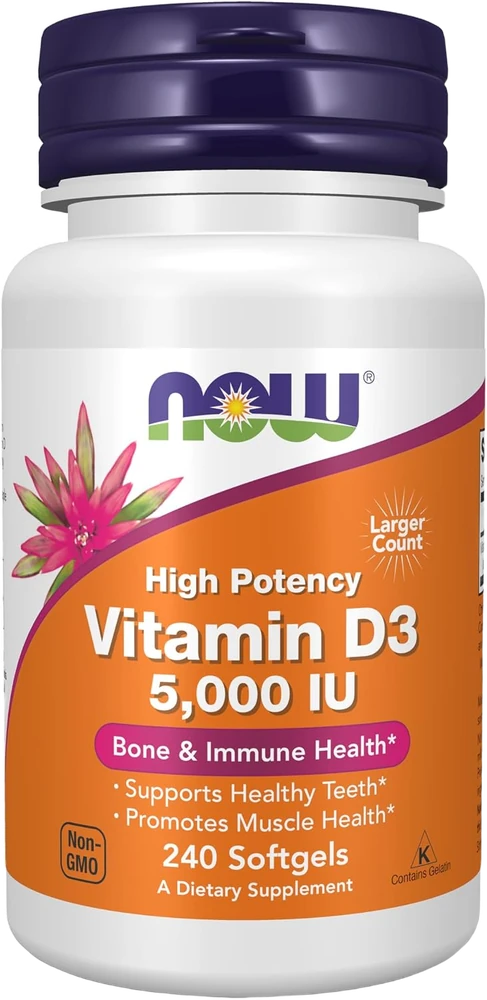 03
NOW Vitamin D-3 5,000 IU
The default first-time pick.
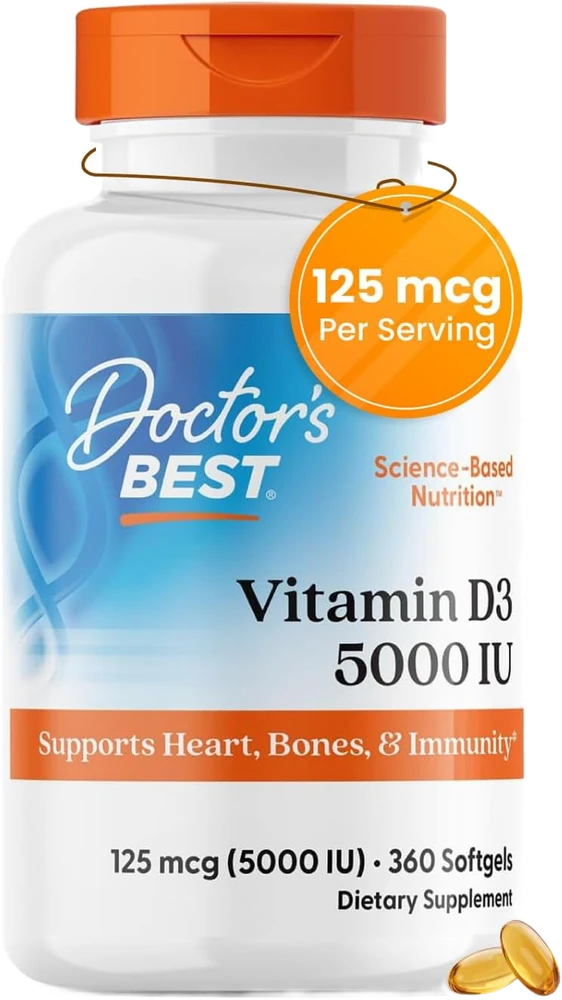 06
Doctor's Best Vitamin D3
If NOW Foods is out of stock or you specifically want to buy a 1-year D3 supply in one purchase, Doctor's Best is the answer.
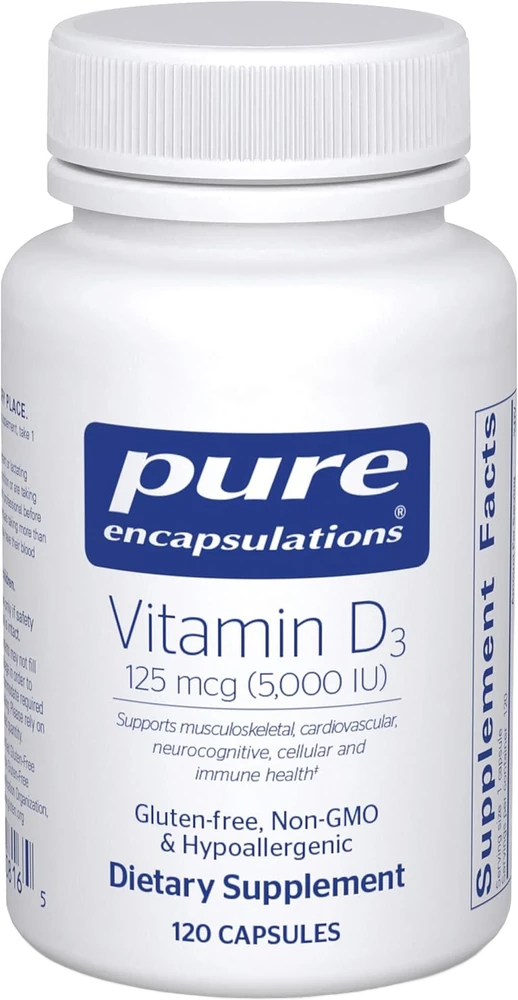 02
Pure Encapsulations Vitamin D3
If you have allergen concerns (gluten, soy, dairy, gelatin), want the absolute cleanest D3 label on the planet, or your integrative medicine practitioner specifically recommended Pure Encapsulations, this is the answer.
Quick Answers
What exactly do I need to dose this powder safely?
A milligram-precision micro-scale (0.001 g resolution, ~$25 on Amazon) — non-negotiable. The label's math: a 5,000 IU dose is a 50 mg scoop of powder carrying 0.125 mg (125 mcg) of cholecalciferol, diluted onto maltodextrin/modified starch/sucrose so it's weighable at all. The difference between a 5,000 IU dose (50 mg) and a 50,000 IU dose (500 mg) is a 10× swing by weight — nothing marks that out of an undifferentiated bag, and BulkSupplements' own label only promises 'about' 50 mg per serving. Without a milligram-precision scale, do not buy this powder — go softgel SKUs (NOW Foods #3) instead. With the scale, pre-measure your weekly doses into individual gelatin or vegetarian capsules at the start of each week and don't free-scoop daily. The Vieth 1999 safety review documents the toxicity threshold; dose-error risk is uniquely consequential in this category.
What's the actual cost-per-month if I dose this accurately?
A 1 kg bag (20,000 servings of 50 mg each, 125 mcg / 5,000 IU of D3 per serving per the label) costs $60.97 — Amazon buy-box price checked Sep 9, 2026 — and holds 100,000,000 IU of D3 total. At 5,000 IU/day that's on the order of a 55-year supply, working out to ~$0.09/month — mathematically the lowest cost-per-IU in the entire supplement category. By comparison: NOW Foods (#3) is $3/month, Doctor's Best (#6) is $3/month via the 720-softgel value bottle — Bulk Supplements is roughly 33× cheaper than even those budget-floor SKUs. The savings are real but conditional on the dose-accuracy infrastructure. Add a $25 micro-scale, bulk K2 MK-7, and bulk magnesium glycinate and the D3 leg of a DIY D + K + Mg stack is effectively a rounding error — but the time/discipline cost is high, and we haven't priced the K2/magnesium powders against their own labels here.
Can I just dissolve a scoop in water or mix into food?
Water alone won't work — D3 is fat-soluble and needs lipid carriers to absorb. Mix the precisely-weighed daily dose into a fat-containing food (full-fat yogurt, smoothie with avocado or nut butter, salad with olive oil, eggs cooked in butter). Avoid mixing into hot beverages above 60°C — heat slowly degrades D3 across multiple exposures. The cleanest protocol is encapsulating pre-weighed doses into gelatin or vegetarian capsules at the start of each week and swallowing one daily with breakfast that includes 10+ g of fat. The capsule approach eliminates daily measurement risk and standardises absorption.
How does Bulk Supplements' COA compare to Nordic Naturals' per-batch transparency?
Genuinely competitive — Bulk Supplements is unusual among bulk-powder brands in publishing per-batch Certificates of Analysis with full identity, potency, heavy metal, and microbial testing data. You can look up your specific lot number on the brand's website. Most bulk-powder competitors operate on aggregate QC claims without lot-level transparency. The Bulk Supplements COA layer is one tier above standard drugstore-aisle brands and on par with Nordic Naturals (#7) for analytical visibility. Not NSF Certified for Sport, but the COA discipline is genuinely strong and load-bearing for the bulk-powder tier's value proposition.
Should I buy Bulk Supplements' K2 powder too for the full stack?
If you're committed to the DIY-stacker workflow, yes. Bulk Supplements sells matching pure-powder SKUs across K2 MK-7, magnesium glycinate, zinc picolinate, and most other cofactors — so the brand's catalog supports a fully custom stack mixed into one capsule. Target ratios per cap: 5,000 IU D3 + 100-200 mcg K2 MK-7 + 200-400 mg magnesium glycinate. You can dial each component independently. The trap is that K2 MK-7 dosing precision matters less than D3 (K2's therapeutic window is much wider), but magnesium dose-accuracy matters more (over-dosing causes GI distress). Build the protocol against the Pludowski 2018 cofactor guidance.
What happens if I accidentally over-dose by 10× for a few weeks?
Probably nothing immediately, but you're on the path to hypercalcemia if you don't catch the error. The Holick 2007 NEJM review documents that chronic dosing above 10,000 IU/day for months can drive serum 25(OH)D above 100 ng/mL, and above 150 ng/mL hypercalcemia becomes clinically meaningful. A 10× over-dose (50,000 IU/day instead of 5,000) sustained over 4-8 weeks would push most people into the symptomatic toxicity range — headache, nausea, polyuria, kidney stress. The fix if you suspect over-dosing: stop D3 entirely, retest serum 25(OH)D and calcium, hydrate aggressively, and resume only after serum levels normalize. The Vieth 1999 safety review documents the toxicity-vs-time curves. This is why the micro-scale is non-negotiable — the format's biggest risk is silent, gradual over-supplementation.
Sources & Further Reading
5 peer-reviewed sources, each linked to PubMed
- [1] Tripkovic 2012 PMID 22552031 — Comparison of vitamin D2 and vitamin D3 supplementation in raising serum 25-hydroxyvitamin D status: a systematic review and meta-analysis. Meta-analysis confirming D3 raised serum 25(OH)D ~1.7× more efficiently than D2. Bulk Supplements' cholecalciferol powder (diluted onto a maltodextrin/starch/sucrose carrier) is the same D3 molecule every reputable brand starts from before adding an oil base.
- [2] Heaney 2003 PMID 12499343 — Human serum 25-hydroxycholecalciferol response to extended oral dosing with cholecalciferol. Dose-response rule: +1 ng/mL serum 25(OH)D per +100 IU/day chronic D3 dosing. The pharmacokinetic backbone for why precision dosing matters — bulk powder users must hit ~125 mcg/day (5,000 IU) of actual D3 accurately, weighed out as a 50 mg scoop of the diluted powder, which requires a milligram-precision scale, not a kitchen spoon.
- [3] Holick 2007 PMID 17634462 — Vitamin D deficiency. NEJM review including the toxicity-threshold discussion: chronic dosing above 10,000 IU/day for months can drive serum 25(OH)D above 100 ng/mL into hypercalcemia territory. The reference for why bulk-powder dose errors are uniquely dangerous in the D3 category.
- [4] Pludowski 2018 PMID 28216084 — Vitamin D supplementation guidelines. Global expert consensus codifying dosing guidelines and the K2 + magnesium cofactor pairing. The reference protocol that advanced bulk-powder stackers should specifically be building their custom stacks against.
- [5] Vieth 1999 PMID 10232622 — Vitamin D supplementation, 25-hydroxyvitamin D concentrations, and safety. Foundational safety review establishing the dose-response relationship between chronic D3 intake and serum 25(OH)D, including the toxicity threshold at sustained intake of 40,000-100,000 IU/day for months. The reference for why bulk-powder dose-error risk is uniquely consequential — accidental 10× over-doses become toxicologically meaningful at chronic intake.
Affiliate disclosure: every Amazon link uses our Associates tag (superachieverclub-20). We earn a small commission at no cost to you; it funds independent reviews. We never accept payment to change a ranking.