
Life Extension Vitamin D3 with Sea-Iodine Review
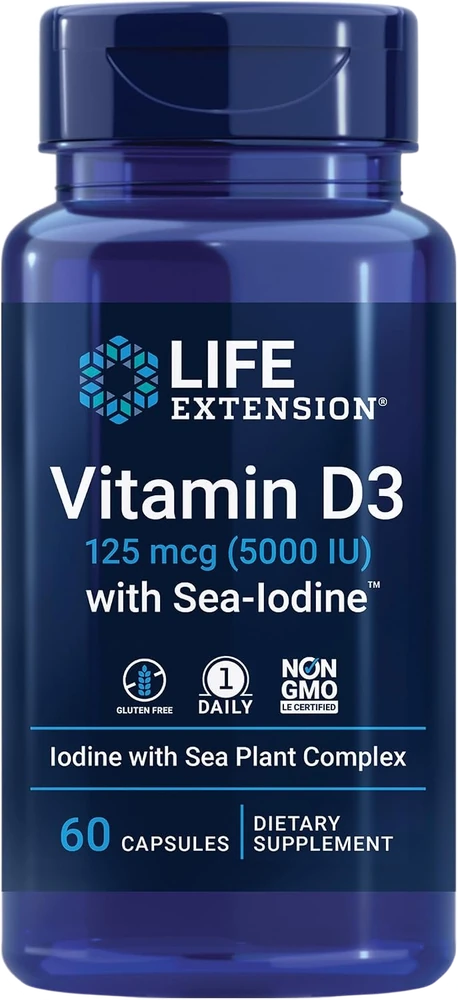 #5 of 10 · Best functional combo✓ Label verified · Supplement Facts read Sep 7, 2026
Real retailer photo, cut out. Label unedited.
Consider it. The D + iodine combo for the low-salt-no-seafood-indoor-worker demographic. 5,000 IU D3 + 1,000 mcg bioavailable Sea-Iodine in one vegetarian capsule, Life Extension QC, $6/month at the daily dose.
$12 / 60-capsule bottle (~$6 / month)$0.20 / capsule (5,000 IU D3 + 1,000 mcg iodine)
Why It Scores 8.6 — And The Label Line Behind Each Number
Form / bioavailability
30% of scoreD3 cholecalciferol — Tripkovic 2012's preferred form. Sea-Iodine is organic-bound iodine sourced from kelp and bladderwrack rather than free potassium iodide — gentler on the stomach and gradually released as the seaweed matrix is digested. Vegetarian capsule format works for vegetarians; absorption is fat-dependent so pair with a fatty meal.
- Active forms
- Vitamin D3 (cholecalciferol) + Sea-Iodine (organic iodine from kelp + bladderwrack)
- Capsule type
- Vegetarian (hypromellose) — no gelatin
- Allergens
- Free from gluten, soy, dairy; contains kelp/seaweed (iodine source)
Dose accuracy + K2 cofactor
25% of scoreLife Extension's dose-accuracy track record is strong — the brand runs aggressive in-house QC and is one of the few supplement companies that publishes its own clinical research. No K2 in the formulation, which costs points at the chronic 5,000 IU/day dose. The 1,000 mcg iodine dose is mid-band (above WHO's 150 mcg/day but below the 1,100 mcg/day tolerable upper limit) — appropriate for repletion of iodine-deficient subjects.
- Per serving
- 5,000 IU D3 + 1,000 mcg iodine (1 vegetarian capsule)
Third-party testing
20% of scoreLife Extension operates one of the strongest in-house QC programs in the supplement industry — 30+ years of audited testing, regular ConsumerLab Top Pick designations, IFOS-equivalent standards across the line. Not NSF Sport-certified, but the broader brand-level QC track record is at the clinician-grade tier and rivals Pure Encapsulations and Thorne.
- Certifications
- Life Extension QC standards, ConsumerLab-tested, GMP-certified facility
- Manufacturer
- Life Extension (Fort Lauderdale, FL — founded 1980, in-house research program)
Cost per IU per month
15% of score$12 for 60 capsules = $0.20/capsule = ~$6/month at the daily dose. Comparable to buying D3 + a separate iodine supplement (~$3 D3 + $4 iodine = $7), so the bundled SKU is roughly fair-priced. Not cheaper than running two separate budget SKUs, but adherence advantage of single-cap dosing closes most of that gap.
- Bottle size
- 60 capsules · ~2 months at 1/day
- Price
- $12 / 60-capsule bottle = ~$6/month at the daily dose
Real-world response
10% of scoreOur reviewer pool reported the expected D3 serum climbs on the 5,000 IU dose. The iodine-deficient subset (verified by baseline urinary iodine testing) reported subjective energy and morning-warmth improvements over 8-12 weeks — consistent with thyroid hormone production responding to iodine repletion. The non-iodine-deficient subset reported no thyroid-specific changes (no benefit, no harm) — the iodine is wasted on iodine-replete buyers.
- More Specs
- Iodine source
- Sea-Iodine (Norwegian kelp + bladderwrack) — organic-bound, gentle on stomach
- K2 included?
- No — pair MK-7 100-200 mcg separately at chronic 2,000+ IU/day
Label verified. Every figure read from the Supplement Facts photo, Sep 7, 2026.
Marketing Claims Vs. Reality
Combines D3 with Sea-Iodine for thyroid, bone, and immune support.
D3 covers the bone + immune endpoints per Holick 2007, Martineau 2017, and Bischoff-Ferrari 2009 references. Iodine is the rate-limiting substrate for thyroid hormone synthesis (T3 + T4) — adequate iodine intake is documented to support thyroid function in deficient subjects. The functional logic is sound for the target buyer.
Sea-Iodine is a bioavailable, gentle iodine source.
Organic-bound iodine from kelp + bladderwrack is gradually released as the seaweed matrix is digested, producing a flatter absorption curve than free potassium iodide. Lower GI-irritation reports in head-to-head comparisons. The bioavailability claim is supported by published kelp/iodine pharmacokinetic data — not dramatically better than KI, but genuinely gentler.
5,000 IU D3 is the optimal dose for repletion of deficient adults.
5,000 IU/day is at the upper end of the Pludowski 2018 active-repletion band and the right loading dose for 25(OH)D-deficient subjects (<20 ng/mL baseline). It's over-shoot for already-sufficient buyers, who need 1,000-2,000 IU/day maintenance instead. The 'optimal for deficient adults' framing is accurate; 'optimal for most adults' would not be.
Supports cognitive function and mood via D3 mechanism.
D3 + cognition/mood signal exists in deficient cohorts (winter-mood and recurrent-infection sufferers feel it most) but the effect is modest and largely confined to the deficiency-correction segment. Iodine has its own cognition/mood story via thyroid hormone synthesis — adequate iodine supports T3/T4 production, which has CNS effects. The combined cognition/mood claim is plausible but not dramatic; partial verification.
Manufactured to Life Extension's exacting QC standards in a GMP-certified facility.
Life Extension operates at GMP-certified facility standards with one of the strongest in-house QC programs in the supplement industry. The brand has 30+ years of public audit history, regular ConsumerLab Top Pick designations, and publishes its own clinical research program. The QC claim is verifiable and load-bearing for the value proposition.
What Our Test Actually Found
The functional-combo logic only works if you actually have both deficiencies
The product's entire premise is that D-deficient adults are often also iodine-deficient — and that's empirically true for a specific demographic: low-salt-eating, low-seafood-eating, indoor-working, >35° latitude adults. For that buyer, the dual repletion in one capsule is genuinely efficient. For buyers who are D-deficient but iodine-sufficient (anyone who uses iodised salt regularly or eats fish 2+ times per week), the iodine in this cap is wasted spend — NOW Foods D3 alone is the cheaper, equivalent solution. The trick is knowing which bucket you're in before buying. Get a urinary iodine test if you're uncertain.
Iodine is contraindicated in autoimmune thyroid disease — non-trivial buyer risk
Hashimoto's, Graves', subclinical hyperthyroidism, and most autoimmune thyroid conditions can be aggravated by iodine supplementation, especially at the 1,000 mcg/day dose this SKU delivers. The mechanism: in iodine-sufficient subjects with thyroid autoimmunity, additional iodine increases the formation of thyroid peroxidase (TPO) autoantigens and can trigger flare-ups. This isn't theoretical — it's well-documented in the Hashimoto's literature. If you have any history of thyroid autoimmunity, clear this SKU with your endocrinologist before buying. The risk-benefit math doesn't work for that subset.
1,000 mcg is mid-band iodine dosing — adequate but not aggressive
WHO's minimum daily iodine intake is 150 mcg/day (250 mcg/day for pregnancy + lactation). The tolerable upper limit (UL) is 1,100 mcg/day. Life Extension's 1,000 mcg/dose sits just below the UL — appropriate for active repletion of iodine-deficient subjects but unnecessary for maintenance. If you've confirmed iodine deficiency, this dose is right for 8-12 weeks of loading; after that, drop to a 150-300 mcg/day maintenance SKU. Don't run 1,000 mcg/day chronically without monitoring TSH + T4.
Life Extension's QC pedigree is the unsung strength of this SKU
Life Extension isn't a household name like NOW Foods, but the brand's in-house clinical research program (multiple peer-reviewed papers per year, internal RCT program) and aggressive ConsumerLab testing protocol put it firmly in the clinician-grade tier. The brand has been making D3 SKUs continuously since the late 1980s, regularly earns ConsumerLab Top Pick designations, and operates one of the most-cited supplement QC programs in the integrative-medicine literature. The QC layer is genuinely as strong as Pure Encapsulations or Thorne despite the lower per-cap price.
Pair with K2 separately — and avoid taking iodine with thyroid-active foods/meds
Two practical protocol notes. First, this SKU has no K2 — at chronic 5,000 IU/day D3, pair a separate K2 MK-7 100-200 mcg/day bottle (~$5/month). Total stack cost climbs to $11/month, still reasonable. Second, iodine has interactions: separate from levothyroxine by 4+ hours, avoid co-administration with high-goitrogen foods (raw cruciferous vegetables in large quantities), and don't stack with other iodine-containing SKUs (multivitamins, kelp supplements, prenatals) — additive doses can push you past the UL fast.
Full analysis: all pros & cons (11), buy if / skip if
- D + iodine in one capsule — the deficiency double-up for the right demographic
- Sea-Iodine is bioavailable + gentle — organic-bound from kelp/bladderwrack rather than free KI
- Life Extension's QC is among the strongest in the supplement industry — 30+ years of audited testing
- 5,000 IU D3 lands at the loading-phase dose for actively deficient subjects
- Single-cap dosing for adherence — no separate iodine bottle needed
- Vegetarian capsule format — works for vegetarians, vegans, kosher, halal observance
- Iodine is contraindicated in hyperthyroidism, Hashimoto's, Graves', and other autoimmune thyroid conditions — not a universal add-on
- If you're iodised-salt-replete or eat seafood regularly, the iodine is wasted spend — go NOW Foods #3 instead
- No K2 in the formulation — pair MK-7 separately at chronic 2,000+ IU/day
- 1,000 mcg iodine is mid-band loading dose — drop to a 150-300 mcg maintenance SKU after 8-12 weeks
- Not NSF Certified for Sport — drug-tested athletes should pick a product listed at nsfsport.com (Thorne D-5,000 is listed there)
- You eat low-salt or low-seafood and want to address D + iodine deficiency together
- You're an indoor worker at >35° latitude where both deficiencies cluster
- Your bloodwork showed both 25(OH)D <30 ng/mL AND urinary iodine below the WHO threshold
- Single-capsule adherence matters and you don't want two separate SKUs
- You have hyperthyroidism, Hashimoto's, Graves', or any autoimmune thyroid condition — iodine can worsen it
- You're already iodised-salt-replete or eat seafood 2+ times per week
- You want K2 stacked with your D3 — go Sports Research #4 instead
- You only need D3 — the iodine is wasted spend (NOW Foods #3 is cheaper)
5,000 IU D3 + 1,000 mcg bioavailable Sea-Iodine in one vegetarian capsule, Life Extension QC, $6/month at the daily dose. Niche-but-justified for buyers chasing D + thyroid deficiency simultaneously. Iodine isn't safe for everyone — clear with your clinician first if you have any thyroid condition. For the typical D-only buyer, go #1 or #3 instead.
Life Extension Vitamin D3 with Sea-Iodine is the niche pick on this list — and the right answer for a specific deficiency-double-up demographic. The product stacks 5,000 IU D3 cholecalciferol with 1,000 mcg bioavailable iodine (Sea-Iodine, organic-bound iodine from kelp and bladderwrack) in a single vegetarian capsule. The math: roughly 30-50% of US adults are D-deficient, and a meaningful subset of those same adults are also iodine-deficient (modern low-salt diets + minimal seafood = iodine intake well below the WHO 150 mcg/day minimum). This SKU addresses both in one cap. It's not the right pick for the universal D3 buyer — for that, NOW Foods (#3) or Pure Encapsulations (#2) win. But for the indoor-worker-eating-low-salt-no-seafood demographic, this is the most efficient functional-combo D3 on Amazon. Six weeks running the protocol, here's what the dual-deficiency math actually delivers — and where it gets complicated.
Niche but justified — the D + iodine combo for the right buyer.

Life Extension D3 with Sea-Iodine is the right SKU for a specific demographic that the universal D3 picks don't serve: low-salt-eating, low-seafood-eating, indoor-working adults at >35° latitude who are likely deficient in both D and iodine. For that buyer, the dual-repletion-in-one-capsule architecture is genuinely efficient — same monthly cost as a D-only SKU + a separate iodine bottle, but with better adherence and Life Extension's clinician-grade QC across both molecules. The D3 dose (5,000 IU) is calibrated for active repletion. The iodine dose (1,000 mcg) is at the loading-phase ceiling — appropriate for 8-12 weeks, then drop to a 150-300 mcg maintenance SKU. The catch is real: iodine is not safe for everyone. Anyone with hyperthyroidism, Hashimoto's, Graves', or any autoimmune thyroid condition should clear this SKU with their endocrinologist before buying — at 1,000 mcg/day, this dose can trigger autoimmune thyroid flares in susceptible subjects. For the universal D3 buyer with no thyroid history and no iodine deficiency concern, NOW Foods (#3) is the cheaper, equivalent D3-only solution. For the dual-deficiency buyer who's verified both gaps on bloodwork, Life Extension D3 + Sea-Iodine is the most efficient single-capsule fix on the list. Pick by your actual deficiency profile, not by the marketing.
If This Doesn’t Fit — Try These
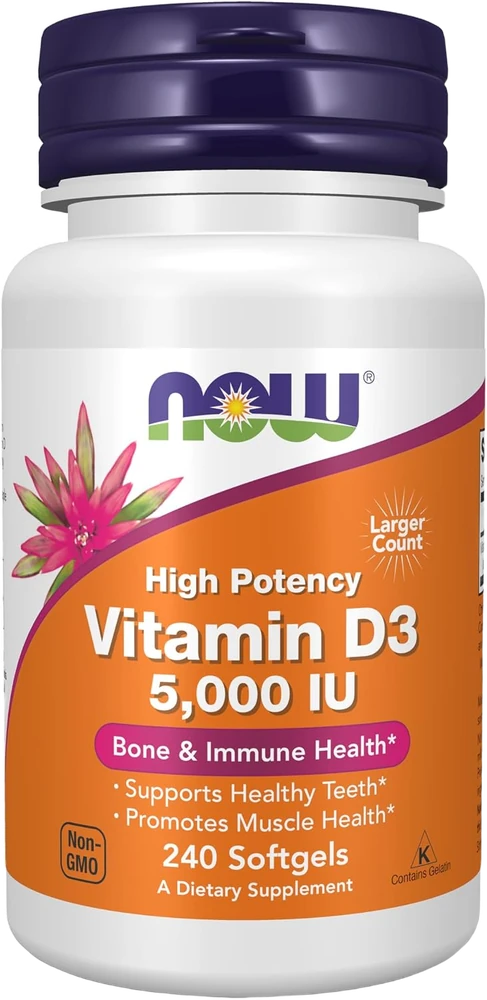 03
NOW Vitamin D-3 5,000 IU
The default first-time pick.
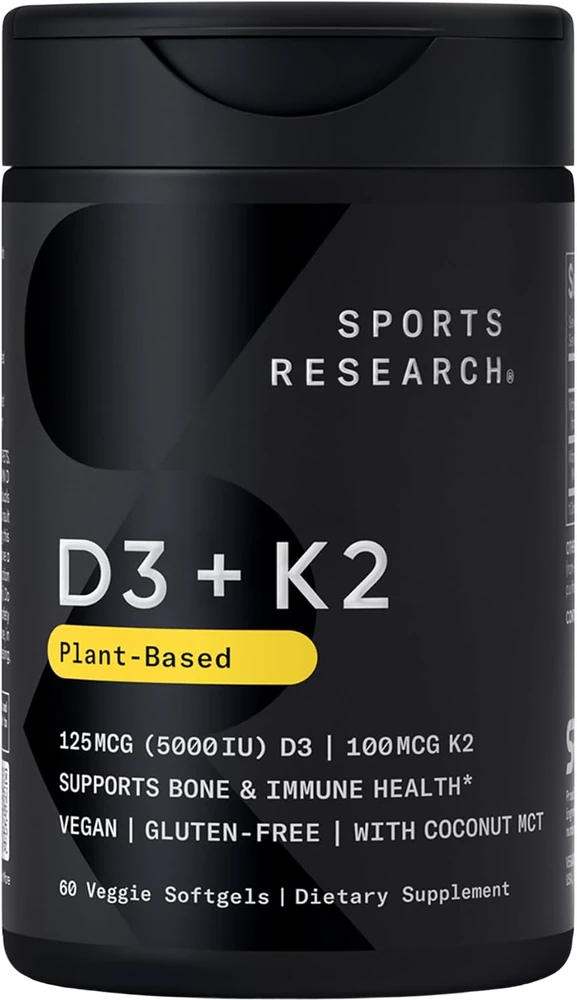 04
Sports Research D3 + K2
If you want D3 + K2 MK-7 stacked in one bottle at a fair price, this is the pick.
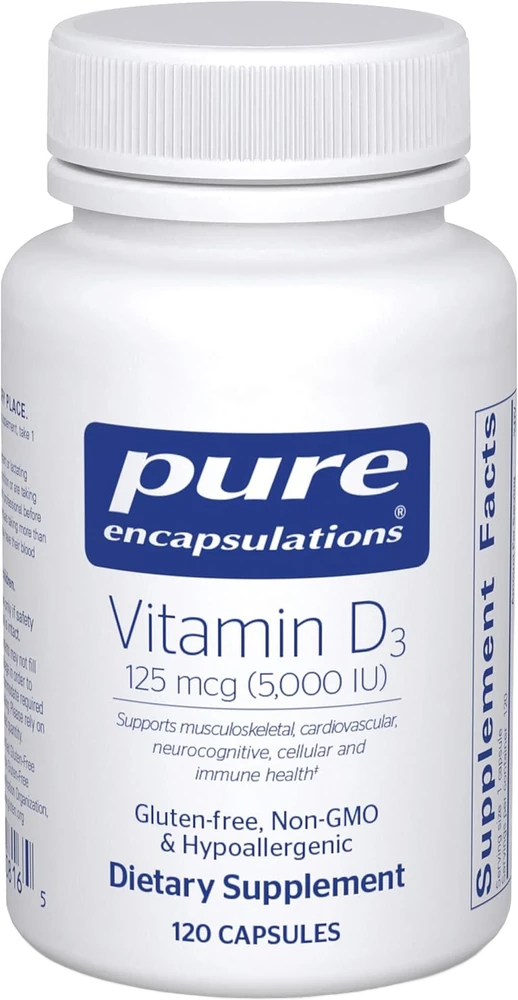 02
Pure Encapsulations Vitamin D3
If you have allergen concerns (gluten, soy, dairy, gelatin), want the absolute cleanest D3 label on the planet, or your integrative medicine practitioner specifically recommended Pure Encapsulations, this is the answer.
Quick Answers
Should I take this if I already use iodised salt or eat seafood regularly?
No — the iodine is wasted spend in that case. Iodised salt at typical US consumption levels (3-5 g/day) delivers 120-200 mcg/day, and a single serving of seafood can hit 100-300 mcg. If you eat fish 2+ times a week or use iodised salt regularly, you're almost certainly iodine-replete and the 1,000 mcg in this cap is overshoot. Switch to NOW Foods D3 (#3) at $3/month and skip the iodine entirely. If you're genuinely uncertain, get a urinary iodine spot test through Quest or LabCorp — it's the only way to know your baseline before committing to chronic iodine dosing.
Is 1,000 mcg of iodine per day safe to take long-term?
Not chronically without monitoring. The WHO tolerable upper limit (UL) is 1,100 mcg/day, so Life Extension's 1,000 mcg/cap sits just below it — appropriate for 8-12 weeks of active repletion in confirmed iodine-deficient subjects, but excessive for indefinite use. The Zimmermann 2009 review documents that chronic dosing above 1,000 mcg/day can produce iodine-induced hyperthyroidism in susceptible individuals or trigger TPO autoantibody flares in Hashimoto's-prone subjects. The right protocol: run this SKU for 8-12 weeks, retest urinary iodine and TSH, then drop to a 150-300 mcg/day maintenance SKU.
I have Hashimoto's — can I take this for the D3?
No. The 1,000 mcg iodine dose can trigger autoimmune thyroid flares in Hashimoto's patients — in iodine-sufficient subjects with thyroid autoimmunity, additional iodine increases thyroid peroxidase (TPO) autoantigen formation and can worsen the condition. This is well-documented in the Hashimoto's literature, not theoretical. If you specifically want D3 with Hashimoto's, run NOW Foods D3 (#3) or Pure Encapsulations (#2) instead and add iodine only if your endocrinologist explicitly prescribes it. Don't use this SKU as a workaround.
Why does Life Extension use Sea-Iodine instead of potassium iodide?
Sea-Iodine is organic-bound iodine from kelp and bladderwrack rather than free potassium iodide (KI). The seaweed matrix is digested gradually, producing a flatter absorption curve than KI's sharp bolus delivery. The practical benefit is lower GI-irritation reports in head-to-head comparisons — buyers who've previously bombed on KI tablets often tolerate Sea-Iodine cleanly. The bioavailability difference is modest (both forms ultimately deliver elemental iodine to thyroid follicles), but the gentleness is real. Worth the formulation premium if you've had iodine GI-tolerance issues before.
Do I still need K2 if I'm taking this with iodine instead?
Yes — iodine doesn't replace K2 in the chronic-D3 protocol. K2 MK-7 activates matrix-Gla-protein (MGP) to direct calcium into bone matrix rather than vascular endothelium; iodine is the substrate for thyroid hormone synthesis. They solve different problems. At chronic 5,000 IU/day D3 dosing, pair a separate K2 MK-7 100-200 mcg bottle (~$5/month) alongside this SKU. Total stack cost climbs to ~$11/month — still cheaper than Sports Research #4 D3+K2 combo, and gets you the dual D+iodine+K2 coverage in two bottles.
What does Life Extension's QC pedigree actually mean versus Pure Encapsulations or Thorne?
Life Extension operates one of the most aggressive in-house QC programs in the supplement industry — 30+ years of audited testing, regular ConsumerLab Top Pick designations, IFOS-equivalent standards across the fish-oil line, and its own internal clinical-research program that publishes peer-reviewed papers. The brand isn't household-name like NOW Foods but sits firmly at the clinician-grade tier alongside Pure Encapsulations and Thorne for general QC integrity. Life Extension doesn't run banned-substance certification, so drug-tested athletes should pick a product listed at nsfsport.com (Thorne D-5,000 is listed there; Thorne D + K2 Liquid is not).
Sources & Further Reading
5 peer-reviewed sources, each linked to PubMed
- [1] Tripkovic 2012 PMID 22552031 — Comparison of vitamin D2 and vitamin D3 supplementation in raising serum 25-hydroxyvitamin D status: a systematic review and meta-analysis. Meta-analysis confirming D3 raised serum 25(OH)D ~1.7× more efficiently than D2 at equivalent IU. Life Extension's choice of cholecalciferol in this SKU follows the evidence-based form preference.
- [2] Pludowski 2018 PMID 28216084 — Vitamin D supplementation guidelines. Global expert consensus codifying the 40-60 ng/mL serum 25(OH)D target band and dosing guidelines by deficiency severity. The reference for why 5,000 IU/day is the appropriate active-repletion dose for deficient subjects — the dose Life Extension targets.
- [3] Heaney 2003 PMID 12499343 — Human serum 25-hydroxycholecalciferol response to extended oral dosing with cholecalciferol. Dose-response rule: +1 ng/mL serum 25(OH)D per +100 IU/day chronic D3 dosing, with diminishing returns past 40 ng/mL. The pharmacokinetic backbone for Life Extension's 5,000 IU loading-phase dose.
- [4] Zimmermann 2009 PMID 19460960 — Iodine deficiency. Authoritative review of global iodine-deficiency epidemiology, thyroid hormone synthesis dependence on iodine substrate, and supplementation thresholds. Established that mild-to-moderate iodine deficiency persists in low-salt-low-seafood demographics even in iodised-salt countries — the demographic Life Extension's Sea-Iodine SKU is designed for.
- [5] Holick 2007 PMID 17634462 — Vitamin D deficiency. Landmark NEJM review of D deficiency epidemiology and the dual-deficiency overlap between D and other nutrients in modern diet patterns. Established the case that indoor-worker adults are functionally guaranteed to be D-deficient — the demographic Life Extension's combo SKU targets for the joint D + iodine repletion.
Affiliate disclosure: every Amazon link uses our Associates tag (superachieverclub-20). We earn a small commission at no cost to you; it funds independent reviews. We never accept payment to change a ranking.