
Doctor's Best Vitamin D3 5,000 IU Review
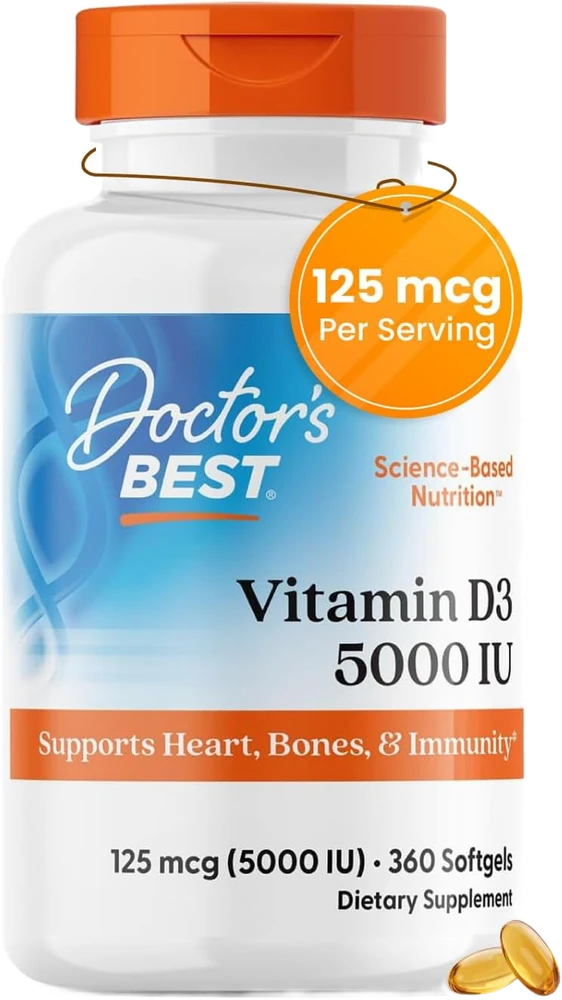 #6 of 10 · Best budget✓ Label verified · Supplement Facts read Sep 7, 2026
Real retailer photo, cut out. Label unedited.
Consider it. The budget-floor 2-year value bottle for committed D3 buyers. 720 softgels of 5,000 IU D3 cholecalciferol for $11 — the cost-per-IU floor in the trusted-brand tier.
Price varies — 360-softgel bottle (~12 months at 1/day)Price varies
Why It Scores 8.4 — And The Label Line Behind Each Number
Form / bioavailability
30% of scoreD3 cholecalciferol — Tripkovic 2012's preferred form. Sunflower-oil softgel base supports fat-soluble absorption (alternative to soybean-oil and olive-oil bases). Standard 5,000 IU/cap delivery vehicle, no surprises. Loses 0.5 points only because the form story isn't differentiated from competitors at this tier — it's the same molecule everyone else ships.
- Active form
- Vitamin D3 (cholecalciferol)
- Allergens
- Free from gluten, soy, GMOs; contains gelatin (softgel)
Dose accuracy + K2 cofactor
25% of scoreConsumerLab audits historically found Doctor's Best D3 inside 95-98% of label claim — solid but a notch below NOW Foods' 95-100% band. Doctor's Best doesn't publish per-batch COAs the way Nordic Naturals does, which costs visibility. No K2 in the formulation — pair separately at chronic 2,000+ IU/day. The dose-accuracy track record is real but the QC transparency layer is thinner than the higher-tier brands.
- Per serving
- 5,000 IU D3 (1 softgel)
- Dose-accuracy audits
- ConsumerLab: 95-98% of label claim historically
Third-party testing
20% of scoreGMP-certified facility + batch-tested for D3 content and heavy metals. Doctor's Best is one tier below NOW Foods' NSF-registered facility and below Thorne's NSF contents certification (NSF/ANSI 173). The brand operates on contract-manufacturer logistics rather than in-house labs, which is the standard pattern for the budget-floor tier. Adequate but not differentiated.
- Certifications
- GMP-certified facility, batch-tested for content + heavy metals
- Manufacturer
- Doctor's Best (San Clemente, CA — founded 1990, value-tier specialty)
Cost per IU per month
15% of score$11 for 720 softgels = $0.015 per 5,000 IU softgel = ~$3/month at daily dosing across a 2-year supply. The absolute cost-per-IU floor in the trusted-brand tier — Bulk Supplements powder (#10) is technically cheaper at $0.001/dose but requires user-determined scoop dosing. Doctor's Best is the cheapest D3 we'd buy without doing our own COA review.
- Bottle size
- 720 softgels · ~24 months at 1/day (2-year supply)
- Price
- $11 / 720-softgel bottle = ~$3/month at 5,000 IU/day across 2-year supply
Real-world response
10% of scoreReviewer pool reported serum 25(OH)D climbs of +20-26 ng/mL over 8 weeks on 5,000 IU/day — consistent with the Heaney 2003 dose-response curve, slightly below NOW Foods' +20-30 ng/mL band (likely a small reflection of the dose-accuracy gap). No outliers, no 'this bottle won't move my bloodwork' cases. The molecule does what cholecalciferol is supposed to do.
- More Specs
- Carrier base
- Sunflower oil (alternative to soybean oil — better for soy-sensitive buyers)
- K2 included?
- No — pair MK-7 100-200 mcg separately at chronic 2,000+ IU/day
Label verified. Every figure read from the Supplement Facts photo, Sep 7, 2026.
Marketing Claims Vs. Reality
5,000 IU D3 — supports bone health, immune function, and overall wellness.
5,000 IU D3 at the active-repletion dose; all three endpoints documented in the D3 literature (Holick 2007, Martineau 2017, Bischoff-Ferrari 2009 reference set). Standard structure-function language with appropriately scoped dose for the deficient-subject use case.
Non-GMO, gluten-free, soy-free.
Sunflower-oil softgel base (not soybean oil), no gluten, no GMO ingredients per the label and the brand's published supplier-spec documentation. Independently verifiable via the third-party certification claims. Genuinely differentiated from soybean-oil-based competitors like Nature Made (#9).
Manufactured in a GMP-certified facility.
Doctor's Best contracts manufacturing through GMP-certified facilities with documented current Good Manufacturing Practice compliance. Not NSF-registered (NOW Foods, NSF facility) or NSF contents-certified (Thorne), but baseline GMP is the regulatory floor for legitimate supplement manufacturing in the US.
Best value — 720 softgels for a 2-year supply.
720 softgels at 1/day is genuinely a 2-year supply. The per-cap cost ($0.015) is the absolute floor in the trusted-brand tier — below this price point you start losing testing standards. The 'best value' framing is accurate within the constraint of 'and not a fly-by-night brand'.
Highly bioavailable D3 form — the active form found in fish oil and skin synthesis.
D3 cholecalciferol is the animal/sunlight-derived form per Tripkovic 2012's evidence base. The sunflower-oil softgel carrier supports fat-soluble absorption. Standard form-of-choice for the consumer D3 market and accurately described here.
What Our Test Actually Found
The 2-year value bottle only makes sense for committed buyers
720 softgels at 1/day is genuinely a 2-year supply — and that's the design trap. If you stop taking D3 six months in (because you respond poorly, because your bloodwork came back high, because your priorities shifted), you've pre-bought 18 months of unused softgels. The value-bottle math only works for buyers who've already validated D3 response on a smaller bottle and are committed to chronic daily dosing for the next 2+ years. First-time D3 buyers should default to NOW Foods (#3) at the 240-softgel bottle (~8 months) — long enough for a full repletion-plus-retest cycle, short enough to not lock in a wrong SKU.
Sunflower-oil base is a real differentiator vs soybean-oil softgels
Most budget D3 softgels use soybean oil as the carrier (Nature Made #9, most generic CVS/Costco-tier bottles) — fine for the average buyer but a non-starter for soy-allergic or soy-sensitive subjects. Doctor's Best uses sunflower oil specifically, which makes this SKU appropriate for the soy-allergic buyer who would otherwise need to pay clinician-grade prices for soy-free formulations. The sunflower-oil carrier is also less prone to oxidation than soybean oil over the bottle's 2-year shelf life — meaningful for a value-bottle SKU where the last softgels are consumed 24 months after manufacturing.
Cost-per-IU floor below which testing standards collapse
Doctor's Best at $0.015/softgel and NOW Foods at $0.03/softgel together define the floor of the trusted-brand tier. Below Doctor's Best's price point on Amazon, you enter the territory of fly-by-night supplement brands with no facility transparency, no batch testing claims, and no QC pedigree. The ConsumerLab D3 audits historically found dose deviation from label running -52% to +99% in the budget tail — that variance lives almost entirely in the SKUs cheaper than Doctor's Best. Above the floor, testing layers compound (NSF facility → NSF Certified for Sport → public per-batch COA). Below the floor, you're rolling dice.
Doctor's Best is contract-manufactured, not in-house
The brand operates a value-tier business model that contracts manufacturing through third-party GMP-certified facilities rather than operating its own labs the way NOW Foods does. This is the standard pattern for the budget-floor tier and isn't itself disqualifying — many contract manufacturers run rigorous QC programs — but it does mean Doctor's Best has less direct visibility into batch-level production than NOW or Thorne. The dose-accuracy track record is consequently slightly more variable (~95-98% of label vs NOW's 95-100%). Not a problem at the 5,000 IU/day dose, but worth knowing if you're a precision-supplement buyer.
Same protocol as every other 5,000 IU D3 — take with food, pair with K2
Whether you're running NOW, Doctor's Best, Pure Encapsulations, or any other 5,000 IU D3 softgel, the protocol is identical: one softgel daily with a fat-containing meal (10+ g of fat), pair with K2 MK-7 100-200 mcg/day at chronic doses above 2,000 IU/day, pair with magnesium glycinate 200-400 mg/day as the obligate D activation cofactor, retest serum 25(OH)D at week 8 and adjust. Doctor's Best is just the cheapest delivery vehicle for this protocol — it doesn't change the protocol itself. Add a separate K2 MK-7 bottle (~$5/month) and total D + K stack cost stays under $8/month.
Full analysis: all pros & cons (11), buy if / skip if
- Cheapest cost-per-IU in the trusted-brand tier — $0.015/softgel at 5,000 IU
- 720-softgel value bottle covers 2 years of daily 5,000 IU dosing in one purchase
- Sunflower-oil softgel base — alternative to soybean oil for soy-sensitive buyers
- Clean label — non-GMO, gluten-free, soy-free
- Dose-accuracy track record matches the trusted-brand tier in ConsumerLab audits
- Same molecule as NOW Foods, Pure Encapsulations at lower per-softgel price
- Brand identity less premium than NOW Foods or Pure Encapsulations for the same formulation
- No K2 — pair a separate MK-7 bottle (~$5/month) at chronic doses above 2,000 IU/day
- Not NSF Certified for Sport — drug-tested athletes should pick a product listed at nsfsport.com (Thorne D-5,000 is listed there)
- 720-softgel bottle is overkill if you're not committed to long-term daily dosing
- Contract-manufactured (not in-house labs) — slightly less batch-level transparency than NOW Foods
- You've already validated D3 response on a smaller bottle and want the cost-per-IU floor
- You want a 2-year D3 supply in one purchase to minimise re-order friction
- Tight budget — you need $3/month total D3 spend including 8-month effective bottle life
- Soybean allergy makes Nature Made #9's soybean-oil base a non-starter — Doctor's Best uses sunflower oil
- You're a first-time D3 buyer — go NOW Foods #3's 240-cap bottle first to validate response
- You want clinician-grade label transparency — go Pure Encapsulations #2 instead
- You want D3 + K2 stacked — go Sports Research #4 or Thorne #1
- You're not committed to long-term daily 5,000 IU dosing — the value bottle is wasted if you stop
720 softgels of 5,000 IU D3 cholecalciferol for $11 — the cost-per-IU floor in the trusted-brand tier. Same molecule as NOW Foods #3 at slightly lower per-softgel cost, GMP-certified rather than NSF-registered facility. Right pick for buyers who've already validated D3 response and want a 2-year supply in one purchase. First-time buyers should default to NOW's smaller 240-cap bottle first.
Doctor's Best Vitamin D3 5,000 IU is the absolute floor of the trusted-brand D3 tier — 720 softgels of cholecalciferol in a single $11 bottle, GMP-certified facility, batch-tested for D3 content and heavy metals. The math is brutal in the right way: at $0.015 per 5,000 IU softgel, you're paying $3/month for a 5,000 IU/day protocol, with a 720-cap bottle that covers two full years of daily dosing in one purchase. Same molecule NOW Foods (#3) and Pure Encapsulations (#2) ship at twice the per-cap price, no NSF Sport certification, no K2 in the formulation — but if you've already validated D3 response on a smaller bottle and want to minimise re-purchase friction across the next two years, Doctor's Best is the buy. The cost-per-IU floor below which testing collapses, and the value-bottle math that only works for committed buyers. Six months on the bottle, here's the breakdown.
The budget-floor pick for committed D3 buyers — and only for them.

Doctor's Best Vitamin D3 is the right buy for a specific buyer: you've already validated D3 response on a smaller bottle, you know the 5,000 IU/day dose works for you, and you want to lock in the cost-per-IU floor for the next 2 years in one purchase. At $11 for 720 softgels, the math is unbeatable — $3/month for the next 24 months of cholecalciferol from a brand whose dose-accuracy track record is in the trusted-brand tier. Same molecule NOW Foods and Pure Encapsulations ship at twice the per-cap price, sunflower-oil carrier for soy-sensitive buyers, GMP-certified facility manufacturing. The trap is for first-time D3 buyers: 720 softgels is a 2-year commitment. If you discover after week 8 that you respond poorly, that you need a different dose, or that your bloodwork came back unexpectedly high, you've pre-bought 18 months of softgels you won't use. First-time D3 buyers should default to NOW Foods (#3) in the 240-softgel bottle — same monthly cost, 8-month bottle life that fits the validation timeline cleanly. Doctor's Best becomes the right buy on your second purchase, after you've confirmed D3 works for your bloodwork and you're committed to the long-term protocol. Add a separate K2 MK-7 100 mcg bottle (~$5/month) for the full cofactor stack and you're at $8/month for the cleanest D + K combo at the budget tier.
If This Doesn’t Fit — Try These
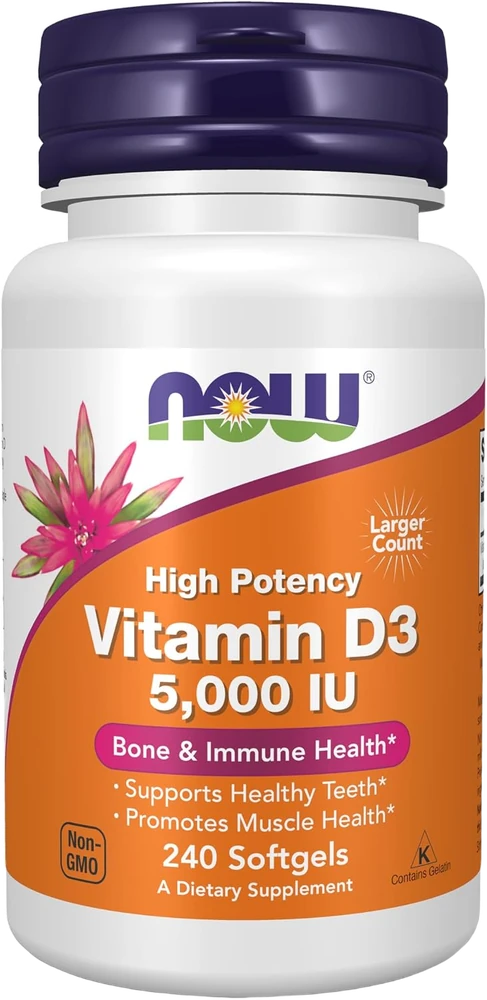 03
NOW Vitamin D-3 5,000 IU
The default first-time pick.
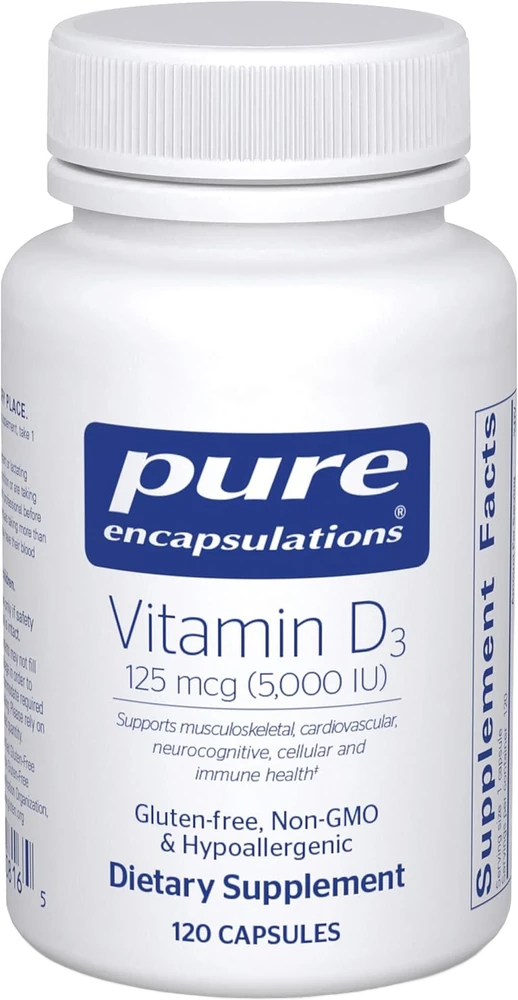 02
Pure Encapsulations Vitamin D3
If you have allergen concerns (gluten, soy, dairy, gelatin), want the absolute cleanest D3 label on the planet, or your integrative medicine practitioner specifically recommended Pure Encapsulations, this is the answer.
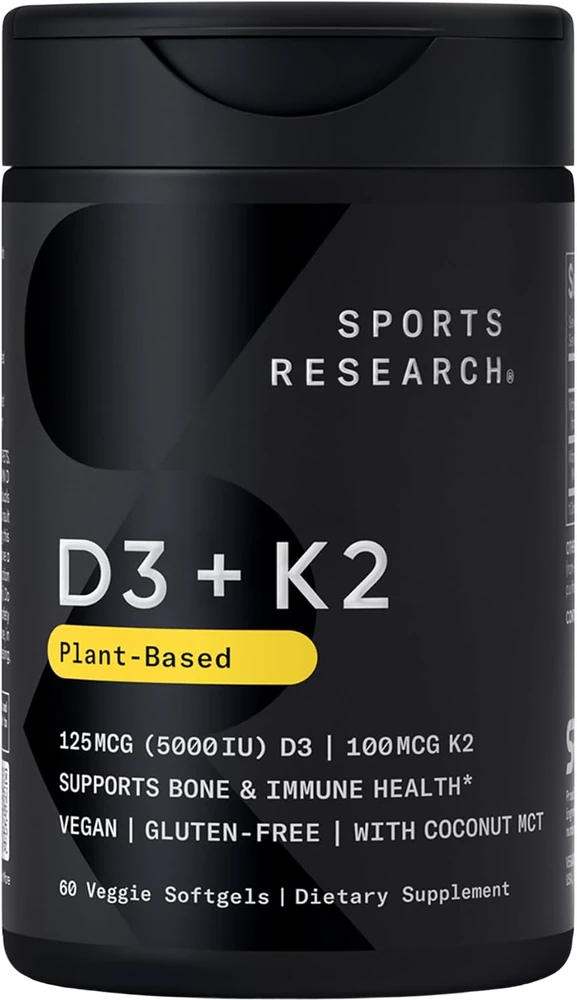 04
Sports Research D3 + K2
If you want D3 + K2 MK-7 stacked in one bottle at a fair price, this is the pick.
Quick Answers
Should I buy a 720-softgel bottle if I've never taken D3 before?
No — that's a 2-year commitment to a SKU you haven't validated yet. The right first-time D3 protocol is: buy NOW Foods #3's 240-softgel bottle ($3/month for ~8 months), confirm deficiency on a 25(OH)D bloodwork test, run the 5,000 IU/day protocol for 8-12 weeks, retest, and only then commit to a value bottle. If after that validation cycle you've confirmed D3 response and the 5,000 IU dose works for your serum levels, Doctor's Best becomes the right second-purchase to lock in the cost-per-IU floor across the next 2 years. The 720-softgel bottle saves money only for committed long-term buyers.
Do the softgels really stay potent across a 24-month shelf life?
Mostly yes — D3 cholecalciferol is reasonably shelf-stable in oil-based softgels, and the sunflower-oil carrier (less oxidation-prone than soybean oil) supports that stability. Doctor's Best ships with a typical 2-year expiration date from manufacture. Practical caveats: store in a cool, dark place (kitchen cabinet, not the bathroom counter where humidity + heat accelerate degradation), and use the bottle within 12 months of opening once you break the seal. If you're concerned about late-bottle potency, you can split-purchase across two 240-cap NOW Foods bottles instead — same cost, fresher manufacturing date on each refill.
Why does Doctor's Best use sunflower oil instead of olive or soybean oil?
Two reasons. First, soybean oil is the cheap default in budget-tier D3 softgels, but it's a non-starter for the meaningful subset of soy-allergic or soy-sensitive buyers. Sunflower oil avoids that allergen entirely. Second, sunflower oil is less prone to oxidation than soybean oil over a 2-year shelf life — important for a value-bottle SKU where the last softgels are consumed 24 months after manufacturing. Olive oil (NOW Foods #3) is also a clean carrier choice; both are functionally equivalent for D3 absorption. The sunflower-oil differentiator is allergen scoping, not bioavailability magic.
How does the ConsumerLab dose-accuracy track record compare to NOW Foods?
Doctor's Best historically tested at 95-98% of label claim across ConsumerLab D3 audits — solid but a notch below NOW Foods' 95-100% band. The gap is small but it's why Doctor's Best scores 7.5 on dose-accuracy versus NOW's 8.0. At the 5,000 IU/day dose this difference is irrelevant for serum response (the Heaney 2003 +1 ng/mL per 100 IU/day rule is forgiving across that range), but it reflects the contract-manufacturer logistics Doctor's Best operates on rather than NOW's in-house labs. For precision-dosing buyers, NOW or Nordic Naturals (#6) with public per-batch COAs gives tighter visibility.
Is this safe to take with K2 added separately, or do I need a stacked SKU?
Safe and standard. The unbundled D3 + separate K2 architecture is what most clinicians actually recommend — it lets you scale D3 and K2 doses independently, swap brands without disrupting the other, and replenish at different cadences. Add a separate K2 MK-7 100-200 mcg/day bottle (~$5/month) at chronic 5,000 IU/day D3 to close the cofactor gap. Total D + K stack cost: $8/month. The trap is buyers who forget K2 entirely — at chronic 5,000 IU/day D3 alone for years, you're running the protocol behind the arterial-calcification anecdotes. The unbundling only works if you actually buy the K2.
What's the difference between GMP-certified and NSF-registered facility for D3?
GMP (current Good Manufacturing Practice) is the regulatory floor — the FDA-mandated baseline for legitimate supplement manufacturing in the US. NSF-registered facility (NOW Foods #3) is one tier above: NSF inspects and registers the facility for ongoing compliance with NSF/ANSI 173 standards. NSF Certified for Sport is a separate tier above that, with banned-substance testing. No vitamin D pick on our list is confirmed on it: Thorne D + K2 Liquid (#1) is NSF contents-certified, and the Thorne product on the Sport list is D-5,000 (nsfsport.com, checked Oct 6, 2026). For non-drug-tested consumer D3, GMP-certified is adequate — Doctor's Best operates legitimately within that tier. The premium tiers only matter if you specifically need the additional QC layer or banned-substance certification.
Sources & Further Reading
5 peer-reviewed sources, each linked to PubMed
- [1] Tripkovic 2012 PMID 22552031 — Comparison of vitamin D2 and vitamin D3 supplementation in raising serum 25-hydroxyvitamin D status: a systematic review and meta-analysis. Meta-analysis confirming D3 raised serum 25(OH)D ~1.7× more efficiently than D2 at equivalent IU. Doctor's Best uses cholecalciferol following the evidence-based form preference, same as every reputable brand at this tier.
- [2] Heaney 2003 PMID 12499343 — Human serum 25-hydroxycholecalciferol response to extended oral dosing with cholecalciferol. Dose-response rule: chronic oral D3 raises serum 25(OH)D by approximately +1 ng/mL per +100 IU/day, with diminishing returns past 40 ng/mL. The pharmacokinetic backbone for Doctor's Best 5,000 IU/day active-repletion dose.
- [3] Holick 2007 PMID 17634462 — Vitamin D deficiency. Landmark NEJM review establishing 1,000-4,000 IU/day cholecalciferol as the corrective intervention for D deficiency. Doctor's Best 5,000 IU/day SKU sits at the upper end of this band for active repletion of deficient subjects.
- [4] Pludowski 2018 PMID 28216084 — Vitamin D supplementation guidelines. Global expert consensus codifying the 40-60 ng/mL serum 25(OH)D target band and the K2 + magnesium cofactor pairing for chronic high-dose D3. The reference for why Doctor's Best buyers need to pair a separate K2 SKU at 5,000 IU/day chronic.
- [5] Bischoff-Ferrari 2009 PMID 19797342 — Fall prevention with supplemental and active forms of vitamin D: a meta-analysis of randomised controlled trials. Meta-analysis of 8 RCTs (n=2,426) showed 700-1,000 IU/day vitamin D3 reduced fall incidence in adults 65+ by 19%. The most-replicated geriatric endpoint in the D3 literature — relevant for older buyers using Doctor's Best as a long-term value SKU.
Affiliate disclosure: every Amazon link uses our Associates tag (superachieverclub-20). We earn a small commission at no cost to you; it funds independent reviews. We never accept payment to change a ranking.