
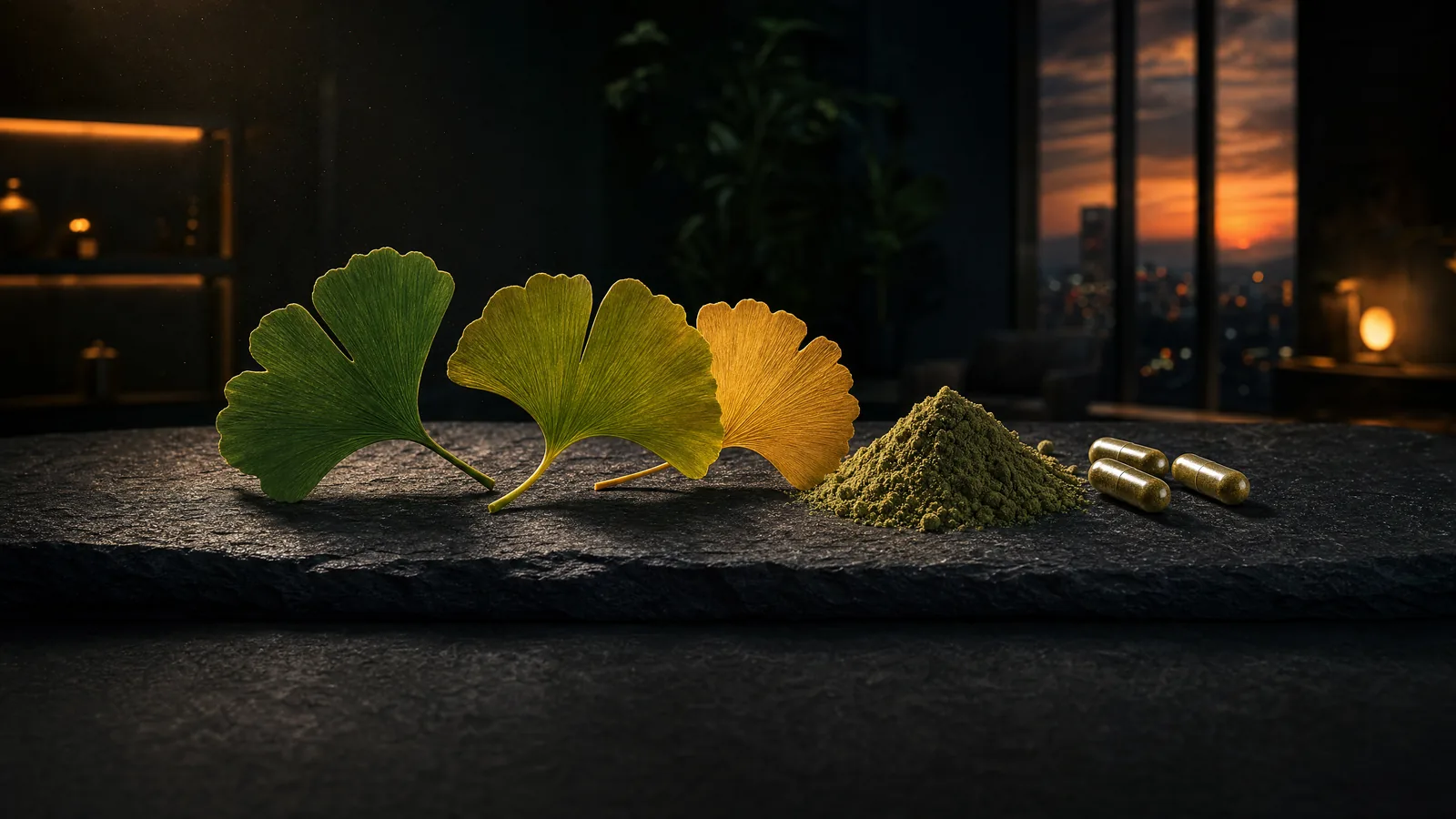
Ginkgo Biloba: Benefits, Dosage & Side Effects (2026)
Ginkgo biloba is a standardised leaf extract (EGb 761, 24% flavonol glycosides / 6% terpene lactones) with modest RCT support as a symptomatic memory and circulation aid — not a proven dementia preventive.
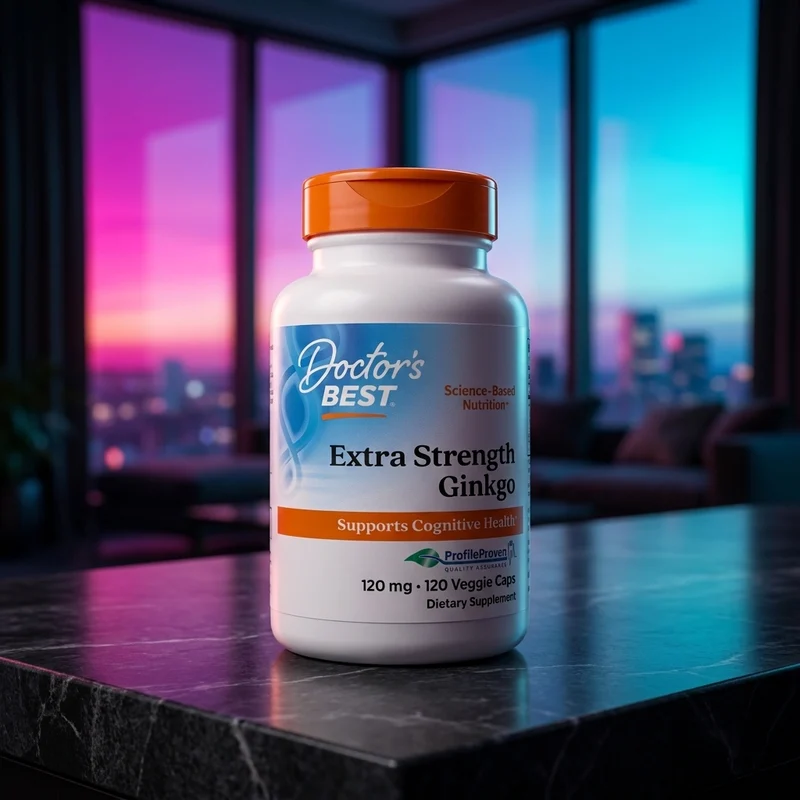
Doctor's Best Extra Strength Ginkgo 120 mg
What is Ginkgo Biloba?
Ginkgo biloba is the leaf extract of the maidenhair tree, one of the oldest living tree species on Earth, and one of the most-studied botanicals in Western and traditional medicine. The supplement that matters is not raw leaf powder but a concentrated, standardised extract — and almost the entire body of credible research used a single material: EGb 761, a leaf extract standardised to 24% flavonol (flavone) glycosides and 6% terpene lactones (the ginkgolides and bilobalide). That 24%/6% ratio is the most important specification in the category. A bottle labelled '24% / 6%' resembles what the trials tested; a bottle that just says 'Ginkgo Biloba 500 mg' of unstandardised leaf is a different product that happens to share the name.
The active compounds fall into two groups. The flavonol glycosides are antioxidant flavonoids that scavenge free radicals and support the vascular lining. The terpene lactones — ginkgolides A, B, C and bilobalide — are the more pharmacologically distinctive fraction, with ginkgolide B in particular acting as a platelet-activating-factor (PAF) antagonist that influences blood flow and platelet behaviour. A serious ginkgo extract is also purified to remove ginkgolic acids, naturally-occurring compounds in the leaf that can be allergenic at high concentrations; the cleanest products document a low limit (e.g. <1 ppm).
The honest framing every buyer deserves: ginkgo's real, replicated benefit is as a SYMPTOMATIC support at the studied 120-240 mg/day dose — modest improvements in memory and cognitive function in people with dementia, and modest improvements in walking distance in people with poor leg circulation. What it has NOT been shown to do is prevent cognitive decline in healthy people. The large, six-year Ginkgo Evaluation of Memory (GEM) Study found 240 mg/day ginkgo no better than placebo at preventing dementia. Buy ginkgo for what it does; ignore the 'prevents Alzheimer's' marketing.
How it works
Ginkgo's two compound classes drive two overlapping mechanisms: circulation and neuroprotection. On circulation, the terpene lactones — especially ginkgolide B — antagonise platelet-activating factor (PAF), which reduces platelet aggregation and supports microvascular blood flow; the flavonol glycosides relax vascular tone and protect the endothelium. The net effect is modestly improved peripheral and cerebral perfusion. This is the mechanism behind the one clearly non-cognitive benefit: in Pittler & Ernst 2000 (PMID 11014719), a meta-analysis of eight RCTs, standardised ginkgo (120-160 mg/day) increased pain-free walking distance in people with intermittent claudication by about 34 metres versus placebo — real, if modest.
On cognition, ginkgo's flavonoids are antioxidants that buffer oxidative stress in neural tissue, and bilobalide appears to have neuroprotective and mitochondrial-supportive effects. In dementia populations, standardised EGb 761 produced small but measurable benefits: Le Bars 1997 (PMID 9343463, JAMA) randomised Alzheimer's and multi-infarct dementia patients to 120 mg/day for 52 weeks and saw modest cognitive (ADAS-Cog) and functional gains versus placebo. Herrschaft 2012 (PMID 22459264) confirmed and extended this at the higher 240 mg/day dose over 24 weeks, improving both cognition (SKT) and the neuropsychiatric symptoms (NPI) that often accompany dementia — a meaningful finding for caregiver-relevant outcomes.
The crucial counterweight is prevention. It is tempting to assume that a herb which modestly helps an impaired brain must also protect a healthy one, but that assumption failed its biggest test. The Ginkgo Evaluation of Memory (GEM) Study (DeKosky 2008, PMID 19017911, JAMA) followed 3,069 older adults — cognitively normal or with mild cognitive impairment — on 240 mg/day EGb 761 versus placebo for a median of about six years. Ginkgo did NOT reduce the incidence of dementia or Alzheimer's disease, and did not slow overall cognitive decline. So the mechanistic story supports symptomatic use at the studied dose, not prevention in healthy people — and that is exactly how an honest buyer should frame it.
At-a-glance facts
- The spec that matters
- EGb 761 standard — 24% flavonol glycosides / 6% terpene lactones
- Studied dose
- 120 mg/day (Le Bars 1997) up to 240 mg/day (Herrschaft 2012)
- What it really does
- Modest SYMPTOMATIC memory + circulation support — NOT dementia prevention
- Time to felt effect
- Weeks, not days — judge at 6-8 weeks; trials ran 24-52 weeks
- Active fractions
- Flavonol glycosides (antioxidant) + terpene lactones (ginkgolides/bilobalide, PAF-antagonist)
- Purity marker
- Ginkgolic acid — look for a low limit (e.g. <1 ppm); allergenic when high
- Key safety flag
- Bleeding risk — avoid with blood thinners/antiplatelets/NSAIDs and before surgery
- Cost range (US)
- ~$0.07-$0.37 per 120 mg serving depending on brand + count
- Evidence verdict
- Real but modest for symptoms; clearly negative for prevention (GEM Study)
Evidence: Mixed but well-characterised. Standardised EGb 761 has replicated RCT support as a MODEST symptomatic aid: Le Bars 1997 (PMID 9343463) and Herrschaft 2012 (PMID 22459264) showed small cognitive/functional benefits in dementia at 120-240 mg/day, and Pittler & Ernst 2000 (PMID 11014719) found a modest walking-distance gain in claudication. But the large GEM Study (DeKosky 2008, PMID 19017911) found ginkgo did NOT prevent dementia in healthy older adults — so the evidence supports symptomatic use, not prevention. We rate it a 3: genuine, replicated, but modest and bounded.
Who it's for — and who it isn't
- Older adults seeking a modest, evidence-consistent symptomatic support for memory and cognitive function (at a standardised 120-240 mg/day dose)
- People with poor peripheral circulation or intermittent claudication — ginkgo modestly increased pain-free walking distance in a meta-analysis of RCTs
- Anyone who specifically wants the EGb 761-class extract the trials used (24% flavonol glycosides / 6% terpene lactones) rather than raw leaf powder
- Caregivers and patients managing the neuropsychiatric symptoms that accompany mild-to-moderate dementia, where 240 mg/day EGb 761 showed benefit
- Patients who want a well-tolerated botanical to trial patiently over 6-8+ weeks with realistic expectations
- Healthy people hoping to PREVENT future cognitive decline or dementia — the six-year GEM Study found ginkgo no better than placebo at prevention
- Anyone on blood thinners (warfarin, clopidogrel), antiplatelet drugs, or NSAIDs, or scheduled for surgery — ginkgo's PAF-antagonist effect can add bleeding risk; clinician supervision is essential
- People expecting a strong, fast nootropic 'lift' — ginkgo's effect is modest and builds over weeks, not a noticeable same-day boost
- Anyone taking seizure-threshold-lowering medication or with a seizure disorder (concern relates to ginkgotoxin in seeds/poorly-made products; use only standardised, ginkgolic-acid-limited extracts)
Week-by-week, what happens
- Week 1-2No felt change. Ginkgo works cumulatively on circulation and oxidative balance; take a standardised 120 mg dose consistently and don't judge it yet.
- Week 3-6Any circulation-related effects (e.g. walking comfort in claudication) begin to build. Subtle cognitive support, if it comes, starts to register — modestly.
- Week 6-8The realistic decision window. If a standardised 120-240 mg/day dose is going to help your memory or circulation, you should have some sense of it by now.
- Month 3-12Trial-magnitude effects settle in (the dementia RCTs ran 24-52 weeks). Maintenance phase — benefits, where present, persist with continued daily dosing.
Safety & contraindications
- Bleeding risk is the headline safety concern: ginkgo's terpene lactones antagonise platelet-activating factor, so it can add to the effect of blood thinners (warfarin), antiplatelet drugs (clopidogrel, aspirin), and NSAIDs. Avoid combining without clinician supervision, and stop ginkgo well before any surgery or dental procedure.
- Use only STANDARDISED, ginkgolic-acid-limited leaf extract. Ginkgolic acids are allergenic at high concentrations; the best products document a low limit (e.g. <1 ppm). Never consume raw ginkgo seeds — they contain ginkgotoxin, which can lower the seizure threshold.
- People with seizure disorders or on seizure-threshold-lowering medication should be cautious and consult a clinician — the concern relates to poorly-purified products and seeds, not properly-made leaf extract, but caution is warranted.
- Most common side effects are mild: headache, dizziness, GI upset, or palpitations, usually transient. Start at the standard 120 mg/day rather than the 240 mg upper dose if you're sensitive.
- Not established as safe in pregnancy or breastfeeding — avoid unless a clinician advises otherwise, partly due to the bleeding-risk profile.
- Buy on the SPEC, not the milligram number: a 120 mg 24%/6% standardised extract is the studied material; a large-milligram raw-leaf product is not equivalent and may be both weaker and less consistent.
All articles on Ginkgo Biloba
Best Bacopa Monnieri Supplements
8 Bacopa monnieri capsules ranked on whether they carry a clinically studied extract at the 300 mg trial dose, printed bacoside standardization, testing and formulation — every Supplement Facts panel read by us.
Read →Best Caffeine + L-Theanine Supplements
8 caffeine + L-theanine combo capsules ranked on the 1:2 ratio the trials used, ingredient sourcing, testing and dosing flexibility — every Supplement Facts panel read by us.
Read →Best Ginkgo Biloba Supplements
The 9 best ginkgo biloba supplements ranked on the EGb 761 standardisation benchmark (24% flavone glycosides / 6% terpene lactones), the 120–240 mg studied dose, purity and value — with the honest read that ginkgo is a modest symptomatic memory/circulation support, not a dementia preventive.
Read →BulkSupplements.com L-Theanine 200 mg Review
The stockpile pick — cheapest per serving on the list, for confirmed daily responders only.
Read →Doctor's Best Extra Strength Ginkgo 120 mg Review
The textbook clinical ginkgo — right spec, right dose, best value.
Read →FreshCap Premium Organic Lions Mane Capsules Review
The highest verified beta-glucans on the list, at a genuinely fair price.
Read →Gaia Herbs Lion's Mane Mushroom Review
The cleanest label on the list — mature fruiting body, no grain or filler, fully traceable.
Read →Host Defense Lion's Mane Capsules Review
Paul Stamets' flagship — real organic credentials, but it's the mycelium form at the highest price.
Read →Jarrow Formulas Ginkgo Biloba 50:1, 60 mg Review
The flexible-dosing pick — good extract, but mind the two-capsule math.
Read →Jarrow Formulas Theanine 200 mg Review
The reputable, vegan-friendly known-name pick at a fair price.
Read →Life Extension Ginkgo Biloba Certified Extract 120 mg Review
The purity pick — the only bottle printing a <1 ppm ginkgolic-acid limit.
Read →Nature's Bounty Ginkgo Biloba 120 mg Review
The recognisable, low-cost on-ramp — a trusted name at a budget price.
Read →Nature's Way Ginkgold Max 120 mg Review
The most clinically-pedigreed ginkgo extract — at a premium price.
Read →Nootropics Depot Lions Mane Mushroom 8:1 Dual Extract Review
The lab-data favorite — whole fruiting body with the most rigorous published COAs.
Read →NOW Foods Ginkgo Biloba 120 mg Review
The trust-and-value pick — verified non-GMO at the full clinical spec.
Read →NOW Foods Lion's Mane 500 mg Review
The best value on the list — genuine organic fruiting body from a brand you can trust.
Read →NutraBio L-Theanine 200 mg Review
The transparency hawk's value pick — fully disclosed, filler-free, third-party tested, under $0.20/serving.
Read →Nutricost Ginkgo Biloba 120 mg Review
The cost-per-day champion — unbeatable value, thinner spec disclosure.
Read →Nutricost L-Theanine 200 mg Review
The reliable budget brand with a great cost basis — if gelatin caps and generic form are fine.
Read →Om Mushroom Superfood Lion's Mane Capsules Review
Certified-organic whole-food style — but 'cultured on oats' means a big chunk of the milligrams is substrate.
Read →Pure Encapsulations Ginkgo 50, 160 mg Review
The hypoallergenic, higher-dose pick — clean formula at a premium price.
Read →Pure Encapsulations L-Theanine 200 mg Review
The cleanest-label Suntheanine — the right call for sensitive users, overkill for everyone else.
Read →Solgar Ginkgo Biloba Leaf Extract (SFP) Review
The heritage-brand pick — clean and recognisable, but priciest per dose.
Read →Solgar L-Theanine 150 mg Review
Real Suntheanine from a respected brand — undercut by a sub-trial 150 mg dose.
Read →Swanson Organic Lion's Mane Mushroom 500 mg Review
The rock-bottom budget pick — fine as a cheap start, but '40% polysaccharides' isn't beta-glucans.
Read →Thorne Theanine 200 mg Review
NSF contents-certified L-Theanine at the 200 mg trial dose — if you can accept generic form over Suntheanine.
Read →Toniiq Lion's Mane Ultra High Potency 10:1 Extract Review
A real 10:1 concentrate at the best per-serving price — but the '30% polysaccharides' number hides what the top picks verify.
Read →FAQ
Does ginkgo biloba actually improve memory, or is it hype?
It's a modest, real effect in the right population — not hype, but not magic either. Standardised ginkgo (EGb 761) produced small but measurable cognitive and functional benefits in people with dementia: Le Bars 1997 (PMID 9343463, JAMA) at 120 mg/day over 52 weeks, and Herrschaft 2012 (PMID 22459264) at 240 mg/day over 24 weeks, which also improved the neuropsychiatric symptoms that accompany dementia. So for an impaired brain, the support is genuine. What ginkgo will NOT reliably do is sharpen an already-healthy brain or deliver a noticeable same-day lift — the effect is subtle and builds over weeks. Buy it with realistic expectations, dose it at a standardised 120-240 mg/day, and judge it at 6-8 weeks.
Can ginkgo prevent Alzheimer's or dementia?
No — and this is the most important thing to understand about ginkgo. The single largest, longest trial designed to answer exactly this question found it does not. The Ginkgo Evaluation of Memory (GEM) Study (DeKosky 2008, PMID 19017911, JAMA) followed 3,069 older adults — cognitively normal or with mild impairment — on 240 mg/day ginkgo versus placebo for about six years, and ginkgo was no better than placebo at preventing dementia or Alzheimer's, and did not slow overall cognitive decline. So ginkgo is a modest symptomatic support, not a preventive. Any product or article promising that ginkgo 'prevents Alzheimer's' is selling hope the evidence doesn't support.
What does the '24% / 6%' on the label mean, and why does it matter?
It's the standardisation that defines a clinical-grade ginkgo extract: 24% flavonol (flavone) glycosides and 6% terpene lactones — the spec of EGb 761, the material used in almost every meaningful ginkgo trial. The flavonol glycosides are antioxidant flavonoids; the terpene lactones (ginkgolides and bilobalide) are the more pharmacologically active fraction. A bottle that hits 24%/6% resembles the studied extract; a bottle that just says 'Ginkgo 500 mg' of raw leaf powder does not, even though the number looks bigger. When you buy ginkgo, you're really buying that spec — it's the single best predictor that the product will behave like the studied material.
How much ginkgo should I take, and for how long?
The studied dose is 120 mg/day of standardised extract (Le Bars 1997), up to 240 mg/day (Herrschaft 2012) — so 120 mg once daily is the sensible starting point, with 240 mg the evidence-backed upper end. Take it consistently for at least 6-8 weeks before judging, because ginkgo is slow: the trials ran 24-52 weeks. More is not better — 120 mg is the most-studied dose and is plenty for most people, and the 240 mg dose is best discussed with a clinician given the bleeding-risk profile. Buy a 24%/6% standardised product, take it daily, and be patient.
Is ginkgo safe to take with my other medications?
Often, but bleeding risk is the real concern, so check first. Ginkgo's terpene lactones reduce platelet aggregation, so it can add to the effect of blood thinners (warfarin), antiplatelet drugs (clopidogrel, aspirin), and NSAIDs — and it should be stopped well before any surgery. People on seizure-threshold-lowering medication should also be cautious, and ginkgo isn't established as safe in pregnancy or breastfeeding. None of this makes ginkgo dangerous for a healthy person not on those drugs, but if you take any medication — especially anything affecting bleeding — clear ginkgo with your clinician before starting.
Does ginkgo help with anything besides memory?
Yes — its best-supported non-cognitive use is circulation. Because the terpene lactones improve blood flow (via PAF antagonism), standardised ginkgo modestly increased pain-free walking distance in people with intermittent claudication (poor leg circulation) — Pittler & Ernst 2000 (PMID 11014719) pooled eight RCTs and found about a 34-metre improvement versus placebo. The effect is real but modest. Ginkgo is also studied for tinnitus and other conditions with less consistent results. The two endpoints with the clearest evidence are symptomatic cognitive support in dementia and this peripheral-circulation benefit — both at the standardised 120-240 mg/day dose.
Sources & further reading
- Le Bars 1997 (EGb 761, dementia)A placebo-controlled, double-blind, randomized trial of an extract of Ginkgo biloba for dementia
52-week RCT of standardised EGb 761 (120 mg/day) in Alzheimer's and multi-infarct dementia: modest but measurable benefit on cognition (ADAS-Cog) and function versus placebo. The anchor trial for ginkgo's symptomatic memory use and the 120 mg standardised dose.
- Herrschaft 2012 (240 mg, dementia + NPI)Ginkgo biloba extract EGb 761 in dementia with neuropsychiatric features: a randomised, placebo-controlled trial to confirm the efficacy and safety of a daily dose of 240 mg
24-week RCT, 410 patients with mild-to-moderate dementia and neuropsychiatric symptoms: EGb 761 240 mg/day was significantly superior to placebo on both cognition (SKT) and neuropsychiatric symptoms (NPI). Confirms the symptomatic benefit at the higher end of the studied dose range.
- DeKosky 2008 — GEM Study (prevention: negative)Ginkgo biloba for prevention of dementia: a randomized controlled trial
The Ginkgo Evaluation of Memory (GEM) Study: 3,069 older adults (normal cognition or mild cognitive impairment), median ~6 years, 240 mg/day EGb 761 vs placebo. Ginkgo did NOT reduce the incidence of dementia or Alzheimer's disease. The pivotal negative trial — the basis for telling buyers ginkgo is a symptomatic support, not a preventive.
- Pittler & Ernst 2000 (claudication)Ginkgo biloba extract for the treatment of intermittent claudication: a meta-analysis of randomized trials
Meta-analysis of eight RCTs of standardised ginkgo (120-160 mg/day) in intermittent claudication: a statistically significant increase in pain-free walking distance versus placebo (weighted mean difference ~34 m). Establishes ginkgo's modest, real peripheral-circulation benefit.