
Lion's Mane: Benefits, Dosage & Side Effects (2026)
Lion's Mane (Hericium erinaceus) is an edible medicinal mushroom whose fruiting-body compounds stimulate nerve growth factor, with early RCT evidence for cognition and mood.
The Lion's Mane market in numbers
Our independent analysis of 10 lion's mane products, scored on three proprietary indices — the SAC Product Score™, Transparency Index™, and real Cost-Per-Effective-Dose™. Updated October 2026.
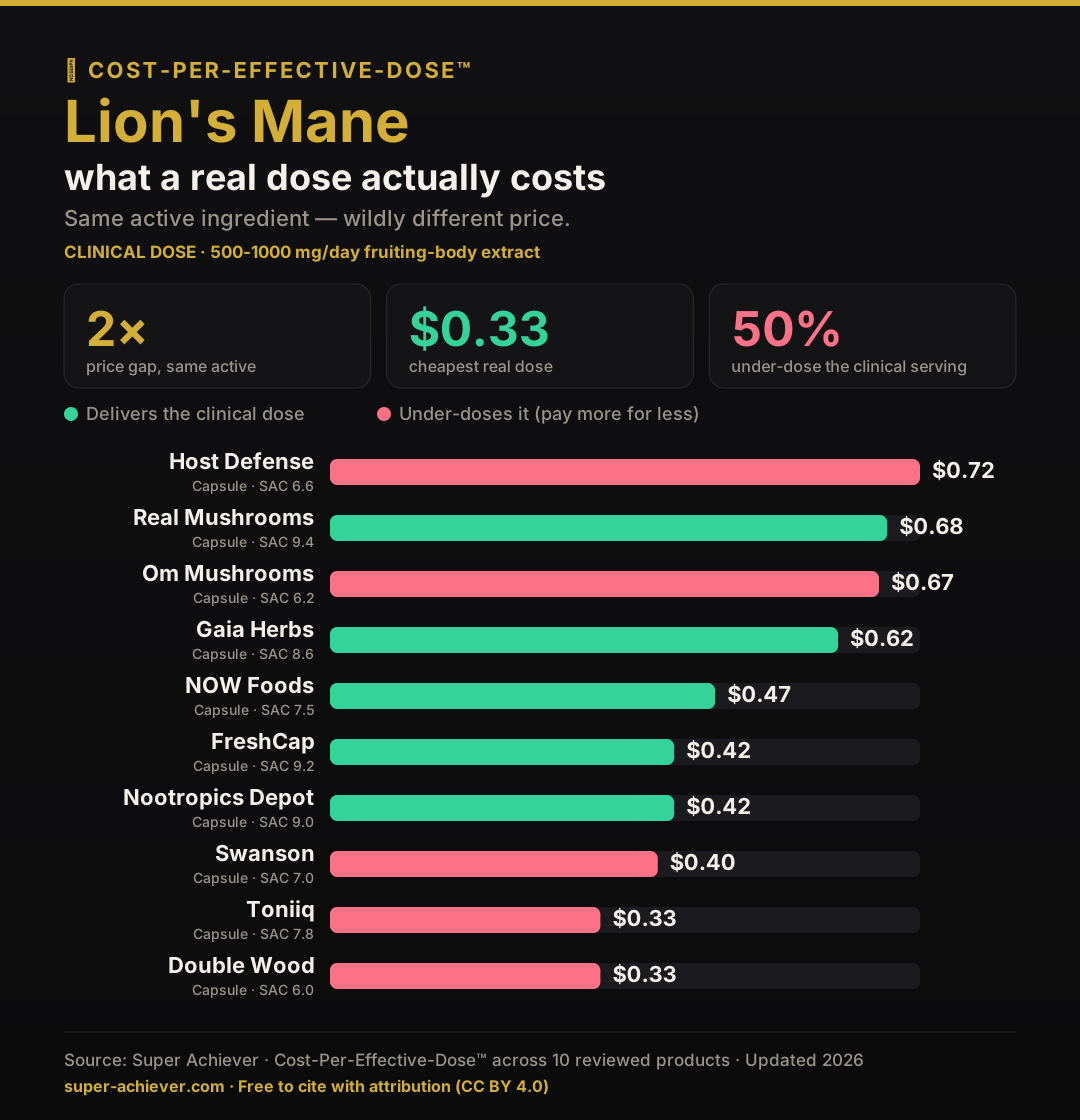
| # | Product | SAC Product Score™ | TXI™ | CPED™ | |
|---|---|---|---|---|---|
| 1 | Real Mushrooms Lion's Mane Mushroom CognitionCapsule | 9.4 | 70 | $0.68 | Most transparent |
| 2 | FreshCap Premium Organic Lions Mane CapsulesCapsule | 9.2 | 20 | $0.42 | Best value |
| 3 | Nootropics Depot Lions Mane Mushroom 8:1 Dual ExtractCapsule | 9.0 | 70 | $0.42 | |
| 4 | Gaia Herbs Lion's Mane MushroomCapsule | 8.6 | 70 | $0.62 | |
| 5 | Toniiq Lion's Mane Ultra High Potency 10:1 ExtractCapsule | 7.8 | 0 | $0.33 | Under-dosed |
| 6 | NOW Foods Lion's Mane 500 mgCapsule | 7.5 | 40 | $0.47 | |
| 7 | Swanson Organic Lion's Mane Mushroom 500 mgCapsule | 7.0 | 0 | $0.40 | Under-dosed |
| 8 | Host Defense Lion's Mane CapsulesCapsule | 6.6 | 0 | $0.72 | Under-dosed |
| 9 | Om Mushroom Superfood Lion's Mane CapsulesCapsule | 6.2 | 20 | $0.67 | Under-dosed |
| 10 | Double Wood Organic Lions Mane Mushroom CapsulesCapsule | 6.0 | 0 | $0.33 | Under-dosed |
Methodology. SAC Product Score™ blends our editorial rating (RCT quality, dose, safety, value) 50/50 with community ratings. Transparency Index™ (0-100) = third-party certification (0-50) + public batch COA (0-30) + dose honesty (0-20). Cost-Per-Effective-Dose™ is the real price of one clinical dose, not one marketed "serving". Free to cite with attribution to Super Achiever.
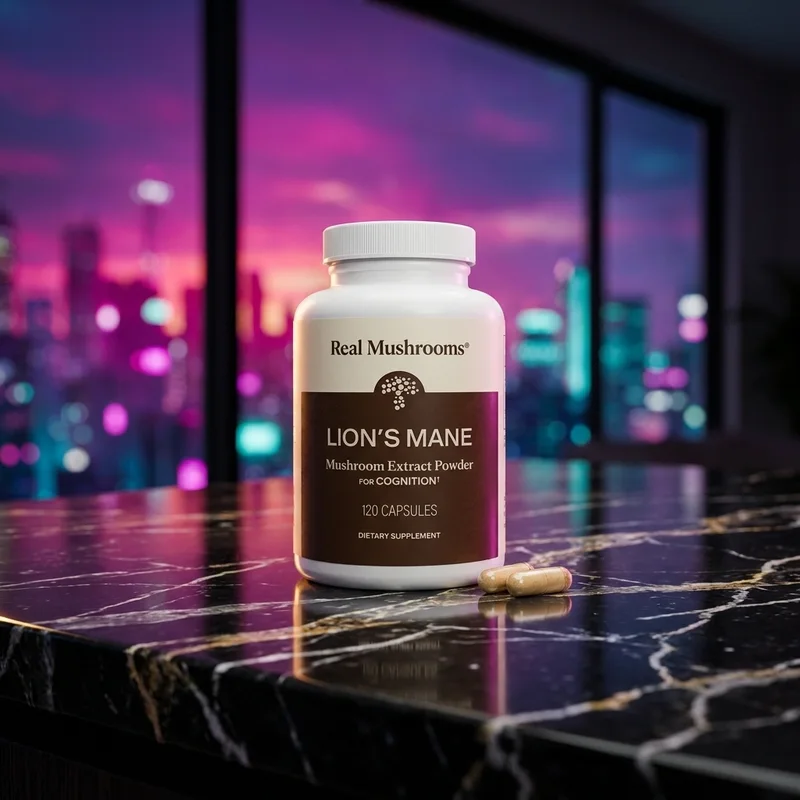
Real Mushrooms Lion's Mane Mushroom Cognition
What is Lion's Mane?
Lion's Mane is an edible medicinal mushroom — Hericium erinaceus, the cascading white "icicle" fungus you'll see growing on hardwood logs — that has been used in Chinese and Japanese food and herbal practice for centuries (in Japan it's called Yamabushitake). In the supplement world it's the lead "nootropic mushroom," sold as capsules and powders aimed at memory, focus, and mood. What makes it more than a culinary curiosity is its chemistry: the mushroom produces two families of compounds — hericenones (concentrated in the fruiting body, the visible mushroom) and erinacines (concentrated in the mycelium, the root-like network) — that can stimulate the synthesis of nerve growth factor (NGF), a protein that keeps neurons alive and helps them grow connections. That NGF link is the entire reason Lion's Mane is interesting for the brain rather than just the dinner plate.
The single most important thing a buyer needs to understand is fruiting body versus mycelium-on-grain. The "mushroom" most people picture — the white pom-pom — is the fruiting body. The mycelium is the thread-like growth phase, and the cheap industry shortcut is to grow mycelium on a grain substrate (rice or oats), then grind up the whole mass — mycelium plus leftover grain — and sell it as "Lion's Mane." The problem: that grain is mostly starch, so it dilutes the actual mushroom actives. The compounds that matter for the immune and (plausibly) neurological effects are beta-glucans, a class of mushroom cell-wall polysaccharide. A pure fruiting-body extract can carry 25-40%+ beta-glucans; a mycelium-on-grain product often carries a fraction of that while still printing a big "polysaccharide" number on the label — because starch from the grain is *also* a polysaccharide. "Polysaccharides" is the word that hides the grain; "beta-glucans" is the word that reveals the mushroom.
So the practical definition of a useful Lion's Mane is: a *fruiting-body* extract (or at minimum a clearly-labelled, grain-free product) with a *verified* beta-glucan percentage, ideally above 25%, confirmed by third-party testing rather than asserted on the front of the box. The dosing in the human trials was in grams of mushroom material or hundreds of milligrams of concentrated extract — and crucially, those studies used real fruiting body or erinacine-enriched mycelium, not the grown-on-grain biomass that dominates the budget shelf.
How it works
The mechanism that gives Lion's Mane its reputation runs through nerve growth factor (NGF) and, in animal work, brain-derived neurotrophic factor (BDNF) — two of the body's "neurotrophins," signalling proteins that keep neurons alive, support their repair, and promote the growth of new connections. In cell and animal studies, hericenones (from the fruiting body) and erinacines (from the mycelium) stimulate NGF synthesis; erinacine A in particular is small enough to cross the blood-brain barrier in rodents, which is why erinacine-enriched mycelium is the form used in the Alzheimer's-focused trial. More neurotrophin support, the theory goes, means better-maintained neural circuitry — the kind of thing that would plausibly show up as steadier memory and cognition over months, not as an instant jolt of focus. Lion's Mane is not a stimulant; there is no caffeine-like kick. Whatever it does, it does slowly.
The most-cited human result is Mori 2009 (PMID 18844328): a double-blind, placebo-controlled trial in 30 older Japanese adults (50-80) with mild cognitive impairment. The Lion's Mane group took 3 g/day of fruiting-body powder for 16 weeks and improved significantly on a standard cognitive scale versus placebo — but the gains faded after they stopped, suggesting the effect is maintained only while you take it. Saitsu 2019 (PMID 31413233) found a similar signal in healthy older adults: 2.4 g/day for 12 weeks improved scores on a Japanese cognitive test. On mood, Nagano 2010 (PMID 20834180) ran a 4-week placebo-controlled crossover in 30 women and found significantly lower depression and anxiety scores on Lion's Mane. The most ambitious trial, Li 2020 (PMID 32581767), used erinacine A-enriched *mycelium* (not fruiting body) in patients with mild Alzheimer's disease for 49 weeks and reported improvement on the Mini-Mental State Examination versus placebo.
Here is the honest part, and it matters: this is an *early* evidence base, not a mature one. The trials are small (most under 50 people), several come from the same Japanese research groups, and the headline studies are in older adults with cognitive complaints — not the healthy 25-year-old buying it for "focus." In healthy young adults the data are thinner and mixed: Docherty 2023 (PMID 38004235), a double-blind RCT in 41 young adults, found faster reaction time on the Stroop task an hour after a single dose and a *trend* toward less stress after 28 days — promising, but a pilot. A 2025 systematic review (PMID 40959699) pulled the whole literature together and concluded the same thing we do: the signals are real and consistent enough to be interesting, but the evidence is preliminary and the field needs larger, longer, independent trials. Lion's Mane is a credible bet, not a settled one.
At-a-glance facts
- What it is
- Hericium erinaceus — an edible medicinal mushroom whose hericenones (fruiting body) and erinacines (mycelium) stimulate nerve growth factor (NGF)
- Form is everything
- Fruiting-body extract with verified beta-glucans >25% beats mycelium-on-grain, where leftover starch dilutes the actives and inflates the 'polysaccharide' number
- Typical dose
- 500-1000 mg/day of fruiting-body extract (capsules), or ~1-3 g/day of mushroom powder. Human trials used 2.4-3 g/day powder or erinacine-enriched mycelium
- Active to check
- Beta-glucans (the real mushroom cell-wall actives), not 'polysaccharides' (which can include grain starch). Look for a third-party-verified % on the label
- Strongest use-case
- Mild, age-related cognitive complaints — built over 8-16 weeks (Mori 2009; Saitsu 2019). Mood/anxiety is a secondary early signal (Nagano 2010)
- Onset
- Not acute — it's a neurotrophin play, not a stimulant. Judge it over 8-12 weeks of consistent daily use, not on day one
- Evidence stage
- Early but consistent — a handful of small human RCTs, mostly in older adults; thinner and mixed in healthy young adults
- Cost range (US)
- $20-45 / month for a fruiting-body extract from a brand that publishes its beta-glucan % and third-party testing
Evidence: Promising but early human evidence — a handful of small RCTs, not a deep bench. The best-supported use is mild, age-related cognitive impairment (Mori 2009, PMID 18844328, double-blind, n=30) with a supporting signal in healthy older adults (Saitsu 2019, PMID 31413233, n=31) and on mood/anxiety (Nagano 2010, PMID 20834180, n=30). The most ambitious trial used erinacine-enriched mycelium in mild Alzheimer's (Li 2020, PMID 32581767). A 2025 systematic review (PMID 40959699) concludes the evidence is consistent but preliminary. Rated 3, not higher: trials are small, several share research groups, benefits fade on stopping, and data in healthy young adults are thin and mixed (Docherty 2023, PMID 38004235).
Who it's for — and who it isn't
- Older adults with mild, age-related memory or cognitive complaints — this is where the strongest human evidence sits (Mori 2009; Saitsu 2019), with benefits that build over 8-16 weeks of daily use
- People looking for a non-stimulant, slow-acting cognitive support to run alongside (or instead of) caffeine — Lion's Mane works on neurotrophins over weeks, not as an acute jolt
- Anyone wanting mood/stress support with a plausible mechanism and early signal — Nagano 2010 found reduced anxiety and depression scores over 4 weeks
- Mushroom-curious supplement users who'll actually read a label — the whole value depends on choosing a fruiting-body extract with verified beta-glucans, not the cheapest mycelium-on-grain tub
- Patients exploring evidence-based adjuncts for early cognitive decline — but only in conversation with their doctor, and ideally the erinacine-enriched form used in Li 2020
- Anyone expecting a same-day focus stimulant — Lion's Mane is not caffeine; if you feel nothing in the first hour that is completely normal and expected
- People with a known mushroom allergy — Lion's Mane has caused skin and respiratory allergic reactions; this is the clearest contraindication
- Bargain hunters who buy on the biggest 'polysaccharide' or milligram number — that number often counts the grain substrate, not the active beta-glucans, so the cheapest tub is frequently the weakest
- Anyone wanting hard certainty — the human evidence is early and mostly from small trials; this is a promising bet, not a proven drug, and we won't pretend otherwise
Week-by-week, what happens
- Day 1 - Week 1Expect to feel nothing dramatic. Lion's Mane is not a stimulant — there's no acute focus rush. (The one acute signal in the literature, La Monica 2023, was a small reaction-time bump an hour after a single dose, not a felt 'kick'.)
- Week 2-4The window where mood/anxiety effects emerged in the trials (Nagano 2010 ran 4 weeks). Some people report a subtle lift in mental clarity or calm; many feel little yet. The mechanism works slowly through neurotrophins.
- Week 8-16The window where the cognitive benefits showed up in the human studies (Mori 2009 ran 16 weeks; Saitsu 2019 ran 12). This is when to honestly assess whether memory/focus feels steadier — give it the full course before deciding.
- After stoppingThe benefit appears to be maintained only while you take it — in Mori 2009 the cognitive gains declined in the weeks after the supplement was stopped. Treat it as ongoing support, not a one-time rewiring.
Safety & contraindications
- Lion's Mane is generally well tolerated in the human trials, with no serious adverse events reported in the small studies to date. The most common complaints are mild and digestive (stomach discomfort, nausea) when starting.
- Mushroom allergy is the clearest contraindication. There are documented case reports of allergic skin reactions (and at least one of respiratory difficulty) linked to Lion's Mane — if you react to mushrooms, don't take it.
- Form matters more than dose for getting any benefit: a fruiting-body extract with a verified beta-glucan percentage is what the value rests on. A mycelium-on-grain product with a big 'polysaccharide' number can be mostly starch — safe, but largely inactive. This is a wasted-money risk, not a safety one.
- The human evidence is early. Long-term safety over years, and safety in pregnancy/breastfeeding, simply hasn't been studied — so pregnant or breastfeeding people should skip it absent a doctor's guidance.
- If you're on medication or have a health condition — especially anything affecting blood sugar or bleeding, where preclinical (animal/lab) hints exist but human confirmation does not — clear it with a doctor first. Don't substitute Lion's Mane for prescribed treatment of a diagnosed cognitive condition.
- Buy from brands that publish the exact form (fruiting body vs mycelium), the verified beta-glucan %, and third-party test results. 'Lion's Mane, 2000 mg, 40% polysaccharides' with no fruiting-body claim and no beta-glucan number is the form the evidence base did not test.
All articles on Lion's Mane
Best Creatine for Brain
Creatine raises brain phosphocreatine — biggest cognitive lift for vegetarians + the sleep-deprived (Rae 2003). Monohydrate at 5 g/day; ranked by label purity, dose, and cognitive-trial alignment.
Read →Best Creatine for Women
Ten creatine picks re-scored for women: lean-mass preservation, postmenopausal bone-density support (Chilibeck 2015), cognition/mood uplift, no-loading-default, kitchen-friendly tub sizes.
Read →Best L-Theanine Supplements
L-Theanine ranked by form (Suntheanine / pure L-isomer beats generic racemate + under-dosed blends), the 200 mg trial dose, third-party testing, and value — the calm-focus amino acid.
Read →Best Lion's Mane Supplements
Lion's Mane ranked by form first — 100% fruiting body + verified beta-glucan beats mycelium-on-grain and 'polysaccharide %' label tricks — then extract + dose, testing, and value. The early-but-promising cognition mushroom.
Read →Best Magnesium L-Threonate (Magtein) Supplements
Magnesium L-threonate (Magtein) ranked for cognition — the only form that meaningfully raises brain magnesium. Honest about its low elemental dose (not for repletion) and premium price.
Read →Best Nootropics for Focus
The natural nootropics with actual trial evidence — L-Theanine + caffeine, Lion's Mane, Bacopa Monnieri, Alpha-GPC. Ranked by clinical evidence + cognitive endpoint specificity.
Read →Double Wood Magnesium L-Threonate (Magtein) Review
Twelve weeks on the value Magtein L-Threonate — same patent as Neuro-Mag at 21% lower price. The right Magtein for personal users.
Read →Double Wood Organic Lion's Mane Mushroom Review
200:1 extract + fruiting body blend at budget price — bigger dose claim but mycelium-blend QC asterisk vs. 100% fruiting body.
Read →FreshCap Premium Organic Lions Mane Capsules Review
The highest verified beta-glucans on the list, at a genuinely fair price.
Read →Gaia Herbs Lion's Mane Mushroom Review
The cleanest label on the list — mature fruiting body, no grain or filler, fully traceable.
Read →Host Defense Lion's Mane Capsules Review
Paul Stamets' flagship — real organic credentials, but it's the mycelium form at the highest price.
Read →Life Extension Neuro-Mag Magnesium L-Threonate Review
Twelve weeks on Magtein L-Threonate — the only magnesium form crossing the blood-brain barrier. What the Liu 2016 trial dose actually delivers for cognition.
Read →Nootropics Depot Lions Mane Mushroom 8:1 Dual Extract Review
The lab-data favorite — whole fruiting body with the most rigorous published COAs.
Read →NOW Foods L-Theanine 200 mg (Suntheanine®) Review
The default L-Theanine for 80% of users — household brand at Suntheanine patent quality, $0.20/serving, the form measured in the major RCTs.
Read →NOW Foods Lion's Mane 500 mg Review
The best value on the list — genuine organic fruiting body from a brand you can trust.
Read →Nutricost Magtein Magnesium L-Threonate Review
Licensed Magtein, 2,000 mg per 3 capsules with 150 mg magnesium printed, about $1.10 a serving; no certifier listing. 8.0/10.
Read →Om Mushroom Superfood Lion's Mane Capsules Review
Certified-organic whole-food style — but 'cultured on oats' means a big chunk of the milligrams is substrate.
Read →Real Mushrooms Lion's Mane Mushroom Cognition Review
100% fruiting body Lion's Mane with verified beta-glucan content — the form Mori 2009 measured, not mycelium-on-grain dilution.
Read →Swanson Organic Lion's Mane Mushroom 500 mg Review
The rock-bottom budget pick — fine as a cheap start, but '40% polysaccharides' isn't beta-glucans.
Read →Toniiq Lion's Mane Ultra High Potency 10:1 Extract Review
A real 10:1 concentrate at the best per-serving price — but the '30% polysaccharides' number hides what the top picks verify.
Read →Ashwagandha vs L-Theanine
Acute calm vs chronic reset: L-theanine's fast non-sedating focus against ashwagandha's weeks-long cortisol and sleep effect.
Read →FAQ
Fruiting body vs mycelium — which should I buy, and why does it matter so much?
Buy fruiting body (the actual mushroom), or at minimum a clearly grain-free product, with a verified beta-glucan percentage. Here's the trap: the cheap industry method is to grow mycelium (the root-like phase) on a grain substrate like rice or oats, then grind up the whole mass — mycelium plus leftover grain — and sell it as 'Lion's Mane.' That grain is mostly starch, which dilutes the actual mushroom actives. The compounds that matter are beta-glucans, and a good fruiting-body extract carries 25-40%+ of them; a mycelium-on-grain tub often carries far less while printing a big 'polysaccharide' number — because grain starch is *also* a polysaccharide. So the rule is simple: look for 'fruiting body' on the label and a third-party-verified beta-glucan % above 25%. 'Polysaccharides' is the word that hides the grain.
How much Lion's Mane should I take?
Most fruiting-body capsule products land at 500-1000 mg/day of extract, and that's a reasonable everyday range. For context, the human trials used larger amounts of less-concentrated material: Mori 2009 used 3 g/day of fruiting-body powder, and Saitsu 2019 used 2.4 g/day, both for the cognitive benefit. The Alzheimer's trial (Li 2020) used about 1 g/day of erinacine-enriched mycelium. The honest answer is that the optimal dose of concentrated extract isn't pinned down — so the form and verified potency (fruiting body, beta-glucan %) matter more than chasing a particular milligram number. Pick a quality extract, take it daily, and judge it over 8-12 weeks.
Does Lion's Mane actually work, or is it hype?
It's a credible bet with real but early evidence — not settled science, and not pure hype. The strongest result is Mori 2009 (PMID 18844328), a double-blind placebo-controlled trial where older adults with mild cognitive impairment improved on a cognitive scale over 16 weeks. Saitsu 2019 (PMID 31413233) found a similar signal in healthy older adults, and Nagano 2010 (PMID 20834180) found reduced anxiety and depression over 4 weeks. But these are small studies (most under 50 people), several from the same research groups, and a 2025 systematic review (PMID 40959699) concluded the evidence is consistent but preliminary. So: promising mechanism (it boosts nerve growth factor), encouraging early trials, but it earns a measured 'worth trying,' not a guarantee.
How long until I feel something?
Don't expect a same-day effect — Lion's Mane is not a stimulant and there's no caffeine-like kick. It works slowly through neurotrophins (nerve growth factor), so the cognitive benefits in the trials emerged over 8-16 weeks of daily use (Mori 2009 ran 16 weeks; Saitsu 2019 ran 12). Mood effects showed up a bit sooner, around 4 weeks (Nagano 2010). There is one small acute signal in the literature — faster reaction time an hour after a single dose in young adults (La Monica 2023) — but that's a subtle lab measure, not a felt buzz. Give it a full 8-12 week run before deciding whether it's doing anything for you.
What's the difference between 'beta-glucans' and 'polysaccharides' on the label?
This is the most important label-reading skill for mushroom supplements. Beta-glucans are the specific cell-wall polysaccharides from the mushroom itself — the actives the research points to. 'Polysaccharides' is a broader category that *also* includes starch. So when a product is mycelium grown on grain, the leftover grain starch gets counted in a 'total polysaccharides' figure, which can make a weak product look potent. A high 'polysaccharide' number tells you almost nothing; a verified beta-glucan number (ideally >25%, confirmed by a third-party lab) tells you how much real mushroom active you're getting. If a brand reports only polysaccharides and won't state beta-glucans, treat that as a flag.
Is Lion's Mane safe, and are there side effects?
For most people it's well tolerated — the human trials reported no serious adverse events, and the main complaints are mild digestive upset (stomach discomfort, nausea) when starting. The clearest contraindication is a mushroom allergy: there are documented case reports of allergic skin and respiratory reactions, so if you react to mushrooms, avoid it. Two honest caveats: long-term safety over years hasn't been formally studied because the evidence base is young, and it hasn't been tested in pregnancy or breastfeeding — so skip it in those situations unless a doctor advises otherwise. And don't use it as a replacement for prescribed treatment of a diagnosed cognitive condition; if you're managing something serious, involve your doctor.
Sources & further reading
- Mori 2009 (H. erinaceus in mild cognitive impairment)Improving effects of the mushroom Yamabushitake (Hericium erinaceus) on mild cognitive impairment: a double-blind placebo-controlled clinical trial
Double-blind, placebo-controlled trial in 30 Japanese adults aged 50-80 with mild cognitive impairment: the Lion's Mane group took 3 g/day of fruiting-body powder for 16 weeks and scored significantly higher on a cognitive function scale than placebo. Gains declined after the supplement was stopped. The landmark human cognition trial.
- Saitsu 2019 (cognition in healthy older adults)Improvement of cognitive functions by oral intake of Hericium erinaceus
Trial in 31 healthy older adults: 2.4 g/day of Hericium erinaceus for 12 weeks significantly improved scores on the Kana Pick-Out Test, a standardised Japanese cognitive assessment, with good safety and adherence. A supporting cognition signal in a non-impaired older population.
- Nagano 2010 (depression & anxiety)Reduction of depression and anxiety by 4 weeks Hericium erinaceus intake
Placebo-controlled study in 30 women who ate Hericium erinaceus cookies for 4 weeks: depression severity and several 'indefinite complaint' measures (including anxiety and irritability) were significantly lower than placebo. The primary human mood/anxiety signal.
- Li 2020 (erinacine A-enriched mycelium in early Alzheimer's)Prevention of early Alzheimer's disease by erinacine A-enriched Hericium erinaceus mycelia pilot double-blind placebo-controlled study
Pilot double-blind placebo-controlled trial in patients with mild Alzheimer's disease: ~1 g/day of erinacine A-enriched H. erinaceus mycelia for 49 weeks produced a significant improvement on the Mini-Mental State Examination versus placebo, with biomarker and contrast-sensitivity signals. The most ambitious clinical trial to date (note: mycelium, not fruiting body).
- Docherty 2023The acute and chronic effects of Lion's Mane mushroom supplementation on cognitive function, stress and mood in young adults: a double-blind, parallel groups, pilot study
Double-blind RCT in 41 healthy adults aged 18-45: a single dose produced faster Stroop-task performance at 60 minutes, and 28 days of supplementation showed a trend toward reduced subjective stress. A pilot signal in healthy young adults — encouraging but preliminary, included here to be honest about the thinner data in this group.
- Menon 2025 (systematic review)Benefits, side effects, and uses of Hericium erinaceus as a supplement: a systematic review
Systematic review of the Hericium erinaceus supplement literature (RCTs, pilot trials, and preclinical work): reports consistent neuroprotective and NGF/BDNF-stimulating signals and cognitive/mood benefits, while concluding the human evidence remains preliminary and calls for larger, longer trials. The synthesis behind this hub's honest 'early evidence' grade.